

Most creator campaigns still send their clicks to the brand's own site by default. This habit made sense when DTC was the growth story. It makes less sense now that Amazon holds 39.7% of US ecommerce sales in 2026, according to EMARKETER, and pays brands a rebate on the outside traffic they bring in.
Amazon has spent the last few years building tools for exactly this traffic across the Amazon Ads suite: Amazon Attribution, the Brand Referral Bonus, Creator Connections, video ad formats, and the Brand Store. Each one turns creator content into something Amazon can measure and reward.
This guide covers how those tools lift Amazon ROAS, when Amazon beats your DTC site as the destination, and how to build and measure the program.
P.S. If you'd like a team that runs creators and Amazon ads together, our Amazon agency builds these programs end to end.
TL;DR
- Amazon influencer marketing for brands means sending creator traffic to Amazon and reusing creator video inside Amazon ads and the Brand Store.
- The Brand Referral Bonus pays a rebate on sales from tagged outside traffic, which raises effective ROAS before any optimization.
- Amazon's own data shows video lifts Sponsored Products click-through and Brand Store visits lift new-to-brand purchase rates.
- Heritage brands already have search demand on Amazon, so creator traffic converts where shoppers already buy.
- Judge the program on total Amazon sales and TACoS, with Attribution data as the first layer.
Our view: creators are a supply line of native, testable creative, and Amazon is one of the best labs that creative can run in.
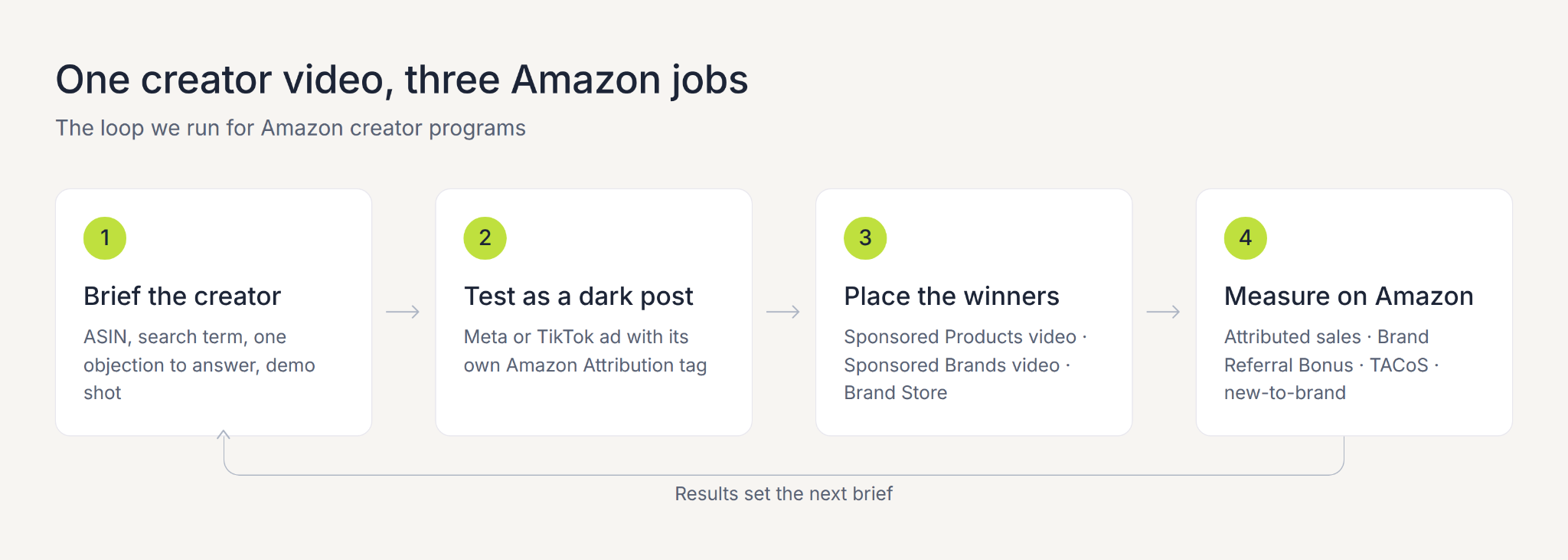
A creator video earns its keep three times on Amazon: once as outside traffic that qualifies for a rebate, again as Sponsored Products video, and again on the Brand Store, where new shoppers decide whether to trust the brand.
We judge all of it by total Amazon sales and TACoS, because platform ROAS on a single campaign hides the halo that creator content creates. The brands that win treat creators, Amazon ads, and measurement as one system with one scoreboard.
What Is Amazon Influencer Marketing for Brands?
Amazon influencer marketing for brands is the practice of partnering with creators to drive shoppers to your Amazon listings, then reusing their content inside Amazon ads and your Brand Store.
The phrase causes confusion because most search results describe the creator side. The Amazon Influencer Program lets creators build Amazon Storefronts, curated storefronts filled with curated lists of products they recommend. Amazon pays those creators sales commissions through the Amazon Associates Program.
The brand doesn't sign anything, and mostly doesn't know it's happening.
Brands work on the other side of that system. You can fund creators directly, offer extra commission through Creator Connections, and tag every outside link with Amazon Attribution so the sales show up in your reports.
The table below shows how the main Amazon creator programs differ in participation, brand involvement, and tracking.
Program | Who joins | What it does for the brand | Brand-side requirement |
|---|---|---|---|
Amazon Influencer Program | Creators with a social following | Creators can feature your products in their storefronts and shoppable videos, unprompted | None, you can't control it |
Amazon Associates | Publishers, bloggers, creators | Amazon pays affiliate commissions on any sale they refer | None |
Creator Connections | Approved Amazon creators and publishers | You add a bonus commission so creators prioritize your products | Brand Registry and a US ad account |
Direct creator deal plus Amazon Attribution | Any creator you hire | You control the brief, the content, and the usage rights, and you see the attributed sales | Amazon Attribution access (free) |
How Do Creators Lift Amazon ROAS?
Creators lift Amazon ROAS through four levers: the Brand Referral Bonus rebate, video inside Sponsored ads, Brand Store traffic, and external traffic that brings in new-to-brand shoppers.
First, the scoreboard. ROAS is attributed ad sales divided by ad spend. TACoS (total advertising cost of sale) is ad spend divided by total Amazon sales, including organic.
Creator work show up in TACoS before it shows up in a single campaign's ROAS, because many creator viewers search for the brand later and skip the tracked link.
There's a reason to take creator traffic seriously on Amazon specifically. During Prime Day 2026, Adobe found that influencers converted shoppers 11x more than social networks overall, across all US retailers.
Each lever affects a different part of Amazon performance, as shown below.
Lever | What the creator supplies | Amazon metric it moves |
|---|---|---|
Brand Referral Bonus | Tagged external traffic | Effective ROAS, net margin |
Sponsored Products video | Demo and unboxing videos | Click-through and conversion rates |
Brand Store traffic | Links to a curated Store page | New-to-brand purchase rate, order value |
External traffic | Reach on social media platforms | New-to-brand sales, organic rankings |
Let’s now discuss each lever in detail:
1. Brand Referral Bonus Adds Value to Creator-Driven Sales
The Brand Referral Bonus pays enrolled brands a bonus averaging 10% of product sales driven by non-Amazon marketing, measured through Amazon Attribution. Amazon describes the bonus as an average, so your rate can differ, and the bonus also covers other products from your brand that the shopper buys within 14 days of the click.
That rebate changes the math on every creator campaign. Below is an illustrative example, with fees and product costs rolled into creator spend:
Creator spend | Attributed sales | BRB credit (10%) | ROAS | Effective ROAS with BRB |
|---|---|---|---|---|
$10,000 | $20,000 | $2,000 | 2.0 | 2.2 |
$10,000 | $30,000 | $3,000 | 3.0 | 3.3 |
$10,000 | $50,000 | $5,000 | 5.0 | 5.5 |
The formula:
Effective creator ROAS = (Attributed sales + BRB credit) / (Creator fees + Product cost + Commissions).
Amazon processes the bonus about two months after the sale, so build that lag into monthly reporting.
2. Creator Video Can Improve Sponsored Ad Performance
Sponsored Products campaigns that include video see 67% higher click-through and 9% higher conversion rates than campaigns without video, according to Amazon Ads. Shoppers who watch for five seconds or more are twice as likely to buy from that brand within seven days.
Most brands don't have a steady supply of short product video. Creators do.
Unboxing videos, side-by-side demos, and "how I use it" clips are the formats that slot into PPC campaigns with the least editing. We cover the ad formats themselves in our Amazon advertising strategies guide.
3. Brand Store Traffic Can Help Convert New-to-Brand Shoppers
New-to-brand shoppers who visited a Brand Store were 62.7% more likely to purchase and spent 72.3% more per order, based on Amazon's August 2024 data. In a separate 2021-22 analysis, Amazon found that Sponsored Brands campaigns linked to a Store drove 55% more detail page views.
For a creator campaign, the Store does the job a DTC landing page would do: it gives a new shopper the full range and the brand story in one place, with Prime shipping and reviews attached.
4. External Traffic Can Increase New-to-Brand Sales
Amazon says external traffic "can help support organic rankings," but it publishes no lift figure, and neither does any source we'd trust.
Amazon has reported a clearer impact on new-to-brand sales. Advertisers that optimized their non-Amazon media using Amazon Attribution insights saw an average 18% increase in new-to-brand sales.
Because Amazon does not publish a specific organic ranking lift, treat ranking gains as a hypothesis. Record your organic rank for your top ten keywords before a creator campaign, then check again two and four weeks later. Measure the change rather than assuming external traffic caused it.
Why Should Heritage Brands Send Creator Traffic to Amazon?
Heritage brands should send most creator traffic to Amazon because their demand already lives there. Shoppers search for the brand by name, trust the reviews, and expect Prime delivery, so a creator click converts with less friction than it does on a DTC site.
A heritage brand here means an established name with category search demand and an existing presence on Amazon, whether through its own listings, wholesale partners, or resellers. Branded search is usually where a heritage brand's Amazon sales start, and creator traffic sent elsewhere works against that demand.
1. Shoppers Already Search for Heritage Brands on Amazon
In Jungle Scout's 2023 consumer survey, 57% of US shoppers started their product searches on Amazon, compared with 42% on search engines. In the US eCommerce market, product discovery for a known brand mostly happens inside Amazon's search bar.
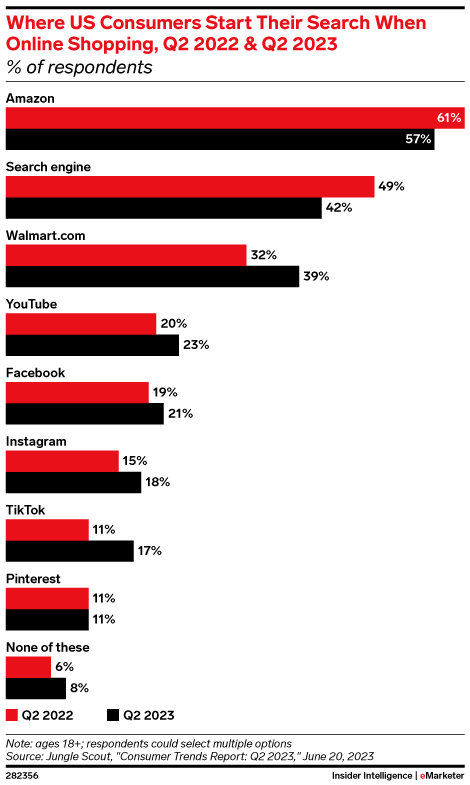
This matters for creator content. A viewer who hears about your product on TikTok will often open the Amazon app next, because that's where the product reviews, the price, and their saved payment details already are.
2. Amazon Can Reduce Friction Compared With DTC Acquisition
Deloitte estimates that DTC customer acquisition costs have risen 25-40%, depending on the channel. Every creator click sent to a DTC site has to cover that cost alone, with no rebate and no marketplace trust behind it.
On Amazon, the same click qualifies for the Brand Referral Bonus and lands on a page with existing reviews and ratings. If you're working on DTC acquisition costs at the same time, our breakdown of ecommerce customer acquisition cost covers the levers on that side.
Nike's return to Amazon shows how even a major heritage brand can rebalance away from a heavily DTC-led model. Nike started selling directly on Amazon again in 2025, ending an exit that began in 2019, as Modern Retail reported. The same report cited Coresight Research data showing 38% of Amazon apparel shoppers had bought Nike in the previous 12 months.
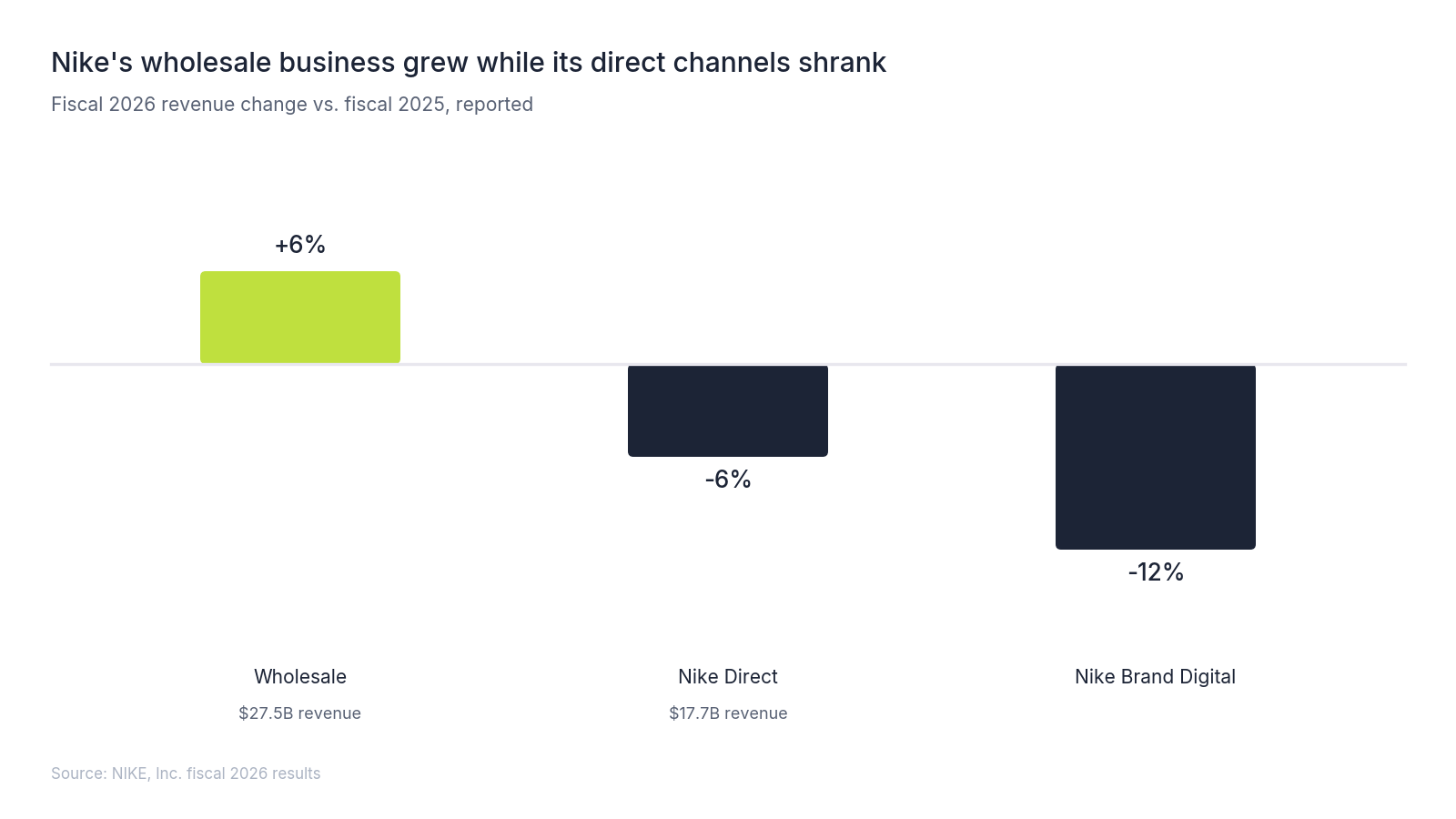
Nike's own fiscal 2026 results add more context. Nike Direct revenue fell 6% to $17.7 billion, with Nike Brand Digital down 12%, while wholesale grew 6% to $27.5 billion. That does not prove Amazon caused the shift, but it does show Nike leaning more heavily on partner channels again, with Amazon now back in the mix.
3. Heritage Brands Can Regain More Control Over Their Amazon Presence
A known brand appears on Amazon whether it participates or not, because resellers and third-party sellers list it. Selling directly, with Brand Registry, gives the brand back control of the listing content, the price, and the brand's presence on the page.
Amazon has also made that control easier to keep. Its proactive systems blocked more than 99.9% of suspected infringing listings in 2025 before a brand had to report them.
For heritage brands, this matters because Amazon becomes easier to manage as an official sales channel when product information, imagery, and brand presentation stay consistent.
Where Should Creator Traffic Go: Amazon, Your DTC Site, or TikTok Shop?
Send creator traffic to Amazon when the product already has search demand and shoppers usually buy it there. However, send it to the DTC site when first-party data, subscription value, or customization matter more than conversion rate.
You can use this table to make the call for each product:
Situation | Send to Amazon | Send to DTC site | Why |
|---|---|---|---|
Heritage brand with broad demand | Yes | Rarely | Branded search, reviews, and Prime close the sale; BRB adds a rebate |
New DTC-native brand | Sometimes | Yes | No Amazon reviews yet; owning the customer list matters more |
Subscription or replenishment | Yes, with Subscribe & Save | Yes, if LTV depends on your own subscription | Pick whichever channel owns the reorder |
Bundles and personalization | No | Yes | Amazon listings handle custom options poorly |
Gift and seasonal peaks | Yes | Sometimes | Fast delivery wins in the final week |
Impulse buys from short video | Sometimes | Rarely | TikTok Shop may convert better, see our TikTok Shop creator affiliate strategy |
Within Amazon: multi-SKU catalog | Brand Store | n/a | The Store shows the range |
Within Amazon: one hero product | Detail page | n/a | Fewer clicks to purchase |
Match the destination to the target audience of each creator, too. TikTok creators with a young, mobile-first audience fit Amazon's app checkout well, while a niche newsletter audience may value your DTC site's education content more.
How Does Amazon Creator Connections Work for Brands?
Amazon Creator Connections lets brands set a bonus commission, a budget, and campaign dates on chosen products. Amazon creators promote them, and you pay only on qualifying sales within 24 hours of a click.
There are no base, platform, or daily fees. Amazon charges commission on the net price after coupons, and if another seller wins the featured offer, that sale isn't attributed to your campaign.
To join, a brand needs Brand Registry and a US advertising account. Creators need to be in the Amazon Influencer Program at Creator Stars Bronze tier or higher, and publishers such as Hearst and Condé Nast also take part, alongside YouTube creators and deal sites.
An Amazon brand guide lists minimums of a 10% commission and a $5,000 budget, with campaigns running 30 to 365 days. Check current commission rates in your account before planning around them, since the guide is undated.
Set up a campaign in five steps:
- Confirm Brand Registry and your advertising account are connected.
- Select the ASINs you want creators to promote, starting with products that already convert well.
- Set the commission rate and maximum budget.
- Set start and end dates that cover a full sales cycle, including a promotion if you have one.
- Check the aggregate reports weekly for sales, orders, and clicks.
Creator Connections works well for brands that want a commission-led creator program with less hands-on sourcing. Direct creator deals, on the other hand, give brands more control over briefs, deliverables, and usage rights.
The comparison below focuses on the operational trade-offs between Creator Connections and direct creator partnerships.
Factor | Creator Connections | Direct creator deal |
|---|---|---|
Best fit | Brands that want commission-led creator scale | Brands that need specific creators or campaign concepts |
Payment model | Bonus commission on qualifying sales | Flat fee, commission, or hybrid deal |
Management effort | Lower | Higher |
Creative direction | Limited | Defined in the creator agreement |
Usage rights | Not automatically included | Can be negotiated |
Creator recruitment | Creators opt into campaigns | Brand sources and selects creators |
Reporting setup | Program-level reporting | Separate tracking can be set up by creator |
Best use case | Broad product promotion across many creators | Product launches, hero assets, paid usage, or tightly controlled campaigns |
How to Find Amazon Influencers for Your Brand
Find Amazon influencers in four places: creators who already feature your products in their Amazon Storefronts, creators who opt into your Creator Connections campaign, social search on TikTok and Instagram, and influencer platforms.
Now, let’s explore each option in detail:
1. Creators Already Featuring Your Products on Amazon
Search Amazon for your brand and your closest competitors, then open the creator videos on those product pages and the storefronts behind them. Creators who already feature your products have proven audience fit, so treat them as a recruiting list.
Invite them into Creator Connections or a direct deal with an Attribution tag. That turns unpaid mentions into tracked creator activity and gives you more control over the campaign brief, deliverables, and potential paid usage.
For direct deals, use a clear influencer brief to define the message, deliverables, usage rights, and tracking requirements.
2. Creators Who Opt Into Your Creator Connections Campaign
Every creator who applies to your Creator Connections campaign is already in the Amazon Influencer Program and has picked your product. Review their storefronts and past videos, then move the strongest into a direct deal when you need usage rights or a tighter brief.
3. Social Search on TikTok and Instagram
Search hashtags such as #amazonfinds and #founditonamazon alongside your category and competitor names. Shortlist creators whose posts already link to Amazon and whose comments show purchase questions. Our guide on how to find micro-influencers covers the search tactics in more detail.
4. Influencer Platforms and Agencies
Influencer platforms filter creators by audience, category, and platform, which speeds up shortlisting when you need dozens of creators.
An agency takes on more of the execution. This can include creator vetting, outreach, rate negotiation, briefing, usage-rights agreements, campaign tracking, and coordinating content for paid media. This matters when you need creators at scale but do not want your internal team managing dozens of separate relationships.
How to Build an Amazon Creator Marketing Program
An Amazon creator marketing program, the core of any Amazon influencer marketing strategy, takes eight steps, in order, starting with the listing and ending with scaled spend on the creators who lift total Amazon sales.
If you'd rather hand off the creator side, our influencer marketing agency sources, briefs, and tests creators for Amazon programs.
1. Get the listing conversion-ready first
Check the main images, A+ content, review count, stock depth, and Brand Store before any creator posts. A creator click that lands on a listing with three reviews and two weeks of stock wastes the creator's audience. Fix the weakest of those five before you brief anyone.
2. Create one Amazon Attribution tag per creator and per channel
This is what makes sales eligible for the Brand Referral Bonus and lets you compare creators. Name tags consistently (creator, platform, month) so campaign tracking stays readable at 30 creators.
3. Pick creators by shopper persona and category fit
Score each creator on audience fit with your target demographic, engagement rates, and content quality in a simple creator scorecard. Micro influencers usually win on cost per video and trust. Build two or three influencer personas (the gift buyer, the expert, the skeptic) and cast creators against each.
4. Brief for the Amazon purchase moment
Good influencer briefs name the exact ASIN, the search term to use if the viewer doesn't click, the one objection the video must answer, and the demo shot you need.
5. Secure paid usage rights
Content rights decide whether a creator video can run in Amazon ads and the Brand Store. Agree the term, the placements, and the fee up front. UGC creators usually license content without posting it, which is cheaper when you mainly need ad video, and our guide to UGC usage rights covers the contract terms.
6. Test creator videos as dark posts before Amazon spend
Run each video as an unpublished ad on Meta or TikTok with an Attribution tag, then compare click-through and attributed sales. Only the winners move to Amazon placements.
7. Place the winners in Amazon ads and the Brand Store
Each placement wants a slightly different cut of the same influencer content. The table below shows which formats fit each Amazon placement and which metric to watch.
Placement | Best creator format | Format note | Metric to watch |
|---|---|---|---|
Sponsored Products video | Close-up demo | Product in frame from the first second, captions for sound-off | Click-through rate |
Sponsored Brands video | Problem and solution | One clear benefit, brand visible early | New-to-brand sales |
Brand Store | Lifestyle and unboxing videos | Longer cuts work, the shopper is already browsing | Time on Store, attributed sales |
Product detail page video | Honest review or comparison | Answer the top question from your product reviews | Conversion rate |
Amazon live streams | Hosted demo with Q&A | Pair with a time-limited deal | Units sold during stream |
8. Scale spend on what lifts total Amazon sales
Move budget to the creator and angle combinations that raise total sales and lower TACoS, then refresh shoppable content on a fixed cadence before it fatigues. Amazon DSP can extend the winners with retargeting advertising to shoppers who viewed the detail page after a creator click.
How to Measure Amazon Influencer Marketing ROI
Measure Amazon influencer marketing ROI using Amazon Attribution first, then compare creator activity against total Amazon sales, TACoS, and new-to-brand sales.
Amazon Attribution is free and reports clicks, detail page views, add-to-carts, purchases, product sales, and new-to-brand metrics for non-Amazon traffic. Tracking that data by creator is the starting point. The broader picture comes from the metrics below, while our guide to influencer marketing attribution models explains how creator measurement fits with other channels.
Metric | Where it lives | What it tells you | Watch-out |
|---|---|---|---|
Detail page views | Amazon Attribution | Whether the creator drove interest | Inflated by curious clicks |
Add-to-cart | Amazon Attribution | Purchase intent | Carts abandon |
Attributed sales | Amazon Attribution | Direct revenue from tagged links | Last-touch only |
New-to-brand sales | Amazon Attribution | Customer acquisition | One-year lookback |
BRB credit | Seller Central | Rebate earned | Arrives about two months later |
TACoS | Your Amazon ads and sales reports | Whether total efficiency improved | Moves slowly |
Branded search volume | Brand Analytics | Brand awareness the creator built | Seasonal noise |
Organic rank | Rank tracker of your choice | Keyword rankings support | No proven causal link |
Use the effective ROAS formula from the Brand Referral Bonus section above for campaign-level reads. Two reporting limits matter here:
- Tagged attribution can miss assisted creator impact. A shopper may see creator content, search for the brand later, and purchase without returning through the original Attribution link.
- Click counts will not always match perfectly. Amazon says a 10–20% discrepancy between Amazon Attribution and publisher or ad server traffic metrics can occur because of differences in click-counting methodology. Variances above 20% should be investigated.
Engagement metrics on social tell you what to brief next, but they don't prove sales. To see the true lift, run a holdout test:
- Pick two comparable periods or regions and keep everything else constant.
- Run creator traffic in one and pause it in the other.
- Compare total Amazon sales and branded search between the two.
Our guide to incrementality testing explains how to structure the comparison and calculate lift.
How Much Does Amazon Influencer Marketing Cost Brands?
Amazon influencer marketing costs can range from a few hundred dollars for a small creator asset to several thousand dollars for larger creators, paid usage rights, and multi-creator campaigns. Creator Connections uses a commission model, while direct deals usually combine creator fees, product costs, and licensing.
For direct creator work, recent 2026 benchmarks suggest roughly $100-$500 per post for nano creators, $500-$2,500 for micro creators, and $2,500-$10,000+ for macro creators.
Note: These are broad planning ranges rather than Amazon-specific rate cards, and actual quotes move with platform, engagement, niche, deliverables, and usage terms.
The table below shows the main cost layers brands should budget for.
Model | Typical cost structure | Best for | Cost watch-out |
|---|---|---|---|
Creator Connections | Bonus commission on qualifying sales; Amazon guidance has listed a 10% minimum commission and $5,000 minimum campaign budget | Scaling performance-led creator activity | Commission only applies when qualifying sales occur |
Nano creator deal | About 500 per post | Testing multiple creators and angles | Usage rights may cost extra |
Micro creator deal | About 2,500 per post | Performance creative and targeted reach | Rates rise with niche expertise and stronger engagement |
Macro creator deal | About 10,000+ per post | Larger launches and broader reach | High upfront cost before sales are proven |
Product seeding | Product cost plus shipping | Low-cost sampling and creator outreach | Sending product does not guarantee a post |
Paid usage rights | Commonly about 20–50% on top of the base creator fee | Reusing creator content in Amazon ads and other paid placements | Longer licenses and broader placements increase the fee |
Amazon Associates | No direct creator fee from the brand | Passive affiliate exposure | Brand has little control over who promotes the product |
Influencer platforms and affiliate networks add their own subscription or service fees on top, so include them in the cost line of the effective ROAS formula.
Bespoke discount codes are the other hidden cost. A creator-specific code helps tracking on your DTC site, but on Amazon the tagged link already does that job, and a deep code trains shoppers to wait for a deal.
Common Amazon Influencer Marketing Mistakes
The most expensive mistakes in Amazon creator programs are tracking and offer errors. Each one costs revenue you can recover with a process fix.
Let’s take a look at some of the common mistakes:
Mistake | What it costs | Fix |
|---|---|---|
Untagged creator links | No Brand Referral Bonus, no per-creator data | One Attribution tag per creator and channel |
Creators linking to a reseller's offer or the wrong variation | Sales go to another seller | Send creators the exact ASIN link, check the featured offer before launch |
Paying the same creator twice through Creator Connections and a direct deal | Double cost on one sale | Keep a single list of creators and their pay model |
Reporting gross revenue | Overstates ROI | Report effective ROAS and TACoS |
Discount-led heritage campaigns | Erodes price positioning | Use content-tailored promotions sparingly, lead with the product |
Missing disclosure | FTC risk and lost trust | Follow disclosure rules, see our FTC guidelines for influencers |
Paying for reviews | Account risk | Amazon's Community Guidelines ban compensation for reviews; keep creator content off the review section |
How to Choose an Amazon Agency for Creator Programs
Choose an Amazon agency that runs creators, Amazon ads, and Attribution reporting in one team, so the content and the ad spend are planned together on the Amazon platform.
You can ask these five questions before you sign, or start from our list of Amazon advertising agencies:
- Who sources the creators, and do they brief for the Amazon purchase moment or for social engagement?
- Do they tag all influencer collaborations with Amazon Attribution and claim the Brand Referral Bonus?
- Can they show creator video running in Sponsored Products, Sponsored Brands, and a Brand Store?
- Do they report on TACoS and total Amazon sales, or only campaign ROAS?
- How do they handle usage rights and disclosure across social media and Amazon?
Scale Amazon Influencer Marketing with inBeat Agency
inBeat Agency runs Amazon creator programs as one system: we source and brief creators, test their videos as dark posts, move the winners into Sponsored ads and your Brand Store, and report on total Amazon sales and TACoS. Every creator gets an Attribution tag from day one, so the Brand Referral Bonus and per-creator data are built in.
For heritage brands, this means creator traffic lands where demand already lives, with a rebate attached and content that keeps working inside Amazon long after the post goes live.
Book a strategy call with us and we'll review your Amazon listings, your current creator work, and where creator traffic should go first.
FAQs
Does the Brand Referral Bonus apply to sales from Creator Connections links?
Amazon doesn't document the two programs stacking. Creator Connections uses its own 24-hour attribution and reporting, while the Brand Referral Bonus requires Amazon Attribution tags. Plan your numbers as if they don't combine, and confirm in your own reports before counting both.
How many creators does an Amazon test need before the results are readable?
Amazon sets no threshold. A practical floor is three creators per persona and angle, so a single creator's audience doesn't decide the result, with each video tested as a dark post before Amazon spend. Read results after at least two weeks to cover the 14-day Attribution window.
Does sending creator traffic to Amazon cannibalize DTC site sales?
It can, for brands whose loyal customers already buy direct. Check with the holdout test above, measuring total revenue across both channels. For most heritage brands, Amazon adds new-to-brand customers the DTC site wasn't reaching.
How do you split credit between Meta spend and Amazon sales when creators run as dark posts?
Tag each dark post with its own Amazon Attribution tag, so Amazon sales are tied to the specific ad. Then run the holdout test above on the Meta spend. Credit the difference to the creator campaign, and treat Meta's own reported conversions as a partial view.
How does inBeat use creator content inside Amazon advertising?
inBeat can take creator-style product demos, unboxings, and UGC-style assets and adapt them for Amazon placements such as Sponsored Brands Video, Sponsored Products video, Stores, and A+ Content. These assets can then be tested to see which creative angles improve click-through and conversion before more budget is added.
Does inBeat help with Amazon Attribution and creator performance tracking?
Yes. inBeat can structure creator tracking around Amazon Attribution and connect creator-driven traffic with broader Amazon performance metrics such as attributed sales, new-to-brand sales, ACOS, TACoS, and total account sales. This makes it easier to see how creator activity contributes to overall Amazon performance.