

Imagine a buyer facing a problem your product could solve perfectly. They think of three brands, compare their options, and make a purchase. Yours never enters the conversation. The frustrating part? You might have had the strongest offer.
This is the problem with competing only for buyers who are actively shopping. The LinkedIn B2B Institute's 95:5 rule illustrates the challenge in long-cycle B2B markets: most potential buyers aren't looking for suppliers today. The proportion varies by category, but what people remember when circumstances change can shape which brands they consider.
Category entry points offer a way to influence that memory. We'll explore how to identify the situations that trigger buying decisions and make your brand easier to recall when they happen.
See which moments matter.
TL;DR
- A category entry point (CEP) is the situation, need, or feeling that makes a buyer think of a category before they think of a brand.
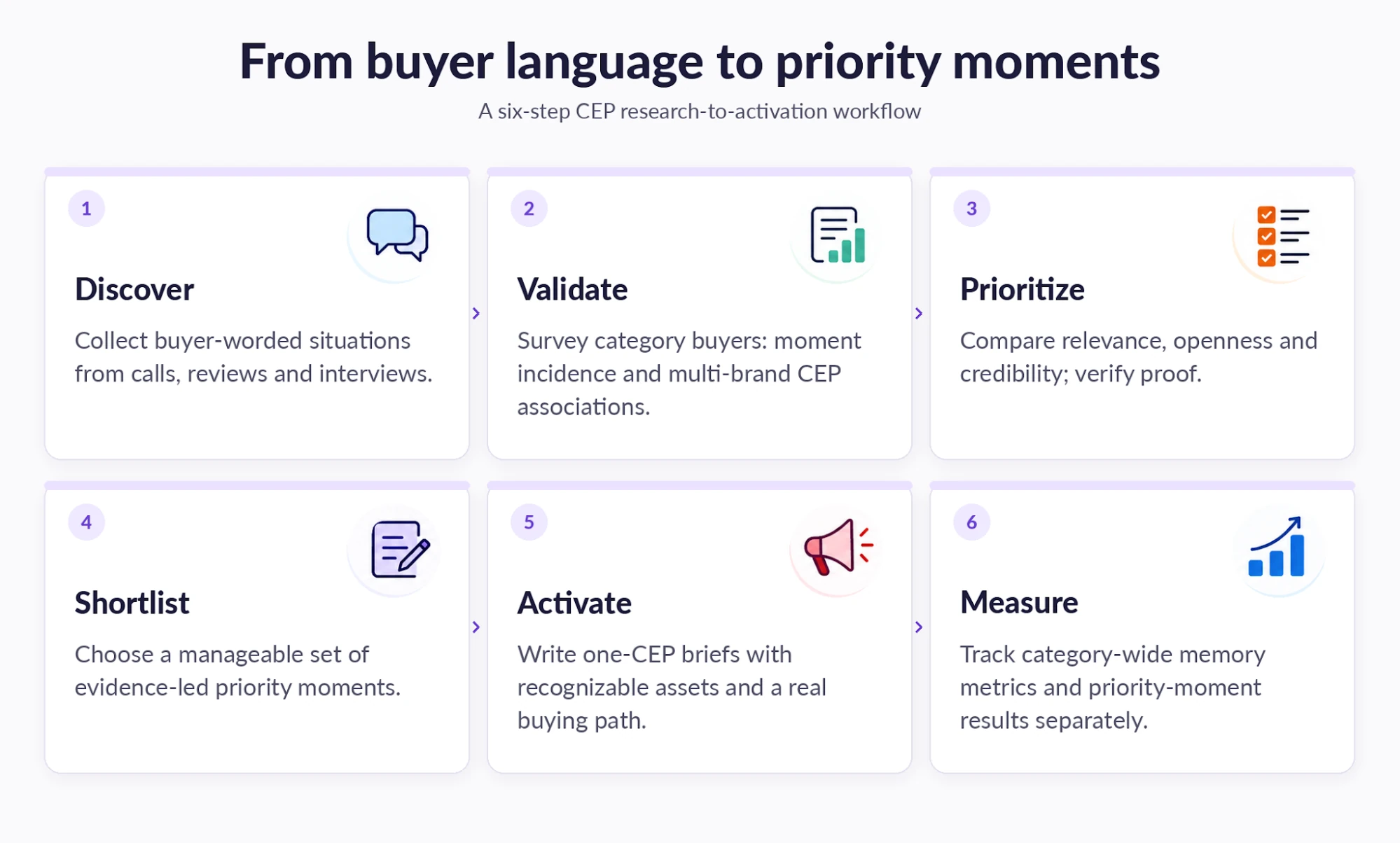
- Build a buying-moment map in buyers' own words, using the seven W questions, sales conversations, and a survey of your target group.
- Use the three Cs to compare moments. The 0-5 multiplication in this guide is an illustrative planning score; check product credibility before shortlisting.
- Build a focused shortlist of five to eight priority moments, then translate each into creative and a realistic path to purchase.
- Measure category-wide mental availability separately from priority-moment performance. AI-search prompts provide an additional visibility check, not a buyer-memory metric.
What Are Category Entry Points?
A category entry point is a cue that helps a buyer recall brands when a buying situation arises. Ehrenberg-Bass Institute research splits these cues into internal ones (needs, motives, emotions) and external ones (a place, a time of day).
- "Our contract renews next quarter" is a CEP in B2B software.
- "I need something quick for dinner" is a CEP in food.
CEPs are the building blocks of mental availability, the likelihood that a brand comes to mind in a buying situation.
CEPs belong to the buyer and exist whether or not your brand does. Professor Jenni Romaniuk told Marketing Week that category entry points "are not about the brand, they're about the buyer".
The category, rather than your brand positioning, is the starting point: buyers encounter a need and retrieve possible suppliers. Map that cue before choosing the claim you want to make.
Category Buying Triggers, Buying Occasions, and Jobs to Be Done
These labels often overlap. Use them as practical distinctions for research, rather than fixed or mutually exclusive categories.
A persona describes the buyer, while an attribute such as "trusted" describes the brand. Neither replaces a situation in the map.
Throughout the process, "buying moment" means a buyer-worded CEP. "Occasion" refers to its real-world context, and "trigger" to an event that activates it.
Why Category Entry Points Matter for Brand Growth
Brands that are linked to more category situations have more chances to be recalled when those situations arise. Lead generation serves existing demand; CEP communications can also build memory before a buyer enters the market. Consideration still depends on offer fit, availability, and buying constraints.
Romaniuk calls the ambition "wider, fresher networks": linking the brand to several useful situations over time, rather than relying on one positioning line.
In the Ehrenberg-Bass analysis of US business-insurance decision-makers, each additional CEP associated with a supplier corresponded to roughly a 5% relative reduction in the modeled likelihood of switching on the Juster stated-probability scale. The association was statistically significant for 16 of 17 insurance products. It was not an observed five-percentage-point reduction in churn, nor proof that adding a CEP causes retention.
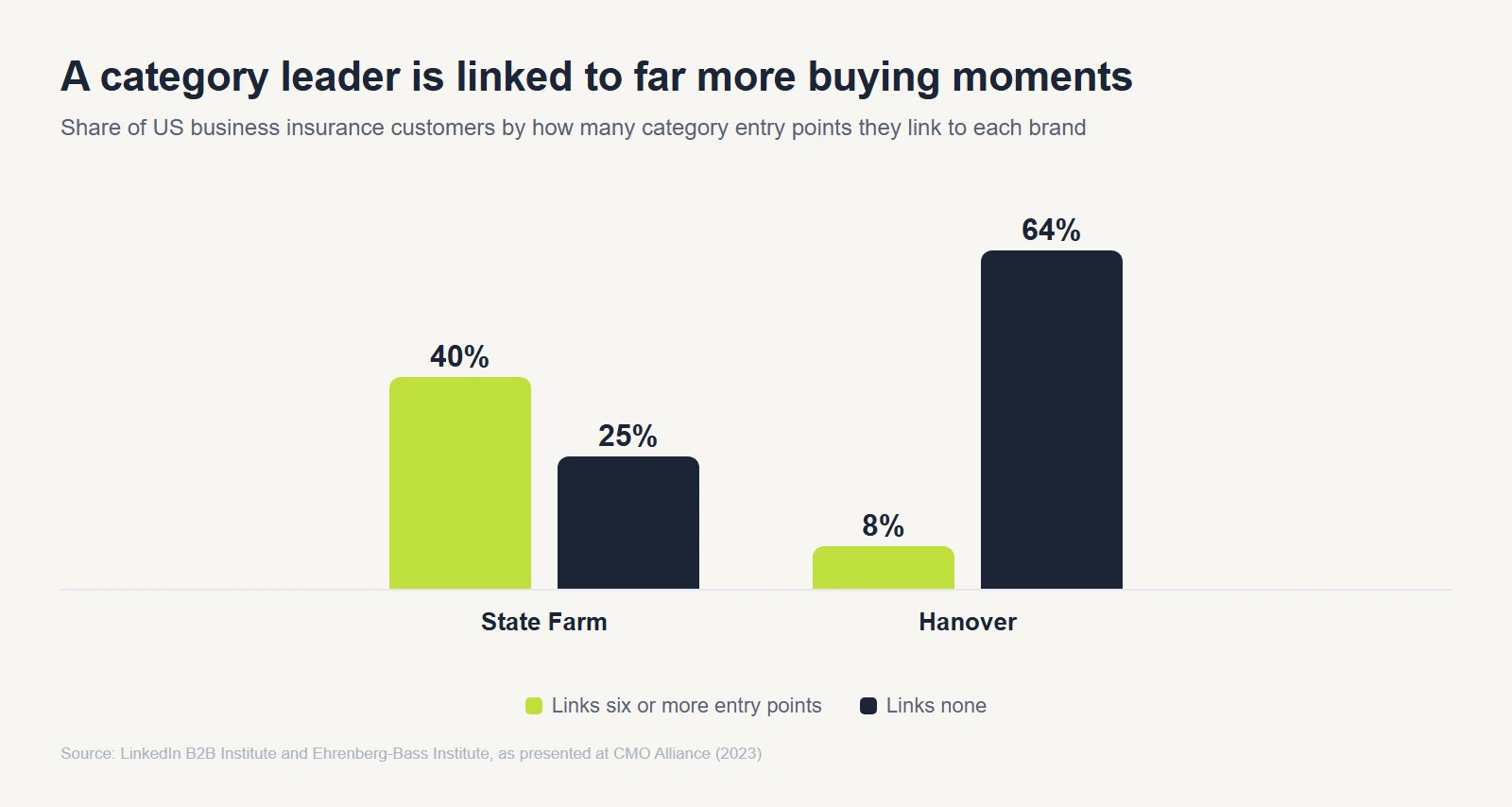
The same US business-insurance research shows a category-wide association pattern. In the B2B Institute presentation, 40% of surveyed customers linked six or more CEPs to State Farm and 25% linked none. For Hanover, the corresponding shares were 8% and 64%. These are prompted brand-CEP links, not unaided recall or market-share figures.
For budget planning, use the map to choose which buyer situations brand activity and short-term media should address. Performance campaigns still help people ready to buy, while repeated category cues can make the brand easier to consider later. This fits alongside a digital marketing funnel, rather than replacing it.
Category Entry Point Examples: Campaigns and What the Evidence Shows
The four examples show two ways to extend CEP associations: meeting buyers in an existing situation or widening the occasions tied to an established brand. The published figures are observational, agency-reported or broader business results, rather than controlled tests of CEP impact.
What to Take From These Campaigns
Use these examples as a creative test: can buyers recognize the situation before seeing the logo, and can your brand credibly address it? For established buying moments, align your message and media placement with the context. For new occasions, build the association through repeated executions rather than a single campaign.
For a mature brand extending its range of occasions, our legacy brand marketing guide covers the earlier audit of brand memory and creative assets.
How to Build a Buying-Moment Map
Start with verbatim situations and the seven W tags, then add survey incidence and prompted multi-brand associations. The first row below is wholly hypothetical (n=200 category buyers); the second is a reusable worksheet row. Neither represents an inBeat Agency client result. The source field records where a buyer quote originated, not a survey metric.
Use the Seven W Questions to Find Buying Moments
The Ehrenberg-Bass seven W prompts help surface timing, context, people, complements and feelings that bring a category to mind.
A familiar contrast is coffee: a weekday commute and a quiet Sunday morning can retrieve different brands within the same category. Record the context, then test which names buyers associate with it.
Mine Sales Conversations and Buyer Language First
Before fielding the survey, gather buyer language from several distinct sources:
- Sales calls and the first messages prospects send.
- Customer support tickets and service escalations.
- Product reviews, competitor reviews and category discussion.
- Search queries and comments, potentially grouped with social listening tools.
- Open-ended interviews with customers and non-customers.
Keep the original phrasing. A quote like "I have two hours before a board update" gives researchers a time and pressure cue; a generic feature description rarely does.
ListeningMind's 2026 search-intent analysis offers examples from US non-alcoholic beer, including Dry January, summer events and golf outings. These observations suggest occasions worth interviewing buyers about, rather than population-level demand estimates.
Search evidence generates hypotheses. Buyer interviews and category-representative surveys determine whether those cues are relevant and which brands people link to them.
Quantify Each Moment With a Survey of Your Target Group
Validate buyer language with a survey designed to keep occasion frequency separate from brand association:
- Choose a defined category-buyer population and test how often each situation is relevant. Record whether the list was prompted or spontaneously elicited; keep the approach consistent over time.
- Recruit from the category, including buyers who have never purchased from your brand. Panel recruitment services can broaden coverage beyond existing customers; report the sampling method and number of eligible respondents.
- For each prompted CEP, show a balanced, randomized list of relevant brands plus "none". Let each person select zero, one or multiple brands; do not ask only for the first brand recalled.
- Report moment incidence and each brand-CEP association as a share of all eligible surveyed category buyers. These are separate survey outputs; the final map column still records the interview, call or review that surfaced the quote.
How to Score Buying Occasions by Relevance, Competition, and Credibility
Romaniuk's three Cs are credibility, competitiveness and commonality. The 0-5 grid below is an illustrative inBeat Agency planning adaptation, not a published or validated Romaniuk formula: it treats commonality as buyer relevance, reverse-scores competitiveness as openness, and multiplies the three workshop judgments to expose trade-offs.
Apply the exclusion gate first: a 0 on any dimension removes the moment. Use 2 or 4 when the evidence sits between named anchors, and record the survey, competitor or product evidence behind each rating.
An eligible shortlist candidate also needs relevance of at least 3, credibility of at least 4, and a specific proof asset checked by the team. Treat the score as a discussion aid; record estimated margin and commercial value separately when reliable data exist.
The next six moments and all their 0-5 ratings are hypothetical editorial examples for a fictional project-management software brand. These values demonstrate the scoring decisions rather than reporting buyer-research findings.
For illustration, assume the brand can document collaboration features, integrations and a renewal-ready comparison page. A real scoring session would use survey proportions, observed competitor links and checked proof before awarding points.
Relevance: How Often Buyers Enter the Moment
Use the share of eligible category buyers reporting a moment as the starting point, not raw mentions from a convenience sample. If you have reliable conversion and margin data by occasion, add it as a separate economic input; avoid claiming the survey itself measures revenue. Choose minimum incidence and quality thresholds before seeing workshop preferences.
Competition: Who Already Occupies the Moment
Score openness using both the strength and distribution of multi-select brand associations. A moment dominated by one rival may be harder to enter, but an even spread doesn't necessarily mean the space is open. Several competitors may already have strong associations with the same CEP. Brand shares use the same eligible-buyer denominator and can total more than 100% because respondents may select multiple brands.
Romaniuk's follow-up on the risk of exclusive CEP "ownership" cautions that buyers commonly associate several brands with a moment. Record the two or three most linked competitors and the percent of all category buyers who associate each one.
Credibility: Whether Your Brand Can Back the Moment
Credibility is the fit between the current offer and the situation buyers describe. A hypothetical rating of 4 or 5 is insufficient on its own: show the product feature, independent review, demonstrated outcome, or customer evidence that can carry the creative claim.
Add a proof field for each candidate. If the evidence does not exist, mark the moment Research or Test, even when its multiplied score ranks highly.
Shortlist Five to Eight Moments to Own
The five-to-eight long shortlist is Romaniuk's useful planning range, not a compulsory quota. Sort the eligible moments by buyer demand and practical fit, then review them with sales and product teams before committing budget.
Start with one moment for which you can validate the buyer cue and deliver the promise. Set a test schedule for the remaining eligible moments and revisit priorities as evidence changes.
B2B Buying Groups: Adapt the CEP Survey by Role
A B2B purchase can involve different recall cues for finance, procurement and hands-on users. Sample these roles separately before pooling responses: a high-frequency IT problem may matter little to the economic buyer, while renewal risk may dominate procurement conversations. Note the role and decision authority alongside every association.
A June 2025 B2B Institute commentary on GenAI category entry points highlighted how familiar products are linked to tasks such as writing and summarizing, while broader productivity and reassurance needs have less distinct brand associations.
These differences offer a starting point for research, but your own buying-group survey should establish which situations matter to each role.
For each role-specific cue, first ask which brands buyers associate with that situation. Use a randomized brand list, allow multiple answers, and include a "none" option. Then use the follow-up questions below to understand what each role needs from a supplier.
Compare results by role, then agree which moments can reach the buying group as a whole. If users favor convenience and procurement favors compliance, consider separate executions and a shared proof package instead of averaging the two priorities into a meaningless single score.
The resulting role-specific briefs will also differ from consumer work, as explained in our B2B and B2C content marketing guide.
Physical Availability: Being Easy to Find and Buy When the Moment Hits
Physical availability means the buyer can actually find, assess, contact and buy the offer when a relevant situation arises. The B2B Institute's Easy to Find framework describes presence, prominence and portfolio as levers. Advertising and events can introduce a brand, but the order page, stock, sales access and distribution route determine whether the buyer can act.
Consumer: Match the Occasion With a Buying Route
For a takeout-evening cue, discovery might happen in delivery search and the transaction through a usable app or ordering page. Domino's reported that more than 85% of its 2025 US retail sales came through digital channels. That shows the scale of digital ordering for the business, not that any particular CEP or already-open app caused the orders. Check delivery coverage, availability and checkout as well as creative placement.
B2B: Connect Discovery, Evaluation and Sales Access
In B2B, a review site or industry event may introduce a supplier, but neither guarantees a purchasable route. The path needs proof and a reachable next step: reliable product information, a technical demo, a proposal owner and terms a buyer can approve. Build the handoff for each priority moment rather than assuming event presence is enough.
How to Turn a Buying-Moment Map Into Briefs, Content, and Sales Scripts
Ehrenberg-Bass recommends focusing each execution on one CEP while building a wider network across multiple executions over time. Turn each shortlisted moment into a production brief, then align creative, sales conversations and proof assets around that specific situation. This also improves sales and marketing alignment.
Example: Write a Renewal-Moment Brief
Picture an operations lead with one week to compare project-management tools before renewal. Their team still assembles reports by hand, and finance wants evidence that switching would help. Open the creative on that deadline, show the friction, support the alternative with a documented integration demo or credible customer outcome, and finish with a clear comparison request. Carry tested brand assets throughout so buyers can connect the proof to the right supplier.
The same validated cue can support different creative routes. For creator-led work, test persona-by-moment combinations before concentrating spend on the strongest execution; measure those tests separately from long-term memory gains.
Protect Visual Identity While the Network Widens
Carry a consistent, recognizable set of assets across executions, such as a distinctive color and a recurring character. Two elements are an example, not an evidence-based universal rule. Where attribution research exists, use the assets buyers correctly and uniquely link to the brand; the measurement section explains how to test that recognition.
How to Measure Whether You Own a Buying Moment
Ehrenberg-Bass defines three distinct mental-availability metrics. Mental penetration is category buyers linking a brand to at least one tested CEP divided by all eligible category buyers. Network size is the mean CEP links among those buyers. In a sample of N, brand linkages equal N x mental penetration (as a fraction) x network size. Mental market share is those linkages divided by the total linkages for every brand across the category CEP set, not penetration multiplied by network size. Top-of-mind awareness alone cannot substitute for these measures.
Keep the survey design stable and report this alongside a marketing measurement framework so teams can examine memory movement and business outcomes without conflating them.
Brand Strength: Mental Penetration, Network Size, and Mental Market Share
For category-wide mental penetration, network size and mental market share, survey a balanced set of important CEPs and relevant competing brands. Hold the CEP set, sample definition, prompts and method consistent across waves. A separate dashboard for the priority moments can show campaign progress, but it is not the category's mental market share.
Connecting CEP Gains to Commercial Outcomes
Stronger memory links may put a brand into more consideration sets, while preference and purchases also depend on price, offer quality and distribution. Compare CEP changes with branded search and sales over similar periods, treating branded searches as an imperfect supporting signal. Use a holdout or controlled test when you need to estimate incremental effects.
Brand Asset Research: Testing Distinctive Assets
Test whether brand assets remain recognizable across different situations. Show each asset without the brand name, ask which brand owns it, and compare awareness with uniqueness of attribution. Retain visual or audio cues buyers reliably link to your brand and investigate elements commonly attributed to competitors.
Common Mistakes: A Prelaunch Quality Check
Check the research inputs before approving a map. Do respondents include category buyers beyond your CRM, and are finance, procurement and end users represented when relevant? Do survey questions describe situations neutrally rather than steering people toward your preferred brand? Have you randomized a balanced competitor list with a "none" option?
Next, inspect the outputs. Are moment-incidence and multi-brand association shares calculated from the same eligible denominator? Can someone reproduce why a moment passed the proof gate? Does the priority dashboard carry its own label instead of category-wide mental share? These checks catch problems that a workshop-only scorecard can hide.
Testing Category Entry Points in AI Search and LLM Answers
A buyer may also describe a situation to an AI assistant and receive recommended suppliers. McKinsey reported that roughly half of Google searches displayed AI summaries in its analysis. That makes AI visibility worth checking, but a model's answer is not a proxy for how many humans associate your brand with a CEP.
Treat this as a supplementary channel audit after your buyer-memory survey, not a replacement for it.
AirOps found 85% of 21,311 brand mentions came from third-party domains in a vendor study of B2B software queries across three models. That sample argues for accurate third-party coverage as a discovery source, without guaranteeing that off-site mentions change category-buyer memory.
Repeat an audit monthly with a consistent protocol:
- Turn each priority CEP into a few stable prompts, such as "Which project-management tools should we compare before our contract renews next quarter?"
- Run them in the same models and record geography, language, date, version and account/search settings wherever possible.
- Log which eligible brands appear, how prominently, and which pages each answer cites; separate direct brand mentions from citations.
- Review factual gaps in your owned content and legitimate third-party reviews, independent comparisons or earned coverage. Avoid manipulating community conversations to shape outputs.
Win Your Buying Moments With inBeat Agency
The map identifies when buyers enter the category; survey evidence shows which of those moments can support a credible campaign. At inBeat Agency, we help turn those priorities into tested creative, channel planning and measurement that work together.
Book a strategy call to review your category and outline a practical first CEP study.
FAQs
How do you score buying occasions without a category-wide survey budget?
Start with a smaller, clearly defined category-buyer sample and present the results as directional, including sample size and recruitment limitations. Avoid using only customers or measuring just your preselected moments if the goal is category-wide market share. A limited study can guide testing without pretending to deliver a population-representative tracker.
How do moment frequency and competitive association differ?
Moment incidence measures how many eligible buyers encounter or recognize a situation. Brand association measures how many link each brand to that cue, with multiple answers allowed. A frequent moment may already be strongly associated with competitors, which is why you need both readings before ranking it.
How are category entry points different from keywords in paid search?
A keyword reflects a phrase typed into search; a CEP is a buyer situation that can affect which brands come to mind before or during that search. Keyword data can help discover language, while a brand-association survey tests memory directly. Search volumes alone do not establish CEP ownership.
Do buying moments hold across countries?
Some travel, such as hunger, thirst, or a deadline, and others are local, such as holidays and payment habits. Re-run the survey step in each market before reusing a map, because the category may be bought differently and different competitors may hold the links.