
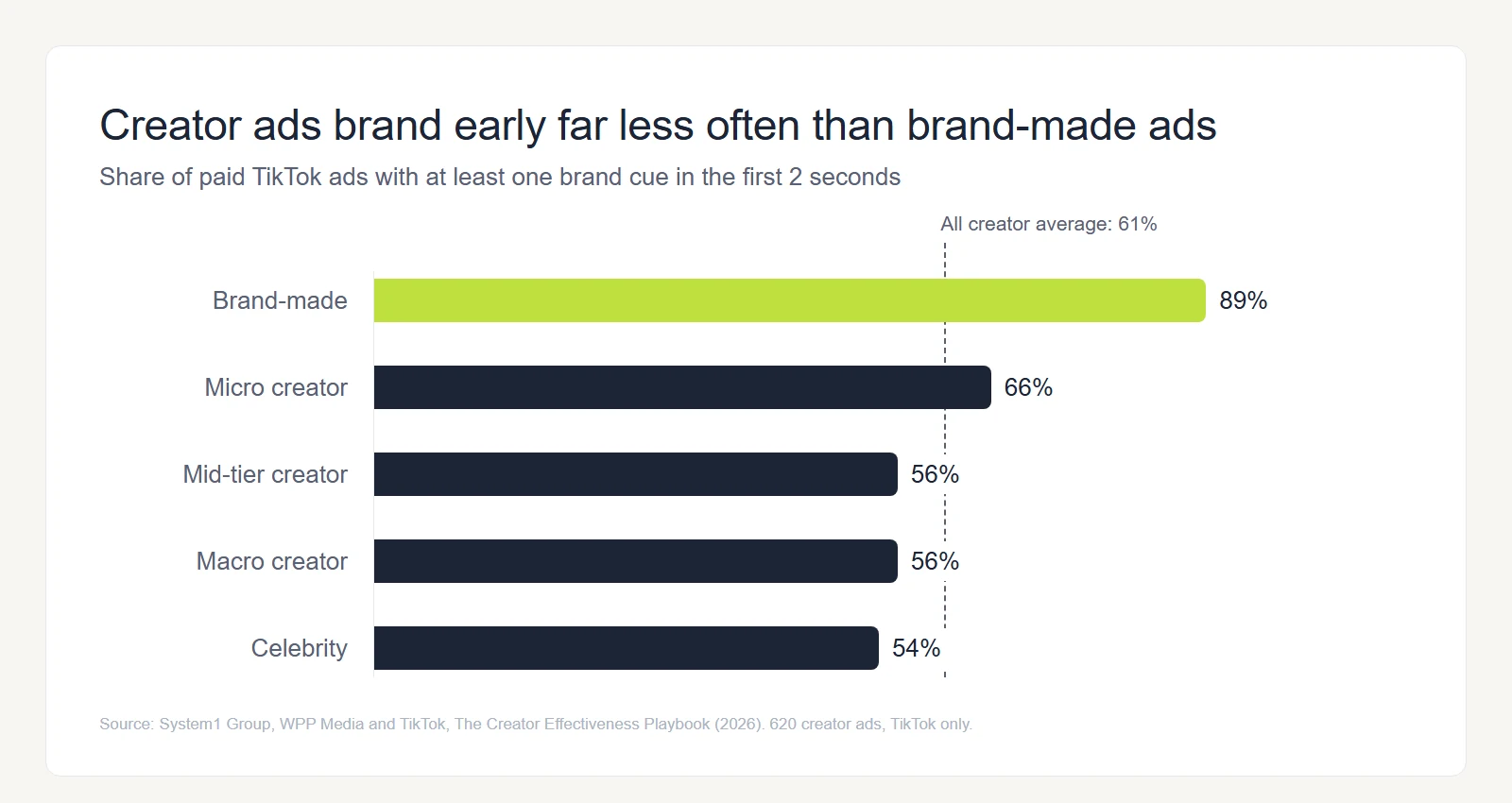
I was reading the Creator Effectiveness Playbook when a particular finding caught my attention. Only 61% of creator ads include a brand cue in the first two seconds, compared with 89% of brand-produced ads.
The temptation is to tighten the creative brief. But give thirty creators the same script, opening shot and product placement, and you risk losing the very thing that makes creator content worth watching: individuality.
For me, the answer lies in separating brand consistency from creative consistency. In this guide, I'll explain which distinctive brand assets I'd prioritize, how I'd brief creators, and where I'd give them creative freedom.
TL;DR
- I'd test two to four branding cues in the first two seconds of a creator ad, based on System1's TikTok findings.
- Say the brand and show it. Audio and visual cues work together to help viewers identify the advertiser.
- Lock the essential branding cues in the brief and leave the creative concept open.
- Treat creative similarity and fatigue as separate problems, and refresh concepts accordingly.
- Use an attribution test to measure recognition and a creative audit to spot missing brand cues.
What Are Distinctive Brand Assets in Creator Ads?
A distinctive brand asset is a non-name element, such as a color, a sound, a character or a phrase, that makes buyers think of a particular brand.
The Ehrenberg-Bass Institute says an asset needs two qualities:
- Fame: category buyers recognize the brand through that element.
- Uniqueness: the associations overwhelmingly belong to that brand.
Of the two, the institute gives uniqueness priority. Jenni Romaniuk set out the method in her 2018 book, Building Distinctive Brand Assets.
One distinction matters for video: a spoken or written brand name is a direct branding cue. I use "branding cues" throughout this guide to cover both names and distinctive assets.
True distinctiveness is rare.
Ipsos and JKR tested five asset types with more than 26,000 respondents and found that only 15% were truly distinctive, with color at 4% and slogans at 6%.
Think of Nike's Swoosh, McDonald's Golden Arches or Cadbury's purple packaging. Each can identify its brand without a written name. For a creator, the opportunity is to make that familiar detail part of the scene.
The extra effort is worth it. In the July 2026 follow-up study, System1, WPP Media and TikTok analyzed 1,217 paid TikTok ads, 620 of them creator-made. The latter delivered 23% more Brand Memory Lift than brand-made ads.
Still, I treat those findings as a starting point for other placements because TikTok co-produced the research, and its platform was the only one studied.
Logos, packaging and jingles are familiar examples of distinctive brand assets. In short-form video, the challenge is to make an existing asset work in a new setting. Before you brief a single creator, audit which brand assets customers already recognize.
Which Distinctive Brand Assets Work Best in Creator Ads?
Four branding cues stand out in the System1 study: the spoken brand name, the written brand name, the logo shown in context and a sonic cue.
The table maps ten options to their role in a video and the pitfalls to avoid. I treat the non-name elements as potential distinctive assets until their brand associations have been measured.
| Branding cue | Fits a creator video? | Where it sits | What breaks it |
|---|---|---|---|
| Spoken brand name | Yes | Inside the creator's first sentence | A name read off a script in a flat voice |
| Written brand name | Yes | On-screen text and caption | Text placed where platform buttons cover it |
| Logo in context | Yes | On a product, screen or sign the creator uses | A logo card that interrupts the first frame |
| Sonic cue | Yes, if cleared for ads | A short tag in the opening; optional at sign-off | Audio without suitable paid-use rights |
| Catchphrase or tagline | Yes | Said once, early, in the creator's phrasing | A slogan the creator would never say |
| Brand color | With care | A wall, mug or box in frame | A filter that shifts the product shade |
| Product or pack shot | With care | Used in the action | A pack held to camera in frame one |
| Brand font | Limited | Captions and overlays | An editor swapping in app fonts |
| Recurring character | Yes, with appropriate rights | Repeated across creators | A character tied to one creator who leaves |
| Recurring setting or ritual | Yes | A repeated place or behavior | A setting outside the creator's own world |
How to Use Sonic Branding in Creator Ads
Sonic assets deliver the highest Brand Memory Lift of any cue in the playbook, yet fewer than 5% of creator ads use one early.
That makes the rights check worth doing early.
TikTok recommends its Commercial Music Library for commercial content; other sounds need appropriate licenses. Meta also requires advertisers to hold the necessary commercial music rights and recommends its Sound Collection for ads.
My answer is a short original audio tag, such as a spoken line or a three-note hook, with rights secured for the brand. A trending sound belongs to the trend. A commissioned tag can stay in your videos for years if the agreement allows it.
The music licensing guide for UGC covers the permissions to check.
Brand Color and Product Shots Work as Props in the Frame
I'd work color and packaging into the action itself.
System1 associates early brand colors and product shots with lower Brand Memory Lift, so consider a wall, a mug or a shipping box the creator touches on screen.
A pack shot held up to the camera in frame one is the first cue I'd cut if it interrupts the action.
How Many Distinctive Brand Assets Should One Creator Ad Use?
Start with two to four branding cues in the first two seconds, the range System1's published findings support for paid TikTok creator ads. Attention and early recognition would tell me when to add or remove one.
The sharper finding is about how people encounter the brand. Early brand recognition reached 7.5% with no cues, 25.7% with a visual cue only, 45.4% with a spoken cue only and 53.1% when the creator said and showed the brand.
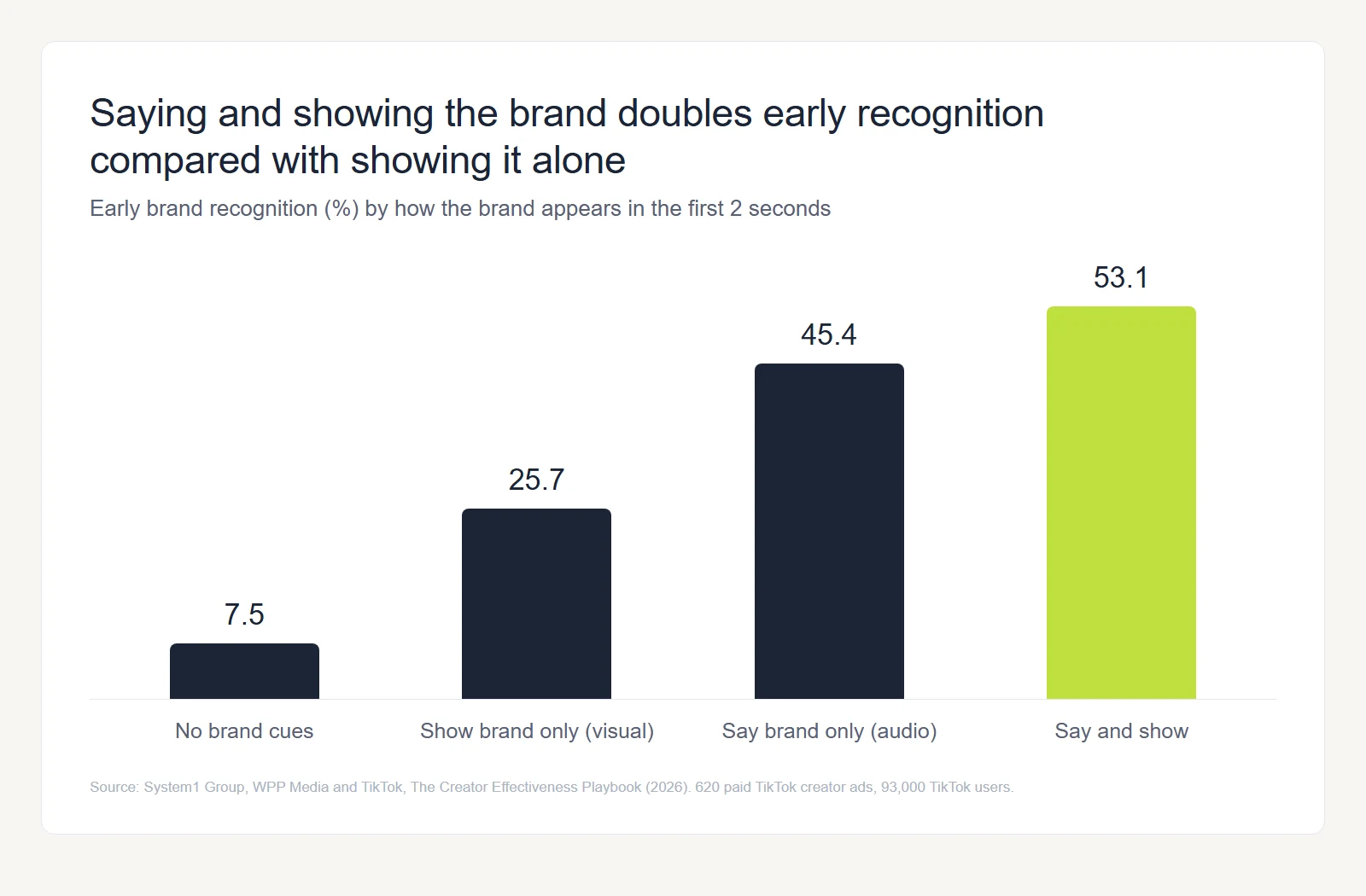
That combination gives me a practical starting point: say the name, put it on screen and introduce one detail the creator can work in naturally, such as a prop, a phrase or the sonic tag. If it interrupts the hook, I'd test a different placement in the first three seconds of a UGC ad before locking it.
How to Keep Creator Ads Recognizable Without Making Every Video Look the Same
Keep a short set of brand cues consistent across executions and give each video its own concept. The tension is real. A distinctive asset needs repeated exposure; a compelling creator video needs room for individual interpretation. Giving each a separate job helps resolve both.
Split the Asset Layer From the Concept Layer
The asset layer tells viewers which brand is behind the ad. The concept layer gives them a reason to watch, while the creator should retain their own way of telling the story.
| Layer | Stays fixed | Varies | Who decides |
|---|---|---|---|
| Asset layer | Selected cues: name, sonic tag, logo or fixed line | How each cue fits the scene | The brand |
| Concept layer | Campaign objective and required claims | Persona, scene, hook, offer angle, format | The creator and the strategist |
| Creator voice | Required claims and disclosures | Phrasing, humor, pacing | The creator |
In practice, that means committing to a short list of brand facts and leaving the rest of the execution open.
Two published inBeat cases show how that works in production.
For Native, a Procter & Gamble personal care brand, inBeat ran UGC production across five collection releases, drawing on a vetted pool of micro-creators. Each launch had its own brief with room for personal expression. The case reports more than 1,000 photo and video assets and 200% of the initial content target.
Native Fall Escape - Kirsten - Video 1. Source: inBeat on Vimeo
Turo took a different approach: inBeat cast and briefed more than 50 creators around a national campaign idea.
Turo — Case Study 01. Source: inBeat on Vimeo
A shared direction can accommodate diverse executions, as both cases illustrate. Neither reports brand recognition lift.
Build the Brand Into the Creator's Action
Build each early cue into something the creator already has a reason to say or do. The playbook suggests that a brand name spoken as part of a thought feels more native than a logo card, and I agree.
So I'd phrase the requirement as an action: "say the brand name in your first sentence" or "use the amber mug on the desk". A graphic request invites a sticker. An action produces a video.
Wrap Mashups in One Caption and Color System
Mashups call for a slightly different approach. When several creator clips come together, the consistency lives in the frame around them.
I'd use one caption system and one color grade across all footage, with a uniform CTA voice and any required creator credits. The frame belongs to the brand and the clips belong to the creators.
Let the Creator Own a Social Device
A social device is a repeatable format audiences recognize before the content explains itself, whether it's a recurring prop, persona, place, phrase, sound or behavior.
In the playbook's marketing sense, that device belongs to the creator. By entering a familiar format, a brand can build recognition through repetition, provided the product has a credible role.
When selecting creators, I'd start with those who have an established device. In a recurring comedy sketch, for instance, the product could become part of the setup so the humor helps people remember the advertiser. The creator keeps the rhythm of the joke.
That fit between product and format is part of inBeat's creator marketing work, and it's worth establishing before commissioning the first video.
How to Write the Asset Section of a Creator Brief
A good asset section tells creators which actions are required and leaves the interpretation to them. There's a practical reason to keep it short.
Early on I wrote briefs with a dozen brand rules, and the videos came back looking like the same ad with a different face on it.
- List the assets you own and score each for fame and uniqueness, using the grid in the testing section below.
- Pick the branding cues to lock for this campaign, using the testing range above as a starting point.
- Write each one as an action, for example "say the brand name in your first sentence".
- Mark persona, scene, hook and phrasing as open.
- Aim for three to five creative non-negotiables in the brief, including the locked cues. List every mandatory claim, disclosure and legal requirement separately, regardless of the count.
- Agree one consolidated creative review round, with additional compliance or factual checks wherever required.
To see how that division works in practice, consider a fictional serum brief.
| Brief line | Locked | Open |
|---|---|---|
| First sentence | Says the brand name | Everything else in the sentence |
| On-screen text | Brand name in the caption style | Wording of the hook |
| Props | The amber bottle in the opening scene | Where the bottle sits and what surrounds it |
| Sound | The three-note tag in the opening | Other commercially cleared audio |
| Persona and scene | Nothing | The creator's choice |
inBeat's published TikTok briefs follow the same principle. For a ready-to-use starting point, try the modular UGC brief.
How Creative Similarity and Fatigue Affect Creator Ads on Meta
Meta's December 2025 creative diversification guidance describes how ads that look or feel alike may be treated as variations of one creative.
Fatigue refers to overexposure to an ad, while similarity concerns a lack of meaningful variation among ads.
Either can limit performance, and they need different fixes. Counting files tells you very little about which problem you have, so I'd look at how many distinct ideas sit inside the ad set before looking at spend.
My rotation rule is simple: rotate the hook and the scene, and hold the asset. When fatigue is the issue, I recommend refreshing the opening hook while keeping winners live.
Frequency and week-over-week CTR are worth reading together because the threshold that matters varies with audience, spend and campaign objectives.
| What changes | Likely creative relationship | Use it for |
|---|---|---|
| New caption on the same footage | Iteration of an existing concept | Hook and call-to-action tests |
| New creator, same script and scene | Potentially a similar execution | Reading the creator effect on one concept |
| New persona and scene with the same spoken name and sonic tag | Potentially a distinct concept | Reach and persona expansion |
The table reflects my reading of Meta's guidance; the platform offers no guarantee about how it will classify an individual execution.
Notice what the bottom row does: it retains the name while changing the idea. Tracking concepts, variants and files separately makes media feedback easier to act on.
Where to Place Brand Assets on TikTok, Reels and Meta Feed
Place key branding cues near the opening and keep written elements within each platform's safe zones. I'd use TikTok's timing guidance and Meta's layout requirements as production checks, then test early recognition by placement.
Partnership formats add a wrinkle. When an ad runs from an authorized creator post on TikTok, the ad appears as if the creator published it. Meta partnership ads can feature a partner's identity with permission.
That's where I'd give the spoken name and the logo in context extra weight: the visible handle may identify the creator before the viewer identifies the advertiser.
| Placement | Best cue early | What to check | Source |
|---|---|---|---|
| TikTok in-feed and Spark Ads | Spoken name in the first sentence | Proposition inside 3 seconds | TikTok Ads help |
| Instagram Reels | Spoken name plus sonic tag | Keep key elements out of the bottom 35% and check safe zones | Meta Ads Guide |
| Facebook and Instagram feed video | Written name and logo in context | Readable with sound off; captions in safe zones | Meta video ad guidance |
Who Owns a Creator's Catchphrase, Format or Sound?
Ownership and reuse rights depend on the asset, the applicable law and the agreement. The U.S. Copyright Office explains that short phrases and general ideas are typically outside copyright protection, although trademarks, specific recordings and other protected material can raise separate issues. I'd have counsel review the agreement before signing.
With that in mind, these are the clauses I'd clarify in the influencer contract to keep a recurring format usable when the partnership ends.
| Clause | What to settle | Why it matters to recognition |
|---|---|---|
| Usage rights and term | How long and where the brand may run the content | A device you cannot run is a device you cannot repeat |
| Category exclusivity | Whether the creator can post the same device for competitors | Competitor use can dilute the brand association |
| Reuse after the contract | Whether the brand may keep the phrase or format | Decides if the cue survives the creator |
| Partnership ad access | Who grants and who can revoke the permission | Meta says partners can revoke permissions |
My preference is to build a core set of brand-owned assets first. A creator's established device can then be a valuable addition.
How to Test Whether Distinctive Brand Assets Are Working
Measure recognition separately from ad performance. I'd use an attribution test to find out whether the asset identifies the brand, then look at its effect on the creative.
Run an Attribution Test
Show each asset on its own, without the brand name, to a sample of category buyers. Ask which brand or brands it brings to mind.
Fame measures the proportion of respondents who associate the element with your brand.
Uniqueness measures the proportion of all brand associations for that element that belong to your brand.
A separate buying-situation check can tell you when people think of the brand.
Score Each Asset on the Distinctive Asset Grid
Once those scores are in, plot each element on the Ehrenberg-Bass Distinctive Asset Grid. Its four quadrants help you decide which cues to use, develop or retire.
| Quadrant | Fame | Uniqueness | Action |
|---|---|---|---|
| Use or Lose | High | High | Use it consistently where it fits the brief |
| Invest | Low | High | Build fame through repeated use |
| Avoid | High | Low | Avoid using it alone; it can also cue competitors |
| Test or Ignore | Low | Low | Test, revise or deprioritize the element |
Audit the First Two Seconds of Your Last Ten Creator Ads
Next, review the last ten creator ads and count the cues in their opening two seconds. Record whether each video said the brand, showed it or did both. I'd flag zero-cue openings first, then check if the other cues are recognizable.
Read Performance Against Recognition
A cue can improve recognition and still weaken the hook. For that reason, I'd test one creative variable at a time, reading performance and recognition side by side.
Set a recognition baseline before the campaign and repeat the test after meaningful audience exposure. System1's TikTok findings give you a starting point for creative decisions, with no universal timeline for building recall.
Build Recognizable Creator Ads With inBeat Agency
I'd judge a creator program by how much of its creative learning survives the next production cycle. If the media team knows why an ad worked but the next creator brief loses that information, the brand pays to learn the same lesson again.
That's where inBeat connects creator production with paid testing. If you want a second pair of eyes on the next batch of ads, book a strategy call.
FAQs
Does a small brand with no assets build one or borrow one?
For a small brand, I'd start with one or two inexpensive elements, such as a recurring phrase or recognizable prop. Test whether category buyers already associate them with a competitor before investing in repetition. An established creator format can also help the brand get attention while its own assets build fame.
How long before a new asset shows up in recall on social?
Measure change after a planned period of repeated exposure, using comparable audiences. System1's study gives no universal timeline. If recognition remains flat, look at how consistently the cue appeared and whether it can distinguish the brand before deciding to revise or retire it.
Should distinctive brand assets change when creator ads are localized?
I'd keep recognizable visual assets consistent across markets where they already work. Spoken phrases may need more flexibility: a literal translation can sound awkward or lose its meaning. Give local creators room to adapt the wording, and check that the adapted version still identifies the brand.
How should creator ads introduce new brand assets after a rebrand?
I'd introduce new elements alongside familiar ones during the transition, provided the old assets still fit the new identity. For example, a redesigned pack can appear with an established sonic tag. This gives existing customers a recognizable reference while they learn the updated visual identity.