
Your creative team can deliver every asset on time and still leave your campaigns stuck. In a 2026 EMARKETER and Perion survey, 53.2% of marketers said creative insights arrive later than media optimization signals.
For outsourced creative production, that delay can mean the people making your ads never see which hooks, angles, or concepts actually perform. The next batch arrives on schedule, but it starts with the same assumptions as the last.
So where does the feedback get lost, and how can you turn campaign data into better creative decisions? Here's what to fix before your next production cycle.
P.S. At inBeat, our performance creative agency connects production with media results from the very first brief.
TL;DR
- Delivered assets are only half the job. The next brief also needs the results of the previous tests.
- The handoff typically breaks down around data access, reporting detail, review timing and briefing.
- The real cost is how few distinct concepts reach a useful decision for the production budget spent.
- Meta can recognize similar-looking ads as iterations of one concept, so cosmetic edits often offer less learning than genuinely distinct ideas.
- A shared naming system, accessible results and a timely review help each batch inform the next one.
- When evaluating a partner, ask for one campaign result that changed what they produced next.
Why Does Outsourced Creative Production Fail Without Media Feedback?
Outsourcing can increase production capacity, but it often separates the people who make ads from those who measure them.
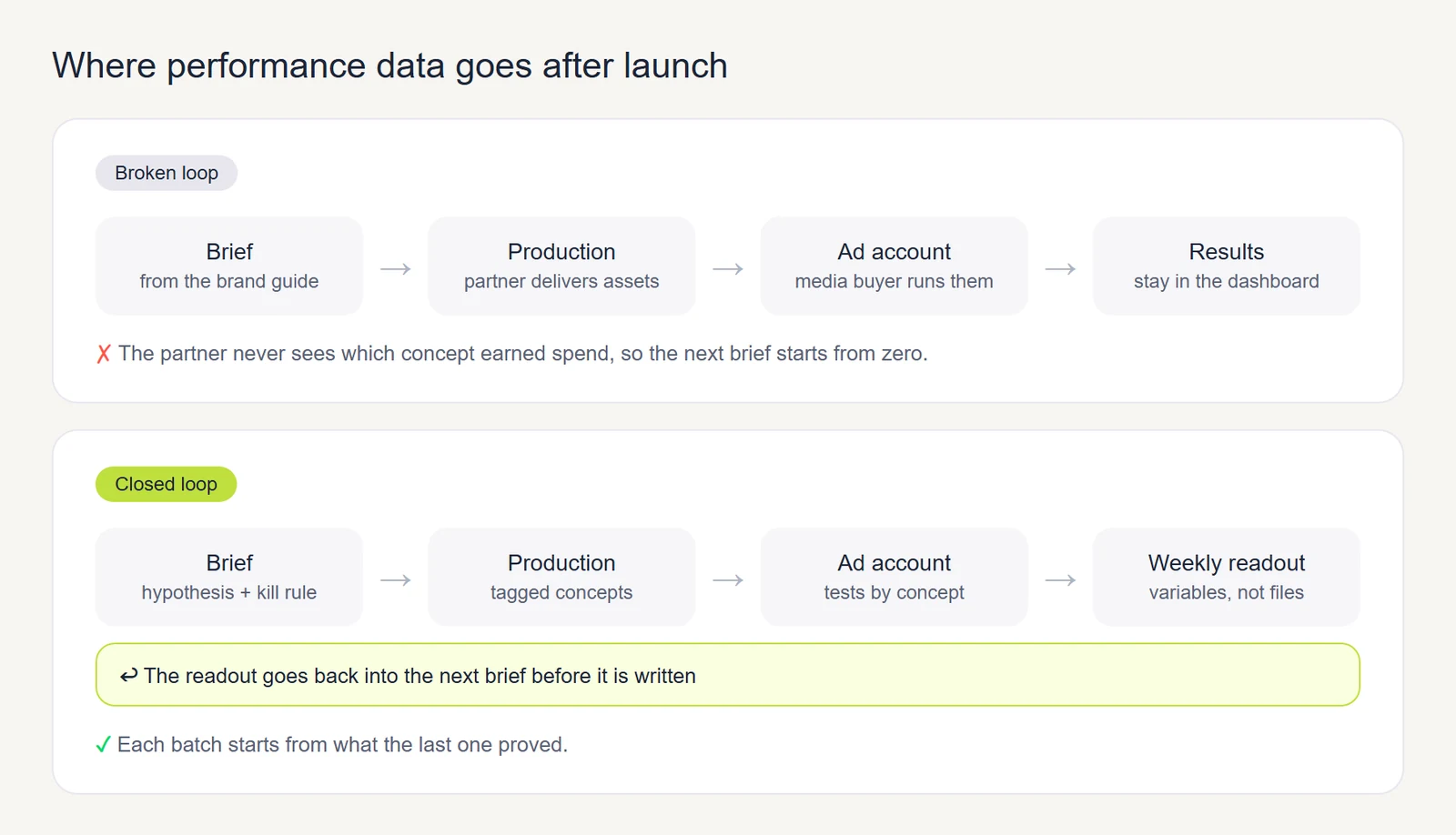
Media buyers see which concepts earned spend and drove conversions; producers may see little beyond approvals and deadlines. By the time the next round is planned, the two sides can be working from very different information.
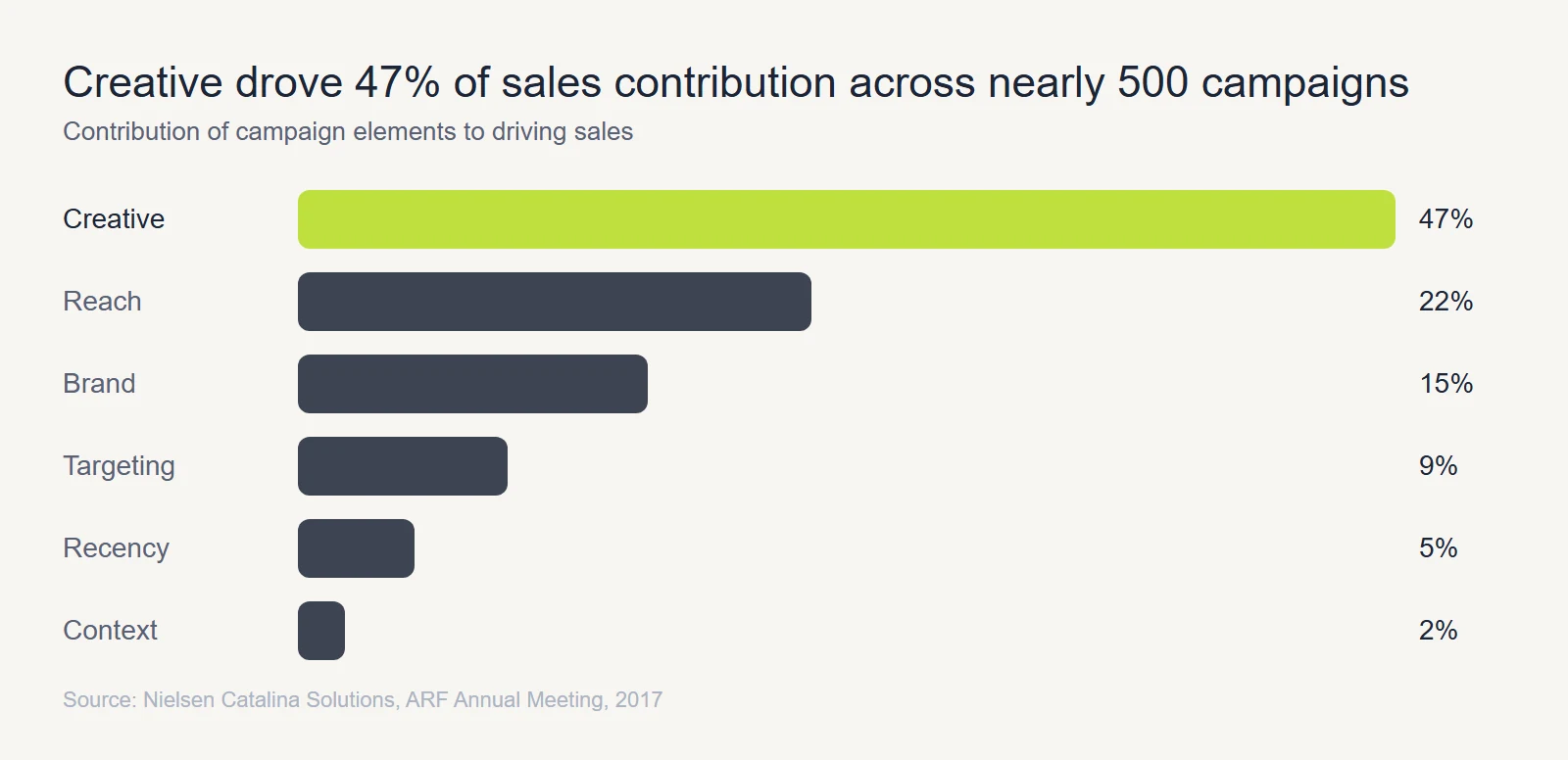
The commercial stakes go well beyond production efficiency. In a 2017 Nielsen Catalina Solutions analysis of nearly 500 campaigns, creative accounted for 47% of the relative contribution of measured advertising elements to sales, compared with 22% for reach and 15% for brand.
Those findings should inform creative strategy as well as media buying.
Meta's Dribbleup example illustrates what closer collaboration can look like. Its in-house team reportedly went from producing three or four new creatives a week to nearly 50, with creative and media buying working together.
While this example comes from an internal setup, the same principle applies wherever production happens.
An external partner can work with the same visibility. What stays in-house and what a partner produces is ultimately a resourcing choice; both models still need a reliable way to turn campaign findings into better creative decisions.
How the Creative Feedback Loop Breaks in Outsourced Setups
Four common breakdowns explain where that process comes apart.
They can affect capable partners too, particularly when creative production and media reporting sit in separate organizations.
| Break point | Where the data sits | What the partner does next | What the brand sees |
|---|---|---|---|
| Data stays in the ad account | Media buyer's dashboard | Briefs the next batch from the original plan | New ads that look like the old ones |
| Reports describe assets | A report listing ad names and CTR | Copies the winning format | Clones of one winner |
| Review slower than production | A monthly review call | Ships three or four batches blind | Fatigue before the readout |
| Briefs reset to zero | Nowhere in the brief | Rebuilds from the brand guide | The same hooks retested |
Why Performance Data Stays in the Ad Account
Media buyers typically have the clearest view of ad delivery and acquisition costs. Production teams see file requests, approvals and deadlines. Unless someone owns the transfer between them, the people making the next batch have little evidence to refine their ideas.
The handoff often lacks a named owner.
Agree on the fields producers need, assign someone to send them and set a deadline ahead of each new brief. A dependable creative-level report is far more useful than occasional updates mentioned on a call.
Why Asset-Level Reports Alone Aren't Enough
A report may name "Ad C" as the winner without explaining what made it different. Was it the opening line, the offer, the person on screen or the format? When only the file name gets passed back, the producer has little to build on beyond another near-copy.
Instead, connect each outcome to the variable being tested.
- Did one hook outperform another for the same persona?
- Did a new opening change results under comparable conditions?
Consistent tags for angle, hook, format and creator help the team answer those questions.
Why Review Cadence Has to Match Production Cadence
Imagine fresh ads arriving every Monday while the media team reviews results once a month. Several batches may ship before the first one's performance influences a brief. By then, an early winner could already be losing momentum.
TikTok's beginner playbook suggests a seven-day creative refresh as one starting point. The actual timing depends on how quickly fatigue appears and how much data the campaign collects.
For outsourced production, the signal needs to arrive while there is still time to update the next assignment. A partner delivering every two weeks may benefit from a weekly check-in, while faster testing calls for a shorter review cycle.
Why Briefs Reset to Zero Without Results
Brand guidelines explain what an ad should communicate, but they rarely capture how the last campaign performed. A useful brief includes the target persona, the hook already tested and the evidence behind the proposed change.
The previous test's result should sit beside campaign goals, audience details and creative requirements. With that context, the team can refine a promising angle, rewrite a weak opening or explore a new idea.
What Are the Signs a Production Partner Has No Media Feedback?
You can often spot the missing handoff in recent briefs and ad reports. Look for these four patterns, then check the evidence behind each one. None proves the problem by itself.
| What you see | What it likely means | What to check first |
|---|---|---|
| Batches look different but test the same variable | The partner varies surface style and leaves the hook and persona alone | Tag a batch by persona, angle and hook and count distinct values |
| A hook structure that already fatigued returns | The previous fatigue signal never reached production | Compare the hook's retirement date with the next brief date |
| Partner questions are about format and length | Audience and offer findings rarely enter the conversation | Look at what the partner has asked for in the last three briefs |
| One asset holds most spend for weeks while near-copies queue | New files arrive without a clear testing question | Compare spend share by concept with concepts shipped |
Compare recent briefs with the reports available when they were written before blaming the production partner. You may find that the team never received the numbers or that nobody translated them into decisions. Either way, the next batch has less evidence to build on.
What Does Blind Creative Production Cost per Tested Concept?
A more revealing measure than cost per delivered asset is cost per tested concept.
Count each distinct persona-angle-hook combination that received enough media spend for a decision under criteria agreed before launch. Then divide your production budget by the number of concepts that reached a readable result.
The illustration below holds the budget and output constant. All figures are hypothetical.
| Input | Blind production | With a weekly readout |
|---|---|---|
| Monthly production spend | $20,000 | $20,000 |
| Concepts shipped | 20 | 20 |
| Concepts that reached a readable test | 8 | 14 |
| Cost per tested concept | $2,500 | about $1,430 |
With the same $20,000 spent and 20 concepts shipped, one team gets 14 usable findings instead of eight. That brings its cost per tested concept from $2,500 to about $1,430.
Actual production volume will depend on spend, target CPA, test design and hit rate.
Why Creative Diversification Raises the Cost of Missing Feedback
The need for variety makes the missed feedback even more visible. A partner can deliver plenty of files while testing only a handful of distinct hypotheses, particularly when each asset makes a small change to an existing idea.
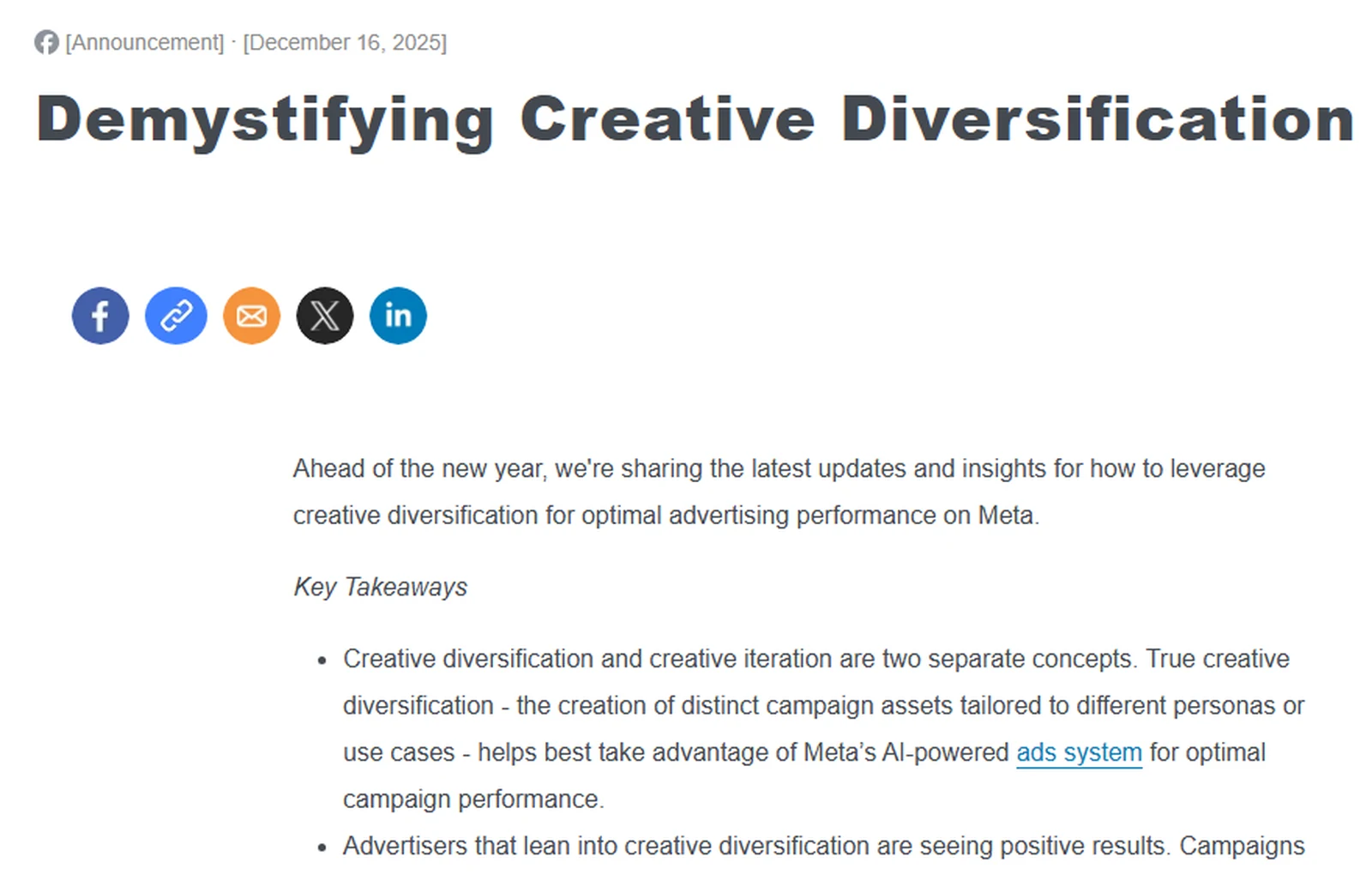
Meta's December 2025 explainer separates creative diversification, meaning distinct assets for different personas or use cases, from creative iteration, such as two ads with the same visuals and different CTAs. Ads that look or feel alike are treated as variations of one creative, and learnings are shared at that level.
Meta also describes creative fatigue as overexposure that can lower engagement and raise cost per result. TikTok likewise recommends using meaningfully different creatives rather than relying entirely on small variations. Neither platform's guidance replaces a test plan tailored to the account.
Reporting needs two levels of detail.
Concept-level results help decide which ideas deserve more testing, while individual executions reveal what a different hook or edit may have changed. That distinction keeps asset volume from being mistaken for meaningful variety.
A falling CTR or higher cost per result should trigger a closer look at frequency, audience shifts and spend. Together, those indicators help the team choose between refreshing an execution, testing another angle and retiring a concept.
How to Build a Creative Feedback Loop With Your Production Partner
The process only improves when someone owns each handoff. These six steps help make campaign findings part of the next production decision.
- Give the production team access to useful results. Offer suitably permissioned read-only access or a scheduled export with spend, CPA and video engagement by concept. A screenshot of the top ad rarely provides enough context.
- Agree on naming and tagging before the next launch. Include the persona, angle, hook, format and creator in every ad name. For example: PERS-Commuter_ANG-TimeSaved_HOOK-ColdOpen_FMT-UGC_CRTR-014_V02. That lets both teams filter results without guessing what each file was meant to test.
- Share the findings before briefing another batch. A one-screen summary can capture the hypothesis, outcome and recommended change while the production team still has time to act.
- Put a testable hypothesis and a clear stop rule in each brief. Define the spend needed for a readable outcome and the threshold for another iteration. This also means choosing between multivariate, A/B and split tests based on the question being asked.
- Bring the creative lead, media owner and partner strategist into a focused 30-minute weekly session. Everyone should leave knowing what to repeat, revise or retire, rather than with another set of dashboard screenshots.
- Apply the agreed rules when a concept reaches its stop threshold or shows sustained fatigue. Record the reason for retiring it before commissioning the replacement, and carry the original tags forward so later reports show what changed.
Here is a fictional readout showing the level of detail a production partner can use.
The comparisons are illustrative and should only guide real decisions when the test conditions and sample sizes support them:
| Variable tested | Better initial signal | Alternative tested | Illustrative evidence | Implication for next brief |
|---|---|---|---|---|
| Hook | Cold open on the problem | Product-first opening | At equal spend: CPA $42 vs $56; hook rate 31% vs 23% | Test additional problem-led openings |
| Persona | Commuter | Student | Equal spend and offer; CPA $48 vs $62 for commuter vs student | Prioritize commuter messaging; revisit the student angle |
| Format | 15-second UGC | 30-second UGC | Same hook and persona; CPA $51 vs $65 for 15s vs 30s | Try another 15-second cut; validate by placement |
Read the table from left to right: a variable was tested, the evidence suggests a direction and the next brief responds to it. Keep that explanation with the assets so future teams understand why each decision was made.
Which Creative Analytics Should an Outsourced Production Partner See?
Different roles need different views of the same campaign data. Editors can use engagement signals to improve a cut, while the media team provides spend and acquisition cost by concept. Revenue and incrementality add context about what happens beyond the click.
Hook rate and hold rate can reveal a weak opening or a pacing issue, although their definitions vary by platform. Neither proves why someone converted. Pair them with CPA and revenue data, and use incrementality to answer broader questions about business impact.
| Data | Source | Cadence | Owner | Why the producer needs it |
|---|---|---|---|---|
| Hook rate and hold rate | Ad platform | Weekly | Media buyer | Highlights early-video drop-off |
| Spend by concept | Ad platform | Weekly | Media buyer | Shows where delivery concentrated |
| CPA by concept | Ad platform plus store data | Weekly | Media buyer | Shows acquisition cost; pair with value data to assess payback |
| Fatigue signals (CPM, CTR, frequency) | Ad platform | Weekly | Media buyer | Flags potential fatigue for review |
| Incrementality or blended MER read | Lift test, store data | Monthly | Measurement owner | Adds context beyond attributed results |
Platform attribution and incrementality answer different questions. Ads Manager reports conversions attributed within the configured reporting window; Conversion Lift estimates incremental impact by comparing randomized test and control groups.
A 28-day click view may appear in comparison reporting, rather than as the campaign's standard optimization window.
Remember: A concept can look attractive in platform ROAS yet deserve a different interpretation when business or incrementality data are considered.
Share both sets of results, note the attribution settings and avoid treating an account-level lift estimate as proof that one individual ad caused the difference.
How Creative Feedback Differs for UGC and Creator Content
Creator footage can make this process more flexible. With the right usage rights and reusable raw clips, a team can test another opening, persona or edit without arranging a fresh shoot. The actual options depend on what the creator delivered and the terms of the agreement.
A recut should answer a question raised by the last test. Otherwise, extra footage merely gives the team more versions to sort through without a clear reason to choose one.
Dark posting can help teams test paid creator content without publishing every variant to a creator's organic feed. It does not automatically create a clean experiment: audience, delivery, spend and other variables still need to be controlled well enough for a useful comparison.
Before recutting, whitelisting or scaling a creator's content, confirm the usage terms. They determine where the creative can run, for how long and under whose account.
Give creators one focused round of feedback tied to the hypothesis. If the test concerns a new hook, for example, keep the offer and audience as consistent as possible so the outcome is easier to interpret.
Keep the notes specific: which opening seconds to change, which lines to retain and which persona deserves another try. For brands that want creator production and paid testing coordinated together, our UGC agency handles both.
How to Check Whether a Creative Production Agency Learns From Media Data
The clearest proof of a working process is a brief that changed after a test. Ask the agency to walk through the original hypothesis, the outcome and the decision that shaped the next production round.
Bring this up before discussing price.
A partner with an established process should be able to name the reporting owner, explain the cadence and share an anonymized example. You'll also learn how much analysis your own team would need to handle.
For a new partner, a 90-day pilot with success gates and kill criteria offers a defined period to see whether test findings actually influence the work. That is more useful than judging the relationship by the number of assets delivered.
| Question | Strong answer | Weak answer |
|---|---|---|
| Show a test that changed your next brief | Links a result to a specific brief change | Only describes its general creative process |
| What data do you need from us and how often? | Names the fields, owner and reporting frequency | Asks for occasional screenshots |
| How do you tag assets? | Shares consistent concept tags and examples | Has no consistent way to group creative tests |
| What happens when a concept fatigues? | Names fatigue signals and response time | Cannot name a rule or responsible owner |
| Who owns learnings if we leave? | Provides tagged files and the learning archive | Keeps test findings in internal files |
Write these expectations into the contract, so data and insights stay accessible as the relationship evolves:
- Access to creative-level data
- A named owner for the weekly readout
- A turnaround on replacement briefs
- Delivery of the tagged learning archive at exit
For a deeper vendor assessment, our guide to choosing a performance creative agency covers briefing, reporting and contract terms.
Build a Tighter Creative Feedback Loop With inBeat Agency
At inBeat, our creative strategists work alongside media buying and measurement, so campaign findings shape the next production round. Concepts are tagged by persona, angle, hook, format and creator, giving the team a shared view of what deserves further testing.
For brands already working with outside producers, comparing the last few briefs with campaign reports can reveal which insights never made it back to production.
Want more informed decisions before the next batch? Book a strategy call. We'll review the handoff with you and identify the changes worth testing first.
FAQ
How do you get creative-level data to a partner when a separate media agency owns the ad account?
When another agency manages media, agree on a weekly creative-level export or appropriately restricted account access. Name the person responsible for turning those results into the next brief, and include access and confidentiality terms in both agreements.
How do you keep a partner from overfitting to one winning ad?
Ask which variable appeared to drive the result, under what test conditions and with how much confidence. Use that finding to request a new angle or a controlled iteration rather than several look-alike versions.
Does the loop change with a UGC marketplace instead of an agency?
A marketplace may deliver content from several creators without a shared testing framework. In that case, your team needs to manage the tags, usage rights and performance interpretation.
An agency may coordinate those jobs, but someone still has to own the handoff from campaign findings to the next creative brief.
How do you measure creative performance when platform ROAS and lift results disagree?
Platform ROAS is useful for quick optimization, while lift studies and blended results address broader business impact. When they disagree, first compare the attribution assumptions and test designs. A campaign-level lift result cannot establish which individual ad caused the change.