

One of the most expensive assumptions in international advertising is that a successful concept at home will work just as well abroad.
The numbers suggest otherwise. Ipsos found that only 31% of ads achieve the same level of performance across countries.
Yet brands still face decisions about scripts, casting, and creative direction long before they know how local audiences will respond.
International focus groups help reduce that uncertainty before production budgets are committed. The key is knowing what to ask, how to compare reactions, and when the findings justify changing the concept.
Here's where to start.
P.S. For brands running creator programs across several markets, see inBeat's influencer marketing agency.
What Are International Focus Groups for Ad Concept Testing?
International focus groups for ad concept testing bring target consumers together in two or more countries to react to a shared creative idea. Each market sees a comparable script, storyboard, or animatic, with any planned language or cultural variants recorded separately. The goal is to understand how the same concept is interpreted before production decisions are locked.
The format is standard focus group market research pointed at a specific decision: which concept elements survive the border and which don't.
How a Multi-Country Concept Test Differs From a Single-Market Focus Group
A single-market group produces one read. A multi-country test produces several reads that must be comparable, which means:
- One guide adapted per market
- Participants matched on the same persona
- A decision log that lines markets up against the same concept elements
Show one animatic to matched groups in Germany and Mexico in the same stimulus order and you get two interpretation reads to set against each other.
What the Groups Can and Cannot Tell You About an Ad Concept
They tell you what people understood, what they misread, and why. They don't estimate reach, click-through or conversion; that’s the job of creative testing in live media.
Scripts, storyboards, animatics, rough cuts and taglines can all work as stimuli if participants have enough context to interpret the idea. A storyboard is useful for visual storytelling; earlier scripts or treatments can also support meaningful discussion across markets.
When Are International Focus Groups Worth Running Before Ad Production?
Run international focus groups when the concept depends on something culturally loaded, such as humor, idiom, a social situation or a symbol, and the production budget at risk is large relative to what the research costs. Skip them when the concept is a product demonstration that will be re-cut weekly anyway.
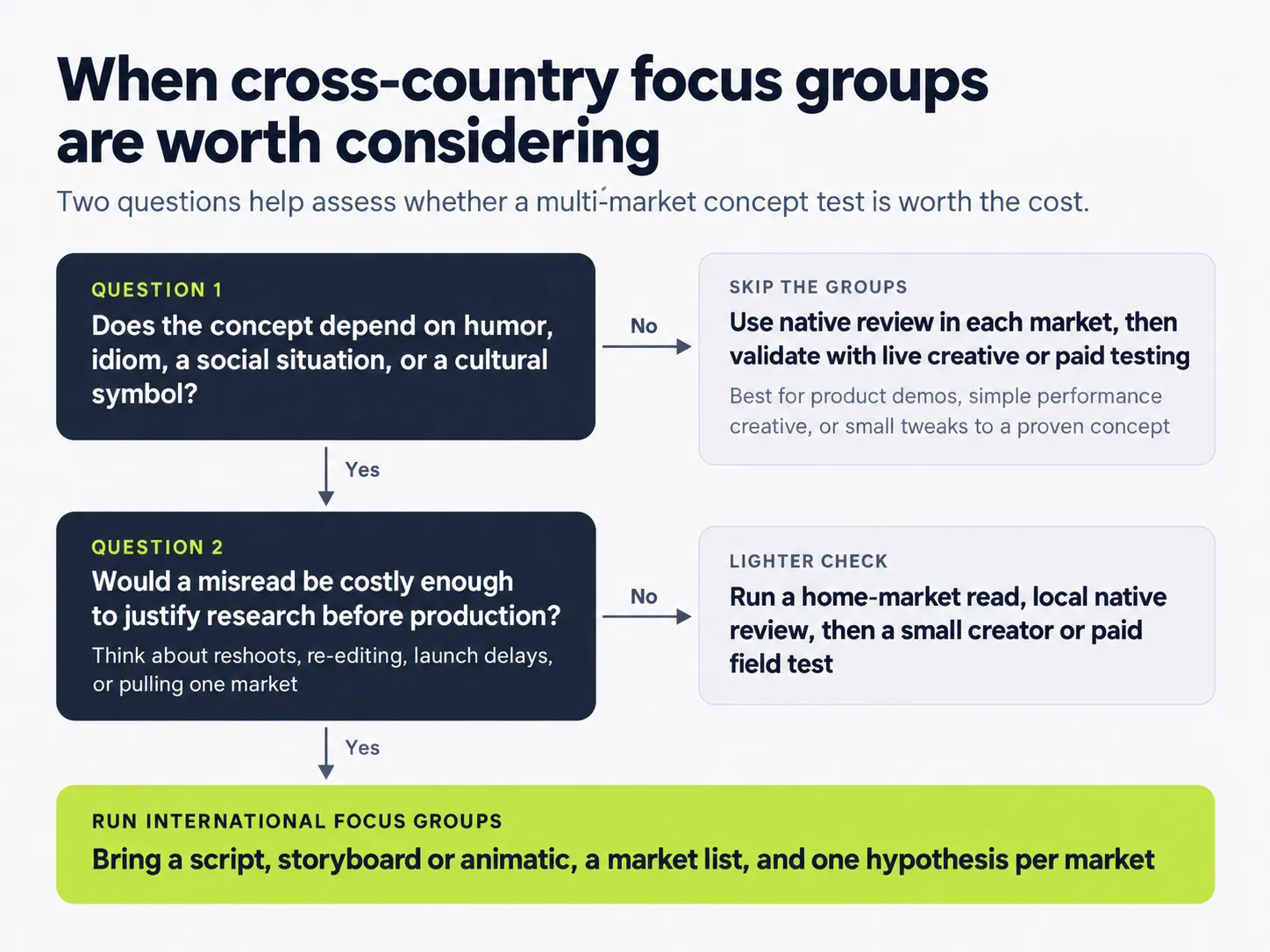
Signs a Multi-Country Concept Test Is Worth the Cost
The strongest signal is a concept whose meaning lives in the culture more than in the product. A humor-led storyboarded spot planned for three European markets, with a single hero shoot feeding all three, is the textbook case: the joke carries the idea, the joke may not travel, and a failed market after the shoot means a second shoot.
The groups surface the why behind the reaction, which is exactly what a production decision needs before money moves.
Other signals: on-screen talent chosen for one market's recognizability, a claim framed around a local proof convention, or a tagline built on wordplay.
Cost Drivers to Weigh Against the Production Budget at Risk
No single benchmark covers this, so weigh the drivers against your own numbers. Research cost is driven by:
- Participant incentives per market
- Native moderator and translation fees
- Facility or platform fees
- Observer access across time zones (travel, simultaneous interpretation, or both)
Put that total next to the cost of reshooting one market or dropping it from the launch. Avoiding a costly correction could justify the research expense, provided the findings lead to an actionable change before production.
When to Skip Focus Groups and Test With Live Creator Ads
For product-demo ads, frequently refreshed performance creative, and small adaptations of an already validated concept, a home-market read plus a native reviewer in each market may be a reasonable first check.
In those cases, a batch of creator-made versions tested in live paid social may provide a faster early signal. Results still depend on execution, audience and delivery, and they rarely explain a cultural misunderstanding on their own.
Before proceeding, have three things in hand:
- A clear creative stimulus, such as a script, storyboard or animatic
- A candidate market list
- One written hypothesis per market about which element you expect to be misread
A hypothesis helps keep the comparison focused, while open-ended questions leave room for unexpected reactions.
How Audiences in Different Countries Interpret the Same Ad Concept
Audiences in different countries interpret the same ad concept through language, visuals and social context. Each layer can create a mismatch even after accurate translation, so localized ads may need changes beyond copy.
The groups' job is to expose how and why the reading diverges. That's the layer quantitative scores can't explain.
Build a three-layer checklist for your concept and mark the elements you expect to be read differently in each market before fieldwork. That list becomes the hypothesis the moderator is briefed on and the rows in your decision log.
Language, Idiom and Product Claims That Change Meaning in Translation
Puns rarely survive because register shifts: a casual tone that signals confidence in one market reads as disrespect in another.
Category vocabulary sometimes has no equivalent, so the translated word carries a different product in people's heads. Proof conventions differ too, with "clinically tested" or "number one" claims that are routine in one market and suspicious or legally awkward in another.
Moderators need to render brand and category jargon into everyday speech, which is the same capability health researchers flag when they describe the difficulty of selecting moderators who can translate medical terms into plain language.
Side note: That source is about health research, so treat it as an analogue; the mechanism is identical when the specialist terms are yours.
Probe this layer by asking participants to retell the ad in their own words, then to explain the tagline to a friend. Log the retelling along with their verdict.
Symbols, Colors, Gestures and On-Screen Talent That Read Differently by Market
Color carries mourning, luck or cheapness depending on where you stand. A thumbs-up or an open palm can be rude. The setting of a scene (a kitchen, a car, an office) signals income and status differently, and casting signals who the product is for.
On-screen text conventions, from reading direction to how much copy is acceptable on a frame, change how the visual is scanned.
Probe by pausing on specific frames and asking what the people in them are like, what they earn, and who the ad is talking to.
Tone and Social Norms Around the Product Moment
The social layer is what the ad implies about family, gender roles, money or intimacy, and whether the product moment is plausible locally.
A dinner-table scene under an English pun is a useful example:
- In one hypothetical market the pun dies in translation (language layer)
- In another the table and seating imply a family hierarchy that participants reject (social layer)
- In a third the dish on the table looks wrong for the occasion (visual layer).
Three markets, three different failures, one concept.
Cross-cultural methodology work on focus groups notes that group dynamics themselves vary by culture, including how willing participants are to disagree in front of others, which an RTI comparison of focus groups across cultures examines in detail. Read quiet agreement in a market with strong politeness norms as absence of data until the moderator has probed individually.
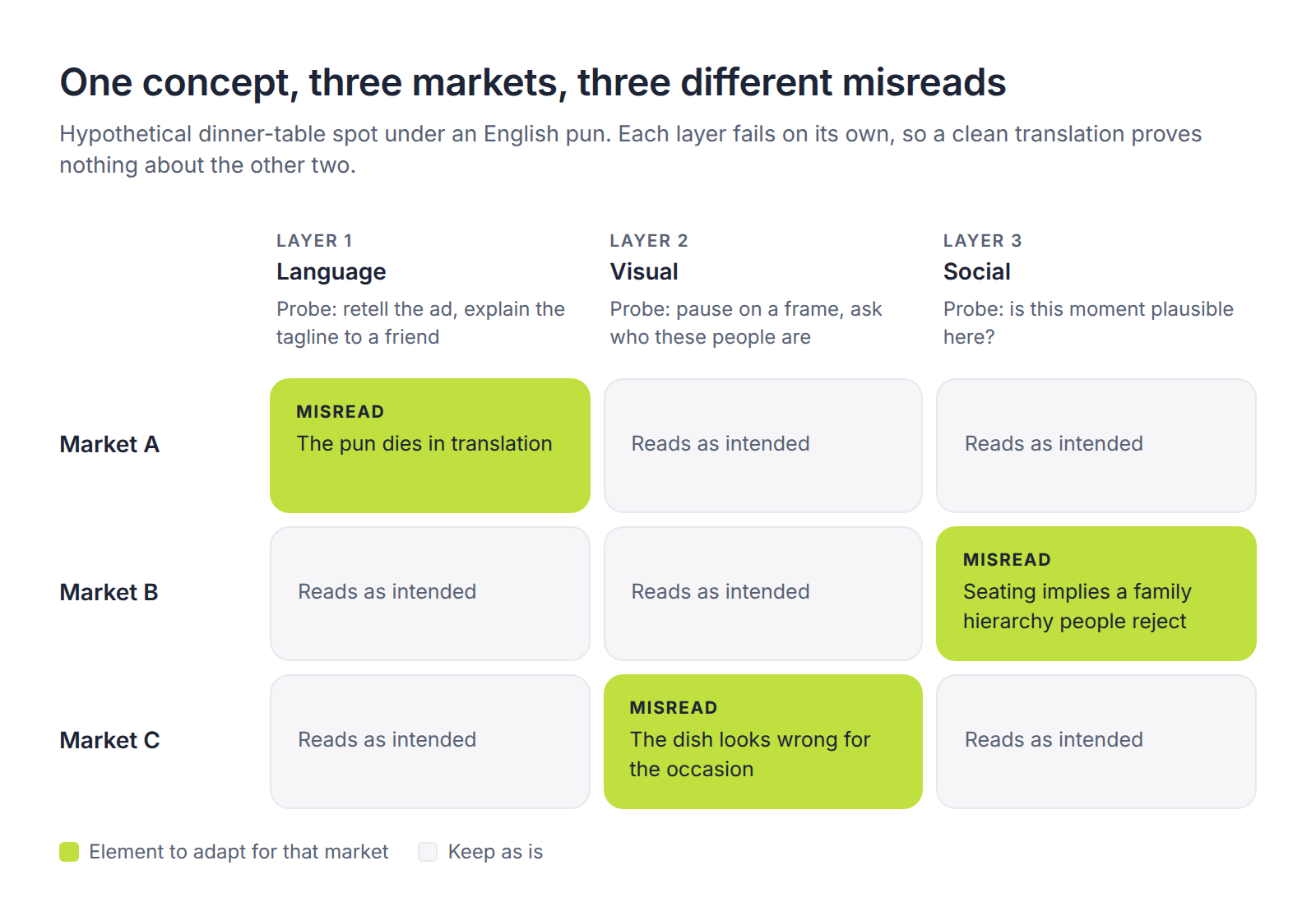
Log misreads by layer, market and concept element, with the participant's own phrasing attached. That structure is what lets you compare a German misread with a Mexican one instead of comparing two moderator summaries.
Should You Run International Focus Groups in Person or Online?
Run international focus groups online by default when the stimulus is a storyboard or animatic. One team can observe several markets within days, participants don't travel, and the recordings sit in one place for the debrief.
Go in person when the concept depends on physical product interaction, on group energy, or when connectivity or privacy conditions in a market suppress candor.
The method's purpose, understanding reactions to a concept, is identical in either format, so choose on logistics and candor.
When Online Focus Groups Across Countries Are the Better Call
Online wins on speed to field and on observer access. Your brand team in one time zone can watch Tokyo in the morning and Mexico City in the evening without a flight.
Health researchers who compared virtual and in-person focus groups on cost, recruitment and participant logistics documented exactly these tradeoffs, and later work on running virtual groups during the pandemic showed the format is workable for serious qualitative data collection, with caveats about technology and rapport.
Side note: Those studies come from health settings, so take the logistics lessons and ignore any assumption that the participants resemble yours.
Dedicated online focus group platforms handle stimulus sharing, backroom chat and recording consent, which matters when a market's recording rules differ from your home market's.
When In-Person Focus Groups in Local Facilities Still Earn Their Cost
In-person earns its cost when participants need to hold packaging, when the category is sensitive enough that people won't speak frankly on camera at home, when household devices or bandwidth make video unreliable, or when the concept relies on the room's reaction, as comedy often does.
Local facilities also give you a deeper local moderator pool in some markets.
The format comparison draws on the virtual versus in-person health research linked above; the defaults are a judgment call for ad concept work.
Hybrid Setups for Mixed-Market Programs
A hybrid approach makes sense when one market needs in-person sessions for product handling, privacy or participation conditions while other markets can use online groups. Choose each format for a documented reason rather than assuming the primary launch market requires a facility. Keep the guide core and stimulus sequence comparable, and flag format differences in the analysis.
How to Recruit Cross-Border Participants for International Focus Groups
Recruit participants who match the persona the concept targets in each market, with criteria adapted to local category behavior but comparable in intent. This section defines the screener spec you hand to a recruiter or provider; panel sourcing mechanics belong elsewhere.
Keep Screening Criteria Comparable Across Markets Without Copying Them Word for Word
A "weekly category buyer" in one market may be a monthly buyer in another because of pack sizes, retail density or income. Copying the criterion literally produces groups that match on paper and differ in reality.
To avoid that:
- Define the intent (regular, engaged users of the category who could plausibly see this ad) and let the local threshold vary.
- Do the same for income bands and life stage.
Cross-cultural focus group methodology treats this comparability of participants as a precondition for comparing findings at all, a point developed in Sage's chapter on cross-cultural focus group research.
Two red flags break comparability fast: professional respondents who appear in every panel, and category-use or income definitions that drift between markets without anyone recording why.
Group Composition and Size per Country
Aim for comparable group sizes and numbers across markets. If local recruitment conditions require differences, document them and account for those differences when comparing findings.
Composition should follow local candor norms: mixed-gender groups work in many markets and suppress discussion in others. Meanwhile, age mixing can silence younger participants where deference is expected.
- Decide per market.
- Write the reason down.
- Keep it constant across that market's groups.
Scheduling, Incentives and Consent Across Time Zones
Schedule sessions in windows that let the core observer team watch live, because the same-day debrief depends on it; online formats make this easier, as the previous section covered.
Set incentives to local norms (it's better than using a converted home-market figure). Bear in mind that participants in many markets compare offers on public lists of paid research studies and will notice an underpaid session.
Confirm consent and recording rules per country before fieldwork, since what's routine in one jurisdiction needs explicit written consent in another. Book one backup participant per group.
Write all of this as a one-page screener spec per market: shared persona criteria at the top, local adaptations below, with the rationale for each adaptation. Hand that to the recruiter and keep a copy for the decision log.
How to Run International Focus Groups on an Ad Concept Step by Step
Write one master discussion guide in the source language, adapt it per market, back-check the meaning, pilot it locally, then run every session in the same stimulus order with a native moderator briefed on the hypothesis.
That sequence is what makes multilingual focus groups comparable instead of merely simultaneous.
- Define the decision each market must inform. Write it as a sentence: "Does the tagline and the dinner scene survive in market X, and if not, which element fails?"
- Choose markets and participant profiles. Use the three-layer checklist to pick markets where you expect divergence, and the persona the concept targets.
- Recruit against the screener spec from the previous section.
- Write one master guide in the source language with a fixed stimulus order.
- Adapt guide wording and local examples while preserving the meaning of core questions. Localize ad stimuli where the planned execution requires it, and document each version.
- Back-translate or have a second native reviewer compare meaning, then pilot the guide with one or two locals.
- Brief a native moderator per market on the hypothesis, never on the preferred answer.
- Run every session with the same stimulus order and debrief each market the same day.
Write One Master Discussion Guide and Freeze the Comparable Core
The master guide has two parts:
- A comparable core that is identical in meaning across markets
- A flexible local block kept visibly separate
A workable template has six blocks: warm-up, category context, spontaneous reaction to the animatic, comprehension probe, cultural-fit probe, and adaptation ideas.
- The core is blocks three through five.
- Warm-up and category context can flex locally; adaptation ideas can run as long as the market wants.
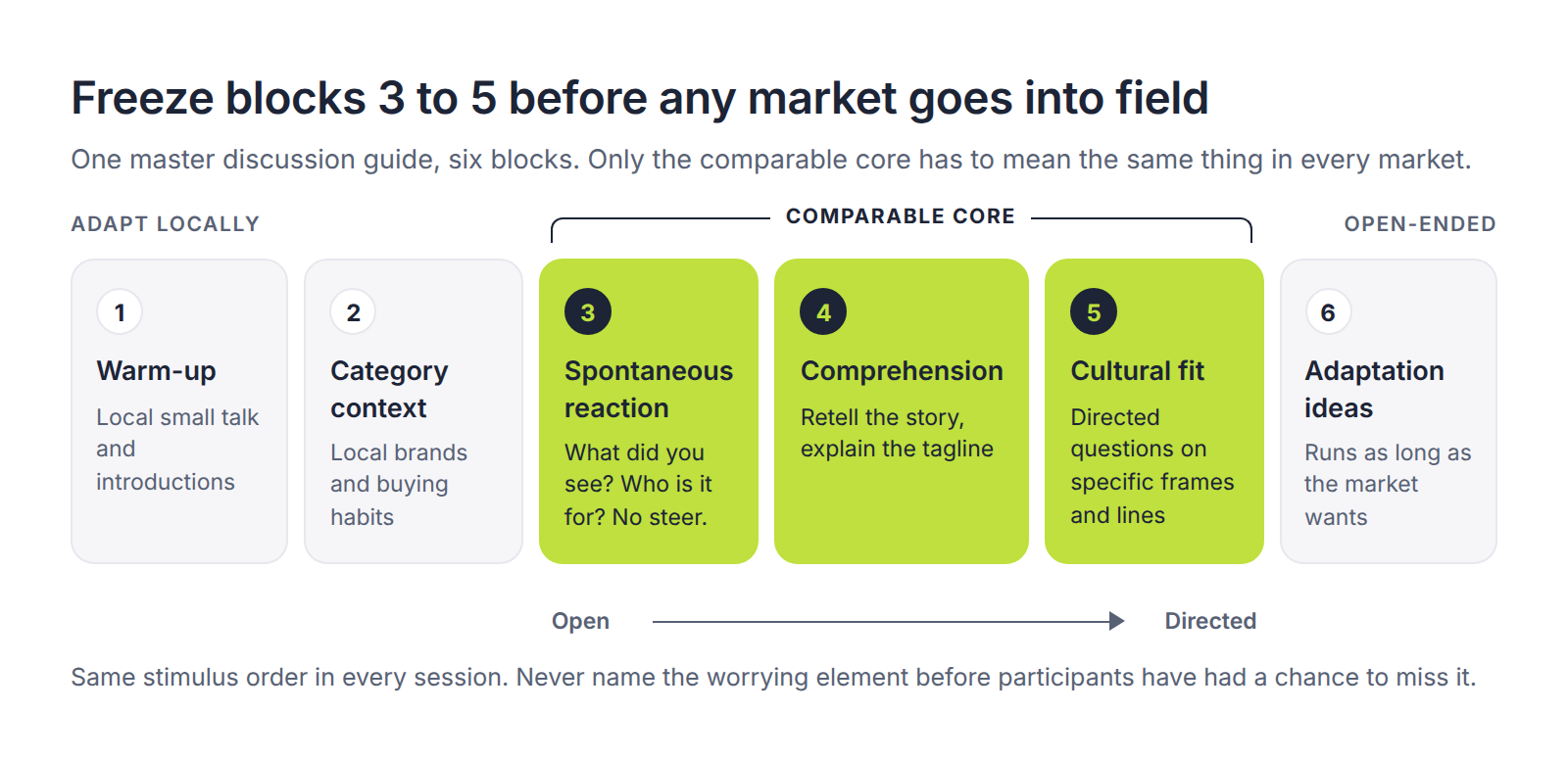
Sequence the probes from open to directed. Spontaneous reaction first, with no steer: what did you just see, what is it for, who is it talking to.
Then comprehension: retell the story, explain the tagline.
Only then the directed cultural-fit questions about specific frames and lines.
The method's strength is open why, what and how questioning, and you lose it the moment the moderator names the element you're worried about before participants have had the chance to miss or misread it on their own.
Freeze the core before any market goes into field. Changes after the first market has run turn a comparison into two different studies.
Translate, Back-Check and Pilot the Guide and Stimuli per Market
Adaptation covers three things: question wording, examples used in probes, and the stimuli themselves.
- For question wording, give the translator the intent of each probe along with the text.
- For examples, swap local brands and situations so the probe lands.
- For stimuli, specify whether each market sees the original tagline, its local version or both. Keep the sequence consistent where the same comparison is intended, and log any localized variants.
Build a glossary of untranslatable terms before translation starts. For each, record the local rendering and any meaning it loses, so the moderator can probe the difference. Then back-translate the adapted guide, or ask a second native reviewer to compare its meaning with the master, and resolve discrepancies in writing.
Finish with a pilot: one or two locals matching the persona walk through the guide and stimuli, and you watch where they hesitate. The pilot catches the probe that is grammatical and meaningless, which back-translation often misses.
Pro tip: run the pilot with the moderator who will field the real sessions. Half the value is the moderator learning where the guide fights the language.
Brief Native Moderators on the Hypothesis and Hold Stimulus Order Constant
Choose native speakers who can turn brand and category jargon into everyday language on the fly, the moderator capability flagged in the health-research methodology referenced earlier.
Pro tip: A bilingual moderator who lives elsewhere tends to miss the current register.
Brief them on the hypothesis for their market: which elements you expect to be misread and why. Never brief them on the answer you hope to hear. A moderator who knows the team loves the pun will rescue it in the room.
During sessions, stimulus order is fixed and documented.
If a moderator deviates, the deviation goes into a log with the reason, so the analysis can discount that group on the affected element. Observers submit questions through the backroom channel; the moderator decides whether and when to ask them inside the structure.
Debrief each market the same day, with the moderator, the lead observer and whoever owns the decision log. Fill the log while the sessions are fresh and before the next market runs, so the team's reading of market one doesn't quietly reshape the probes in market two.
Pro tip: ask the moderator at debrief which probe they would delete. The answer tells you where the guide is forcing a reaction that participants didn't have.
How to Choose an International Focus Group Provider
Choose an international focus group provider on four capabilities: a named native moderator per market, a documented translation back-check, screener controls that keep markets comparable, and a report that lines markets up side by side.
Price comes after these four, because two proposals that look equivalent on cost can differ sharply on them.
Native Moderators and Translation Back-Checking in Every Market
Ask for the name and recent local experience of the moderator in every market, plus an example of how they probe an unfamiliar brand term without leading the group. This tests practical facilitation rather than a generic claim of native fluency.
Request a sample translation review showing who checked the guide, which discrepancies they found, and how they resolved them. A proposal with unnamed moderators or no documented meaning check deserves follow-up before approval.
Participant Screening Quality and Comparability Across Countries
Ask for a redacted screener and a summary of how the provider identifies repeat panelists and documents local eligibility thresholds. Compare the screening logic across markets, rather than accepting identical wording as proof of comparability.
Request their process for logging stimulus-order deviations and passing observer questions to the moderator. A sample fieldwork log makes these claims easier to verify.
Reports That Compare Markets Side by Side
Request a redacted sample report before signing. It should compare markets on the same concept elements, include participants' own words, and flag deviations that could affect interpretation.
Ask the provider to show how its findings map to a single decision log. Separate country summaries can be useful, but they also need a comparable cross-market view.
How to Turn International Focus Group Findings Into Go, Adapt or Kill Decisions
Turn findings into decisions with a log that records, for every concept element in every market, what was understood, what was misread, how severe the misread is, the proposed adaptation, an owner, and the decision.
Set the log up before fieldwork and agree in writing which finding patterns trigger adapt, kill or field-test, so the decision doesn't get renegotiated after the team has heard a group it liked.
Keep a Decision Log per Market and per Concept Element
Complete each market's entries within 48 hours of its last group.
Columns: concept element, market, understood, misread, severity, proposed adaptation, owner, decision.
Severity needs a rule: a misread that changes what the product does or who it's for is severe; a misread that costs a laugh is moderate; a misread one participant raised and others corrected is low.
Weight the evidence by pattern. Volume of talk counts for little. A misread shared across every group in a market is a flag. A single participant's view is a hypothesis, logged and tested later. Strong liking is never a forecast.
Separate Qualitative Findings From Performance Predictions
Use the table below to keep interpretation findings separate from performance forecasts and choose a proportionate next step for each pattern.
"Adapt" has a specific meaning here. Change the misread element, keep the comparable core intact, and re-check the adapted version with a lighter method: a short round of individual interviews, a native reviewer, or the field test below.
Re-running full groups for one changed line is rarely worth it.
"Kill" applies to a single market; a concept that fails in one market and reads cleanly in three others loses the one market.
Field-Test Adapted Concepts With Local Creators Before Full Production
The step between the decision log and the shoot is a field test. Hand the adapted concept to local creators in each market and have them produce low-cost versions in their own voice, then run those versions as small paid tests in that market's feed.
Small paid tests can provide directional signals about attention or early conversions that focus groups alone cannot. Interpret those signals alongside execution quality, audience selection, delivery conditions and sample size rather than treating them as a forecast.
Use the feed test as one input to a go, adapt or kill decision.
- If an adapted version shows promising signals against a relevant baseline, review execution quality and production feasibility before approving the next stage.
- If results are weak or inconclusive, check the audience, creative execution, placement, delivery and test volume first. Revisit the concept when those checks point to a specific creative problem.
Worked example, hypothetical: the tagline is misread in every group in one market, so it's adapted, re-rendered by three local creators, and run as dark posts with a small budget against the original before the shoot is scheduled.
In the same study, a single participant disliked a cast member; that goes in the log as a hypothesis, and the field test includes one creator version without that casting choice to see if anyone else notices.
Planning a market-by-market creator test after the groups? Book a strategy call.
Frequently Asked Questions About International Focus Groups
How many focus groups per country are enough to compare markets on an ad concept?
There's no universal minimum. Two groups per market can be a practical starting point for a directional comparison, but the right number depends on audience diversity, concept complexity, and how consistent the findings are. A reaction repeated across groups deserves attention, while an isolated comment calls for further investigation. Keep the research design comparable across countries and document any differences in group counts before drawing conclusions.
How long does a multi-country focus group study take from brief to decision?
Plan for several weeks from brief to decision rather than assuming the sessions alone set the calendar. Recruitment, translation back-checks, local pilots and scheduling often take longer than the sessions themselves. Work backwards from the production lock date and reserve time for the decision log and any follow-up creator test. Ask the provider for a market-by-market schedule before approving the study.
Should we show the tagline in English or translated when testing in non-English markets?
Show it the way it will run. If the launch plan keeps the English line, test the English line and probe what people take it to mean. If it will be translated, test the translation, and consider showing the source after the probe so participants can tell you what the translation dropped. Apply the same decision rule across markets, keep exposure order consistent within comparable tests, and record every version shown.
Can international focus groups replace quantitative ad pre-testing or creator field tests?
Groups explain interpretation; quantitative pre-tests estimate attention or persuasion at a sample size; field tests show what the live feed does with the message. Each answers a different question. The groups' job is to make sure what you quantify or field-test is the version people understood.
What do we do when two markets reach opposite conclusions about the same concept element?
It's a finding about the element, and a useful one. Branch the creative per market, keep the shared core, and let the field test in each market confirm the branch. Forcing one reading onto both markets throws away the exact information you paid for.
How late in the creative process is too late to run cross-country focus groups?
Run groups once the concept is specific enough to discuss; a script, storyboard or animatic can all qualify, provided the team can still revise the idea. Once the shoot and core creative decisions are locked, the study has less practical value. At that stage, native review or a small creator test may be a more proportionate check.