

Two ads can sell the same product to similar audiences and deliver different sales results.
In a validation study of 970 ads, Kantar found that ads with high pre-test sales-likelihood scores generated 33% more sales than the average ad, while low-scoring executions generated 27% fewer. These are observed differences, rather than a guaranteed lift from swapping creatives.
Now imagine giving the weaker ad most of your budget because its early Ads Manager numbers looked promising.
We'll cover how to set a test budget, separate real winners from early noise, and use each result to guide your next creative brief.
TL;DR
- Creative testing in media buying is a controlled comparison of ad concepts under fixed conditions, judged by a rule set before launch.
- In NCSolutions' CPG research, creative accounted for the largest share of incremental sales, making a planned test budget worth considering.
- Automated delivery favors ads in real time; a controlled test is designed to answer a specific question.
- For Meta's creative testing tool, consider its 20% budget guidance. Size formal A/B tests around the sample needed for a decision.
- Review each test at the agreed time, record what you learned, and carry that lesson into the next brief.
We bring creative, media buying and measurement into the same process. What matters afterward is whether the team can explain the result:
- A losing ad that taught you something was money well spent.
- A winning ad nobody can explain is a result you cannot repeat.
What Is Creative Testing in Media Buying?
Creative testing in media buying asks a different question from routine platform delivery: which concept performs better under comparable conditions? To answer it, define the hypothesis, budget, measurement window and decision rule before launch.
It helps to separate four terms teams often use interchangeably:
| Term | What it means | Example |
|---|---|---|
| Concept | The single argument an ad makes | Show the product replacing a three-step routine |
| Variant | The same concept with one layer changed | Same argument, new first three seconds |
| Test | A comparison with a rule set in advance | Two hooks, equal budgets, 7-day window, CPA decides |
| Refresh | Replacing an ad that has decayed | New execution after the Delivery column flags fatigue |
Keeping a concept distinct from a variant matters in practice: validate the selling idea first, then compare hooks or formats without changing two things at once.
Why Ad Spend Without Creative Data Is Waste
That distinction becomes expensive once the budget starts moving. A platform may favor an ad without proving that its concept is better. Meanwhile, the cost of an uncertain creative decision can appear as a higher CPA or fewer sales from the same spend.
How Much of Ad Performance Does Creative Drive?
NCSolutions' analysis of 455 Sales Effect studies estimated how five factors contributed to incremental sales in CPG advertising:
| Factor | Share of incremental sales |
|---|---|
| Creative | 49% |
| Brand | 21% |
| Reach | 14% |
| Targeting | 11% |
| Recency | 5% |
The sample covers CPG campaigns. It shows why creative matters without promising the same split for every business.
Creative scores can vary widely within the same campaign.
Kantar's LINK+ analysis reports average spreads of 12 to 17 points for single-media campaigns and 26 to 30 points for multi-media campaigns. These are point differences across Kantar's short-term sales and longer-term brand-effectiveness measures, not percentage-point changes in actual sales.
Kantar also reports one FMCG client that matched 8,500 digital ads to sales using marketing mix modeling. The top third of ads by Kantar's LINK AI score delivered 37% more incremental platform-driven sales than the bottom third. That is one client's validation and a vendor's own analysis, so treat it as a data point and not a benchmark.
What Untested Spend Costs: A Worked Example
Consider an illustrative $30,000 monthly budget with two ads: one averages a $40 CPA and the other $80. The second scenario spends $8,000 on an even two-cell test ($4,000 per ad), then assigns the remaining $22,000 to the winner.
The example assumes the test correctly identifies that winner and both CPAs hold as spend changes.
| Scenario | Spend on the winner | Spend on the weaker ad | Conversions | Blended CPA |
|---|---|---|---|---|
| Even split, no test | $15,000 | $15,000 | ≈563 | $53.33 |
| Test ($8k), then back the winner | $26,000 | $4,000 | 700 | $42.86 |
Under those assumptions, testing before reallocating the budget produces roughly 138 more conversions. The initial test costs $8,000, split evenly between the two ads. Once the winner is identified, the remaining $22,000 goes to it.
Of course, the example assumes that the winning CPA survives higher spend and that an $8,000 test can identify the right ad. Either assumption may fail. For a real campaign, estimate sample size from the effect you need to detect before committing the budget.
Can Platform Delivery Replace a Test?
Automated delivery optimizes for the next result, while a creative test is meant to explain a difference between ads. Treating the two as interchangeable creates three problems:
- First, switching ad sets on and off can distort the results. Meta's own help center warns that informal testing, where ad sets are switched on and off, "can lead to inefficient ad delivery and unreliable test results", citing overlapping audiences as one cause.
- Second, Meta's creative testing feature can rank variants without reporting the confidence level of a formal experiment. Use it to shortlist ideas, then run a controlled A/B test when the outcome will drive a substantial budget decision.
- Finally, ad-level CPA tells only part of the story. A creative that looks costly in isolation may still contribute to campaign performance. Compare test cells with their controls, then check whether the apparent win carries through to the campaign as a whole.
Creative Testing Budget: How Much Spend to Reserve for Tests
Start with what your account can realistically measure. Meta's creative testing feature suggests assigning no more than 20% of an existing budget to test ads.
A formal A/B experiment works differently: calculate the required sample and power first, then decide whether the media spend is affordable.
| Account situation | What to do | Reasoning |
|---|---|---|
| Using Meta's creative testing tool | Up to 20% of the existing budget | Limits the effect on the running campaign |
| Running a formal A/B test | Set by power, not a percentage | Meta recommends at least 80% estimated power |
| Ad sets marked 'Learning limited' | Fewer ads per ad set | Meta lists too many ads at once as a cause |
| Budget below the read threshold | Fewer, bigger concepts | Small samples cannot separate small differences |
That leaves a practical question: how many comparisons can the account afford to read properly? When conversion volume is thin, a few distinct concepts have a better chance of producing an answer than a long list of slight variations.
Estimate Test Cost From CPA and Sample Size
Estimate media spend by multiplying expected conversions per test cell by target CPA. At $40 per purchase, 50 conversions cost about $2,000 per cell, or $8,000 for four cells. But 50 is a budgeting illustration, not a statistical threshold.
The sample you need depends on baseline conversion rate, minimum detectable effect and desired power.
There's another number media buyers often confuse with sample size.
Meta says an ad set usually stabilizes after about 50 results in the week after its last significant edit. At a $40 CPA, four ad sets would need roughly $8,000 in weekly spend to reach that delivery milestone. It still says nothing about statistical power.
For a $30,000 monthly account, that pace can crowd out other activity. Rather than spreading a limited budget across many variants, prioritize fewer experiments and mark any underpowered read as inconclusive.
What a Small Account Can Test
When conversion volume is low, larger creative differences are more practical to test than subtle changes. Evan Miller's sample-size tables show why. To detect a 10% relative lift at 80% power and 5% significance, a 10% baseline needs 14,313 observations per branch, a 5% baseline needs 30,244 and a 1% baseline needs 157,697.
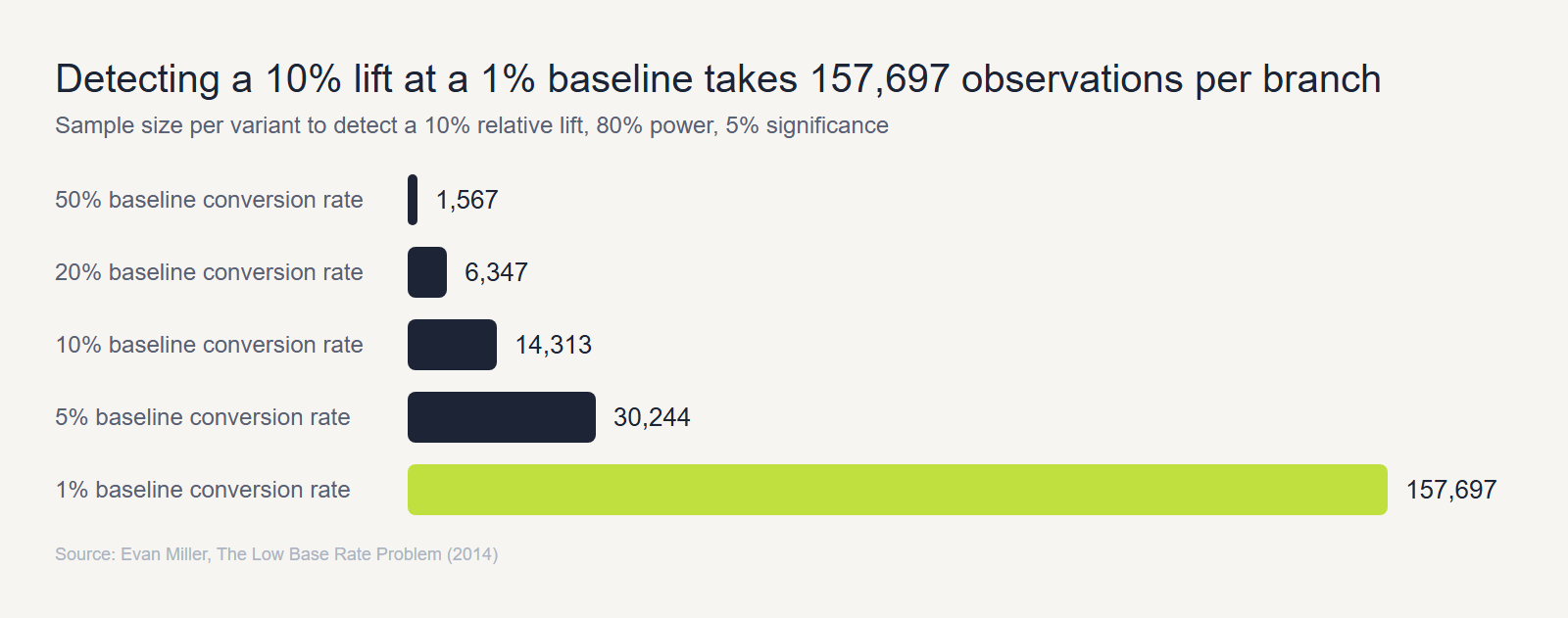
For accounts with limited conversion volume, that suggests three practical moves:
- Start with two or three concepts that make genuinely different arguments about the product.
- Screen early rounds on click and view signals, and confirm the winner on conversions before scaling.
- Leave button-color or single-word headline experiments until there's enough conversion volume to make those comparisons meaningful.
Creative Testing Framework: Six Steps to a Decision
A useful test starts with a question that will change what the team does next. Our guide to testing ads inside Meta Ads Manager covers the setup. Here, the focus is on the decisions that make a result worth acting on.
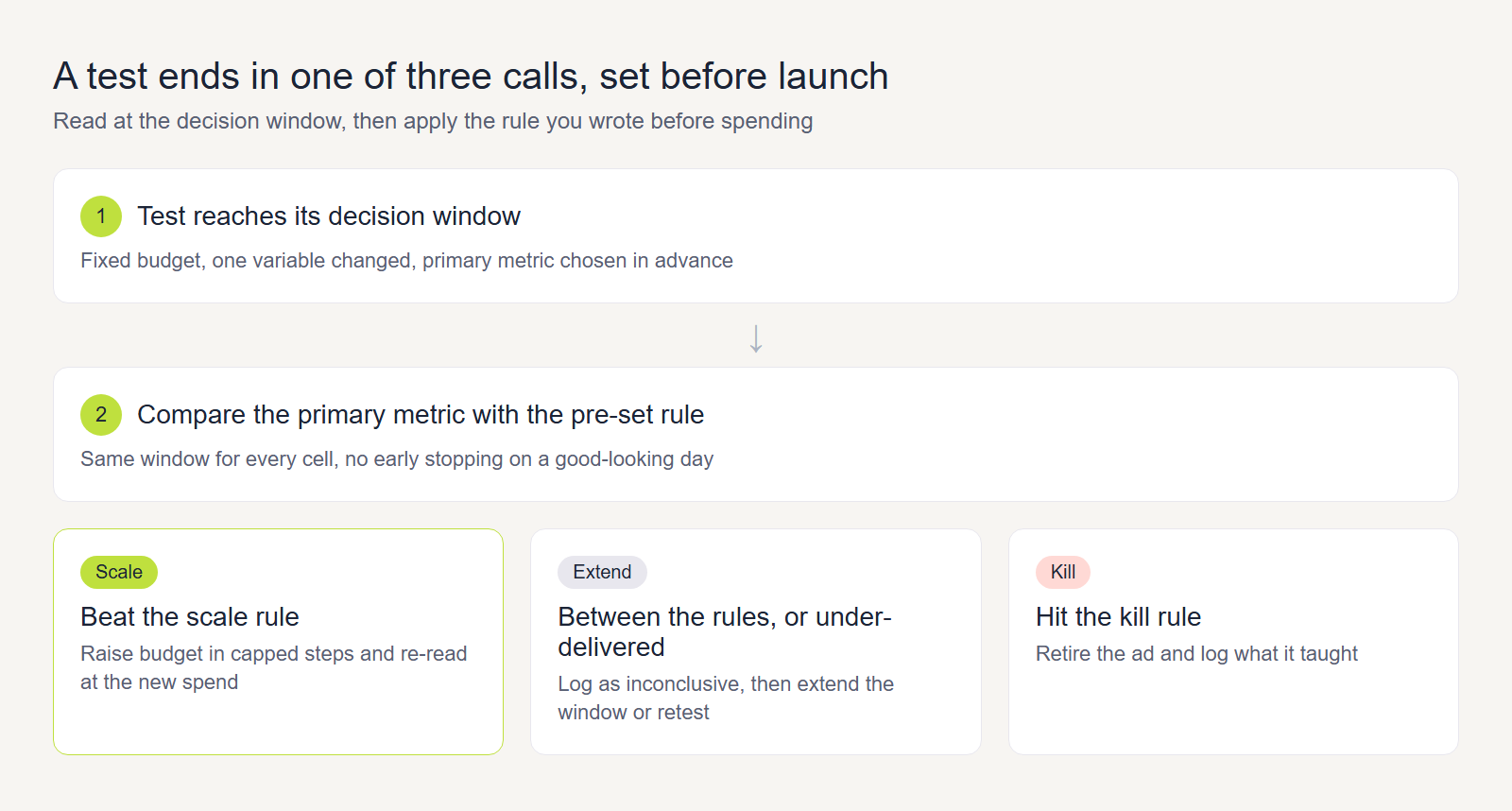
- Write the hypothesis first. Name the expected result, the primary metric and the threshold that would justify scaling or stopping.
- Change one layer at a time. Compare concepts before experimenting with hooks or formats, so you can trace the difference back to a specific choice.
- Set the budget, duration and conversion event before launch. Meta advises running A/B tests for at least 7 days, because shorter tests may produce inconclusive results. If conversions take longer, extend the duration and check whether the sample can reach at least 80% estimated power.
- Isolate the comparison. Use a controlled A/B setup with mutually exclusive, comparable audience splits, a capped budget and a consistent conversion event. That reduces interference from existing delivery.
- Read the result when the agreed window closes, even if the dashboard looks decisive earlier. Evan Miller explains why stopping a test at the first significant result can invalidate the usual significance interpretation.
- Record what happened, what remains uncertain and what you'll do differently next time.
The plan itself can be as simple as one row per hypothesis:
| Hypothesis | Variable | Primary metric | Decision window | Kill rule | Scale rule |
|---|---|---|---|---|---|
| Problem-first hook beats demo-first hook | Opening 3 seconds | CPA | 7 days | Set before launch | Set before launch |
There's no universal CPA threshold for declaring a winner. Set the stop and scale rules around margins, the business objective and the sample available before launching the test.
inBeat's creative strategy sprints follow that principle, with a 90-day roadmap and 3 to 5 concepts per sprint, each with its own hypothesis.
Which Metrics Show That a Creative Won
Choose the primary metric from the business goal: CPA for acquisition, cost per qualified lead for lead generation, or a revenue or lift metric when value matters more than volume. Supporting signals explain how the creative performs and where the apparent win may mislead.
| Signal | What it shows | Where it misleads | Use it for |
|---|---|---|---|
| Thumbstop or 3-second view rate | Whether the opening earns attention | Attention that never converts | Screening hooks |
| Link CTR | Whether the message earns a click | Curiosity clicks that never buy | Diagnosing the message |
| Conversion rate | Whether the click matches the offer | Landing page effects blend in | Spotting message-offer mismatch |
| CPA | Cost of the optimization event | Window and attribution dependent | Primary for acquisition tests |
| Platform ROAS | Platform-attributed revenue per dollar | Over- and under-counts across platforms | Ranking ads within one platform |
| Blended CAC, MER or incrementality | Total business result | Slow, and cannot isolate one ad | Confirming winners move the business |
Platform results can reveal relative performance, though they rarely tell the whole business story. Why Meta, Google and GA4 report different results explains why reports differ. Before committing more budget, look for the same direction in blended results.
Before scaling a promising ad, check three things:
- Compare platform CPA with blended CAC or MER over the same weeks. The metrics measure different things, but their direction can help show whether the improvement reaches the wider business.
- Raise spend in stages, and check whether the result holds as delivery expands.
- Before a major budget shift, consider a holdout to check the incremental impact.
That check has a limit. An ad-level test compares variants, and it cannot say how much revenue would have arrived without any ad.
For that question, see when an A/B test cannot show causal lift and a holdout design fits better.
Creative Fatigue: When a Winner Stops Winning
Creative fatigue can emerge when repeated exposure weakens an audience's response. Before retiring an ad, separate that effect from auction changes, a weaker offer or tracking problems. Three points matter:
- Meta flags it selectively. In eligible single-creative ad sets, Ads Manager may show "Creative limited" or "Creative fatigue". Meta counts exposures to the same image or video across a Page's campaigns. If an ad set contains several creatives, the absence of a warning tells you little; compare frequency, link CTR and cost per result over time.
- TikTok approaches this differently. Its Smart Creative feature allocates no more than 10% of the ad group budget to initial creative selection, watches for 3 to 5 days and pauses videos that show fatigue early. That timing describes the feature's operation, rather than a general fatigue threshold. For a more hands-on approach, see our guide to the signs of creative fatigue on Meta.
- Fatigue is often over-diagnosed. Mark Ritson reports in Marketing Week that Analytic Partners' 2022 ROI Genome found that of more than 50,000 ads, only 14 had run their full course and shown wear-out when they were replaced. That evidence covers brand advertising in general, so it does not transfer cleanly to high-frequency paid social.
Before replacing a winner, check whether frequency and acquisition costs are rising while response falls. If the pattern persists under comparable conditions, refresh the execution rather than assuming every dip is fatigue.
Ad Creative Testing for Creators and AI-Generated Variants
For creator-led ads, separate the idea from the person delivering it.
An unpublished paid post can help test that combination before amplifying it through the creator's handle. The same concept can perform differently with another messenger.
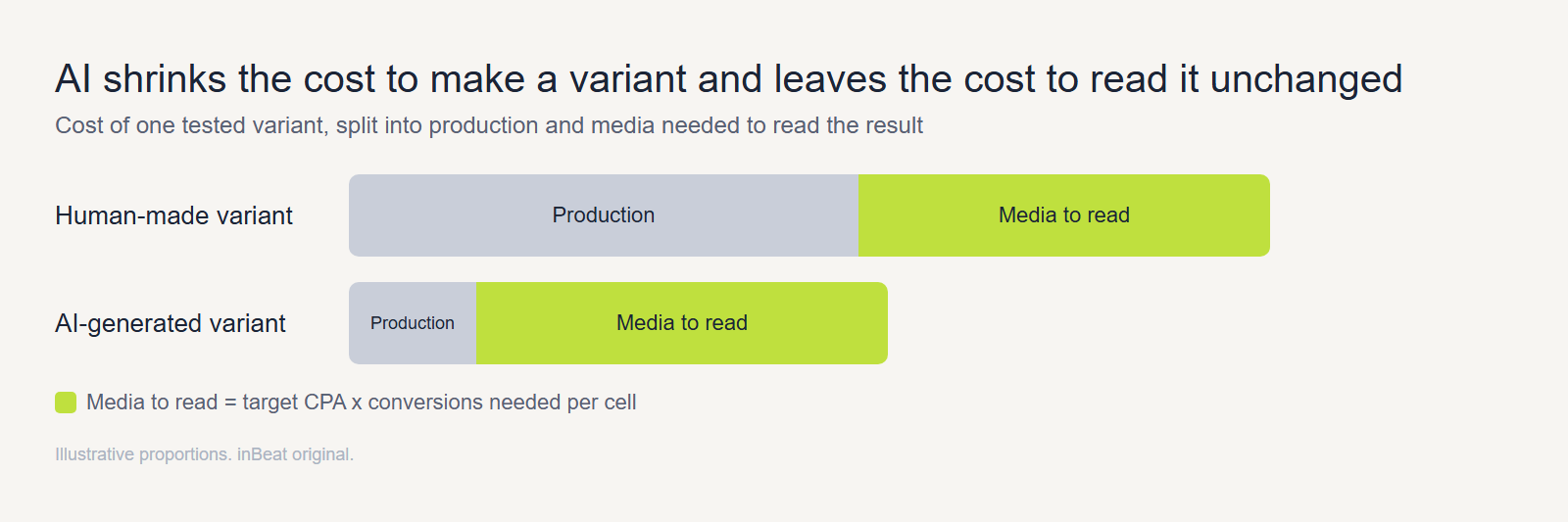
AI can make variants cheaper to produce, but it cannot buy the impressions or conversions needed to judge them. Ten new hooks still compete for the same media budget. Choose the hypotheses worth answering before you generate the next batch.
Start with variations on a concept you've already tested, such as a new opening, voiceover or format. Reserve separate comparisons for fresh ideas.
The choice between AI-generated UGC and real creator content should follow the hypothesis and production constraints, rather than the number of variants you can generate.
Who Owns Creative Testing in a Media-Buying Team?
When creative, media and analytics share a test, each decision still needs one owner. Otherwise, a promising result can stall while everyone waits for the next move. A workable split gives the strategist the hypothesis, the buyer the budget and launch, and the analyst the readout.
| Decision | Media buyer | Creative strategist | Analyst |
|---|---|---|---|
| Write the hypothesis | Consulted | Owns | Informed |
| Set budget, window and event | Owns | Consulted | Consulted |
| Launch and isolate the test | Owns | Informed | Informed |
| Read results at the window | Consulted | Consulted | Owns |
| Make the scale, kill or extend call | Owns | Consulted | Consulted |
| Log dates, spend and status | Owns | Informed | Consulted |
| Log the lesson and next action | Consulted | Owns | Consulted |
Use the weekly review to assign a next step to each completed test, while leaving experiments inside their scheduled window alone. For hybrid teams, also name who approves changes to spend.
Our guide to hybrid in-house and agency media buying covers the handoff between the internal team and agency.
Creative Testing Learning Log: What to Record After Each Test
A test becomes more valuable when its lesson is easy to find later. Keep one row per execution, so your team can see which ideas have already been tried and what changed after each result. Five fields are enough:
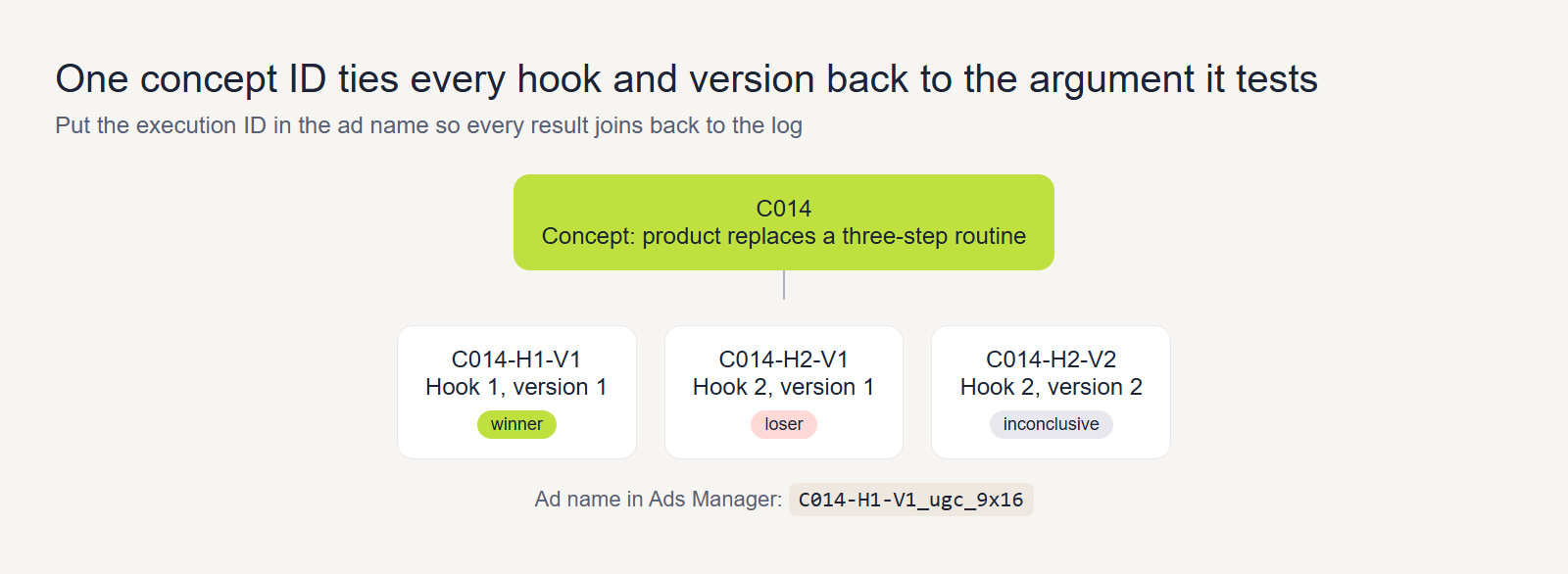
- Concept ID and execution ID. Use a stable pattern, such as C014 for the concept and C014-H2-V1 for the second hook on its first version, and put the execution ID in the ad name.
- Hypothesis and variable. Record what you changed and what you expected to learn.
- Dates, spend and conversions. Record the decision window and what the ad actually spent.
- Status. Mark the execution as testing, winner, loser or inconclusive. Low delivery means the read is inconclusive, rather than evidence that the ad lost.
- Next action. Scale, retest, iterate or retire, with the reason.
One promising result is a starting point. Validate the concept again at higher spend before treating it as a repeatable winner.
When Creative Testing Stops Paying Off
More creative tests help only when the account is ready to learn from them. Before briefing the next batch, check four things:
- An offer or landing-page problem. If every ad converts poorly, inspect the offer, page experience and message-to-page match before commissioning more variants. Creative may still contribute, but a new hook alone is unlikely to fix a broken checkout.
- Insufficient sample. If the budget cannot support the planned sample and conversion volume, the result may remain inconclusive. Meta's delivery-learning threshold is a separate constraint, rather than the statistical threshold for a test.
- A concept that keeps losing. When several executions of the same idea underperform under comparable conditions, try a different argument before making another minor variation.
- Unreliable tracking. When conversion events misfire or count twice, the reported difference between ads may reflect measurement errors. Fix the event before trusting the result.
Build a Smarter Testing Program With inBeat Agency
At inBeat, we start our structured ad testing program by reviewing what the account has already tried, then prioritize new concepts on a 90-day roadmap.
Each round has a hypothesis, a business metric (CPA, CAC or ROAS) and a record of what we learned.
The work comes down to three practical pieces:
- A library audit that separates tested concepts from untested assumptions.
- A prioritized testing calendar with hypotheses, budget caps and decision owners.
- A concise readout that links wins, losses and inconclusive tests to the next round of briefs.
If you want a second set of eyes on your testing budget, decision rules or learning log, book a strategy call and we'll review your setup together.
FAQs
How do you read a test when the algorithm gives one ad most of the spend?
If one ad gets most of the spend, that's a delivery choice rather than an experimental verdict. When the difference affects a budget decision, compare the contenders in a controlled A/B test with equivalent audience splits and a pre-set measurement window.
Does a winner from one platform carry over to another?
Carry the hypothesis over and leave the result behind. Audience, placement and auction conditions differ by platform, so a Meta winner becomes a TikTok test candidate with its own decision window and its own read.
Will a test winner still win when you scale it?
A winner can slip when spend rises, because the ad reaches a broader audience and a higher frequency. Re-read the winner at the scale budget before treating the test CPA as the scale CPA.
How long should a creative A/B test run for a longer buying cycle?
Set the test duration before launch and allow enough time for delayed conversions, especially when buyers need days or weeks to decide. Meta gives 10 days as one example for longer-consideration purchases within its 1-to-30-day test duration range. Keep the attribution setting consistent between test cells; it is separate from how long the experiment runs.
What changes when the creative is a whitelisted creator post?
The creator's handle, audience trust and comments can affect the outcome. When permissions and platform setup allow, first test an unpublished paid execution; if you then activate the creator's handle, treat that as a distinct version and recheck performance.