

An ad can be translated perfectly and still lose what made it work. Dub a creator testimonial, and the new voice may feel disconnected from the face. Keep the original audio with subtitles, and viewers may miss the product while reading the hook. Both options make the message understandable, but they change how people experience it.
That trade-off matters on feeds where reading video is routine. In XR Extreme Reach's 2026 study of 3,000 consumers across five countries, 39% said they use captions always or often when watching short-form video.
Yet caption habits alone cannot tell you whether dubbing or subtitles will serve your ad better. The seven checks below help you make that decision before spending on localization.
P.S. If you'd rather skip the trial and error, our UGC agency builds and tests localized creator ads across markets. Book a free strategy call.
TL;DR: Dubbing vs Subtitles for Ads in Seven Checks
- Review each ad across seven checks: speech dependence, on-screen text, speaker visibility, viewing context, reading load, timing, and native review.
- Use the checks to spot format constraints, rather than tallying votes. When both treatments remain viable, test them.
- Subtitles on the original voice suit face-to-camera ads where the speaker is the proof.
- Dubbing or voice-over suits narrated demos, animation, and footage with no mouth on screen.
- A dubbed ad usually still needs a caption layer, written for the dub and separate from the source translation.
- Test the track on one variable before you scale spend behind it.
Dubbing, Subtitles, and Voice-Over: What Each Option Changes in a Video Ad
Dubbing replaces the spoken track with a translated, timed performance. Subtitles keep the original audio and add translated text on screen.
Voice-over lays a narrator over the footage, either replacing the original audio or sitting on top of it. Captions are same-language text, usually for muted playback.
| Option | What changes | What stays | Typical ad use |
|---|---|---|---|
| Dubbing | The full dialogue track, often with lip-sync adjustment | Footage, music, text layers | Talking-head ads with verified lip-sync in markets accustomed to dubbing |
| Subtitles | Text added on screen | The original voice and performance | Creator ads where the speaker's voice is the trust signal |
| Voice-over | A narrator replaces or overlays the audio | Footage and visuals | Product demos, explainers, animation |
| Captions | Same-language text for muted viewing | Everything else | Any paid social ad |
Platforms now offer dubbing as a built-in feature. Meta translates, dubs, and lip syncs Reels for creators, and in June 2026 it reported that over half a billion Facebook users watch AI-translated videos each week, which raises the baseline viewers expect. It does not decide which track suits your ad, and the next section does that.
Dubbing vs Subtitling for Ads: A Seven-Check Decision Matrix
The right treatment depends on the specific creative, not a majority vote. A brand can run subtitled testimonials and voice-over demos in the same market because each video has different constraints.
Work through the seven checks below before commissioning a translation. Some identify a format preference; others flag work required in either version. If both options are feasible, compare them in a controlled test.
| Check | Question to ask | Subtitles: considerations | Dub / voice-over: considerations | Red flag |
|---|---|---|---|---|
| Speech dependence | How much of the message is only spoken? | Preserves the original voice; readable text can carry light speech | Makes essential spoken claims audible in the local language | Hook is a spoken line you cannot paraphrase |
| On-screen text | What text sits in the footage? | Translate every visible offer and CTA separately | Also requires translated on-screen text; no inherent audio advantage | Text baked into the pixels, no source file |
| Speaker visibility | Is a mouth on screen? | Close-up talking head | Back of head, product-only, or voice-over footage | Lip-sync tool on a covered or off-angle face |
| Viewing context | Is audio likely on? | On-screen text must carry the message when sound is off | Audio may add value when people listen; captions still matter | Assuming the placement default |
| Reading load | How many words must be read? | Works when viewers have enough time to read | May reduce reading load, provided speech fits the edit | Subtitle line outruns the cut |
| Timing | Does the translation fit the edit? | Reading time must fit each subtitle and shot | Dubbed speech needs timing checks; a locked cut can constrain it | Translated line 2x the English length |
| Native review | Who signs off on the translation? | Native reviewer checks meaning, reading speed, and claims | Native reviewer checks delivery, timing, pronunciation, and claims | No native speaker in the loop |
Speech Dependence: How Much of the Message Is Spoken?
Count how many claims in the ad exist only in audio. If the price, the offer, or the proof point is spoken and never shown, the track carries the sale and quality of the voice matters.
Look at the first three seconds. When the hook is a spoken line, such as a question to camera, the track decision is a hook decision, and a flat dub weakens exactly the part of the ad that buys attention.
- Speech-light ads (b-roll, product close-ups, text hooks) tolerate either track.
- Speech-heavy ads need the strongest voice option you can afford, or a native re-record.
- Action: write down the three spoken claims that must survive translation.
On-Screen Text: What Has To Be Replaced Besides Audio?
Neither track localizes text that is baked into the footage. Price cards, offer banners, app interface text, and end cards all need their own translated versions, whatever you choose for audio.
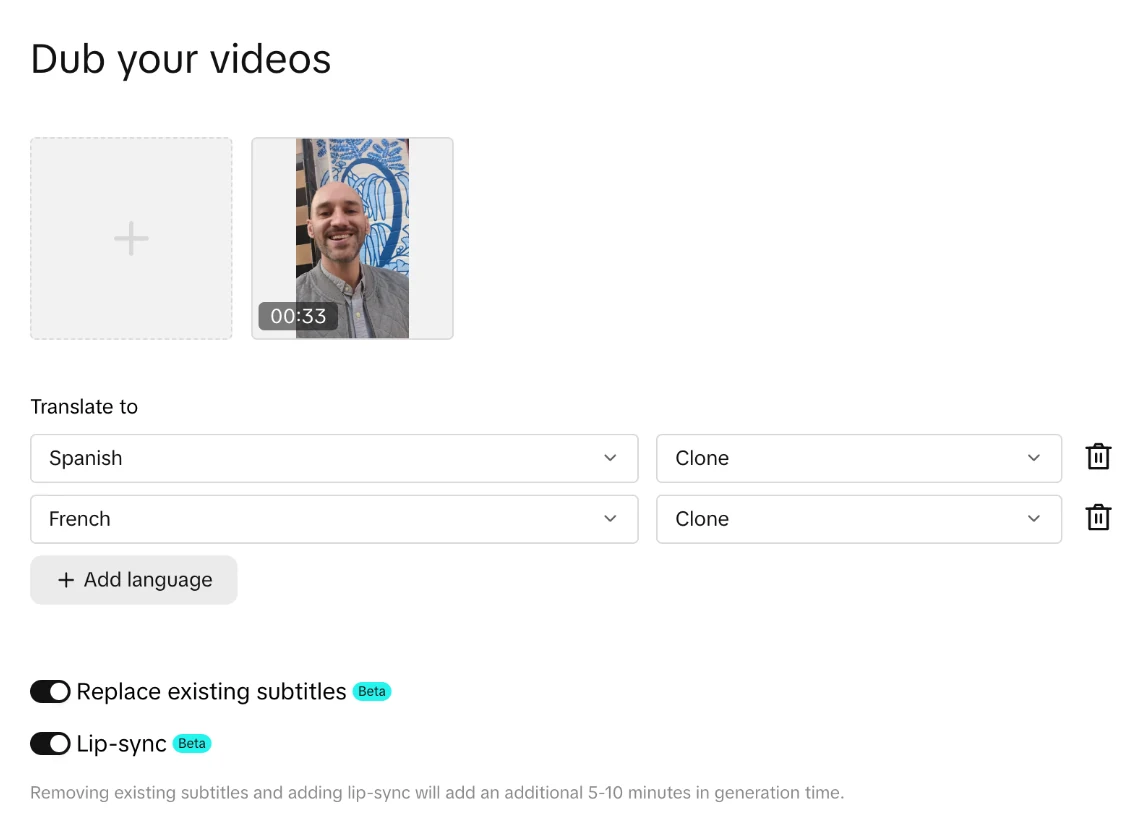
TikTok's translate-and-dub tool shows the layering: it has a separate switch to replace existing subtitles, because burned-in subtitles in the original are a different layer from the audio. Burned-in subtitles in the original video have to be rebuilt from the source project file or masked.
- List every text layer in the master file before choosing a track.
- Check whether you have the editable project file or only the exported video.
- A master with burned-in text and no project file pushes the decision toward re-editing, which costs more than either track.
Speaker Visibility: Is a Mouth on Screen?
A visible, close-up mouth is the hardest case for dubbing, because translated syllables rarely match original lip movement. Footage without a visible mouth, such as product shots, screen recordings, hands, or the back of a head, dubs cleanly.
Lip-sync tools narrow the gap but have limits. TikTok's own guidance says lip-sync does not work for videos with multiple speakers, covered mouths, poor lighting, or background noise. That is a normal description of creator content shot on a phone.
There is also a trust issue. Our view is that dubbing alone cannot make a spokesperson feel local. Casting, cultural cues, and the original performance also shape how viewers respond.
Viewing Context: Sound Off, Sound On, and Platform Defaults
The placement and the viewer's settings decide whether the track is heard at all. TikTok makes the case that sound matters on its own feed: a TikTok and Kantar study reported that 88% of TikTok users say sound is essential and that 73% would stop and look at ads with audio. That study dates from 2021 and was commissioned by the platform, so treat it as a directional signal.
We skip the often-quoted sound-off percentages because their original sources are hard to trace. Your own account is the better evidence.
- Check the placement breakdown for the ads you already run.
- Compare thumb-stop and hold rate on muted-friendly and sound-led creative.
- Action: if audio is likely off, subtitles or captions carry the message regardless of what you did with the audio.
Reading Load: How Much Text Can a Viewer Read in a 15-Second Ad?
At 17 characters per second, a 15-second video allows an illustrative 255 characters; at 20, it allows 300. Actual usable subtitle space is lower when viewers also need to follow the visuals.
These benchmarks come from Netflix's timed-text rules, which cap lines at 42 characters, two lines at a time, and set reading speeds of up to 20 characters per second for English and 17 for Spanish, French, German, Italian, and Dutch.
These long-form streaming guidelines are reference points, not ad-platform limits or recommended targets. The table is simple arithmetic, before accounting for shot changes and time spent looking at the product.
| Ad length | Max characters at 17 cps | Max characters at 20 cps |
|---|---|---|
| 6 seconds | 102 | 120 |
| 15 seconds | 255 | 300 |
| 30 seconds | 510 | 600 |
If the localized script demands too much reading for the available shots, shorten the subtitle copy or test a spoken local-language version. Captions remain useful in the dubbed version.
Our UGC video length benchmark covers how ad length changes what a viewer takes in.
Timing: Does the Translated Script Fit the Edit?
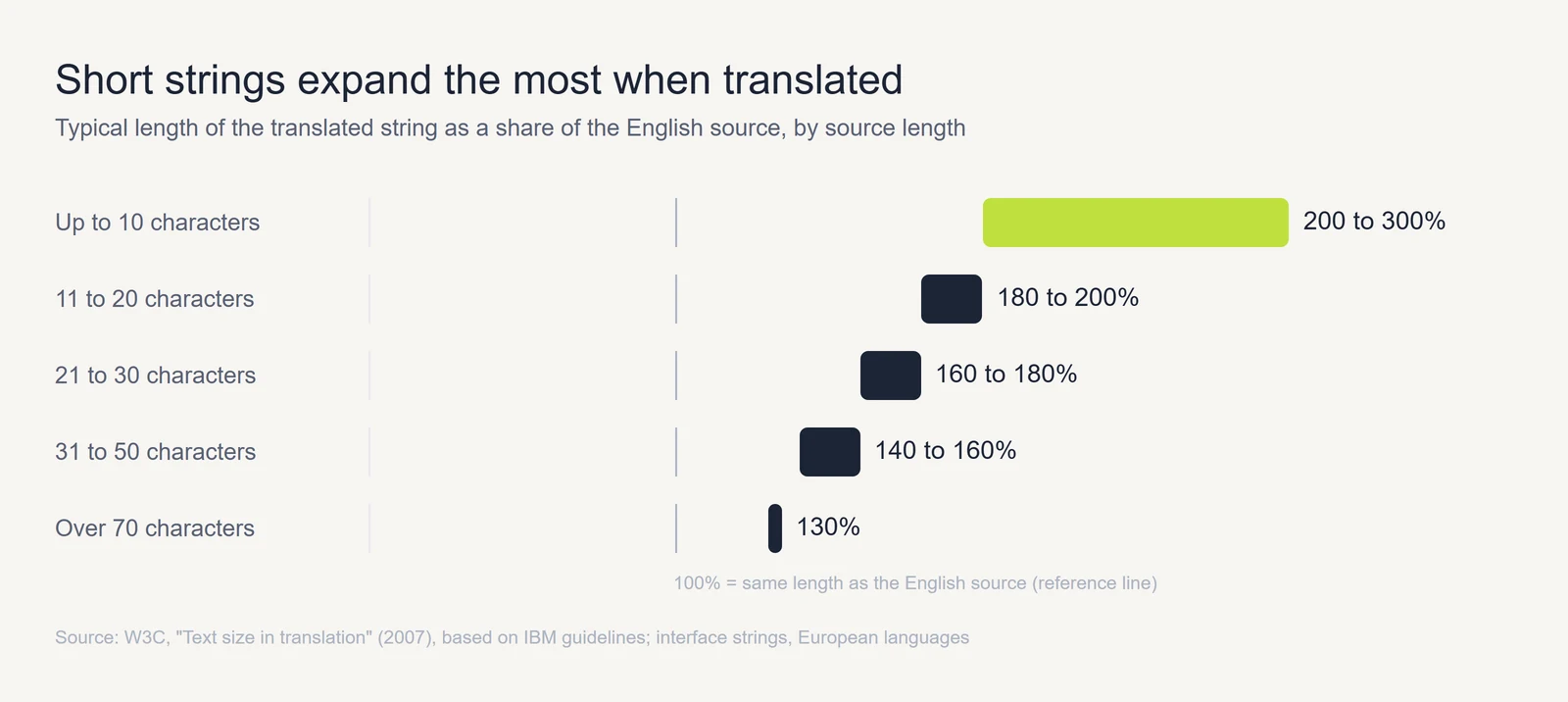
Translations run longer than English, and short strings expand the most. The W3C's reference table shows source strings of 11 to 20 characters expanding 180 to 200 percent, while strings over 70 characters expand about 130 percent. The table is from 2007 and covers interface strings, so use it as a foundational reference.
The W3C figures describe written text, not spoken duration. For ads, translate the hook and CTA early, then separately check subtitle length and the time needed to deliver each spoken line.
- Dubbing needs the translated script to fit the original cut, or the cut to move.
- Subtitles need shorter lines than a literal translation produces.
- Action: translate the hook and the CTA first and check them against the edit before approving the rest.
Native Review: Who Checks the Translation Before Launch?
A machine translation can pass a spell check and fail a claim check. Offer wording, regulated claims, idioms, and brand names read aloud all need a native speaker who also knows the category.
Review the spoken script and the subtitle file as separate items, because they are written to different constraints.
Our global influencer marketing guide frames the per-asset decision as choosing between subtitles, dubbing, a revised script, or a new shoot, and native review is how you find out which one the asset really needs.
If the review reveals a transcreation problem, such as a joke or reference that does not travel, the track is no longer the question. The process for language QA and transcreation across markets is covered in our global creator program guide.
Applying the Checks to Three Example Ads
These hypothetical examples show how the checks reveal constraints, rather than producing a numerical score. Native review remains necessary for every version.
| Ad type | Key constraints | Recommended treatment | What to test |
|---|---|---|---|
| Face-to-camera testimonial | Visible speaker, speech-heavy hook, tight timing, and high reading load | Original-voice subtitles first; consider a quality-checked lip-synced dub | Whether a local dub improves results without weakening credibility |
| Narrated product demo | No visible mouth, heavy on-screen text, and flexible editing | Local voice-over plus rebuilt text layers and captions | Whether the local narration improves hold rate or conversion |
| 15-second animated explainer | No visible mouth, but a locked cut limits spoken timing | Short local voice-over with translated visual text and captions | Whether the translated narration fits and improves performance |
Why Dubbed Video Ads Still Need Captions
Yes, a dubbed ad usually still needs a caption layer, because a muted viewer hears nothing and a hearing-impaired viewer never hears the dub. Dubbing solves the language problem for audio.
Treat the finished ad as four layers: the audio track, same-language captions, translated on-screen text, and the end card. Each layer has its own way to break.
| Layer | Needs translation | Common failure |
|---|---|---|
| Audio track | Yes, dubbed or voice-over | Hook line runs long against the cut |
| Captions | Yes, written for the dub | Caption text copied from the source translation and out of sync with the spoken line |
| On-screen text | Yes, rebuilt | Original-language price card left in |
| End card and CTA | Yes, plus a local link | CTA points to the home-market page |
Captions for Muted Feeds
Burned-in captions are text drawn into the picture of the dubbed version, in the local language.
They show on every placement and cannot be turned off. Platform caption tracks can be toggled and restyled, but depend on viewer settings. For paid social where you cannot assume audio, burned-in captions are the safer default.
Dubbed Audio and Mismatched Captions
Caption text for a dubbed ad should match what is spoken in meaning and timing, even when it is shorter. A viewer who hears one phrase and reads another notices at once, and it makes the ad feel machine-made.
That means writing two scripts. The dub script is written to be spoken in the time available. The caption script is written to be read, and is usually shorter, using the reading-load ceiling above.
Accessibility and Platform Caption Requirements
Captions also serve viewers with hearing loss and viewers in noisy places. Some platforms and placements expect a caption field or file, so check the specification for each. This is a different job from localization, and it should not be skipped because the audio has been dubbed.
When a Native Re-Record Makes More Sense
Some videos call for a third option: recording a local speaker or creator rather than translating the original performance. This is worth considering when the hook depends on humour, local references, or the speaker's personality. A new recording can change the delivery and the edit together instead of forcing a translated line into the source cut.
The creator's own voice is often what makes the ad feel native. Our guide on briefing creators for native content explains why polished production can erase it, and a replaced voice carries the same risk. When briefing a local creator, keep the offer and claims consistent, but give them room to adapt the wording, pacing, and delivery to their audience.
For a priority market, compare a localized re-record against the adapted original when the budget allows. Keep the claim, offer, and audience consistent, then judge whether the new performance earns its production cost.
What Drives the Cost of Dubbing and Subtitles for Ads
Dubbing usually costs more than subtitling, because it adds talent, studio time and re-timing, but we could not find an industry-body price benchmark, and vendor per-minute figures vary too much to quote. This section gives you the cost drivers and the questions to put in a quote request.
| Cost driver | Subtitles | Dubbing | Voice-over |
|---|---|---|---|
| Runtime and number of languages | Scales per language | Scales per language | Scales per language |
| Talent and studio | None | Voice actors, studio, direction | One narrator, short session |
| Revisions | Edit text file | Re-record or re-time audio | Re-record lines |
| Text-layer rebuild | Needed | Needed | Needed |
| Native review | Read the file | Listen to the audio | Listen to the audio |
| Turnaround time | Fastest | Slowest | In between |
Five questions to ask in a quote:
- Is the price per finished minute or per source minute?
- How many revision rounds are included?
- Does the quote cover rebuilding on-screen text and the end card?
- Who does the native review, and is it included?
- What does a one-line copy change cost after delivery?
Ask the same five questions of an AI dubbing tool's plan, because the cost moves from studio hours to review hours.
Which Markets Expect Dubbing and Which Expect Subtitles
Preferences vary sharply by country. In the EU, 53% prefer subtitles to dubbing for foreign films and programmes (Special Eurobarometer 540, 2023, 26,523 respondents), and the table shows the spread by country.
| Market | Share preferring subtitles |
|---|---|
| Sweden, Finland | 95% |
| Netherlands | 93% |
| EU average | 53% |
| Slovakia | 38% |
| Austria | 36% |
| Germany | 34% |
Age moves the number too: 65% of 15 to 24 year olds prefer subtitles, falling to 44% of people aged 55 and over. A paid social audience skewing young leans toward subtitles even in dubbing-heavy countries.
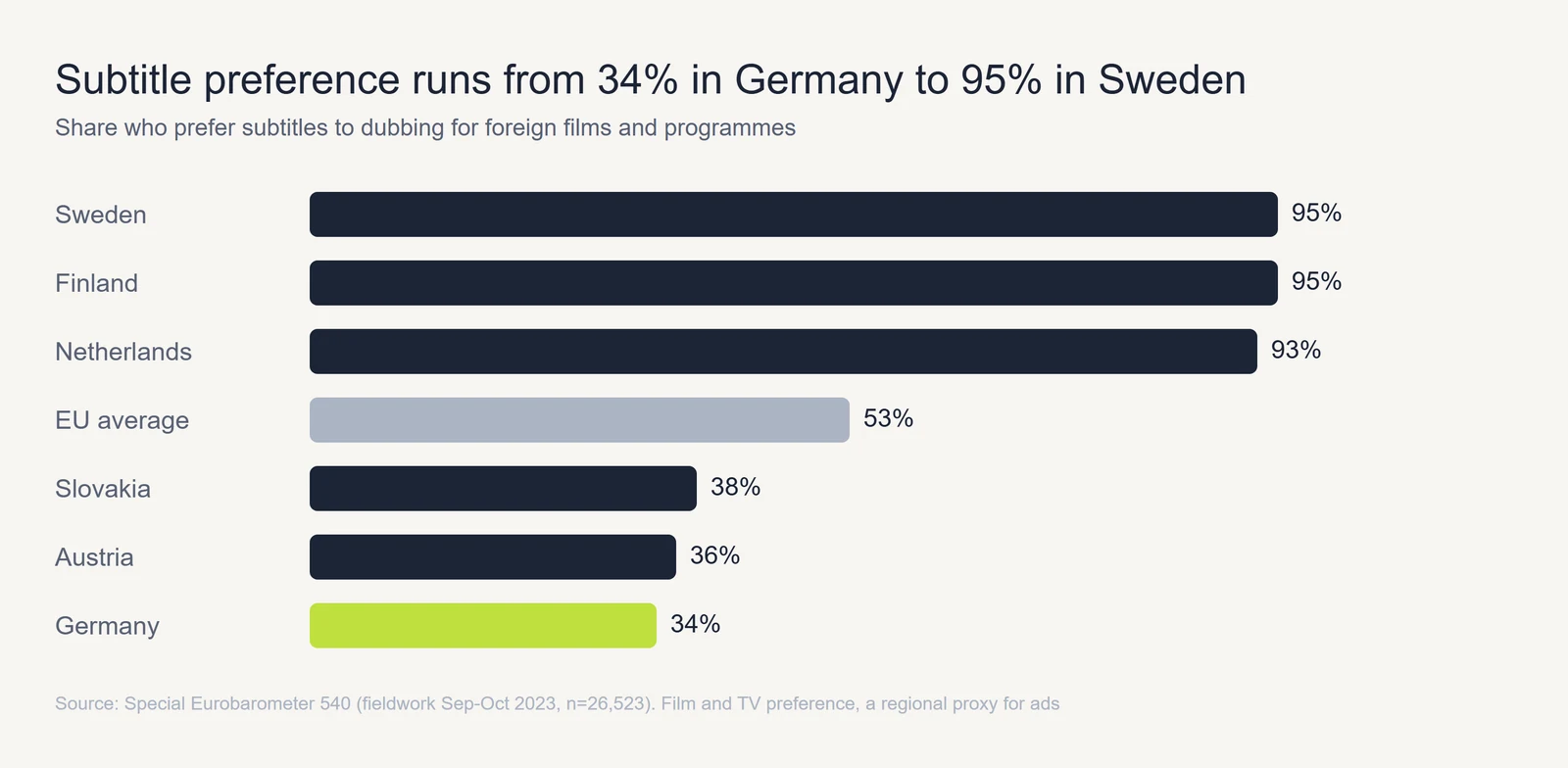
Two cautions apply. These figures are for films and television, so they work as a regional proxy for ad behavior. And language itself matters beyond format: CSA Research found that 76% of consumers prefer products with information in their own language, a 2020 finding about websites and product content.
Use the table to set a starting hypothesis per market, then check it in the test.
Localizing Video Ads on Meta, TikTok, and YouTube: Platform Behavior
Each platform treats localized video differently, and most of the dubbing news is about creator features, and few of those are ad products. Plan around what the ad tools actually document.
| Platform | Native dubbing or translation | Ad-level support | Caption behavior |
|---|---|---|---|
| Meta | AI translates, dubs, and lip syncs Reels for creators | Multi-language ads deliver a language version by viewer locale; auto-translation covers ad copy | Burned-in text always shows |
| TikTok | Symphony Creative Studio translate and dub, with voice clone and lip-sync | Exports to Ads Manager with an AI-generated label | Replace-subtitles switch in the tool |
| YouTube | Auto-dubbing in 27 languages | Creator feature, verify for ads | Viewer chooses track |
Meta. Meta's multi-language ads documentation describes language-specific video and text assets delivered by viewer locale, with a default version as a backup. Its automatic translation applies to ad copy, and the documentation does not describe audio dubbing of ad video.
For ads, you typically supply each localized video file yourself.
TikTok. The translate and dub help guide says you can clone the original voice or pick a stock voice, add several languages, and export to Ads Manager with an AI-generated label. Script edits are limited to minor corrections, and the feature is unavailable in Texas and Illinois.
YouTube. YouTube says auto-dubbing covers 27 languages, with Expressive Speech in eight, and that more than 6 million daily viewers watched at least 10 minutes of auto-dubbed content in December 2025. That is a creator feature, so verify ad-level behavior before planning a campaign around it.
Is AI Dubbing Safe for Ads? Quality, Consent, and Disclosure Checks
AI dubbing is fast, and the same speed that makes AI UGC ads attractive adds three checks that human dubbing handled implicitly: quality of tone and lip-sync, consent for a cloned voice, and disclosure.
| Risk | What to check | Owner |
|---|---|---|
| Tone and lip-sync quality | Native speaker listens to the full ad, never a sample | Reviewer |
| Brand names and numbers | Pronunciation, prices, units read aloud correctly | Reviewer |
| Voice-clone consent | Written permission from the speaker for a cloned voice in each market | Legal |
| Disclosure | Platform AI label applied; local rules checked | Legal and media |
| Claim accuracy | Translated claims match approved claims | Brand |
On consent, a dubbed creator voice is a modification of the licensed asset. Our post on why global UGC usage rights fail explains why re-edits still need valid rights, and a cloned voice in another language belongs on that list.
On disclosure, Article 50 of the EU AI Act requires deployers of AI that generates or manipulates audio or video constituting a deep fake to disclose it, and it applies from 2 August 2026. Whether a dubbed ad falls within that definition is an interpretation, so ask counsel before you launch cloned voices in the EU.
How To Localize a Video Ad Step by Step, From Master File to Launch
Localize an ad in seven steps, in this order, so that each decision is made before the cost it controls.
- Audit the master file. List every layer: audio, captions, on-screen text, end card, and confirm you have the project file.
- Review the seven checks, resolve production constraints, and shortlist one or two treatments to test.
- Write the localized scripts separately: one for speaking, one for reading, with the hook and CTA first.
- Rebuild the text layers and the end card, including a local landing page link.
- Produce the track, whether recorded, generated, or voiced, and export the caption file (an SRT file for platform tracks, or burned-in captions).
- Run native review on the audio and the captions as two items.
- Check playback muted and unmuted on the placements you will buy.
Use this checklist in step 7: offer wording, prices and units, claims, caption text against spoken audio, pronunciation of the brand name, and the CTA destination.
How To Test Dubbing vs Subtitles Before Scaling Spend
Compare treatments using the same underlying creative, offer, audience, and comparable delivery conditions. Cell A keeps the original voice with translated subtitles; cell B uses a local dub with matched local-language captions. The language treatment necessarily changes, so keep other creative differences to a minimum.
| Test cell | Audio | Text | Decision it informs |
|---|---|---|---|
| A | Original voice | Local-language subtitles | How the original performance works with local-language text |
| B | Local dub | Local-language captions | Whether replacing the voice improves results versus subtitles |
| C (optional) | Local voice-over | Rebuilt text layer | Whether narrated delivery improves demo performance |
Read hold rate, click-through rate, and cost per acquisition together. Use the testing principles in our creative testing guide: test A and B concurrently in priority markets when budget allows, with comparable targeting and spend. If you phase testing, use market fit and commercial priority to choose where to trial both treatments; weak subtitle results alone should not rule out a dub.
Research has compared dubbed and subtitled advertising, including a 2026 study in the International Journal of Advertising examining how language adaptation affects brand evaluations across three countries. That does not establish a universal winner for paid-social metrics such as CTR or CPA. Treat the better-performing format as a market- and creative-specific question.
Build a Localized Video Ad Workflow With inBeat Agency
A successful ad gives you a head start, but it also gives you something worth questioning. Which parts of the creative appeal to people beyond the audience it was originally made for? A new market might respond better to a different creator, a simpler product demonstration, or a more familiar way of delivering the same message.
At inBeat Agency, we work with local creators to develop ads around the audiences brands want to reach. Already have a video performing well and a new market in mind? Book a strategy call, and we'll help you figure out what to create next.
FAQs
Should you use a lip-synced AI dub when a creator's face is on screen?
Not by default. The lip-sync limits described in the Speaker Visibility check fit a lot of creator footage. Run the subtitle version as the control and the lip-synced dub as the challenger, and judge on hold rate and cost per acquisition.
Does Meta or TikTok treat a dubbed ad as the same creative as the original for learning?
We have not found documentation that says either way, so assume each localized version is a separate creative and give it its own budget and learning phase. Group variants by language so one market's results do not dilute another's.
What changes in the decision for a 6-second bumper compared with a 30-second ad?
At the Netflix reference speeds, six seconds represents roughly 102 to 120 characters before allowing time for the visuals. That is an upper-bound illustration, not a recommended ad target. Consider a brief text hook, a short voice-over, or little speech. Our guide to short-form vs long-form video covers how format length changes what the ad can carry.
How do you handle a market where the preference is dubbing but the platform audience skews young?
Treat the market preference as a hypothesis to test. Younger viewers prefer subtitles more often in the Eurobarometer data, so test both cells with an audience filtered by age before you commit.