.svg)
.svg)
.svg)
.svg)


.svg)






A 15-second UGC ad might be long enough to catch someone's attention. But is it long enough to convince them to buy?
The platforms offer surprisingly different answers. Meta says Instagram feed videos under 15 seconds tend to perform best. TikTok favors 21-34 seconds. Meanwhile, Google recommends 15-20 seconds for action campaigns and 2-3 minutes for consideration.
The problem is that these recommendations reveal little about which length will actually work for your audience. So, what happens when we compare 6-15, 16-30, and 31-60-second UGC videos across Meta, TikTok, and YouTube?
This guide examines the evidence behind each recommendation, explores where extra seconds help or hurt, and shows you how to find the winning length with your own creative tests.
P.S. If you'd rather have the testing done for you, our UGC agency builds and runs it. Book a free strategy call.
TL;DR: What Is the Best UGC Video Length in 2026?
Start with 6-15 seconds for Instagram Feed, compare shorter cuts against 16-30 seconds on TikTok, and use 31-60 seconds for explanations that need more time. Let paid performance decide.
- The platforms' own guidance points to different buckets, and TikTok's best-performing range straddles two of them.
- We found no published paid UGC study comparing all three length buckets across Meta, TikTok, and YouTube, so the findings below are graded by their supporting evidence.
- The one peer-reviewed study on very short ads found more immediate traffic and a similar direct sales effect, using TV and one Facebook test.
- Completion rate favors the shortest cut by construction, so judge length on cost per acquisition.
- Creator fees follow deliverables, so one shoot can produce all three user-generated videos.
What Counts as a 6-15, 16-30, and 31-60 Second UGC Video?
A UGC video is creator-shot, native-looking footage used as an ad, with the creator on camera or on voiceover. This article sorts that user-generated content into three buckets of whole seconds: 6-15, 16-30, and 31-60.
The buckets reflect common platform recommendations: Meta favors videos under 15 seconds for Instagram Feed, TikTok highlights 21-34 seconds, and Google recommends Shorts ads under 60 seconds. Bumpers under 6 seconds and videos over 60 seconds fall outside this comparison.
For the format types that fill each bucket, see our guide to choosing UGC video types.
Maximum UGC Video Length by Platform: Reels, TikTok, YouTube Shorts, and Facebook Feed
Instagram Reels ads allow up to 15 minutes, TikTok auction ads up to 10 minutes, and Google lists YouTube Shorts ad assets up to 3 minutes. Google recommends keeping Shorts ads under 60 seconds, although its help pages give conflicting descriptions of how longer videos play in the feed.
| Placement | Minimum | Maximum | What plays |
|---|---|---|---|
| Instagram Reels ads | None stated | 15 minutes | Full video; viewers can skip |
| Instagram Stories ads | 1 second | 60 minutes | Under 16 seconds plays whole; longer videos may split into up to three cards |
| Facebook Feed | None stated | 241 minutes | Full video |
| Facebook in-stream ads for Reels | 5 seconds | 15 seconds | Full ad, non-skippable by default |
| TikTok auction In-Feed | 5 seconds | 10 minutes (Spark Ads: no restriction) | Full video |
| YouTube Shorts ads | 6 seconds (Video Reach) or 10 seconds (other campaign types) | 3 minutes | Google's asset-spec guide says the first 60 seconds play in the feed; its FAQ describes playback up to 180 seconds. |
| YouTube skippable in-stream | None stated | Any length | Full ad until the viewer skips |
| YouTube bumper | None stated | 6 seconds | Full ad, non-skippable |
| Demand Gen video | 5 seconds | None stated | Videos under 10 seconds are ineligible for YouTube in-stream |
Two TikTok pages disagree. The ad policy page still says 5 to 60 seconds, while the auction spec page, last updated June 2026, allows up to 10 minutes. Treat the newer spec page as current.
FTC Disclosure Rules for Short UGC Videos
The FTC says a disclosure in a video endorsement belongs in the video itself, and a line in the description alone doesn't satisfy it. Disclosures placed at the end of a video or behind a "more" link are likely to be missed.
For a 6-15 second UGC endorsement that requires a disclosure, plan it before writing the script. FTC guidance ties the disclosure to how the endorsement appears: visual endorsements need a visual disclosure, spoken endorsements need an audible one, and a combination calls for both. Keep on-screen disclosures easy to read and include a spoken disclosure when the creator endorses the product aloud.
What Are the UGC Video Length Benchmarks for Each Platform?
The comparison draws on platform recommendations, organic engagement datasets, and peer-reviewed research on very short ads. We found no comparable paid UGC study covering all three platforms and length buckets under the same conditions. The table identifies what each source actually measures, so readers can judge how much weight to give its findings.
| Platform | 6-15 seconds | 16-30 seconds | 31-60 seconds | Evidence grade |
|---|---|---|---|---|
| Instagram Feed | Meta: videos under 15 seconds tend to perform best in feed | Meta: feed video ads can run up to 60 minutes; the page gives no guidance for this band | No data | Platform recommendation, no study published |
| Instagram Reels | No paid data; organic 0-30 seconds: 0.28% engagement | Same organic band | Organic 45-60 seconds peaks at 0.35% | Organic brand-account dataset (about 6M Reels, Jan-Jun 2026) |
| TikTok In-Feed | Guide: strong ads tell a story even in 15 seconds or less; organic 0-15 seconds: 5.90% | Guide: 21-34 seconds performs best; organic 15-30 seconds peaks at 6.00% | Guide range ends at 34 seconds; organic 30-60 seconds: 4.20% | Platform recommendation (2021 model) plus organic dataset (about 6M videos) |
| YouTube Shorts | Overlaps the 10-30 second Action range | Google: Action ads run 10-30 seconds, vertical | Google recommends under 60 seconds | Platform recommendation |
| YouTube skippable in-stream | Below Google's range | :15-:20 for Awareness and Action | 2:00-3:00 for Consideration | Platform recommendation |
| TV ads and Facebook field test (10 seconds or less) | More immediate website traffic in TV data, plus more clicks in a Facebook test | Not tested | Not tested | Peer-reviewed, immediate response only |
Platform recommendations differ by placement, and the evidence behind them varies in quality. Three limitations matter when comparing lengths:
- TikTok's guide leaves room at both ends. It names 21-34 seconds as the best-performing range and also says strong ads can tell a story in 15 seconds or less. The range comes from a 2021 internal model with no published sample, and it straddles the 16-30 and 31-60 buckets.
- Platform guidance and organic data diverge. Organic Reels peak at 45-60 seconds and TikTok at 15-30 seconds, while Meta points to under 15.
- The one peer-reviewed study defines micro ads as 10 seconds or less, so it covers only the lower half of the 6-15 bucket and none of the others.
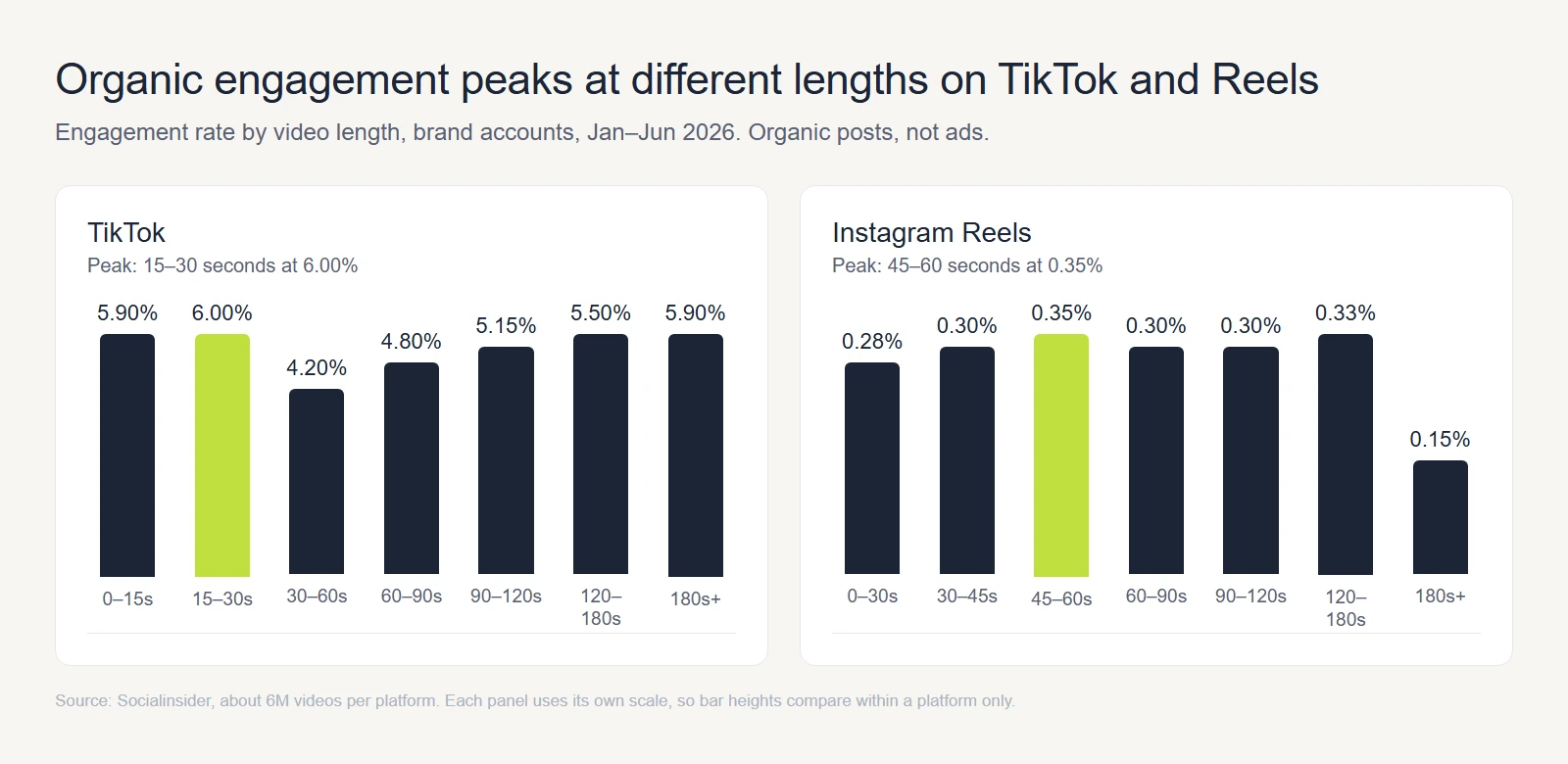
Organic datasets are a poor guide to paid performance, because organic reach and engagement come from follower behavior and algorithmic distribution, and ad auctions work differently.
These datasets show that organic brand videos can generate engagement across different lengths. Engagement rate, however, doesn't measure how long viewers watch, so these findings tell us little about retention.
For broader creator-content benchmarks, see our UGC statistics roundup.
Meta: Facebook Feed, Instagram Reels, and Stories
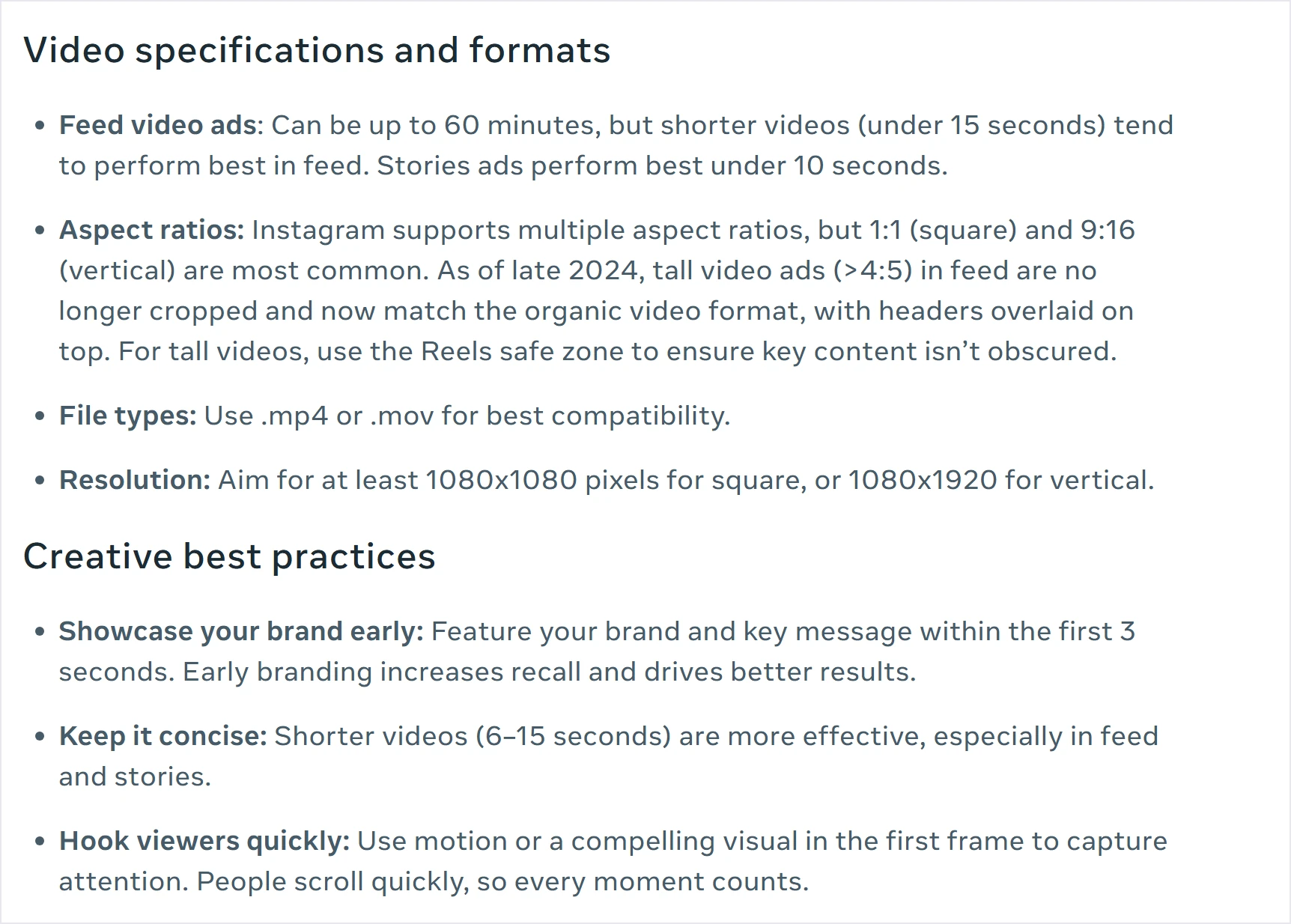
Meta publishes no study behind its length guidance, so treat "under 15 seconds in feed" as a starting hypothesis. The page we found covers Instagram video ads, and we found no comparable length figure for Facebook Feed. Its guidance also asks for the brand and key message in the first three seconds, which pairs naturally with a 6-15 cut.
For social media creatives built for Reels, shoot vertical first and crop to feed later; our Instagram Reels ads guide covers the setup.
Meta's one large published test compares ad types and says nothing about lengths. Creator content run as partnership ads cut cost per result by 19% against business-as-usual creative, across about 2,400 advertisers in one week of June 2025. On Meta, test 6-15 against 16-30 head to head in feed before touching Stories.
TikTok: In-Feed and Spark Ads
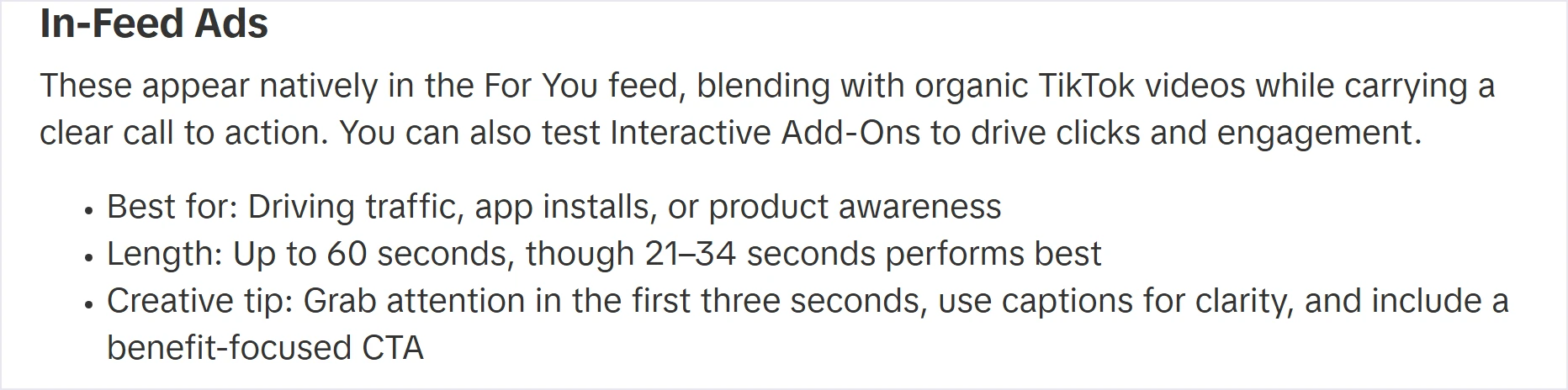
TikTok's 21-34 second range was modeled on May to July 2021 ads, so a recommendation that old should carry little weight on its own. Test it against a 15-second cut, using one hook and one creator.
Spark Ads on creator content showed +30% completion, +142% engagement, and +43% conversion against standard in-feed ads, according to TikTok's internal data from Q4 2020 to Q2 2021. That is a format effect and says nothing about length. If you run TikTok at volume, our TikTok advertising agency page shows how we structure it.
YouTube: Shorts, In-Stream, and Demand Gen
YouTube spreads one creator video across the widest range of placements, and content consumption patterns differ between them: viewers lean back in-stream and scroll through Shorts. The same 45-second review can behave very differently in each.
Google's own research on format mix is easy to misread as a length finding. A Nielsen meta-analysis commissioned by Google found that mixing In-Stream, In-Feed, and Shorts delivered 94% higher ROAS than in-stream alone in Video View campaigns. That effect comes from placement variety.
For the third-party view data on Shorts, see our YouTube Shorts statistics roundup, and remember most of it is organic.
When Should You Use a 6-15 Second UGC Video?
Use the 6-15 second bucket for quick hook tests and concise offers, particularly in Instagram Feed prospecting. This length gives you room for one hook, one proof point, and one offer.
- Seconds 0-3: the hook, with the speaker and the product visible.
- Seconds 3-10: one proof point, shown on screen.
- Seconds 10-15: the offer and a spoken call to action.
Brand signaling has to happen inside those first seconds because no later chance exists. TikTok Marketing Science found that 90% of ad recall impact is captured within the first six seconds, according to a 2023 CreatorIQ report citing the 2021 analysis.
Platform timing sets the drop-off points. YouTube's skippable ads allow a skip after 5 seconds, and Google Ads shows the call-to-action button on Shorts ads after 3 seconds for Performance Max, App, and Demand Gen campaigns and after 10 seconds for Video Reach and View campaigns.
The hook has to land before the 5-second skip mark, and the spoken offer should line up with the call-to-action button appearing.
Two failure modes show up often in short cuts:
- A disclosure that crowds the frame and pushes the proof point out.
- A claim with no proof, because the seconds ran out before the demonstration.
For hook writing, see our guide to ad hooks that stop the scroll.
When Should You Use a 16-30 Second UGC Video?
Use the 16-30 second bucket for a product demonstration plus a reason to believe. Product demonstrations need time to show the product working, and this band gives them that while staying inside the range platforms recommend for action objectives.
- Seconds 0-3: the hook.
- Seconds 3-15: the demonstration, one action per beat.
- Seconds 15-24: social proof, such as a result, a review, or a before and after.
- Seconds 24-30: the offer and call to action.
Make the landing page UX match the video. The claim made at second 20 should be the first thing on the page, because a mismatch there erases whatever the longer cut earned.
For context on format, Motion's analysis of more than 550,000 Meta ads found that demo-format ads were winners 8.11% of the time, where a winner is an ad that spends at least ten times its account median. That figure is a baseline for the format, and Motion doesn't split it by length.
The common failure is stretching a 12-second idea to fill 20 seconds. Extra seconds without a new fact tend to lower hold rate and gain nothing. Our UGC script guide shows how to structure each beat.
When Should You Use a 31-60 Second UGC Video?
Use the 31-60 second bucket when the buyer needs an explanation before clicking. It suits explainer videos, authentic reviews from customers, and comparisons from brand advocates that tell a first-person story.
Google reports greater consideration lift for YouTube ads lasting 60 seconds to 3 minutes. That range sits almost entirely outside our 31-60 second bucket, so it offers context for longer consideration ads rather than direct evidence for this UGC length. Test 31-60 second cuts when the message needs more explanation.
To hold attention across this length, add a retention checkpoint every few seconds:
- A new visual or camera angle.
- A new claim or number.
- A direct question the next shot answers.
- On-screen text that restates the current point.
For Instagram Feed prospecting, test a 6-15 second cut first, following Meta's feed guidance. TikTok's recommended 21-34 second range extends into this bucket, though it offers no direct evidence for 45-60 second ads. When testing longer cuts, use the extra time for a clear story arc: problem, attempt, result, recommendation.
For the wider trade-offs, see our guide to short-form versus long-form video content.
Which Metrics Decide the Best UGC Video Length?
Judge length on cost per acquisition, because completion rate favors the shortest video by construction. Each metric below flatters a different bucket.
| Metric | Formula | Bias by bucket | Use it for |
|---|---|---|---|
| Hook rate | 3-second views divided by impressions | Neutral across buckets | Judging the opening |
| Hold rate | 15-second plays divided by 3-second plays | Undefined under 15 seconds; favors 16-30 | Judging the middle |
| Completion rate | Full views divided by views | Favors 6-15 | Diagnosis only |
| Watch time | Average seconds watched | Favors 31-60 | Diagnosis only |
| Click-through rate | Clicks divided by impressions | No established length bias; test by placement | Judging traffic |
| Conversion rate | Conversions divided by clicks | May rise with length as viewers pre-qualify (test it) | Judging the landing step |
| Cost per acquisition | Spend divided by conversions | Neutral | The decision |
Definitions vary by platform, so compare hook and hold rates only within one platform. Common targets such as a 30-40% hook rate and a 40-50% hold rate are rules of thumb from Motion with no published method, and they're inconsistent even there. Treat them as a starting reference for diagnosis only.
Attention Metrics: Hook Rate, Hold Rate, and Completion Rate
Read attention metrics in pairs:
- 6-15 second cuts: pair hook rate with completion rate.
- 16-60 second cuts: pair hook rate with hold rate, because completion rate always looks worse as length grows.
These engagement metrics tell you where viewers leave, and cost per acquisition tells you which cut earns revenue.
Click and Conversion Metrics
Click-through rate alone misleads, and the peer-reviewed evidence shows why. Fossen, Kim, and Chae in the Journal of Marketing found that ultra-short ads drew up to 40% more website visits within five minutes in TV data, with similar direct effects on online sales and a larger indirect effect through traffic.
Their social media field experiment on Facebook found more clicks for shorter ads. Their data covers TV and a nonprofit advertiser, so it supports a traffic claim and says nothing about paid UGC conversion.
Conversion rate then depends on what happens after the click. A fast, clear landing page can erase a click-through advantage, and a mismatch between video and page can erase a conversion advantage.
Cost Metrics: Cost per Acquisition and ROAS
Cost per acquisition combines three inputs, and the bucket with the highest click-through rate doesn't have to win. The table below uses assumed numbers to illustrate media-only CPA. Production costs are excluded, and the figures are illustrative rather than market benchmarks.
| Assumption | 6-15 seconds | 16-30 seconds | 31-60 seconds |
|---|---|---|---|
| CPM (assumed) | $12 | $12 | $12 |
| Click-through rate (assumed) | 1.2% | 0.9% | 0.6% |
| Cost per click | $1.00 | $1.33 | $2.00 |
| Conversion rate (assumed) | 1.5% | 2.4% | 3.0% |
| Cost per acquisition | $66.67 | $55.56 | $66.67 |
In this illustration:
- The 6-15 second cut wins on clicks.
- The 31-60 second cut wins on conversion.
- The 16-30 second cut wins on cost per acquisition.
Real accounts will produce different numbers. The point is that the decision metric is the last row, and ROAS follows the same logic when order value is held constant. Our guide to measuring UGC video performance defines each metric in more detail.
UGC Video Length by Funnel Stage and Retargeting Campaign
For prospecting, choose the starting length by placement: test 6-15 seconds first on Instagram Feed and compare it with 16-30 seconds on TikTok. For consideration, start with 16-30 seconds, then test whether longer explanations improve acquisition costs. In retargeting, compare 16-30 and 31-60 second cuts based on the message buyers still need to hear.
| Funnel stage | Starting bucket | Primary metric | What to test next |
|---|---|---|---|
| Prospecting | 6-15s (Instagram Feed); test 16-30s on TikTok | Hook rate, cost per acquisition | The 16-30 cut of the same hook |
| Consideration | 16-30 seconds | Hold rate, cost per acquisition | A 31-60 explainer |
| Retargeting campaign | 16-30 seconds | Conversion rate | 31-60 reviews against 6-15 reminders |
| Existing customers | 6-15 seconds | Repeat purchase rate | A review-led 31-60 cut |
Creative fatigue can also affect length-test results, especially in smaller retargeting audiences exposed to the same ads repeatedly. Track frequency alongside CPA and refresh creatives when performance starts to decline. Our creative fatigue guide covers the warning signs in more detail.
How to Run a UGC Video Length Test: Step-by-Step Framework
To compare UGC video lengths, build three edits from the same footage and keep the creator, hook, core claim, and offer consistent. Use the extra seconds for demonstrations or story context, then measure which finished cut performs best. Since longer videos also carry more information, the test compares three versions of the same creative idea rather than isolating duration as the only variable.
- Pick one creative concept and one master shoot. Keep the same creator, opening hook, core claim, proof point, and offer across all three cuts.
- Edit the footage into 6-15, 16-30, and 31-60 second versions. Use the extra time for demonstrations, supporting details, or story context while preserving the central message.
- Use the platform's split-testing tools where available. Keep the campaign objective, audience criteria, placements, and attribution settings consistent, and give each cut comparable budget and exposure. If only two variants can be tested at once, run controlled head-to-head comparisons.
- Set the budget, test duration, and minimum conversion threshold per variant before launch. Follow the predefined stopping rule, then compare cost per acquisition. If the test produces too few conversions, treat the result as inconclusive rather than declaring a winner.
- Read hook rate and completion rate to diagnose, and cost per acquisition to decide.
- Retest the winner against a new hook, then rotate before fatigue sets in. Log each result in a creative-level record so the next brief starts from evidence.
Testing volume matters because winners are rare. In Motion's data, roughly half of all ads receive little or no spend, and 6% of ads account for the majority of spend in a given account.
Production Methods and Cost by UGC Video Length
Creator fees follow deliverables, so shoot once and cut three times. Length alone barely moves the price, and the real cost drivers are the extras attached to each video.
A 2022 creator survey reported a median price of $150 for a 15-60 second vertical video. That figure provides historical context rather than a current pricing benchmark. The same source reported the following add-on costs:
- Hook or call-to-action variations at $50 each.
- Raw footage at 30-50% of the base rate.
- Usage rights beyond the standard period at 30-50% of the base rate.
- Whitelisting or Spark Ads at about 30% of the base rate per month.
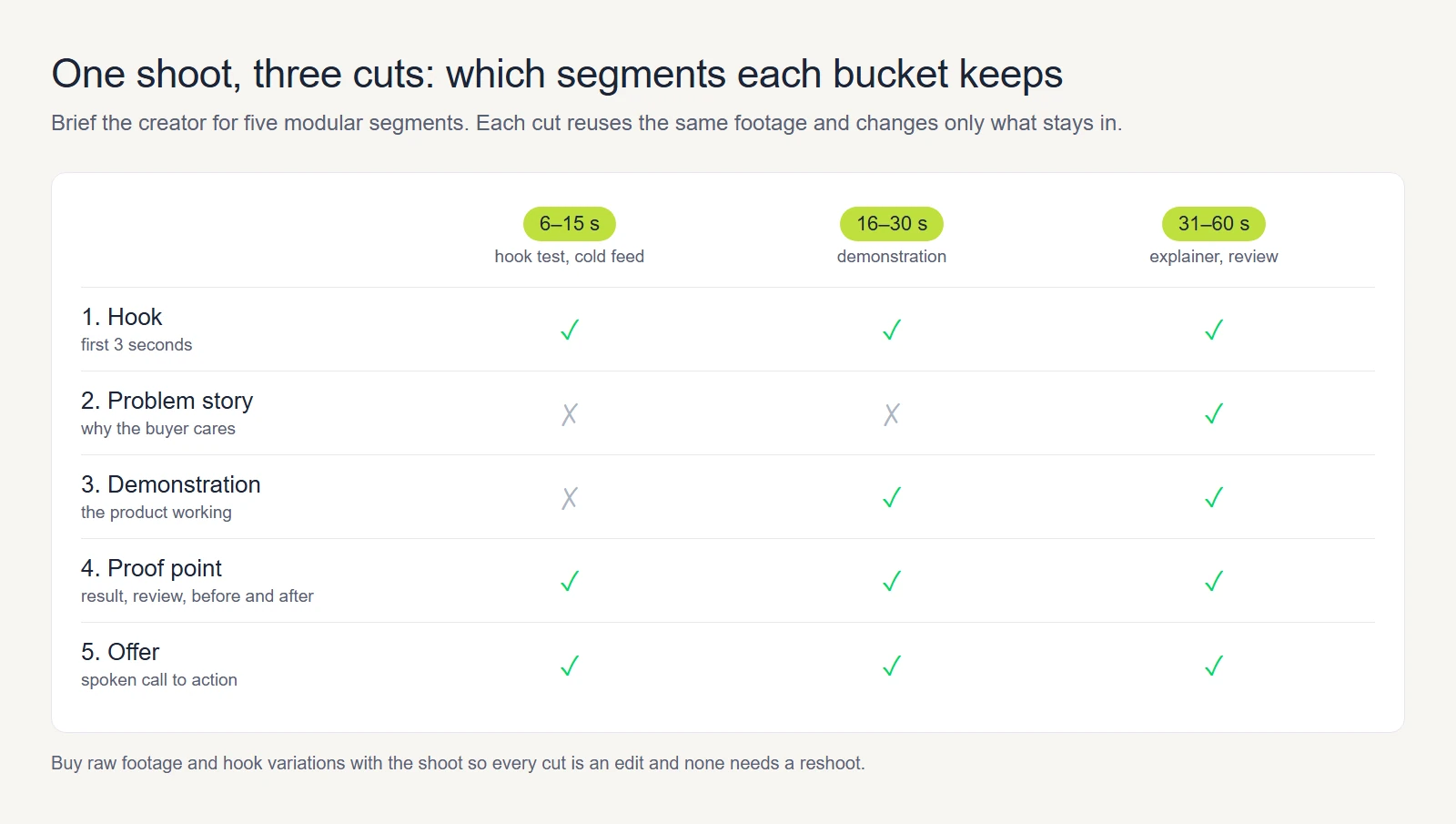
Raw footage and hook variations are what make a three-bucket test cheap. Brief the creator for five modular segments:
- A hook.
- A problem story.
- A demonstration.
- A proof point.
- An offer.
Creator skill matters more as the cut gets longer, because a 45-second review depends on delivery in a way a 10-second hook does not. When that volume gets hard to manage in-house, our content factory produces creator content at scale.
To compare the true cost of each cut, add its allocated production costs to media spend, then divide by the conversions it generates. A more expensive video pays off when it delivers a lower all-in CPA, assuming comparable conversion value.
Build a Winning UGC Video Length Strategy With inBeat
The best UGC video length for your brand is the one your own test returns. We run that loop for brands as part of creative strategy, testing, and creator supply, so each result feeds the next brief.
If you want a length test designed around your platforms and your funnel, book a strategy call and we'll walk through which buckets to test first on your account.
FAQs
Does the best length change for B2B or high-order-value products?
Probably yes, though no published data confirms it. Higher-consideration purchases give buyers more to evaluate, which tends to favor the 31-60 second bucket in retargeting and the 16-30 second bucket in prospecting. Test that ordering on your own account before assuming it.
Do the bucket findings hold for AI-generated UGC video?
They may not, because viewers read synthetic creators differently and the same hook can land differently. Run the same length test on the AI version before reusing a real-creator result. Our comparison of AI UGC ads and real UGC covers where the two diverge.
Should a creator's own social media posts and the Spark Ad use the same cut?
Usually not. A creator's organic social media posts are shaped for their followers, while a Spark Ad or partnership ad reaches cold audiences who have no history with the creator. Cut the paid version to the bucket your test favors and keep the organic post at the creator's natural length.
How often should a length benchmark be re-run?
Re-run it whenever a platform changes its ad specs or placements, and at least once a quarter in an account spending steadily. A result from last year may rest on a rule that no longer applies.