

People laugh at your ad. They share it, quote the punchline, and remember every detail. Except the brand behind it.
That’s the risk of humor in advertising. Kantar found that only 33% of the ads it researches use humor, yet half of its Creative Effectiveness Award winners do. The potential is obvious, but a funny ad still needs to give people a reason to remember the brand.
So how can you tell whether a joke will help your brand or simply entertain your audience? This guide examines real campaigns through four practical tests: audience fit, brand connection, brand memory, and how well the humor holds up in new settings. Each helps you decide whether a funny idea deserves budget.
P.S. If you'd rather pre-test a concept than guess, our ad testing service runs controlled creative experiments before budget goes behind them.
TL;DR: Four Checks Before You Run a Funny Ad
- Audience: the joke fits what this audience already laughs at.
- Brand connection: a name, mascot or product truth makes the joke yours.
- Memory: viewers can name the advertiser afterward.
- Portability: the reaction holds in a new market or placement.
Funny Ads That Keep the Brand in the Joke
Dunkin': Good Will Dunkin' (2026)
In a fake 1995 sitcom, Ben Affleck plays a gifted Dunkin' counter worker surrounded by familiar television faces. The Good Will Hunting pun, the coffee-shop setting and the Munchkins make the advertiser easy to recognize, even as the cameos pile up.
Good Will Dunkin'. Source: Dunkin' on YouTube
In Pollfish's post-game survey of 400 people, 23% recalled Dunkin' unaided and 57% did so with a prompt. The sample is directional, but the creative point is clear: the setting itself carries the branding.
Reese's: Don't Eat Lava (2025)
Reese's presents its lava-themed cups as a public safety problem: people keep trying to eat actual lava. The warning gets more absurd with each scene, but the product name is what makes the whole premise work.
REESE'S | Don't Eat Lava. Source: Reeses on YouTube
Funny Ads That Create a Branding or Audience Risk
Pepsi: The Choice (2026)
Pepsi puts a polar bear associated with Coca-Cola into a blind taste test, where it chooses Pepsi Zero Sugar and has an identity crisis.
The Choice | Pepsi | Super Bowl. Source: Pepsi on YouTube
Borrowing a rival's character makes the gag instantly readable, but it can also confuse viewers about the advertiser. In Pollfish's post-game survey of 400 viewers, 44% thought they had seen a Coca-Cola ad. A separate test by System1 found that 88% recognized the ad as Pepsi's. The populations, methods and moments differ, so the figures cannot be subtracted or ranked. The useful lesson is to test sponsor identification directly instead of inferring it from the joke's popularity.
Manscaped: Hair Ballad (2026)
A man trims his chest hair, and the clumps on the floor start singing a tearful power ballad about their fate before getting flushed.
MANSCAPED® Makes its Super Bowl Debut with Singing Hairball Monsters. Source: BusinessWire on YouTube
The trimmer and grooming setting stay visible, yet a clear product connection did not guarantee a uniformly warm response. In the same Pollfish survey, 17% expressed negative sentiment and 34% said they were unlikely to buy from Manscaped in the next 30 days. With no baseline, that shows how respondents felt, not whether the ad cost sales. A follow-up test should ask intended buyers whether the singing hairballs feel playful or off-putting. That would diagnose tone rather than merely confirming the product is visible.
What Research Says About Humor in Advertising
The campaigns above show why laughter, brand recall, and message takeaway need separate measures. Research helps explain where those outcomes diverge.
Martin Eisend's meta-analysis of 369 correlations found that the effect on attitude toward the ad was about twice that on attitude toward the brand. Humor also lowered perceived source credibility, and the author cautioned that published research may overrepresent positive results.
Kantar finds no direct relationship between humor and remembering the advertiser. Recall can still be strong when the brand is central to the joke. Enjoyment alone tells you little about whether viewers know who made the ad or understand its message.
Four Checks Before Using Humor in a Campaign
1. Does the Audience Get the Joke?
Ryanair's TikTok roasts its own passengers, including reels about what customers expect for €16.99, where silver service meets a bargain fare. The joke frames the low-fare offer and the compromises that come with it, which a former Ryanair strategist told Business Traveller was the aim.
Before writing a script, look for three signals:
- Replies: which jokes get quoted back, and which get explained or corrected.
- Shares: which formats people send to friends.
- Creators: what the creators your audience follows joke about, and in what style.
2. Does the Joke Connect to the Brand?
Imagine the same joke with a competitor's logo on it. If it works just as well, the connection to your brand may be too weak. This is a creative diagnostic, not a validated test, and showing both versions to five people gives qualitative feedback only. A joke can belong to a brand through a name, a mascot, a sound, a category truth or a product feature.
In Axe's "The Neighbour," a man using Axe shower gel loses his water when an unseen hand shuts it off. He asks to shower next door, where the older woman who welcomes him wears a cardigan that matches the mysterious hand's sleeve.
The gel returns in the final shot. The interrupted shower makes the joke relevant to the body-wash category, but the same premise could work for a competitor.
Axe's product placement gives viewers a clear brand cue, while an attribution test would reveal whether they remember the advertiser rather than just the punchline.
AXE - The Neighbour. Source: System1 Group on YouTube
3. Can Viewers Name the Advertiser?
Enjoyment shows how viewers felt. Correct brand attribution shows whether they link the ad to the right advertiser, and brand lift compares exposed viewers with a control group. A strong result on one says little about the others, as the Pepsi spot above shows.
Ask the direct question after viewing, with no logo shown: "Which brand was this ad for?" Add "What was the ad saying?", since viewers can remember the joke and lose the claim.
4. Will the Humor Travel?
Duolingo declared its green owl dead in 2025 and asked learners to complete 50 billion XP of lessons to bring him back.
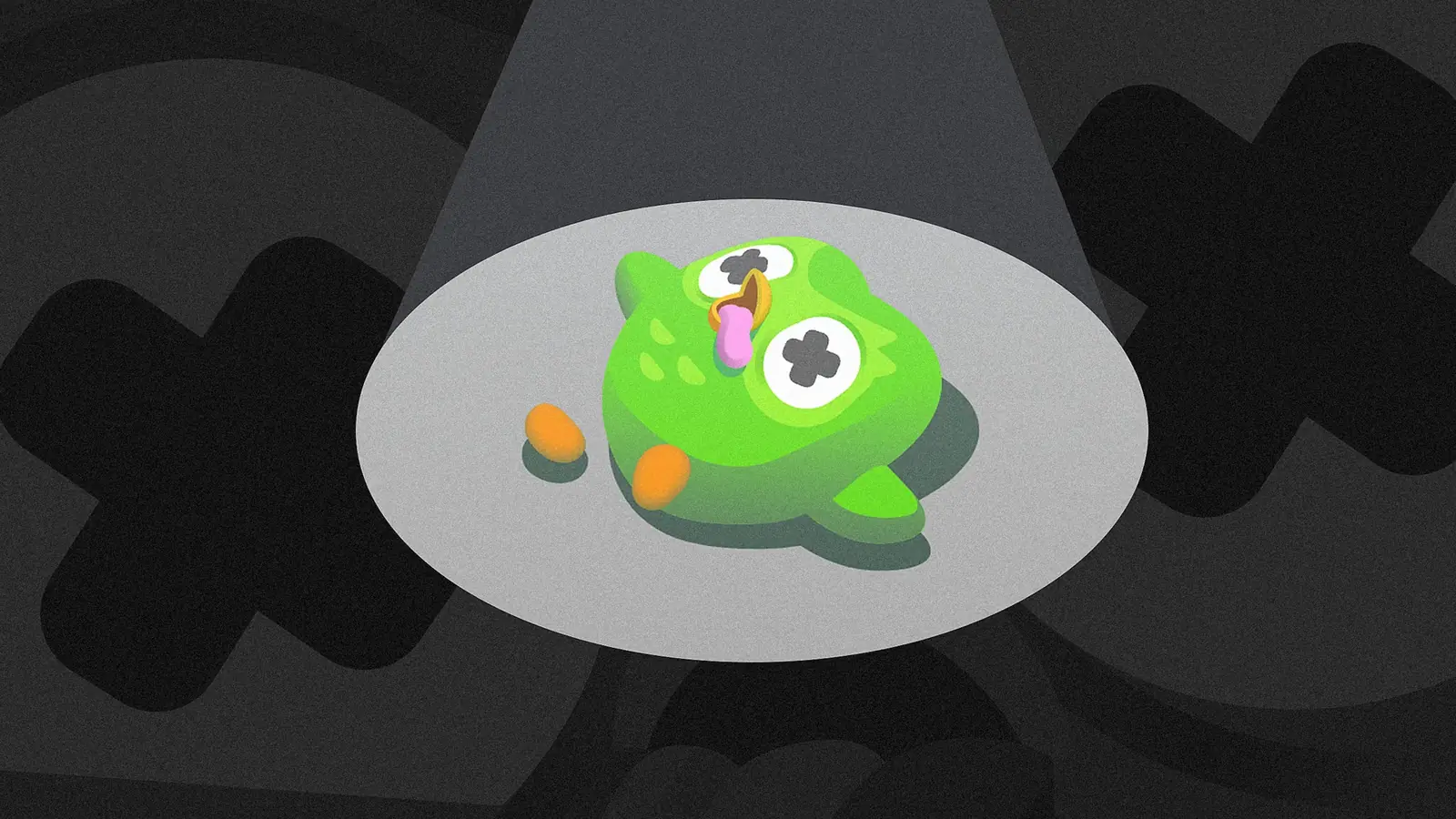
In Japan, where its CEO said joking about death is less accepted, Duo stayed alive. The company described him there as "dead tired." That was a localization choice made in advance, and no test shows the original joke would have failed in Japan.
Kantar notes that physical humor crosses borders more easily than humor that depends on context. Before reusing a joke, check three things:
- Language and reference: does the wordplay or cultural nod survive translation?
- Cultural sensitivity: is the subject welcome in this market?
- Placement: does the tone suit the media environment?
Types of Humor in Advertising and Their Risks
| Humor type | Why it can work | What can go wrong |
|---|---|---|
| Physical or visual | Needs little language, so it travels | The stunt outshines the product |
| Wordplay | A pun on the brand name makes the advertiser memorable | It depends on one language |
| Self-mockery or roast | The audience already jokes about the flaw | The target may not be in on it |
| Character or absurdity | An owned character carries the premise | The premise needs prior context |
| Dark or sensitive | Surprise can create strong engagement | The subject can offend |
WeatherTech shows physical humor at work. Four older women tear around in a 1963 Lincoln Continental to "Born to Be Wild," breakdancing and flashing a bingo host, while floor mats keep the car protected.
WeatherTech Big Game Commercial 2025 : Whatever Comes Your Way - 60 seconds. Source: WeatherTech on YouTube
The physical comedy needs little dialogue, while the floor mats give the chaos a product payoff: the car stays protected as its passengers misbehave.
How to Test a Funny Ad Before Spending More
The four checks diagnose a concept and are not a validated scoring system. We compare how people respond to the idea with how clearly they remember the advertiser, in four steps:
- Define the audience and the brand takeaway. Name who the ad is for and the one thing viewers should remember.
- Screen the concept qualitatively. Five interviews can catch confusion and obvious misses, but they cannot measure recall or attribution.
- Run a controlled test with an attribution survey. Match audience, objective, offer, spend window, length, placement and frequency. Decide first whether you are testing a whole creative or one joke: if humor changes the hook, the result describes the whole creative. Meta's estimated ad recall lift is a modeled recall metric, so it does not replace a survey of correct brand attribution.
- Decide with preset conditions. Write down what triggers a rework, a stop or a scale-up before launch.
| Data source | What it measures | What it cannot tell you |
|---|---|---|
| Platform results (views, click-through rate, cost per result) | Behavior inside the ad platform | Whether viewers named the right brand |
| Brand survey | Attribution, recall and message takeaway | Cost per customer |
| Holdout test | Business change versus a control group | Why viewers reacted as they did |
How Humor Works in Short-Form Video
Kantar describes TikTok humor as fast-moving and often satirical, and Instagram humor as more personal. A creator supplies the timing, and the brief supplies the guardrails:
- Brand cue early: show the product or a recognizable asset in the opening seconds.
- Feed context: check that the joke reads on a phone screen among other posts.
- Creator latitude: fix the claim and the off-limits topics, then leave the delivery to the creator. Our guide to briefing creators covers the handoff.
- Usage rights: agree paid-usage terms, run length and edit approvals before filming, since a cut-down can lose a punchline.
In System1's study of 887 short-form ads, creator ads earned 39% more attention than TV edits but were identified with the correct brand at roughly half the rate. The study covers creator-led ads in general, not only funny ones.
When Humor Needs Extra Care
Humor can work in serious categories, but three situations call for extra care:
- Claims-heavy or regulated categories: keep the claim plain, put the joke around it and route the concept through compliance review.
- Sensitive contexts or vulnerable audiences: ask who the joke might hurt before asking whether it is funny.
- Mismatched media environments: Nationwide's 2015 Super Bowl ad delivered a somber message in a lighthearted slot, a mismatch of tone rather than a failed joke.
Metro Trains Melbourne's "Dumb Ways to Die" pairs cute animated characters dying in absurd ways with a railway safety warning near the end.
Dumb Ways to Die. Source: Dumb Ways to Die on YouTube
The contrast made the warning hard to ignore. Treat it as a creative example, not proof of fewer accidents: the reported pledge and accident figures come from the campaign's own award entry and Kantar, with no independent causal design.
Make the Joke Work for the Brand With inBeat
inBeat helps brands develop creator-led ads, compare creative variants and see what viewers take away before budget scales.
If you have a funny concept on the table, book a strategy call. We'll review the idea, flag the biggest creative risk and outline a practical first test.
FAQs
How long can a funny campaign run before the joke wears out?
No fixed number applies. Watch comment fatigue and attribution, and refresh one recognizable brand idea with new scenarios instead of repeating the same joke.
What should you do when a joke draws negative comments?
If comments suggest harm or a fast-moving backlash, pause paid delivery while you assess the issue. Check whether objections concern the joke's target, its message or the audience it reached. Our crisis management guide covers the response.
Does a funny ad need to drive immediate sales?
That depends on the campaign's objective. A brand campaign may aim to improve recall or consideration, while a direct-response ad needs to earn actions such as sign-ups or purchases. Set the goal before launch, then measure that outcome alongside correct brand attribution rather than treating laughs or views as proof of sales.