%20(1).png)

A talented creator can deliver good footage and still miss the job the ad needs to do. The usual cause is upstream: the brief never clarified the audience, placement, creative angle, proof, or final deliverables.
TikTok's current creative guidance recommends a strong proposition in the first three seconds, a prioritized hook within the first six seconds, vertical production, captions, and continuous testing. Those decisions belong in the brief before filming begins.
This guide gives you a copyable TikTok UGC brief template, explains each field, and shows how we would update three real inBeat briefs today. If you want the full process handled for you, our UGC agency develops the strategy, sources creators, and produces paid-social assets.
Quick Answer
- A TikTok UGC brief should define one campaign job, one audience situation, one creative angle, approved product claims, hook options, storyboard beats, required shots, technical specifications, rights, and review terms.
- The brief should identify where the video will run. An organic creator post, Spark Ad, Non-Spark ad, and TikTok Shop video require different instructions.
- Give creators the message and evidence they must land. Let them express those points in language that sounds natural to them.
- Ask for modular assets such as alternate hooks, raw A-roll, B-roll, and clean footage when the content will support paid testing.
- Keep commercial terms in the contract, then summarize the operational details creators need inside the brief.
Our view is that the brief is the first version of the ad and the first input in the testing loop. Creator selection, production, media buying, and measurement shape one another. A strong brief gives the creator enough customer context to make the message believable, while the deliverables give the media team enough material to test what actually earns attention and action.
Copy This TikTok UGC Brief Template
Copy the template below into Google Docs, Notion, or your campaign management tool. Delete fields that do not apply, and link to supporting documents when detailed product or compliance guidance would make the main brief difficult to scan.
TikTok UGC Creator Brief
Project
Brand: [brand name]
Product: [exact product or service]
Campaign: [campaign name]
Primary goal: [purchase / install / lead / awareness]
Placement: [organic / Spark Ad / TikTok Shop]
Due date: [date + time zone]
Audience
Primary viewer: [specific person and situation]
Problem or desire: [one sentence]
Main objection: [one sentence]
Customer language: [real customer phrase]
Creative concept
Single angle: [main reason to care]
Offer: [offer]
Creator role: [customer / expert / friend]
Format: [testimonial / demo / problem-solution]
Product truth & proof
What the product is: [description]
Primary benefit: [benefit]
Approved proof: [proof]
Must say or show:
- [required point]
- [required point]
- [required product shot]
Must avoid:
- [unapproved claim]
- [competitor mention]
- [restricted language or visual]
Hook options
Hook 1: [line] — Visual: [shot]
Hook 2: [line] — Visual: [shot]
Hook 3: [line] — Visual: [shot]
Story beats
0–X sec Hook and product context
X–X sec Problem or desire
X–X sec Product demo and proof
X–X sec Objection or result
X–X sec Call to action
Shot list
A-roll: [talking head / testimonial]
B-roll: [product / usage / detail / outcome]
CTA & destination
CTA: [what viewer should do]
Destination: [product page / app / TikTok Shop]
Offer: [price / code / deadline]
Deliverables
- [number] edited videos
- [number] alternate hooks
- [number] raw A-roll clips
- [number] raw B-roll clips
Technical requirements
Format: 9:16, 1080 × 1920
Duration: [target]
Audio: [voice / music / no music]
Captions: [baked in / separate / both]
File type: [.mp4 / .mov]
Usage & posting
Creator posting: [yes / no]
Paid usage: [term]
Channels: [TikTok / Meta / website / etc.]
Exclusivity: [category + term]
Review process
First cut: [date]
Final delivery: [date]
Revision rounds: [number]
Final approver: [name or role]
The template is intentionally comprehensive. A simple campaign may need only one or two pages after irrelevant fields are removed. Product instructions, extensive legal language, and large brand-asset libraries can sit in linked documents.
What Is a TikTok UGC Brief?
A TikTok UGC brief is the production guide for a creator-made video. It defines the goal, audience, message, required shots, and final files.
It also gives the editor and media buyer a shared specification. That matters because TikTok UGC may be posted organically, amplified through a creator's account, or delivered as raw material for paid ads. The same creator can produce all three, but the workflow and deliverables are different.
How a UGC Brief Differs From an Influencer Brief
A UGC brief focuses on the asset. An influencer brief also covers distribution through the creator's audience.
| Decision | UGC brief | Influencer brief |
|---|---|---|
| Main purchase | Production skill and usable content | Content plus access to the creator's audience |
| Creator posting | Optional | Usually required |
| Audience data | Helps the creator speak to the buyer | Also helps evaluate the creator's following |
| Deliverables | Edited files, raw footage, hooks, B-roll | Posts, Stories, captions, tags, live dates |
| Paid amplification | Usage rights or creator-handle authorization | May be added to the organic partnership |
| Reporting | Asset and ad performance | Organic post performance plus any paid results |
How the TikTok Placement Changes the Brief
The placement determines what the creator needs to film, publish, authorize, and disclose. It should appear near the top of the brief.
| Placement | Does the creator post? | What the brief must specify |
|---|---|---|
| Organic creator post | Yes | Posting date, caption, disclosure, brand tag, community expectations, and content-live period |
| Spark Ad | Yes | Organic caption approval, posting deadline, ad authorization process, authorization term, CTA destination, and paid usage |
| Non-Spark paid ad | No | Raw and edited files, editing permission, clean versions, CTA context, file delivery, and paid-media rights |
| TikTok Shop video | Usually | Product demonstration, product-link workflow, offer, affiliate disclosure, approved claims, and posting requirements |
| Brand-owned organic post | No | Brand account context, caption responsibility, music permission, editing ownership, and publishing cadence |
This replaces the old habit of adding a universal "hashtags and links" box.
TikTok's current In-Feed Ad specifications state that Spark Ad captions come from the organic video, while Non-Spark captions do not support clickable links or hashtags. The destination and CTA for a paid ad also involve the campaign setup, so the creator needs the destination context without being asked to paste a raw URL into every video.
If the campaign will use creator-posted content, explain the authorization workflow before the shoot. Our TikTok Spark Ads guide covers the publishing and authorization mechanics in more detail. For brand-run campaigns, the TikTok advertising team should review the brief before production so the content matches the planned placement and objective.
Three Real UGC Brief Examples from Our Agency
The following briefs came from real inBeat production work. Their value is the operational detail: creators can see what to film, how long the video should run, and which parts require consistency. They also show where our current process has become more specific.
Luxbox Brief: Modular Hooks and Clear Filming Rules
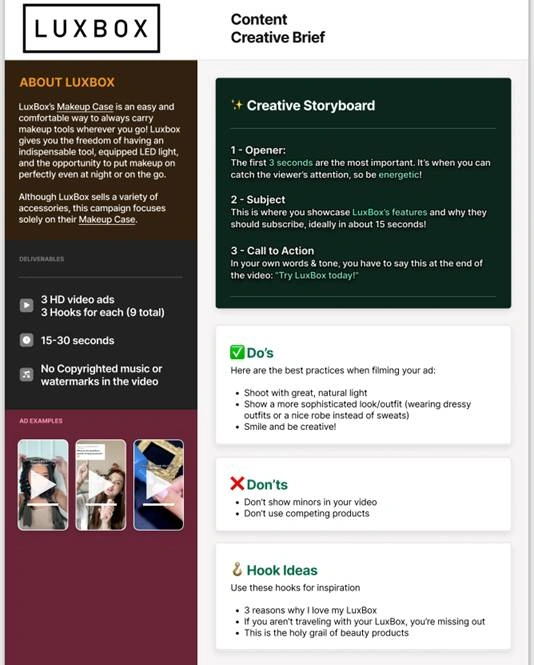
The Luxbox brief requests three HD video ads with three hooks for each, creating nine opening combinations across the deliverables. It also gives creators a 15-to-30-second target, a simple opener-subject-CTA structure, filming guidance, prohibited elements, and reference ads.
What works:
- The deliverables are countable.
- Hook options are treated as production assets.
- The product demonstration has a clear place in the story.
- Practical do's and don'ts reduce avoidable reshoots.
What we would add today:
- The specific campaign job and placement
- A customer situation and main objection
- Raw A-roll and B-roll requirements
- Clean-file and caption instructions
- Usage period, editing permission, and review dates
Aura Brief: More Direction for a Sensitive Product
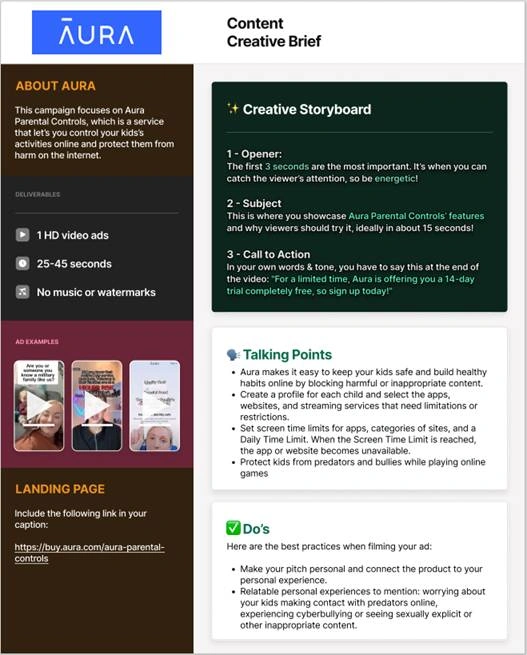
The Aura brief uses a similar visual structure, but the talking-points section is more detailed. That is the right instinct for a product involving child safety, privacy, cyberbullying, and parental controls. The creator receives the product functions and several situations that can make the problem feel real.
What works:
- The creator gets specific product capabilities.
- Personal experience is encouraged within a defined subject.
- Sensitive themes receive more guidance than a simple retail demonstration.
What we would add today:
- An approved-claims list reviewed by the relevant product or legal owner
- Clear wording for any trial terms
- A line separating personal experience from universal safety claims
- Disclosure and paid-usage instructions
- A concept checkpoint before filming
The lesson is broader than this campaign. Creative freedom should expand where delivery matters and narrow where factual accuracy, regulation, or customer safety creates risk.
Chin-Su Brief: Hashtags and Links Need Placement Context
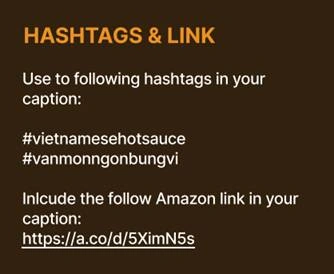
The Chin-Su example asks creators to use campaign hashtags and place an Amazon link in the caption. That can be valid for a creator-posted organic activation. It should not appear as a universal TikTok UGC requirement.
An updated version would first identify the placement:
- For an organic creator post, retain the approved caption, hashtags, disclosure, and destination instructions.
- For a Spark Ad, approve the organic caption before the creator publishes and document the authorization term.
- For a Non-Spark ad, give the creator the product-page and offer context, while the media team handles the campaign destination.
This small change prevents an organic publishing instruction from leaking into an asset-only paid brief.
The 10 Parts of a TikTok UGC Brief
The strongest briefs answer ten production questions in a creator-friendly order. Each answer should reduce a decision the creator would otherwise have to guess.
1. Campaign Job and Placement
Give the video one primary job and name where it will run. "Promote our product" is too broad. "Drive first purchases from a cold TikTok audience through a Non-Spark in-feed ad" gives the creator useful direction.
The campaign job affects the opening, amount of context, proof, and CTA. Cold audiences need the problem and product introduced quickly. Retargeting creative can spend more time on an objection, offer, demonstration, or comparison.
Include:
- The primary conversion or communication goal
- The placement and account the content will run from
- Paid, organic, or mixed usage
- The audience's stage of awareness
- The offer or event that gives the video urgency
2. Audience Situation and Main Objection
Describe one recognizable buyer situation that the creator can perform on camera. "Women aged 25 to 44" may help the media buyer, but it gives the creator no scene, emotional tone, or vocabulary.
A useful audience line sounds closer to this: "A parent who wants to give a child more online independence but still worries about unsafe content and excessive screen time." Add the objection that could block action and a real phrase from reviews, customer interviews, comments, or support conversations.
End the section with one viewer-takeaway sentence written in the first person:
I can set safer boundaries without checking every app manually.
That line helps the creator decide which details deserve time and which ones can be cut.
3. Single Creative Angle and Offer
Choose one lead angle for each video. A short TikTok cannot give equal weight to quality, price, convenience, sustainability, social proof, and every product feature.
The angle should connect a specific audience tension to a reason to care. Common angles include:
- A frustrating problem the product removes
- A visible demonstration or transformation
- Unexpected quality at a familiar price point
- Time, effort, or money saved
- Social proof from a credible user
- A specific objection answered with evidence
Name the creator's role as well. A personal testimonial, knowledgeable demonstrator, friend sharing a discovery, and skeptical customer all produce different performances from the same talking points. This is the strategic core of the creative brief process.
4. Product Truth, Proof, and Claim Boundaries
Give the creator facts they can demonstrate and language they can safely use. Product truth is more useful than a list of marketing adjectives.
Separate the information into three short lists:
- Must say: Product identity, approved benefit, offer, or required qualification
- Must show: Label, application, setup, interface, texture, result, or correct product use
- Must avoid: Unsupported outcomes, medical or financial claims, competitor references, unsafe behavior, or misleading demonstrations
For US campaigns, the FTC advises advertisers to explain what endorsers can and cannot claim, give clear disclosure instructions, and maintain a reasonable approval or monitoring process. Review the current FTC endorsement guidance with legal counsel when the category or claim carries material risk. Other markets have their own requirements.
5. Hook Options
Brief the opening line, opening visual, and on-screen text as one unit. A written hook can still fail if the first frame shows no motion, product, emotion, or recognizable situation.
TikTok's creative best practices recommend introducing the proposition within the first three seconds and prioritizing the hook within the first six. Ask for two or three genuinely different openings, each filmed as a clean standalone clip.
For example:
| Hook type | Opening line | Opening visual |
|---|---|---|
| Problem | "I stopped carrying a full makeup bag for one reason." | Creator empties an overfilled bag onto a table |
| Discovery | "This is the travel case I wish I had years ago." | Product opens directly toward the camera |
| Demonstration | "Watch how much this tiny case actually holds." | Fast close-up of products being packed |
Hook variations should test genuinely different ideas. Minor wording changes usually produce the same opening experience.
6. Storyboard Beats and Shot List
Define the sequence without forcing the creator to recite a screenplay. Use timed beats such as hook, problem, demonstration, proof, objection, and CTA. Then list the shots the editor needs to make those beats visible.
The storyboard controls the argument. The shot list controls whether the editor has the footage to build it.
A strong shot list may request:
- Talking-head A-roll with a clean background
- Product in hand with the label readable
- Correct product use from more than one angle
- Close-ups of texture, interface, feature, or result
- A scene that makes the customer problem recognizable
- Several seconds before and after each action for editing room
References can help with pace, framing, or delivery. Add one sentence explaining what to borrow from each example so the creator does not interpret it as an instruction to copy the entire ad.
7. CTA and Destination Context
Tell the creator what action the viewer should take and why it makes sense now. The line can be fixed when compliance or the offer requires exact wording. Otherwise, give the meaning and allow a natural paraphrase.
The creator should also know where the viewer lands. A product page, app store, lead form, and TikTok Shop product page call for different levels of explanation. Price, discount, trial terms, product name, and availability in the video must match the destination.
This is also where the creative team should flag a weak handoff. A persuasive video cannot compensate for a landing page that presents a different offer or requires the buyer to rediscover the product shown in the ad.
8. Technical Specifications and File Delivery
Specify every file the team needs alongside the appearance of the finished edit. TikTok recommends vertical 9:16 creative, at least 720p resolution, and keeping important content within the platform's UI safe zone. We usually request 1080 x 1920 footage so editors have a cleaner source file.
Clarify:
- Resolution, orientation, frame rate, and target length
- Phone camera, screen recording, voiceover, or talking-head requirements
- Whether captions should be baked in, delivered separately, or both
- Whether the brand needs a clean version without music, text, or filters
- Raw A-roll and B-roll requirements
- File format, naming convention, folder, and deadline
Music rights deserve an explicit line.
Organic trend audio may be unsuitable for paid use. Link creators to approved tracks or request voice-only footage when licensing will be handled during editing. Our guide to music licensing for UGC explains the main usage questions.
9. Usage Rights, Disclosure, and Approval Terms
Summarize the operational rights in the brief and place the binding language in the creator agreement. At minimum, both documents should agree on channels, duration, territory, editing permission, creator-handle advertising, exclusivity, and renewal.
Disclosure instructions depend on the market, relationship, and placement. State the required wording or platform tool, then have the relevant legal or compliance owner approve it. Do not leave the creator to interpret the brand's obligations alone.
The brief should also identify whether the brand may:
- Crop or resize the footage
- Add captions, graphics, voiceover, or new CTAs
- Combine the footage with other creators' clips
- Run the content through the creator's handle
- Use still frames on product pages, email, or marketplace listings
This avoids discovering after approval that the best clip cannot be edited or used in the planned campaign.
10. Timeline, Review, and Revision Rules
Set dates from product receipt, then identify who approves the concept, first cut, and final files. The creator should know how quickly the brand will return feedback and how many revision rounds are included.
Define a reshoot trigger before production. A missed required shot, unusable audio, incorrect format, prohibited claim, or failure to follow an approved concept may justify a correction. A new angle introduced after filming is new scope.
Use one feedback owner whenever possible. Consolidated, time-coded comments are easier to execute than separate messages from marketing, legal, product, and the client contact.
How to Brief Modular UGC for Creative Testing
Plan each shoot as a set of reusable components when the content will support paid media. This gives the editor room to build meaningful variations without paying for a completely new production every time.
| Asset | Useful starting quantity | Why it matters |
|---|---|---|
| Opening lines and visuals | 3 | Tests different reasons to stop scrolling |
| Core body | 1-2 | Preserves the main argument while allowing a second proof route |
| Product demonstrations | 2-4 clips | Makes the value visible and supports faster edits |
| Objection or proof clips | 2 | Lets the team match creative to awareness stage |
| CTAs | 2 | Tests action language or offer framing |
| Clean A-roll and B-roll | Full usable set | Supports captions, cutdowns, mashups, and cross-channel edits |
Three hooks attached to one body and two CTAs can support several distinct edits, provided the combinations still tell a coherent story. Keep each clip clean at the beginning and end, and request a version without copyrighted music when the footage may be used across paid channels.
The most useful performance teams repurpose UGC with a learning goal. Each variation should test a named variable such as the audience tension, opening visual, proof, creator voice, or CTA.
If you need that logic built into production from the start, inBeat's ad testing services connect the brief, edit plan, and media readout.
How to Review and Improve a UGC Submission
Use a staged review process so strategic problems are caught before they become expensive reshoots.
- Approve the concept or opening options. Confirm the audience, angle, product truth, and hooks before the creator records the full video.
- Review the first cut against the brief. Check required claims, shots, pacing, CTA, disclosure, technical quality, and placement fit.
- Return one consolidated feedback document. Add timecodes, separate required corrections from preferences, and name the approver.
- Run final quality control. Verify files, clean versions, raw footage, captions, filenames, rights, and authorization details before the asset enters the media library.
After launch, convert the performance result into a decision for the next brief.
| Performance signal | What it may indicate | What to change in the next brief |
|---|---|---|
| Weak early retention | The opening lacks relevance, motion, or clarity | Test a new customer tension, opening visual, or first line |
| Good watch time and weak CTR | The story holds attention but gives little reason to act | Clarify product value, offer, proof, or CTA |
| Strong CTR and weak conversion | The ad creates an expectation the destination does not satisfy | Align the claim, price, offer, audience, and landing page |
| One creator repeatedly wins | Delivery style or perceived credibility matters | Brief more creators with similar traits while testing the same concept |
| Results decline after repeated delivery | The creative may be fatiguing | Introduce a new concept or customer tension, not a cosmetic hook rewrite |
Treat these as diagnostic prompts. A single metric rarely proves the cause on its own. Read the signal alongside spend, audience, placement, offer, landing page, and other concurrent tests.
TikTok UGC Brief Mistakes
Most unusable submissions trace back to one of these briefing errors:
- A vague goal: "Make an engaging TikTok" leaves the creator to choose the audience, angle, proof, and CTA.
- A demographic-only audience: Age and gender do not give the creator a recognizable situation to perform.
- Too many equal messages: The video becomes a feature list with no clear reason to keep watching.
- A word-for-word script for every line: The creator concentrates on recall and loses the delivery style the brand hired them for.
- No raw-footage plan: The final edit may work once but cannot support future hooks, cutdowns, or channel adaptations.
- Rights discussed after delivery: A useful asset can become commercially unusable when paid usage, editing, or creator-handle authorization was never agreed.
- Fragmented feedback: Multiple reviewers send conflicting notes, and the creator cannot tell which changes are required.
The practical test is simple: a creator should be able to explain the video's job, audience, angle, required proof, files, and deadline after one careful read.
Build a Repeatable TikTok UGC System With inBeat
A good brief improves one production. A connected creative system improves every production that follows.
inBeat brings creator sourcing, creative strategy, UGC production, paid distribution, and performance analysis into the same workflow. The result is a clearer handoff from customer insight to creator footage, from footage to testable ads, and from campaign results to the next brief.
Book a strategy call to review your current UGC workflow, creative volume, TikTok placements, and testing plan.
FAQs
Should a TikTok UGC Brief Include a Full Script?
Use a full script when exact wording is required for compliance, product accuracy, or a tightly controlled concept. For most UGC content creation, a creative brief template with timed story beats, mandatory facts, brand goals, brand guidelines, FTC disclosures, and visual references produces more natural delivery without sacrificing strategic control.
How Many Hooks Should You Request From a UGC Creator?
Two or three distinct hooks are a practical starting point for one concept. Use audience insights and the Meta Ad Library to develop genuinely different opening ideas or visuals. Do not rely on minor wording changes. Structure them as A/B tests and define the performance metrics used to evaluate each variation.
Should Creators Deliver Raw UGC Footage?
Request raw footage when you expect to produce new hooks, cutdowns, mashups, captions, or cross-channel versions. Add the required clips to the deliverables checklist, along with the expected content formats, file quality, aspect ratio, delivery method, editing rights, and relevant platform specifications.
Are Usage Rights Part of the Brief or the Contract?
Put the binding usage-right terms in the contract. Summarize channels, duration, territory, editing permission, creator-handle advertising, and exclusivity in the brief. This ensures everyone producing or repurposing the user-generated content works from the same operational requirements.
Can the Same UGC Brief Work for TikTok and Meta?
The core audience, product truth, and concept may carry across platforms, but the deliverables should reflect differences in placement, pacing, safe zones, captions, CTA behavior, and editing needs. When both channels matter, plan one source shoot with clearly defined platform-specific outputs.
How Much Should a TikTok UGC Video Cost?
Cost depends on creator experience, production complexity, deliverable count, raw footage, paid usage, creator-handle advertising, exclusivity, and revision terms. Scope each component separately so competing quotes can be compared fairly. See inBeat’s performance creative pricing guide for additional format and pricing considerations.