.svg)
.svg)
.svg)
.svg)


.svg)








Your pipeline can look “fine” in dashboards and still be broken in real life.
Marketing hits lead targets, but sales still struggle to move those leads into real opportunities. The result is predictable: an inconsistent pipeline and slower revenue growth.
Sales and marketing alignment is achieved by tightening the mechanics: shared revenue goals, shared lead definitions, shared visibility, and a weekly feedback loop, not quarterly.
This isn’t a soft “collaboration” idea either. Teams that reach full alignment across GTM functions are 67% more likely to meet or exceed revenue goals.
This guide gives you a clear system to get there, without turning your process into a meeting factory. Let’s take a look.
Pro Tip: inBeat Agency can help sales and marketing teams align targeting, messaging, and reporting around revenue outcomes.
TL;DR
Here’s what you’ll walk away with:
- A practical definition of sales and marketing alignment, with clear signals you can audit.
- The revenue cost of misalignment, plus what aligned teams do differently.
- The benefits that show up fast: cleaner handoffs, tighter messaging, higher lead quality.
- The blockers that keep teams stuck: KPIs, data gaps, tool silos, and mismatched lead criteria.
- A 7-step alignment plan you can run with your team.
- The metrics that prove alignment is working, tied to the pipeline, and closed-won.
What Is Sales and Marketing Alignment?
Sales and marketing alignment means both teams operate from the same revenue logic.
Both teams work from one Ideal Customer Profile and the same buyer personas. They qualify leads using the same criteria and track progress through consistent funnel stages inside the CRM.
Sales feedback also moves fast, so marketing can refine targeting, lead scoring, and content based on real conversations with prospects.
Now let’s break down what sales and marketing alignment looks like in practice, and the signals that tell you it’s working:
Aligned teams look like this:
- Marketing targets the same accounts that Sales is prioritizing. It uses the same customer needs language.
- Sales times outreach using engagement signals. It uses marketing collateral that matches the buyer journey.
Misaligned teams look like this:
- Marketing reports marketing qualified leads. Sales rejects them. Nobody fixes the definition.
- Sales outreach clashes with what the ads and content promised. Trust drops before the first real conversation.
If what you’re seeing matches the misaligned side, you need a tighter system. Next, let’s look at how alignment translates into revenue results.
How Sales and Marketing Alignment Powers Revenue Results
In our experience, misalignment creates measurable revenue drag. It shows up in longer sales cycles, lower win rates, and more lost deals.
But the data makes it clear:
ELG Insider has also stated some findings that tie misalignment to real revenue drag. GTM teams dealing with it are 70% more likely to see extended sales cycles and face a 48% higher rate of lost deals.
And the confidence hit is real, too. 57% of GTM leaders don’t expect to meet targets due to misalignment.
The importance of coordination and shared goals isn’t limited to marketing and sales — even in finance, the wealth management firms demonstrate how strategic alignment between advisors and clients leads to stronger outcomes and more predictable growth.
On the flip side, aligned execution changes the math. Mutiny reports that misaligned teams are 2x more likely to miss revenue targets, while aligned teams are 2.3x more likely to exceed them.
We’ve also seen how misalignment shows up in pipeline attribution. Influ2 found that when Sales and Marketing are aligned on audience and handoffs, Marketing can influence up to 29% of the pipeline, versus 10% in companies with broken handoffs.
Pro tip: If your GTM strategy is solid, but execution feels uneven, check alignment before you change channels or spend. Misaligned targeting and messaging will distort every performance metric.
Other Top Benefits That Prove Sales and Marketing Alignment Works
Revenue is the headline, but day-to-day gains show up fast.
Once Sales and Marketing run on the same definitions and feedback loop, you start making cleaner decisions across campaigns, outreach, and sales enablement.
- Improved customer experience: Prospects get consistent messaging from ad to call to demo. We’ve seen consistency build trust and reduce friction in the buyer journey.
- Better lead quality: Marketing generates qualified leads that match Sales criteria. Sales spends less time disqualifying and more time moving deals forward.
- Stronger brand positioning: Your GTM story stays tight across Social Media, marketing collateral, sales collateral, and live conversations.
- Informed decision-making: Shared data and insights sharpen forecasting, pipeline reviews, and campaign optimization. You see what drives pipeline velocity, not just clicks and form fills.
When these benefits start showing up, you’ll notice a shift: fewer debates about lead quality and more clarity on what moves deals forward.
Biggest Challenges Blocking True Sales and Marketing Alignment
Most teams don’t fail at sales and marketing alignment because they “don’t care.” They fail because the system makes misalignment easy.
The most common blockers show up in goals, definitions, tools, and the day-to-day handoff:
- Siloed goals and KPIs: Teams can feel confident in collaboration and still pull in different directions. Mural found that 85% of GTM teams feel confident about how they collaborate, while the same 85% still report working toward different goals and objectives.
- Poor communication and data sharing: RevOps teams are fighting messy inputs at scale. For example, in the 2025 State of RevOps Survey, 99% of respondents said they struggle with technical data issues. This can make data sharing even harder.
- Lack of integrated tools or CRM visibility: If Marketing can’t see what happens after the handoff, and Sales can’t see engagement signals, both teams end up guessing.
- Misaligned customer definitions (e.g., MQL vs SQL): Influ2 also found that 53% of companies have a broken handoff, where Sales follows up with less than 35% of marketing-engaged prospects.
- Cultural or departmental friction: If feedback feels like blame, the loop breaks. Then small issues become recurring “fire drills.”
If these blockers feel familiar, that’s good news. They’re fixable once you standardize goals, clean up definitions, and create shared visibility.
Next, let’s get into the step-by-step system.
7 Steps to Achieve Sales and Marketing Alignment
Use these steps as your playbook and treat it like a shared initiative with clear owners on both teams:
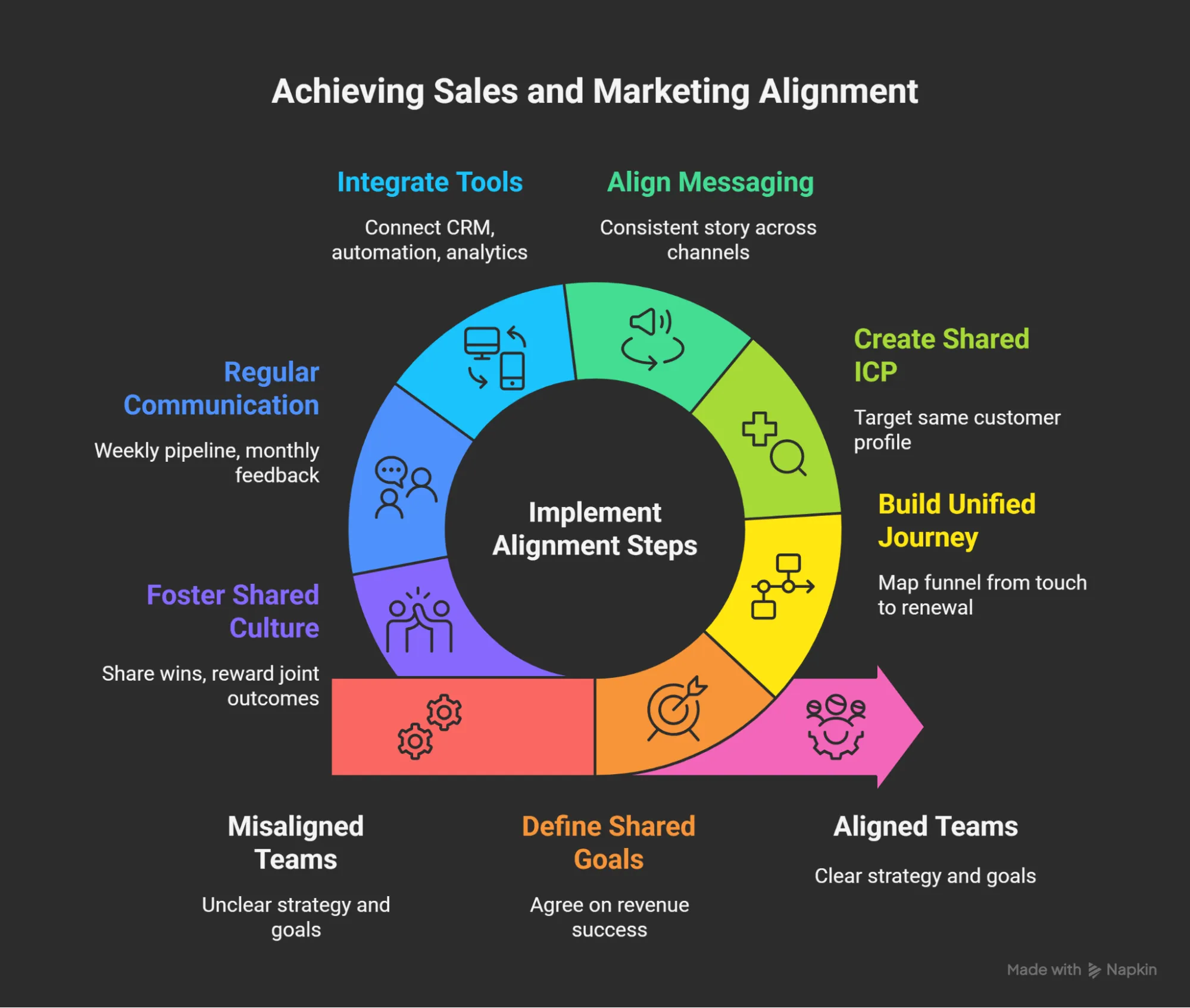
Step 1: Define Shared Goals and Metrics
Start by agreeing on what “success” means in revenue terms. If Marketing is chasing volume and Sales is chasing closed-won, alignment won’t hold.
We advise you to pick a short list of shared outcomes that both teams own. Here’s what works best for us:
- Pipeline created from target accounts.
- Lead-to-opportunity rate for qualified leads.
- Deal velocity by sales funnel stage.
- Win rate for ICP opportunities.
- Revenue influenced per campaign.
Then lock the definitions that sit under those metrics. Spell out what counts as a qualified lead, what qualifies as an SQL, and what disqualifies a lead. Put it in writing and tie it to your CRM system fields and dashboards.
Here’s why this matters: The Mural report also found decision makers were twice as likely (43%) to blame misalignment on unclear strategy and goals, compared to individual contributors (22%).
When the strategy is vague, every team fills the gaps with its own version.
Step 2: Build a Unified Customer Journey
Build the customer journey with Sales and Marketing in the same room. Keep it grounded in how deals actually happen in your market.
We’ve seen good results mapping the full funnel from first touch to renewal:
- Awareness and demand generation.
- Consideration and evaluation.
- Sales conversations and the validation process.
- Procurement and close.
- Onboarding, customer success, and customer retention.
Then, we recommend you to check where things break. Look for messaging gaps, intent drop-offs, and handoffs that happen too late. Those moments show you exactly what to fix in timing, content, and ownership.
Pro tip: In our experience, there’s one practical layer that teams skip: what the buyer is trying to confirm at each stage. If you can’t answer that, your content marketing assets and sales collateral will feel generic, and your sales cycle will stretch.
Step 3: Create a Shared Ideal Customer Profile (ICP)
As we explained above, a shared Ideal Customer Profile keeps both teams pulling toward the same target. Without it, Marketing fills the funnel with the “easiest” leads, and Sales wastes time filtering.
Build the ICP together and make it specific. Here’s how we do it at inBeat Agency:
- Firmographics: Industry, company size, geography, tech stack.
- Buying triggers: Funding, hiring, tool replacement, compliance deadlines.
- Buying committee: Who influences, who approves, who blocks.
- Intent signals: High-fit page visits, pricing views, demo requests, repeated engagement.
- Disqualifiers: Low ACV, missing use case, wrong department, poor fit timing.
If you run account-based marketing, turn your ICP into a target account list and keep it shared and version-controlled. Stick to one source, and your go-to-market motion doesn’t drift across tools and individual files.
Step 4: Align Messaging and Content Strategy
Alignment breaks the moment the story changes between the ad, the landing page, and the sales call.
Create one messaging foundation that both teams use. Our experts at inBeat prefer to keep it short, specific, and tied to real customer needs:
- The primary pain points and what they cost.
- The outcomes buyers care about and how you prove them.
- The top objections and clear answers.
- Voice of Customer language pulled from calls, emails, and notes.
- Proof assets like case studies, benchmarks, white papers, and sales enablement content.
Then, we advise you to validate it against real deals. Sales should review campaigns and point out what performs well and what doesn’t.
Remember: Marketing should review decks and sequences to ensure they match the buyer journey and stay consistent with top-of-funnel messaging.
Of course, we also recommend keeping some flexibility for the segment and deal context. The goal is one core narrative that stays credible in every conversation.
Step 5: Integrate Tools and Data
Sales and Marketing can’t stay aligned if they work from different sources.
At minimum, connect:
- Your CRM system for lead status, opportunities, funnel stages, and outcomes.
- Marketing automation tools for lead nurturing, attribution, and the lead scoring model.
- Analytics tied to pipeline and revenue, and not just for traffic.
- Intent data and engagement signals that show account activity over time.
- Shared dashboards that both teams trust.
Once the systems are connected, clean up the data that feeds them. Standardize fields, enforce lead qualification criteria, remove duplicates, and clarify ownership across Sales, Marketing, and RevOps.
Also, keep an eye on the AI maturity gap. Norwest’s latest benchmark report found Marketing ahead of Sales on adoption: 40% of Marketing teams report 3+ use cases or integrated adoption, while 74% of Sales teams are still in research, pilots, or 1-2 use cases.
The same report cites 27% integrated use cases across Marketing teams versus 11% in Sales. If workflows diverge, the process tends to split with them.
Pro Tip: If handoffs still break in a “connected” stack, review your marketing automation workflow. And check our marketing automation statistics to get more insights.
Step 6: Set Up Regular Communication Cadence
Cadence keeps alignment from turning into a one-time clean-up.
We usually run two recurring sessions:
- Weekly or biweekly pipeline and lead quality review (30 minutes).
- Monthly messaging and campaign feedback review (45 minutes).
We advise our clients to keep the agenda consistent, so each meeting leads to clear next steps. Here’s what we typically focus on:
- What turned into a pipeline, and why?
- What stalled, and why?
- Where did the lead scoring model miss the mark?
- Which content assets did Sales use, and what helped?
- What objections are coming up in calls and emails?
Clear structure matters because communication is still hard even when teams share similar learning styles.
Pro tip: Mural also reported that Sales and Marketing are equally likely to learn best through visual means or reading and writing (61%). We apply this because many still find it difficult to communicate clearly between teams (41% for Sales, 43% for Marketing) and we want to avoid that.
We also encourage you to have a fixed agenda to reduce friction and keep feedback actionable.
Step 7: Foster a Shared Culture
Process gets you started, but culture keeps alignment consistent.
We like to set a few operating norms that make collaboration stick:
- Share wins across the revenue team, not just inside departments.
- Treat feedback as a signal, not blame.
- Use shared language for funnel stages, lead scoring, and the customer journey.
- Reward joint outcomes, such as pipeline velocity and revenue alignment.
This also protects your team. That’s exactly what you need seeing that 80% of leaders report signs of burnout or regretted attrition tied to execution strain. Well, cleaner alignment reduces rework, confusion, and internal friction over time.
How To Measure Sales And Marketing Alignment (And Know It’s Working)
If you don’t measure alignment, and simply focus on activity, something weird happens:
You hit lead targets and still miss the pipeline.
To avoid this, we like to start with a short list of metrics that both Sales and Marketing own:
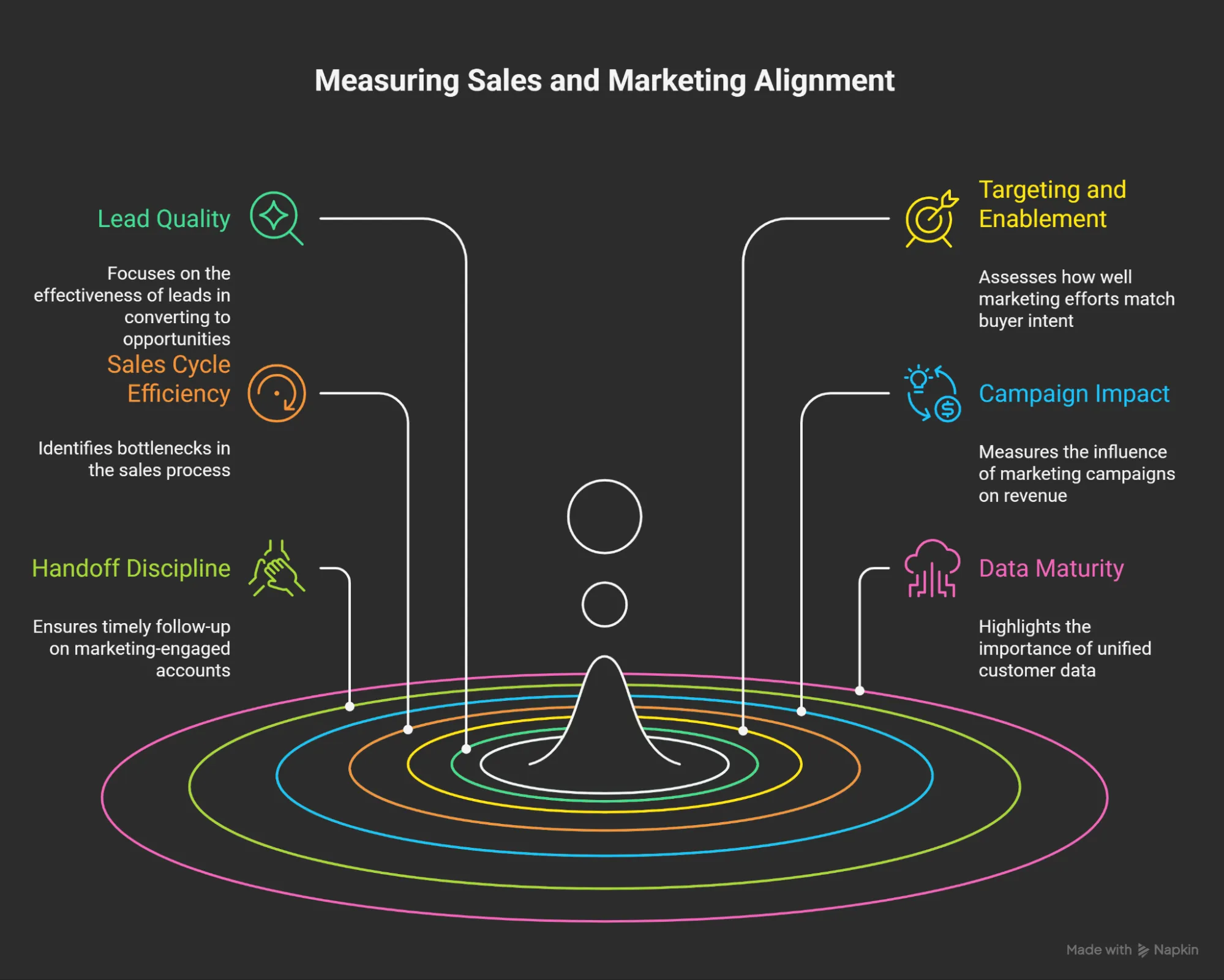
- Lead-to-opportunity rate for qualified leads: Proves lead quality, not just volume.
- Opportunity-to-close rate: Shows if targeting and enablement match buying intent.
- Deal velocity by sales funnel stage: Highlights where handoffs or messaging slow the sales cycle.
- Pipeline and revenue influenced by campaign: Ties demand gen and content to outcomes.
- Time-to-first-follow-up on marketing-engaged accounts: A direct handoff discipline check.
Then, we advise you to watch for signals that don’t show up in dashboards:
- Fewer “bad lead” debates because lead qualification criteria are clear.
- Faster Sales feedback on lead scoring and recurring objections.
- More consistent use of marketing collateral and sales collateral across the sales cycle.
- Cleaner pipeline reviews because funnel stages and definitions match inside the CRM system.
Data maturity matters here, too.
ADC Group also adds that if data stays fragmented, proving revenue alignment gets harder, even when execution improves.
Unfortunately, Salesforce reported that only 31% of marketers are fully satisfied with their ability to unify customer data sources, and only 48% track customer lifetime value (CLV).
At inBeat Agency, we can help you avoid that so you can outperform your competitors.
What Alignment Looks Like Inside Companies Like inBeat
Alignment holds when Sales insights reach Marketing quickly and stay clear.
In our agency, real conversations become inputs. Marketing then turns them into stronger messaging, clearer service descriptions, and proof assets that support the sales cycle.
That loop keeps content tied to what prospects actually ask for. It also helps Sales rely on consistent collateral instead of rewriting the story in every call.
As inBeat’s Marketing Lead, Nadiia Shevelieva, explains:
“At inBeat, we keep sales and marketing aligned by sharing insights quickly and clearly. Our sales team records their calls in Fathom, and as marketers, we listen to understand the real reasons clients reach out to us: what they need, what challenges they face, and what they hope to achieve. These insights help us improve our service descriptions, sharpen our messaging, and create case studies that speak directly to each type of client. For us, alignment means working as one team, using shared data and real client conversations to create content that supports sales and clearly shows the value we deliver.” (Nadiia Shevelieva, Marketing Lead at inBeat Agency)
Remember to keep measurements on a cadence: Review quarterly, update lead scoring, and tie reporting to pipeline velocity and closed-won revenue.
Make Sales And Marketing Alignment Part Of How You Operate
Sales and marketing alignment takes ongoing work. It keeps the pipeline more predictable as goals shift, channels change, and buying cycles stretch.
Once you align, protect the basics: shared definitions, shared visibility, and a clear feedback loop between teams.
Want help tightening your handoff and turning alignment into a qualified pipeline? Contact us today, and we’ll review your current workflow.
FAQs
Why Is Sales And Marketing Alignment Important For Business Growth?
Because growth depends on a predictable pipeline. When Sales and Marketing run on the same definitions and priorities, lead handoffs get cleaner, and follow-up improves. That keeps the sales cycle moving and reduces wasted effort.
What Is An Example Of Sales Alignment?
Sales alignment shows up when the team follows the same qualification process, uses consistent messaging, and tracks deals the same way in the CRM. Everyone knows what a qualified lead looks like and what has to happen at each funnel stage.
What Are The Benefits Of Aligning Sales And Marketing Teams?
You get better lead quality, clearer messaging across touchpoints, and smoother handoffs. Teams also spend less time debating performance and more time fixing what slows the pipeline.
What Are The Common Barriers To Sales And Marketing Alignment?
Misaligned KPIs, unclear MQL vs SQL definitions, weak feedback loops, and limited visibility into the same data. Tool silos and inconsistent CRM hygiene can also create friction fast.
What Are The Best Practices To Establish Communication Between Sales And Marketing Teams?
Keep a simple cadence with structured agendas. Focus on lead quality feedback, pipeline movement, and recurring objections. Document decisions so changes make it into scoring, messaging, and campaigns.
How Can Businesses Measure The Impact Of Sales And Marketing Alignment?
Track revenue-linked metrics like lead-to-opportunity rate, opportunity-to-close rate, and deal velocity by stage. Also watch operational signals like fewer handoff issues, faster feedback, and more consistent use of content in live deals.