



A localized ad campaign usually gets judged by the numbers the platform surfaces first: CTR, CPM, thumb-stop rate. Those numbers can look healthy while the campaign bleeds money one step later, on a landing page that greets a German buyer in English, prices in dollars and quotes US shipping times.
The click was bought. The creative qualified the buyer. Then the destination undid the work.
This guide is a destination audit for growth and ecommerce leads launching paid ads into a new country. It covers:
- What must match the ad on the page
- How to decide between separate pages and one page with dynamic content
- The tests that have to pass before spend goes live
Most of those tests run on a phone, because that is where the large majority of paid social clicks land.
P.S. If you'd rather have a second pair of eyes on your international destinations, inBeat's conversion and CRO work covers this kind of pre-launch audit.
We treat the landing page as the last frame of the ad. A localized creative does the audience selection that platform settings can no longer do on their own. So the page has to carry the same persona, the same promise and the same price in the same currency, or the targeting the creative earned is thrown away on the first scroll.
That's why we read market-level CPA as the outcome of one experiment that runs from impression to checkout. The page team, the creative team and the media buyer should be looking at the same dashboard. A page that halves acquisition cost in one market becomes the brief for the next batch of creative, and a page that leaks checkouts gets fixed before another dollar goes out.
TL;DR: Localized Landing Page Checklist Before International Ads
If you only read one section before approving spend, use these five checks as the launch gate:
- Match the ad's offer, language and currency first. A German-language Meta ad that lands on an English page with GBP pricing fails three checks at once, and the buyer rarely scrolls far enough to find out whether the product is good.
- Verify the checkout with a real test purchase. Check currency, payment methods, delivery promise and required disclaimers from inside the target country, on a phone.
- Treat mobile as the default QA device for paid social. Meta reports that the substantial majority of its ad revenue comes from mobile devices, so a translated layout that breaks on a small screen is a cost line.
- Pick the setup by what differs between markets. Use one page with dynamic content insertion when markets share an offer and a checkout. Use separate pages when offer, compliance or payment flow differ.
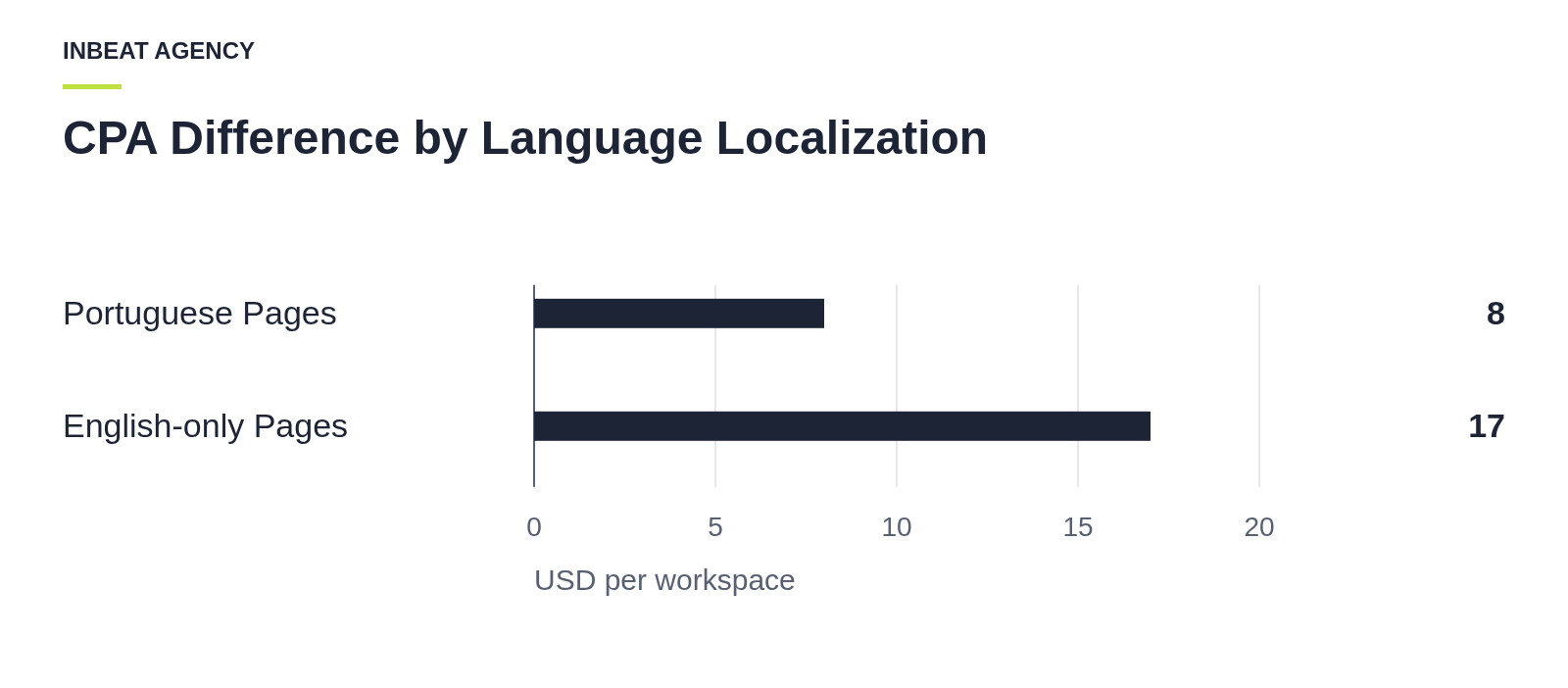
- Read market-level CPA as the scoreboard. One vendor-reported case puts Portuguese-language pages at $8 per workspace against $17 for English-only pages; the sections below unpack what that case does and does not prove.
The checklist section carries the element-by-element audit; the testing section tells you how to prove each element passed.
What Is Landing Page Localization for Paid Ads?
Landing page localization for paid ads means adapting every element a buyer meets after the click, so a visitor from another country can convert without friction: the offer, the language, the currency, the proof, the delivery promise, the compliance elements and the checkout itself.
Google can now offer automatic translation, as you can see in the clip below:
Google ads localization explained
But translation is only one input. The audit is the whole post-click experience.
Localization Adapts the Whole Post-Click Experience, Copy Included
A translated headline over a USD price table is a half-finished page. The ad made a promise in the buyer's language, usually with a specific discount or trial length, and the page has to:
- Repeat that promise
- Price it in the buyer's money
- Say when the product arrives
- Let the buyer pay the way they normally pay
Each of those is a separate adaptation, and each can fail independently of the others. That's why the checklist later in this guide treats them as eight distinct elements.
Internationalization Is the Technical Layer That Makes Content Swapping Possible
Internationalization, usually shortened to i18n, is the engineering work that comes first. Centus describes it as making a site adaptable to different languages, cultures and regions, so that language and formatting change without modifying the code.
Everything in this audit assumes that layer exists. If swapping a currency symbol or a date format requires a developer ticket, the loop described in the maintenance section will not run at a marketing team's pace.
Location Pages for Local SEO Solve a Different Problem
Most guidance that ranks for this topic is about location pages: city-level pages built to rank for "service near me" queries, dependent on consistent business listings and indexation rules.
A paid destination never needs any of that. It needs to convert a click you already paid for. Write a one-line scope statement in your launch brief saying exactly that, so nobody confuses the destination audit with local SEO work.
Ad adaptation and overall market-entry planning sit outside this guide too; this is the page.
Why Landing Pages That Don't Match the Ad Raise CPA in New Markets
The mechanism is simple: by the time a visitor reaches the page, the ad has already paid for a qualified click. Nothing that goes wrong afterward changes the ad's CTR or its CPM; it only changes how many of those clicks turn into a purchase or a signup.
So every post-click mismatch shows up directly in CPA. In a new market, it shows up before anyone has enough data to tell whether the audience or the page is to blame.
Visitors Who See the Wrong Language, Currency or Offer Leave
The clearest documented comparison comes from Tailor AI, a localization vendor. It reports that one team saw roughly 50% lower CPA with Portuguese-language campaigns, at about $8 per workspace against $17 with English-only pages.
That is a single team's result, published by the vendor in 2026. Read it as the size of gap that is possible, because it's not a benchmark per se.
Shoppers say the same in surveys, though.
In DHL's 2026 E-Commerce Trends Report, 41% of shoppers said prices in their local currency would encourage them to buy from another country. Yet 21% of US and 22% of Canadian online businesses still don't localize their store's language and currency.
Most Paid Social Clicks Land on a Phone
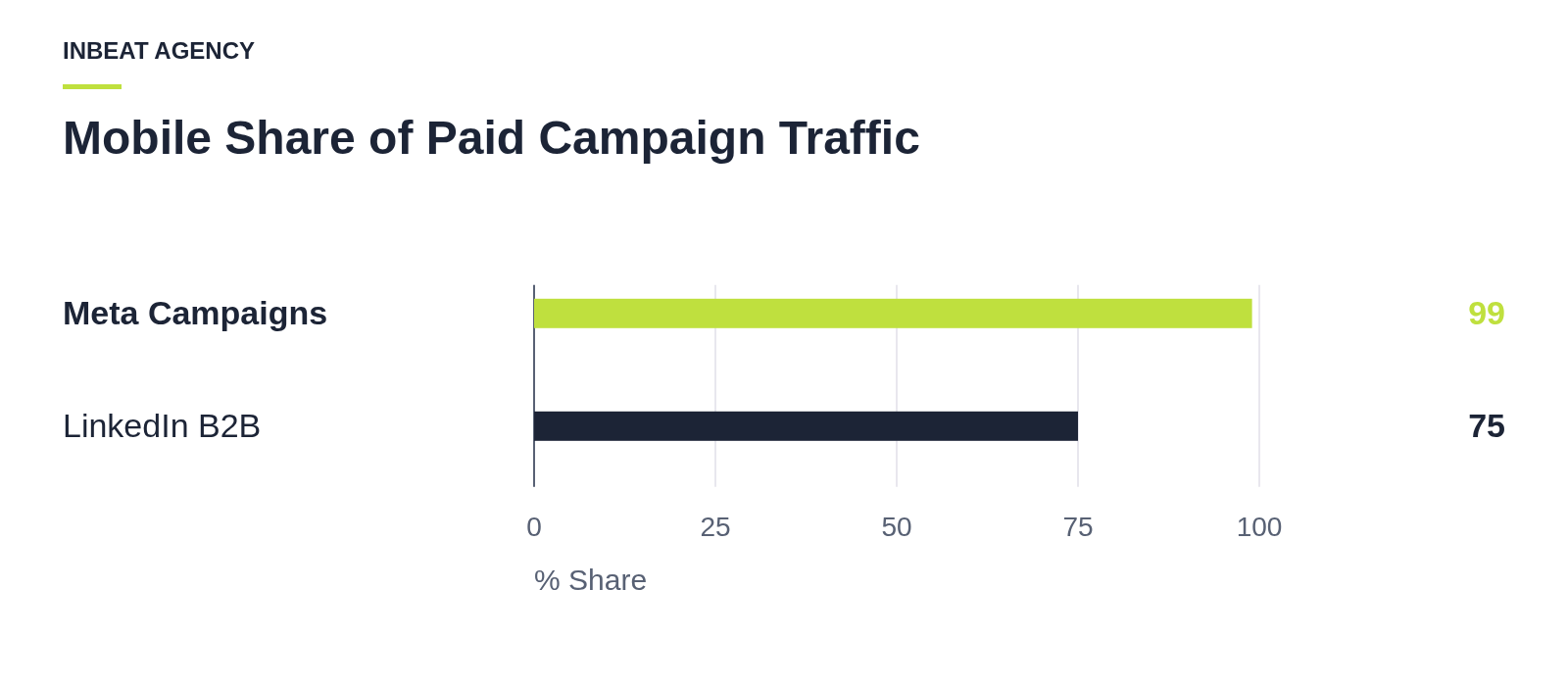
Meta's own annual report for 2025 states that the substantial majority of its revenue comes from advertising on mobile devices. Shoppers have moved the same way: in DHL's 2026 survey of 29,000 online shoppers in 29 countries, 72% said they prefer apps when browsing and buying.
Tailor AI has its own in-house data about Meta campaigns and LinkedIn B2B, both of which rely heavily on mobile traffic.
So check every localized page on a phone. If your localized layout wraps a long German compound noun across the hero, pushes the price below the fold or breaks the checkout button on a common Android screen size, that is a per-market CPA problem. No desktop review will catch it.
How to A/B Test a Localized Page Against the Original in the Same Market
Set up the comparison before launch, so you can read it per market:
- Build the localized page and keep the original live as the control.
- Split the same audience and the same budget between them within one market, using identical creative.
- Run both for the same period and compare CPA and checkout completion. A page can win on conversion rate and lose on average order value or trial quality.
- Repeat per market. A win in Brazil tells you nothing about Germany.
CPA and MER by market are the scoreboard for this work. If the localized page does not move either within the test period, the mismatch you fixed was not the one costing you money, and the checklist in the next section is where to look.
Localization Checklist: 8 Landing Page Elements That Must Match the Ad
Check currency, checkout and compliance first. Those are the fields where a miss costs the most and is hardest to see from the ad account.
Then work through the eight elements below, grouped the way a buyer meets them: what the page promises, what it charges and how it takes payment, and whether it feels local on a phone. Mark each one pass, fail or not applicable per market before any spend is approved.
Offer, Headline and Language Register Must Repeat the Ad's Promise
1. Offer and headline. Whatever the ad promised (a percentage discount, a bundle, free shipping or a 14-day trial) appears on the page in the same words and the same numbers.
Example: a D2C skincare brand runs a German Meta ad promising "kostenloser Versand" and sends buyers to a page with USD pricing and five-to-seven-day US shipping. The language passes. The offer is technically present. The buyer still leaves, because the free-shipping promise sits next to a currency that tells them the store is not for them.
How to check: place the ad copy and the page hero side by side and read them as the buyer would.
2. Language, tone and formality. Have a native speaker review register along with accuracy:
- Formal and informal address differs between markets, and between audiences within one market.
- The language variant matters. Brazilian and European Portuguese are different enough that the wrong one reads as foreign.
- Formats follow the market: dates, number separators, decimal commas and address order. A page that writes 1,500 where the market expects 1.500 misprices the product in the buyer's eye.
Currency, Delivery, Checkout and Payment Methods Must Match the Buyer's Market
3. Currency and prices. Show local currency by default, and state how tax or VAT is handled. In Baymard Institute's checkout research, extra costs like shipping, tax and fees are the top reason shoppers abandon a purchase, cited by 40%.
A price quoted without VAT in a market where the law and buyers expect inclusive prices feels like a bait-and-switch at checkout. Your data will show it as a drop between add-to-cart and purchase.
4. Delivery times and return policy for that country. State the delivery window for the buyer's market, name any duties or import charges, and give a return process that works from that country.
Vague international shipping language is a trust leak, and it concentrates in exactly the markets where you have the least brand recognition. In the same DHL survey, 45% of shoppers named high delivery costs or long delivery times as a barrier to buying from abroad, and 41% named customs, duties and taxes.
5. Checkout and local payment methods. The payment methods a buyer expects should be visible before they commit, on the page or in the first checkout step. That may mean local card schemes, bank transfer, buy-now-pay-later or a wallet that dominates the market.
A page that only shows a US credit card form in a market where most people pay by transfer will show high checkout starts and low completions, and no amount of ad optimization fixes it. DHL's 2026 report also found 62% of shoppers abandon a purchase when their preferred payment option isn't available.
Proof, Forms and Mobile Layout Must Feel Local on a Phone
6. Reviews, client logos and local proof. Proof should come from the market, or at minimum from the language. English reviews from US customers under a French headline tell a French buyer that other French buyers have not shown up yet.
- For consumer brands, creator content from the market is the fastest route to proof that looks local. The same logic that makes a creator relevant to an audience, covered in our piece on the 3 Rs of influencer marketing, makes their testimonial land on a localized page.
- For B2B pages, logos of companies the buyer recognizes from their own market do the same job, and our B2B marketing coverage goes deeper on proof for that buyer.
7. Form fields. Postal code validation, name order, phone number formats and mandatory fields all vary. A form that rejects a valid UK postcode or forces a US-style state field on a buyer in Spain fails silently: your analytics show high form starts with low submissions.
How to check: test with real local addresses; placeholder text isn't good enough here.
8. Mobile layout after translation. Translated copy is often longer and wraps differently. QA the finished page on a device set to the market's language, at the screen sizes that dominate there, and confirm the primary CTA is visible without scrolling.
Paid social is overwhelmingly mobile, so a desktop-only review of a translated page is a review of traffic you barely have.
Use this table as your launch QA document. Each row names what must match, how to verify it before launch and the signal that tells you it failed once spend is live.
| Element | What must match the ad or market | How to verify before launch | Fail signal in the data |
|---|---|---|---|
| 1. Offer and headline | Same discount, bundle or trial length as the ad, in the same words | Place ad copy and page hero side by side; native speaker confirms the promise reads identically | High CTR with low scroll depth and high bounce in that market |
| 2. Language and register | Correct language variant, formality, date and number formats | Native-speaker review on a phone set to the market's locale | Bounce rate higher than the home market at equal traffic quality |
| 3. Currency and prices | Local currency by default with tax or VAT handling stated | Load the page from inside the country and compare displayed price to checkout total | Drop between add-to-cart and payment step |
| 4. Delivery and returns | Country-specific delivery window, duties and return process | Read the delivery block as a first-time buyer from that country | Cart abandonment at the shipping step |
| 5. Checkout and payment methods | Payment methods the market expects, visible before commitment | Complete a test purchase with a local test card or method | High checkout starts, low completions |
| 6. Proof | Reviews, logos or creator content from the market or language | Audit every proof block for origin and language | Time on page without conversion, low trust-section engagement |
| 7. Forms | Accepts local postal codes, name order and phone formats | Submit forms with real local addresses and numbers | High form starts, low submissions, validation errors in logs |
| 8. Mobile layout | CTA and price visible without scrolling on common local devices | QA at the market's dominant screen sizes in the market's language | Mobile conversion rate far below desktop in that market alone |
The mobile weighting behind row 8 follows Meta's report that most of its ad revenue comes from mobile, cited in the CPA section.
The fail signals point to a likely cause without confirming it. A drop at the payment step can also mean a pricing problem, so use the signal to decide which element to retest before deciding which one to blame.
The elements also interact. Fixing currency without fixing delivery often moves the abandonment point one step later instead of removing it. Run the full eight for every market, every launch, and keep the completed table as the record a media buyer can check before the first impression is bought.
Separate Localized Landing Pages or One Page With Dynamic Content Insertion?
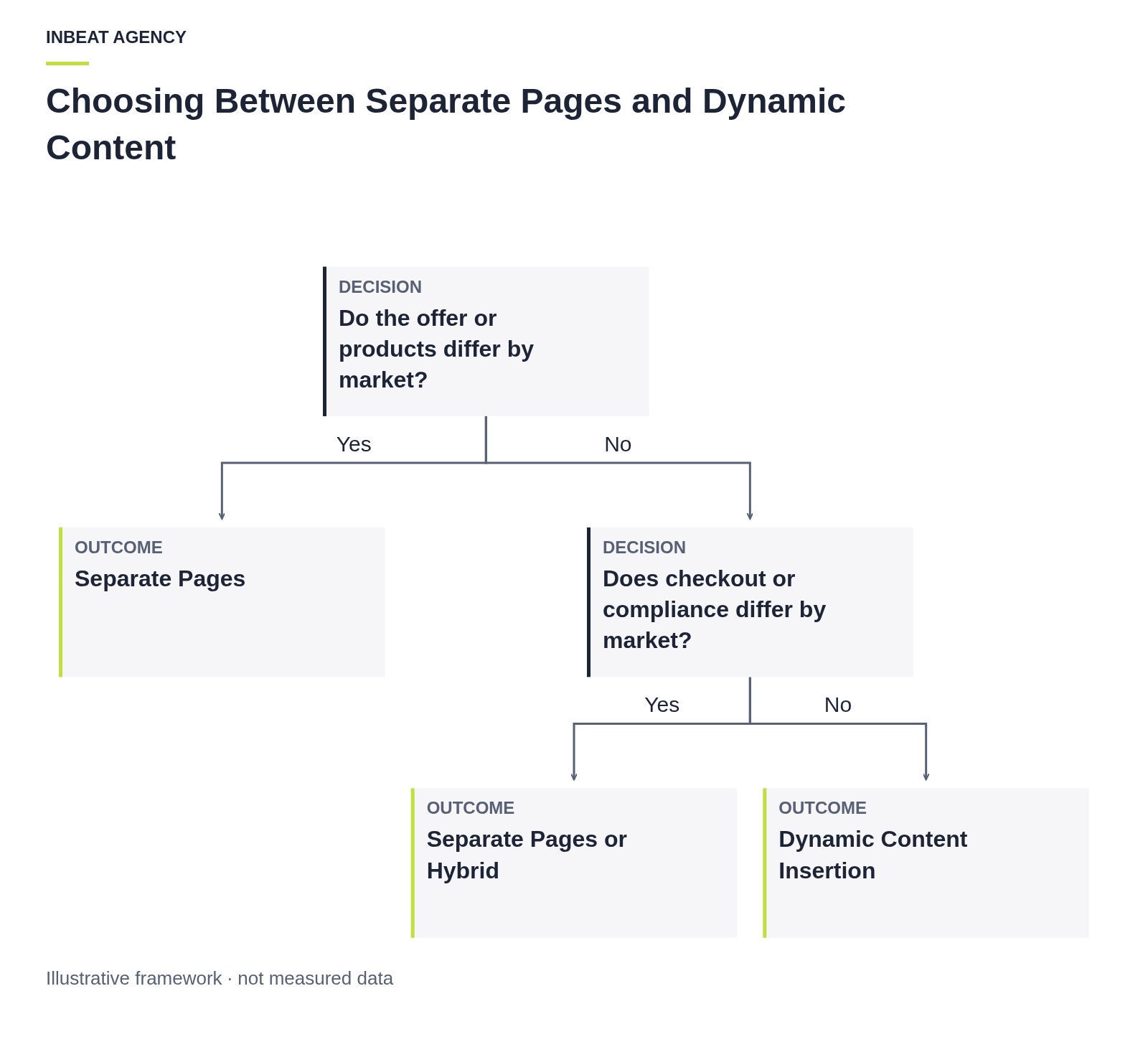
Default to one page with dynamic content insertion when the offer and the checkout are shared across markets. Move to separate pages only where a market's compliance, pricing or payment flow forces you to.
That's our position, and two questions decide it:
- Does the offer differ by market?
- Does checkout or compliance differ by market?
Two noes mean dynamic insertion. Either yes means at least one separate page.
When Separate Landing Pages per Market Are the Better Setup
Separate pages give you full control per market and a simpler compliance review, because a lawyer or a regulator can look at one URL and see exactly what a buyer in that country sees. They make sense when a market needs its own disclaimers, its own price structure or a different payment flow entirely.
The cost is maintenance. Every creative change, every offer update and every proof swap has to be made on each page, and the work grows with the market count. Teams that run five markets on separate pages often end up with five slightly different pages that nobody has reconciled against the current ads, a quieter version of the mismatch this guide exists to prevent.
When One Page With Dynamic Content Insertion Is Enough
Dynamic insertion keeps one URL and swaps language, currency, delivery copy and proof blocks based on where the visitor is: usually by IP, sometimes by browser language or an ad parameter. The ad destination URL stays the same across markets, the checkout stays shared and an offer change is made once.
The failure mode is detection. IP lookups misplace VPN users and travelers: a buyer in Lisbon on a corporate VPN routed through Frankfurt gets a German page. A visible language and currency switcher is therefore a required fallback, placed where a buyer finds it in the first screen.
Example: a retailer selling the same bundle across five EU countries runs one URL with dynamic currency and language blocks. Its regulated supplement line in Canada gets a separate page, because province-specific disclaimers and a different checkout make dynamic swapping more fragile than it is worth.
What Your Website Platform Needs to Support Each Setup
- Dynamic swapping depends on the internationalization layer described earlier. If language and formatting can't change without code changes, the one-URL approach becomes a developer queue and the marketing team loses the ability to iterate.
- Geo detection needs device-level checks alongside it. Because paid social skews so heavily to mobile, the swapped content has to be checked at phone widths.
- Separate pages need less from the platform and more from the process: version control, a shared template and a release checklist that lists every market page.
| Setup | Best for | Maintenance load | Failure mode | Fallback needed |
|---|---|---|---|---|
| Separate page per market | Markets with distinct offers, compliance requirements or payment flows | Grows with each market and each creative change | Pages drift out of sync with current ads | Shared template and a release checklist covering every market URL |
| One page with dynamic insertion | Shared offer and shared checkout across markets | One change propagates everywhere | Wrong market served to VPN users and travelers | Visible language and currency switcher in the first screen |
| Hybrid | Most markets share, one or two do not | Low for shared markets, high only for exceptions | Exceptions forgotten in a global offer change | Exception list reviewed with every ad refresh |
The platform requirement in this table rests on the Centus description of internationalization linked in the definition section; the mobile caveat rests on Meta's mobile revenue figure cited in the CPA section.
How to Test Localized Landing Pages Before Launch
Run every step below for every market in the launch, on a phone, and block spend until each market completes with conversion events firing. The steps follow the order a buyer experiences the page, so a failure early in the sequence usually makes the later steps moot until it is fixed.
Reach the Page the Way a Local Buyer Does (Steps 1 and 2)
1. Open the page from inside the target country. Use a VPN or geo-proxy set to the market, on a phone with the device language set to the market's language.
This is the only way to see the currency, language and proof blocks a local visitor actually receives, and it is where dynamic insertion errors surface. If a switcher is present, use it to confirm the fallback works too.
2. Run a real test purchase in local currency. Use a local test card or the market's dominant payment method where your processor supports it. Then confirm that:
- The displayed price matches the final total, including taxes and duties. Extra costs are the top reason shoppers abandon checkout in the Baymard research cited in element 3.
- The delivery estimate matches what the page promised.
- The local payment options actually appear in checkout.
Example: a B2B SaaS trial page for Brazil that passes language review but offers only US credit card checkout fails here. In live data it would show as high form starts with low completions.
Check Compliance and Tracking the Ad Did Not Need (Steps 3 and 4)
3. Check the legal elements the market requires. Cookie banners, age gates, pricing disclosures, financial or health disclaimers and consent language vary by country, and sometimes by region within a country.
Confirm each required element is present, then confirm the combination does not push the primary CTA below the fold on the market's common phone sizes. A page that contradicts the ad or hides a mandatory disclosure invites user complaints and ad policy reviews. The fix lives on the page; ad settings cannot repair it.
4. Confirm pixel and conversion events fire on every variant. Every localized page or dynamic variant has to send the same events with the same names and values, in the currency you report in, or market-level attribution breaks.
Missing purchase events in one market can disrupt optimization and distort market comparisons. Underreported purchases inflate reported CPA; if no purchases are recorded, purchase CPA cannot be calculated.
Review on a Phone With a Native Speaker and Judge the Result (Step 5)
5. Have a native speaker review the finished page on a phone. They check register, wrapped headlines, truncated buttons and anything that reads as machine-made. Then define pass criteria in writing:
- A completed test transaction
- A CTA visible without scrolling at the market's common device sizes
- Events confirmed in the ad platform
- Post-launch CPA and checkout completion tracked per market against the original page
The Tailor AI Portuguese case shows the kind of gap a passing page can open up, with the single-case caveat already noted.
The high-stakes fields deserve their own pass criteria, because a fail in any one of them is a reason to hold spend.
| Field | Risk if wrong | Pre-launch test | Pass criterion |
|---|---|---|---|
| Currency and final price | Buyers abandon at the payment step when total differs from displayed price | Geo-proxied test purchase from inside the market | Displayed price equals final total including tax and duties |
| Payment methods | Checkout starts with few completions | Complete purchase with a local test card or local method | Market's expected methods appear and process successfully |
| Compliance elements | Complaints, policy flags, mandatory disclosures hidden | Legal review of required notices on a phone at common screen sizes | All required notices present and CTA still visible without scrolling |
| Conversion tracking | Market-level CPA invisible or misleading | Fire each event on every variant and confirm in platform | Purchase and lead events recorded with correct currency and value |
| Mobile layout | Translated copy breaks hero, price or button | Native-speaker review on a device in the market's language | No truncation, CTA and price in first screen |
The weighting toward mobile in this table follows Meta's mobile revenue figure and the DHL app-preference data cited in the CPA section.
Our PPC and paid social teams brief the page and the ad together, so the test purchase happens before the first impression is bought. Doing it the other way round, launching and then auditing, turns the first week of international spend into an expensive way to find a broken checkout.
How to Keep Multilingual Landing Pages Updated During a Campaign
Add a localized-page review step to your creative refresh checklist so no new ad goes live against a destination nobody has rechecked. Launch QA proves the page matched the ad on day one; the loop below keeps it matched for the life of the campaign.
Update the Page Every Time the Ad Changes
1. Tie every localized page or dynamic variant to the ad set it serves, in the campaign tracker, so a new creative angle triggers a page review alongside the ad swap.
Example: a quarterly change from free shipping to a percentage discount has to update the headline, the price display and the delivery block on every market page, in the same release as the ads. If one market's page still promises free shipping a week after the ad stopped, you have rebuilt the mismatch you spent launch week removing.
Retest Each Market's Page on a Set Schedule
2. Re-run the geo-proxied mobile test purchase monthly, and after any payment, shipping or compliance change in the market.
Payment providers alter checkout flows, carriers change delivery windows and regulators change disclosure rules without telling your marketing team. A short recurring test catches those changes before the data has to.
Use Each Market's CPA to Brief the Next Round of Ads
3. Compare CPA and checkout completion by market and by variant, and route what you learn into the next creative brief and the next page brief at the same time.
The Tailor AI Portuguese result is the shape of a finding worth briefing on: one language variant, one clear cost gap, one obvious next test. For B2B programs, pull sales feedback on lead quality by market into the same review, which is where sales and marketing alignment turns into a usable data source.
The reason this loop can run on a marketing team's cadence is the internationalization layer described earlier. When language, currency and formatting change without code changes, a page update is a content task that ships with the ads, and the destination stays the last frame of the creative.
How inBeat Connects Localized Creative to Landing Page Conversion
International ad spend is judged at the destination. The eight-element audit and the geo-proxied test purchase are the minimum gate before launch, and the market-level CPA that follows is the verdict on whether the ad and the page did their job together.
That's why we don't separate the people who make the creative, the people who buy the media and the people who read the data. When a localized angle is briefed, the page that will receive it is briefed in the same document, tested in the same QA pass and read on the same dashboard.
A growth lead with five markets queued for the next quarter can use the checklist in this guide as the shared brief for both the creative team and the page team, so neither one finds out about a mismatch from the finance report.
- Our performance creative work supplies the localized angles.
- Our paid media work treats each market as a laboratory where the destination is part of the experiment.
Book a strategy call with inBeat to review your international launch destinations alongside the paid media and creative that sends traffic to them.
FAQ
Should a localized landing page show local currency if the business settles in USD?
Yes. The buyer decides in their own currency; the settlement currency is a finance-team detail the buyer never needs to see. Show local prices, state clearly whether tax is included, and let the payment processor handle conversion at checkout.
Where the processor charges in USD and the buyer's bank converts, say so before the final step. A surprise conversion on a card statement is a refund request later.
Does machine translation pass QA for paid landing pages?
As a first draft, yes; as a shipped page, no. Machine output gets grammar right and register, variant and idiom wrong often enough that a native speaker should review every headline, CTA and proof block before launch, on a phone, in context. The cost of that review is small against the media budget it protects.
Should localized landing pages use a subfolder, a subdomain or a separate domain?
For paid traffic, a subfolder (example.com/de) is usually simplest: one pixel setup, one analytics property and one checkout. Separate country domains make sense when a market needs its own legal entity, payment flow or compliance review. Whatever you choose, confirm conversion events fire on every version before launch.
Do you need separate landing pages for each language in the same country?
Yes, when a market is officially multilingual, such as Canada (English and French) or Switzerland (German, French and Italian). Match the page language to the ad's language; country matching is just the first step. A French-language ad in Quebec should land on a French page with the same offer.


