

Pet food brands spend heavily convincing owners to try something new.
But what happens when that first bag runs out?
According to a 2026 Packaged Facts survey, roughly half of U.S. dog and cat food purchasers changed foods within the previous year. That means a new customer represents an opportunity for your brand and a retention challenge for every competitor.
That decision takes shape after delivery: as the pet tries the food, the owner manages the transition, and the next purchase approaches. This guide connects the marketing decisions that influence each stage.
TL;DR: What Works in Pet Food Marketing Right Now
- Give owners clear feeding guidance and credible product information. Then track whether the trial leads to another purchase.
- For price-sensitive households, a topper or mixer may be an easier premium entry point than a complete food switch.
- Choose channels around customer shopping habits, margins and access to repeat-purchase data before expanding spend.
- Show label-accurate product use in video, and review visual as well as spoken claims.
- The early feeding period can reveal obstacles; time reorder reminders to the transition schedule and the amount of food remaining.
For our team, the useful question goes beyond which ad earns the first sale.
Creators help us test what buyers need to see, paid media reveals which messages convert, and reorder data shows whether customers return. Together, those findings shape the next brief and keep the focus on customer behavior beyond first-purchase ROAS.
What Is Pet Food Marketing, and How Does It Differ From Other CPG Marketing?
Pet food marketing covers how brands reach owners, explain their products, and earn subsequent purchases. Three characteristics make it different from many other CPG categories.
- Two decision-makers. Owners choose what to buy, but their pets influence whether that choice becomes a regular purchase.
- An ongoing need. Food runs out, making replenishment a central part of the customer experience.
- Claims that need care. Terms such as organic, natural and human grade come with specific requirements, including when they appear in creator videos.
Market conditions have changed, too. Oliver Wyman's 2024 analysis found U.S. pet ownership back near pre-pandemic levels in 2023, while mid-priced offerings gained ground and the premium mix stayed flat.
Target Audience: Who Buys Pet Food and How Pet Parents Differ by Generation
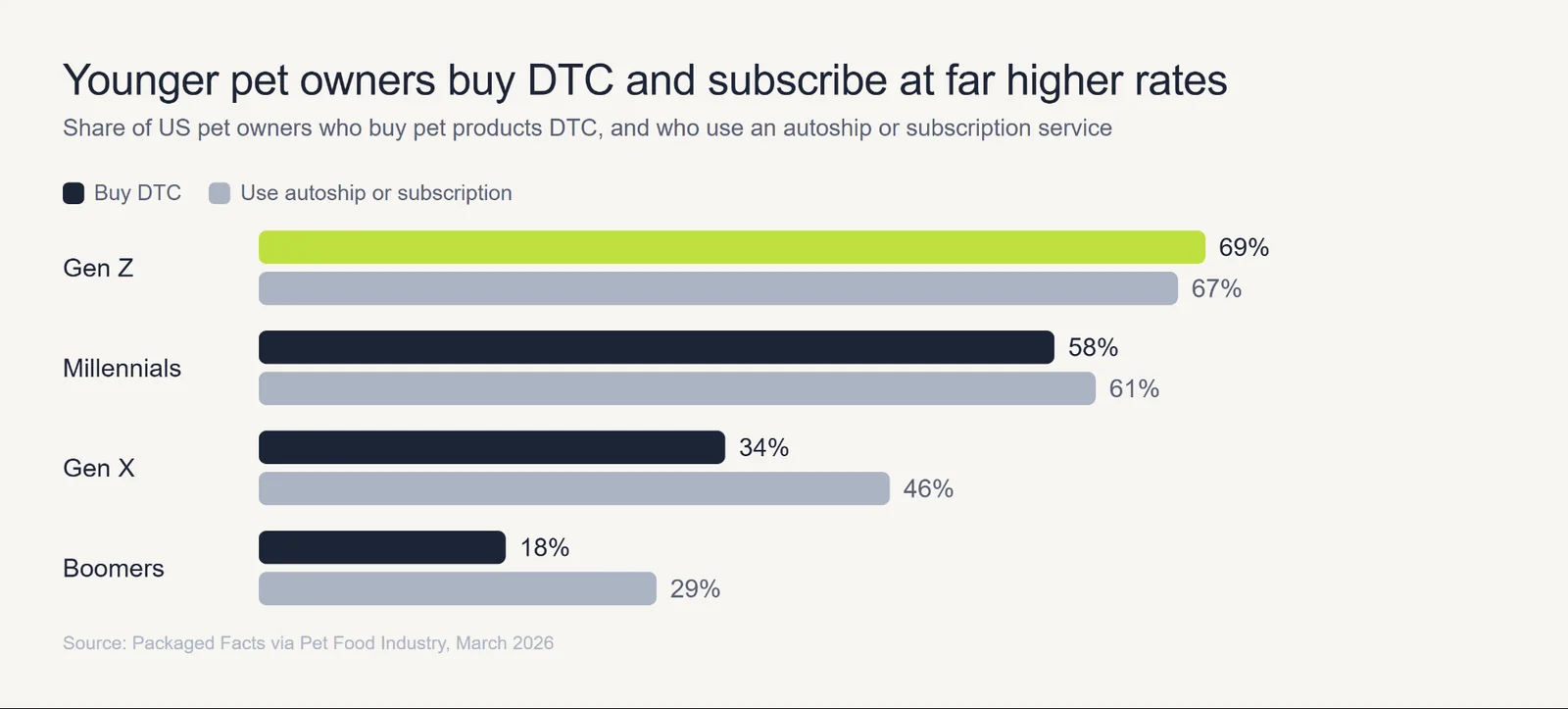
Shopping habits also differ by generation. Younger owners are more likely to buy pet products directly and use subscriptions, although these figures cover pet products broadly rather than food alone.
Packaged Facts data shows 69% of Gen Z owners buy pet products DTC against 18% of boomers, and 67% of Gen Z owners use an autoship or subscription service against 29% of boomers.
Age helps explain channel preference, but the reason someone is shopping can tell you more about what they need. Consider these four situations when building your audience segments.
| Segment | How they buy | What they need to see | Best-fit channel |
|---|---|---|---|
| New pet parent | Researches heavily, buys what a vet or creator names | A clear feeding plan and a reason to trust a new brand | Creator content and search |
| Switcher from kibble | Tries one recipe, compares to the old bag | Proof the dog accepts the food and a simple transition | DTC trial box or sampler |
| Topper buyer | Keeps basic dry as the base, adds extras | A small, affordable add-on that visibly improves mealtime | Amazon, Chewy or retail |
| Senior-pet owner | Buys against a specific health concern | A professional voice and ingredient proof | Vet-led content and email |
Treat these as working segments, then refine them using your purchase and reorder data.
Price sensitivity adds another layer. APPA's 2026 Dog Report counts 71 million dog-owning households, and says spend per household stayed flat as owners turned to value-seeking behavior.
For brands planning an offer, this makes price-per-serving messages and low-commitment trials worth testing.
Pet Food Positioning by Product Type: Dry Dog Food, Wet Dog Foods, Fresh and Raw Frozen
Start with the practical issue each format introduces.
Dry food calls for transition guidance, wet food and toppers need evidence of acceptance, fresh food needs storage advice, and raw frozen options require clear handling instructions.
APPA's dog report found that 72% of dog owners feed primarily dry food, including those who also use other formats. Many dog-food launches therefore need to explain how a new product fits an established feeding routine.
| Food type | Buyer motivation | Proof needed | Best-fit channel | Repeat lever |
|---|---|---|---|---|
| Dry dog food | Quality upgrade at a manageable price | Ingredient sourcing, feeding results | Amazon, Chewy, retail | Subscription and larger bags |
| Wet dog foods | Palatability, picky eaters, mixer use | Visible texture, dog reaction on camera | Retail and Chewy | Multipacks and variety packs |
| Fresh | Ingredient clarity and freshness | Cooking process, freshness chain | DTC subscription | Plan customization |
| Raw frozen dog food | Ingredient sourcing and feeding preferences | Safety handling, sourcing | DTC and specialty retail | Freezer-friendly shipping cadence |
| Treats and toppers | Low-risk way to upgrade a meal | Dog reaction, price per serving | Amazon and retail | Frequent small repurchase |
These are starting recommendations. Adjust the channel and repurchase tactics to suit your audience and product.
Blue Buffalo's October 2025 Love Made Fresh launch illustrates that approach.
General Mills says the launch marks its entry into the fast-growing $3 billion fresh pet food category, and that 80% of pet parents already combine fresh with other types of dog food, mainly kibble. Both figures are company-stated.
The campaign used 30-, 15- and 6-second spots across broadcast, social and digital, including "Big Ones."
Love Made Fresh™ Chuck 30. Source: Blue Buffalo on YouTube
For brands introducing a fresh line, the practical takeaway is to show how the product fits an existing meal without asking owners to change everything at once.
Premium Demand and Affordable Food: Where Value-Driven Owners Land
For some value-seeking dog owners, an affordable base food with a small premium add-on is easier to justify than a complete switch.
APPA found basic or generic dry food purchases rose to 30% of dog owners from 26% in 2024, and many of those owners add toppers, mixers, broths or human-grade foods.
That leaves two useful tests: an affordable topper or mixer where the product fits, and a cost-per-day message that makes the total feeding bill easier to compare.
Organic Pet Food and Insect Protein: Build Consumer Awareness With Proof
For organic food and novel proteins, education often comes before a trial offer. A University of Ghent study of dog and cat owners found 52% of dog owners and 62% of cat owners expressed positive attitudes toward insect-based pet food, which signals interest, although a favorable attitude alone does not establish purchase intent.
For organic products, make sourcing and certification easy to see in the creative.
Insect ingredient maker Innovafeed built @HiluciaforPets, an Instagram page led by a digital mascot named Lucia, to explain the ingredient with carousels and short video.
Pet Food Branding That Earns Trust Before the First Scoop
Branding feels more credible when packaging and videos communicate the same product promise. That consistency is especially important in two places.
Pet Humanization: Sell the Role the Pet Plays in the Family
The first is the role pets play in the household. Pew Research Center found that 97% of U.S. pet owners say their pets are part of their family. That gives brands a reason to show recognizable daily routines rather than rely on vague family language.
Freshpet's May 2026 platform, “Better Food for Your Better Half,” does this through a campaign called Kitchen Conversations. Three :30 spots, "Too Soon," "Zodiac" and "Sleep," show owners talking to their dog while they prepare Freshpet in the kitchen, running across linear and streaming TV and social.

By placing the product inside a familiar moment, the ads connect the brand message to everyday life. Brands can apply that idea at mealtime or during another part of the pet's routine.
Visual Identity and Pet Food Packaging Designs That Teach the Feeding Plan
Packaging can support owners through their first days with a new food. Beyond visual appeal, use the pack and box insert to explain the feeding plan. For example, print the transition schedule on the pack and link a QR code to a short day-one video. WSAVA guidance says diet changes should ideally happen gradually over 7 to 10 days.
Consistent colors, typography and product imagery help owners recognize the brand across packaging, videos and follow-up emails. Good pet food packaging designs also make ingredients and portions easy to find.
Pet Food Marketing Channels Compared: DTC, Amazon and Chewy, and Retail
Choose channels around where buyers already shop and what each route lets you measure. Online shopping data makes that decision particularly relevant: 39% of US pet food sales happened online in late 2025 per Packaged Facts, while omnichannel shoppers account for 64.2% of pet food spending per NielsenIQ.
These figures describe different things: the share of sales made online and spending by shoppers who use multiple channels.
Other estimates also point to online demand, although their methods differ. Euromonitor data cited by Oliver Wyman puts online pet food penetration at 34% in 2024, up from 18% in 2018.
Packaged Facts separately reports that 15% of owners buy pet food directly from brands. Chewy offers another view of subscriptions: Autoship customers generated 83.3% of fiscal 2025 net sales, about $10.5 billion. This covers Chewy's full catalog, beyond pet food alone.
| Channel | Best for | Strength | Trade-off | KPI |
|---|---|---|---|---|
| DTC subscription | Fresh, premium and personalized lines | Owns customer data and the reorder relationship | Highest acquisition cost to reach scale | Trial-to-second-order rate |
| Amazon | Dry food, toppers, treats | Intent-rich search traffic, fast launch | Marketplace controls the relationship and review dynamics | Attributed sales, brand-search lift |
| Chewy | Subscription-friendly staples | Autoship customer base | Retailer terms and margin | Autoship share of orders |
| Specialty and grocery retail | Proven products with broad awareness | Reach and shelf trust | Slower feedback, thinner data | Sell-through per store |
The qualitative comparisons reflect inBeat's assessment of typical channel trade-offs.
The comparisons are a guide; the right expansion sequence depends on customer demand, margins and what you can measure.
- At launch, test DTC or a marketplace according to where shoppers already show intent and which data you need.
- Once repeat demand becomes clearer, evaluate Chewy alongside supply capacity and margin requirements.
- Established brands can approach retail with evidence of demand, reliable supply and creative that also works in stores.
Our guide to Amazon influencer marketing covers the creator-to-marketplace link.
Pet Influencers and Creators: Casting, Briefs and Creative Testing
When casting pet creators, start with the animal's fit for the product and the creator's ability to show real use safely. Confirm objective claims and paid-use rights before filming. Several smaller creators can then explore different pet types, household routines and buyer concerns.
Chewy illustrates how widely this approach can be used: its Storefronts program featured over 600 creators by November 2025, with participants curating shoppable product lists for their audiences.
For more on casting and welfare checks, our guide to pet influencer marketing explains the screening process. Here, the creative brief should define the video's purpose before setting the shots.
| Short-form video type | Funnel stage | Who stars | Metric |
|---|---|---|---|
| Feeding reaction | Awareness | Dog and owner | Hook rate, watch time |
| Day-by-day transformation | Consideration | Owner | Click-through, saves |
| Vet explainer | Consideration | Licensed veterinarian | Cost per add to cart |
| UGC contest entry | Awareness | Customer | Entries, share rate |
| Live feeding | Conversion | Creator | Live-attributed orders |
These formats are starting points, with the final mix determined by the campaign objective.
Nulo takes a different approach. Its "Fuel Incredible" campaign pairs Olympic athletes, including Simone Biles and Caeleb Dressel, with their dogs, and the TV spot “Every Dream They Hold” is on YouTube.
According to Nulo, the campaign generated 230 million impressions across paid channels and 1.79 billion through PR. Its head of retail and product marketing explained that partnerships are chosen for the stories they tell rather than influencer status alone.
For broad-reach campaigns like this, consider a separate retargeting cut that explains the product more directly. Short creator-style edits can answer specific product questions.
Our guide to creator-first content strategy for CPG explores how to plan a coordinated set of assets.
Then test the variations before increasing spend:
- Run licensed creator videos as unpublished ads where appropriate, under comparable audience and spend conditions. Assess hook rate and cost per purchase against thresholds agreed before launch.
- Ask each creator for an emotional and an explanatory version. That lets you compare messages while keeping the person on screen consistent.
- Pause weaker cuts after a fair test, then carry the useful hook, creator profile and approved claim into the next brief.
Email, SMS and Quizzes: Own the Relationship Beyond Social Platforms
At checkout, collect consent for helpful follow-up by email or SMS. Start with the essentials: the chosen recipe, portion guidance and transition schedule.
Before purchase, a short quiz can help owners choose a recipe and portion size. Purina's Pet Food Finder asks 11 questions before recommending a food, and Ollie launched a digital health screening tool after acquiring DIG Labs. For smaller brands, the useful feature is the result: one clear recommendation with a suitable trial option.
How to Turn Pet Food Trial Orders Into Repeat Customers
A useful trial lasts long enough for a gradual switch and a few days at the full serving. Then use delivery and consumption data to decide when to follow up. The process has three parts: understand why trials stop, adapt messages to the buyer and offer autoship when the routine makes sense.
Diagnose the Drop-Off Between Box One and Box Two
Before writing the follow-up, work out why someone may hesitate to reorder. Four issues come up often.
- The pet declined the food. Palatability research notes that when pets do not find a product appealing, caregivers are unlikely to repurchase.
- The transition caused problems. A sudden food change can upset a pet's stomach, making clear instructions and support particularly useful.
- The price was hard to justify. Compared with an affordable staple, a premium formula may require a clearer explanation of cost per serving.
- The reorder reminder arrived after the food ran out. At that point, owners may return to a familiar brand.
Subscription data offers a useful comparison, with an important limitation. Recharge's analysis of 65 million subscriptions found that roughly two-thirds of subscribers continued past the first order, while fewer than 40% remained by the third.
Those cohorts span multiple industries, so use the figures to frame questions rather than set pet-food targets.
Build the 30-Day Sequence From First Box to Second Order
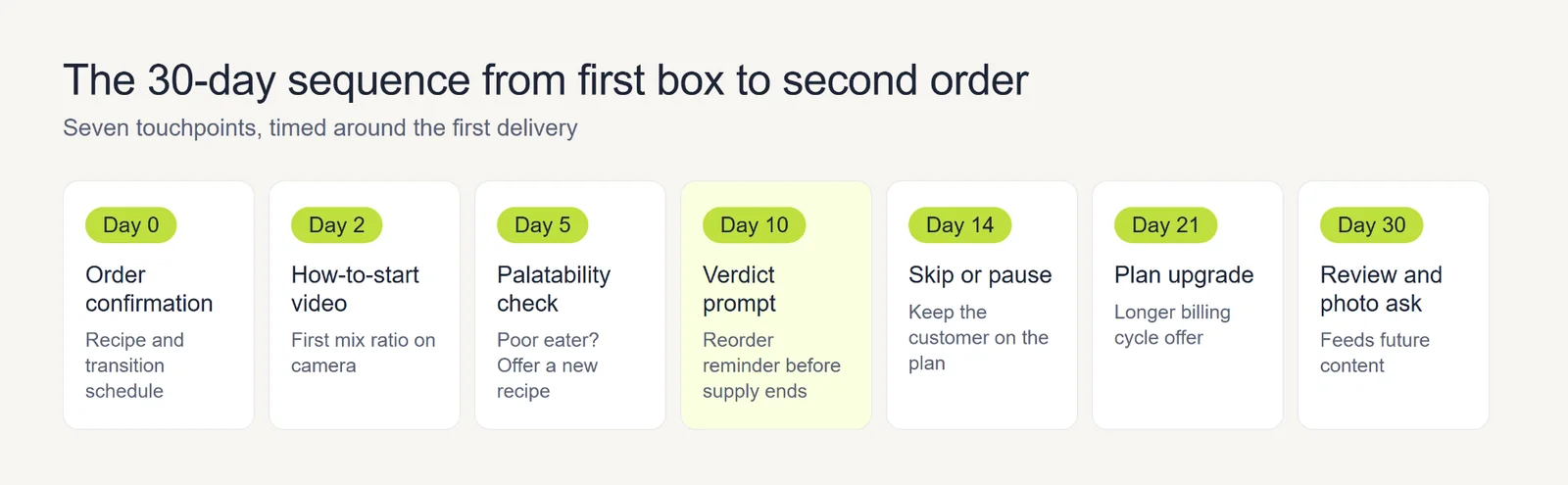
The timeline below is a starting point. Adjust it to delivery dates, feeding schedules and whether the customer already has autoship.
Our guide to food influencer marketing explores how creators can support trial campaigns in food categories.
- Day 0, help the owner get started. Confirm the chosen recipe, portions and transition instructions in the order email.
- Day 2, demonstrate the process. Send a short clip showing label-appropriate transition steps, with veterinary guidance when relevant.
- Day 5, check the experience. Ask how the pet is responding and whether the owner needs help with portions or the transition. Offer practical support first, and recommend veterinary advice for ongoing health concerns.
- Day 10, assess progress. If the transition has finished, ask for initial feedback. Use the remaining supply, rather than the calendar alone, to decide whether it's time for a reorder reminder.
- Day 14, tailor the next step. Show one-time buyers a simple reorder option, while existing subscribers receive delivery-adjustment or pause controls.
- Day 21, match the offer to real usage. If the pet is doing well, suggest the pack size or delivery interval that fits the household's consumption.
- Day 30, invite feedback. Ask satisfied customers for an honest review or photo after enough time with the product, and keep unresolved support cases on a separate path.
| Day | Message | Channel | Metric |
|---|---|---|---|
| 0 | Recipe, transition schedule | Email, box insert | Open rate, schedule views |
| 2 | How-to-start video | Email, SMS | Video completion |
| 5 | Feeding and transition check | SMS | Reply rate, support requests |
| 10 | Transition check and conditional reorder | Email, SMS | Reorder rate |
| 14 | Second order or skip/pause, by segment | Second-order conversion; pause versus cancel | |
| 21 | Pack size or delivery cadence | Offer uptake and next-order timing | |
| 30 | Review or photo request, where appropriate | Reviews, UGC submissions |
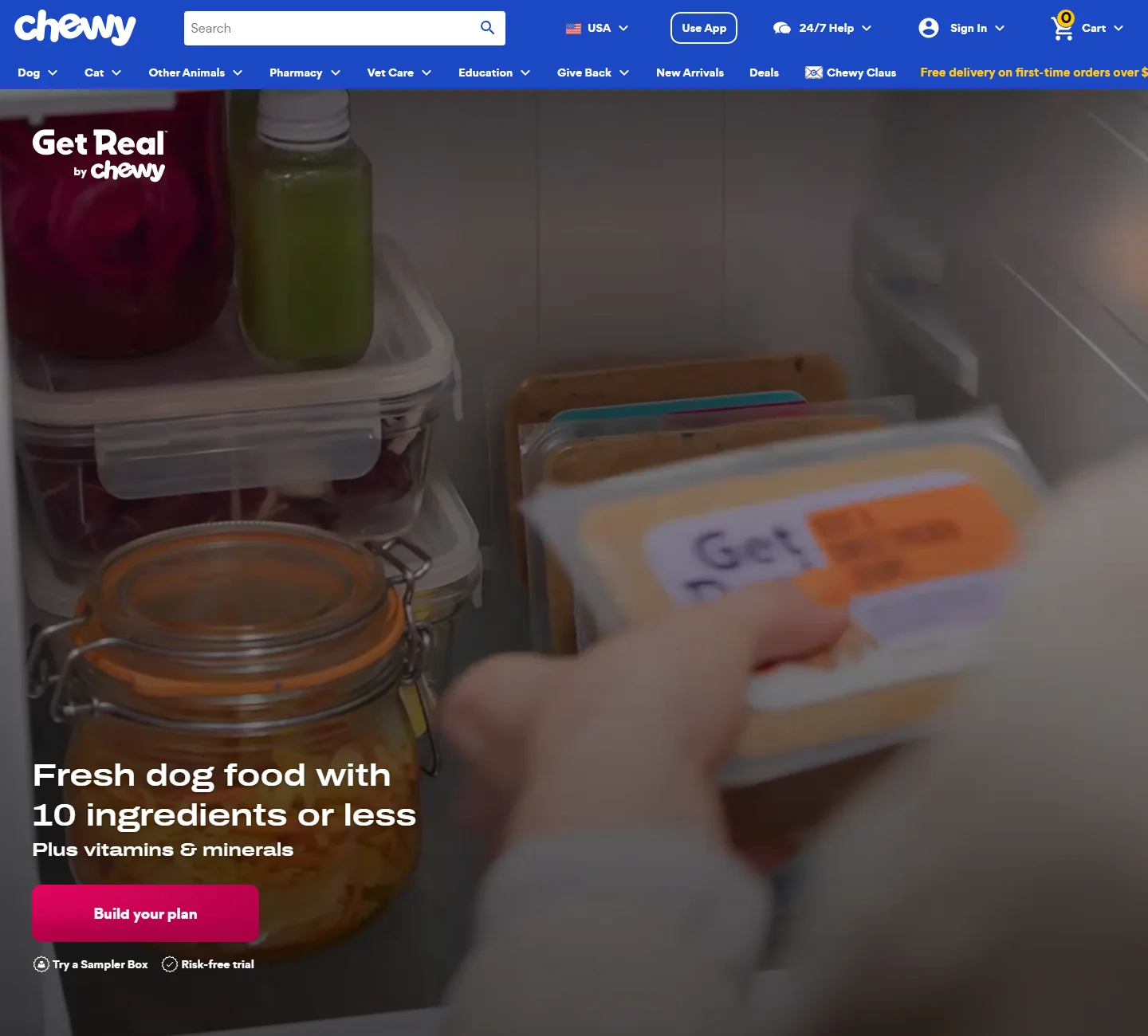
The trial offer should make that first experience easy to manage. Chewy's Get Real fresh dog food page, for example, pairs a "Sampler Box" and risk-free trial with custom plans, giving hesitant owners a lower-commitment starting point.
Product seeding programs can use the same principle: send the sample with clear guidance on what happens after delivery.
Offer Autoship When Repeat Demand Is Clear
Once a buyer has settled into a feeding routine, introduce autoship as a practical replenishment option. Some shoppers prefer to subscribe at checkout, so keep both paths available.
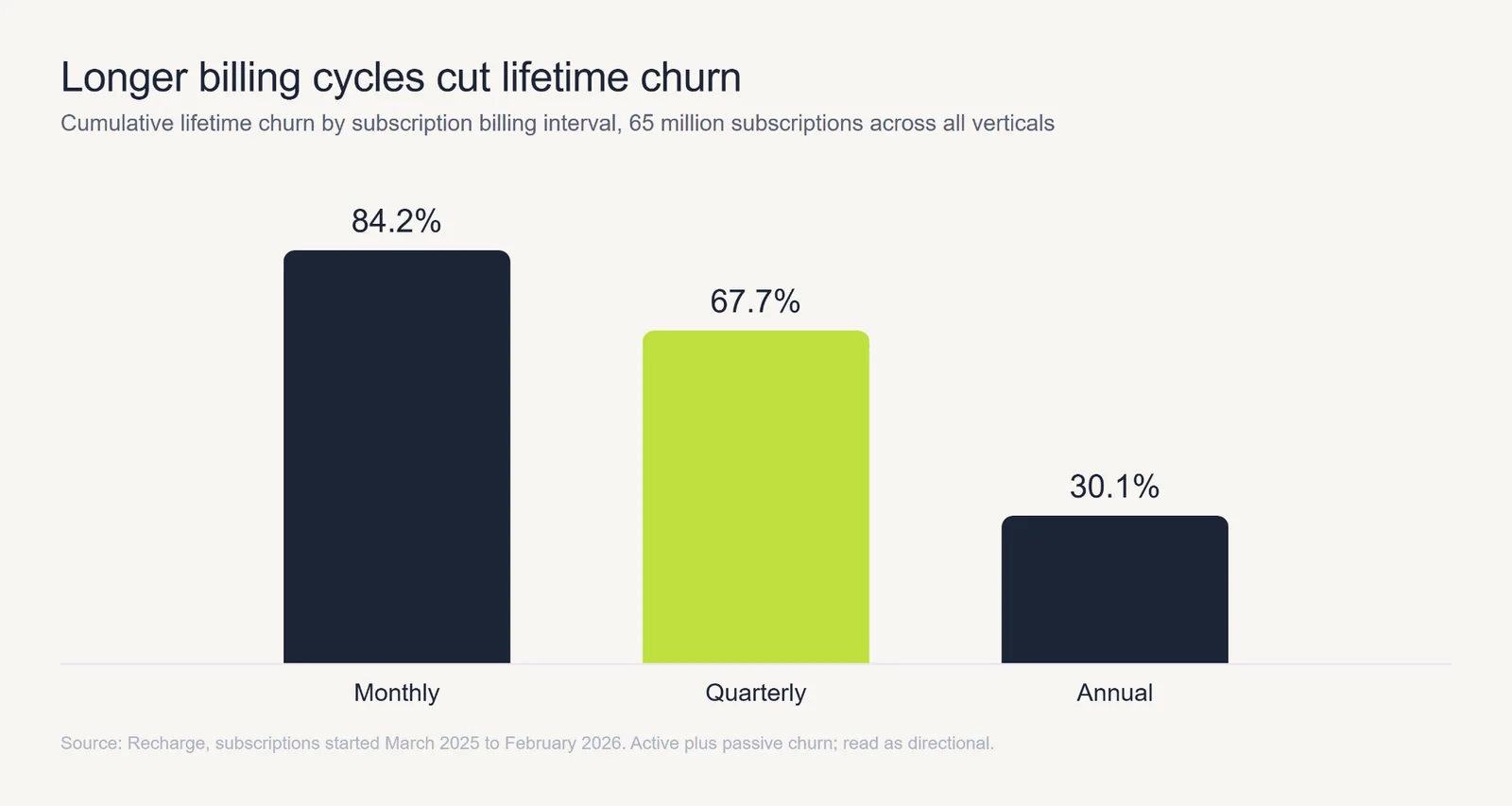
Recharge reported lifetime cumulative churn of 84.2% for monthly plans, 67.7% for quarterly plans and 30.1% for annual plans across many categories.
These are observational comparisons: subscribers choosing longer terms may have been more committed from the start. Test billing changes against your own pet-food cohorts.
Subscription purchasing also matters at the category level: online pet food subscription sales passed $800 million in early 2025, about $160 million ahead of non-subscription online sales. For an individual brand, the right interval still depends on how quickly customers use the product.
For more retention benchmarks across industries, see our customer retention statistics page.
How to Measure Pet Food Marketing: CAC, Repeat Rate and Channel Payback
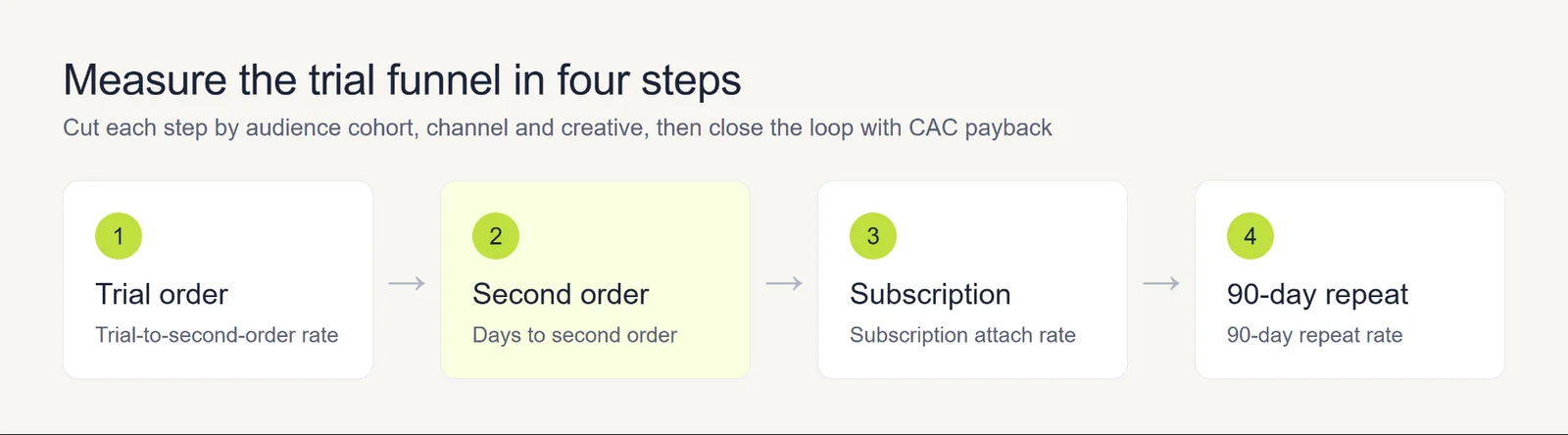
First-purchase ROAS tells only part of the story. To understand whether a product fits the household, measure second orders alongside acquisition costs.
Without a reliable category-wide 12-month repeat-purchase benchmark, start by tracking repeat orders across your own customer cohorts.
| Metric | Formula | Read it by | Decision it drives |
|---|---|---|---|
| Trial-to-second-order rate | Second orders divided by trial orders | Target audience cohort, channel, creative | Which creative and offer to fund |
| Days to second order | Median days from first to second order | Trial size | Trial sizing and reminder timing |
| Subscription attach rate | Subscribers divided by trial buyers | Offer timing | When to show the plan |
| 90-day repeat rate | Customers with 2+ orders in 90 days divided by new customers | Channel | Channel budget |
| CAC payback | CAC divided by gross margin per month | Channel | Whether to scale a channel |
Next, segment those metrics by buying situation. New pet parents, kibble switchers and topper buyers may have different reorder patterns, which a blended rate would conceal.
To check whether follow-up helps, withhold the Day 2 to Day 14 messages from a random group of trial buyers and compare their next-order rate with customers who receive them.
Pet Food Claims and Compliance: What Pet Food Brands Can Say in Video Ads
Claims can appear in captions, voiceover and even the way ingredients are shown on screen. Review the complete video against the same evidence used for the label, paying particular attention to four areas.
| Claim type | Where it hides in video | Who must verify | Source rule |
|---|---|---|---|
| Organic | On-pack shots, voiceover | Brand and certifier | USDA organic labeling categories |
| Natural | Ingredient close-ups, "nothing artificial" lines | Brand and regulatory counsel | AAFCO guidance |
| Human grade | Kitchen scenes, comparisons to human food | Brand and regulatory counsel | AAFCO human grade standard |
| Health outcome | Creator testimonials | Brand and veterinarian | FTC endorsement guidance |
USDA rules distinguish 100% organic, organic at 95% or more, and "made with organic" ingredients at 70% or more.
The USDA seal applies only to the first two. Separately, AAFCO treats natural as a defined claim rather than a safety guarantee. Its January 2023 human-grade standard also addresses ready-to-eat human-food manufacturing requirements.
FTC guidance also requires disclosures within the video when the endorsement appears there, and objective claims still need support. A claims register helps creators and reviewers see which statements are approved before filming.
A Freshpet case shows why those checks extend beyond the script. In March 2026, NAD ruled on three Freshpet video ads following a challenge from a fresh-food competitor. The findings depended on each ad's wording and visuals:
- In one ad, a dog owner compared the food's quality with her own meals. NAD concluded that the execution conveyed a human-grade claim and recommended discontinuing that message.
- In a second ad, Freshpet removed a line comparing its food preparation with the way people make meals.
- The third ad showed a home-kitchen preparation scene, which NAD found did not imply a human-grade claim.
Freshpet said it would comply with the recommendations.
Scale Pet Food Marketing With inBeat Agency
The most useful creative decisions account for what happens after acquisition.
We applied that approach with The Farmer's Dog, where our creator-led performance creative supported more than $20 million in annual ad spend across 10+ channels, with 70+ assets created per month. The results from each batch helped shape the next creative brief.
If you want to build a similar testing process, book a strategy call so we can review your channels, trial offer and first creator test together.
Pet Food Marketing FAQs
Should a pet food brand start on Amazon and Chewy or build DTC first?
DTC suits products that need feeding guidance and a direct view of reorders. Marketplaces can reach shoppers already searching for your category, although customer-level data is more limited. Compare costs, margins and support needs before choosing.
How long should a trial supply last before the second order is due?
Allow for a gradual 7- to 10-day transition, followed by enough time at the full serving to assess acceptance. Base reminders on actual supply remaining and delivery timing. Then compare trial lengths by their effect on second purchases.
Do health claims need a vet voice, or can a pet creator carry them?
A creator can show genuine feeding behavior, while a qualified veterinarian may explain general care when relevant. Any objective health outcome still requires appropriate evidence and claims review before publication, regardless of who says it.
How do you measure repeat rate when pet parents buy at retail after a direct trial?
When retailers own the transaction data, use indirect signals carefully: discount-code redemptions, store-locator clicks and regional branded search. A geographic holdout can help estimate the effect, provided the report makes the limits of that estimate clear.