

Most CPG content plans still treat creators as a line item: book a few posts around a launch, repost the best one, move on.
The brands pulling ahead have flipped that order.
Creators produce the bulk of the creative, and paid social decides which assets deserve reach. The sales team walks into line reviews carrying performance data.
Unilever's stated plan to lift influencer marketing from about 30% to 50% of total ad spend, reported by eMarketer in March 2025, shows creator-led marketing has moved from indie experiment to corporate strategy.
This guide covers how to build the engine: who to recruit, how to brief them, how to test and whitelist, how to carry winners into retail, and how to measure the whole thing inside 90 days.
P.S. If you want the sourcing, creative and media buying handled as one system, see inBeat's paid social services.
A note on our approach: We believe most CPG teams buy the wrong half of the creator. They pay for reach and treat the content as a byproduct, when reach is the commodity any ad platform will sell you tomorrow morning.
The scarce asset is a steady supply of native, persona-specific creative that a real person will put their name and face on.
So we source that creative at volume, dark-post all of it, and let creative-level cost per action decide what gets scaled, whitelisted and carried into the buyer meeting.
As platform targeting narrows, the persona inside the creative does the audience selection that settings no longer can. The media budget is the laboratory that proves which persona and angle earned the spend.
What Is a Creator-First Content Strategy for CPG Brands?
A creator-first content strategy for CPG treats creators as the continuous source of testable creative that paid media and retail run on. The brand team sets the guardrails and leaves the posts to creators.
Creator-First vs. Traditional Influencer Campaigns
A traditional influencer campaign is a line item with an end date. You pick a handful of names, agree on deliverables, run the posts, report reach, and archive the content.
The creative is a byproduct of buying an audience.
Creator-first inverts the flow.
Dozens of creators produce content on a rolling basis, and every asset is treated as a test. The winning assets get reach through paid media and get shown to retail buyers as demand evidence.
The argument that creators have effectively become CPG's sales force, as 3D Color frames it, only holds if the content keeps flowing after the campaign calendar says stop.
Why Legacy CPG Brands Are Moving to Creator-First
This is no longer a challenger-brand tactic. Unilever's plan is stated strategy from the company. Still, when a portfolio of that size announces the shift, the operational question for legacy teams becomes how, and Marketing Dive's coverage of legacy CPG brands moving social-first reads as an attempt to answer exactly that.
How to Structure Your Team for a Creator-First Model
The operating premise splits ownership three ways.
- The brand team owns the persona definitions and the claim guardrails.
- Creators own execution: hook, setting, tone and format.
- Media owns the decision about which assets get reach, and performance data makes that call.
For that split to work, three teams need to sit in the same weekly meeting: creator ops, media buying, and sales or retail.
When creator ops doesn't hear what media killed last week, the next brief repeats the losing angle. When sales never sees the creative-level data, the buyer deck stays generic.
Your first executable step is small. Write a one-paragraph internal definition of creator-first for your brand that names which team owns persona, which owns media, and which owns the retail handoff.
If you can't name an owner for one of the three, that's the gap to close before recruiting a single creator.
Do Creator Ads Outperform Brand Ads at the Same CPM?
The reallocation case rests on creative efficiency at equal media cost. The strongest available evidence for that comes from TikTok's own analysis of campaigns on its platform.
What TikTok's Creator Ad Data Shows
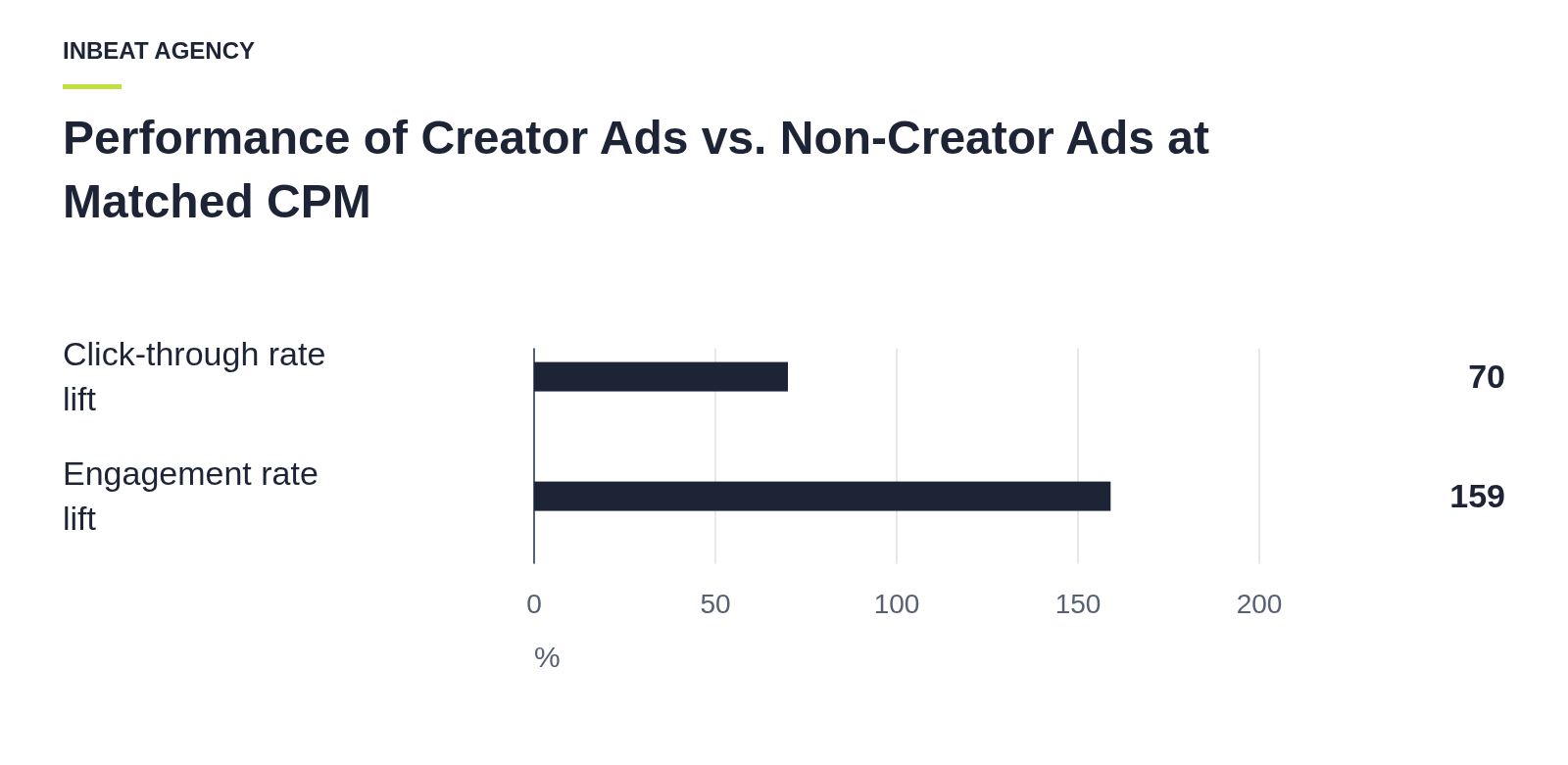
In November 2025, TikTok for Business published an analysis finding that creator ads drove a 70% higher click-through rate and a 159% higher engagement rate than non-creator ads at the same CPM.
Read that with the obvious caveat: it's a platform reporting on its own campaign data with a commercial interest in the conclusion. It says nothing about how the gap looks on Meta or in a specific CPG category.
It's still the most direct comparison in the public record, and the matched-CPM framing is what makes it useful for a finance conversation.
Vendor-side comparisons, such as Social Native's 2026 creator ads versus brand ads piece, point the same direction and carry a similar interest in the outcome.
Why Posting From the Creator's Account Matters
A separate TikTok analysis, cited in the same TikTok Creator Advantage post, isolates a second effect.
Ads posted from a creator's own account showed 59% higher engagement and a 16% higher six-second view-through rate than ads not posted from a creator account.
That's the trust effect: people respond differently to a face they already follow than to the same video under a brand logo.
For a CFO, the point is that CPM parity means same media cost, more downstream action. The creative source changes what each impression produces, at unchanged inventory cost.
How Meta's Algorithm Changes Affect Creator Ads
Platform ranking keeps improving, and that's worth acknowledging. Meta reported that its new sequence-learning architecture produced a 3.5% lift in ad clicks on Facebook and more than a 1% conversion gain on Instagram in Q4 2025.
Real gains, delivered to every advertiser for free. Set them next to a 70% click-through gap between creative sources, and the priority order is clear: the creative decides most of the response.
Those gains lift the floor. They don't tell you which of your assets deserves the next dollar, and they don't produce the next asset.
| Comparison | Media cost basis | Reported performance difference | Evidence and its limits | Reuse rights needed |
| Creator ads vs. non-creator ads | Same CPM | 70% higher CTR, 159% higher engagement | TikTok internal analysis of third-party creator content, February 2024 to January 2025; TikTok only | Usage rights for paid placement |
| Ads posted from a creator's account vs. ads not posted from one | Not specified | 59% higher engagement, 16% higher six-second view-through | Separate TikTok internal analysis, 2024 to 2025; self-reported | Usage plus whitelisting or Spark-style authorization |
All performance figures in the table come from TikTok for Business, November 2025.
Brands and agencies surveyed by CreatorIQ report a similar view of creator marketing's return, though that reflects practitioner opinion from a March 2024 survey.
Before you take any of this to finance, run your own version. Pull last quarter's click-through and cost per action for brand-produced versus creator-produced ads at matched CPM and see whether your gap resembles TikTok's.
If it does, the reallocation argues itself. If it doesn't, you've learned something about your creative pipeline before spending more on it.
How to Build a CPG Creator Roster: Micro-Creators Plus Anchors
Recruit dozens of persona-matched micro-creators as the testing engine and add one or two anchor creators for reach and buyer recognition.
That mix is what a velocity goal needs; three big endorsements give you three data points and little else to test.
How Volume Micro-Creators Supply Testable Creative
A CPG launch usually has three to five buyer personas and several plausible angles per persona.
Forty micro-creators give you forty native assets across every persona-by-angle cell, each made by someone whose audience already trusts them on that topic.
Per-asset cost is lower, you can test more hooks, and the borrowed trust spreads across distinct communities.
Seeding playbooks written for CPG, such as 5WPR's 2026 seeding guide, tend to reach the same structural conclusion: volume is the point.
The account effect is also an argument for many accounts. If the lift comes from posting under a trusted handle, forty handles reaching forty audiences beats one brand page reposting everything.
How Anchor Creators Win Reach and Retail Buyer Attention
One or two anchors per launch do a different job. They add a reach and credibility layer, and they give your sales lead something a category buyer will recognize by name.
A buyer who has never heard of your brand may still know the creator whose audience overlaps their shoppers. Pick the anchor for that overlap. Follower count is a weaker filter here.
How to Vet CPG Creators by Persona
Use this checklist for every candidate:
- Category relevance: they already talk about the shelf your product sits on.
- Audience overlap with your retail footprint, by geography and shopper type.
- Willingness to grant the required usage and whitelisting rights.
- Comment-section quality as a trust proxy: real questions and replies from followers.
- Posting cadence that suggests they'll deliver on schedule.
| Creator tier | Role in the engine | Cost per usable asset | Testing value | Rights and whitelisting complexity | Retail pitch value |
| Micro (volume) | Continuous native creative across persona cells | Low | High: many angles, fast read | Low per creator, high in aggregate; standardize the contract | Moderate: strong in aggregate data |
| Mid-tier | Bridge between test volume and scaled reach | Medium | Medium | Medium; often negotiated individually | Moderate to high |
| Anchor | Reach layer and buyer recognition | High | Low: one or two assets | High; legal review and exclusivity terms | High: a name the buyer knows |
A hypothetical sourcing plan for a snack launch makes the shape concrete: 40 micro-creators split across three personas (busy parents, gym regulars, office snackers), plus one anchor whose audience maps to the retailer's shopper base.
Draft your own recruitment target the same way, X micro-creators per persona and one anchor per launch, with the required rights in every agreement before product ships.
Recruiting persona-matched creators at this volume is the part most teams underestimate; inBeat's social media and creator work is built around it.
How to Write CPG Creator Briefs That Protect Claims and Disclosure
Fix the claims and the disclosure in the brief, then leave the hook, setting, tone and format to the creator. That split protects you legally and protects the trust effect you're paying for.
What a CPG Creator Claims Sheet Should Include
The brief must fix three things: approved product claims, prohibited health or efficacy language, and required disclosure. Everything else stays open.
Over-scripting is the most common way CPG teams sabotage themselves, because a creator reading brand copy sounds like a brand.
The account-posting advantage depends on the content sounding like the person whose name is on it.
A practical claims sheet fits on one page and has four blocks:
- Approved phrases, usable verbatim or paraphrased.
- Banned phrases, with a one-line reason each so creators understand the logic.
- Substantiation-required language: claims allowed only if the creator uses the exact wording your regulatory team cleared.
- An escalation contact for regulated categories such as supplements, functional food or anything touching infant nutrition.
A hypothetical version for a functional beverage: 'helps you focus' is banned unless substantiated, while 'my afternoon pick-me-up' is approved because it describes personal experience.
This article describes a workflow; your regulatory counsel decides where those lines sit for your category.
How to Build Disclosure Into CPG Creator Content
Disclosure works when it's built into how the content is made, before anything reaches review.
Specify in the brief that the partnership label is on, the spoken or on-screen disclosure appears before the product does, and the platform's paid-partnership tools are used where available.
Consumer trust in creators is measurably tied to how openly the relationship is disclosed, which is the concern behind BBB National Programs' work on influencer credibility. Clear disclosure is a condition of the trust effect you're paying for.
How to Set Up a Fast Creator Approval Loop
Run a two-stage review.
- Stage one is pre-shoot: the creator acknowledges the brief and claims sheet in writing.
- Stage two is post-shoot: a claims check against the sheet, with a 48-hour turnaround target so content stays timely and creators stay willing.
The reviewer's job is to catch banned language and missing disclosure. The hook stays with the creator.
Then be honest about what you can't control. You can't govern the creator's other partnerships or the sentiment in their comments.
Monitor both: a weekly scan of active creators' recent posts and a comment-sentiment read on your own placements. Monitoring lets you respond within a day, and it keeps briefs loose enough that creators still want to shoot them.
Build the one-page claims sheet now and attach it to every creator agreement before the first product ships.
How to Amplify CPG Creator Content With Paid Social
Dark-post every creator asset at a small, equal budget, read creative-level cost per action, and scale only what earns it through the creator's own handle.
This is the operational core the generic guides skip, and it's where the creative supply from the previous sections turns into learning.
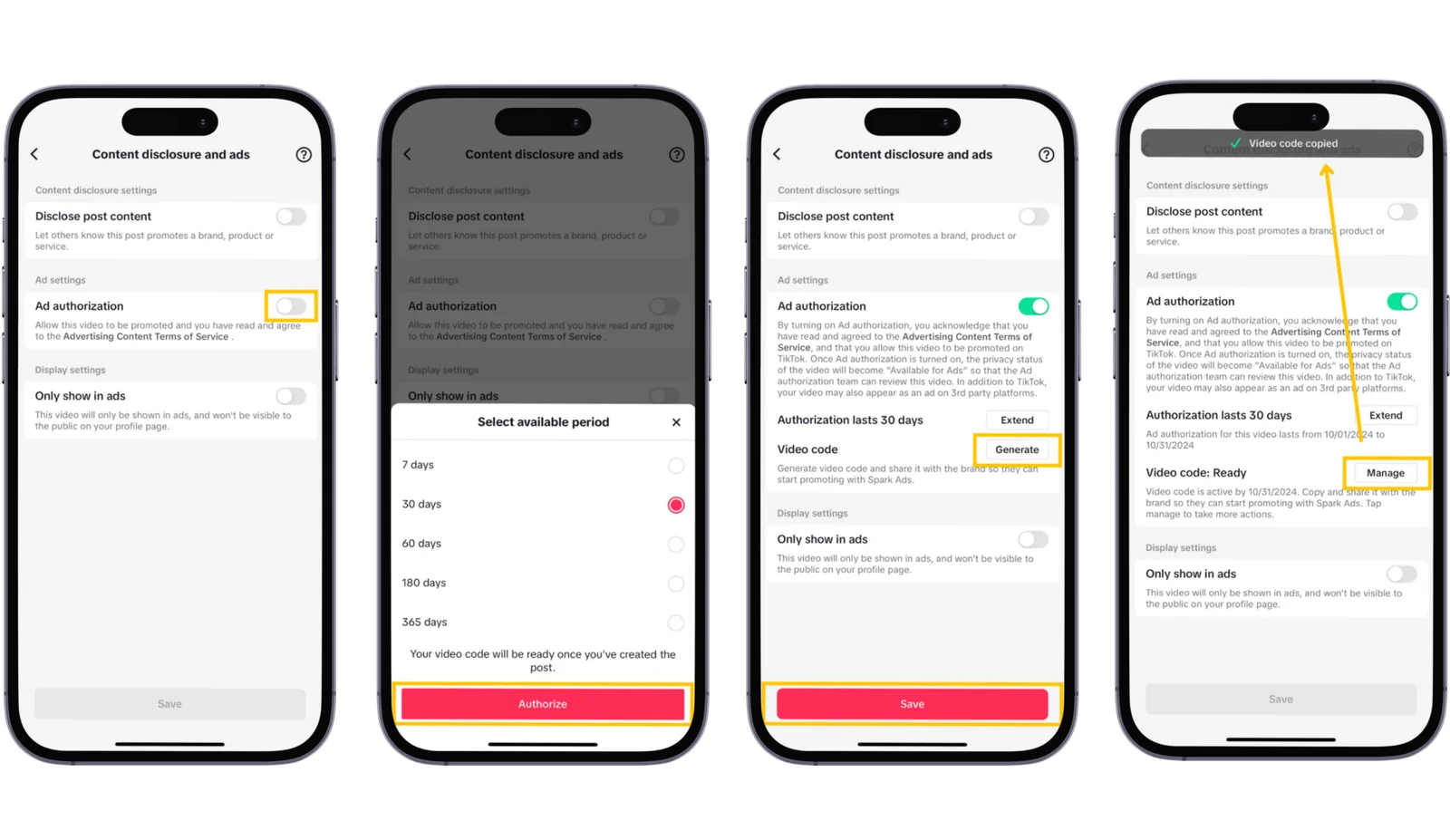
- Secure usage and whitelisting rights up front. Every creator agreement should grant paid usage and permission to run ads from the creator's handle (TikTok's Spark Ads or Meta's partnership ads, depending on platform) for a defined term. Negotiating rights after an asset wins is slow and expensive.
- Dark-post every asset as a low-budget test from the creator's handle where the platform allows. Dark posts don't appear on the creator's organic feed, so you can test forty assets without flooding anyone's followers. Running from the creator's handle keeps the account advantage covered earlier. Repurposing everything onto the brand page throws that advantage away.
- Read CTR, hook rate and cost per action at the creative level. Set a fixed impression threshold per asset before judging, and a kill rule based on cost per action past that threshold. Campaign-level ROAS hides which persona and angle did the work.
- Scale the winners through creator-handle ads and brand-handle ads in parallel. The creator handle carries the trust, and the brand handle gives you a controlled placement for retargeting and catalog formats. Compare the two on cost per action and let the data set the split.
- Feed the losing angles back into the next brief batch. A losing hook is information. Tell the next wave of creators which angles died and which cells in the persona-by-angle matrix are still open.
On budget: reserve a fixed share of the paid social budget for testing every month; the FAQ covers how to size it, and inBeat's paid social budget allocation guide covers the tradeoffs across Meta, TikTok and Snapchat.
The principle stays fixed whatever the number: spend that produces no learning is the waste to cut. A scaled campaign that keeps running a stale asset because nobody tested a replacement is waste dressed up as efficiency.
Set up the dark-post campaign this week with every current creator asset at equal small budgets and a written kill rule. The sooner the first read lands, the sooner the second creator wave can be briefed on it.
How to Use Creator Content in Retail Media and Buyer Meetings
Once the paid loop has produced winners, those assets and their performance data become the material for retail media placements and for the buyer conversation.
What follows is a conceptual framework. Retail media networks differ in what they accept and how they report, and this article can't give per-retailer specs.
How to Feed Retail Media Networks With Winning Creator Assets
The simplest handoff is creative reuse. The hooks that cleared your cost-per-action threshold in the paid loop are the ones you submit for retailer-side placements, with rights language that covers those placements (more on that in the FAQ).
Retail media is one part of a broader paid media plan, and the same discipline applies: test the creator assets against your standard brand assets in the retailer's environment where the network allows creative-level reporting.
Acceptance of creator-style content varies by retailer, and some networks impose format constraints that flatten native video. Ask before you plan around it.
For how retail media fits into the wider mix, inBeat's paid media resources cover the adjacent channels.
How to Build a Buyer Deck From Creative-Level Data
Category buyers care about one thing: will this move off the shelf? An awareness deck full of impressions doesn't answer that.
Creative-level data from the paid loop gets closer, because it shows real people in the buyer's trade area clicking on a specific message about your product. A buyer deck built from creator content contains:
- The three to five top-performing hooks, shown as the actual creative.
- Engagement and click data by persona, so the buyer sees which shopper responded.
- Creator audience overlap with the retailer's footprint, by region and shopper type.
- The planned amplification around the shelf date, with budget and creator count.
A hypothetical outline for a regional grocery pitch: three winning creator hooks, persona-level click data, and a 60-day amplification plan tied to the planogram reset date.
The specific numbers in that deck come from your own loop; none of this article's cited figures belong in it.
How to Match Creators to the Retailer's Shopper Base
Your brand personas and the retailer's shopper base overlap but rarely coincide. Before the pitch, check which of your active creators over-index with that retailer's shoppers by geography and demographic, and lead with those.
This is also where the anchor creator pays off: a recognizable name whose audience maps to the retailer's trade area shortens the credibility conversation.
On applicability, the pressure runs in both directions. Retailers who see creator-driven demand evidence from the biggest portfolios will start expecting it from everyone.
Analyses of how CPGs are maturing their creator programs, like Pilot44's, describe the same shift toward creators as a commercial function.
Start with one slide. Assemble a one-slide creator performance summary per SKU and add it to the next line review or category buyer meeting.
90-Day Creator-First Launch Timeline for CPG Brands
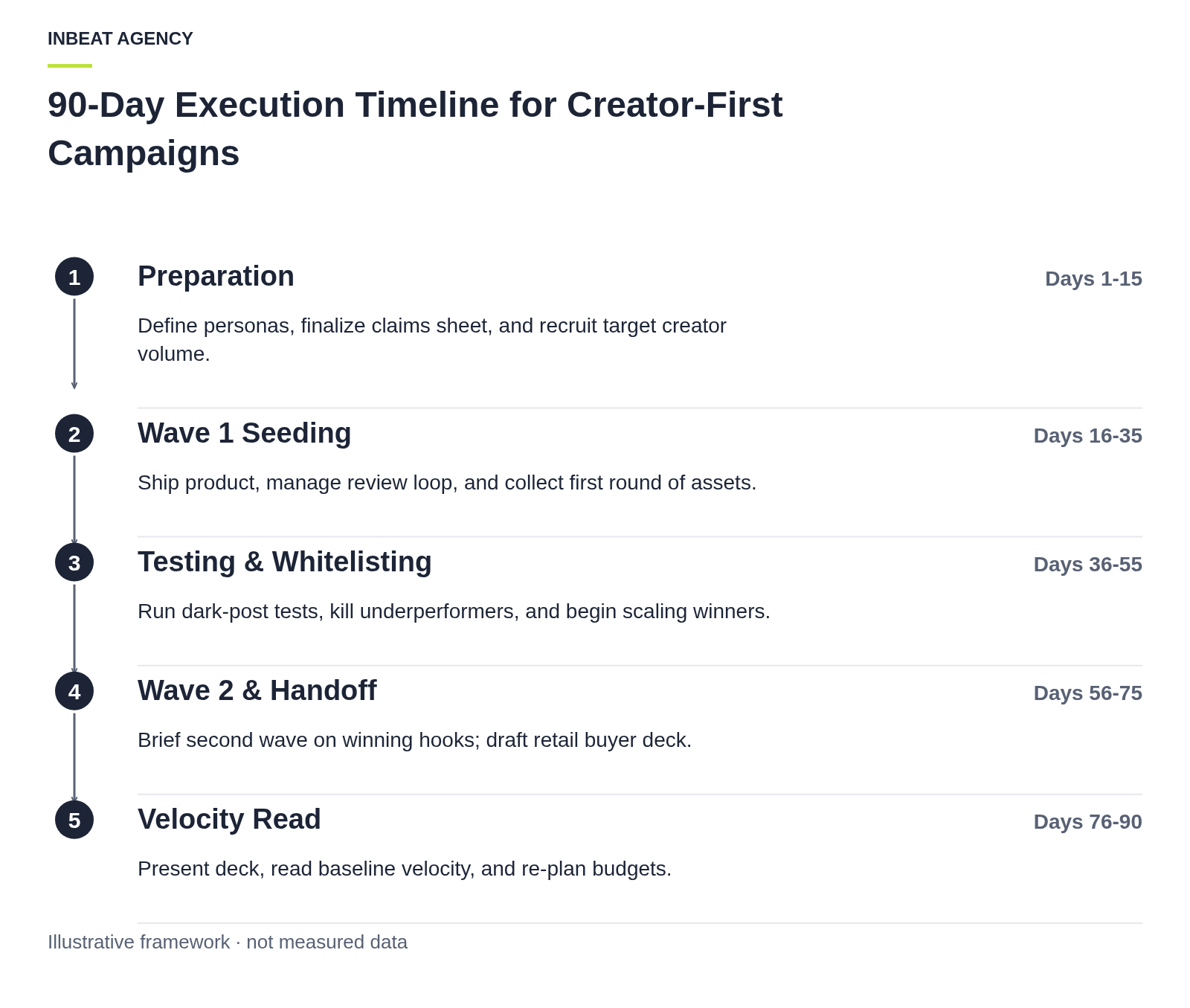
Run the engine as five phases over 90 days, with a written decision gate at each boundary. The phases sequence work described earlier; this section adds timing, gates and who owns what.
- Days 1 to 15: persona definition, claims sheet and recruitment. Brand owns personas and the claims sheet; creator ops recruits against the checklist; media confirms the required rights are in every agreement. Gate: personas agreed, claims sheet signed off by regulatory, and recruitment at or above target for each persona. If recruitment falls short in one persona, proceed with the others and keep sourcing so the whole wave stays on schedule.
- Days 16 to 35: seeding and first content wave. Creator ops ships product and manages the two-stage review; media sets up the dark-post campaign structure while content arrives. Gate: enough approved assets to fill every persona-by-angle cell at least once. A cell with no asset triggers a targeted re-brief to two or three creators.
- Days 36 to 55: dark-post testing and first whitelisted scale. Media runs the tests and applies the kill rule; creator ops logs which hooks won and lost. Gate, as a hypothetical example: at least three creator assets under the target cost per action before the second wave is briefed. If fewer than three clear, re-brief on the closest misses before scaling anything.
- Days 56 to 75: second creator wave briefed on winning angles, plus retail media handoff. This is where compounding starts. The second wave gets a brief built from data: which hooks worked, which personas responded, which cells stay open. Sales begins assembling the buyer deck and media submits winners to retail placements. Gate: second-wave assets in review and buyer deck draft complete.
- Days 76 to 90: buyer deck, velocity read and budget re-plan. Sales presents; finance reads blended CAC and MER against the pre-launch baseline; the team decides the next quarter's split between testing and scaling. Gate: a written go, adjust or stop decision for each persona.
The testing phase can be short because large differences between assets become visible quickly once each asset clears its impression threshold.
Small gaps take longer to trust, which is why the kill rule uses cost per action past a fixed impression threshold.
One person from each function attends the weekly meeting throughout all five phases.
For general framing of how these functions fit a CPG marketing plan, Hummingbirds' CPG strategy primer is a reasonable orientation, though it stops before the mechanics above.
Copy the five phases into your project plan with named owners and a written go-or-re-brief criterion at every gate. A gate without a written criterion becomes a debate, and debates cost the days the timeline doesn't have.
How to Measure a Creator-First CPG Program
Measure each layer of the engine on the metric that drives a decision at that layer, and treat impressions and follower counts as inputs. The table maps the layers; the sections below explain how to read them.
| Engine layer | Metric | Data source | Decision it drives | Blind spot |
| Creator supply | Approved assets per persona cell | Creator ops tracker | Which personas need more recruitment or re-briefing | Says nothing about quality until tested |
| Testing loop | Hook rate, CTR, cost per action per asset | Ad platform, creative-level breakdown | Kill, scale or re-brief each asset | Platform attribution; short windows |
| Scaled paid | Blended CAC and MER | Finance, total revenue over total spend | Budget split between testing and scaling | Can't isolate a single channel or asset |
| Retail | Unit velocity per store per week versus baseline | Retailer or syndicated sell-through data | Whether to expand amplification around a retailer | Confounded by promotions and distribution changes |
Creative-Level Metrics for the Testing Loop
Hook rate (the share of viewers still watching after the first seconds), click-through and cost per action, all at the individual asset level, are what feed the next brief.
They're the only metrics that tell creator ops which angle to repeat. Follower counts belong in the sourcing checklist.
Blended Metrics for the Budget Conversation
MER and CAC are the scoreboard for the paid layer as a whole. Platform-reported numbers are useful, and they reflect the platform's own attribution.
The Meta ranking gains covered earlier are a fair illustration: real improvements, measured by the party that benefits from reporting them.
Check any platform-attributed gain against your blended numbers before it changes a budget decision. If in-platform ROAS climbs and MER doesn't move, the platform is claiming credit for revenue you'd have earned anyway.
Retail Metrics That Close the Loop
Attribution of shelf velocity to creator content is directional unless you run a holdout. For brands with regional distribution:
- Establish unit velocity per store per week for the same stores before launch, accounting for known promotions.
- Select two comparable store sets with similar baseline velocity and shopper demographics.
- Run creator amplification in one set’s trade area and leave the other unchanged during the test window.
- Compare the change in velocity between the sets, accounting for promotions and distribution changes.
The velocity difference, net of any promotions that hit both sets, is your best available read on incremental lift. It's a rough experiment, and far more defensible than a correlation chart.
Before the first seeding wave ships, add a creative-level cost-per-action column and a store-set velocity baseline to the reporting you already run. Retrofitting either after launch is where most measurement plans quietly fail.
How inBeat Runs Creator-First Programs for CPG Brands
The decision in front of you is whether to run the first 90-day cycle in-house or with a partner that already has volume sourcing, creative production and media buying under one roof.
In-house works when creator ops, media and sales can share a weekly meeting and a data layer from day one. If those functions sit in separate agencies or separate P&Ls, the handoffs between recruiting, testing and the retail pitch are where the cycle stalls.
inBeat runs the pieces described here as one system: influencer sourcing at volume, matched by persona; UGC and performance creative production; and paid social buying that treats every asset as a test.
Our paid social and social media service pages describe the mechanics, and the Mogu Mogu case study shows the shape of that work for a CPG beverage in US grocery.
Key Opinion Leader and influencer-led TikTok campaigns built in-store demand for its drinks, generating 445M+ views on the #MoguMogu hashtag and 30M+ social engagements from creator content. Mogu Mogu became the #3 best-selling drink on TikTok, behind Prime and Lucozade.
The numbers you should care about most are the ones your own loop produces in the first 55 days.
If you'd like to pressure-test your personas, tier mix and 90-day gates before committing budget, the fastest route is a conversation.
Talk to inBeat about building your creator-first engine
FAQ
How long should whitelisting and usage rights run relative to a retail launch window, and what happens to scaled ads when they expire?
Rights should cover the full amplification plan plus a buffer. A 60-day retail amplification window typically needs rights that extend well past the planogram date, with a renewal option priced in advance.
When rights expire, creator-handle ads must be paused, and any brand-handle reuse must stop unless the agreement separates the two.
Write the renewal trigger into the original contract: renewing a winner mid-scale on fresh terms is the most expensive way to buy rights.
What share of the paid social budget should be held back for dark-post testing versus scaling proven creator assets?
Size the testing share to your asset volume, conversion speed and how many personas are still unproven. A brand producing forty assets a month needs more testing budget than one producing eight.
How do you handle regulated CPG categories like supplements or infant food where creators cannot make efficacy claims?
The workflow stays the same; the settings get stricter. Keep the approved-language block tighter than usual and name a regulatory reviewer in the escalation line of the claims sheet.
Brief creators toward personal-experience framing and away from outcomes language, and expect a higher rejection rate in the first wave. Your legal team sets the boundaries; the workflow's job is to enforce them at 48-hour speed.
Can creator content from the paid loop be used in retail media network placements, and what rights language does that require?
Usually yes, if the agreement grants paid usage across named third-party platforms, including retailer-owned media, for the stated term. Rights limited to 'social advertising' often exclude retail networks, so name them explicitly.
Also confirm the retailer accepts creator-style creative and any format constraints before you promise it in the buyer deck.
How do you separate creator-driven lift from promotional or distribution changes when reading shelf velocity?
Build the store-set holdout described in the measurement section, log every promotion and distribution change by store set and week, and read velocity net of those events.
Where a holdout isn't possible, report the lift as directional and say so. A directional number stated honestly survives a finance review.
When should a winning creator asset run from the brand handle instead of the creator's handle?
Lean on the brand handle when the creator's whitelisting term is short, when the creator's comment sentiment turns risky, or when the asset needs to run past the creator's rights window under a separate brand-reuse clause.
Keep the creator handle for cold audiences, where the trust effect matters most.
Cover photo: Photo: Towfiqu barbhuiya / Pexels. Art direction: inBeat Agency.