.svg)
.svg)
.svg)
.svg)


.svg)





Snapchat influencer marketing sits in an awkward spot on most media plans. The audience skews young, the content disappears in a day, and the creator pool looked thin until recently. That last point has changed: Sprout Social relays from a Snap webinar that the number of creators actively posting on the platform grew roughly 40% year over year in Q4 2024, so supply is no longer a reason to skip it. The harder question is whether creator Stories can run as a direct response channel with a CAC you'd defend in a budget review. This guide covers the three decisions that settle that: how to brief creators for the Story format, how to wire Snap Pixel and Conversions API before content expires, and how to amplify the winners with paid media. It closes with an agency versus in-house comparison.
P.S. If you'd rather have one team handle the sourcing, briefing and media buying, that is the shape of inBeat's work; the closing section explains how.
We don't treat a Snapchat creator as a distribution deal. Her Story is an ad concept, shot in the one format this audience already trusts, and the organic reach it gets in 24 hours is a first read on the idea, nothing more. Reach is what media buying is for. Whitelist the handle, dark-post the concept, and let Pixel and Conversions API data decide which creator earns more budget. Snapchat forces this discipline because the content is gone by tomorrow: capture it, test it, scale what worked, and write what you learned into the next batch of briefs. Spend that teaches you nothing about your persona is the real waste on this platform.
Snapchat influencer marketing works when you treat creators as a direct response channel
Creators on Snapchat pay off when you run them as a tracked, amplified performance channel, and the platform's mechanics make that easier than the ephemeral format suggests.
Why the platform's mechanics favor conversion over broadcast reach
A Snapchat creator speaks to people who chose to follow them and chose to open their Story. That is a different starting point from a TikTok feed pushing clips to strangers. The audience is smaller and warmer, which favors a direct ask: a swipe-up with a specific offer, or a promo code read out loud, lands differently when the viewer already treats the creator as a friend. Snap's commissioned third-party research from 2024 reports that 63% of users have made a purchase influenced by Snapchat and that 55% share ads with others. Both are self-reported survey figures paid for by the platform, so read them as a description of the environment rather than a forecast of your conversion rate. What they do support is that a conversational surface with an established purchase habit deserves a tracked offer test.
What the creator supply looks like right now
The sourcing pool has grown. The roughly 40% year-over-year increase in actively posting creators that Sprout Social attributes to Snap for Q4 2024 means you can assemble a persona-matched batch of micro creators on Snapchat the way you already do on TikTok or Instagram. The bottleneck has moved from finding creators to vetting and briefing them, which the rest of this guide covers.
Where the ephemeral format helps and where it hurts
The 24-hour Story lifecycle is the core operational constraint. It helps because urgency is built in; a limited offer inside a Story that vanishes tomorrow reads as genuinely limited. It hurts because, as The Influencer Marketing Factory points out, content that disappears takes your attribution proof with it unless you capture data before expiry. Every downstream decision here, from the brief to the paid budget, exists to get ahead of that clock.
Take the example that runs through this article: a DTC skincare brand working with a student creator. Treated as a one-off post, her morning-routine Story is a pleasant moment that is gone by lunchtime. Treated as an ad concept, it gets captured, tracked and dark-posted, and its CAC decides whether she gets a second brief. Before you source anyone, write a one-line channel hypothesis into the media plan that names the creator persona, the conversion event and the paid amplification budget. If any of the three is blank, the channel isn't ready to fund.
Who you actually reach on Snapchat, and which verticals should bother
Snapchat's reach is strongest among teens and students, and for older buyers the captured evidence doesn't yet support a primary budget.
The teen data is real but narrower than the pitch decks suggest
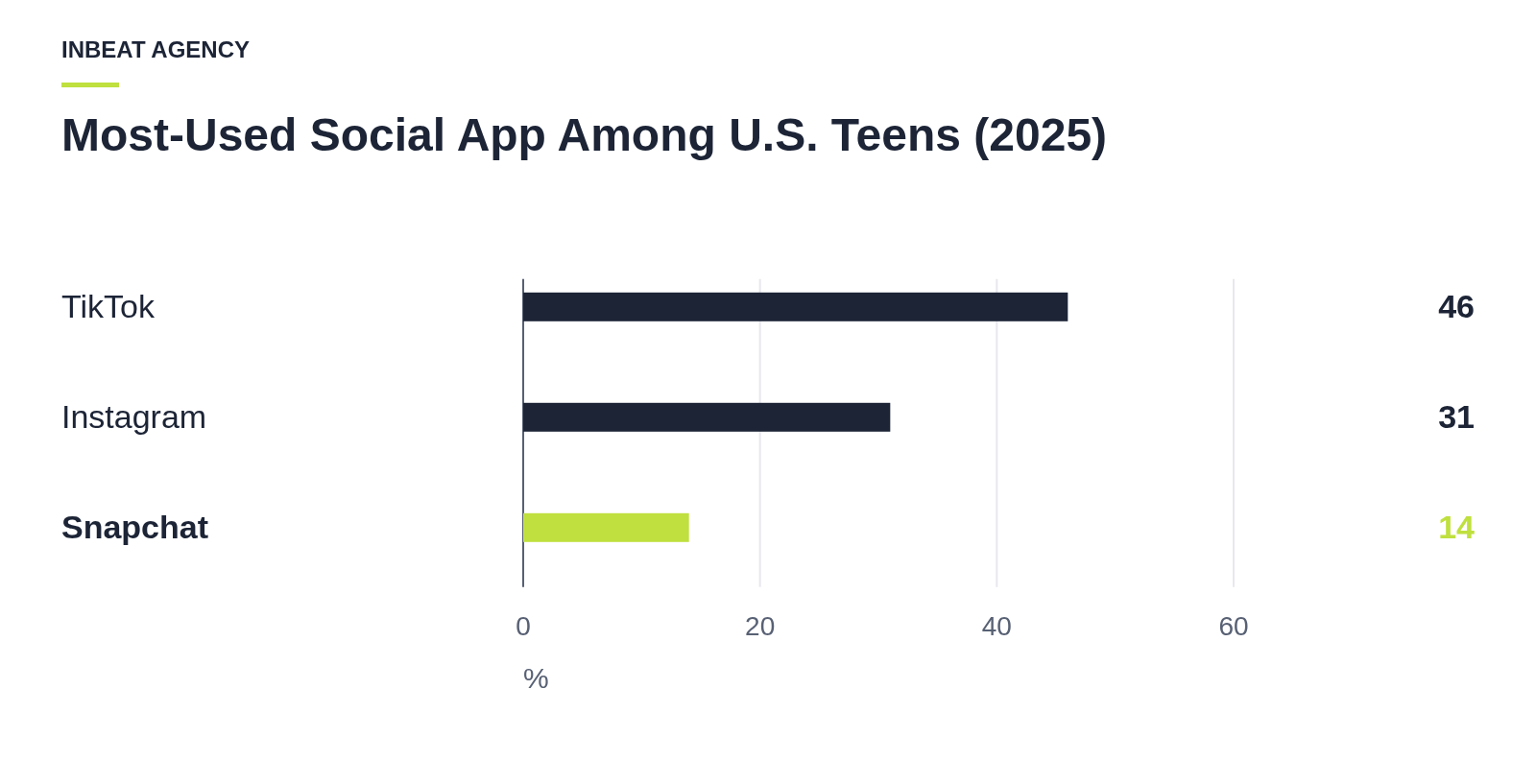
Snapchat is a top-three teen app, but third place is a long way from first. Piper Sandler's 2025 teen survey, which relies on self-reported usage, found TikTok is the most-used social app for 46% of teens, Instagram for 31% and Snapchat for 14%. Sprout Social also relays a Snap figure that 64% of students report a Snapchat-influenced purchase, though the methodology behind that number isn't published with it. Read the two together: Snapchat influences purchases for a real but minority share of teens and students, and the evidence says almost nothing about buyers over 25. Claims about older cohorts belong in a capped test, never in a plan assumption.
Verticals with a natural fit for Snapchat creator campaigns
Cosmetics and personal care come first. The same Piper Sandler survey found 85% of female teens wear makeup sometimes or every day, which gives a cosmetics brand direct survey support for putting Snapchat creators into a primary test. Our guide to influencer marketing for beauty brands covers persona matching for that category in more depth. Beyond beauty, the student purchase figure points to categories where a 17-to-22-year-old is the actual buyer: food delivery, fast fashion, consumer apps, gaming and anything sold on or near a campus. Snap's own business site positions the platform around Gen Z and millennials, which lines up with that list.
When to test Snapchat as a secondary channel rather than a primary one
Use a go/no-go rule. Run Snapchat creator campaigns as a primary channel only when your core buyer persona sits inside the documented teen and student cohorts. If it doesn't, run an incremental test with a budget you can afford to lose, one vertical-relevant offer and a written kill signal. A hypothetical home-goods brand whose median buyer is 35 has no captured evidence on its side here; it may still find a pocket of younger first-apartment shoppers, but it should prove that with a two-creator test before moving any Meta budget across. Score your persona against the survey cohorts, pick the tier, and write the budget cap into the plan before you source a single creator.
Snapchat for Business breaks down platform demographics, audience exclusivity across social networks, and why friend-to-friend recommendations shape shopping intent. Source: Snapchat for Business on YouTube
Match the surface to the funnel stage: Stories, Spotlight and AR Lenses
For direct response on a limited budget, start with Stories and a tracked swipe-up, and add Spotlight and Lenses only after the Story concept has a proven CAC. The surface framework below comes from The Influencer Marketing Factory; it is an agency view rather than measured data, and it matches how the surfaces behave in practice.
Stories carry the high-friction conversion ask
Stories run as a sequence of frames, so a creator can set up a problem, show the product and end on a swipe-up within a few taps. That structure suits offers that need a sentence or two of explanation: subscriptions, trials, apps with onboarding steps. The CTA is direct, the link is tagged, and a purchase or sign-up event can be traced back to the creator. Skip Stories only when you have no landing page ready to receive the swipe, and in that case fix the landing page before you change surface.
Spotlight is a discovery engine that feeds retargeting
Spotlight distributes short vertical video to people who don't follow the creator, so it works as reach and prospecting. Sprout relays a Snap figure that 91% of Snapchatters report feeling happy while using the app. That is platform-reported and unaudited, but it is a fair argument for playful, low-pressure openers on Spotlight and Lenses over a hard sell in the first second. Treat Spotlight views and profile visits as an audience to retarget, and skip the surface entirely when the budget only covers one.
AR Lenses earn shares and product trial, then need a tracked path to purchase
A creator-fronted Lens invites trial, such as a virtual shade try-on in the skincare example, and the 55% ad-sharing figure from Snap's commissioned deck suggests Lenses can travel beyond the creator's followers. A share tells you the Lens traveled and tells you nothing about revenue. To connect Lens activity to revenue, build an engager audience from Lens plays, retarget it with a whitelisted Story or Snap Ad that carries the swipe-up, and read the purchase event from that retargeting layer. Without a retargeting budget behind it, a Lens is a brand asset with no scoreboard.
| Surface | Funnel stage | Best CTA mechanic | Creator format that works | Tracking hook | Skip it when |
|---|---|---|---|---|---|
| Stories | Consideration to conversion | Swipe-up to tagged landing page plus spoken promo code | Three-to-six-frame talk-to-camera sequence | Purchase or sign-up event on the landing page | Only when no landing page exists |
| Spotlight | Awareness and prospecting | Profile visit or follow, then retarget | Fast, playful single clip with a visual hook | View and profile-visit audiences | Budget covers one surface only |
| AR Lenses | Trial and sharing | Try-on, share, then retargeted swipe-up | Creator demonstrating the Lens on themselves | Lens engager audience feeding a retargeting purchase event | No retargeting budget is attached |
The funnel roles in this table follow the Stories-versus-Spotlight distinction described by The Influencer Marketing Factory; the CTA mechanics and skip rules are operating judgment.
A hypothetical plan for the skincare brand: the creator runs a five-frame Story explaining a subscription offer with a swipe-up to a UTM-tagged page, while a branded Lens from the same creator is used only to seed shares and build a retargeting pool. Assign every surface in your plan one funnel role and one tracked conversion event, and cut any surface that can't name its event.
How to brief creators for Snapchat native direct response
Rewrite your creator brief around one persona, one problem and one offer, and make the conversion event, the CTA mechanic and the asset-capture deadline mandatory fields. A Snapchat brief that lists deliverables without naming the metric produces content you can't judge.
Write the brief around one persona, one problem and one offer
Build the brief in this order:
- Define the persona and the pain in one sentence each, written the way the creator's followers would say it rather than the way your positioning deck does.
- State the single offer and the single CTA. One code, one link, one action. A Story that asks for a follow and a purchase gets neither.
- Script the first frame's job and leave the wording to the creator. Tell the creator what the opening frame must establish (the problem, a before-state, a question) and let them phrase it.
- Require an on-screen swipe-up direction in the final frame and a spoken mention of the code in an earlier frame, so the ask survives viewers who watch on mute.
- Fix the promo code and the disclosure language exactly. These are compliance lines and they are not negotiable.
- Request raw exports of every frame and written permission to dark-post and whitelist, delivered before the Story goes live.
- Set a capture deadline inside the 24-hour window for screenshots, insights and click data, and name who on your side owns it.
Interview research with marketing leaders frames influencer integration as alignment with business objectives, with creator selection as one part of a broader strategy. In a brief, that means the conversion metric goes at the top, above the deliverables. Snap's own guidance to marketers is to partner with creators who are honest, authentic and knowledgeable, which translates into a simple division of labor: the creator writes the words, you fix the offer, the CTA and the compliance lines.
Specify the swipe-up, the promo code and the disclosure in the brief itself
The field-by-field rule is lock, leave open, reject.
- Lock: the offer terms, the code string, the landing URL with UTMs, the disclosure wording, the final-frame swipe-up cue, the go-live window and the capture deadline.
- Leave open: the setting, the phrasing, the order of the middle frames, the tone and any personal detail that makes the Story sound like the creator's own week.
- Reject in drafts: over-produced footage that looks like an ad break in the middle of a personal Story, a missing swipe-up cue, a code buried in a caption nobody reads, a hook that opens on the product rather than the problem, and any frame that contradicts the disclosure.
A hypothetical brief for the skincare subscription: the persona is a 19-year-old student with recurring breakouts, the offer is the first box at a fixed discount, the opening frame's job is a candid before-state along the lines of 'this is what my skin looked like three weeks ago', and the swipe-up lands on a page with the code prefilled. Everything else is the creator's call.
Secure usage rights and raw files before the Story expires
Rights and files must arrive before publish, because after 24 hours you are negotiating over content that no longer exists on the platform. Ask for the raw exports, the caption text and the whitelisting permission as a delivery condition, and release payment when those assets arrive instead of when the Story posts. Include a usage term long enough to cover the dark-post learning window plus a scaling period.
Pro tip: ask every creator for two versions of the opening frame. The production cost is minutes, and it gives the media team an A/B pair to dark-post without a second round of briefing.
For the sourcing and persona-matching side of this system, inBeat's influencer marketing guides go deeper on building creator batches at volume.
Build the measurement stack before the first Story goes live
Install Snap Pixel and Conversions API in the same sprint, verify both fire on a single creator Story, and only then release the full creator budget. Measurement built after launch on Snapchat is measurement built after the evidence has expired.
Install Snap Pixel and Conversions API in the same sprint
Snap's documentation describes the Pixel as browser-based code that tracks actions on your site after an ad interaction, and the Conversions API as a server-to-server connection that sends events directly from your systems instead of relying solely on the browser. That distinction matters more on Snapchat than on most platforms because a swipe-up opens an in-app browser, where cookie persistence and cross-site matching are weakest, particularly on iOS. A Pixel-only setup will show fewer purchases than your store records, and you will underfund creators who are actually converting. Run the build in this order:
- Install the Pixel on every page in the swipe-up path, including the checkout confirmation.
- Configure the standard events you will actually decide on: page view, add to cart, purchase, sign up. Skip vanity events.
- Connect Conversions API from your server or commerce platform, sending the same purchase and sign-up events with the matching parameters your platform supports.
- Deduplicate: send a shared event ID on both paths so a single purchase counts once.
- Test with one creator Story before scale. Compare Pixel-reported, CAPI-reported and store-recorded purchases for that Story; the gap tells you how much a browser-only view would have hidden.
Snap updates this tooling, so confirm the current event names and parameter requirements in the Pixel documentation at the start of each campaign. The browser-plus-server principle has been stable; the field names are not guaranteed to be.
Layer promo codes and tagged links to cover what pixels miss
No single layer captures everything, so run three and know what each one is for.
| Measurement layer | What it captures | What it misses | Setup owner | Use it to decide |
|---|---|---|---|---|
| Snap Pixel plus Conversions API | Attributed purchases and sign-ups from tracked swipe-ups, paid and whitelisted | Organic Story clicks outside whitelisted ads, purchases on other devices, viewers who type the URL later | Performance or analytics team | Cost per conversion by creator and hook variant for scaling decisions |
| Creator-specific promo code | Any purchase using the code, regardless of device or path | Buyers who forget the code, code leakage to deal sites, and duplicates when a coded buyer also fires the Pixel | Ecommerce or CRM owner | Whether an organic Story produced sales the Pixel could not see |
| UTM-tagged landing links | Sessions and on-site behavior per creator in analytics | Attribution of the eventual purchase if the session breaks | Analytics owner | Whether the landing page, not the creative, is losing the sale |
| Holdout or modeled incrementality | Lift over a matched group that did not see the campaign | Requires scale and time that a first test rarely has | Analytics lead | Whether the channel is adding customers or reassigning them |
The Pixel and Conversions API definitions in this table follow Snap's documentation; the gaps and decision uses are operating judgment from running tracked creator campaigns.
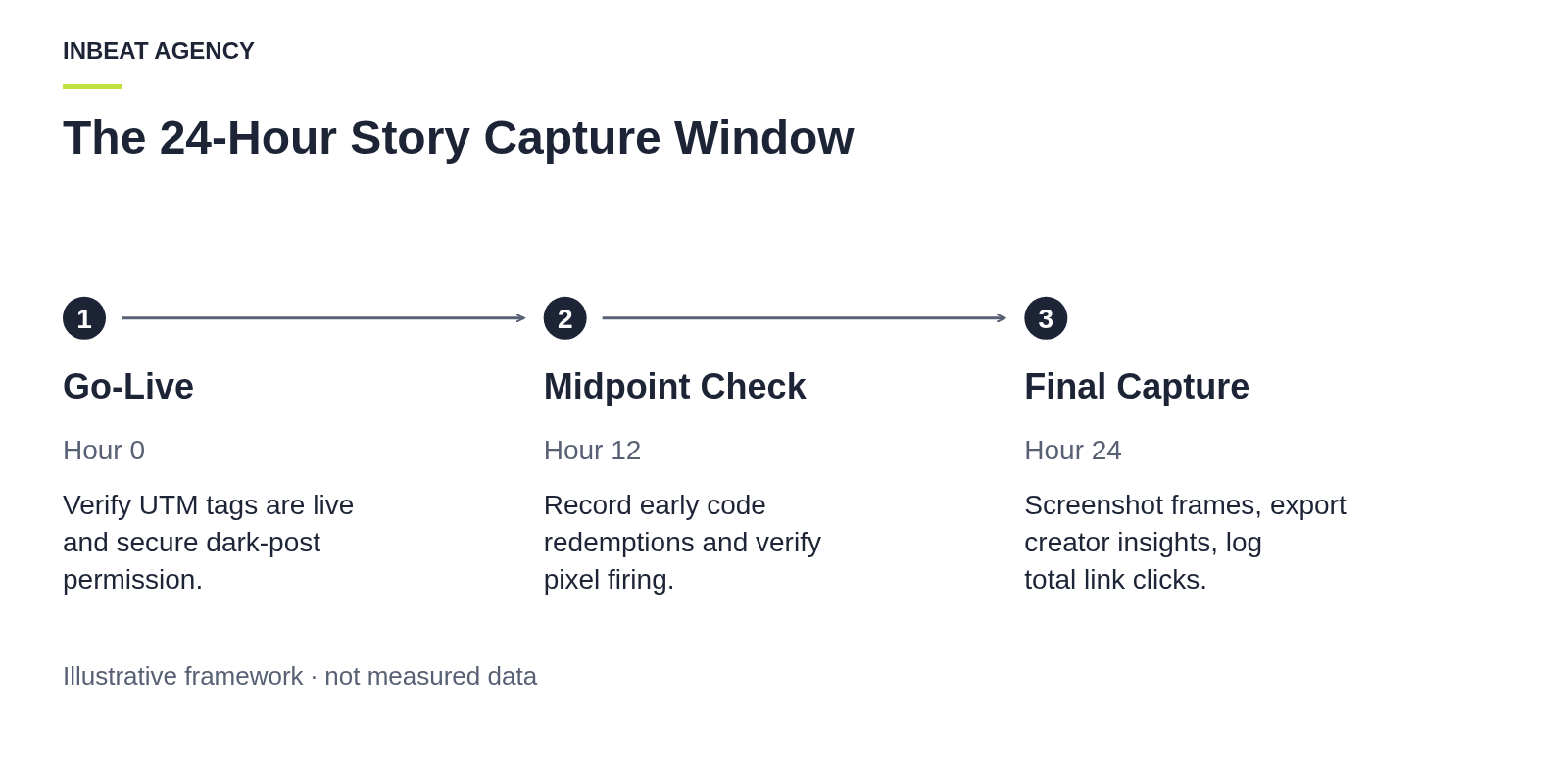
Because a Story vanishes after a day, The Influencer Marketing Factory argues that failing to capture data before expiry erases your ROI proof. Turn that into a checklist with a deadline. Within the 24-hour window: screenshot every frame with the view count visible, export the creator's Story insights, pull link clicks by UTM, record code redemptions at the 12-hour and 24-hour marks, and file the whitelisting approval. Assign one owner and one backup; a missed export is a creator you can never evaluate.
Read results at creator level and close the loop into the next brief
Three numbers will disagree, and you need a rule for which one runs the meeting. Platform-attributed conversions from Pixel and CAPI are the scoreboard for paid and whitelisted spend, because they are the only figure comparable across creators and hook variants in the same dashboard. Code redemptions are the scoreboard for organic Story performance, where no ad exists to attribute to. Modeled incrementality is the audit you run once the channel is large enough to matter to blended CAC and MER, and it is the number that should decide whether Snapchat keeps its budget next quarter.
The limits are real. Promo codes leak to coupon aggregators within days and inflate the organic story. Pixel matching degrades as privacy settings tighten, which is the reason for CAPI in the first place. Organic Story clicks never appear in paid dashboards unless the content is whitelisted and rerun as an ad. In a hypothetical case, the skincare brand sees 30 coded purchases in Shopify from one creator but only a handful of Pixel-attributed conversions, because most swipe-ups happened in an iOS in-app browser; server-side events from the store close most of that gap on the next Story. Whatever the layers report, the creator-level readout feeds the next brief: which persona, which hook, which offer earned another round.
Amplify with paid: dark posting, whitelisting and when organic reach is not enough
Organic Story reach is capped by the creator's follower count and disappears within a day, so paid amplification belongs in the launch plan from day one. Treat the organic run as the first read and the paid run as the actual test.
Whitelist creator handles so the ad runs in their voice
Whitelisting means running Snap Ads from the creator's own handle, with their permission, so the promoted Story appears as the creator speaking rather than as the brand interrupting. That preserves the friend-to-friend context the platform trades on. Sprout relays Snap's figure that 91% of users report feeling happy in the app, and Snap's commissioned research puts ad sharing at 55% of users; both are platform-reported context for why creator voice matters, and neither guarantees performance. Get the whitelisting permission in the contract, as covered in the brief section, and hold it for the full learning and scaling period.
Dark-post concepts, read the signal, scale only what earned it
Dark posts are unpublished ads: the creator's Story runs as a paid placement without appearing on their public profile. The workflow is short. Launch two to four hook variants per creator as dark posts against the same conversion objective. Hold spend flat across variants for a fixed learning window so the algorithm doesn't pick a winner before the data does. Then move budget to the variant with the lowest cost per Pixel-verified conversion, and retire the rest. This is where the two opening frames you asked for in the brief pay back.
The diagnosis when things fail depends on which run failed. If the organic Story produced no swipe-ups and no code redemptions, the creative or the offer is wrong; don't spend paid budget on it. If organic redemptions came in but the paid run shows high CPM and low conversion, the creative works and the audience is wrong; change the targeting, build a lookalike from redeemers, and rerun before blaming the concept. If both fail on two separate creators with different hooks, the offer or the landing page is the problem, and no amount of media fixes that.
A hypothetical illustration: a creator's Story earns 40 code redemptions organically. The brand whitelists the handle, dark-posts the same Story to a lookalike of the redeemers, and reads the resulting CAC against its existing paid-social benchmark. If the number is within range, the creator gets a second brief and more budget; if not, the concept is parked with a note about why.
Set a paid-to-organic budget ratio before launch
No captured source publishes a Snapchat-specific split, so set the ratio as a decision rule. Reserve a defined share of the creator budget for whitelisted dark posts before any creator is paid, sized so that every creator's best hook can run through a full learning window. If the reserve isn't large enough to test at least two hooks per creator, you have too many creators for the media budget; cut creators and keep the paid reserve intact. Our comparison of paid ads versus influencer marketing covers why the two budgets belong in one plan. The same team should read creator content performance and media performance side by side, because creator-level CAC and blended MER are what decide the next batch of briefs.
Agency or in-house: choosing how to run Snapchat creator campaigns
Run Snapchat creator campaigns in-house if you already own paid social and server-side tracking; use a specialist agency when you need volume sourcing plus creative and media under one roof; and default to a hybrid where the agency sources and produces while you own the Pixel and CAPI data.
What in-house teams do well and where they stall
In-house teams win on data ownership and speed of iteration once the stack exists. A performance team that already runs Meta CAPI can, hypothetically, add Snapchat events in weeks, and it reads creator-level CAC in the same dashboard as everything else. Where in-house stalls is sourcing and vetting at volume. The roughly 40% growth in active creators in Q4 2024 that Snap reported via Sprout makes finding creators easier and vetting them harder, and a brand team without a media buyer will lose the 24-hour capture window on the first campaign.
What a specialist agency adds and what it costs you in control
An agency brings a creator bench, briefing patterns tuned to the Story format, and usually its own media buyers. The price is control: over the ad account, the usage rights and the raw performance data. The interview research on influencer integration finds that results depend on a cohesive strategy aligned with business goals, and that creator selection on its own doesn't deliver them. That argues against outsourcing only the sourcing step, because a vendor who hands over creators and leaves has no stake in the CAC.
A decision rule based on volume, tracking maturity and paid media skill
| Capability | In-house | Specialist agency | Hybrid | What tips the decision |
|---|---|---|---|---|
| Sourcing volume | Slow past a handful of creators | Bench ready, vetting included | Agency sources, brand approves | Need for more than five matched creators per batch |
| Briefing expertise | Depends on prior Story experience | Format-specific templates | Agency drafts, brand locks offer and compliance | Whether anyone in-house has briefed for Stories before |
| Pixel and CAPI ownership | Fully owned | Often in agency account | Brand-owned, agency has read access | Whether server-side tracking already exists |
| Media buying | Strong if a paid social buyer exists | Included, creative and media together | Split, with clear handoffs | Whether creative and media can sit on one team |
| Speed to first learning | Fast once stack is live | Fast from day one | Moderate, handoffs add days | How soon the budget review needs a CAC number |
| Cost transparency | Full | Varies by contract | Full on media, negotiated on production | Whether creator fees are itemized |
The capability rows are operating judgment; the argument for keeping strategy and measurement together rests on the integration research cited above.
Whichever model you choose, ask any agency four questions before signing: who owns the ad account, who holds usage and whitelisting rights, how creator-level CAC is reported and how often, and whether the people making the creative sit with the people buying the media. Score your own team on the six rows, keep the data, and outsource only what you lack.
How inBeat approaches Snapchat influencer marketing as one growth creative system
The three levers in this article, Snapchat-native briefs, Pixel plus Conversions API measurement, and whitelisted paid amplification, are the same three levers we run as one system across every platform.
Creative, media and performance on the same team
We sell influencer sourcing, UGC and performance creative, and paid social buying as a single growth creative system because each part sharpens the others. The person reading a creator's CAC on Snapchat is on the same team as the person writing her next brief, so nothing is lost in a handoff, and the 24-hour capture window is a scheduled task rather than a scramble.
Creators sourced at volume and matched by persona
Snapchat is one channel inside that system, and the same persona-matrix testing applies. When platform targeting narrows, the persona carried inside the creator's Story does the audience selection that settings no longer can. We source micro creators in volume, match them to persona and angle, and let the results tell us which combination deserves scale.
Make, launch, learn, repeat
The loop is plain. Brief a batch of creators against one persona and one offer. Dark-post the concepts from whitelisted handles. Read creator-level CAC and blended MER. Feed what worked into the next batch of briefs. In a hypothetical engagement, a brand hands us a persona and an offer, receives a batch of Snapchat-native Stories, and our media team scales the winners while reporting CAC per creator. No client results are claimed here; the method is the offer.
FAQ
How many creators should a first Snapchat direct response test include before judging the channel?
Enough to separate the creator from the channel, which in our operating judgment means at least five persona-matched creators with two hooks each. One creator's failure tells you about that creator; five failures on different hooks tell you about the offer or the audience.
Should promo codes or Pixel-attributed conversions be the primary scoreboard when they disagree?
Pixel and Conversions API conversions for anything running as a paid or whitelisted ad, because they are comparable across creators; code redemptions for the organic Story run, where no ad exists to attribute. When both are available for the same Story, the higher figure is closer to reality and the gap is your browser-tracking loss.
How long should a dark-post learning window run before shifting budget between creator hook variants?
Long enough for each variant to accumulate a meaningful count of Pixel-verified conversions at flat spend, which is a threshold rather than a calendar. No captured source publishes a Snapchat-specific window; set a minimum conversion threshold per variant in advance and don't move budget before every variant reaches it.
What usage rights and whitelisting permissions need to be in the creator contract for Snapchat specifically?
Raw frame exports delivered before publish, written permission to run the content as dark posts and from the creator's handle, a usage term that covers the learning window plus a scaling period, and the disclosure wording as a contractual line. Tie payment to delivery of the assets, since the Story itself is gone in a day.
Can AR Lens engagement be tied to purchases, or is it only useful for retargeting audiences?
Indirectly. A Lens play is not a conversion, but Lens engagers can be built into an audience and retargeted with a swipe-up Story or Snap Ad that carries the purchase event. Read Lens value through that retargeting layer's CAC, and treat a Lens without retargeting budget as a brand asset with no scoreboard.
When does it make sense to drop Snapchat after a test, and what signal should trigger that decision?
Drop it when at least two creators with different hooks have run through full organic and paid windows and the best cost per verified conversion still sits outside your paid-social range with no landing-page fix left to try. Falling short on one creator or one hook is a creative signal; the channel verdict needs the fuller test above.
Cover photo: Photo: Mikhail Nilov / Pexels. Art direction: inBeat Agency.