

Growth marketing vs performance marketing is one of those decisions that sounds simple until your budget, targets, and customer acquisition goals are on the line.
Gartner’s 2025 CMO Spend Survey found that marketing budgets stayed flat at 7.7% of company revenue during the past two years. At the same time, digital channels now account for 61.1% of total marketing spend, growing year-over-year.
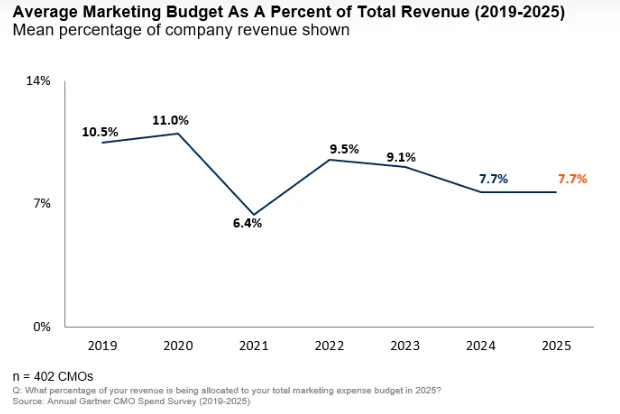
So, you have to be much sharper about where ad spend goes, which marketing channels deserve priority, and how each campaign supports the wider customer journey.
Performance marketing gives you a clearer way to track clicks, conversions, return on ad spend, and campaign revenue. Growth marketing looks at the wider growth model, including acquisition, retention, referral, customer lifetime value, and the customer experience after the first sale.
In this blog, we’ll break down:
- How growth marketing and performance marketing differ across goals, channels, and KPIs
- When to use each approach based on your stage, budget, and customer acquisition cost
- How both strategies can work together across the marketing funnel
- Which model your brand needs if you care about conversion rate, return on ad spend, retention, and long-term growth
Spending more on ads but still struggling to turn clicks into real revenue? inBeat Agency helps you combine creator-led content, paid media, and performance tracking so campaigns are built around measurable growth. Book a free strategy call now!
TL;DR: How Growth Marketing and Performance Marketing Compare: Focus, Funnel, Goals + More
What Is Growth Marketing?
Growth marketing is a digital* marketing approach that looks beyond the first click or sale. It studies how people discover your brand, what makes them take action, and what keeps them engaged over time.
Instead of putting all the pressure on short-term campaigns, a growth marketer studies where people move smoothly and where they drop off. The goal is to improve the path from first touch to repeat purchase.
The main idea is simple: test, learn, and improve. Growth teams use data and experiments to find what works, fix weak points, and create a growth model that can scale over time.
* Note: While most growth marketing happens online, some teams occasionally test offline channels such as billboards, direct mail campaigns, or pop-up events. The difference is that they still apply the same measurement mindset, using QR codes, dedicated landing pages, and exclusive promo codes to track performance and calculate ROI with precision.
Key Characteristics of Growth Marketing
Growth marketing works best when your team connects three things: data, channels, and the customer lifecycle.
- Data-driven decision-making: A growth marketer looks at real behavior before making changes. This can include A/B tests, Google Analytics metrics, or CRM data. Growth marketing metrics include conversion rate, churn rate, and customer lifetime value among others.
- Cross-channel strategy: Growth marketing connects your content, social media, email, product experience, paid search, and referral programs so they support the same direction. This matters because customers do not interact with your brand through one channel alone.
- Lifecycle marketing: The focus goes beyond customer acquisition. Growth marketing also looks at activation, retention, referrals, and repeat purchases, so your brand can keep creating value after the first conversion.
Common Growth Content Types
Growth marketing content supports different stages of the buyer journey. Each format we mention below helps people understand your brand, take the next step, or stay engaged after they convert.
Educational Content
Blog posts, whitepapers, guides, and webinars answer customer questions before they are ready to buy. This makes content marketing and, by extension, search engine optimization, useful for building trust and organic growth.
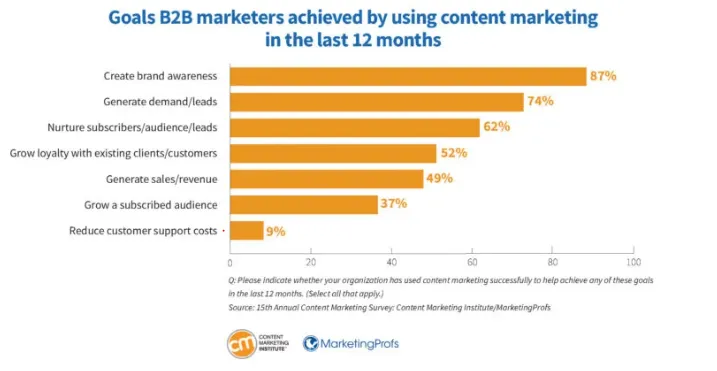
In fact, Content Marketing Institute’s 2025 B2B report found that content marketing helped 87% of B2B marketers create brand awareness and 74% generate demand or leads.
Social Media Content
Growth-focused social media entails more than daily posting. You need a strategy behind sharing product education, customer stories, creator content, and community-led conversations to make your brand easier to trust.
Email Marketing
Email campaigns help you activate leads, onboard new customers, recover abandoned carts, and bring existing buyers back. They also give you useful signals about customer interest and readiness.
SEO and Paid Search
SEO helps your brand show up across search engines when people are already looking for answers. And paid search helps capture high-intent demand through branded keywords and search ads pointing to your landing pages.
Growth Marketing Strategies & Tools
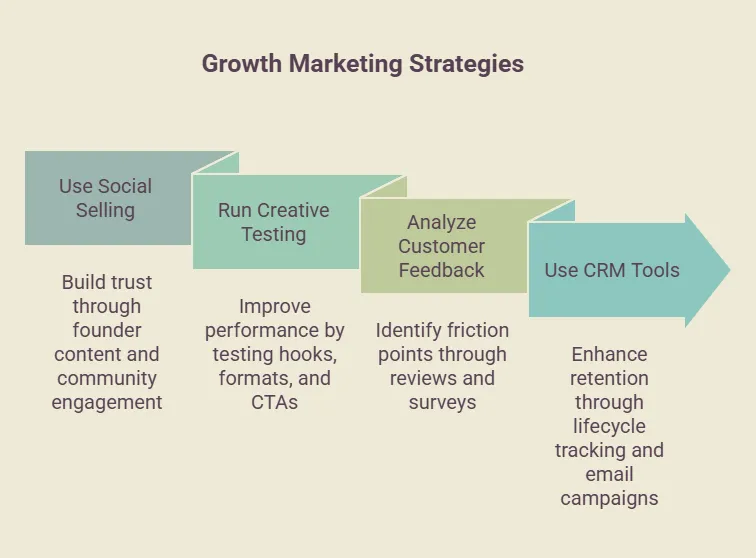
Growth marketing needs a simple system for learning, testing, and keeping customers engaged. Below, we have shared some strategies to help you turn customer data into practical next steps.
Use Social Selling to Build Trust
Founder content, creator-led conversations, community posts, and direct replies can help people understand your brand before they enter a formal sales flow. This works well when your audience needs education, proof, and a human reason to care.
Run Creative Testing to Improve Performance
Test hooks, formats, CTAs, offers, product angles, and landing pages to see what improves click-through rates, conversion rates, and customer acquisition costs. Strong creative testing helps your team learn faster before putting more ad spend behind a campaign.
Analyze Customer Feedback to Find Friction
Reviews, surveys, support tickets, social comments, and Net Promoter Score data can show where people get stuck.
This matters because Salesforce found that 80% of customers say experience is as important as products and services, while 65% expect companies to adapt to their changing needs.
You can use these insights to improve messaging, onboarding, user experience, and product readiness.
Use CRM Tools to Improve Retention
HubSpot, Salesforce, and similar CRM tools help you track lifecycle stages, segment customers, trigger email campaigns, and manage customer retention programs.
In fact, data also reports that 88% of marketers use analytics or measurement tools, while 86% use CRM systems. Those are probably your competitors, so if you’re not using the same tactics too, expect to be left behind.
Real-World Examples of Growth Marketing
Before we compare growth marketing with performance marketing, it helps to see how this approach works in real campaigns.
The examples below show how brands use testing, customer insight, and full-funnel planning to turn attention into repeatable growth.
1. Dashing Diva
At inBeat, we worked with Dashing Diva to turn casual beauty buyers into loyal brand advocates through a full-funnel growth marketing strategy.
The brand needed more than one-off content. It needed a system that could reach shoppers, build trust, and guide them toward purchase across multiple touchpoints. So, our team focused on creator-led content exuding social proof, paid media testing, and customer journey improvements.
We also helped Dashing Diva expand from 3 to 7 marketing channels, which gave the brand more ways to reach, educate, and convert its audience.
Through our growth marketing services, we helped the brand improve media efficiency across the funnel. As a result, Dashing Diva saw a 24% decrease in customer acquisition cost.

2. Hurom
Hurom needed more than traffic to its product pages. The brand had to educate health-conscious buyers on why its slow juicers mattered, then turn that interest into profitable growth.
Our inBeat team built a full-funnel paid media, SEO, and influencer strategy supported by an editorial playbook. We combined authority bloggers, creator-led product education, and blog content to help buyers understand the product before they reached the purchase stage.
Once the content foundation was in place, we used paid media testing to refine audiences, messages, and offers. This helped Hurom convert demand more efficiently across the funnel.
The campaign delivered:
- 300% increase in ROAS
- 70% reduction in overall CPA
- 33% month-over-month growth in net profit margin
- 150M+ impressions in one year

3. Airbnb
Airbnb is another classic example of growth marketing. The company turned word of mouth into a measurable growth loop.
They noticed that happy guests and hosts were already talking about Airbnb. Instead of treating referrals as a small side feature, Airbnb rebuilt the program across web, Android, and iOS. Their goal was to make invites easier to send, easier to track, and more connected to real booking behavior.
The team also tracked:
- Monthly active users sending invites
- Number of invitees per inviter
- Conversion rate to new users
- Conversion rate to new guests
- Conversion rate to new hosts
Airbnb connected customer behavior, product experience, referral incentives, and A/B tests into one growth model. The program increased user signups and bookings by over 300% per day, while referrals increased bookings by over 25% in some markets.

What Is Performance Marketing?
Performance marketing is a digital marketing approach where campaigns are tied to measurable actions. Instead of judging success only by reach or awareness, you look at clicks, leads, conversions, sales, return on ad spend, and other clear KPIs.
The main idea is accountability. Your ad spend connects directly to a result, which makes performance marketing useful when your brand needs faster feedback on campaign performance.
In many cases, it also follows a pay-for-performance model. This means you may pay based on actions such as clicks, signups, purchases, app installs, or affiliate sales, depending on the campaign setup.
Key Characteristics of Performance Marketing
Performance marketing works best when your team has a clear offer, a defined audience, and a specific result to measure.
- Short-term, conversion-driven campaigns: These campaigns are usually built around immediate outcomes, such as purchases, qualified leads, booked calls, app installs, or trial signups.
- Heavy reliance on paid media: Performance marketing typically runs through paid media channels such as Google Ads, Meta Ads, search ads, display ads, affiliate marketing, influencer partnerships, and programmatic advertising. These channels give you more control over budget, targeting, timing, and testing.
- Clear attribution and KPIs: Every campaign needs a measurement plan. Teams track click-through rate, conversion rate, cost per acquisition, return on ad spend, and customer acquisition cost to see which campaigns deserve more budget and which ones need changes.
Common Performance Marketing Content Types
Performance marketing content is built to make the offer clear and move people toward action. Each format should reduce friction and support a clear next step.
Paid Ads
Google Ads, Meta Ads, search ads, and pay-per-click ads need direct copy, strong visuals, clear CTAs, and landing pages built for conversion. Every element should make the offer easy to understand and the next step easy to take.
Affiliate Marketing
Affiliate partners may use product reviews, comparison pages, coupon content, tutorials, and buying guides to drive trackable sales or leads.
impact.com’s 2025 State of Affiliate Marketing report found that 74% of brands generate 11% to 30% of their total revenue from affiliate marketing, which shows why partner-led content can become a serious revenue channel.
Influencer Campaigns with Trackable ROI
Creator content works best when each post, video, or story has a clear campaign goal. You can track results through promo codes, affiliate links, UTM links, and platform analytics.
In fact, Influencer Marketing Hub’s 2026 benchmark report found that among brands increasing influencer budgets, 35% track conversions and 25% track attributable revenue or sales as KPIs.
Programmatic and Display Ads
Programmatic advertising uses automated buying to place ads across websites, apps, video platforms, Connected TV, and Premium CTV Inventory. Display ads are the creative assets people see in those placements, such as banners, video units, interactive display ads, and rich media formats.
In performance marketing, these assets need clear messaging, strong audience fit, and measurable actions such as clicks, site visits, form fills, or purchases.
Performance Marketing Tactics
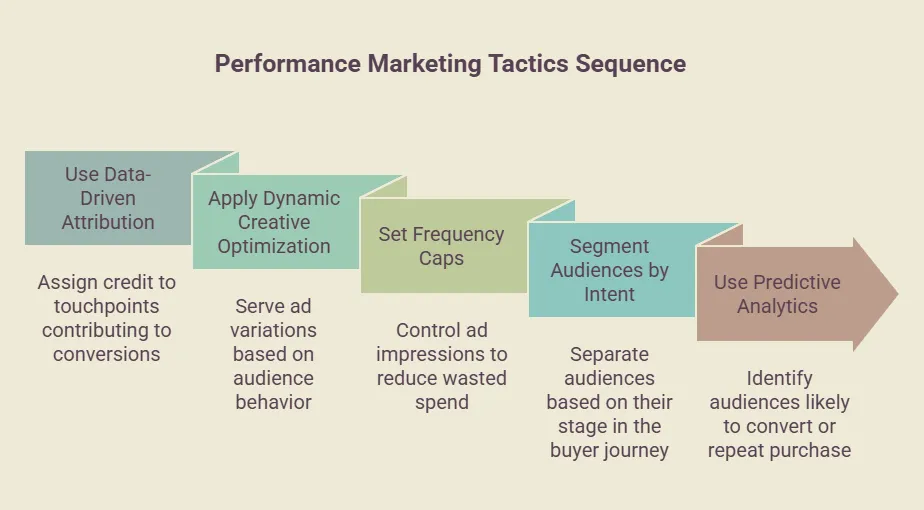
Performance marketing tactics help you spend smarter, test faster, and understand which campaigns deserve more budget.
Use Data-Driven Attribution
Data-driven attribution helps you see which touchpoints contribute to a conversion. Instead of giving all credit to the last click, you can review how search ads, paid social, affiliate marketing, display ads, and landing pages work together before someone takes action.
Even better, Google reports that advertisers who switch to data-driven attribution from another model typically see a 6% average increase in conversions.
Apply Dynamic Creative Optimization
Dynamic Creative Optimization helps you serve different ad variations based on audience behavior, location, device, or intent. This can improve relevance across paid media channels without building every ad manually from scratch.
Set Frequency Caps
Frequency capping controls how many times the same person sees your ad. This helps reduce wasted impressions, protect ad spend, and avoid creative fatigue when you run display ads, retargeting campaigns, or Connected TV placements.
Segment Audiences by Intent
Audience segmentation lets you separate cold visitors, engaged prospects, cart abandoners, past buyers, and high-value customers. Google describes audience segments as groups based on interests, intents, demographics, and past interactions.
In one Google case study, Vodafone Turkey used audience data to generate 11x more enterprise conversions at a 25% lower CPA. Each group needs a different message, offer, and next step.
Use Predictive Analytics
Predictive analytics uses data science, machine learning, and AI-driven targeting to identify which audiences are more likely to click, convert, or repeat purchase. This helps performance teams prioritize budget around stronger conversion opportunities.
Real-World Example of Performance Marketing
Performance marketing is easiest to understand when you see how brands connect paid media, tracking, creative, and attribution around one clear outcome.
The examples below show how performance campaigns turn budget into measurable actions like leads, bookings, sales, or signups.
1. Booksy
For Booksy, a beauty scheduling app, our inBeat team built a TikTok-first performance strategy to turn creator content into measurable app and business growth.
Through our performance marketing services, we used UGC, influencer whitelisting, and paid media testing to speak to real pain points like double bookings, manual scheduling, and missed appointments.
This made the campaign feel native to TikTok while still staying tied to clear performance goals. Each creative angle was designed to move high-intent users toward app installs and business registrations.
The campaign drove:
- 1,700% increase in business registrations in 3 months
- 637% month-over-month jump in app installs
- 92% drop in cost per business registration month over month

2. Unroll.Me
For Unroll.Me, an email cleanup app, our inBeat team built a performance campaign around a clear user pain point: inbox frustration.
We used dark posting across multiple countries and tested creator-led angles. The messaging stayed simple and direct: people wanted a cleaner inbox without extra effort.
The campaign reduced CPA by 20% and increased referral sign-ups by 40%. This makes it a clear example of performance marketing built around acquisition, testing, and cost efficiency.

3. Lenovo
Lenovo is a global PC and technology brand. Its case shows how attribution can change performance marketing decisions.
According to a Think with Google case study, Lenovo found that its old last-click model gave the team an inflated view of performance. The brand moved to data-driven attribution to see how paid search, display, paid social, and comparison shopping engines contributed to revenue.
The new view showed that 73% of revenue came from multi-touch conversion paths. It also revealed that comparison shopping engines had about 42% better ROAS than the next best channel, which made budget decisions much clearer.
Growth Marketing vs Performance Marketing: Key Differences
Growth marketing and performance marketing both use data, testing, and digital channels, but they are built for different jobs. Growth marketing looks at the full customer journey, while performance marketing focuses more on measurable campaign outcomes.
A. Strategy Focus
Growth marketing is built around long-term improvement. It looks at how your brand attracts people, converts them, keeps them engaged, and turns them into repeat customers or referrals. The focus is on building a stronger growth system over time.
Performance marketing, on the other hand, is more campaign-focused. It looks at what a specific campaign can deliver right now, such as clicks, leads, purchases, signups, or revenue. This makes it useful when you need clear results from a defined budget.
B. Funnel Coverage
Growth marketing covers the full funnel. It looks at what happens before someone discovers your brand, what helps them convert, and what keeps them coming back after the first purchase.
Performance marketing usually sits closer to the middle and bottom of the funnel. It works best when people already have some level of intent, and your campaign needs to turn that interest into a lead, signup, booking, or sale.
C. Metrics & KPIs
Growth marketing tracks metrics that show long-term business health. This includes customer lifetime value, retention, churn rate, engagement, Net Promoter Score, repeat purchase rate, and monthly active users.
Performance marketing looks at the numbers that show how efficiently a campaign turns budget into action. This includes cost per acquisition, return on ad spend, conversion rate, click-through rate, cost per click, leads, purchases, and total revenue from a campaign.
So, the difference is simple.
- Growth marketing asks, “Are we building stronger customer relationships over time?”
- Performance marketing asks, “Did this campaign deliver the action we paid for?”
D. Time Horizon
This is where the difference becomes easier to see.
Growth marketing takes a longer view. It focuses on sustainable growth, so your team keeps improving acquisition, retention, customer experience, and customer lifetime value in the long run.
Performance marketing works on a shorter timeline. It helps you understand what a campaign can generate within a defined window, such as leads, purchases, app installs, or booked calls.
So, if you need stronger long-term growth, growth marketing makes more sense. And if you need faster demand or revenue from a clear budget, performance marketing is usually the better fit
How Growth and Performance Marketing Work Together
Growth marketing and performance marketing work best when they support each other. You do not have to choose just one forever.
From our experience at inBeat, the strongest campaign results usually come from combining both. Growth marketing builds the bigger system, while performance marketing turns that system into measurable action.
For example, you can use creator content, social proof, blog content, referral programs, and email flows to build trust across the customer journey. Paid media, creator whitelisting, affiliate marketing, paid search, and retargeting can then move high-intent users toward a purchase, signup, demo, or booking.
The feedback loop helps you replicate winning strategies. Performance data shows you which hooks, offers, audiences, landing pages, and CTAs convert best. These insights can improve content, onboarding, retention, and future experiments.
That’s why we see growth and performance as connected parts of the same system. Growth marketing gives your brand a stronger foundation, while performance marketing helps turn that foundation into trackable revenue, leads, and customer acquisition.
Turn Growth & Performance into One Clear Strategy with inBeat Agency
If you are struggling to connect creator content, paid media, and customer acquisition strategies to results you can actually measure, inBeat Agency can help. We build campaigns that combine growth thinking with performance marketing execution.
Our team works across creator partnerships, paid media, UGC, whitelisting, and campaign testing to improve conversions, lower customer acquisition cost, and scale with more confidence. Book a free strategy call now.
FAQs
What is the main difference between growth and performance marketing?
The main difference comes down to purpose. Growth marketing builds a system for long-term customer acquisition, retention, referrals, and customer lifetime value. Performance marketing focuses on specific campaigns that drive measurable actions like clicks, leads, sales, CPA, and ROAS.
Is growth marketing better than performance marketing?
No, growth marketing is not automatically better. It depends on your stage and goals. Growth marketing is stronger for long-term retention and LTV, while performance marketing is better when you need faster leads, sales, or signups.
Which is more cost-effective, growth or performance marketing?
Growth marketing can become more cost-effective over time because it improves retention, referrals, and organic growth. Performance marketing can be cost-effective when campaigns convert efficiently, but rising ad spend can increase customer acquisition cost fast.
How do you transition from performance to growth marketing?
Start by using performance data to find patterns beyond each campaign. Look at which audiences, offers, hooks, and landing pages bring high-value customers. Then build content, email flows, retention programs, and growth experiments around those insights.
Appendix
- http://gartner.com/en/newsroom/press-releases/2025-05-12-gartner-2025-cmo-spend-survey-reveals-marketing-budgets-have-flatlined-at-seven-percent-of-overall-company-revenue
- https://www.gartner.com/en/newsroom/press-releases/2025-06-02-gartner-survey-finds-digital-channels-account-for-61-point-1-percent-of-total-marketing-spend
- https://contentmarketinginstitute.com/b2b-research/b2b-content-marketing-trends-research-2025
- https://www.salesforce.com/small-business/what-are-customer-expectations/
- https://www.salesforce.com/marketing/marketing-statistics/
- https://impact.com/research-reports/state-of-affiliate-marketing/
- https://influencermarketinghub.com/influencer-marketing-benchmark-report/
- https://blog.google/products/ads-commerce/turning-data-into-results-with-data-driven-attribution/
- https://www.thinkwithgoogle.com/_qs/documents/10108/PrivacyPlaybook_Marketers_FINAL.pdf
- https://www.thinkwithgoogle.com/_qs/documents/514/lenovo-radically-new-view-results.pdf