

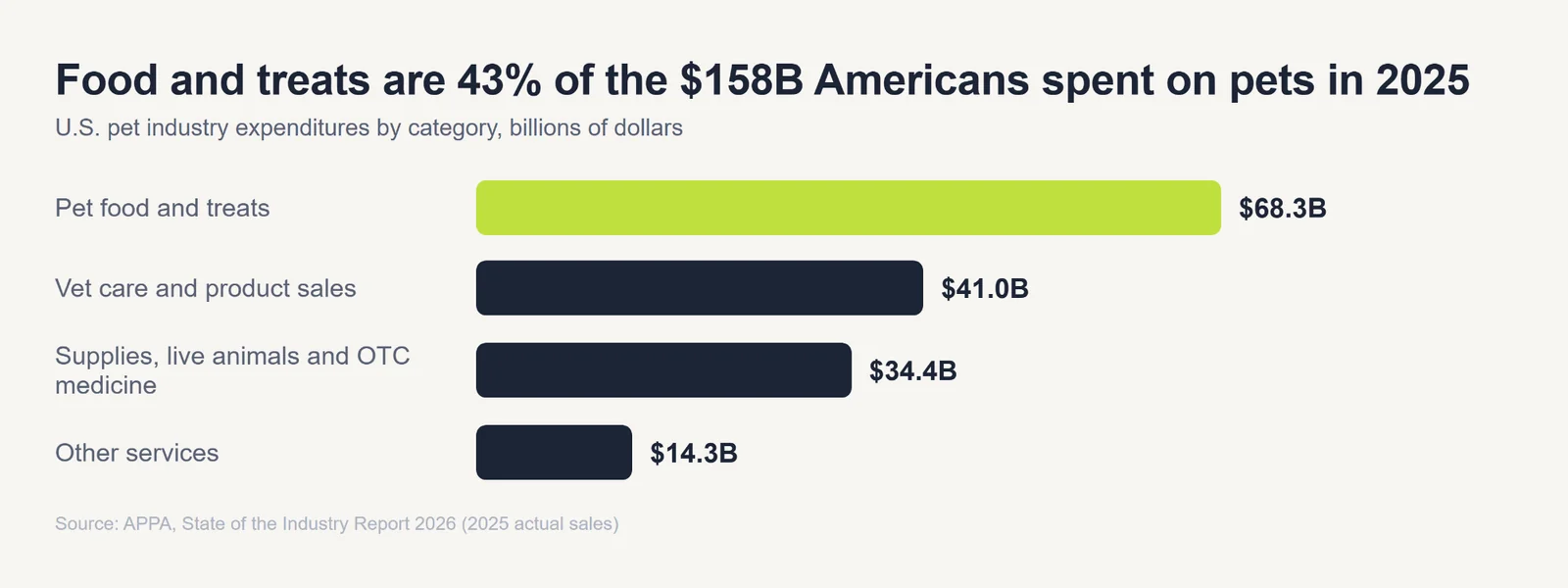
In a 2026 survey by AICPA and The Harris Poll, 69% of US dog and cat owners said they'd rather cut spending on themselves than their pets.
That's quite a commitment. But caring deeply about a pet doesn't automatically translate into loyalty to a particular brand.
What makes someone switch foods, trust a supplement, or believe a creator's recommendation?
Those answers rarely appear in industry spending reports.
This guide explores how pet market research can uncover the motivations behind purchasing decisions and turn real owner insights into creator briefs and ads worth testing.
TL;DR
- Pet market research studies the pet category and its buyers, so a brand can choose a product, price, message, or channel.
- Pet consumer research explains why owners buy, switch, or quit. Pet brand audience research maps who they are, where they spend time, and the words they use.
- Research should clarify what owners care about, then feed message ideas into paid creative tests before the team commits more budget.
- Start with a focused interview round and add participants while important new themes are still emerging. DIY incentives may cost under $2,000, while a multi-method study can start around $17,000.
- Give the creative team something concrete: real customer language, message hypotheses, and clear criteria for the next test.
What Is Pet Market Research?
Pet market research looks at both the category and the people buying within it. For brands, that means understanding where the opportunities are, what influences a purchase, and which product, pricing, or messaging decisions deserve closer attention.
You hear from the person making the purchase, along with people who influence that choice, such as veterinarians, breeders, and retailers. The pet uses the product; the owner explains the decision.
There are two starting points. Secondary research draws on published data, including the APPA National Pet Owners Survey, which has tracked pet ownership since 1988.
Primary research goes directly to your audience through interviews, surveys, and listening. Since the terminology often overlaps, here's what each approach can tell you:
| Term | Question it answers | Typical output |
|---|---|---|
| Pet market sizing | How big is the category, who competes, and where is it growing? | Market size, share, trend report |
| Pet consumer research | Why do owners choose, switch, or abandon a product? | Motivations, objections, decision paths |
| Pet brand audience research | Who buys from this brand, where do they spend time, and how do they talk? | Segments, channels, a language bank |
Published reports provide useful context, but they rarely explain why your own customers hesitate, switch, or stay. For that, you need first-party data or conversations with the people you're trying to reach.
If you're looking for a research partner, our consumer research roundup profiles fourteen specialist firms.
How Pet Consumer Research Differs From Other Consumer Research
Buying for a pet is different from buying for yourself. The owner chooses and pays, while the animal uses the product. And because one household may have several pets, the way you recruit participants matters. Four considerations follow.
The Owner Buys and the Pet Consumes
Ask owners to describe what they did, rather than guess what their pet felt. "Walk me through the last time you bought food" reveals the steps behind a purchase. "Does your dog like it?" gives you an interpretation of the animal's behavior instead.
Test for Pet Parent Language in the Screener
Some owners call themselves pet parents; others prefer a different term. Leave room for both in your screener. APPA reports that 22% of pet owners spent less on their pets in 2025, which makes spending choices worth exploring alongside emotional language. Ask how people describe their relationship with the pet and how they weigh price, then compare the responses by segment.
Multi-Pet Households Break Single-Pet Samples
Before recruiting, set quotas for dog-only, cat-only, and mixed-pet households. Then anchor each conversation to one named pet so the purchase story stays specific.
Otherwise, the easiest owners to reach can dominate the sample. APPA's 2025 data, published in 2026, shows:
- Dog ownership at 53% of U.S. households.
- Cat ownership at 39%.
- Gen X pet ownership up 12%, with growth reaching birds, reptiles, and freshwater fish.
Category Behavior Splits by Species and Life Stage
The questions a new puppy owner asks can be very different from those of someone caring for a senior dog or an indoor cat. A vet may also influence the decision. Start with the species your product serves, then separate life stages when needs or purchase triggers change.
The triggers that start a purchase ("my dog just turned seven") are the category entry points worth listing in the screener.
Pet Market Research Methods Compared: Which One Fits the Decision
Before choosing a method, ask what you're trying to decide. Do you need to understand a behavior, estimate how common it is, or compare messages in the market? The options below answer different parts of that question, with different trade-offs.
| Method | Best for | Typical sample | Speed | Main weakness |
|---|---|---|---|---|
| Online survey | Sizing a pattern, concept appeal, price sensitivity | 400 responses; precision depends on sampling design | Moderate | Owners report intent, and intent overstates behavior |
| Pet owner interviews | Why owners buy, switch, or quit | 12 to 15 per segment | Moderate | Small sample, so patterns need a second source |
| Focus group | Reactions to messages and concepts | 6 to 10 people per group | Moderate | One loud voice can steer the room |
| Home visit or photo diary | Real routines, storage, feeding habits | 6 to 10 homes | Slow | Costly to scale |
| Social listening | Owner language, objections, emerging worries | Thousands of public posts | Fast | Public posts skew toward strong opinions |
| Review and ticket mining | Product-level objections in the owners' words | Hundreds of reviews | Fast | Covers existing buyers only |
| Secondary reports | Market size, ownership, spend by generation | Published data | Fast | Broad reports may miss brand-specific motives |
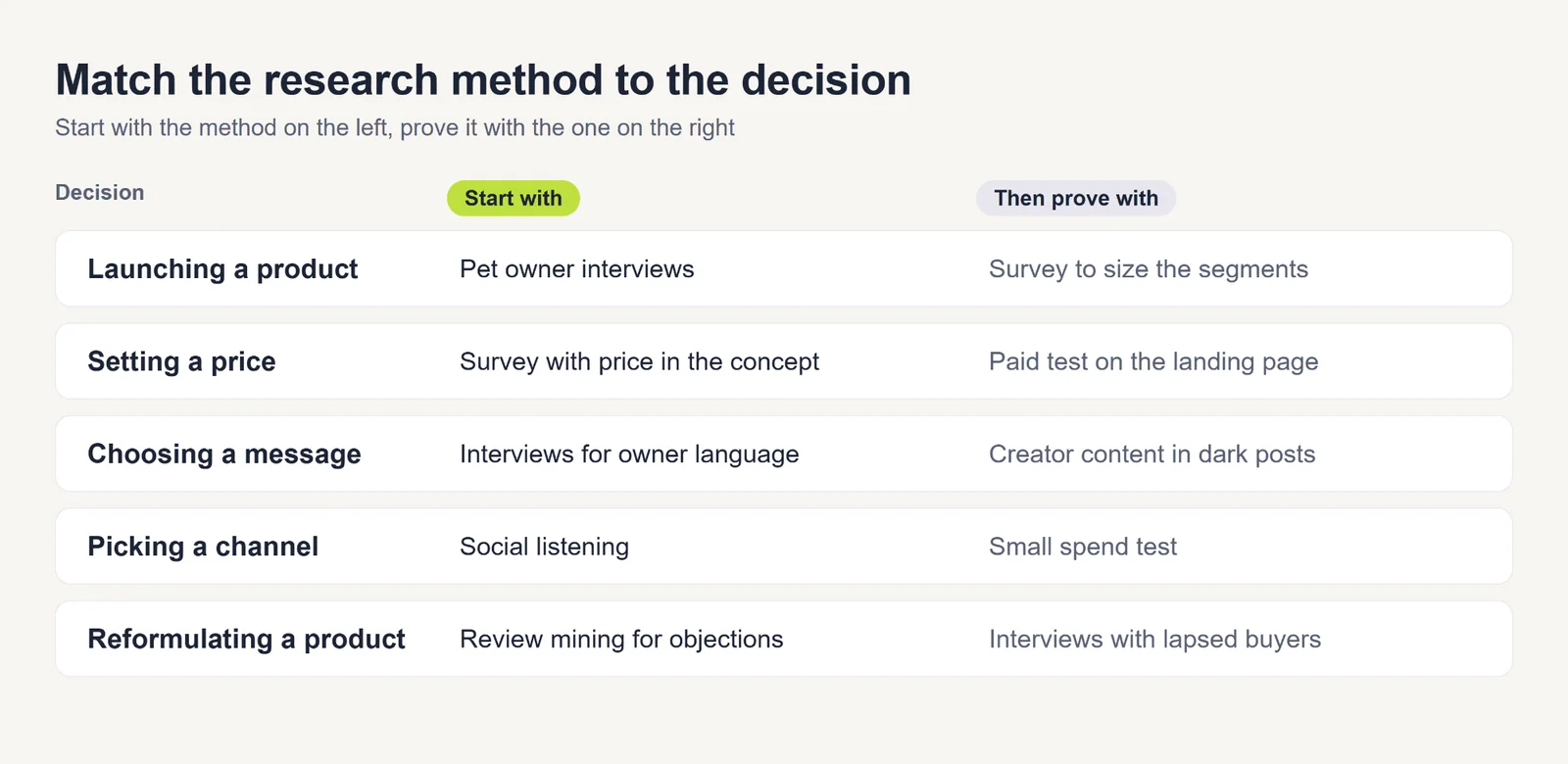
Here's how those methods can work together:
- Launching a product: interviews first, then a survey to size the segments the interviews surfaced.
- Setting a price: a survey with price in the concept, then a paid test on the landing page.
- Choosing a message: interviews for language, then creator content tested in dark posts.
- Picking a channel: social listening for where owners already talk, then a small spend test.
- Reformulating a product: review mining for objections, then interviews with lapsed buyers.
Run Pet Owner Interviews in Six Steps
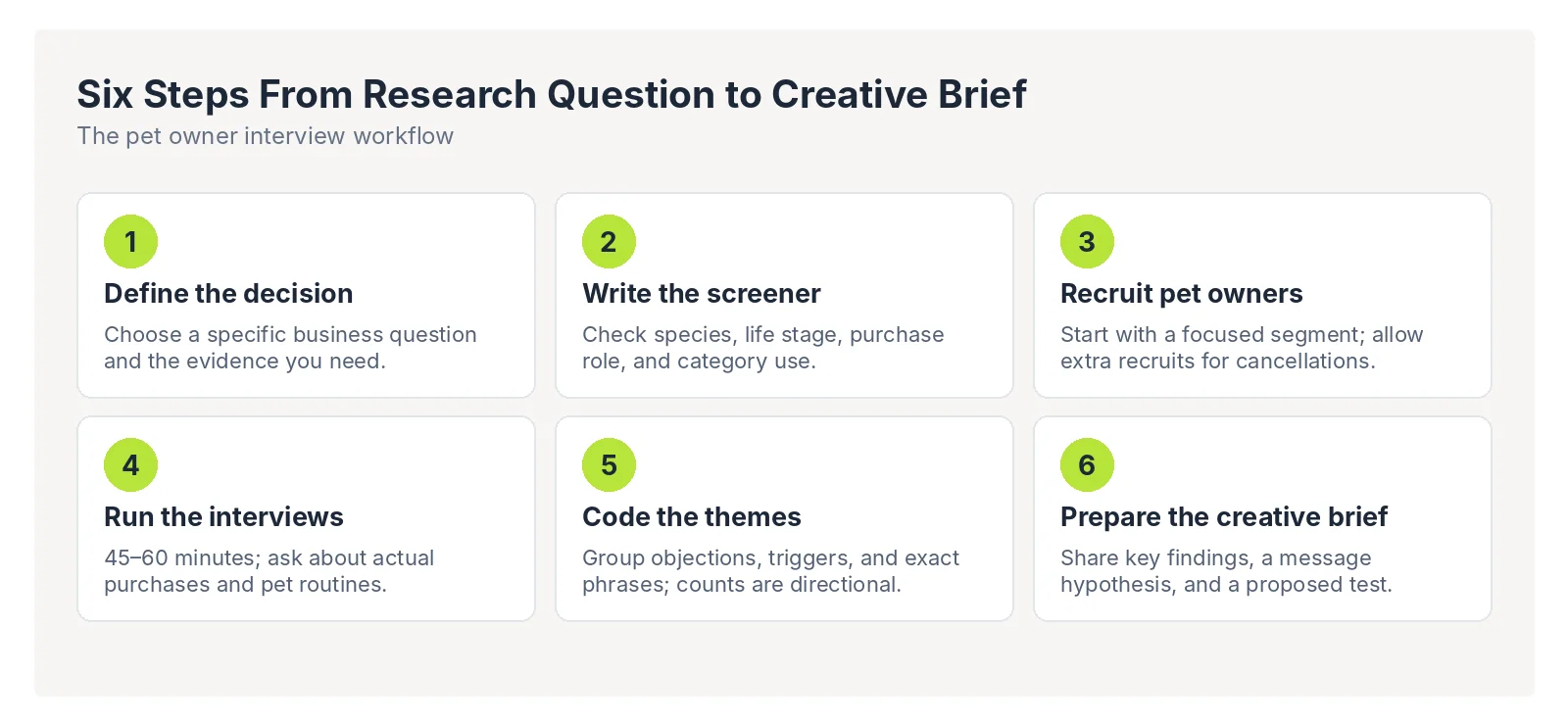
Good interviews begin with a decision to make, rather than a long list of things you'd like to know. These six steps show how to turn that decision into a useful creative brief.
- Define the choice you're trying to make. "Understand our audience" is too broad; "choose between a vet-led and an owner-led message for senior-dog food" gives the interviews a purpose. If vet influence comes up repeatedly, you can brief both approaches and compare them in a creative test.
- Build a screener with roughly nine questions covering species, life stage, household composition, purchasing role, current brands and retailers, the last purchase, and how people refer to their pets. Keep the sample focused on those who actually make the relevant purchase.
- For a focused segment, start with 12 to 15 owners and allow two or three additional recruits for cancellations. After the first round, check whether new themes are still emerging.
- During each 45- to 60-minute session, ask about real purchases and routines, focusing on one named pet. With the participant's permission, a photo of the current product can help ground the conversation. Record only with consent.
- Afterward, tag transcripts for objections, purchase triggers, other decision-makers, and useful verbatim phrases. Note how often a theme appears, but treat those counts as directional rather than population estimates.
- Finally, share a concise summary with the media and creative teams, including a message hypothesis and a proposed test. We'll come back to that handoff in the creative section.
A single method can still miss part of the story. A Journal of Business Anthropology case on a pet food brand ran psychologically oriented focus groups and anthropologically informed ethnographies independently:
- Focus groups: a positioning built on resolving cognitive dissonance.
- Ethnographies: a positioning that reframed the whole pet food category as a way to elevate the brand.
Each method suggested a different positioning direction, which gave the brand a more informed choice.
Pet Owner Interview Questions That Surface Real Buying Behavior
A recent purchase usually tells you more than a hypothetical preference. These questions help owners describe what happened, with follow-ups when the first answer is vague.
| Question | What it uncovers | Follow-up probe |
|---|---|---|
| "Walk me through the last time you bought this." | The real purchase path, channel, and household roles | "What happened right before that?" |
| "What almost stopped you from buying?" | Objections and deal-breakers | "What would have changed your mind?" |
| "Who else weighs in on what your pet eats or uses?" | Vet, partner, breeder, online communities | "What did they say?" |
| "When did you last switch brands, and what triggered it?" | Switching moments | "How long had you been considering it?" |
| "Where did you first hear about the brand you use now?" | Discovery channels | "What convinced you after that?" |
| "What does your vet say about it?" | Vet influence | "Have you ever disagreed with the vet?" |
| "When did a price last make you hesitate on this?" | Price thresholds from a real decision | "What did you do instead?" |
| "How would you describe your pet to someone who has never met them?" | Identity language and humanization level | "Which word would you never use?" |
| "What did you search or ask an assistant before buying?" | The information path, including AI | "What did the answer miss?" |
| "What should brands in this category stop saying?" | Language friction | "What do you hear instead?" |
Avoid hypotheticals such as "Would you buy this?" and agreement prompts such as "Don't you think this is better?" Both hand the owner the answer.
How to Tell When You've Interviewed Enough Owners
Sample size depends on how varied the owners are and whether each conversation reveals something new. If purchase contexts differ substantially, treat them as separate segments. If important questions remain, keep interviewing. The cost estimates below assume a managed round of 10 to 15 interviews.
As a practical check, look for three consecutive interviews that add no meaningful objections or triggers. That may suggest saturation, although a varied audience can require more sessions. Stop only when the key questions are sufficiently covered.
Recruit Pet Owners Through Your Own Channels Before a Panel
Start with your own audience, then broaden recruitment to see whether the themes hold beyond existing customers. Our consumer panel recruitment guide covers incentives and retention.
These channels bring different perspectives:
- Your customer and email lists, especially lapsed buyers who can explain why they left.
- Creator audiences. Ask pet creators to share a screener with followers, but tag those recruits separately because people who follow pet content may differ from the broader market.
- Vet clinics and shelters, where owners are reachable at moments of real decision.
- Breed and local communities, with the moderators' permission.
- A paid social screener that routes qualified owners to a short re-screening call.
- A paid panel, as the fallback when the segment is narrow.
Plan $75 to $150 per participant for incentives. A simple verification step, such as a photo of the current food bag, can also help screen out ineligible respondents.
Pet Brand Audience Research With Social Listening and First-Party Data
You can learn quite a bit before commissioning a survey. Reviews, support tickets, communities, and first-party search data reveal how owners describe problems in their own words. They're accessible starting points, though each source has its own bias.
| Signal | Where to find it | What to extract | Limit |
|---|---|---|---|
| Breed and species communities | Breed forums, local groups, subreddits | Recurring worries, vocabulary, advice owners trade | Skews toward the most engaged owners |
| Short-video and video comments | TikTok, YouTube, Instagram | Hooks that draw replies, objections in the comments | Entertainment accounts attract entertainment audiences |
| Retailer and marketplace reviews | Your product pages, competitor listings | Objections by frequency, praise by phrase | Existing buyers only |
| Support tickets and returns | Your own help desk | Confusion, unmet expectations, usage mistakes | Complaints overstate the rate of problems |
| Search queries | Search Console, autocomplete | The questions owners type before buying | Shows interest, not purchase |
A 2025 veterinary study offers a useful example of why these sources work better together. Researchers combined 132 kidney-related responses drawn from a larger survey of 1,633 dog owners with social media discussions on canine kidney disease:
- Both sources agreed on the main worry, increased urination and thirst.
- The social data also revealed pain as a major concern and the emotional toll of end-of-life decisions, neither of which the survey asked about.
Those extra concerns could shape the next interview questions and reveal language a brand might otherwise overlook.
Which Pet Communities and Platforms Reveal Owner Language
Rather than monitoring everything, choose three places relevant owners already spend time and log recurring questions in one sheet. Our guide to social listening explains the tools and workflow.
A good starting mix is a breed community, a relevant short-video hashtag, and reviews of the top three competing products.
How to Mine Reviews and Support Tickets for Objections
As a starting point, sample 200 to 300 reviews and group recurring objections, noting how often each appears in that set.
Include a few representative customer quotes in the creative brief, preserving their context. Use those themes to decide which concerns deserve a test.
Run an Influencer-Led Pet Owner Focus Group
For a focused concept review, invite 6 to 10 micro-creators who own the species you're targeting. Prepare the discussion guide before recruitment so everyone reacts to the same prompts.
Separate what participants think personally from what they predict their followers will think. If you need help finding participants and running the sessions, our influencer-centric focus group service supports both.
Validate Social Signals Against Interviews
A comment shows what someone chose to post; an interview lets you ask what happened before and after. If a pattern looks promising, explore it with people in the target segment before changing the campaign.
When those sources point in the same direction, you have a better-informed hypothesis to take into a controlled creative test.
Turn Pet Owner Insight Into Ads and Creator Briefs
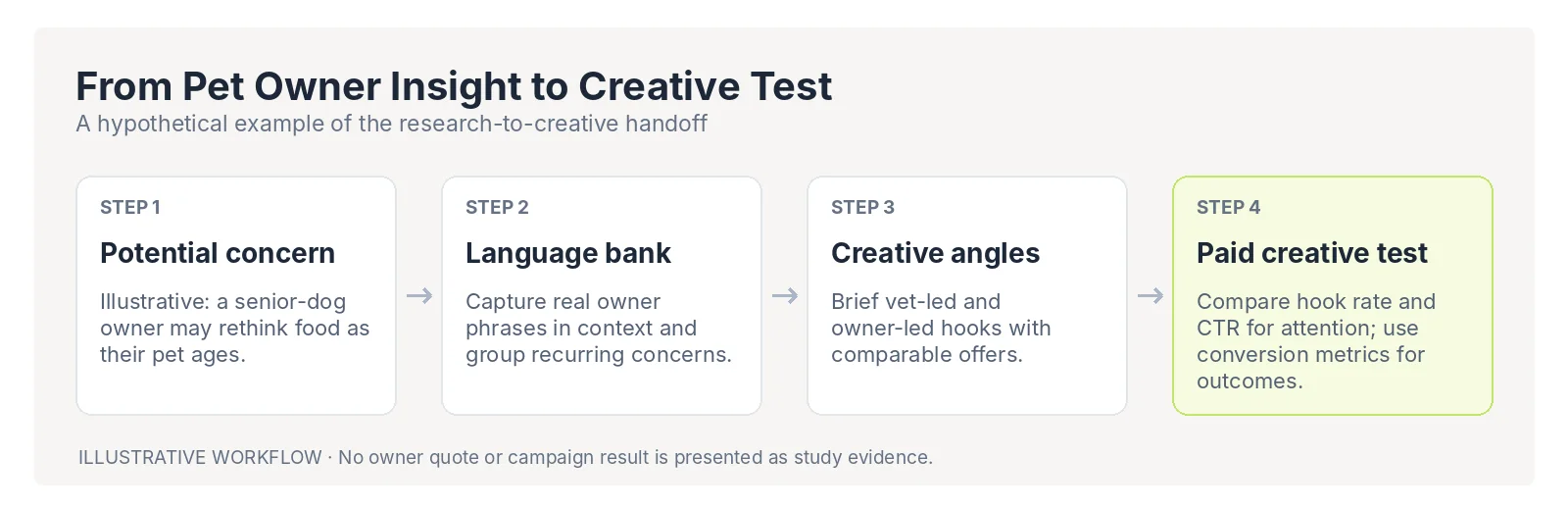
The creative team needs more than a general persona. Each insight should lead to a message worth exploring, a way to express it, and a test to run. The examples below are illustrative, rather than findings from a completed study.
| Finding | Creative output | How to test |
|---|---|---|
| Senior-dog owners trust their vet above any brand | A creator and vet pairing, with a vet-voiced hook | Two cells with the same offer: vet-voiced hook and owner-voiced hook |
| First-time cat owners describe feeling overwhelmed by choices | A "what I'd buy first" checklist from a creator | Checklist format against a single-product demo |
| Lapsed buyers cite price per serving | A cost-per-day breakdown in a creator's own kitchen | Cost-per-day claim against a quality claim |
| Owners switch food after a vet visit | A post-visit routine video | Placement near vet-visit search and content moments |
Build a Language Bank From Transcripts
Start with owners' exact words and group them by concern. An illustrative worry such as "My dog is getting older, and I'm rethinking his food" could point to an age-related nutrition angle.
Keep the original phrasing in the research notes for context. From there, let creators express the idea in a way that suits their own voice.
Convert Segments Into Persona and Angle Tests
Next, map audience segments against a few message angles. For instance, senior-dog owners might respond to a vet-trust concept, which you can compare with an owner-led approach.
Choose three to five combinations and brief a suitable creator for each. Keep the differences between concepts clear enough to compare their performance.
Prove Each Angle With a Small Paid Test
When the concepts are ready, use comparable dark posts to change one main variable at a time. Set a minimum delivery threshold and decision rule before launch.
Hook rate and CTR can indicate attention; conversion rate or CPA help assess commercial outcomes once enough data is available. If a result raises a new question, bring it into the next research round.
How Do Pet Owners Use AI Search, and What Does It Change for Research?
AI assistants are becoming another place pet owners look for answers about care and nutrition. That makes their questions worth including in research, even though adoption figures differ across surveys. Two studies from 2026 show why:
- A HABRI and Chewy Health survey of 2,008 U.S. dog and cat owners, fielded in May 2026, found 36% have used AI for pet care.
- A Talker Research survey of 2,000 owners commissioned by a pet food brand, fielded in April 2026, found 43% had used AI tools for pet health or nutrition information. The same survey found that 71% still trust veterinarians most.
To see what answers owners might encounter, run a small prompt audit:
- Write ten questions from your interview transcripts, in the owners' own words.
- Ask each question in two or three assistants.
- Log which brands, sources, and claims each answer cites.
- Compare the answers with what owners told you, and note what the assistants miss.
- Repeat monthly and track which sources keep appearing.
Because assistants and prompts return different sources, look for patterns across several runs rather than treating one response as definitive. Compare those patterns with the questions owners raised in interviews.
Our guide to social search optimization covers building that presence.
How Much Does Pet Market Research Cost?
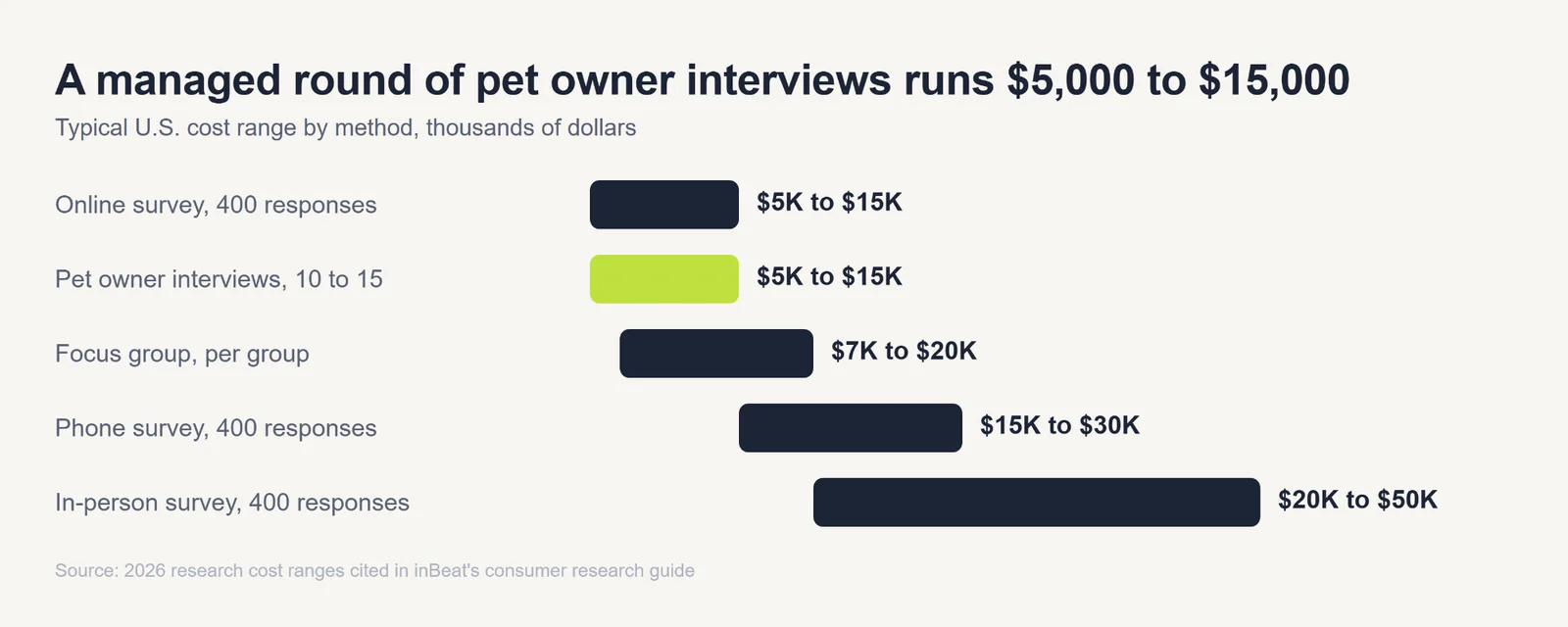
Research budgets depend on how hard participants are to reach and how much work your team handles in-house. The 2026 vendor ranges below are useful starting points, rather than fixed quotes for a pet-specific study.
Cost by Method
| Method | Typical US range | What drives price |
|---|---|---|
| Online survey | $5,000 to $15,000+ for 400 responses | Audience rarity, questionnaire length |
| Pet owner interviews | $5,000 to $15,000 for 10 to 15 interviews | Recruitment difficulty, incentives |
| Focus group | $7,000 to $20,000+ per group | Moderator, facility, incentives |
| Phone survey | $15,000 to $30,000+ for 400 responses | Length, callbacks |
| In-person survey | $20,000 to $50,000+ for 400 responses | Travel, field staff |
| Social listening and review mining | Staff time plus a tool plan | Volume of sources, tool tier |
The estimates come from a 2026 vendor guide cited in our consumer research roundup. Under a simple random-sampling assumption at 95% confidence, illustrative margins of error are about 10% for 100 responses, 5% for 400, and 3% for 1,000.
These figures do not automatically apply to opt-in online panels or other nonprobability samples.
Three Budget Tiers for Pet Brands
- Tier one, DIY: At $75 to $150 per participant, 12 interviews mean $900 to $1,800 in incentives, plus screening and staff time. This suits a focused, single-segment question.
- Tier two, scoped study: Choose one managed method, such as an interview round or a survey with 400 responses, when you need more support without a full program.
- Tier three, multi-method program: A survey, interviews, and a focus group together could cost roughly $17,000 to $50,000 using the ranges above. Consider this for a launch or repositioning.
How to Judge Return Before You Commit
One useful check is to compare the research cost with the budget it will inform.
A $10,000 study supporting $50,000 in monthly creative spend equals 20% of one month's budget. That may be worthwhile if the findings guide several rounds of work.
For a message you can change easily, a small paid test may answer the question faster. More involved research makes sense for decisions that are harder to reverse, including:
- Formulation.
- Pricing architecture.
- Entering a new segment.
Common Pet Market Research Mistakes and Their Warning Signs
Even a polished report can lead you astray if the sample is skewed, questions are leading, or curiosity is mistaken for demand. Before acting on the findings, look for these warning signs.
| What you see | What it likely means | What to check |
|---|---|---|
| Every interviewee sounds the same | The recruit came from one channel, such as your email list | Add owners from two other channels and compare household composition |
| Findings contradict your best-performing ad | The ad reaches a different segment, or it wins on attention and the research answers belief | Check who the ad reaches, then test both messages side by side |
| A search trend spikes with no sales lift | Curiosity, not purchase intent | Interview recent purchasers and compare with review volume |
| The survey says yes and the paid test says no | Stated intent overstates behavior, or price was missing from the concept | Add price to the concept and run a paid test |
| Transcripts contain photos or vet details | Consent and privacy gaps | Get written consent and strip medical identifiers before sharing |
Turn Pet Owner Research Into Creative With inBeat Agency
Owner insight becomes useful when it helps the team decide what to make next. At inBeat, our pet marketing work connects owner feedback with creator production and paid testing:
- Recruiting owners and creators.
- Moderating the sessions.
- Turning transcripts into a language bank.
- Producing and testing the creator content that follows.
If you're weighing a launch message, a new audience, or a pricing decision, book a strategy call and we'll help turn that question into a focused research plan and first creator test.
Pet Market Research FAQs
How many pet owner interviews do you need when customers split across dog and cat segments?
If dog and cat owners face different buying decisions, start with separate groups and roughly 12 to 15 interviews per group as a planning estimate. Review the themes before setting the final sample. Recruit mixed-pet households deliberately rather than counting one interview twice.
Do creator audiences bias pet brand audience research?
They can. Creator followers are often more engaged with category content, making them useful for language and concept reactions rather than representative market estimates. Add customers and paid-screener recruits, then tag participants by source to compare responses.
When do vets or breeders matter more than owners as interviewees?
Their input matters most when a purchase depends on expert guidance, such as with therapeutic diets, supplements, or breed-specific products. Ask vets or breeders what they recommend and why, then ask owners how that advice influenced an actual purchase.