
Your next customer might discover your brand while watching someone else’s dog steal a sandwich. That’s the reality of pet social media: pets get the attention, while brands have to earn a place in the conversation.
APPA’s 2026 research found that 47% of pet owners discover new products through social media, up from 41% in 2024. Cute content may start the conversation, but the brands that keep it going understand what owners share, ask, and care about.
We'll show how to turn those insights into a practical pet social media strategy, content calendar and community management routine.
TL;DR
- Give each platform one job and one primary metric. TikTok finds new audiences, Instagram holds the community, YouTube proves the product.
- Build the calendar in three layers: weekly series, a seasonal layer and a small reactive slot.
- Start with a named community owner, daily inbox checks and a clear escalation route for pet-health concerns; expand coverage as message volume rises.
- Check every claim, disclosure and permission before a post goes live, because pet content carries health and safety risk.
- Run a 30-day pilot around one product, track each platform's primary goal and evaluate paid acquisition costs separately.
Before we plan posts, we look at what pet owners are already saying. Questions beneath a litter-box video, replies to a food brand and the jokes people share about their dogs tell us which topics deserve attention. That feedback shapes our creator briefs, content choices and paid tests:
- Publish an idea worth sharing.
- Watch how owners respond.
- Put paid support behind promising formats.
- Let those responses shape next month's calendar.
What Is Pet Social Media Marketing?
Pet social media marketing brings organic posts, community management, creators and paid distribution together to introduce products, encourage first purchases and give customers reasons to return. Since owners already fill their feeds with pet content, a brand needs to add something worth watching, saving or sharing.
This is especially relevant for younger owners. APPA names TikTok, YouTube and Instagram as channels where Gen Z owners discover and engage with pet products.
That distinction shapes the examples we'll use. We're focusing on brands selling food, treats, litter, toys, health products and accessories; local services such as vets, groomers and sitters build trust in a different way.
We'll cover creators here, while our separate guide to pet influencer marketing explores sourcing and rates in more detail.
Pet Social Media Strategy: Which Platform Should a Pet Brand Use for What?
We start by giving each channel a clear purpose. A lean team can learn more from content tailored to one or two platforms than from sharing the same asset everywhere.
Once those channels show what works, you can decide whether another one belongs in the mix.
What Goal Should a Pet Brand Pick First?
From there, choose the outcome you want your content to influence:
- Discovery: reach new owners with pet-first content. Read reach and sends.
- Trial: move an interested owner to a first order. Read tagged-link clicks and cost per first purchase.
- Repeat: keep owners buying. Read replies, UGC submissions and reorder rate from the brand's own data.
Which Platform Fits Which Job for a Pet Brand?
| Platform | Job for a pet brand | Content that fits | Metric to read | Posting cadence (all industries; YouTube = pets) |
|---|---|---|---|---|
| TikTok | Find new owners and test formats | Short pet-first clips, creator ads, trend replies | Views to follows, saves | 2.0 videos a week |
| Hold the community | Reels, owner features, Stories Q&A | Sends, saves, replies | 3.7 posts a week | |
| YouTube | Prove the product | Longer demos, series, vet explainers | Watch time, tagged-link clicks | Under one video a week (pets) |
| Reddit and Facebook groups | Listen | Read-only research, answers where allowed | Recurring questions | Not applicable |
The posting figures come from Quid's 2026 industry benchmark.
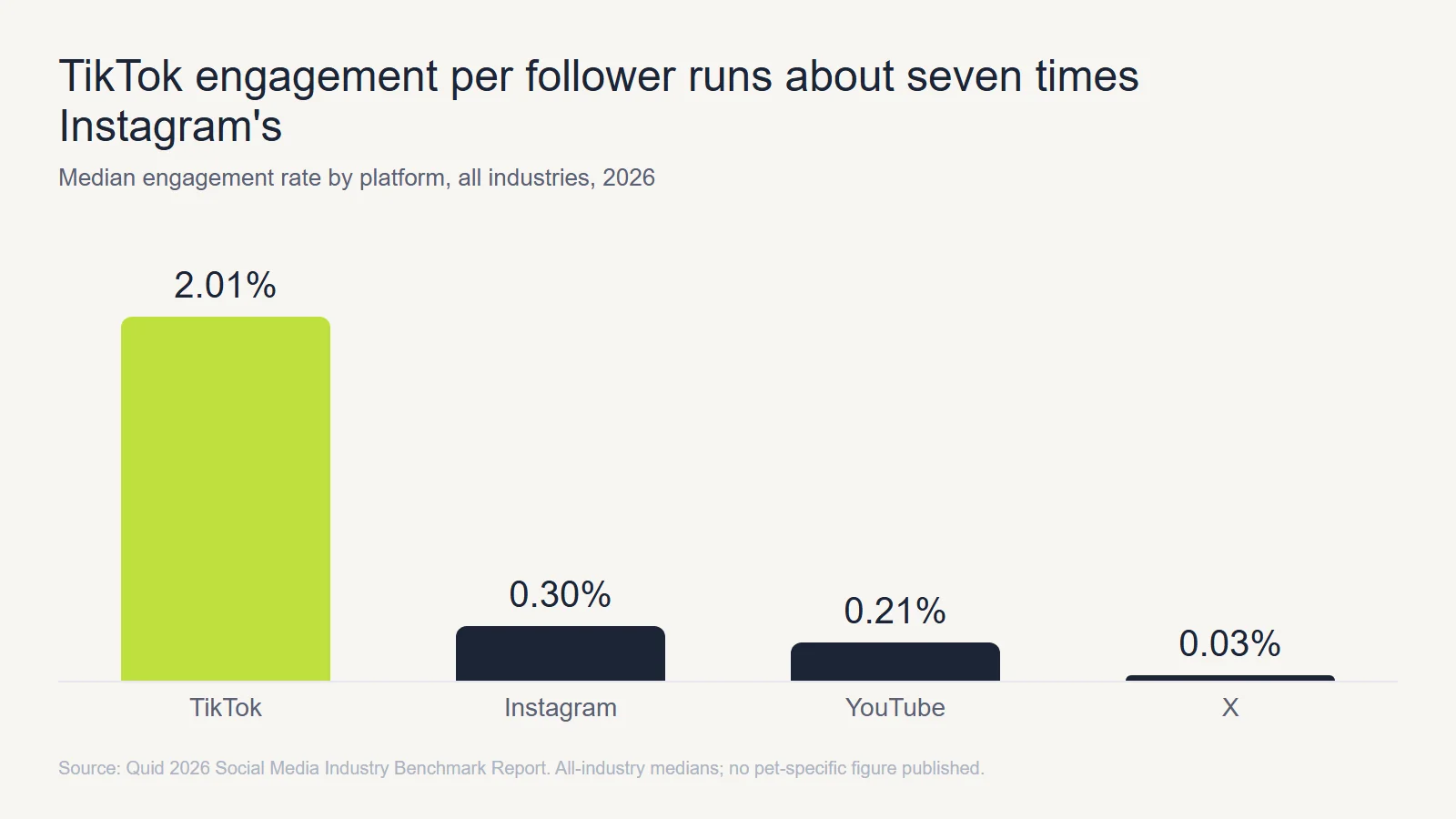
Across industries, the median was 3.7 Instagram posts and 2.0 TikTok videos per week, with engagement per follower at 0.30% and 2.01%. These are reference points, rather than a calendar to copy.
The pet category tells a slightly different story: accounts posted fewer than one YouTube video a week while achieving above-median engagement. Quid gives no pet-specific percentage here, so let your own results set the pace.
Publishing choices also depend on platform rules. TikTok's ad policy bars promoting or selling live animals and pets but allows pet products and services such as toys, food and grooming, so a food or litter brand can advertise, while adoption ads are limited to shelters and nonprofits.
And Instagram Trial Reels let brands test a reel with non-followers first and review initial metrics about 24 hours later. That gives us a way to check the hook before sharing it more widely.
Our guide to Instagram Reels ads covers the paid side.
Tidy Cats offers an example of building a recognizable series rather than isolated posts. Its October 2026 series, "Special Litter Unit," is a three-part crime-procedural parody starring Kumail Nanjiani and the creator Jordan Howlett, released on Instagram, TikTok and YouTube
Special Litter Unit Episode 1: The Agents Pounce On The Case. Source: Purina Tidy Cats on YouTube
Each mock case focuses on a familiar litter complaint: odor, weak clumps or tracking. The brand has published no campaign results, and the reporting provides no test method for its tracking claim. We're using the series to illustrate a content format, rather than to suggest product performance.
How to Choose Content Pillars for a Pet Brand
We'd begin with four or five pillars and give pet-first stories the most room. To test an idea, ask whether someone would still share it with the logo removed.
The proportions below are our starting point, rather than a published industry benchmark. After the first month, we'd give more space to what owners actually save, discuss and share.
| Pillar | What the post does | Format | Share of calendar (starting point) |
|---|---|---|---|
| Pet-first portraits and owner stories | Earns shares and follows | Photo sets, short clips | 30% |
| Education | Earns saves and trust | Carousels, vet-reviewed explainers | 25% |
| Product in use | Drives trial | Demos, unboxings, creator clips | 20% |
| Community features | Rewards owners, feeds UGC | Reposts with permission, replies as posts | 15% |
| Reactive and seasonal | Rides moments | Trend replies, holiday posts | 10% |
For a portrait-led series, look at The Dogist. Founder Elias Weiss Friedman has more than 10 million social followers and has posted over 50,000 photos and videos since 2013.
That audience was already in place when he hosted a group walk in Philadelphia in October 2026, ahead of the Dogist Company's first product, a supplement chew. The follower figure illustrates the account's reach, rather than the product's sales.
Pet Brand Content Calendar: How to Build One in Four Steps
Those pillars need a publishing rhythm. We build the calendar around recurring formats, seasonal needs, room for timely ideas and an approval process the team can maintain:
- Start with repeatable series. Choose two or three formats, perhaps a Monday owner feature and a Thursday vet-reviewed tip. They'll make production easier to plan while giving followers something familiar to return to.
- Add the seasonal layer. For product brands the useful moments are flea and tick season, summer heat safety, adoption surges, holiday gifting and retailer promotion windows. These are planning prompts, so check each against the brand's own sales and search data before committing production. The demand side is covered in pet industry trends for 2026.
- Keep about 15% of posts unscheduled so there's room for a trend, a cultural moment or a customer story that surfaces mid-month.
- Finally, batch production and build in an approval checkpoint. Health-related information should receive veterinary review before a post is scheduled.
| Calendar layer | Share of posts | Planned how far ahead | Approval needed |
|---|---|---|---|
| Weekly series | About 60% | 4 to 6 weeks | Brand and claims check |
| Seasonal | About 25% | 8 to 12 weeks | Brand, claims and vet review |
| Reactive | About 15% | Same day | Pre-approved rules that exclude health and product claims, one named approver |
A pillar describes what a post should accomplish; the calendar layer tells you when to prepare it. A seasonal post, for instance, can still educate owners or show a product in use. Track both in your working calendar:
| Date | Pillar | Platform | Format | Hook | Owner | Claims check | Link or product |
|---|---|---|---|---|---|---|---|
| Example: Tue 3 | Education | Carousel | "5 signs your cat's litter isn't working" | Content lead | Vet review done | Litter line page |
National Puppy Day (23 March) and International Cat Day (8 August) can be useful prompts when a product connection feels natural. Otherwise, we'd save the slot for something owners already care about.
Friskies shows why a timely response often starts with preparation. Its "Certified Frisky on the Field" program ran from 31 May to 19 July 2026: Friskies posted a "Certified Frisky Alert" on Instagram and TikTok after a US men's national team goal, and fans had 30 minutes from the goal to claim a free $10 wet-food coupon through the MyPurina app.
Separately, the first goal of each match triggered a 100,000-meal donation to shelter cats in match cities.
In September it extended the format to college football: six cat mascots from five universities, with 10,000 meals donated on each team's first score, up to 500,000 meals in the season.
What we'd borrow here is the preparation: a response built around a live event and a clear 30-minute window for fans to act.
Pet Community Management: Daily Workflow and Reply Rules
Once posts go live, someone needs to own the replies. For a small pet brand, we'd begin with a daily inbox check, one responsible person and a defined route for pet-health concerns.
The response windows below are starting suggestions. Adjust them to the messages coming in and the hours your team can actually cover.
| Comment type | Example | Reply approach | Escalate to |
|---|---|---|---|
| Product question | "Is this grain free?" | Suggested target: 4 business hours; link the product page | Customer care if unsure |
| Praise or tagged post | Owner shares their dog with the product | Reply within a day, ask permission before reposting | Content lead |
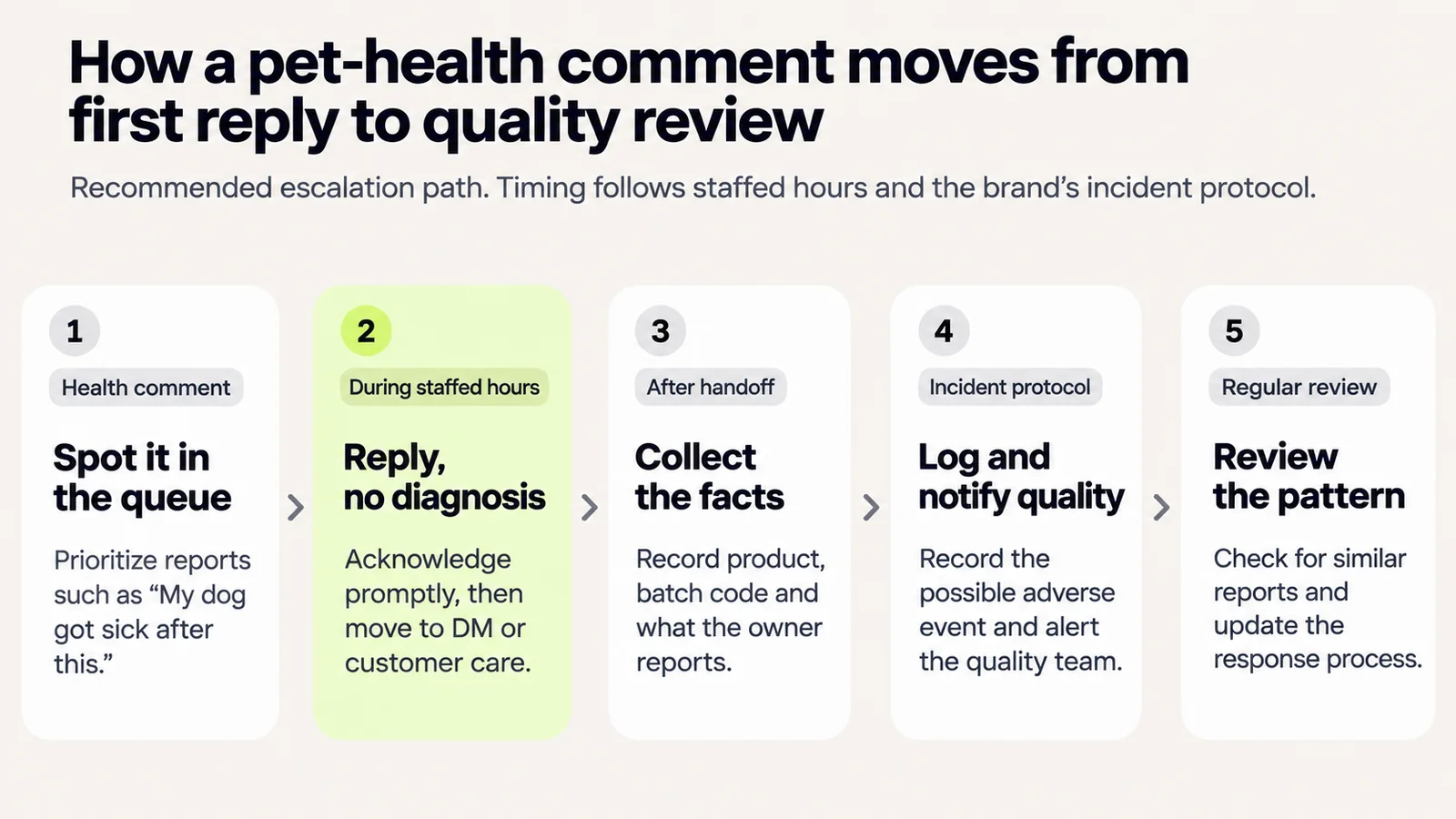
| Pet-health concern | "My dog got sick after this" | Triage promptly during staffed hours, move to DM, no diagnosis | Customer care and quality via incident protocol |
| Spam or off-topic | Link drops, bots | Hide, then delete if repeated | None |
| Complaint | Price, shipping, taste | Acknowledge, take it to DM, resolve | Customer care |
| Troll | Insults, bait | Hide, do not reply | Social lead if it spreads |
| Press or creator inquiry | DM from a reporter or creator | Acknowledge within a day | Brand or PR lead |
Speed matters, but safety comes first. We avoid diagnosing pets in public comments and send illness or adverse-event reports to customer care and quality under the brand's incident protocol.
What a Daily Pet Community Management Routine Includes
That escalation process works only if the inbox gets consistent attention. We pair a daily sweep with a shorter follow-up check and alerts for pet-health comments:
- Clear the reply queue by comment type, oldest first.
- Review new tagged posts and mentions and log candidates for reposting.
- Triage DMs and move health concerns to the escalation path.
- Listen beyond your own posts. Scan comments and relevant pet subreddits for recurring concerns, using the approach in our social listening guide to group the questions by theme.
- Write down one insight for the calendar.
For recurring questions, we'd keep approved reply templates but tailor the opening to the person asking. Copy-paste responses can make an otherwise helpful account feel automated.
The same care matters when a brand joins a joke. PetSmart's March 2026 reply to a viral bit shows how quickly tone can affect the reaction.
Creator Ben Lapidus's "Pet Smart vs Pets Mart" bit reached nearly 40 million views across TikTok and Instagram, and PetSmart responded with the line "It's Pet Smart. Case closed."
One columnist reported that TikTok users read it as a buzzkill, quoting the comment "Could of cooked but instead you microwaved," while Instagram's response was warmer.
That reaction reflects one columnist's reading, rather than a measured audience response. Still, it shows how a brand can add to a joke instead of closing it down.
We have ANSWERS. No more screaming, you're scaring the pets. Source: PetSmart on YouTube
What to Do When a Pet-Safety Incident, Recall or Backlash Hits
When a safety incident, recall or serious backlash occurs, follow this sequence:
- Pause scheduled posts and paid ads that touch the issue.
- Publish one holding statement from one named spokesperson.
- Point every thread to one source of truth, such as a single web page.
- Give customer care a script and a case-logging process.
- Review the thread after 48 hours and write down what to change.
Pet UGC and Community Programs: Contests and Usage Permission
Community participation works best when the invitation and its safeguards are planned together. A rewarded photo contest needs different rules from a donation campaign.
For commissioned content briefs and acceptance criteria, see pet UGC for brands.
| Program | Mechanic | What it needs | Risk |
|---|---|---|---|
| Photo contest with reward | Owners submit, every entry earns a coupon | Coupon system, entry rules | Giveaway and promotion rules |
| Public-vote contest | Entries on a brand page, public vote | Landing page, moderation | Spam voting, fairness |
| Share-to-donate | A donation per share, capped | Donation cap, partner charity | Unmet cap, partner claims |
Purina's Beggin' XI is a reward-per-entry contest. Owners submit a photo of their dog to build a roster of eleven dogs, hosted by the actor Brendan Hunt, and every submission earned a free bag of Beggin' treats by coupon before submissions closed on 17 May 2026.
Embark's "World's Weirdest Dog" contest ran from 15 October to 15 November 2026 with public voting open to anyone and a Times Square billboard as the top prize. Entries lived on the brand's own page, which keeps data and moderation under the brand's control.
Finding a great owner photo is only the first step. Before reposting it, get clear permission for the intended use:
- Ask in writing, in the comment or DM thread, naming the exact use.
- Keep the reply as the permission record.
- State the usage scope and duration.
- Credit the owner on the repost.
- Honor removal requests quickly.
Our UGC usage rights guide covers the licensing language.
Should a Pet Brand Use Creators or Pet Talent on Social?
Pet creator programs can work in two ways. Sometimes the animal is the recognizable personality; in other cases, the owner explains the product. We choose based on the role the content needs to play, and a campaign can use both.
- Pet as talent: the animal is the face of the content. IAMS paired its March 2026 "Smooth Deliveries" campaign with a social partnership with the petfluencer @brodiethatdood, who appears across IAMS channels.
- Owner as creator: a person who speaks for the product. Smalls built its September 2026 "Is Cat" campaign with cat-parent creators alongside TV and out-of-home.
That distinction matters in the brief: a pet-led video needs moments the animal can do naturally, while owner-led content needs a product story the person can explain convincingly.
The disclosure rule is the same for both. The FTC says a connection between an endorser and the marketer that a significant minority of consumers wouldn't expect must be disclosed clearly and conspicuously, and free product counts.
Whichever format you use, the brand still needs to monitor disclosures. We put the requirements in the brief and check the posts after publication.
Our FTC influencer guidelines explain the wording in detail, and TikTok's branded content policy should be checked for animal categories before any brief goes out.
Pet Social Media Claims and Compliance: What to Check Before Posting
We apply the same substantiation standards to social posts as to packaging, with qualified review for health-related advice. For paid creator content, we also check that material connections are disclosed clearly. Both checks happen before scheduling.
| Content type | Risk | Check before publishing |
|---|---|---|
| Food and treat claims | Misleading claims, drug claims | AAFCO: claims must be truthful and not misleading, and pet foods cannot carry drug claims. Its page covers labeling, so run social posts through the same review. |
| Supplement and health claims | Treatment language | Vet and legal review, no "cures" or "treats" language |
| Safety content (toxic foods, heat, sedation) | Wrong advice gets shared | Vet-reviewed source, dated |
| Paid creator posts | Missing disclosure | Disclosure in brief and post check |
| Live-animal references on TikTok | Ad rejection | Check the animals policy before promoting |
| Sensitive moments (pet loss) | Tone | No promotion, short human reply |
AAFCO's guidance is that claims need sound scientific or empirical evidence and that it does not pre-approve them, so the brand owns the substantiation file. Keep one file per claim with the source, the reviewer and the date.
Pet Social Media KPIs and a 30-Day Test Plan
We assess each platform against its role: reach and shares for discovery, conversations for community, and qualified traffic or purchases for conversion.
Cost per tracked purchase helps evaluate paid acquisition, while platform-reported ROAS remains directional.
The table below shows what to monitor:
| Metric | What it tells you | Where to read it | When to act |
|---|---|---|---|
| Saves per reach | Content owners want to keep | Platform insights | Falls for three posts in a row, change the format |
| Sends per reach | Content owners pass on | Platform insights | Rising, build a series around it |
| Comment quality | Intent and questions | Manual sample | Repeated question, answer it in a post |
| UGC submissions | Community pull | Mentions and tags | Flat after a program, change the mechanic |
| Response time | Community health | Inbox tool | Over your standard, add coverage |
| Cost per tracked purchase | Acquisition efficiency in paid tests | UTM-tagged links, store data | Compare like-for-like paid acquisition tests |
Use the first month to establish a baseline for each format and channel. Then compare posts with similar goals before deciding what to change.
To find out what deserves more production time or paid spend, run a focused 30-day pilot:
- Pick one product and one offer.
- Build five ideas around one product, then adapt each to the channels where it fits. A YouTube demo can explain more than a TikTok discovery clip, so give each its own edit.
- Give every platform its own UTM-tagged link.
- Give each platform one decision metric tied to its role. For paid conversion tests with enough orders to read a pattern, compare cost per tracked purchase separately.
- Review early signals on day 14. By day 30, decide which formats to expand, rework or pause without treating every platform as if it has the same job.
Pro tip: Pair the test with the method in our creative testing guide, and see the trial-to-repeat plan in our pet food marketing guide.
| Result at day 30 | Signal | Action |
|---|---|---|
| Paid acquisition generates purchases at a sustainable cost | Scale | Increase spend gradually on the tested format if purchase volume holds |
| Good interest, but few customers reach the product | Iterate | Check the product offer and landing-page path before revising creative |
| Limited interest and little useful action | Stop | Pause the format and test a new hook or audience |
How Much Time and Budget Does Pet Brand Social Media Need?
For an early test, we'd budget roughly six team-hours a week; a busier program may need about 15, while a larger one often requires dedicated roles.
These are inBeat planning estimates, rather than industry averages. Build your own forecast around real reply volume, production costs and staff availability.
A paid social agency can support paid testing when the internal team has limited capacity.
| Stage | Weekly hours | Roles | Illustrative monthly creator and paid budget |
|---|---|---|---|
| Start | 6 | One owner, part-time | $500 to $1,500 |
| Growth | 15 | Social lead plus part-time editor, creators on retainer | $3,000 to $8,000 |
| Scale | 35 or more | Social lead, community manager, editor, creator manager | $10,000 and up |
Scale Pet Social Media Marketing With inBeat Agency
At inBeat, we build and test creator-led performance content for consumer brands. For The Farmer's Dog, that meant 70+ creative assets per month across 10+ channels, supporting $20M+ in annual ad spend.
Through our pet social media marketing agency service, we'd bring that testing discipline to your calendar, community feedback and next round of creative tests.
On the first call, we'd look at:
- The content formats already earning useful engagement.
- Who handles replies and how sensitive questions are escalated.
- A focused 30-day pilot with goals that match each platform.
- Creator capacity and the approvals each format requires.
Book a strategy call and bring your last 30 days of posts.
FAQs
Should a pet brand post the product or the pet?
Give people a reason to watch the pet first, and let the product fit the moment. As an opening test, try one product-led post for roughly every five posts, then adjust to the response.
How often should a pet brand post on each platform?
Choose a schedule your team can sustain while keeping up with replies. The benchmarks above offer context, but your own engagement and inbox volume should decide when to post more often.
Does a pet brand need a community manager before it works with creators?
At minimum, give someone ownership of replies. Creator posts can bring new audiences into your comments, and those visitors may have product questions before they buy.
How do you reply to a comment about a pet getting sick?
Acknowledge the concern without diagnosing the pet, and route it promptly to customer care during staffed hours. Log it as a potential adverse event and alert the quality team under your incident protocol.
Can a brand repost a customer's pet photo without asking?
No. A tag or hashtag is not a license, so follow the permission steps in the UGC section.
What changes for a supplement brand compared with a treat brand?
Supplements call for closer scrutiny of health claims. AAFCO says pet foods cannot carry drug claims, so we recommend vet and legal review of supplement wording before it appears in a post, creator brief or ad.