

An ad can lose money before it spends a dollar. A missing creator disclosure holds up a launch. An unsupported claim sends creative back into review. By the time it's approved, the testing window may have closed, and the team has learned nothing from the delay.
That's the part of social media advertising compliance that rarely makes it into campaign forecasts. The rules shape approval speed, delivery continuity, and how much creative a team can test.
This guide explains what Meta, TikTok, and Google expect, where violations become costly, and how to build a seven-step workflow from pre-launch checks to post-submission monitoring.
Spot the hidden friction.
TL;DR
- Paid social compliance starts with accurate claims, evidence, appropriate disclosures, and placement-specific platform rules.
- A repeatable review process can reduce preventable rework, interruptions, and lost testing opportunities.
- For specified FTC rule or order violations, civil penalties can reach $53,088 per violation in 2026; other exposure depends on the conduct and jurisdiction.
- Meta, TikTok, and Google handle AI labels, creator disclosures, and political ads differently, including differences between creator posts and paid placements.
- The guide gives a seven-step launch-to-monitoring workflow and five operational KPIs to track the process.
What Does Advertising Compliance Cover on Paid Social Platforms?
Advertising compliance on paid social is the set of checks that keep an ad truthful, backed by evidence, properly disclosed, and acceptable to the platform that reviews it. This guide covers paid placements and supporting creator content, and it flags whether a rule covers a creator's own post or an ad submitted through Ads Manager.
Core Principles of Advertising Compliance
Three principles carry most of the weight, and every other rule in this guide applies one of them.
- Truthful claims: nothing in the ad, the caption, or the landing page misleads a reasonable viewer.
- Evidence first: every objective performance, health, or earnings claim is substantiated before the ad runs. This guide calls that record the claim file.
- Clear disclosure: material connections, such as payment or free product, and qualifying terms are visible where the viewer looks.
Objective claims need support in every risk tier. Only review depth changes: health, earnings, finance, and other sensitive claims call for an expanded file and a named senior reviewer.
Which Rules Apply to Paid Social Ads
The rules that apply depend on the product, target market, creative format, and whether the placement is a creator post or a paid ad. Work through four buckets in order.
- Consumer protection and endorsements: in the US, the FTC Act and the Endorsement Guides.
- State or national ad rules: consumer statutes and newer disclosure laws. New York, for example, requires a conspicuous disclosure when an ad uses a synthetic performer (effective June 9, 2026), which our guide to compliance for NYC ads explains.
- Platform placement policies: Meta's Advertising Standards, TikTok's ad and branded content policies, and Google Ads policy, each applied to the specific placement.
- Privacy and consent rules: the GDPR, other regional laws, and US state privacy statutes where they cover the audience and data in use.
The EU Digital Markets Act and Digital Services Act principally regulate platform obligations. They can change advertiser workflows, as the less-personalized ads option did, without being interchangeable with the GDPR.
Why Is Social Media Advertising Compliance a Growth Lever?
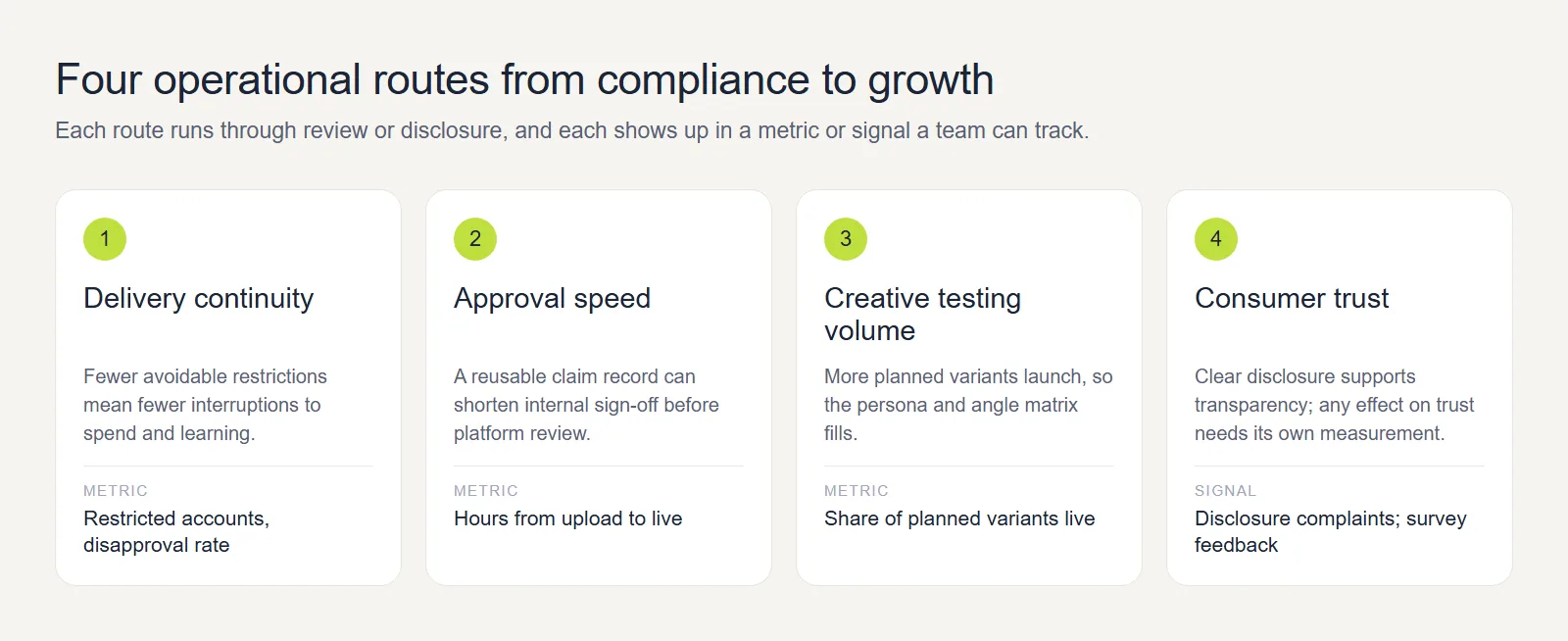
Compliance can make paid social easier to operate by reducing avoidable launch interruptions, review delays, and rejected creative. Those operational effects are easier to measure than any broader impact on trust or sales. Four mechanisms follow.
Ad Delivery Continuity
A whole-account suspension can interrupt delivery and testing at the same moment, though not every isolated ad restriction pauses every campaign. Continuous delivery is therefore the first operational benefit of compliance.
- Verification is becoming a gate: Meta says it aims to have verified advertisers account for 90% of its ad revenue by the end of 2026, up from 70%. Verification requirements still depend on the advertiser and its risk profile.
- Scam enforcement is large-scale: Meta reported removing more than 159 million scam ads in 2025, including 92% before user reports. Those figures describe scam enforcement, not the rejection rate for legitimate campaigns.
- Google can act without warning: its misrepresentation policy says egregious violations lead to suspension on detection, without prior warning, with reinstatement only in compelling circumstances.
Keep the original claim evidence and the exact rejected creative on file so an appeal can be supported when the platform allows it.
Ad Approval Speed
Approval speed has two parts: internal sign-off and platform review. A reusable, supported claim can shorten the internal check for new variants, but each ad still faces the platform's own review process.
The following hypothetical scenario illustrates how preventable review holds can reduce creative-testing capacity. Replace the assumptions with account data before using it in a forecast.
| Scenario (hypothetical) | Variants per week | Held in review | Average hold | Variant-days lost |
|---|---|---|---|---|
| Ad-hoc internal review, no reusable claim record | 20 | 6 | 3 days | 18 |
| Reusable claim record, templated disclosure | 20 | 2 | 1 day | 2 |
Variant-days lost equal variants held times the average hold: 6 x 3 = 18 and 2 x 1 = 2. It is a modeled scenario, not measured performance.
Pro tip: Document approved claim language and disclosure requirements in the brief so reviewers can check new variants consistently. Platform review still applies.
Creative Testing Volume
A test matrix only supports decisions when enough planned concepts actually launch. Tag each variant by persona and angle, record whether it reached delivery, and explain missing cells before comparing winners. The claim boundaries in the brief help keep new versions comparable, and our guide to creative testing best practices covers how to size the matrix.
How Does Disclosure Affect Consumer Trust in Paid Social Ads?
Trust matters to buyers: Edelman's 2026 brand study found that 88% regard trusting the brand as an important or critical purchase criterion, on par with value and close to quality. That result is about brand choice broadly, not a return from ad disclosures.
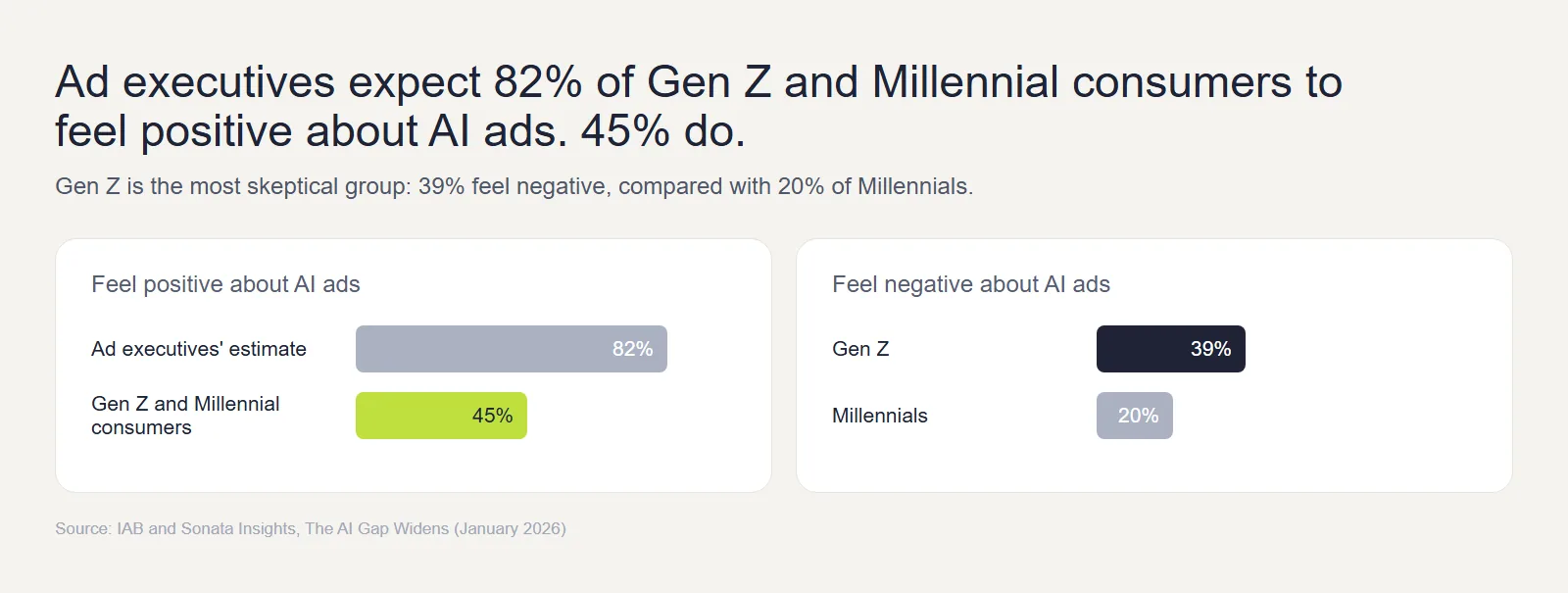
A different question is how consumers respond to AI-generated ads. IAB's 2026 study found a gap between advertiser assumptions and younger consumers' views:
- 39% of Gen Z respondents feel negative about AI ads, compared with 20% of Millennials.
- 82% of ad executives think Gen Z and Millennial consumers feel positive about AI ads, while 45% of those consumers say they do.
- 73% of Gen Z and Millennial respondents said knowing an ad was created with AI would increase or leave unchanged their likelihood to purchase.
AI-label transparency and creator paid-partnership disclosures are related but separate cases, and neither study measures conversion lift. Clear disclosure is a defensible transparency practice; measure any effect on conversion in your own tests.
What Does Non-Compliance Cost a Paid Social Program?
For specified FTC rule or order violations, the applicable civil penalty can reach $53,088 per violation in 2026. That is a statutory ceiling for qualifying conduct, not a standard fine for every rejected or misleading social ad. The FTC's 2025 penalty release set the amount, and a September 2026 Federal Register notice confirms 2025 levels still apply. The exposures below arise under different legal theories, and no single campaign faces all of them.
| Exposure type | Trigger and who is exposed | Reference point | Source |
|---|---|---|---|
| FTC civil penalty | Violation of a covered FTC rule, order, or specified statute; the brand and sometimes the endorser | Up to $53,088 per violation in 2026 | Federal Register, 91 FR 58446 |
| FTC consent order | FTC allegations settled by a company and its principals | Final FTC order in July 2026: Publishing.com and two principals agreed to pay $1.5 million to settle allegations involving earnings claims and undisclosed or incentivized endorsements. A settlement amount, not a per-violation penalty. | FTC case page and press release |
| Private lawsuits | Class-action plaintiffs suing brands and influencers | Complaints in a 2025 wave of endorsement-disclosure lawsuits, including against Celsius, Shein, Revolve, and Alo Yoga, sought approximately $25 million to more than $500 million. These were allegations and requested damages, not awards. | ArentFox Schiff (law-firm analysis) |
| GDPR enforcement | Data protection violations by controllers in any sector | Cross-sector context: 2,685 fines with complete data through March 1, 2026; mean fine around €2.28 million for 2018 to 2026, skewed by outliers. Not a typical paid social advertiser penalty. | CMS Enforcement Tracker |
| Business interruption | Paused spend and lost learning; the advertiser | No sourced figure exists | Track it in your own account |
Two points sit behind the table:
- Platforms get fined too. The European Commission fined Meta €200 million under the Digital Markets Act in April 2025. That was platform-level action, not a fine against advertisers.
- Creator programs carry the fallout. A disclosure failure rarely stays inside one post, as our piece on influencer marketing crisis management shows.
Pricing the last row takes more than comparing review cost with paused media. Illustrative economics with invented numbers: ten hours of review at $60 per hour cost $600 a week. A three-day campaign pause with $5,000 in planned daily media spend delays $15,000 of scheduled spend, but that amount is not automatically lost revenue.
Estimate the orders and contribution margin that cannot be recovered after launch resumes, then weigh that against the review cost. Expected avoided loss equals the reduction in the probability of a preventable disruption times the non-recoverable contribution margin per disruption, and net expected benefit equals expected avoided loss minus control cost. Both need a historical baseline and stated assumptions before they support an ROI claim.
How Do Meta, TikTok, and Google Ad Policies Compare?
The three platforms differ on who applies the label, what counts as disclosure, and which ads are barred outright.
Each row names its surface because policy details depend on surface, market, and product. The table reflects public help pages as of October 2026; verify current platform help before launch.
| Policy area and surface | Meta | TikTok | |
|---|---|---|---|
| AI-generated or altered creative (paid creative) | Meta may apply an "AI info" label to ads created or significantly edited with its generative AI tools, and has begun detecting third-party AI-edited ads through industry-standard signals. The label sits in About this ad; display varies by context and region, and not every edit is labeled. | For qualifying non-Spark ads, use the AI-generated content toggle in Ads Manager, a mandatory disclaimer for fully AI-generated or significantly AI-modified media. Spark Ads follow creator-post AI disclosure rules. | Since July 2026, Google offers AI content label settings for eligible generated or edited creatives and may label some assets from its own AI tools. Election ads with synthetic content use a separate disclosure checkbox. |
| Creator and branded content (creator-branded post) | The creator or brand applies the paid partnership label, including for gifted products. It is separate from Ads Manager review of a paid ad. | The creator turns on the Commercial Content Disclosure setting, which adds a Commercial content or Paid partnership label. The Branded Content Policy governs creator-branded posts. For Spark and non-Spark ads, check the relevant TikTok Ads policies separately. | The creator selects the paid promotion button in YouTube Studio, which adds a label at the start of the video. This is separate from Google Ads review. |
| Political and social-issue ads (EU political ad) | Stopped from early October 2025 in the EU | Paid political advertising is generally prohibited, with defined exceptions for government entities and official election bodies | Restricted EU political advertising under its September 2025 policy update, ahead of the TTPA taking effect in October 2025. Limited exceptions apply to qualifying official public information. |
Three practical consequences follow:
- Build one claim file and one disclosure line, then adapt placement to each platform's label mechanics.
- Check each row against the right surface: a creator-branded post, a Spark ad, a non-Spark ad, and a YouTube creator upload each follow different help pages.
- Date-stamp your checklist and review it quarterly: Meta updated AI ad labeling in June 2026, and Google and TikTok updated AI labels and political policy in July 2026.
What Does the FTC Require for Branded Content and Creator Ads?
A paid or gifted creator endorsement needs a clear disclosure of the material connection. A material connection is any financial, employment, personal, or family relationship with the brand, including free or discounted product. The disclosure should be conspicuous and sit with the endorsement itself; no single literal first line is required.
The FTC says a platform's built-in disclosure tool might not be enough on its own, so use partnership labels as an additional tool, and our guide to FTC guidelines for influencers walks through the full rule set.
Where the disclosure sits depends on format, according to the FTC's Disclosures 101:
- Text and caption posts: place it where it is hard to miss, outside hashtag clusters and any "more" click. A clear opening caption helps, and plain terms such as "ad" or "sponsored" work.
- Video: disclose within the video, with the description as backup; audio plus on-screen text is more likely to be noticed.
- Images and Stories: superimpose legible text and leave time to read it.
- Live streams: repeat the disclosure periodically.
Tagging the brand does not count as disclosure, because a tag shows an endorsement and says nothing about the relationship. Paid and gifted endorsements both require clear disclosure, but the wording should reflect the actual relationship. For product-only gifts, "Gifted by [Brand]" may be appropriate, while paid sponsorships should clearly identify the commercial arrangement.
A brand-run ad with no creator endorsement needs no endorsement disclosure, but its claims and qualifying terms still need review.
Responsibility sits with the brand as much as the creator. In its endorsement FAQ, the FTC says enforcement usually focuses on advertisers and their agencies, and that a reasonable training, monitoring, and compliance program makes action over one rogue influencer unlikely. The brief is therefore the first control, and it should state:
- The disclosure wording and position for each format.
- The claims the creator may and may not make.
- The approval step before posting.
- Who to contact for a takedown.
Pro tip: Monitor posts after launch. The FTC sets no fixed period and calls "at least a few months" probably reasonable after a free-product campaign.
Which Ad Categories Need Extra Review on Paid Social?
Some categories need extra checks because claims, eligibility, targeting, or disclosure requirements are narrower. Use the table to identify the trigger; the subsections explain what to do when the creative sits on a boundary. The baseline applies to every ad, and a sensitive claim adds expanded evidence and senior sign-off.
| Category | Typical review trigger | What to check before launch | Where the rules live |
|---|---|---|---|
| Health and weight loss | Before-and-after claims, outcome promises | Substantiation on file; TikTok bars weight-loss promotion in creator branded posts, so validate paid placements against TikTok Ads policies | FTC claim substantiation; TikTok branded content policy |
| Supplements | Disease or performance claims | Claim wording against evidence; creator script limits | FTC and platform health policies |
| Finance | Rate and earnings claims, targeting by age or location | Qualifying terms visible; targeting limits for consumer finance | Google restricted targeting policy |
| Political and social-issue | Issue-adjacent topics | Classification before spend | Platform political ad policies |
| AI-generated creative | Realistic synthetic people or voices | Label or disclaimer applied | Meta, TikTok, and Google pages in the policy table above |
Political Advertising Requirements on Social Platforms
A cause-related brand campaign can fall under social-issue rules without anyone intending it. Ask three questions in review:
- Does the ad try to influence a vote, a law, or a public debate?
- Will it run in a market where the platform restricts political content?
- Does a reviewer on your side have authority to hold the ad if the answer is unclear?
A "yes" to the first question calls for a platform-specific political or social-issue review rather than automatic classification. Cause-related ads may fall under social-issue advertising rules even without mentioning candidates, parties, or legislation.
Check the applicable policy for the target market and document the reviewer's decision before launch.
Health, Finance, and Supplement Ads
- Health and wellness: TikTok's Branded Content Policy governs creator posts, so check scripts against it. It does not settle paid-ad eligibility, which needs validating against TikTok Ads policies for the placement and market.
- Supplements: keep creator scripts inside the claims the evidence file supports.
- Finance: in US and Canadian Google Ads campaigns for housing, employment, or consumer finance, targeting by age, gender, marital status, parental status, and ZIP code is restricted. That does not prohibit every form of location targeting, so check campaign settings against Google's access-to-opportunities rules.
- AI-assisted claims: the FTC's 2024 Operation AI Comply sweep put it plainly, saying there is no AI exemption from the laws on the books.
Escalation example: a creator script says a supplement "supports healthy weight." The reviewer checks the evidence for that exact wording and the placement type, then routes the claim to the named specialist before it ships.
For platform requirements specific to compounded weight-loss drugs, see our GLP-1 marketing strategy, which owns that category.
How Privacy Laws and Regional Rules Change Paid Social Targeting
Regional rules can change how ads are targeted, labeled, and measured. Before comparing campaign performance across markets, check the applicable privacy settings and each platform's locally available ad products.
EU platform rules are shaping advertiser options. The Digital Markets Act fine above was for how Meta handled the choice of less personal data. Meta then committed to offer EU users a less personalized ads choice, presented from January 2026.
Performance effects are still emerging. WIRED reported that Meta's European ad revenue grew 18% year over year in Q3 2026, versus 33% in the US and Canada.
The timing coincides with Europe's less-personalized ads option, but the comparison is a correlation, and the gap does not isolate that feature's impact on advertiser performance. Meta did not attribute the gap to the option.
Rules differ outside the US and EU. The UAE requires qualifying individuals who publish advertising content through social accounts to hold an advertiser permit; exemptions include individuals promoting their own businesses through personal accounts. This is not a blanket permit for every brand running platform ads, and our guide to Dubai's advertising regulations on social platforms explains the details.
Three market-by-market checks keep a multi-region account safe:
- Tag every ad set with its market and the privacy regime that applies.
- Confirm consent, targeting, and measurement settings per region before scaling spend.
- Keep a separate performance baseline for each region and compare against it.
How to Build a Seven-Step Paid Social Compliance Workflow
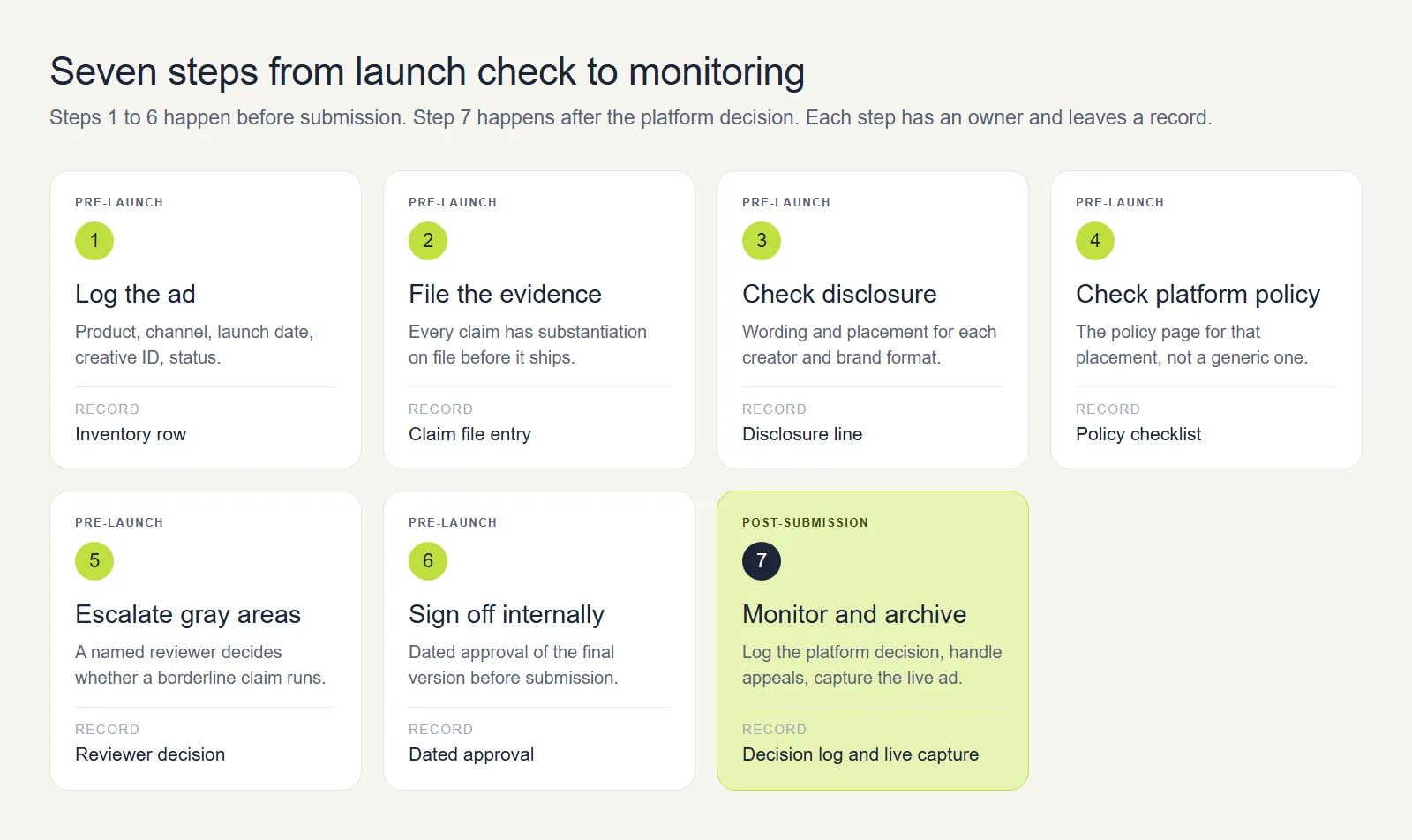
Treat compliance as a launch-to-monitoring sequence. The first six steps prepare and approve creative before submission; the final step records the platform decision and the version that actually ran. Each step has an owner and leaves a record.
- Log every ad in one inventory. Record the product, channel, launch date, creative ID, and approval status so any ad can be found fast.
- Keep substantiation records for every objective claim. Use the template below to document supporting evidence, its limitations, and approved wording before launch. High-risk claims require more detailed records and additional review.
- Check disclosure wording and placement. Compare each creator and brand post to the FTC guidance above, format by format.
- Check the creative against the platform policy page. Use the page for that placement, since Reels, TikTok feed, and YouTube differ.
- Escalate gray-area claims to a named reviewer. A person with authority decides whether a borderline claim runs.
- Record a dated internal approval. Save the final creative ID, approved claim language, reviewer, market, and version before submission.
- Post-submission: monitor outcomes and archive the result. Log disapprovals and handle corrections or appeals promptly; for approved ads, capture the live creative, placement, URL, and timestamp. Same-day response is a team goal, not a platform promise.
A claim file entry can be short. Illustrative template: replace each placeholder with substantiated campaign data.
| Field | Template entry |
|---|---|
| Proposed claim | [Exact claim proposed for the ad] |
| Supporting source | [Report or study title, owner, date, evidence link] |
| Evidence scope | [Population, sample, method, measured outcome, material limits] |
| Approved wording and qualifiers | [Specific supported wording and required on-screen or context disclosure] |
| Applies to | [Product, region, platform, creative version] |
| Approved by and date | [Reviewer and date; do not imply legal sign-off unless completed] |
| Review trigger | [Product change, new evidence, policy change, or scheduled refresh] |
Which Compliance KPIs Should a Paid Social Team Track?
Five operational measures show where ads stall: first-pass disapprovals, time to live, appeal outcomes, account restrictions, and the share of planned variants that launch. Read them beside campaign performance, but do not treat CPA or sentiment as proof that disclosure changed sales. Keep compliance data in the performance dashboard, because a separate report never reaches the media buyer.
- First-pass disapproval rate: ads disapproved on first submission divided by ads first submitted in the period. Count resubmissions separately.
- Time from upload to live: median hours from final creative to first impression, split into internal approval and platform review where records permit. Scheduled launch times and budgets also affect it.
- Appeal success rate: successful appeals divided by appeals with a final decision. Track sample size and rejection reasons; a low rate is a prompt for review, not proof that the claim file is inadequate.
- Account restrictions: count and severity of restrictions, plus the spend hours affected.
- Share of planned variants that went live: variants live divided by variants planned in a fixed testing window, with reasons for missing ones.
Treat consumer trust as optional qualitative context (disclosure complaints or survey feedback) and CPA as adjacent business data; neither is a direct compliance effect.
Illustrative example: 40 disapprovals among 400 first-time submissions is a 10% rate. If the same-sized submission set has 20 disapprovals, that is 5%, or 20 fewer first-pass rejections. Whether more variants go live also depends on appeals, scheduling, and budget, and a decline calls for a look at creative mix and policy changes before crediting the workflow.
Review the trend monthly and adjust the checklist.
For the wider KPI set, our guide to marketing measurement covers the setup.
Who Should Own Ad Compliance: In-House Team or Agency?
The advertiser remains responsible for its marketing even when an agency manages day-to-day execution. The FTC says delegating promotion to an outside company does not remove a company's responsibility under the FTC Act.
Set a written ownership map: who approves claims, who checks placement rules, who confirms creator disclosures, who can stop a launch, and who handles a rejection. The split can vary by team; the handoff must be visible. One sample division:
- The brand: supplies the evidence and makes the final decision on gray-area claims.
- The agency: implements the workflow, runs policy checks, and manages appeals.
- The creator: produces the content and makes the material-connection disclosure.
- One named person: owns the final approved version, so changes after review do not slip through unchecked.
Your contract or RACI should name these owners. When you evaluate an agency, ask five questions:
- Can I see a sample claim file and a dated sign-off log?
- Who handles appeals and rejections, and what is the response target?
- How do you track disapproval rate and time to live?
- What happens to a creator post that goes live without the disclosure?
- How do you record changes after approval?
Build a Compliance-Ready Paid Social Program With inBeat Agency
Compliance works best when the people writing the brief, approving claims, and launching ads share the same record of what was cleared.
A coordinated process leaves fewer decisions stranded between a creator, a brand, and a media buyer.
At inBeat, we connect creative production, creator partnerships, and paid social execution so those checks can happen within the campaign workflow.
If you want to find where your own review process slows delivery, book a strategy call at inbeat.agency/book-a-call, and we can discuss your current setup and the gaps worth addressing first.
FAQs
When a creator skips the disclosure, who carries the liability?
Both parties can, but the FTC says its focus usually falls on advertisers and their agencies. Keep the brief, approval record, and monitoring log as evidence of your program.
What should a team do when automated review rejects an ad whose claim is substantiated?
First check the stated rejection reason against the current placement policy. If the ad appears compliant, use that platform's appeal path and provide relevant evidence in the form the interface supports. Save the original creative and rejection record; if you revise instead, treat the revised version as a new submission.
Do EU less-personalized ads change how a team reads CPA benchmarks across regions?
They can. A CPA gap against the US may reflect a different data signal before it reflects weaker creative, though the reported figures show correlation, not cause. Compare each region against its own trailing baseline.
Is a full compliance review worth it for low-risk categories?
A lighter process often works, but factual claims still need support. Keep a basic record of creative, substantiation, disclosure, and approval for every ad. Use deeper evidence review and a named specialist for health, earnings, finance, or other high-risk claims. Risk tiers change how much review is needed, not whether a claim must be truthful.
How does AI-generated creative change the disclosure step?
It adds a platform-specific label check. Meta may apply an "AI info" label to certain ads, TikTok uses an AI-generated content toggle for qualifying non-Spark ads (Spark Ads follow creator-post disclosure), and Google added general AI label settings in July 2026 beside its separate election-ad checkbox. IAB's 2026 research found that more than half of surveyed consumers want disclosure for fully AI-generated ads.