.svg)
.svg)
.svg)
.svg)


.svg)







If you’re a marketer, seeing an ad spend of $1.16 billion in 2024 within Dubai and the UAE makes you think two things. One is: “I need to get in on that”, and what quickly follows is “How do so many advertisers survive in Dubai’s strict advertising world?”
Even forgetting to type the two letters that make up “ad” on your social media promotion post can cause legal problems that unsettle your whole ad campaign.
You can’t just drag and drop your global ad strategy here, so getting familiar with the unique but transparent legal guidelines in Dubai will define your success.
That’s what this guide is for.
We’ve studied the laws and will be breaking down everything from general advertising rules to the sector-specific regulations for native, print, and digital advertising.
You’ll see how to stay compliant with Dubai and UAE marketing laws, so your brand voice isn’t lost in trying to get your advertising approved.
Let’s jump in.
TL;DR
- The legal guidelines exist to protect people in Dubai from predatory advertising, so businesses should prioritize transparency.
- An advertiser permit allows residents and visitors to advertise their businesses in Dubai.
- There are different classes of the Advertiser Permit for different formats of advertising, like native ads, digital ads, and design.
- Failure to comply with the rules attracts fines and advert removals.
Overview: What Laws Regulate Advertising in Dubai?
The advertising rules in Dubai are made up of the various laws compiled in documents like:
- The UAE Media Law under Federal Decree-Law No. 55 of 2023
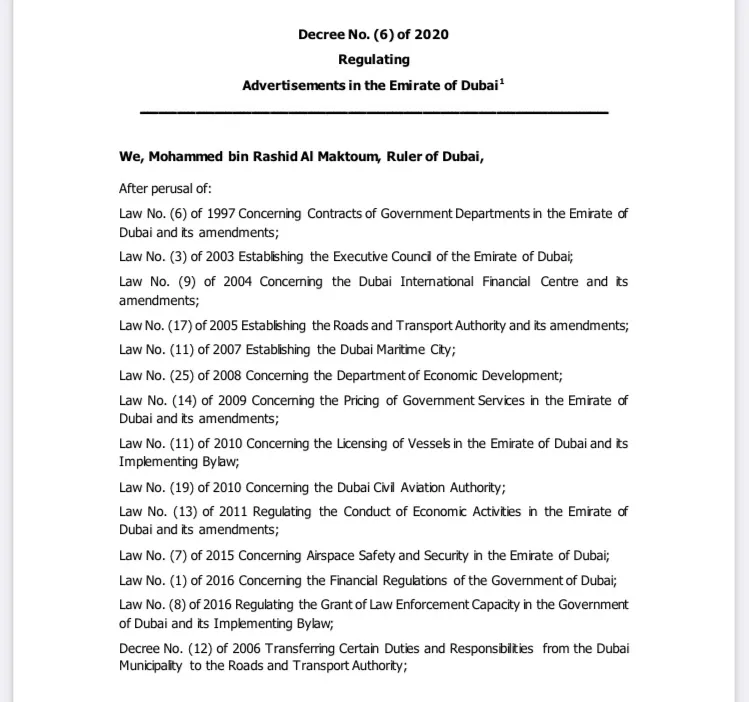
- Decree Number 6 of 2020, which specifically regulates advertisements in the Emirate of Dubai.
These documents give a summary of decrees and laws on advertising from proclamations that go as far back as 1980.
The Council also updated Media laws in 2023 with a phased rollout of new advertising rules in Dubai. These regulations went into full enforcement a year later, in 2024, with AI helping to automate compliance checks beginning in 2025.
Dubai’s digital ecosystem is defined by the growth of the e-commerce sector and high internet penetration. This just further presses on the need to tread carefully in the hyper-aware regulatory bubble, or risk business fines and campaign bans.
Regulators are responsible for keeping the advertising content in line with established rules. They include:
- The UAE Media Council
- Dubai Department of Economy and Tourism
These bodies work together to make sure public morality and professional standards are upheld, while punishing defaulters who compromise consumer protection by not operating legally.
The advertising regulations cover all media activity practiced in Dubai, including outdoor, print, audio, and visual media, and digital marketing. That means everything from billboards and leaflets to digital ads on websites and social media like TikTok, Facebook, LinkedIn, Instagram, and all other major platforms.
Dubai Advertising Guidelines: Main Objectives and Regulatory Goals
With almost 100% of UAE residents having internet access, Dubai citizens are exposed every day to new challenges that require new safeguards from regulators.
The UAE Media Council created its guidelines to become a practical framework that emphasizes consumer protection from non-compliant ads across the print and digital landscape of Dubai.
The primary objectives include:
- Preserve established local and cultural values: The legal guidelines instill a deep respect for the traditions and religion of Dubai so that brands steer clear of offensive content. This ensures the protection of public morality and maintains the social order of the UAE.
- Promote the media’s freedom of expression: Advertisers should have creative freedom to express themselves without pressure or undue censorship. The national and Dubai laws ensure there’s a framework that will reduce undue influences on creative expression while promoting accountability of advertisements to the public.
- Boost overall economic growth: A healthy advertising sector increases how much consumers spend. This means that if guided properly, advertising will contribute to the total economy. In fact, ad spend of the UAE advertising industry was forecasted to hit $1.72billion by the end of 2025; that figure is sure to positively impact the GDP of the region and Dubai specifically.
- Attract talent and investment: Dubai’s legal guidelines foster a transparent regulatory ecosystem that will position the UAE as a creative hub where everyone from individual content creators to institutional investors can thrive.
- Create a clear distinction for licensing requirements: The guidelines outline the different licenses needed for specific advertising activities, so advertisers understand exactly what is permitted and how to stay compliant.
- Assure content quality and safeguard privacy: All advertisement content must meet standards set for impartiality, transparency, and protecting society from harmful influences. At the same time, content has to respect the privacy of individuals. These safeguards prevent the creation of misleading advertising campaigns.
- Promote consistency with Dubai’s broader media strategy: Advertising guidelines form a major pillar of the UAE Vision 2031 framework. They reinforce the goal of becoming a world-leading media hub that is grounded in ethical principles.
All of these objectives reinforce Dubai’s plan to build a regulated, high-quality advertising sector that fuels long-term economic growth.
Legal Guidelines Relating to Advertising In Dubai
The legal guidelines within Dubai’s Advertising Standards set out principles that are already contained in several existing legislations and regulations.
These standards cover traditional and digital advertisements, meaning a broad category that can range from social media marketing to in-store advertising and OOH. They include cultural preservation, assuring content quality, and safeguarding privacy (as we discussed above).
First, let’s take a closer look at some more general rules:
Respect for cultural, religious, and political institutions
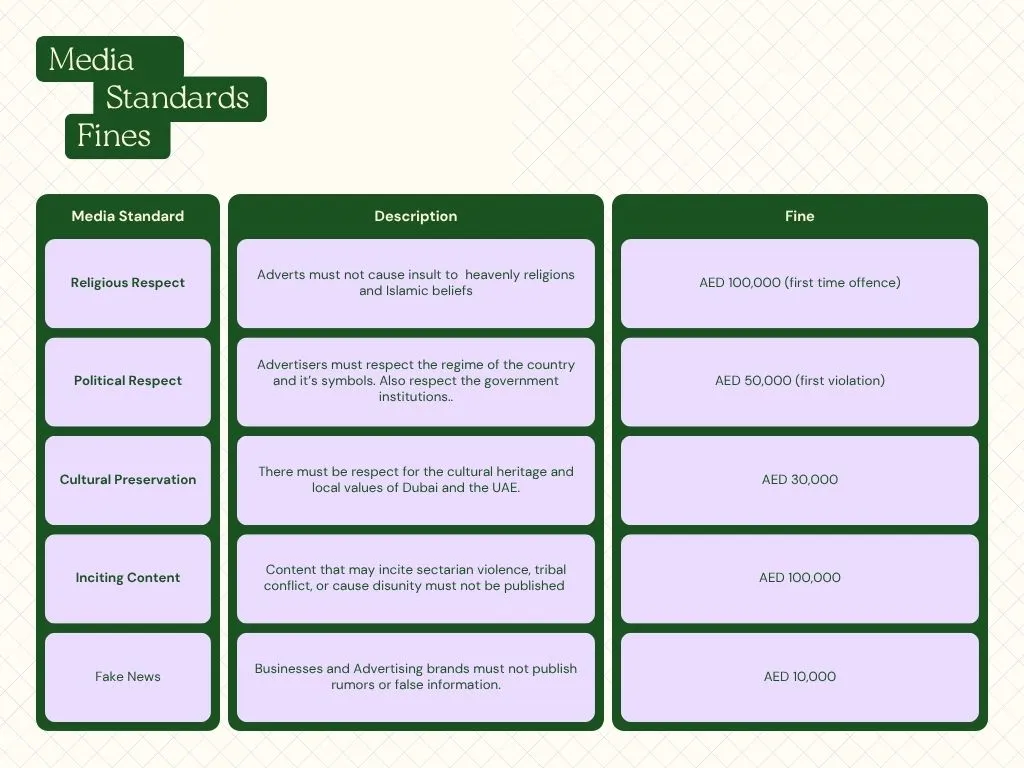
Advertising content should not offend Islamic beliefs, as well as any other theistic religions. It must also respect the sitting regime in the UAE as well as their symbols and political parties/ institutions.
Also, published content of advertisers must not disrespect the culture or disrespect local and international policies.
Prohibited Content
The advertising standards prohibit the spread of advertising content that:
- Breaches public morals
- Spreads information that endangers women, children, or other members of society
- Provokes sectarian violence or hatred.
Prohibited Products
Regulators strictly prohibit the advertising of Tobacco products, smoking, alcohol, or any other banned product/service.
Permit Compliance in Dubai
All advertisers in Dubai need an Advertiser Permit to design adverts and get them approved for audiences in the Emirate. But there are also other licenses that are specifically meant for different types of advertising content in Dubai.
Licenses like the Mu’lin Permit (Advertiser Permit for digital marketing) must be obtained in line with the set timelines, or else you could attract hefty fines.
Health Regulations
Content advertising medical or related health pharmaceutical products have specific rules that advertisers must know and seek approval for before they can publish their advertising. There are very strict disciplinary actions against companies that fail to comply or make claims that mislead the public.
Consumer Protection
Consumer protection is one of the major goals of Dubai regulators, and they make sure to spell it out in the advertising rules. Businesses and advertising firms should not put consumers at harm with false statements or by engaging in anti-competitive practices and illegal monopolies.
Digital Advertising Restrictions
Advertisements posted anywhere across the World Wide Web and social media need to follow a special set of rules in addition to the general advertising guidelines.
For one, you must post every ad on a registered account that’s tied to your advertising permit. Other restrictions include:
Disclosure Rules
Ads must expressly state that they’re sponsored in a clear font. Use hashtags like “#sponsored” or “#ad”. To ensure your audience understands, you can make your disclosure in both Arabic and English.
Your permit number should ideally also be visible on the first post on your page or in your account’s bio.
Product Placement
Even when you just send a content creator some merch for a shoutout, it still counts as an advert. So whether it’s a product unboxing, a GRWM fashion haul, or a food review, the disclosure requirements still apply.
Any influencer you work with should also have a permit to operate in Dubai or be affiliated with a talent agency that has the right approvals.
Privacy Protection
Target Ads usually scrape for data about people from all sources on the internet, so they can show users what they think they want or remarket. In order to shield the privacy of individuals, the UAE Data Protection Decree No.45 2021 explicitly forbids the unapproved use of this information, like using their browsing and cookies without their consent.
Print, Native, and Outdoor Advertising
The Dubai Municipality and the Department of Economy and Tourism also regulates the content and nature of native ads. Billboards require permits, just like any other type of advertising, and use of trademarks in traditional ads without permission is a fine-worthy offence.
Other legal standards include:
- Astrology, witchcraft, and sorcery advertisements are not allowed.
- Respecting the national identity of the UAE.
The UAE Media Council enforces the advertising rules strictly, and failure to comply with rules for native adverts can see advertisers fined for up to AED1,000,000 ($272,294). And this amount doubled for repeat offenders.
Requirements and Conditions for Advertising in Dubai
Before you can start worrying about the rules for your content, advertisers must meet certain conditions before they can publish adverts in Dubai.
One requirement that applies to all classes of advertisers is that every advert has to be in standard Arabic or the local dialect of Dubai.

The other general conditions are:
- You must be 18 and above.
- You need to apply for a license before publishing any advertising content. The Advertiser Permit you get allows the specific activity you applied for. For example, electronic blogging and marketing management require two different licenses.
- Seek prior approval for specialized ads like advertising that relates to health, real estate, education, and other campaigns.
- Applicants should ideally have academic qualifications, which are decided by the Council based on the type of business you’re advertising.
- As an applicant, you must have a clean record. That means no active criminal record or proof that an applicant betrayed the public trust.
- Applicants should not have suspended or revoked licenses or other restrictions that prevent them from carrying out media activity, like their company being shut down.
There are also requirements for social media, which we’ve talked about under the legal guidelines. Requirements like clear disclosure of ads and posting only on your registered account (the account that you registered with the Council, which is mentioned in your Permit).
But the Council also provides clarity on social media advertising activities that don’t even require licensing, like:
- Charity and volunteer work done for free
- Free advertising done on a non-commercial basis
- Individuals under the age of 18 who are promoting educational, athletic, cultural, or awareness activities.
But beyond individuals, businesses like studios, advertising agencies, and brands have to meet an additional number of requirements:
- Media compliance and financial obligations: Companies must be ready to follow the media activity practice regulations set by the Dubai Media Council. They should also not have any outstanding debts owed to the Council.
- Office location: Corporate applicants should have the center of their business within the UAE, or at least have one of their branches in the country.
- Legislative compliance: Any business should be established according to the legislations that apply within the UAE. Furthermore, the companies should ensure there are no violations against them from the regulators in Dubai and the rest of the UAE.
- Active trade license: Just like with individual applications, your business will need a valid UAE-administered license to carry on advertising in Dubai.
Quick tip for marketers: Have a Dubai-native review your Arabic copy for cultural context. This can save you editing costs for small changes you can make now.
How To Stay Compliant When Advertising in Dubai
- Align your internal guidelines for content with the content penalty schedule.
- Do a licensing audit to make sure you have all the necessary licenses and permits.
- Review content before publishing to ensure complete compliance, and also make sure you have the right license for the type of content.
- Follow global best practices for protecting children from harmful content.
- Get familiar with the compliance processes, penalties, and appeals structure.
How Does Dubai Enforce These Legal Guidelines for Advertising?
The UAE Media Council has the authority to penalize advertising activities that don’t comply with its rules and remove the adverts from the air.
The good news is you don’t always get hit with the heavy hand of the law right away for a first-time offense. The council may issue a written warning and allow for correction of the mistake.
However, serious offenders can pay fines of up to AED 1,000,000 for advertising violations that show “disrespect for the Divine Entity, Islam, and other religions.”
The consequences for violating digital advertising rules after warnings follow this process:
- In the first stage, a fine is issued based on the offence committed. The fine has to be paid within the time specified by the Council, and if a defaulter fails to meet the deadline, they’ll pay additional fines that the Council will impose.
The fine will be increased for a repeat offence and can go over AED1,000,000 for serious offences.
- Secondly, the Council will ask you to remove any part of the published ad that doesn’t comply with the legal principles for advertising content.
- If deleting the portion of the ad that violates the guidelines isn’t possible, the Council will completely prohibit its circulation.
- This restriction will not be lifted until the defaulting party corrects the printed, visual, or audio material in a way that satisfies the advertising media standards of the UAE Media Council. This step isn’t always possible because the Council could decide the ad is not rectifiable.
How to Get A License for Advertising Activities
One of the main requirements for advertising in Dubai is applying for an advertising permit from the UAE Media Council by following these steps:
- Register online via the Media Council’s portal.
- Fill out application details, including relevant passports, ID cards, and personal photographs of the applicants.
- Attach a copy of the applicant’s academic qualifications.
- Attach your trade license (for residents) or, in the case of a visitor, your approved agency sponsorship.
- Specify your advertising location (in this case, Dubai).
- Pay the applicable processing fees and submit your application.
- Permits should be issued within 3 days and will last:
- 3 years for residents.
- 3 months for visitors
- In the case of social media advertising, display the permit on your linked social media accounts.
Typically, if you don’t hear anything back concerning an application after 15 days, it’s safe to assume it was rejected by the Council.
Fees to Expect for Advertising in Dubai
- Billboard ads: Installing or designing a commercial billboard, like any other advertising activity, requires a license. Getting this license for the first time costs AED10,000, and renewing it is AED5,000, according to the UAE Legislation’s Cabinet Resolution 41 (2025).
- Radio advertisements and audio songs: This covers all kinds of audio works and radio programs. It’s a lot cheaper than a billboard because a first-time issue costs AED10,000 and renewal comes to AED6,000 based on the previously cited source.
- Television commercials and visual songs: All related film, serials, or visual ads that appear on television cost AED10,000 for proper licensing and AED6,000 for renewal. We find this figure in the UAE Legislation’s Cabinet Resolution 41 (2025), too.
- Advertising websites and social media: Applicants can get a Mu’lin license for advertising on social media and an e-license for website advertising. Residents can also get these licenses under the titles of the Ghadan and Fursa licenses for social media and website advertising, respectively.
- The visitor permit costs AED500 for 3 months and can be extended for a further 3 months for AED500.
- The residents’ advertiser permit is free for the first 3 years and can be renewed continuously for a period of one year at a time, for AED1000.
- Trade license: Trade licenses cover commercial advertising activities like e-commerce services and social media development services (eTrader license) for Dubai residents.
The fees start around AED15,000 in Dubai’s free zone, i.e, Dubai City, but can be much lower in mainland parts of the UAE.
Can I Advertise Without a License?
You can get a waiver of the media license that applies to approved exemptions granted by the UAE Media Council.
This only happens in special cases:
- Non-commercial promotion: This means raising awareness without charging a fee on a website or a social media account.
- Personal hobbyists’ accounts: Personal accounts that have a wide reach will not need an advertising permit as long as they are not promoting any one business but just sharing their passions.
In any other case, advertising without a license is not allowed and will attract fines (sometimes after initial warnings).
Legal Guidelines for Visiting Advertisers in Dubai
A ‘guest’ advertiser is an ad agency or business from outside the UAE that’s looking to tap into Dubai’s market. The general rules for visiting advertisers and residents are the same, but visitors need to apply for a Visitor Advertiser Permit.
Here’s an overview of how a visitor advertiser permit is different from a resident permit:
- Duration: The visitor advertiser permit comes at a price and lasts 3 months. It can then be renewed once for an additional 3 months. Whereas for residents, the permit is free for the first three years and can be renewed for an additional year.
- Eligibility: International advertising agencies and brands are eligible for it. UAE-approved Influencer Management agencies should also apply. And if your campaign targets Dubai audiences, you must apply too.
- Work visa exemptions: A visitor's permit does not exempt you from getting the necessary visa and work approvals. Work with immigration to find out the entry permissions and work arrangements you need to make. Residents may not need a work permit.
Start Advertising in Dubai with inBeat Agency
Advertisers who follow the legal guidelines in Dubai make every campaign stretch to its full potential.
Adhering to the rules means you’re doing more than just saying the right things. It also means you keep the trust of the target audience with total transparency and staying true to your brand.
If you’re doing all that and feel like you could be doing so much more with your marketing campaigns, inBeat Agency has exactly what you need.
We create first-rate digital marketing content that keeps you compliant without compromising your adverts’ creativity because of rules. We make sure your campaign and acquisition costs are justified by profit.
Don’t wait. Book a strategy call. Think of advertising in Dubai as a form of public speech. You wouldn’t want to say something immoral or that insults people and puts them in harm’s way.
FAQs
1. What are the rules for advertising in Dubai?
Advertising in Dubai is governed by UAE media regulations. Your content must be truthful, culturally respectful, and aligned with media content standards. Ads must not disrespect Islam, other religions, or the values of the UAE. Repeated violations can lead to significant penalties from the UAE Media Council.
2. How long does it take to process an Advertiser Permit?
The Dubai Advertiser Permit is usually reviewed within three working days. After the decision is made, the Council typically notifies you within another three days.
3. How do I appeal an advertising penalty?
If you receive a penalty, the Council will inform you within 15 days. You then have 15 days to file an appeal with the competent authority or the UAE Media Council. If your content can be corrected, you’ll receive feedback within 15 days of submitting your appeal. If there’s no response within 45 days total, the appeal is considered unsuccessful.
4. Where can I get the Advertiser Permit?
You can apply for a Mu’lin Permit through:
- The Dubai Department of Economy and Tourism (for mainland businesses)
- Your relevant free-zone authority, such as Dubai Media City
- The UAE Media Council, if you plan to advertise across multiple emirates
5. How do I advertise a business in Dubai?
To advertise in Dubai, follow the required media law:
- Apply for the advertising license that matches your ad format.
- Ensure your visuals and copy meet content standards and respect local culture.
- Avoid content that harms or exploits women or children.
- Submit your ad for approval.
- Renew your advertising permissions before they expire.
These steps apply to traditional ads, digital media, social media platforms, influencer marketing, and broader content strategy initiatives under UAE social media laws.