.svg)
.svg)
.svg)
.svg)


.svg)







Advertising in New York City isn’t just about reaching audiences; it's about navigating one of the most complex compliance ecosystems in the United States.
Nationwide rules from the Federal Trade Commission, state regulations, city laws, tax obligations, platform-specific requirements… Miss a single link of this endless chain and you’re opening the door to fines, regulatory scrutiny, and (perhaps most costly of all) a damaged reputation.
If you’re working in NYC, or even just targeting the Big Apple, you need to get this right, whether you’re a brand, an agency, or even a content creator.
Luckily for you, in this guide, we’re going to outline what disclosures must look like, how advertising services are taxed in the state of New York, and how different platforms expect you to play by the rules.
Consider it your strategic compliance blueprint for 2026.
P.S. Looking to grow your brand with measurable results in New York City and beyond? Trusted by 250+ brands, inBeat Agency designs data-driven strategies to create campaigns that meet goals and defy expectations. See some of our work here!
TL;DR
- NYC advertising compliance blends federal FTC rules, New York State consumer laws, NYC disclosure requirements, and individual platform policies.
- Influencer and branded content must include clear disclosures when any material connection exists, including gifted items and affiliate relationships.
- Agencies and brands must track and verify disclosures, maintain records, and follow each platform’s branded content tools to protect reach and avoid enforcement.
- Creative and strategy work is generally exempt from New York sales tax; tangible production, printing, and resold media may trigger tax obligations.
- NYC businesses may be subject to UBT or corporate tax depending on structure and income sourcing.
- Creators must report gifted products as taxable income using fair-market value.
- Common risks include incorrect disclosures, misclassified services, incomplete documentation, and missed platform requirements.
- A strong compliance workflow includes quarterly tax reviews, precise invoicing, clear contracts, and ongoing monitoring of platform rules.
- Following clear disclosures, accurate filings, and platform policies helps NYC advertisers protect budget, performance, and brand reputation.
The Layers of NYC Ad Compliance
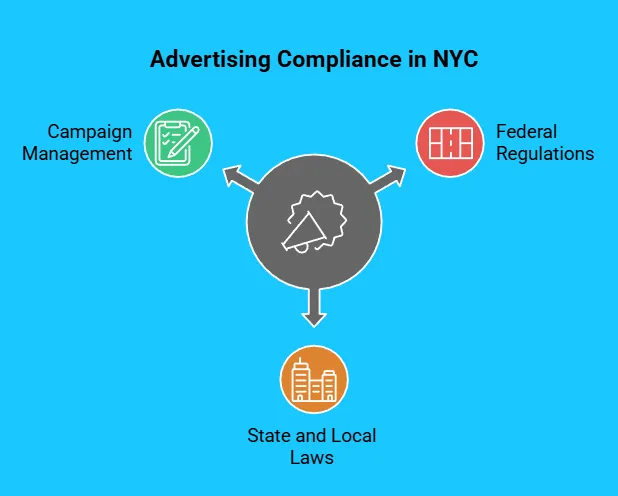
Compliance in advertising isn’t merely legal boilerplate: it protects your campaign’s integrity, the trust of your audience, and the stability of your business. In NYC, this means understanding overlapping layers of rules:
- At the federal level, the FTC demands clear disclosures of endorsements and sponsored content.
- At the state and local level, New York’s consumer protection statutes impose additional requirements on advertising claims, promotions, and potentially deceptive acts.
- On top of that, if you’re running campaigns, creating content, distributing media, or working with influencers, you must deal with specific disclosure, taxation rules, platform-specific branded content tools, and agency-creator contracts.
Needless to say, even the smallest misstep can cost you dearly, with brands being publicly warned by the FTC for non-disclosure violations on a regular basis.
From an agency perspective, every element (from influencer contracts to caption disclosures and sales tax classification of services) can ripple into legal risk. Therefore, the very first step for any advertiser in New York City is to build a compliance map that covers disclosures, offerings, taxation, and platform policies. This is particularly critical for brands investing in influencer marketing in NYC, where regulatory scrutiny and platform-specific requirements are more stringent.
If you’re working on influencer campaigns, see our FTC Guidelines for Influencers for additional context.
Disclosure Rules: FTC and NYC Requirements
Transparency is the foundation of compliant advertising. Whether you’re running influencer campaigns or paid media, clear disclosure is what separates legitimate partnerships from misleading promotions.
In New York City, that responsibility operates on two levels: the federal FTC disclosure rules that govern all U.S. advertisers, and local NYC consumer protection laws that tighten how those rules are enforced.
Understanding both is essential to keep your campaigns trustworthy and penalty-free.
The Basics of FTC Disclosure
Whenever there’s a material connection between an influencer (or any endorser) and a brand, whether in the form of cash payment, free products, discounts, or affiliate relationships, the endorsement must be “clear and conspicuous”.
For influencers, this can be as simple as writing “ad”, “sponsored by [Brand]”, or “paid partnership” in the caption, like so:
For advertisers and agencies, it means explicitly requiring disclosure compliance when contracting creators, and then verifying disclosures when posts go live.
Failing to follow these rules could result in monetary penalties or injunctions, as in the 2017 case of Trevor “TmarTn” Martin and Thomas “Syndicate” Cassell, who were fined after promoting their own gambling site without proper disclosure, something that an FTC spokesman told Axios could result in civil penalties of over $40,000 per violation, per day.
NYC-Specific Guidelines
While the FTC governs nationwide advertising and endorsements, additional layers apply in the state of New York, enforced by the New York City Department of Consumer and Worker Protection (DCWP).
For instance, New York’s General Business Law § 349 declares deceptive business practices unlawful and allows the Attorney General to bring actions seeking restitution and penalties.
Key implications for NYC advertisers:
- Claims must be truthful, clear, and not misleading, whether in copy, images, or pricing.
- If you’re working with influencers or user-generated content campaigns, you must ensure that any “gifted product” or discounted access is treated as a material connection and disclosed accordingly.
- You’re required to keep precise records of promotional offers, campaigns, and any disclaimers, as these can be requested by the DCWP.
By combining the federal disclosure framework with NYC’s local law obligations, you create a compliance foundation that covers both national reach and local enforcement.
AI & Synthetic Performers
If your NYC-targeted creative includes an AI-generated or digitally created “synthetic performer” (e.g., an avatar presented as a real person), New York now requires a conspicuous disclosure that the performer is synthetic.
This requirement applies even if the AI content is already disclosed under FTC endorsement rules.
This first-of-its-kind state law amends New York General Business Law § 396-b and takes effect on June 9, 2026.
Failure to comply with the synthetic performer disclosure requirement may result in civil penalties of $1,000 for a first violation and $5,000 for each subsequent violation.
So, build this into your creative QA checklist and require agencies and creators to confirm whether any AI-human elements were used before launch.
Also ensure that any required disclosures are placed prominently in all relevant media distributed in New York.
Consumer Reviews & Social Proof Compliance
In addition to disclosure requirements for paid endorsements and influencers, advertisers targeting U.S. consumers must also comply with the FTC’s Consumer Reviews and Testimonials Rule.
This rule formally codifies the prohibition of deceptive practices involving consumer reviews, testimonials, and social-proof indicators.
Under this Rule:
- Fake or fabricated reviews/testimonials - including those created by AI or attributed to fictitious persons, are prohibited. Advertisers may not write, purchase, or disseminate reviews or testimonials that misrepresent whether the reviewer exists or actually used the product/service.
- Incentivized reviews - offering compensation, rewards, or incentives contingent on a positive review or particular sentiment is banned.
- Insider or undisclosed affiliate reviews - reviews or testimonials by employees, agents, or affiliates must include a clear and conspicuous disclosure of their relationship; otherwise they can be treated as deceptive.
- Company-controlled review sites - misrepresenting a review platform as “independent” when controlled by your company is prohibited.
- Review suppression - suppressing or removing negative reviews through intimidation or false display practices is treated as an unfair or deceptive act.
- Fake social media indicators - selling or buying fake followers, likes, views, or other artificial metrics that misrepresent influence for commercial purposes is prohibited.
Violations of this rule enable the FTC to seek civil penalties (in many cases up to approximately $50,000+ per violation) and other relief.
Advertising Taxes and Filings in NYC
When advertising in New York City, your financial compliance doesn’t end with creative approvals; it extends to how your ad services are taxed. The state and city treat advertising differently depending on what you sell and how you sell it.
What’s Taxable (and What’s Not) in NYC
According to the New York State Department of Taxation and Finance, most creative and consulting services, such as strategy, design, and copywriting, are not taxable. However, printing, tangible production, or data storage may be subject to sales tax.
Media placement (buying ad space or airtime) is exempt from sales tax when done on behalf of a client, provided the agency acts as an agent and not as the principal. However, if you purchase and resell ad space, the markup may be taxable.
As you can see, the lines get blurred very easily, and tackling regulations can be tricky without professional advice.
To stay compliant, agencies should:
- Itemize invoices clearly between creative work (non-taxable) and production or tangible deliverables (taxable).
- Keep written agency-client agreements clarifying the nature of media buying relationships.
- Maintain documentation for exemption claims for resale.
An Overview of NYC Business Taxes
New York City imposes two main business taxes that can apply to advertising agencies and independent creators:
- Unincorporated Business Tax (UBT): 4% on net income for sole proprietors, partnerships, LLCs, or other unincorporated entities that carry on business in the city..
- Corporate tax regimes: For corporations doing business in NYC (e.g., employing capital, leasing property, deriving NYC-source receipts), a tax applies; for federal S-corporations & qualified S subsidiaries, this is the General Corporation Tax (GCT) (historical rate ~8.85%), and for other corporations, the Business Corporation Tax (BCT) applies.
Independent creators or agencies based in NYC need to assess which tax applies based on their structure, how and where their income is sourced, and whether they maintain nexus in the city.
It is also important to keep in mind that the IRS treats gifted products as taxable income at fair-market value. Creators based in NYC must report those items on Schedule C as business income.
Tax Risks for Data, Analytics & Digital Advertising Services
In New York, certain advertising-related data, analytics, and reporting services may be treated as taxable information services for sales tax purposes (even when bundled with creative or consulting work).
The NY Department of Taxation & Finance has issued advisory opinions finding that services involving data collection, processing, and customized performance reports can qualify as taxable information services if the primary deliverable is data-driven analysis rather than creative strategy.
New York courts have also upheld taxation of certain advertising measurement and analytics platforms when the core function was gathering and analyzing client data to generate reports.
However, case outcomes can vary depending on how services are structured and invoiced, making this a gray area for agencies and martech providers.
Common Mistakes in NYC Ad Taxation
- Failing to register for a Certificate of Authority to collect sales tax.
- Misclassifying services, especially when campaigns mix design, production, and digital media.
- Ignoring local filing deadlines, such as NYC’s April 15 UBT deadline for most entities.
Pro tip: Schedule quarterly tax reviews aligned with your campaign calendar. It’s easier to reconcile ad spending, influencer payouts, and deductions before annual filings.
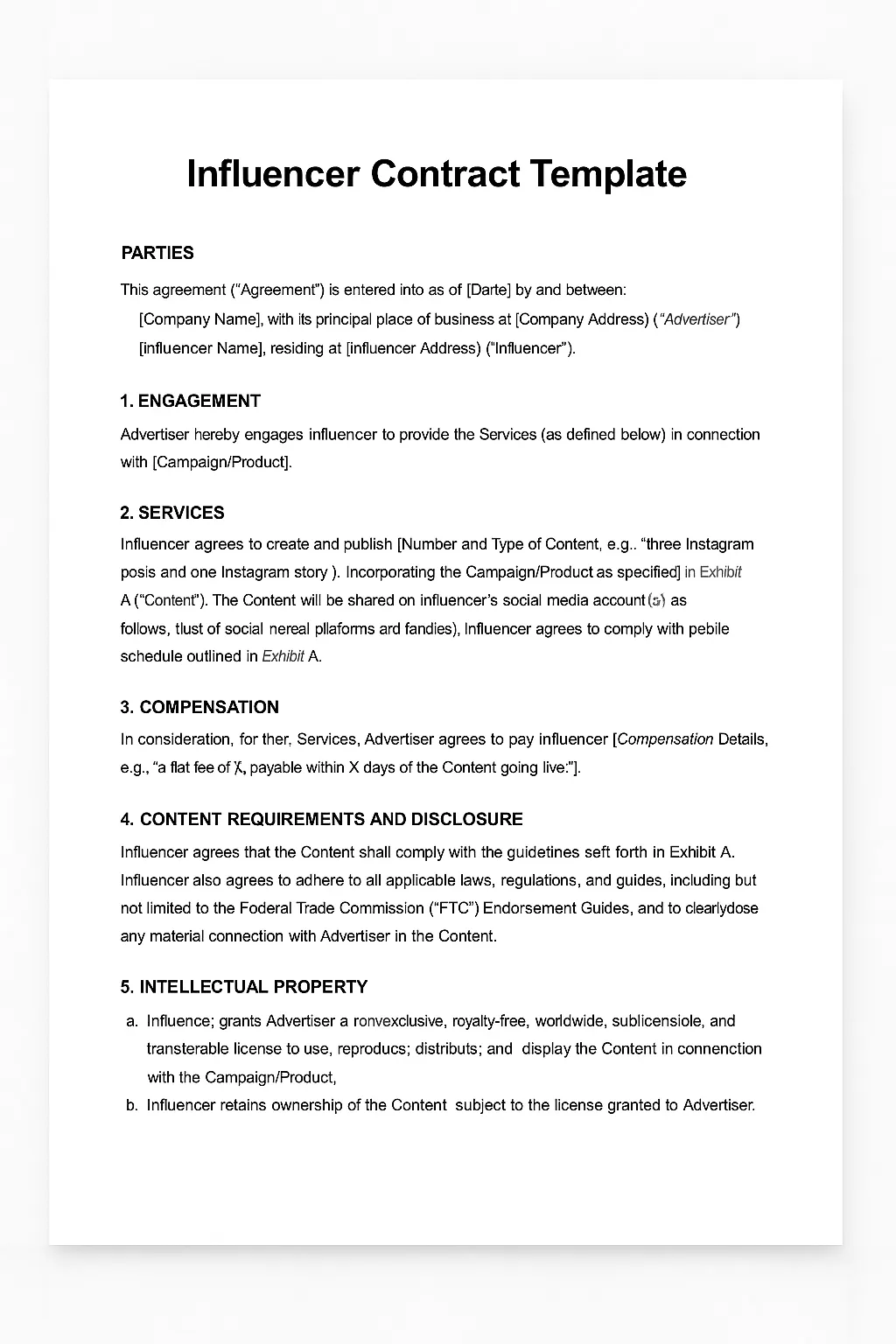
For agencies managing multiple influencer partnerships, see inBeat’s influencer contract template to align financial and disclosure compliance.
Platform Rules for NYC Ads: Staying Compliant Across Marketing Channels
Ad regulations don’t stop at city or state borders; each platform enforces its own policies to protect consumers and advertisers. We advise you to regularly monitor platform dashboards to confirm that your creators use the appropriate partnership toggles.
If a post is removed or restricted, ad-spend efficiency drops significantly, and engagement data skews.
This affects your campaign ROI and potentially breaches your contracts, too.
Repeated violations can even trigger account suspensions that freeze ad operations during critical launches.
Below is a breakdown of the major platform-specific rules and how to remain compliant with each one.
Meta (Instagram, Facebook & Threads) Advertising Rules for NYC Compliance
Meta’s Branded Content Policy requires any paid partnership or sponsored collaboration to use the Paid Partnership label through its Branded Content Tool. Posts must accurately represent the advertiser relationship.
Meta defines branded content as “a creator or publisher’s content that features or is influenced by a business partner for an exchange of value.” Your brand must be tagged in the post, and then you can view metrics through Meta’s dashboard. If you don’t comply, you may deal with limited distribution or post removal.
Pro Tip: If you want fully optimized and compliant Meta campaigns that actually convert, make sure every creator uses the Paid Partnership label and mirrors your disclosure language. Need help setting this up? Visit our page dedicated to Instagram influencer marketing.
TikTok Ad Policies for NYC Marketers
TikTok’s Branded Content Policy requires creators to toggle the Branded Content switch for any paid collaborations.
TikTok’s rules emphasize:
- Clear verbal disclosure in videos when possible (“This video is sponsored by [Brand]”).
- On-screen text identifying the partnership.
- Avoiding vague phrasing like “Thanks to [Brand]” or “Made possible by [Brand]”, which the FTC considers insufficient.
Here’s a good example:
Google Ads Compliance Guidelines for NYC Campaigns
YouTube requires creators to activate the Paid Promotion Checkbox whenever a video includes paid product placements or sponsorships. Plus, creators must verbally disclose sponsorships at the start of the video or in the description, according to FTC requirements.
Google’s Transparency Report notes that over 11 million videos were removed between April and June 2025 for advertising or policy violations. You definitely don’t want to be one of them.
X (formerly Twitter) Advertising Requirements for NYC Brands
X asks that paid promotion comply with both X’s Ads Policies and the FTC’s endorsement guidelines, requiring that advertisers label sponsored posts clearly, and prohibiting misleading or deceptive claims.
LinkedIn Ad Policy Compliance for NYC Advertisers
LinkedIn’s Branded Content Policy requires any sponsored collaboration or paid partnership to be clearly labeled as such. Posts that include a commercial exchange must use the “Paid Partnership” tag available within LinkedIn’s Campaign Manager or on-page tools.
The platform’s Advertising Policy also mandates that all claims be truthful, verifiable, and compliant with local laws such as the FTC’s Endorsement Guides and the NYC’s consumer protection rules.
For B2B advertisers, this is particularly critical: misrepresenting testimonials, case studies, or professional endorsements can trigger account restrictions. To stay compliant, make sure every sponsored post includes transparent language and aligns with LinkedIn’s marketing solutions guidelines.
Other Platform Ad Rules for NYC Advertising Strategy
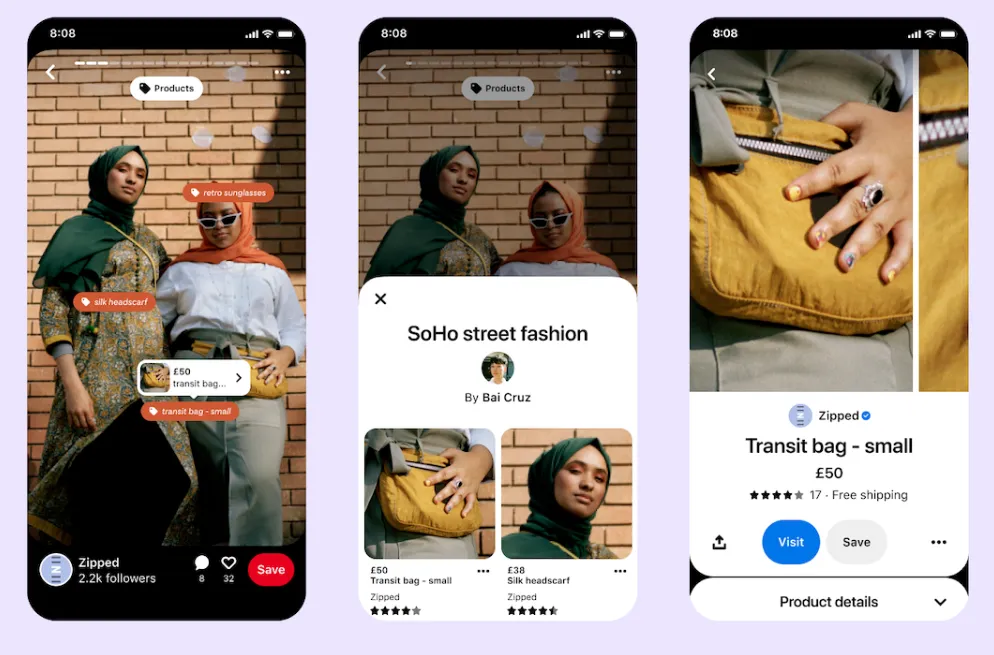
Pinterest and Snapchat each follow guidelines and provide branded content tools for creators, though their systems are simpler and more limited than Meta’s:
- Snapchat has a Paid Partnership tag for Snap Stars.
- Pinterest has a Paid Partnership tool for creators.
Tools & Checklists for Advertisers to Stay Compliant with NYC Ads
Efficient compliance comes down to systems as much as strategy. The following tools and checklists allow brands, agencies, and creators in NYC to stay on top of disclosures, tax rules, and platform policies.
Need help auditing your campaign’s compliance? Book a free consultation with our team!
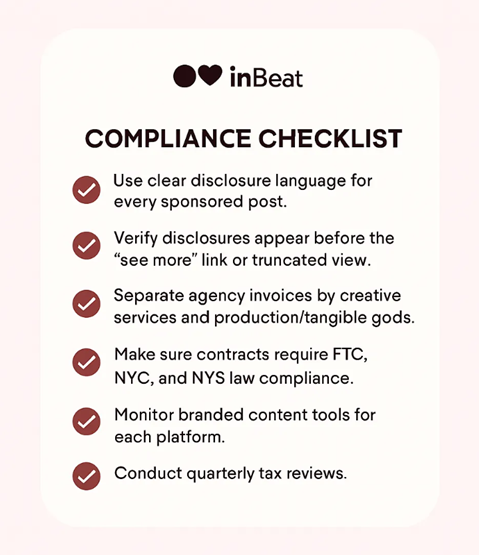
Compliance Checklist
- Use clear disclosure language for every sponsored post.
- Verify disclosures appear before the “see more” link or truncated view.
- Separate agency invoices between creative services (generally non-taxable) and production/tangible goods (which may be taxable in New York).
- Make sure that influencer contracts include language requiring compliance with FTC regulations as well as New York City and New York state laws.
- Monitor branded content tools for each platform.
- Conduct quarterly tax reviews aligned with campaign cycles to reconcile payouts, ad spend, and deductions.
Useful Platforms & Portals
The tools you use to track disclosures, verify claims, reconcile invoices, and monitor platform-level compliance can determine whether your campaigns run smoothly or expose you to unnecessary risk.
Every step in the workflow needs visibility, documentation, and audit-friendly processes, rendering a strategic stack of compliance-focused platforms absolutely essential.
At the basic level, we advise advertisers to maintain direct access to official regulatory sources, like the New York State Department of Taxation for clarifying sales-tax obligations, and the NYC Finance portal for local business-tax filings.
But beyond the fundamentals, modern compliance also depends on tools that help validate media buying, verify publisher behavior, monitor influencer activity, and ensure that campaigns follow both FTC guidelines and individual platform rules.
Ad-verification platforms have become especially critical as marketers rely more heavily on programmatic placements, influencer-generated content, and user-generated assets.
Gartner maintains a continuously updated market overview of ad verification tools, including fraud detection, brand-safety monitoring, and viewability verification, which offers a clear overview of trusted providers and how they perform in real environments.
See Gartner’s market comparison here.
Common Mistakes in NYC Ad Compliance + How to Avoid Them
Avoiding compliance pitfalls starts with recognizing recurring errors and preventing them proactively.
- Failing to disclose “free” or gifted products: even if no cash is exchanged, the value counts as a “material connection”, and the FTC has flagged creators failing to do so.
- Misclassifying services for tax purposes: for example, billing “creative campaign strategy” is non-taxable in many cases, but handing over printed materials may trigger tax.
- Overlooking platform-specific requirements: even if your disclosure meets FTC standards, failing to abide by a platform’s branded content policy can lead to reduced ad distribution or removal.
- Neglecting contract and record-keeping obligations: NYC’s enforcement arms expect documentation (campaign briefs, influencer handles, invoices, disclosure screenshots…). A lack of records can escalate a minor error into an audit risk.
Create NYC-Compliant Ads with inBeat Agency
Advertising in New York City isn’t just about creative excellence; it’s about mastering compliance: from federal disclosure rules to state and city tax regulations, all while complying with each platform’s branded content system.
The regulatory map is vast, but getting it right means successfully protecting your brand, your budget, and your reputation.
Start by:
- Disclosing clearly.
- Filing tax obligations accurately.
- Staying on top of platform policies.
For deeper insights and influencer-campaign best practices, read more on the inBeat blog.
Looking to grow your brand with measurable results? Book a free consultation today!
FAQs
1. What accessibility rules apply to digital ads in NYC?
Digital ads must follow the Americans with Disabilities Act (ADA) and basic Web Accessibility Standards, including proper color contrast and alignment with Web Content Accessibility Guidelines. This ensures your ads are readable and accessible to every natural person viewing them.
2. Do platforms enforce additional content standards?
No. Platforms apply content standards, community standards, and acceptable use policies that govern what can be promoted. Violations can trigger platform enforcement, reduced reach, or ad removal.
3. How should NYC advertisers handle required disclosures?
Most platforms offer built-in disclosure tools for paid partnerships, political content, and local transparency requirements. Advertisers are responsible for using these tools correctly and keeping disclosures prominent across social media channels.
4. What targeting settings matter for NYC-specific compliance?
Some platforms restrict or monitor targeting settings for sensitive categories (housing, employment, credit, political content). NYC advertisers should review these options carefully to avoid discriminatory or non-compliant targeting.
5. How do NYC rules intersect with platform Codes of Conduct?
Each channel enforces a Code of Conduct or acceptable use policy that governs ad content and behavior. Advertisers must follow both city-level disclosures/ tax rules and the platform’s community requirements.
6. What should brands do if platform enforcement flags their NYC ads?
If a platform initiates platform enforcement, review the specific policy cited (such as community standards or accessibility requirements). Correct issues like missing disclosures, improper targeting, or accessibility gaps before resubmitting.
Research Sources
The following sources support the key statistics and compliance references included in this article:
1) Government and Regulatory Guidance (US / NYC / NYS)
- Federal Trade Commission (FTC) - FTC’s Endorsement Guides: What People Are Asking
- Federal Trade Commission (FTC) - Full Disclosure (FTC blog on clear & conspicuous disclosures)
- Federal Trade Commission (FTC) - Disclosures 101 for Social Media Influencers
- Federal Register / FTC - Trade Regulation Rule on the Use of Consumer Reviews and Testimonials
- NYC Department of Consumer & Worker Protection (DCWP) - False Advertising (Key implications for NYC advertisers)
- NYC.gov (Consumer Protection & Licensing Laws) - Overview page for NYC advertising / consumer protection requirements
2) Legal / Policy Analysis Referenced for Quantified Claims
- Cooley (legal insight) - New York enacts synthetic performer disclosure law…
3) Tax and Financial Guidance Used in the Article
- Internal Revenue Service (IRS) - Taxable Income (Topic No. 409)
- Deloitte - New York: Taxation of information services continues to expand
- New York State Dept. of Taxation and Finance - Advisory Opinion TSB-A-24(6)S
- UpCounsel - NYC corporate tax overview (used for cited tax-rate context)