

GLP-1 telehealth is the category where the ad that converts fastest is usually the ad that ends the program. Transformation hooks, speed claims, and 'personalized formulation' positioning win click-through for a few weeks and then meet three enforcement layers at once: FDA compounding and advertising rules, FTC endorsement expectations, and platform prescription drug policies.
The pressure tightened this year.
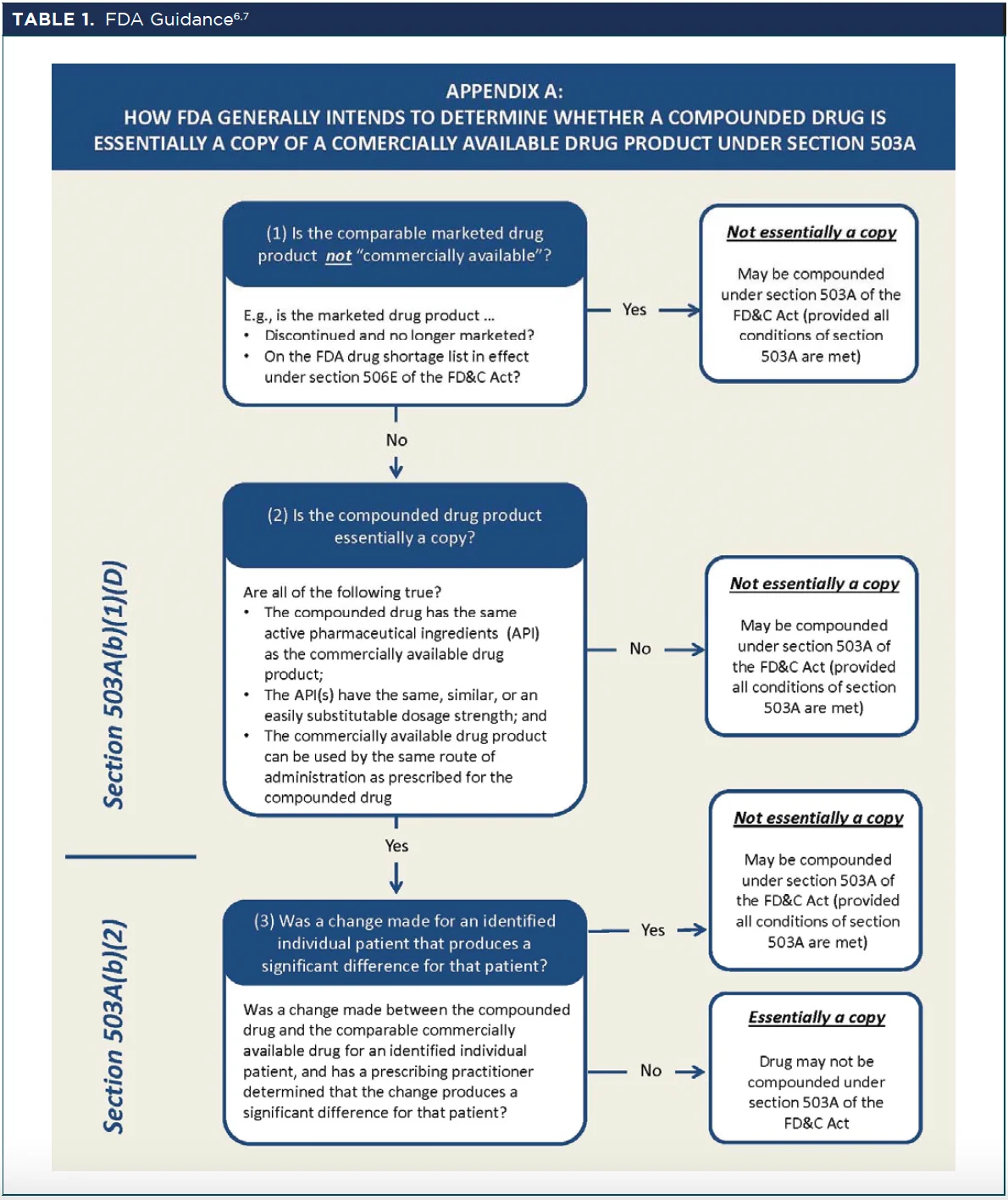
On April 1, 2026, the FDA clarified its compounding policy and used semaglutide combined with vitamin B12 as an example of a product it may still consider 'essentially a copy' of a commercially available drug.
In the same stretch, the agency sent waves of warning letters to telehealth companies over how they market compounded GLP-1s.
This article treats that shift as the creative brief. You'll get a claims audit, a creator brief structure, a de-identified outcomes library, and a review-gated account structure, so testing keeps running while the rules move.
P.S. If you'd rather have creative, media buying, and compliance review built side-by-side from day one, see how inBeat runs paid social programs.
We believe GLP-1 programs are where 'the creative is the targeting' gets its hardest test. Platform settings won't find your patient in a regulated category, and the hook can't do the job either, because the hook that converts fastest tends to be the one that gets the account disabled.
What's left is the persona carried inside the creative. When you collaborate with a micro-creator, you're buying their likability and their lived context, so the brief has to leave efficacy with the clinician. Media buying then does what it exists for: dark-post the compliant concepts, read the signal at the creative level, scale what earned it. Spend that teaches nothing is the real waste, and a banned account teaches nothing at all.
TL;DR: a compliant GLP-1 marketing strategy in six answers
A compliant GLP-1 marketing strategy comes down to six decisions, each with an owner.
- The FDA's April 1, 2026 clarification says a semaglutide and B12 compound may still count as 'essentially a copy', and its 2026 warning letters target claims implying sameness with FDA-approved drugs. Any positioning built on formulation or equivalence needs rewriting now.
- Standard DTC wellness hooks, meaning dramatic transformations, unverified speed claims, and undisclosed creators, are a fast route to an account ban in this category; persona-led substitutes still convert.
- Creator programs work when the brief buys the creator's likability and lived context, the creator describes their experience, and the licensed clinician owns every efficacy statement.
- Patient outcomes become usable creative only after identifying information is removed, and the result is presented as an anonymous case study or aggregate data (according to HHS).
- Account structure is a compliance control: confirm platform authorization first, dark-post concepts on a test structure behind a review gate, then whitelist only what passed review and earned performance.
- Plan for a market where compounding is restricted. The durable assets are a claims library and a creative testing system, and both keep working whatever happens to supply.
Each of these six needs a named owner, and the ones without one are the first week's work. Consider the telehealth brand whose entire landing page and ad set describe a 'personalized semaglutide with B12' formulation: that brand has no owner for the first bullet, and every other bullet depends on it.
What the FDA's April 2026 Compounding Clarification Means for GLP-1 Ads
On April 1, 2026, the FDA restated the conditions compounded drugs must meet to qualify for the 503A and 503B exemptions, and for the first time spelled out what it considers 'essentially a copy' of a commercially available drug.
Its example was semaglutide combined with vitamin B12, which it may treat as a copy depending on route of administration and strength (Polsinelli).
Two caveats before anything else. The clarification is a statement of policy without the force of law, and it governs compounding eligibility; advertising enforcement runs through a separate track, covered in the next section. Have counsel read the FDA's statement before you change copy at scale.
Healthcare regulatory attorneys examine FDA, FTC, and intellectual property compliance risks for compounded GLP-1 marketing and web content.
Is "Semaglutide With B12" Still a Defensible Ad Claim?
The added-ingredient claim was never a pharmacy detail. It lived in headlines, landing pages, comparison charts, and creator scripts as the reason a program's product was 'different' from the branded drug and therefore cheaper and available.
After the shortages ended, many compounders added a second ingredient, most often B12, to argue their formulation differed from the approved product, and the April 1 example appears aimed squarely at that playbook (according to Polsinelli).
If your differentiation story rests on the formulation, the clarification undercut your story, and every ad still running it is an exposure point.
Which Compounded GLP-1 Ad Claims Create Regulatory Exposure?
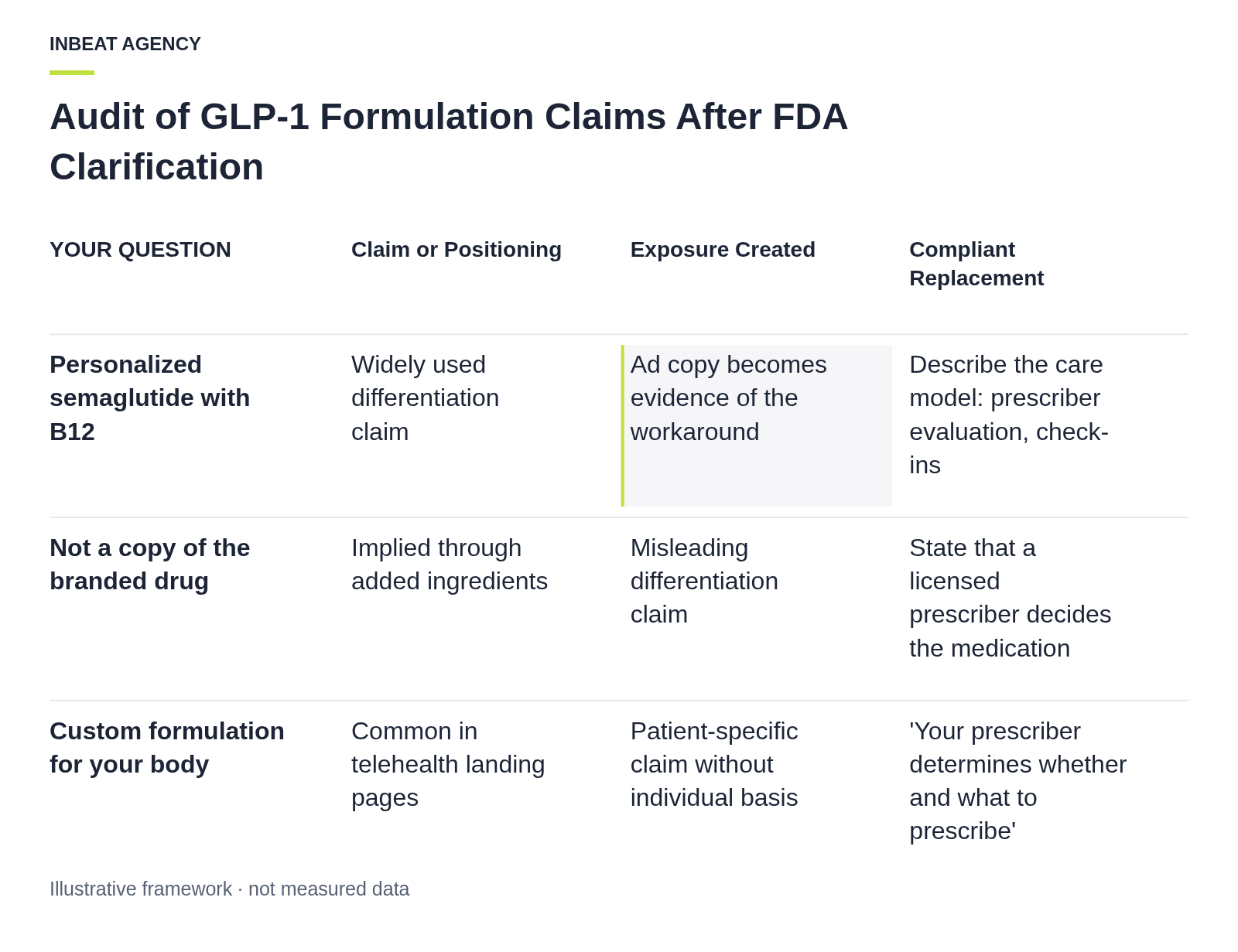
The table maps the common compounded GLP-1 positioning statements against their status before and after the 2026 FDA actions and the replacement language that survives them.
| Claim or positioning | Status before 2026 | Status after the 2026 FDA actions | Exposure created | Compliant replacement |
|---|---|---|---|---|
| 'Personalized semaglutide with B12' as a distinct product | Widely used as the differentiation claim | Named as an example the FDA may consider essentially a copy | Ad copy and pages become evidence of the workaround | Describe the care model: prescriber evaluation, dosing supervision, check-ins |
| 'Not a copy of the branded drug' | Implied through added ingredients | Contradicted by the clarification's stated purpose | Misleading differentiation claim | Remove product comparison; state that a licensed prescriber decides the medication |
| 'Custom formulation for your body' | Common in telehealth landing pages | Undermined unless patient-specific need is documented per prescription | Patient-specific claim without individual basis | 'Your prescriber determines whether and what to prescribe after evaluation' |
| 'Same active ingredient, lower price' | Frequent price-anchoring hook | Claims implying sameness with FDA-approved products were a primary violation in the March 2026 warning letters | Sameness claim plus a price that collapses with supply | Program price transparency without medication equivalence claims |
| Product sold under the telehealth brand's own name | Common branding choice | Cited in the March 2026 warning letters as implying the telehealth firm is the compounder | Obscured product sourcing | Qualify the product name and identify who compounds it; confirm wording with counsel |
| Formulation-based creator talking points | Scripted into experience content | Creator posts carry the same exposure as owned ads | Endorsement of a claim the brand may not make | Creator describes their routine and access to care only |
The first two rows draw on the FDA's April 2026 clarification (Foley & Lardner); the sameness and branding rows draw on the FDA's March 2026 warning letters; the remaining rows are our operational reading of how the same logic extends to adjacent claims and should be confirmed with counsel.
One applicability note. Branded manufacturers advertise under the FDA's prescription drug advertising rules, including fair balance between benefits and risks. GLP-1 drugs accounted for $360.9 million, or 35.7%, of the top 10 prescription linear TV ad spend in the first half of 2025 (eMarketer). Telehealth programs and clinics mostly advertise a service: access, evaluation, monitoring. The compounding rules bite the second group. Apply the rule set that matches what you actually sell.
How to Audit Live GLP-1 Ads, Landing Pages, and Creator Posts
- Run the table against every live asset this week.
- Export all active ads, landing page variants, and sponsored creator posts into one sheet.
- Tag each with the row it matches.
- Pause anything tagged to the first five rows until counsel clears replacement copy.
- Record the pause date and reason.
The archive becomes the evidence trail that you acted when the guidance appeared, which matters if a platform or regulator asks later.
What Did the FDA's Warning Letters to GLP-1 Telehealth Companies Flag?
The FDA's marketing enforcement runs through misbranding warning letters, on a separate track from the compounding clarification. The agency launched a crackdown on misleading direct-to-consumer drug advertising in September 2025 and says it sent thousands of letters to pharmaceutical and telehealth firms over the following six months.
On March 3, 2026, it announced 30 warning letters to telehealth companies over claims about compounded GLP-1s on their websites. Another 25 letters followed during the week of June 15, 2026 (Sheppard Mullin).
The FDA named two primary violations in the March letters:
- Claims implying sameness with FDA-approved products.
- Drug products branded with the telehealth firm's name or trademark without qualification, which implies the telehealth firm is the compounder.
Both map onto rows in the claims table above. The first is the 'same active ingredient, lower price' hook in regulatory language. The second catches a branding decision most growth teams never route through review: the product name itself. Add both to your audit sheet as standing checks.
Who Else Is Enforcing GLP-1 Ad Rules?
State attorneys general are also enforcing GLP-1 ad rules.
In December 2025, a bipartisan coalition of 35 attorneys general asked Meta to enforce its own policies against weight-loss ads using AI-generated before-and-after photos and false guarantees of effectiveness, and to allow prescription drug ads only for FDA-approved products with their risks disclosed.
Manufacturers are active as well: Novo Nordisk sued Hims & Hers in February 2026 over its compounded semaglutide products (as per CNBC), a case covered in the restricted-compounding section below.
Can Compounded GLP-1 Ads Mention Ozempic or Wegovy?
Treat branded drug names as off-limits in compounded GLP-1 advertising. Guidance written for compounders by a pharmacist-attorney at Frier Levitt says never to reference brand names in advertising or describe a compound as a generic version, and flags safety and efficacy claims for compounded drugs as prohibited.
The FDA makes the underlying point directly: compounded drugs are not FDA-approved, and they are not the same as generic drugs.
The rule reaches past the product name.
A comparison chart that sets your program price against Wegovy's list price, or a creator script that says 'it's basically Ozempic,' creates the same sameness impression the March 2026 warning letters cited.
If your program also prescribes branded medication, present it as one option the prescriber may choose, and keep compounded and branded options clearly separated on the page.
Why the Standard DTC Wellness Playbook Fails for GLP-1 Programs
The standard DTC wellness playbook fails in this category because its most reliable hooks are also documented enforcement triggers. In supplements or skincare, a bold transformation claim costs you a rejected ad at worst.
Attached to a prescription drug, the same claim invites FTC scrutiny of the endorsement, platform prescription drug policy enforcement, and, for compounded programs, the FDA exposure covered in the sections above.
What a GLP-1 Ad Account Ban Costs
The real cost of a ban is the lost learning. A disabled account erases creative-level performance history: which persona converted, which angle held frequency, which proof line lifted conversion. That history is the asset a testing system runs on, and it can't be repurchased.
The social media advertising strategy playbook we use for ecommerce assumes you can iterate hooks fast and take a few rejections; in GLP-1, rejections compound into account health problems, so the iteration has to happen before launch.
Which GLP-1 Ad Tactics Trigger FTC and Platform Enforcement?
Researchers at the University of Exeter have already published a critical discourse analysis of 90 Facebook and Instagram ads for GLP-1 weight loss drugs, and state attorneys general are pressing Meta over the same kind of ads. The feeds you're buying are being read closely.
The table pairs each tactic with its exposure and the substitute that keeps the persona.
| DTC wellness tactic | GLP-1 exposure | Who enforces it | Compliant substitute |
|---|---|---|---|
| Before-and-after transformation hook | Visual efficacy claim tied to a prescription drug | Platform drug policy, FTC | Day-in-the-life persona content with clinician segment |
| 'Results in X weeks' | Unsubstantiated speed claim | FTC, platform policy | Program structure claim: evaluation, weekly check-ins, adjustment cadence |
| Countdown or urgency pricing | Pressure on a medical decision, price tied to supply | Platform policy | Transparent program pricing with what's included |
| Undisclosed paid creator post | Hidden material connection | FTC | Clear disclosure in first line and in-video |
| Formulation differentiation | Compounding exposure after April 2026 | FDA | Care model and access claims |
The formulation row follows the FDA's April 2026 clarification (according to Polsinelli); the other rows describe platform prescription drug policies and FTC endorsement principles in general terms; check them against the current policy text for each platform before relying on them.
Compliant GLP-1 Ad Hooks Built on Persona-Led Creative
Persona-led creative replaces the hook by answering who this program is for and what daily life looks like inside it.
A hypothetical rewrite: 'lose 20 lbs in 8 weeks' becomes a nurse on night shifts talking about managing appetite around irregular meals and fitting clinic check-ins between shifts, with a clinician-voiced segment covering dosing and expected outcomes.
The persona selects the audience the way targeting settings used to.
Rebuild your top three hooks this way and launch them as the first test cell. Branded manufacturers should note that even these substitutes need fair-balance risk disclosure when the ad names the drug, so their versions run longer and carry more on-screen text.
How to Write a Compliant GLP-1 Creator Brief
Write the creator brief so the creator owns their experience, and the clinician owns efficacy. That single division of labor resolves most of the trust problem in this category.
Micro-creators matched by persona work better here than celebrity transformation content because the persona carries the audience selection that platform settings can't, and because a working parent or shift nurse describing their routine is believable in a way a dramatic reveal is not permitted to be.
You're buying their likability and context, the same logic behind the creator-documented content in our campaign for Mindbloom. Here, our micro-influencer marketing campaign had 15+ creators go through the treatment. This led to a 25% decrease in CAC and a 40% increase in referral sign-ups.
The same strategy could be applied to products like GLP-1, if you ensure the claims creators make are compliant.
That brings us to the next point:
Which GLP-1 Claims Creators Can Make and Which Need a Clinician
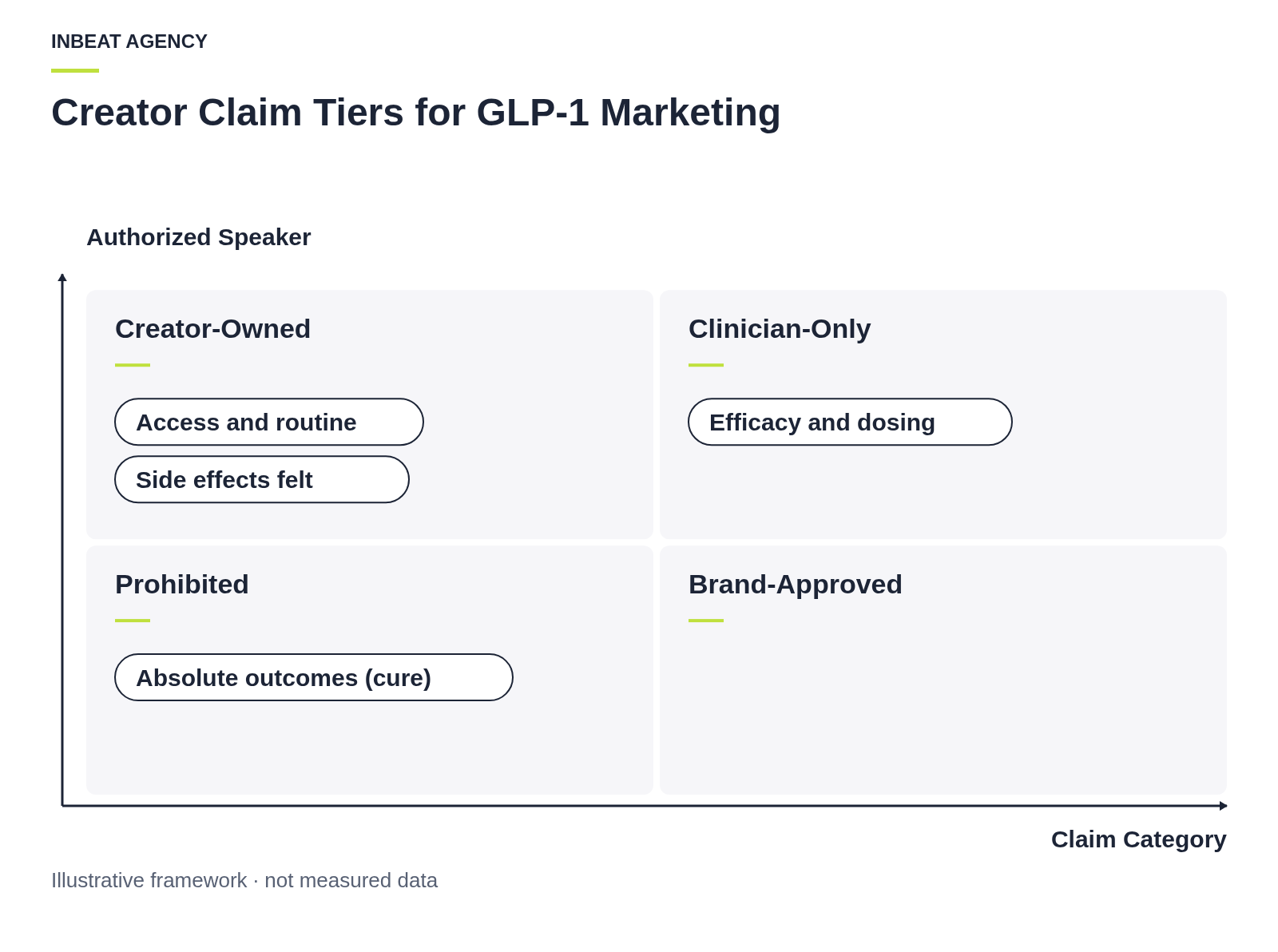
Use a three-tier claims boundary in every script.
| Claim tier | Who may say it | Example wording | Prohibited version |
|---|---|---|---|
| Experience | The creator | 'I do my check-in with my prescriber every two weeks, and here's what that looks like' | 'This is the best weight loss program out there' |
| Access and routine | The creator | 'The evaluation took one video call and my prescriber decided what was right for me' | 'Anyone can get approved in minutes' |
| Side effects felt | The creator, in their own words | 'The first few weeks I had some nausea and my prescriber adjusted my plan' | 'No side effects at all' |
| Efficacy and dosing | A licensed clinician only | 'Typical outcomes and dosing depend on evaluation; here's how we monitor progress' | Creator quoting pounds lost per week |
| Absolute outcomes | Nobody | No permitted version | 'Cure', 'guaranteed', 'permanent results' |
Any outcome a creator references follows the de-identification rule covered in the outcomes section: their own experience, or the program's aggregate numbers from the approved library, never another patient's story with traceable details (according to the HHS guidance cited above).
FTC Disclosure Requirements for Paid GLP-1 Creator Posts
Disclosure goes in the first lines of the caption and in the video itself, spoken or on screen, before the substantive content. Paid creators never present as unsolicited patients who happened to find the program; the brief states the relationship plainly and the script repeats it.
The FTC Endorsement Guides are the framework here, and pending counsel's read of the current guides, the operating rule is conservative: if a reasonable viewer could miss the disclosure, it isn't disclosed.
How to Turn Approved Creator Posts Into Ad Variants
The brief template needs six fields: persona, permitted claim tier, required disclosure, mandatory clinician handoff line, prohibited words, and review sign-off.
The handoff line is the highest-stakes field.
It's the sentence where the creator stops talking and points to the prescriber, and it's what keeps a compelling story from becoming an efficacy claim.
Once a post clears review, cut variants by changing the opening seconds and the persona framing while holding the claim tier constant, so the test reads back to persona and angle and never to a claim you can't defend.
The same discipline applies across our healthcare marketing work: vary the messenger, hold the message inside the approved boundary. Rewrite your current brief with these six fields before the next batch is commissioned.
How to Use De-Identified Patient Outcomes in GLP-1 Ads
Remove identifying information first, then choose the format, and default to aggregate data over individual transformation imagery. Outcome-led messaging is the strongest proof a program owns, and it's also the asset most likely to breach patient privacy or a platform's drug policy if handled the way wellness brands handle testimonials.
How to De-Identify GLP-1 Patient Outcomes
HIPAA's Safe Harbor method sets the baseline for covered entities: remove names, geographic subdivisions smaller than a state, all date elements except the year, full-face photographs, and any other unique identifying characteristic.
Practitioner guidance applies the same rule to marketing: present outcomes as an anonymous case study or a collection of aggregate data (Elite NP).
Pro tip: 'Any other unique identifying characteristic' is where teams slip. A start weight, a distinctive occupation, a small-town clinic name, and a date range can identify a person when combined.
Treat privacy obligations, including HIPAA where it applies, as a general duty on every asset and have compliance confirm the standard your organization uses; nothing here is legal advice.
Why Aggregate Program Data Is Safer Than Before-and-After Photos
Before-and-after photos are the wrong default in this category. They tie a visual result to a prescription drug, invite rejection under platform drug policies, and are almost impossible to de-identify because the face is the content; HIPAA's Safe Harbor list names full-face photographs as an identifier.
Aggregate program metrics (such as adherence rates, check-in completion, and average program duration) describe your service, are easier to substantiate from your own records, and stay reusable when supply or formulation changes.
| Asset type | De-identification requirement | Platform risk | Reusability in paid social | Recommended use |
|---|---|---|---|---|
| Before-and-after photos | Practically unachievable | High: visual drug efficacy claim | Low; frequently rejected | Avoid in paid; not recommended in organic either |
| Individual anonymous case study | Full PII removal, details generalized | Moderate; depends on outcome language | Medium, per approved wording | Long-form landing page or clinician-narrated content |
| Aggregate program metrics | Inherently de-identified if sample is large enough | Low when framed as service metrics | High | Primary proof line in ads and creator scripts |
| Patient-volunteered public story | Written consent plus PII review | Moderate | Medium | Organic and owned channels with clinician framing |
| Clinician-voiced outcome explanation | No patient data required | Low | High | Efficacy segment across all formats |
The de-identification column applies HIPAA's de-identification guidance; risk and reusability ratings are our operational assessment and should be read as judgment calls; we have no measured rejection rates to attach to them.
How to Build a GLP-1 Claims Library
- Stand up one claims library document and make it the only permitted source of numbers in ads, landing pages, and creator scripts.
- Each entry carries the statistic, its source system, the observation window, the sample size, the approval date, the approver, and the permitted contexts.
A hypothetical entry: 'Check-in completion rate, program records, January to June, all active patients, approved July 15 by compliance lead, permitted in ad copy and creator scripts, prohibited alongside weight figures.' Nobody improvises a number, and when a buyer asks whether a stat is usable, the answer is in the sheet.
The library also closes the testing loop.
It supplies the proof variable while persona and angle vary, so when a variant wins, you can read the result back to a specific approved claim. That's what turns compliance from a gate into a learning input, and it's the discipline we apply across programs whether the category is regulated or not.
What Do Meta and Google Require Before a GLP-1 Ad Can Run?
Meta requires online pharmacies and telehealth providers to be actively certified with LegitScript and then to request Meta's authorization before promoting prescription drugs. Authorized advertisers:
- Can only target people in the United States, Canada, or New Zealand.
- Can only run ads in the countries where they're certified.
- Can't target prescription drug ads to anyone under 18.
LegitScript certification is also what telehealth and pharmacy advertisers use to qualify for prescription and telemedicine advertising on Google, Microsoft, TikTok, and other platforms.
This has two consequences for the account structure in the next section. Confirm that every ad account you plan to use, test accounts included, is covered by the authorization before you build the dark-post structure. And treat geography as a certification question: a program expanding to Canada needs certification there before the first test cell launches.
How to Structure Paid Social Accounts for GLP-1 Ad Testing
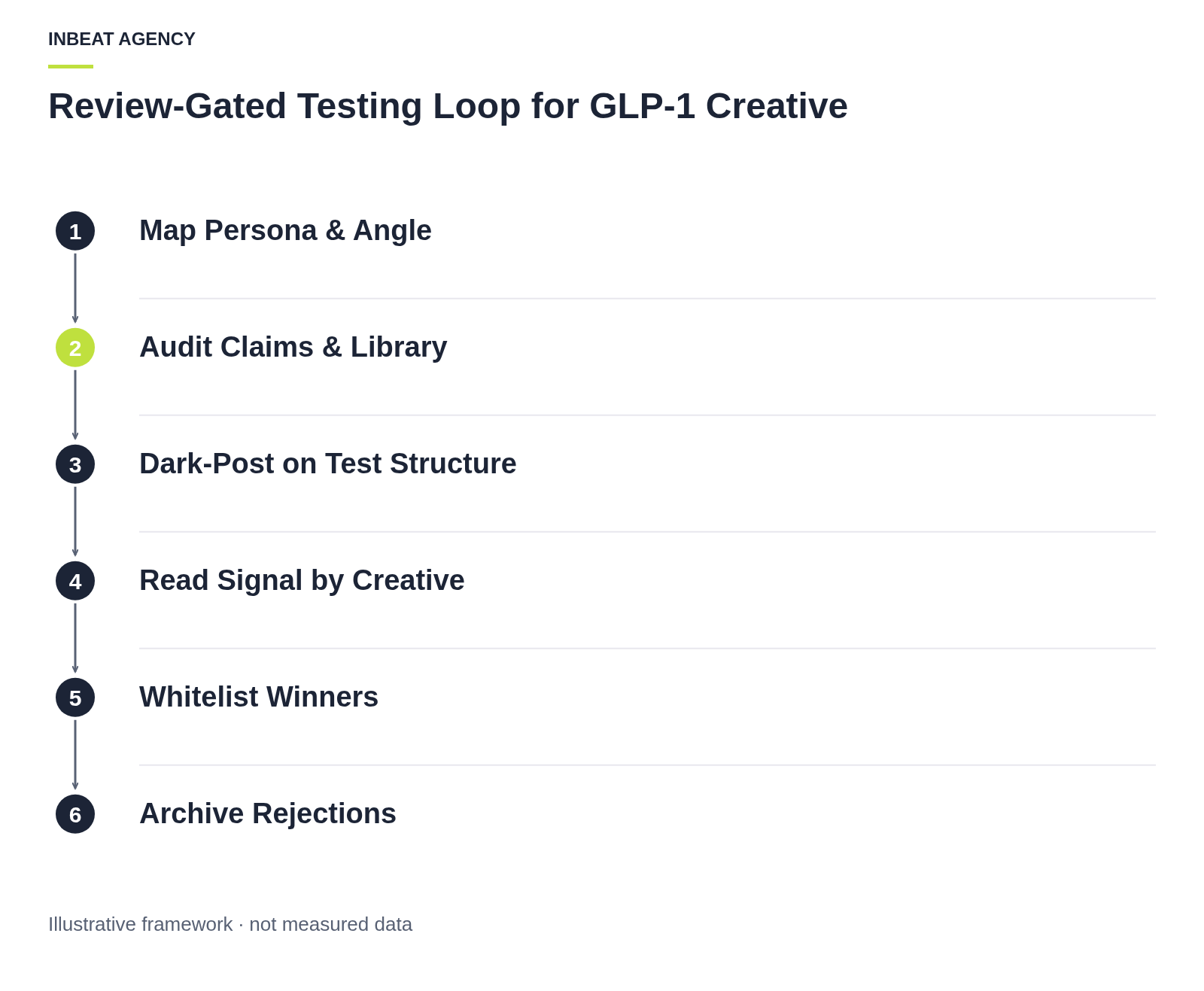
Set up a six-step loop with a named compliance reviewer at step two, and run one full cycle before you add budget. Account structure in this category is a compliance control as much as a media tactic, because repeated policy violations can restrict an ad account and take its business assets down with it.
- Map the persona and angle matrix. List the three to five personas your program serves and the two or three angles per persona (care model, access, routine fit). Every concept gets a cell.
- Route every concept through the claims audit and the outcomes library. The reviewer checks claim tier, disclosure, handoff line, and the source of any number. The April 2026 clarification and the sameness and branding violations from the FDA's warning letters become standing checklist items here, reviewed on every cycle, so formulation or equivalence language never resurfaces in a new hook.
- Dark-post on a dedicated test structure. Run concepts as unpublished posts under a business asset reserved for testing, covered by your platform authorization, with landing pages whose claims match the ad claims word for word.
- Read signal at the creative level. Judge each variant on CAC and MER contribution, hold rate, and comment sentiment, and tag it with persona, angle, claim tier, and compliance-pass status.
- Whitelist and scale only what passed review and earned performance. Move winners to the scaling asset, running through the creator's handle where permitted, with the same disclosure carried into the ad.
- Archive rejections with reasons. Platform rejection text, reviewer notes, and the fix applied all go in the archive, which becomes the pattern library for the next batch.
The gate sits before launch for a reason.
Every rejection costs time, repeated violations put the account at risk, and an account that gets restricted loses its testing history along with its spend.
Solution: Keep test and scale structures separate so a problem in one doesn't strand the other, and keep landing page claims consistent with ad claims, since a page that promises more than the ad is an avoidable rejection.
A hypothetical cycle: nine creator variants across three personas, each tagged with its claim tier. Six clear compliance review. Of those, four clear the CAC threshold. Only those four move to whitelisted scaling, and the archive records why the other five stopped.
The mechanism of cost control here is preserved learning: nothing about avoiding bans lowers CPA directly, but keeping the account alive means every dollar of test spend keeps informing the next brief.
The structural logic builds on the funnel structure we laid out for NYC ecommerce paid social, with the review gate added as a non-negotiable step.
Pro tip: make the compliance-pass flag a required attribute in your reporting, so any asset that wins without the flag is logged as an error and held back from scaling.
How to Prepare GLP-1 Marketing for Restricted Compounding
Plan for restricted compounding as the destination.
The FDA removed tirzepatide from its shortage list in December 2024 and semaglutide in February 2025, and on April 30, 2026, it proposed excluding semaglutide, tirzepatide, and liraglutide from the 503B bulks list, which, if finalized, would close the last legal pathway for most compounded GLP-1s (Stanford Medicine).
A narrow exception remains: the FDA has said it doesn't currently intend to act against 503A pharmacies that fill no more than four prescriptions of an essentially-a-copy product per month (according to Polsinelli). Positioning anchored to formulation has a short shelf life.
Which GLP-1 Marketing Assets Survive Restricted Compounding
The durable assets describe how you deliver care and support patients: the persona matrix, the claims library, clinician-led content, the creator roster, and the creative-level performance history. None of these depends on where the drug comes from.
Which GLP-1 Claims Lose Value When Compounding Ends
Formulation claims, price-arbitrage messaging tied to compounded supply, and any creative that converts only because it implies a different product all lose their footing when supply is restricted.
Hims & Hers is the clearest example. After Novo Nordisk sued it in February 2026, the two companies settled on March 9, 2026: Hims agreed to stop advertising compounded GLP-1s except where medically necessary and to offer branded Ozempic and Wegovy on its platform (Frier Levitt).
| Asset | Depends on compounded supply? | Survives restriction? | Action now |
|---|---|---|---|
| Persona and angle matrix | No | Yes | Keep investing |
| Claims library of aggregate program metrics | No | Yes | Re-approve after each regulatory change |
| Clinician-led efficacy content | No | Yes | Expand as the primary proof format |
| Persona-matched creator roster | No | Yes | Renew agreements with updated briefs |
| Formulation differentiation claims | Yes | No | Pause and replace |
| Price hooks tied to compounded cost | Yes | No | Replace with program-inclusive pricing |
| Creative implying a distinct product | Yes | No | Retire and archive with reason |
The supply-dependency reading follows the direction of the FDA's April 2026 clarification and its April 30, 2026 bulks-list proposal; survival judgments are our planning assessment.
How to Reposition a GLP-1 Program Around the Care Model
Move the lead message to care model, adherence support, clinician access, and continuity.
A hypothetical program that swapped 'personalized formulation' for 'weekly clinician check-ins included' can keep advertising whichever medication its prescribers choose.
Tag every live asset as durable or stranded using the table and point the next production budget at the durable column.
How inBeat Approaches Compliant GLP-1 Creator and Paid Social Programs
Compliance is the creative brief in this category. Programs that treat FDA compounding and advertising rules, FTC endorsement expectations, and platform drug policies as inputs to creator scripting, outcome assets, and account structure keep creative testing alive, and testing is what lowers acquisition cost over time.
Programs that borrow the aggressive DTC wellness playbook lose the account, and with it the performance history that made the spend worth anything.
inBeat runs creative, media, and review side-by-side as one loop: persona-matched creator sourcing at volume, performance creative production, and paid social buying, with the claims boundary built into the brief before a creator records a line.
We haven't published GLP-1 client work, and we won't imply results we can't show you.
What we can show is the system, and how it maps to a regulated category where the review gate has to sit before launch.
Whatever partner you evaluate, expect four handoffs in the proposal:
- A claims audit of your live assets.
- A brief template with claim tiers and a clinician handoff line.
- An outcomes library with approval metadata.
- A review-gated account structure that separates testing from scaling.
A proposal missing any of the four is asking you to carry that risk yourself.
Book a strategy call with inBeat to map your GLP-1 program against the audit, brief, and library framework.
FAQ
Who owns efficacy language in a GLP-1 creator campaign, and how do you handle a creator who ad-libs a result on camera?
A licensed clinician owns efficacy in every asset. When a creator ad-libs a result, the reviewer cuts that segment before the post clears, and the brief's prohibited-words field is updated so the same phrasing is flagged next time. Publishing and correcting later is the expensive option.
Can we whitelist a creator's handle for paid scaling after their post clears review, and does the disclosure need to change when it runs as an ad?
Yes, once the post passes review and the creator agreement covers paid usage. The disclosure travels with the asset: the same material-connection statement stays in the caption and on screen, and the paid placement itself never substitutes for it.
What counts as sufficiently de-identified when a patient volunteers to share their own story publicly?
Written consent covering the specific use, plus a review that removes or generalizes name, location, dates, and combinable details, following HIPAA's de-identification standard. Volunteering doesn't waive the review; it only starts it.
Do telehealth brands need LegitScript certification to run GLP-1 ads on Meta?
Yes. Meta requires telehealth providers to be actively certified with LegitScript and then authorized by Meta before promoting prescription drugs, and limits those ads to adults in the countries where the advertiser is certified.
How should a branded manufacturer's fair-balance obligations change the creator brief compared with a telehealth program?
A manufacturer brief adds mandatory risk disclosure whenever the drug is named, longer on-screen text, and medical-legal review of every variant. A telehealth brief centers on service and access claims and the compounding and advertising rules covered above.
How do you keep creative-level performance history if a test account is disabled mid-cycle?
Export creative-level results to your own warehouse after every read, tagged by persona, angle, and claim tier, and keep test and scale assets separate so a disabled test structure doesn't take your winners with it.
Which program attributes can a telehealth brand advertise that do not depend on the medication's supply source?
Prescriber evaluation, check-in cadence, dose supervision, adherence support, continuity of care, and transparent program pricing.
How often should the claims library be re-approved, and who signs off after a regulatory change like the April 2026 clarification?
Re-approve on a fixed quarterly cadence and immediately after any regulatory or platform policy change, with the compliance lead signing each entry and counsel reviewing the entries a change touches.
Cover photo: Photo: Mikhail Nilov / Pexels. Art direction: inBeat Agency.