

Would you market a prescription refill the same way you market a routine checkup? Patients certainly see them differently. In Doximity’s survey of 2,400 U.S. adults, 56% preferred virtual visits for medication management and refills, versus just 23% for regular checkups.
That gap changes everything from the ad promise to the booking page. A convenient virtual visit for one patient can feel like a compromise to another. And a cheap lead means little if eligibility, scheduling, or intake stops them before the consultation.
This telehealth marketing guide shows how to tailor campaigns by care model and measure qualified consultations.
TL;DR: Telehealth Marketing in Six Answers
- Care model sets the plan. Cash-pay subscriptions, insurance-billed visits, behavioral health, hybrid health systems and sponsored programs convert and drop for different reasons.
- Rules set the targeting. Platform policy, drug-claim law, state licensure and tracking each change how the ad account is built.
- Paid social is a test lab. Use one care model, two personas, and three angles per persona. Compare booked consultations early, then qualified consultations before scaling.
- The creator brief documents the visit moment. It names the objections to answer, the claim line and who owns it.
- Funnel friction hides between click and visit. Eligibility, intake, insurance, scheduling and joining the visit each leak patients.
- Measure the outcome each care model delivers. Track qualified consultations when a visit is required, clinician-approved patients for asynchronous prescribing, incremental patients for hybrid care and activated members for sponsored programs.
How Does Telehealth Patient Acquisition Differ by Care Model?
Telehealth patient acquisition splits into five care models, and each one needs its own promise, drop-off point and success metric.
Cash-Pay Subscription Telehealth
The ad promises convenience, price clarity and fast access to a prescriber. Intake and clinician review determine eligibility, and some cash-pay services reach approval without a live visit. Lead volume alone therefore overstates the patients the service can treat.
For asynchronous prescribing, track cost per clinician-approved patient. When the care model requires an attended visit, track cost per qualified consultation instead. Monitor clinician declines and appointment no-shows by ad angle to see which creative attracts eligible patients.
Insurance-Billed Virtual Primary and Urgent Care
The ad promises same-day access and acceptance of the patient's insurance. Insurance verification is where interest turns into abandonment, so the landing page should answer the coverage question before it asks for a form. Manage cost per completed visit.
Virtual Behavioral Health
Stigma shapes both the creative and the privacy cues, and first-appointment attendance is the weak link. At one East Carolina University psychiatry clinic, 29.8% of first-time video visits were missed during the pandemic.
Data sharing carries the highest risk in this model. The FTC's 2023 action against BetterHelp says the company used customers' email addresses and the fact that they had been in therapy to have Facebook find similar people, which brought in tens of thousands of new paying users.
It ended in a $7.8 million order and a ban on retargeting. Manage cost per attended first session.
Hybrid and Health-System Virtual Front Doors
Telehealth works here as an entry point that routes patients to in-person care without eating into clinic capacity. Target by service line and drive time, and judge campaigns on incremental new patients. Total bookings include existing patients who would have booked anyway.
Employer- and Payer-Sponsored Programs
Acquisition happens through benefits enrollment, so paid social supports awareness at most, and the creator brief, test and target sections later in this guide do not cover it.
Treat it as a separate program: a reminder channel during open enrollment, judged on enrollment activation, which paid media rarely owns.
Telehealth Advertising Rules That Change Targeting and Creative
Four rule areas shape telehealth campaigns: platform policy, drug-claim law, state licensure and tracking. Prescription-service ads may also require separate platform approval before launch.
Prescription-service ads have a separate approval gate. Google's healthcare advertising policy restricts online prescribing ads and requires certification for eligible advertisers. In the U.S., telemedicine services that facilitate prescribing generally need LegitScript accreditation and Google healthcare certification. Meta requires authorization for ads that promote prescription drugs. Requirements vary by country, service and creative, so confirm platform approval separately from clinician licensure.
The enforcement pace is the reason to build this into the account. In March 2026 the FDA announced 30 warning letters to telehealth companies over compounded GLP-1 claims.
The violations it named were claims implying sameness with approved products and branding that obscured who compounds the drug.
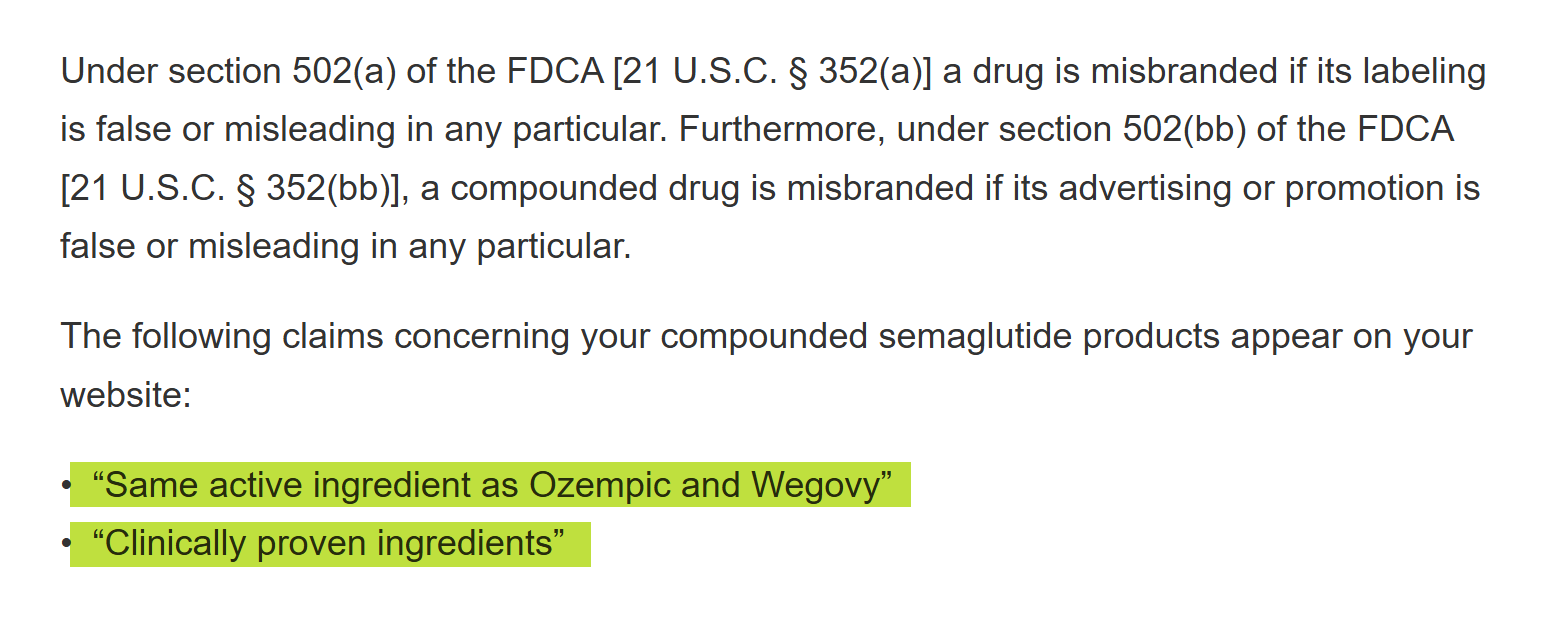
The agency's September 2025 letter to Hims and Hers shows what that looks like in copy. It cited the line "Same active ingredient as Ozempic and Wegovy" and the phrase "Clinically proven ingredients" as false or misleading.
Our GLP-1 marketing strategy guide covers that category in depth, so this guide keeps to the pattern: any sentence that borrows an approved drug's credibility is a claim to clear before it ships.
Pro tip: ask the clinical lead for a one-page list of what the service can and cannot say before any creative goes out. Rewriting after a platform rejection costs more than the wait. Our advertising compliance checklist turns that review into a pre-launch list.
Tracking carries the other large exposure. The FTC said Cerebral's website and app trackers sent sensitive data on nearly 3.2 million consumers to LinkedIn, Snapchat and TikTok, and the order bans most advertising uses of its health data.
The status of HHS tracking guidance is nuanced. A 2024 court order vacated part of its approach to IP addresses on unauthenticated pages, but did not create a blanket exemption for appointment booking or intake data. These flows still require a privacy review.
A generic booking-confirmed event is not automatically safe to send to an ad platform. On appointment pages, identifiers and event context may reveal that someone sought care. Review the event payload, vendor agreements and legal basis before enabling external tracking.
Which Channels Belong in a Telehealth Advertising Mix?
Four channels handle distribution; creator-led content supplies the ad variations tested through paid social. Each has a different role in patient acquisition.
Search captures existing intent, while paid social can introduce a care option earlier in the decision process. Split budgets by care model. Use bookings as an early signal, then compare qualified consultations once clinical outcomes are available.
How to Test Telehealth Paid Social by Persona and Angle
Telehealth paid social works best as a structured test: one care model per campaign, two personas, three angles per persona and a fixed spend before any decision.
Interest and demographic targeting does little audience selection in health, so the persona inside the creative carries it, while geography and age floors stay in force.
- Pick one care model per campaign. A cash-pay prescriber and a behavioral health practice answer different hesitations, and mixing them blurs the read.
- Define two personas from that model's friction points. For virtual behavioral health, that could be a first-time seeker worried about privacy and a returning patient who needs a faster appointment.
- Write three angles per persona from that care model's hesitations, such as price clarity, speed to the first visit, what happens in the visit or, for behavioral health, privacy.
- Screen every angle for unsupported outcome claims, implied diagnoses, age restrictions and prescription-service approvals before production.
- Run the six creatives as dark posts in a prospecting campaign. At equal spend, compare cost per booked consultation by persona and angle as an early signal. Our dark posting guide explains how to run creator concepts as ads before anything is published organically.
- When enough booked visits have become qualified consultations, scale the best-performing angles through partnership or whitelisted ads and pause the rest.
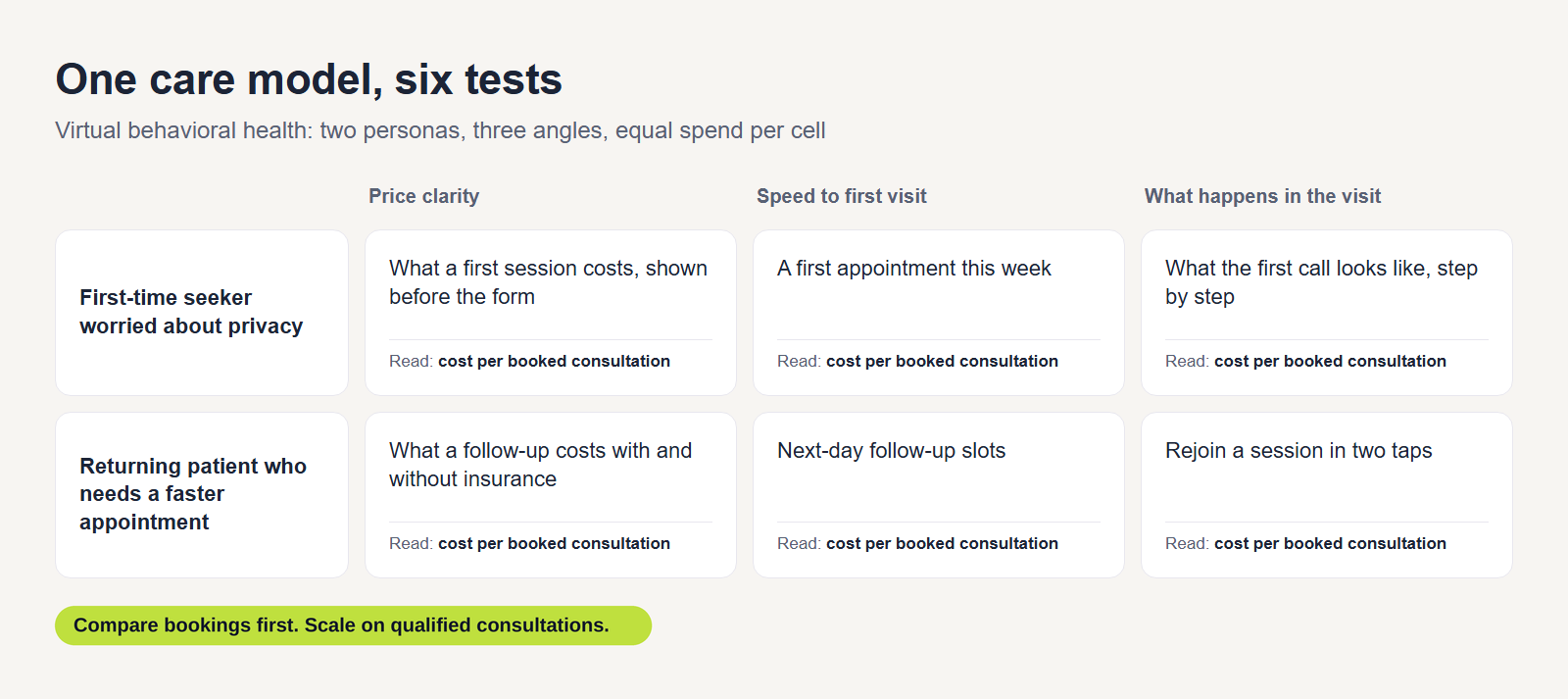
Read each cell at the same spend. Use your observed booked-to-qualified rate to estimate a provisional cost-per-booked ceiling from the cost-per-qualified-consultation target below. Confirm winners against actual qualified-consultation costs before increasing spend, since qualification rates can vary by creative.
A creative can win on clicks or bookings and still bring in fewer eligible patients. The qualified-consultation result is the one to scale.
How to Write a Creator Brief for Telehealth Ads
A telehealth creator brief documents the visit moment, meaning what happens between booking and the first appointment, because that is the part a viewer cannot picture.
Ro's team wrote that it chose to show the app and provider experience on screen in its Super Bowl spot, and the same post credits an associate director of regulatory affairs on the production team.
- Name the care model and the patient situation in one line, such as "adult seeking therapy for the first time, worried about privacy."
- Script the booking-to-visit moment: tapping book, answering the intake questions, meeting the clinician. Have the creator film it from a demo account with no patient data in frame.
- List the objections to answer on camera: is it a real clinician, what does it cost, is insurance accepted, who sees my information.
- Set the claim line and its owner. The creator describes the experience, and the clinician owns every statement about treatment or results.
- Require an unmistakable paid-partnership disclosure in the video and the visible caption, then collect raw footage for approved variants. Ro's production post also disclosed its ambassador's family business connection.
Casting is a separate job. Our healthcare UGC casting guide covers the five creator types and credential checks.
Copy this skeleton into the brief:
- Care model and patient: [one line]
- Visit moment to film: [booking, intake, first call]
- Objections to answer: [three]
- Creator may say: the experience, in their own words
- Clinician owns: every treatment or result statement
- Disclosure: clear on-video paid-partnership notice (visual and spoken where appropriate), plus a visible caption label
Before launch, check four items:
- Every sentence the creator speaks describes the experience.
- The clinician line is approved in writing.
- A paid-partnership disclosure appears in the video and remains visible in the caption without expanding it.
- Nothing on screen identifies a real patient.
Where Telehealth Funnels Lose Patients Between Click and Consultation
Telehealth funnels lose patients at seven steps between the ad click and the completed visit, and each step has a metric that shows the leak.
The join step is easy to overlook. The ECU study raises a useful question about visit access, but its phone-versus-video no-show differences came from one clinic during the pandemic and do not establish causation.
Review show rates by device, visit type and join method before attributing missed appointments to the creative. Test simpler instructions or a phone option where clinically appropriate.
Pro tip: complete the full intake on a phone using a test account and time each screen. Start by shortening the slowest step without removing fields clinicians need, then monitor intake completion and show rate.
How to Measure Qualified Consultations in Telehealth
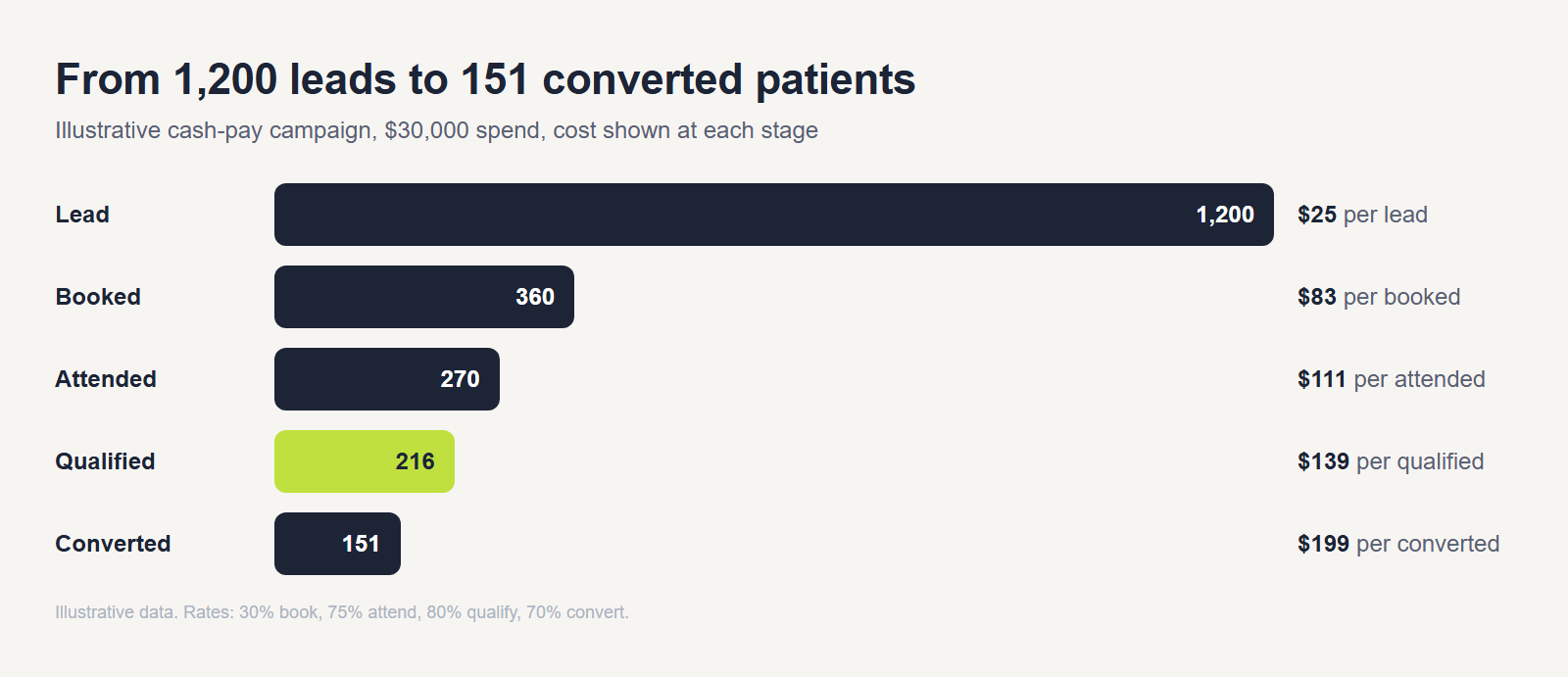
For visit-led services, a qualified consultation is a completed appointment that meets the model's clinical and payment criteria.
Clinician approval during cash-pay intake is a separate step, and some asynchronous services have no visit. In that case, cost per approved patient is the downstream KPI; when a visit is required, use cost per qualified consultation.
The stage table below describes a visit-led funnel. Insurance-billed care also needs coverage verification, while hybrid and sponsored programs need their own outcome metrics.
Cost per qualified consultation = ad spend ÷ qualified consultations. The first illustration follows one hypothetical $30,000 cash-pay campaign through the funnel.
The separate table below compares two $15,000 campaigns to show why a lower cost per lead can hide a higher cost per qualified visit.
Campaign A looks twice as efficient on cost per lead and costs 83% more per qualified consultation, because only 40% of its attended visits met the criteria against 80% for Campaign B.
Do not transmit booking or other patient-level events to ad platforms by default. A generic event name does not make the underlying identifiers and visit context safe; review every proposed data flow with privacy counsel first.
Connect attended, qualified and converted stages inside access-controlled internal reporting.
Platform-reported conversions can include attributed activity that would have happened anyway. Test incrementality with a suitable regional or time-based holdout where feasible. Our incrementality testing guide explains the approach.
- Define the relevant downstream outcome for each care model with the clinical and operations leads.
- For visit-led care, record lead, booked, attended, qualified and converted stages in access-controlled internal reporting. For asynchronous care, track intake, clinician approval and paid conversion instead. Use privacy-reviewed data joins, keeping patient-level events out of ad platforms by default.
- Backfill 60 days of history to set a baseline for each stage.
- Hold out one region or one week of spend for an incrementality read.
- For consultation-led services, report cost per qualified consultation weekly. For other models, use the corresponding downstream KPI; keep cost per lead as a diagnostic.
How to Set a Cost-per-Qualified-Consultation Target
For consultation-led services, work backward from gross profit: maximum cost per qualified consultation = gross profit per converted patient × consult-to-conversion rate ÷ required return multiple. Hybrid and sponsored models should set a comparable ceiling on their own downstream outcome.
Here is an illustrative cash-pay service that requires a completed consultation. A $150 monthly plan at a 60% gross margin with five months of average retention yields $450 in gross profit per converted patient.
If 70% of qualified consultations convert, a qualified consultation is worth $315, and a 2:1 return requirement sets the ceiling near $157. Replace every input with your own billing data.
Published telehealth benchmarks tend to come from vendors and mix care models, so a ceiling built from your own margin and retention is the safer anchor. Our customer acquisition metrics guide covers payback and lifetime value in detail.
Turn Patient Questions Into Better Telehealth Ads
A patient deciding whether to book wants to know what a virtual visit involves, whether the service fits their needs, and what happens after they click. Clear creator-led ads can answer those questions before the patient reaches intake.
At inBeat, we help healthcare and wellness brands turn those questions into creator-led content, then test ideas through paid social. If you're planning a telehealth campaign or revisiting creative that has stalled, tell us what you're working on. We'd love to explore what to test next.
Frequently Asked Questions
Can a telehealth booking page use the Meta Pixel?
A pixel is neither automatically prohibited nor automatically safe on a booking page. Cookies, identifiers, URLs and event details may disclose protected or sensitive health information. Review data flows, vendor agreements and the applicable legal basis before deployment. If the data cannot lawfully be shared with an ad vendor, disable its tracking on that page.
How should a cash-pay brand count a lead the clinician declines?
Count it as a lead if the first form was completed, and as a booked consultation only if an appointment was scheduled. A clinician-declined case is neither an approved patient nor a qualified consultation. Report the decline rate by ad angle to identify creative attracting ineligible patients.
What attribution window fits a patient who takes weeks to decide?
Start from the lag between first ad click and booking in your own data, and set the window where most bookings have landed. Services with longer consideration, such as behavioral health, usually need a longer window than urgent care. Check the result with a holdout.
When should creator content move from organic to paid?
Move it after the clinical lead approves the claims and the paid partnership is clearly disclosed in the video and caption. Test approved dark posts or partnership ads on bookings first, then confirm qualified-consultation performance before expanding distribution.