

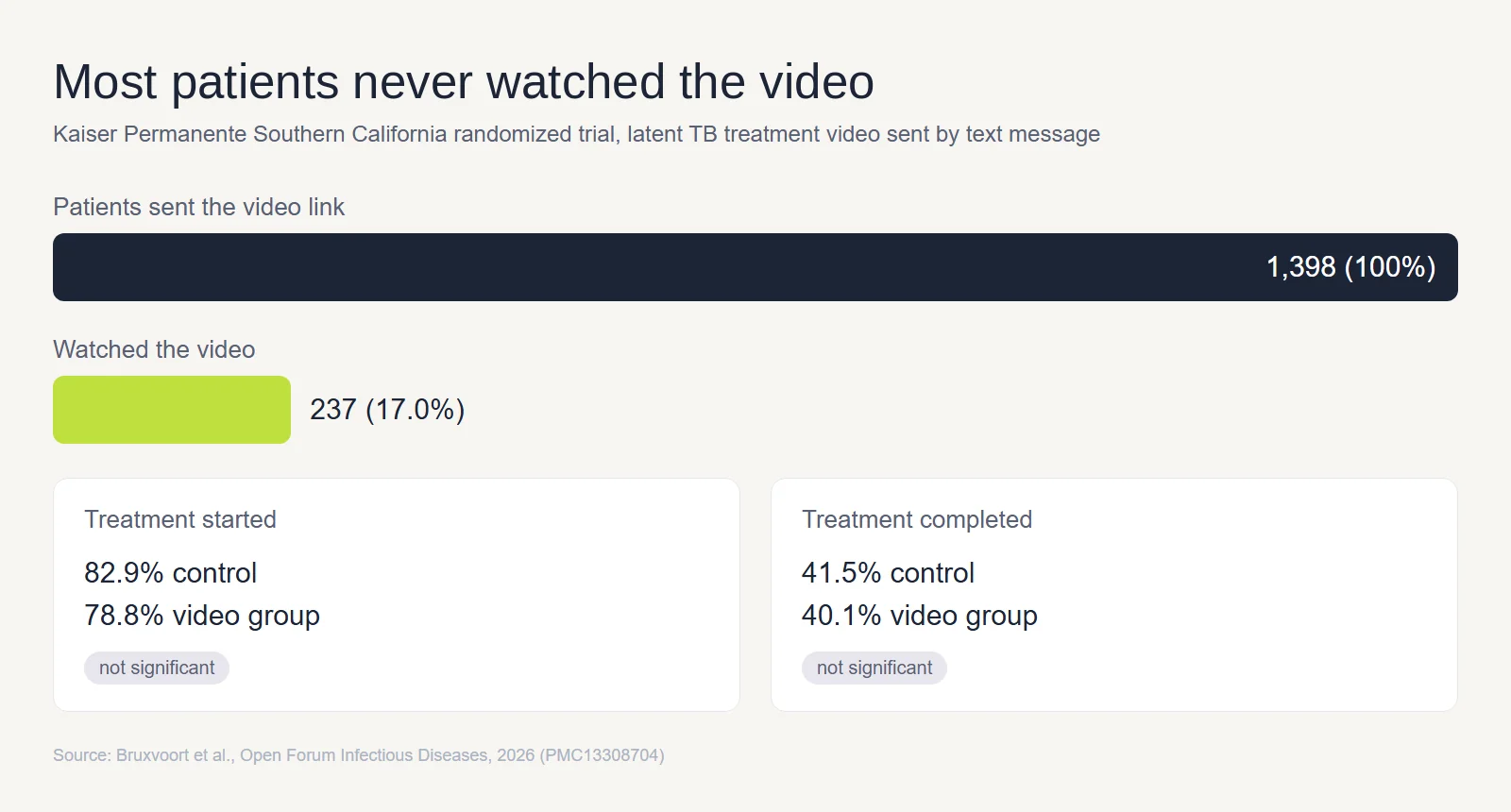
Health systems and device makers publish more patient education video every year, and a 2026 randomized trial inside Kaiser Permanente Southern California shows the catch: only 17.0% of patients who were texted a three-minute treatment video watched it, and treatment start and completion did not change.
Other studies suggest videos can ease anxiety and improve short-term knowledge. But those benefits depend on whether patients see and understand the material.
That shifts attention to decisions made before and after filming: who the video serves, what clinicians approve, and how patients receive it. This guide covers the evidence, an eight-field brief, production and review, formats, costs, distribution, and measurement.
TL;DR
- Evidence: video often helps with anxiety, satisfaction, and short-term knowledge, though results vary by study. Evidence for adherence and clinical outcomes is thin and mixed.
- Brief: agree on eight essentials before scripting, especially the audience, intended action, and clinical approver.
- Script: score it against the CDC Clear Communication Index (90 or higher passes) before you film.
- Format and delivery: match the content to a specific patient question and share it when the answer is needed.
- Measurement: track delivery, comprehension, and outcomes as separate layers.
That distinction matters throughout production: a clear explanation helps little if patients miss it, while a high play rate tells you little about what they understood.
What Are Patient Education Videos?
Patient education videos give people clinician-reviewed guidance on preparing for care, managing a condition, or using a device. The format varies, but the purpose usually falls into one of three groups:
- Before a procedure: what to expect and how to prepare, such as bowel prep or pre-operative instructions.
- After a visit: how to manage a condition or recover, such as wound care or medication schedules.
- Device and medication how-to: how to apply a sensor, use an inhaler, or inject a pen.
The distinction between education and promotion matters, too: the former explains care, while the latter encourages a product or provider choice.
Funding arrangements and product references may call for additional review and disclosure. For those situations, our pharma and physician influencer guide explains the relevant approval responsibilities.
| Organization type | Typical video job | Main constraint |
|---|---|---|
| Hospital or health system | Procedure prep, discharge, chronic care | Clinical sign-off across many departments |
| Specialty practice | Pre-operative and post-operative instructions | One clinician's time for review |
| Device maker | Device setup and troubleshooting | Product instructions must match the label |
| Pharma, unbranded education | Disease awareness and self-management | Education must stay separate from promotion |
Do Patient Education Videos Work? What the Evidence Shows
The evidence is encouraging for anxiety, satisfaction, and short-term understanding. Changes in adherence and treatment outcomes are harder to establish. The studies below show both the reported benefits and their limits.
| Outcome | What the research found | Limit |
|---|---|---|
| Anxiety before diagnostic procedures | Significant reduction in 9 of 14 studies | Meta-analysis of 7 studies; I² above 94%, so results vary widely |
| Satisfaction | Significant increase in 7 of 13 studies | Not pooled: satisfaction scales were not comparable |
| Knowledge, condition management | Positive in 9 of 17 animation trials | High risk of bias in many trials |
| Bowel prep quality, colonoscopy | Adequate prep in 86.1% of the video group, 79.1% of controls | Six UK centers, 2019, one prep regimen |
| Treatment start and completion, latent TB | No significant difference | Most patients never watched the video |
Stronger Evidence: Anxiety, Satisfaction, and Short-Term Knowledge
A 2022 systematic review and meta-analysis of educational videos for diagnostic procedures found that 9 of 14 studies measuring anxiety showed a significant reduction, and 7 of 13 measuring satisfaction showed a significant increase. The authors recommend sharing these videos before the procedure, when patients can still use the information to prepare.
A 2026 update of a systematic review of video animations covered 88 trials and also reported gains in knowledge and some behaviors.
Of the 60 trials measuring knowledge, 48 (80%) found an improvement. The picture was less consistent in condition management, where 9 of 17 trials reported better knowledge. The authors call for larger studies, particularly among people with low health literacy.
The colonoscopy trial offers a concrete clinical endpoint, although its finding was borderline significant (p = 0.047) and mean bowel-preparation scores were similar. In a six-center UK randomized trial, adequate preparation was recorded in 86.1% of video recipients versus 79.1% of controls (odds ratio 1.63, 95% CI 1.02 to 2.61).
Thin Evidence: Adherence and Treatment Outcomes
The Kaiser Permanente trial presents a different challenge. Among 1,398 patients sent a text link to the three-minute whiteboard video, 78.8% started treatment and 40.1% completed it. For the 496 patients receiving usual care, the figures were 82.9% and 41.5%, respectively. Neither difference was statistically significant.
Reach was another concern: only 237 patients in the intervention group watched. The authors point to message fatigue and generic notifications as possible explanations. With so few viewers, the content had limited opportunity to influence treatment decisions.
Even among viewers, treatment initiation (86.5% versus 83.1% in controls) and completion (45.1% versus 41.4%) showed no statistically significant differences. Limited reach may have contributed, but viewing rates alone cannot explain the trial's results.
Healthcare Educational Video Brief: Eight Fields to Lock Before Production
Before scripting begins, a one-page brief should settle eight practical choices. Start with the audience, intended action, and clinical approval owner (fields 1, 2, and 4).
Together, they shape the content and how its impact will be assessed.
| Brief field | What to decide | Example entry (illustrative: pre-operative knee replacement) |
|---|---|---|
| 1. Audience and literacy level | Who watches, what they already know, reading level, languages | Adults 55 to 80 scheduled for surgery, no medical background, English and Spanish |
| 2. One viewer action | The single thing the patient does afterward | Confirm any medication changes with the surgical team before changing a prescribed medicine |
| 3. Moment of delivery | When the video reaches the patient | Sent when surgery is booked, again 3 days before |
| 4. Clinical source and sign-off owner | Which guideline or protocol, and who approves | Surgeon's pre-operative protocol, signed off by the orthopedic nurse lead |
| 5. Format and length | Task video, physician-led, or animation; target runtime | Physician-led, under 2 minutes, one question per video |
| 6. Accessibility and languages | Captions, transcript, translation | Captions in both languages, transcript on the page |
| 7. Consent and talent | Who appears, releases, usage period | Staff clinician plus a patient volunteer with a signed release |
| 8. Distribution and success metric | Where it lives and what counts as success | Patient portal and after-visit summary QR code, play rate above 50% within 14 days of surgery booking |
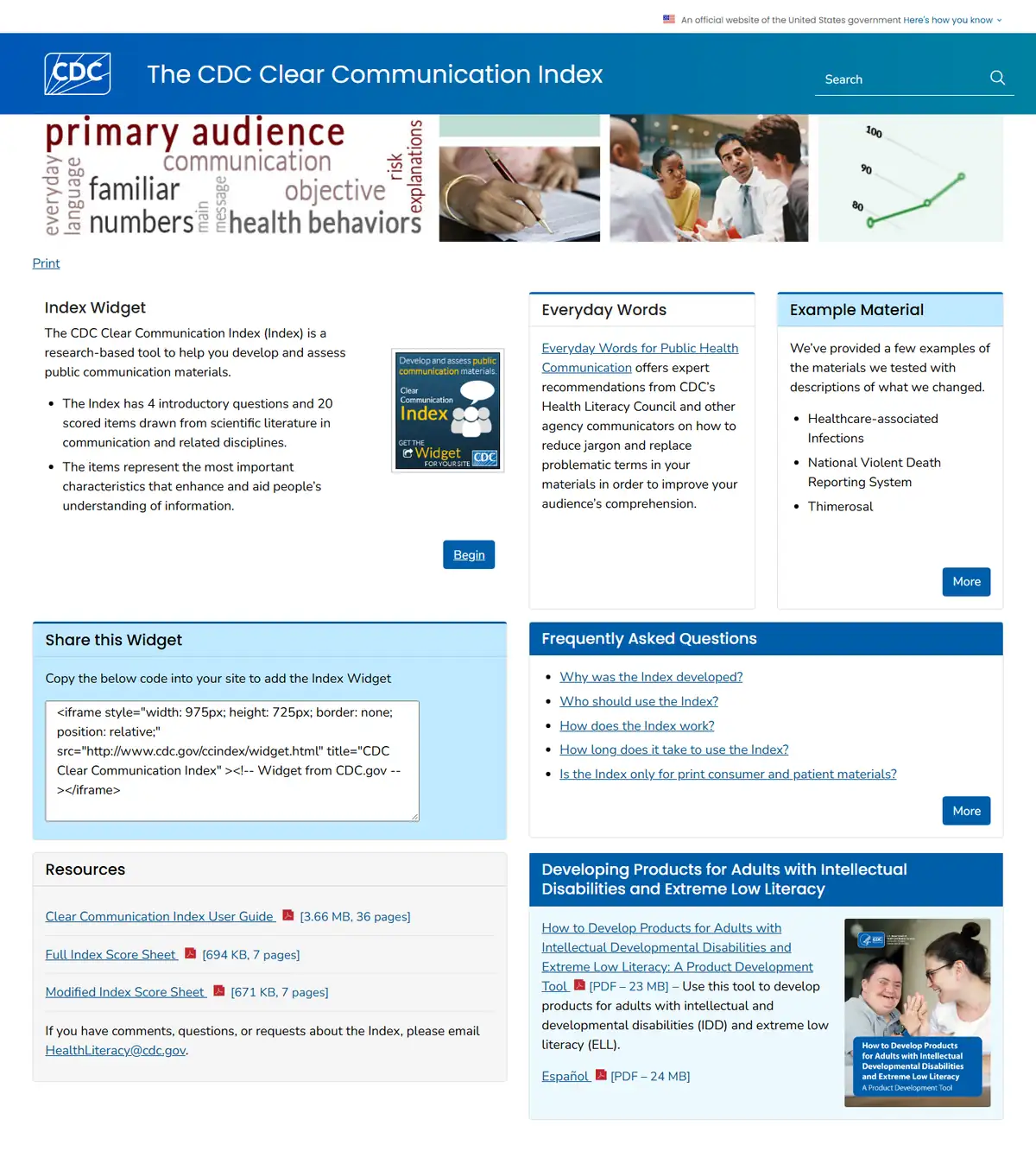
That order also mirrors the CDC Clear Communication Index: its four introductory questions cover the primary audience, health literacy skills, communication objective, and main message before scoring begins. Answer them clearly before sending the draft for clinical approval.
For field 8, pair the distribution target with a deadline. A specific threshold makes it easier to spot delivery problems while there is still time to respond.
Patient Education Video Production: Script-to-Release Workflow
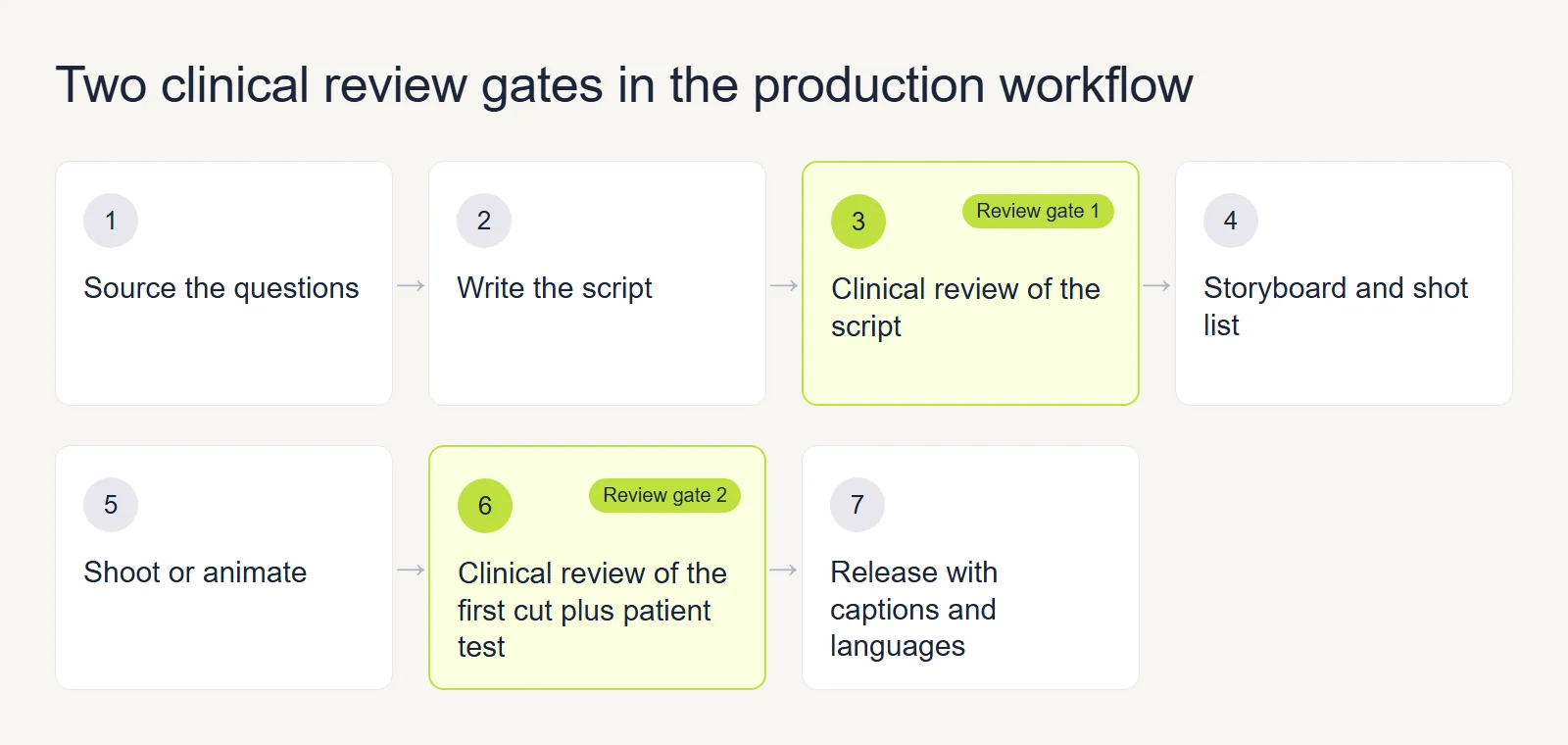
From there, production follows seven steps. Two clinical checkpoints, at script stage and first cut, help catch errors before the video goes live.
- Start with recurring questions. Review call-center logs, portal messages, and feedback on existing videos, then shortlist ten topics by how often care teams have to explain them.
- Write for spoken delivery. Use short sentences, explain actions in sequence, and phrase numbers as patients would hear them. Before clinical sign-off, check the draft against the Clear Communication Index described below.
- Check medical accuracy at script stage. The designated approver confirms facts, doses, and timing in writing.
- Plan the visuals. Map each spoken instruction to a shot or animation frame so patients can follow the step as they hear it.
- Produce the footage or animation. Choose an on-camera clinician who communicates clearly, collect the required permissions before filming, and allow time for feedback.
- Review the first cut, then test comprehension. After the clinical team checks the visuals, ask a few people from the intended audience to explain the next step in their own words.
- Prepare accessible versions for release. Package captions, translations, and a written transcript with the approved video.
A nurse team in Wellington Hospital's intensive care unit planned each video over four to six months, held two subject-matter-expert meetings per video (one on the script, one on the initial cut), and chose caption languages from the national patient demographics: English, te reo Māori, and Samoan.
A clinician-led shoot may move faster, although those two checkpoints still help prevent costly corrections after release.
How to Score a Patient Education Video Script for Health Literacy
Score the script against the CDC Clear Communication Index before filming: it has 20 scored items across seven areas, and a total of 90 or higher is passing. The CDC's user guide puts a full pass at about 15 minutes.
The emphasis on accessible language is grounded in longstanding research. The last federal measure, the 2003 National Assessment of Adult Literacy, found 14% of US adults at Below Basic and 22% at Basic health literacy. Those figures are historical rather than a measure of literacy levels today.
| Index area | What to check in a video script |
|---|---|
| Main message and call to action | The first 10 seconds state the one action and who should take it |
| Language | Everyday words, active voice, every medical term defined on first use |
| Information design | On-screen text matches the spoken step, one idea per scene |
| State of the science | The script says what is known and not known, including limits of the evidence |
| Behavioral recommendations | Each step is something the patient does, in order |
| Numbers | Doses, days, and quantities shown as words and on screen |
| Risk | Warning signs and who to call stated plainly, not buried at the end |
A useful approach is three passes: the writer completes the initial score, an independent reviewer checks clarity, and the clinical lead verifies medical accuracy and the "state of the science" criteria. Resolve any zero-scoring items before storyboarding.
Patient Education Video Formats: Animation, Physician-Led, and Short-Form Tutorials
Once the script is clear, the visual format should follow the information patients need. Demonstrations suit device use, a clinician can answer common questions, and animation helps explain processes that a camera cannot show.
Runtime follows the same logic. With no single evidence-based length for every topic, the examples below are useful references rather than fixed targets.
For more on choosing an appropriate length, see our short-form versus long-form video guide.
| Format | Best for | Watch-outs | Brand example |
|---|---|---|---|
| One-task tutorial | Device setup, medication use | Needs a clean demonstration surface | Abbott FreeStyle Libre 3 sensor tutorial, 2:13 |
| Physician-led explainer | Patient questions, post-visit guidance | Needs a clinician who explains well | Mayo Clinic vasectomy care video, Dr. Sevann Helo |
| Whiteboard or animation | Anatomy, mechanisms, procedures | Review each frame for accuracy | Kaiser Permanente latent TB video, 3 minutes (study video, not public) |
| Long walkthrough with text | Surgery and recovery timelines | Date goes stale as protocols change | Cleveland Clinic knee replacement video page |
One Task per Video: Device and Medication How-To
Device tutorials work best when their chapters match the user's actions. Abbott's FreeStyle Libre 3 sensor tutorial, published December 2025, runs 2:13 and splits into chapters by action:
- Clean the site
- Use the applicator
- Unscrew the cap
- Apply the sensor
- Check that it is secure
By November 2026, the video had attracted more than 250,000 views. More importantly for usability, someone struggling with the cap can return directly to that chapter.
Physician-Led Explainers: One Doctor, One Question
When the main concern is reassurance or clarification, hearing directly from a clinician can be more useful than watching a demonstration.
Mayo Clinic's vasectomy care page features a video in which urologist Sevann Helo, M.D., speaks to the patient's decision directly.
Written guidance can make that explanation easier to revisit. Cleveland Clinic uses this approach on its knee replacement video page, with question headings beside the video. The accompanying text gives patients a quick reference and makes the guidance easier to find through search.
For this format, everyday language and a natural delivery matter more than presenter polish.
Animation for Anatomy and Procedures
Animation becomes useful when patients need to see what happens inside the body, such as a stent opening an artery or the stages of a keyhole procedure. Because each frame needs accuracy checks, it's worth reserving the format for explanations that genuinely benefit from it.
Give the animator an approved script and a list of essential anatomical details, then review the storyboard before rendering begins. Catching problems at that stage is far less costly than revising finished animation.
Accessibility, Language Access, and Consent for Patient Education Videos
Accessibility and permissions belong in the initial brief rather than the final export checklist. Plan for captions, written guidance, the languages your audience needs, and any on-camera authorizations. The requirements can vary by channel and organization.
- Captions: the W3C's WCAG success criterion 1.2.2 requires captions for prerecorded video with audio at Level A, the lowest conformance level and the starting point.
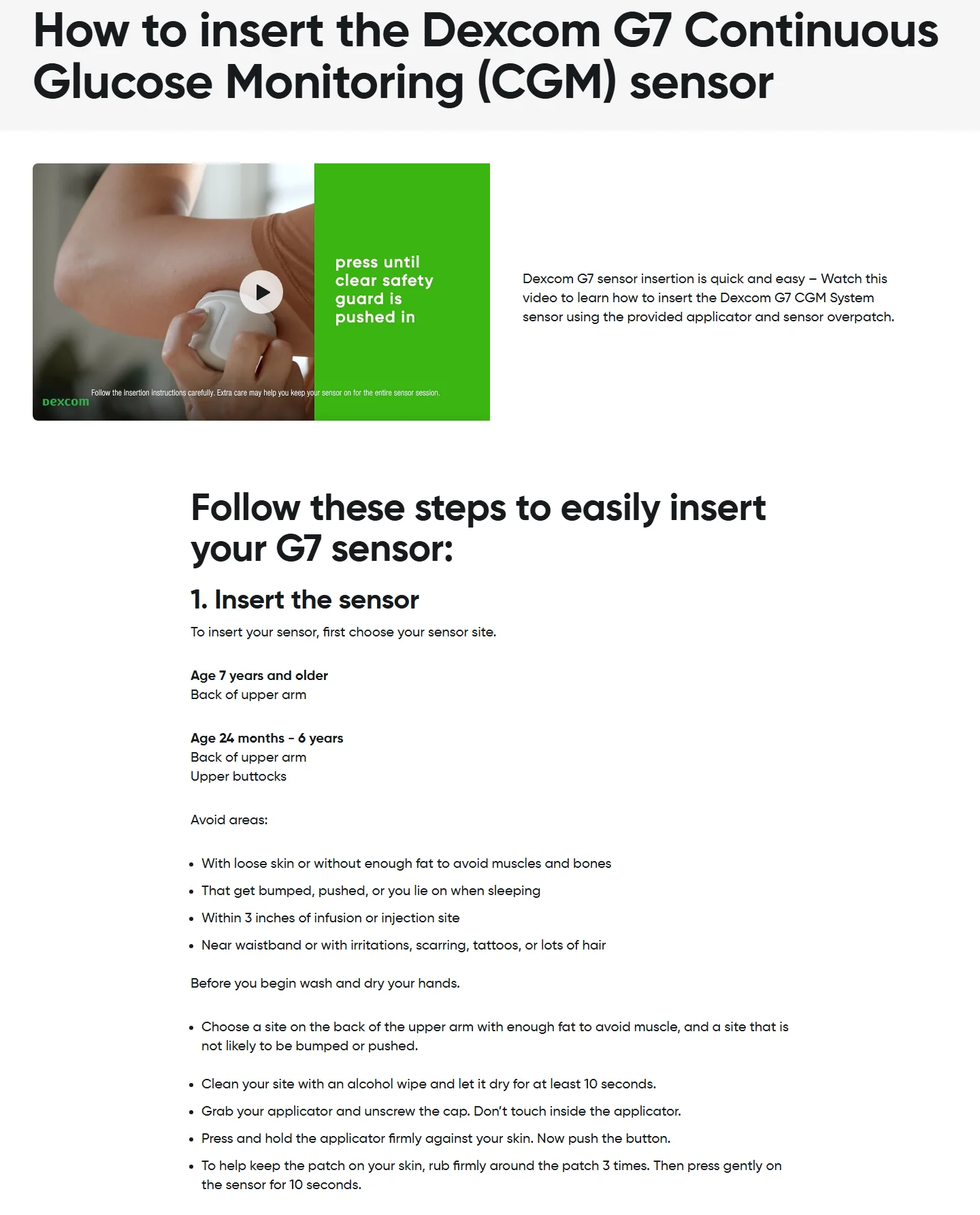
- Text equivalent: a transcript or step list beside the video helps screen-reader users and patients who cannot play audio. Dexcom's G7 training page places the steps in text next to the video, down to "press gently on the sensor for 10 seconds".
- Language access: HHS Section 1557 requires qualified human review of machine translation when accuracy is essential, the content is technical, or it affects meaningful access to care. The October 2025 court decision affected certain gender-identity provisions; the language-assistance requirements remain in force.
- Web accessibility: HHS's Section 504 rule sets WCAG 2.1 AA requirements for covered recipients' web content and apps. Under HHS's May 2026 extension, organizations with 15 or more employees have until May 11, 2027; those with fewer than 15 have until May 10, 2028. Confirm coverage and exceptions with counsel.
- Consent: obtain the appropriate written authorization or release for anyone featured on camera, specify where and for how long the footage can be used, and keep the records with the final file. For authorization detail, our healthcare UGC compliance guide covers HIPAA, FTC, and FDA specifics.
How Much Does Patient Education Video Production Cost?
A simple animated explainer runs about $3,000 to $10,000, and a full patient education series $15,000 to $100,000 or more, per StudioBinder's 2026 estimates.
These figures have limits: StudioBinder provides no underlying dataset, and there is no independent industry benchmark. Treat the ranges as rough planning inputs.
| Route | Typical range | Time | Best when |
|---|---|---|---|
| Simple animated explainer | $3,000 to $10,000 (StudioBinder estimate) | Weeks | One mechanism or procedure needs explaining |
| Full patient education series | $15,000 to $100,000+ (StudioBinder estimate) | Months | You cover a whole service line with review per episode |
| In-house phone-shot clinician video | No public benchmark | Days | Fast answers to repeat questions, low production needs |
| Licensed library subscription | Quote-based, vendors do not publish rates | Immediate | Standard topics with no local variation |
Production price alone says little about value. For a more useful comparison, divide the total program budget by the number of patients likely to watch during the video's useful life.
Consider a hypothetical $8,000 video offered to 4,000 patients over two years. Applying the 17% viewing rate observed in one Kaiser trial would yield 680 viewers, or about $11.76 per viewer. At a hypothetical 34% viewing rate, the figure falls to $5.88. These rates illustrate the calculation; they are not forecasts for another patient population.
Also account for clinical sign-off, captions, translations, hosting, revisions, and subsequent updates. A production quote may exclude several of those expenses.
Patient Education Video Platforms and Sourcing Models
With the budget in view, the next question is how to source the content. Licensed libraries cover standard topics, commissioned videos can reflect local protocols, and an internal team may be better suited to frequent small updates. Ownership and maintenance matter as much as the initial price.
| Route | What you get | Limits | Choose it when |
|---|---|---|---|
| License a library | A catalog of standard-topic videos, usually with hosting and an embed | Generic content, your protocol and branding are absent | The topic is common, such as asthma inhaler use |
| Commission custom video | Your protocol, your clinicians, your branding | Clinical approvals and later revisions require coordination | Local logistics or a specific protocol drive the topic |
| Shoot in-house | A clinician explaining on a phone or simple setup | Accessibility and clinical QA need defined owners | A question repeats weekly and speed matters |
| Free public sources | Government and nonprofit pages with videos | No branding, no control over updates | A patient needs a trusted source the same day |
Library vendors such as ViewMedica, Mytonomy, and Wolters Kluwer UpToDate sell subscriptions to catalogs of standard-topic videos, usually with an embed player for your site and portal. Those catalogs can explain a common procedure, but they rarely cover local details such as where to check in or whom to call after hours.
A practical compromise is to license standard explanations and produce separate clips for local instructions. To shortlist studios for the custom layer, our guide to healthcare video production companies compares providers and covers review timing.
AI presenter tools offer another production option, especially when the script is already approved. However, evidence for AI-presented patient education remains limited. Use the same clinical, accessibility, translation, and release checks as you would for any other format.
Where to Publish Patient Education Videos
Once the material is ready, distribution deserves the same attention as production. Use a familiar channel, time delivery around the care step, and include written guidance alongside the video.
In the Kaiser trial, a text sent within one to two days of the prescription reached patients, and up to two reminders followed after seven days, yet most patients never watched.
The delivery plan can therefore affect whether the work reaches its audience at all.
| Route | Timing | Best for | Watch-out |
|---|---|---|---|
| Patient portal | At booking and again before the procedure | Procedure prep | Many patients never log in |
| QR code on the after-visit summary | At discharge | Recovery and medication steps | The code needs a short, working URL |
| SMS or email link | 1 to 2 days after a prescription, plus a reminder | Reaching patients with a prompt; adherence effect unproven | Nonspecific messages drive message fatigue |
| Waiting-room screen | During the visit | General health topics | Patients are distracted and no captions means no sound |
| Website and YouTube | Always on | Search and shareable answers | Add written steps for access and reference |
| Unbranded social | Campaign windows | Awareness of a condition | Education must stay separate from promotion |
- For the social route, our guide to social media marketing for health brands covers content types and compliance points for educational posts.
- For the website route, our healthcare landing page audit covers how to structure the page the video sits on.
The message itself should explain what the video covers and why it matters now. That gives patients more useful context than a generic "you have a new message" notification.
How to Measure Patient Education Video Results
Measurement should follow the patient's experience: first, did the material reach them; next, did they understand it; and finally, did anything change? Reporting views alone misses the distinction between those outcomes.
| Layer | Metric | How to collect | Caution |
|---|---|---|---|
| Delivery | Send-to-play rate, completion rate | Player analytics, link click data | Keep patient identifiers out of third-party tags |
| Comprehension | Teach-back accuracy, short quiz score | Nurse teach-back at the visit, post-video question set | Ask patients to explain the step, since a yes to "do you understand?" tests nothing |
| Outcome | Prep adequacy, no-shows, call volume on the topic | Clinical and scheduling systems | Compare against a matched group or earlier period |
The AHRQ defines teach-back as asking patients to state in their own words what they need to know or do about their health, and warns that "do you understand?" is not a teach-back question.
The colonoscopy trial provides a useful contrast: bowel-preparation adequacy gave researchers an observable clinical measure rather than another engagement figure.
Choose outcomes that fit both the patient's task and the available evidence, such as anxiety, satisfaction, knowledge, or procedure-specific measures.
If the goal is adherence or completion, first establish whether enough patients actually see the intervention to evaluate it. Keep patient-level information in the appropriate clinical systems.
Patient Education Video Maintenance: Review Dates and Version Control
Publication starts a maintenance cycle. Reassess a video whenever guidelines, protocols, or products change, and schedule a routine check even if they do not. A visible "last clinically reviewed" date helps patients and staff judge how current the guidance is.
Keep the approved script, sign-off history, authorization records, and usage periods together in a version log. When instructions change, update the affected material and document what was revised.
Produce Patient Education Videos With inBeat Agency
inBeat produces short-form healthcare video with clinicians and patients on camera, collecting releases before filming and scheduling clinical review before release. Rather than choosing a format first, we work from the patient's question to the script, visuals, approvals, and distribution.
On a strategy call, we can sort your most common patient questions into videos worth commissioning, topics better covered by existing resources, and instructions your own team can update quickly.
FAQs
Can a video replace the nurse conversation?
No. Videos can handle consistent explanations, leaving the nurse conversation for individual concerns and teach-back. Sharing material before a procedure may also give patients time to prepare questions.
What if surgeons at one hospital use different protocols?
Keep general explanations, such as anatomy and what to expect, in a shared core. Then create separate instructions for steps that differ by surgeon or protocol, so patients receive guidance that applies to their care.
Should captions be a separate file or burned into the video?
Publish a caption file (SRT or WebVTT) on every platform that accepts one, because it can be turned off, translated, and read by assistive technology. Add open captions on versions made for muted autoplay on social.
How many patients should test a video before release?
Five to eight patients from the intended audience can provide a useful first round of feedback. Continue testing if important misunderstandings remain. No published standard sets the number for video teach-back testing, so record what you did.
Is sponsor-funded education still education?
Sometimes. Funding by a manufacturer does not, by itself, determine whether a video counts as product promotion. FDA's disease-awareness guidance allows certain unbranded educational communications, while product claims may trigger promotional requirements. Disclose material sponsorship and endorsement relationships when required by FTC rules, and route the video through the appropriate medical, legal, and regulatory review.