

Before a consumer health brand spends a dollar promoting creator content, there's a bigger question to answer: why should anyone believe it?
About 40% of US adults get health and wellness information from influencers or podcasts, yet only 10% of that group trust all or most of it. Among people who regularly take health advice from influencers, 61% believe those influencers are mostly motivated by financial interests.
That skepticism changes how you approach a product launch. Compelling content can attract attention, but credible claims, clear creator guidelines, and timely approvals determine what happens next.
Here's how to plan your first 90 days.
TL;DR
- Calendar: Day 0 is the full public rollout. The plan runs from T-30 (claims lock) to T+60 (scale decision).
- Claims pack: Every objective claim, including implied ones, gets a register row, an evidence file and an approved phrasing before any creator is briefed.
- Review: Three checks (claims, legal, brand) with a named owner and a turnaround target for each, plus an owner for comments after posting.
- Creator matrix: Each creator tier gets deliverables, allowed claims, approval path, usage rights and disclosure format by phase.
- Gates and criteria: Four go or no-go gates release budget in tranches. Scale, hold or cut decisions follow rules set before Day 0.
What Counts as a Consumer Health Product Launch?
A consumer health product launch is the first commercial push for a product that people buy for themselves: supplements, topicals, wellness devices, functional foods and consumer digital health apps. This plan covers the commercial side only: creator content, approvals and paid amplification.
It leaves out regulatory submissions, pharmaceutical launch planning and marketing to clinicians. Those follow different rules and timelines, and our healthcare marketing guide covers the wider category.
The audience is already on social. 55% of US adults use social media for health information at least occasionally, and 72% saw weight loss, diet or nutrition content in the past 30 days in the same KFF poll.
Health Product Launch Plan: The 90-Day Calendar From Claims Lock to Scale Decision
The 90-day plan starts with a signed claims register at T-30 and ends with a scale decision at T+60.
Complete claim substantiation before the clock starts; use the first two weeks for creator briefings, product seeding and early draft review. Limited paid testing can begin after Gate 2 at T-7, while Day 0 is the full public rollout.
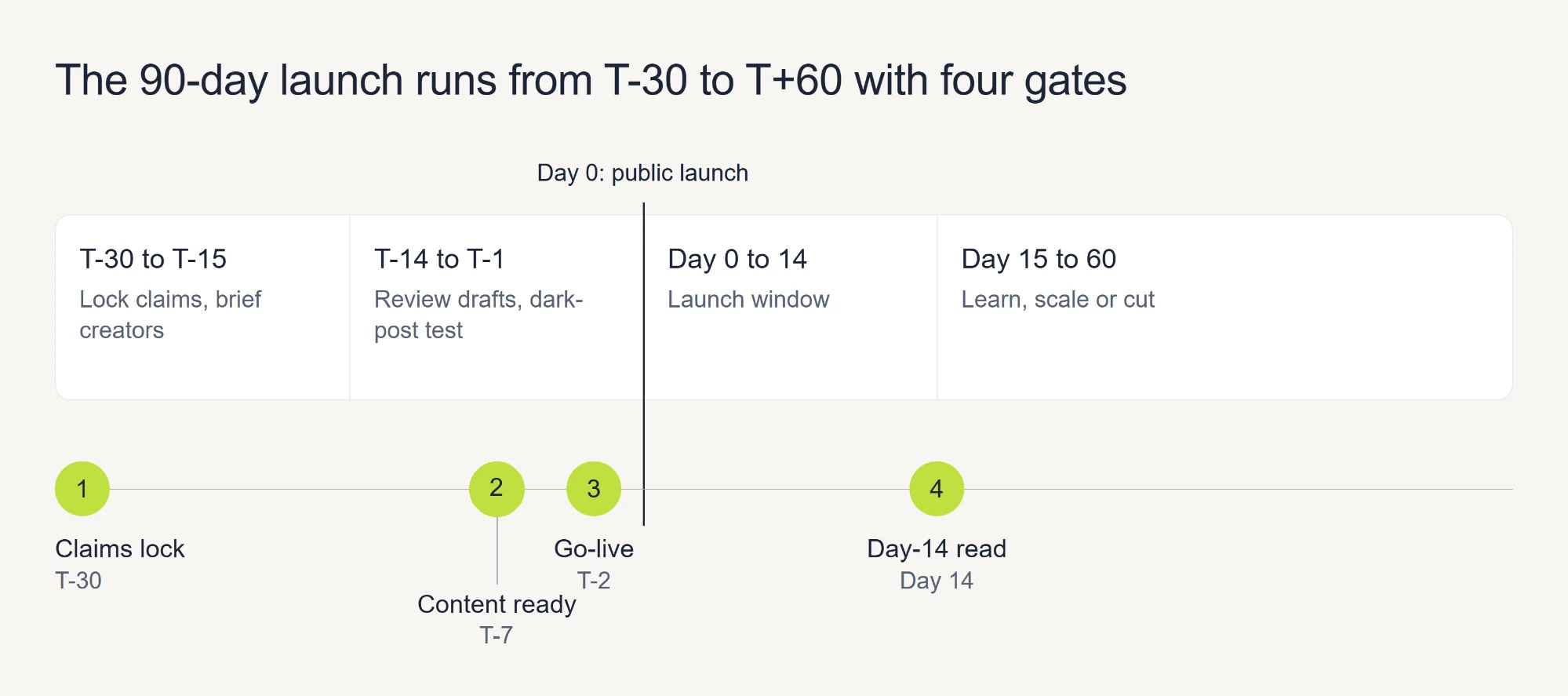
Every window, count, split and ratio in this plan is an inBeat starting point: calibrate it to your legal team's capacity, budget and margin.
T-30 to T-15: Brief Creators and Seed Product
Enter T-30 with the claims register signed. Shortlist creators by audience fit, send contracts and briefs, and ship product early enough for creators to use it before filming. Set delivery and posting expectations in each seeding agreement.
Pro tip: seed more creators than you need. Some will not post, and in health you cannot push a creator to say something the register does not allow. Plan for a posting rate well under 100% when you decide how many boxes to ship and how many approved drafts you need by Gate 2.
T-14 to T-1: Review Drafts and Run the Dark-Post Test
Collect every draft before publication. Run each through the three-check review, allowing time for two routine revision rounds and any additional changes needed for compliance.
After Gate 2 at T-7, run a limited dark-post test through T-2 using approved creative, compliant targeting and an approved landing page. Test two hooks per approved claim with a controlled budget.
These ads reach a limited audience without appearing on the brand's organic feed. Use the results to select hooks for the full public rollout on Day 0; Gate 3 at T-2 remains the final launch-readiness check.
Day 0 to Day 14: Launch Window
Stagger approved posts across the first two weeks to sustain testing and leave room for audience feedback. Moderate comments daily and log any question that asks for a claim the register does not cover (owner and escalation rules are in the review section). Amplify only posts that cleared review, and only to audiences that meet platform age rules.
Day 15 to Day 60: Learn, Scale or Cut
Read results weekly against targets fixed before Day 0. Release the scale tranche only to cells that pass. Criteria for each call are in the learn and scale section below.
Healthcare Launch Campaign Claims and Evidence Pack: What to Lock Before Creators Post
A claims and evidence pack is the set of documents that lets a reviewer approve a creator's draft in hours: a register of claims, an evidence file behind each one, and a one-page sheet creators can follow. Build it before the first brief goes out.
The FTC treats health claims strictly. Advertisers need substantiation before an ad runs, for express claims and for claims the ad implies. The rules and enforcement history are covered in our UGC compliance guide, so this section focuses on building the pack.
Build the Claims Library
List every objective claim the launch will make, including the ones a visual implies. The FTC says a marketer is equally responsible for implied claims, and gives examples such as before-and-after images of someone using a walker and then dancing.
Every claim gets one of three statuses: approved, conditional (needs more evidence or a qualifier) or blocked. FDA rules add a distinction for supplements: structure and function claims describe the role of a substance in maintaining the body, and disease claims are off limits.
For dietary supplements, record whether covered structure/function, general well-being or certain nutrient-deficiency claims appear on the product label or labeling.
These labeling claims require substantiation, the prescribed disclaimer and FDA notification no later than 30 days after first marketing the supplement with the claim. The notification requirement is not a blanket rule for every creator ad.
Assemble the Evidence File for Each Claim
For every approved claim, store:
- The full study text
- The product, dose and form it tested
- Who owns the file
The FTC guidance describes human randomized controlled trials as the most reliable form of evidence for health benefits and expects all outcomes to be reported, including the unfavorable ones.
The FTC's own example is a useful test. In its Example 41, a user reports losing 16 lb in 8 weeks, but the trial showed an average of 4 lb more than placebo.
The FTC says "results not typical" does not fix that, and the ad needs to state the generally expected result. Check every testimonial the launch might feature against this rule.
Write the Creator-Facing Claims Sheet
Give each creator one page with approved lines, banned lines, the typical-result statement if one applies, disclosure wording and platform limits. Keep it short enough to read before filming.
Include the limits that platforms enforce:
- TikTok requires weight loss and muscle gain claims to reach audiences 18 and older, and bars claims that a product alone causes weight change.
- Meta requires dietary, health and weight products to target people 18 and older, and bars cure claims for conditions such as diabetes and cancer.
- Landing pages are reviewed under the same policies, so the page and the post need to say the same thing.
For disclosure details, our FTC influencer guidelines cover what to say and where.
Review Responsibilities: Who Approves Each Launch Asset and How Fast
Every launch asset needs a named owner at each review step and a turnaround target.

Clear ownership prevents drafts from waiting in inboxes while launch dates approach.
Set the turnaround targets before Day 0, based on your legal team's capacity.
Run a Three-Check Review Chain
Every creator draft passes three checks in order. The claims owner checks each statement and visual against the register. Legal approves the claims and the cut. The brand lead checks tone and product accuracy last and cannot change claims. Any edit that touches a statement or a visual goes back to the claims owner.
Set a 48-hour target for routine drafts using approved language. New claims take the longer evidence-review path before sign-off. Plan for two routine revision rounds; if more changes are needed, document the cause and update the brief or review process rather than forcing approval to meet a cap.
If you want a partner to run this chain for you, our healthcare marketing agency manages briefs, drafts and sign-offs against your register.
Assign an Owner for Comments and Corrections After Posting
Review does not end at posting. Name one moderator for the launch window, define what counts as a new claim in a comment thread, and agree when a post comes down or gets corrected. Keep a log of every escalation.
The FTC's Example 40 shows why. A marketer pays a blogger who claims a supplement cures acid reflux with no evidence. The marketer is liable, and the post also needs a paid-relationship disclosure.
FTC enforcement has reached advertisers and other parties involved in marketing. An unapproved claim from a creator can expose the brand and its agency to liability, so escalations need a clear owner.
Creator Deliverable Matrix: What Each Creator Tier Delivers by Launch Phase
A creator deliverable matrix states, for each creator type and phase, what the creator delivers and which rules apply. It turns a vague brief into a contract line that legal can approve once.
Phase is the posting window. Drafts for every tier are due in T-14 to T-1, and dark posts use only creators with paid rights.

Set Deliverables by Phase and Creator Tier
Seeded nano creators post first in the launch window and set the tone. Micro and UGC creators produce the volume that paid media tests. Mid-tier creators add reach in the launch window. Experts add credibility to the claims that need it. Plan the second creator wave around Day 30, when the first creative begins to tire.
Brief for Native Content Inside the Claims Sheet
Give creators a clear structure while leaving room for their own voice within approved claims. Cover the opening hook, the use case, what the creator can genuinely demonstrate, one substantiated claim and the disclosure. Avoid rigid scripts that sound unnatural or introduce unreviewed promises.
Ask creators to send a rough cut or a short outline before filming, so a reviewer can catch an implied claim, such as a visual of instant relief, while it is still cheap to change. Keep the outline to five lines at most, since the goal is a fast review and a fast reply.
Specify Usage Rights, Whitelisting and Disclosure Up Front
Put the paid-usage window, permission to amplify authorized creator posts through your ad account (using Spark Ads on TikTok where applicable), and disclosure requirements in the contract.
Disclosure rules are specific. The FTC says free product given with an expectation of promotion is a material connection that must be disclosed, and that on TikTok, text in the description is very unlikely to be clear and conspicuous. Put the disclosure on screen in the video itself.
An upfront disclosure helps viewers assess the creator's relationship with the brand. For credentialed creators, check scope of practice: a pharmacist or nurse can explain what the evidence says, but cannot step outside their license to promise results. See our guide to healthcare professional influencers for how to vet them.
Launch Gates: Four Go or No-Go Checks That Release the Budget
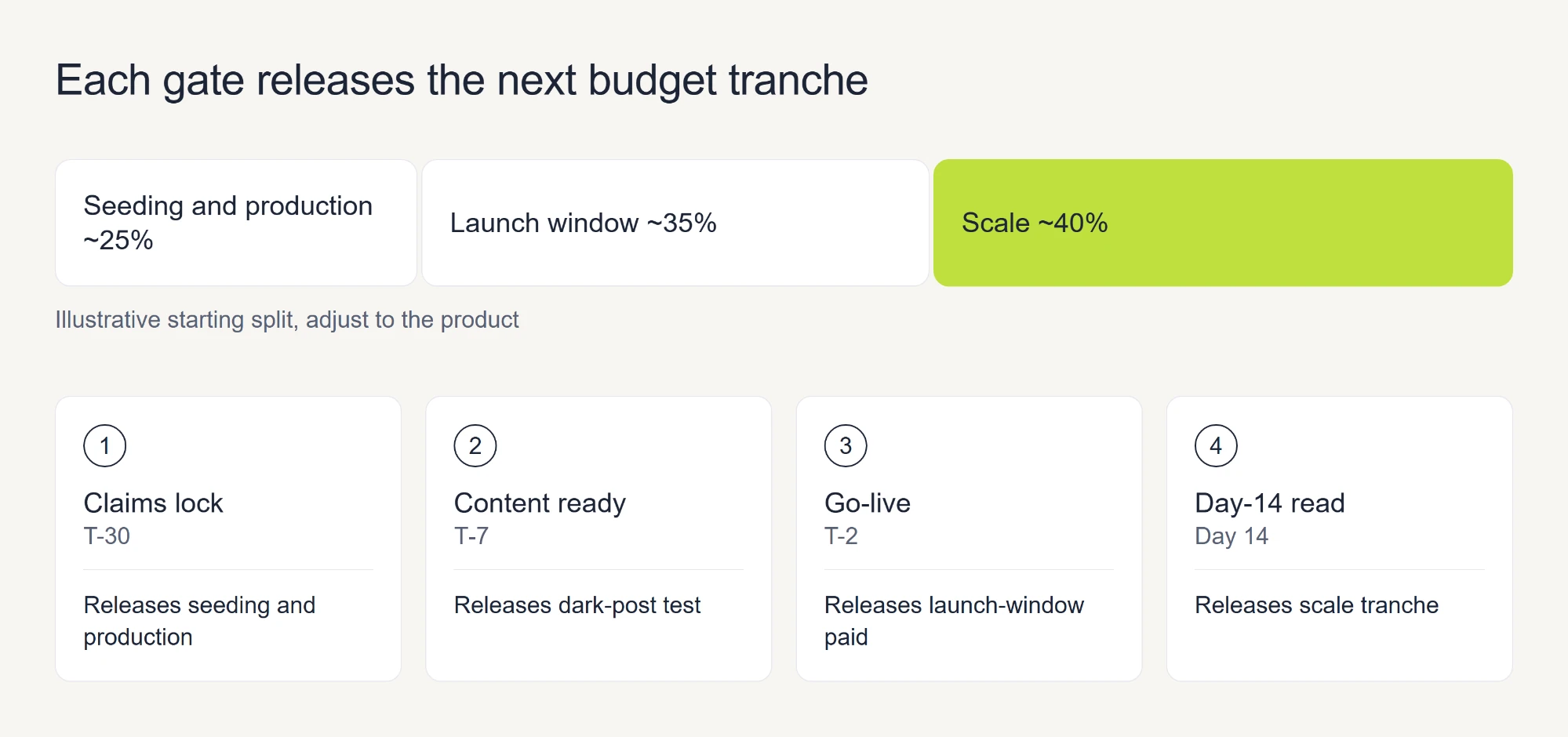
A launch gate is a pass or fail check at a fixed date that decides whether the next tranche of budget is released. Four gates cover a consumer health launch.
Hold the launch budget in three tranches and tie each one to a gate:
- About a quarter for seeding, production and the dark-post test
- About a third for the launch window
- The rest for scaling
Health adds its own failure conditions. Fail Gate 3 if the landing page makes a claim the register has not approved, because TikTok's weight management policy covers landing pages as well as ads.
Pause spend at any gate if ads are disapproved for health reasons or if comment threads show people reporting adverse experiences.
For category-specific advice, see our guide to supplement influencer marketing.
Learn and Scale Criteria: When to Scale, Hold or Cut Creator Content
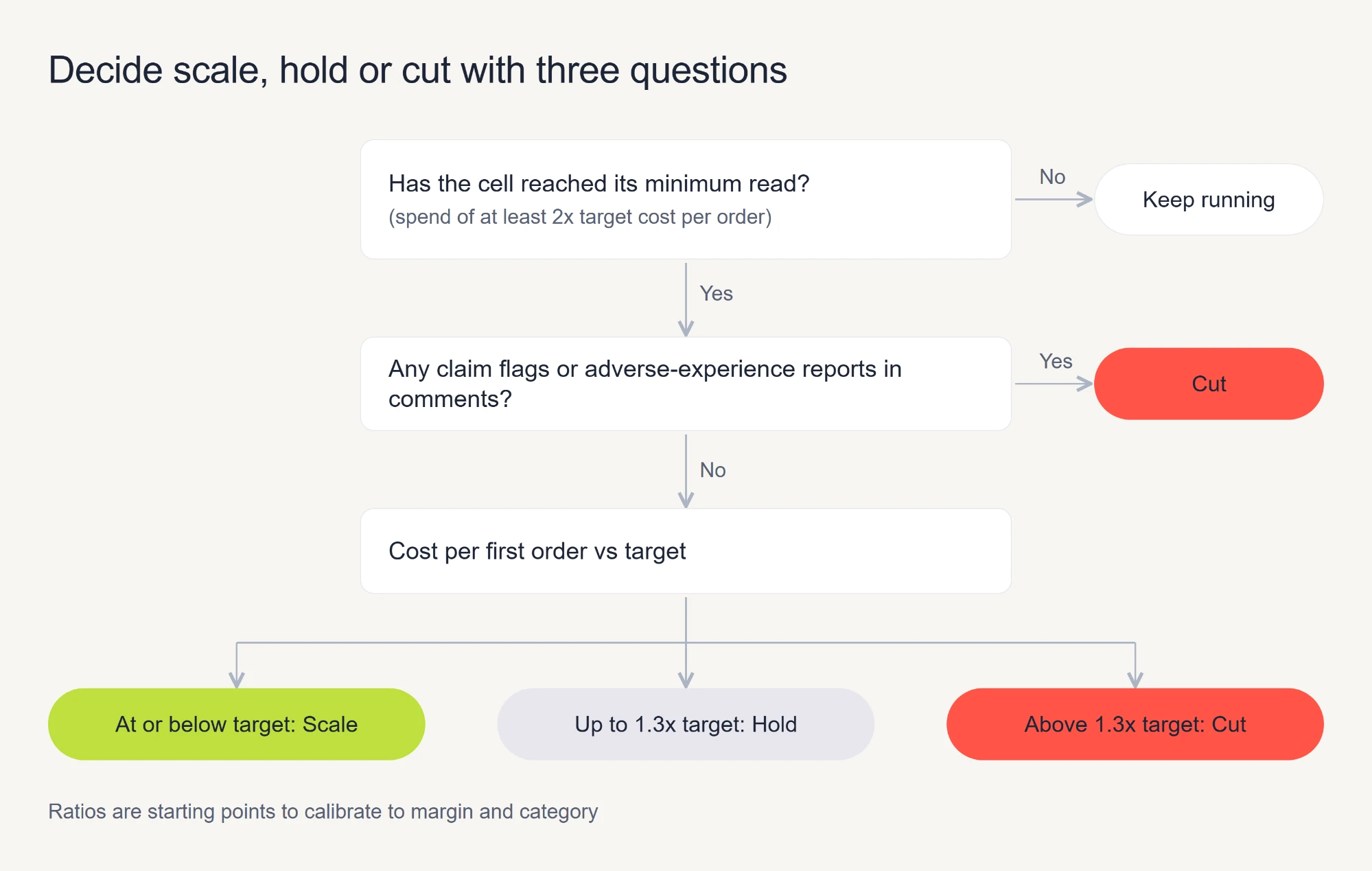
Scale a creator cell when it meets its target at the minimum spend, hold it when it is close, and cut it when it misses or draws claim flags. Set the thresholds before Day 0.
Set a minimum spend, conversion-count threshold and read window for each cell before launch. Spend alone is insufficient for a reliable scale decision. Repeat and return signals arrive only after the first reorder or return window, so use them for the Day 45 and Day 60 calls, outside Gate 4.
Set the Baseline Before Day 0
Set the target cost per first order using contribution margin and a defensible estimate of repeat purchasing. Record the minimum spend, conversion-count threshold and test window for each creative cell before launch. Without those baselines, Gate 4 becomes a subjective call.
Scale What Passes the Test, Cut What Draws Flags
Scale winners in steps, adding spend only when results hold. Refresh the brief weekly with the angles that worked. Pause any creative that raises substantiation or safety concerns until the issue is reviewed, even if it converts.
Measure Beyond Last-Click
Creator content can influence people who later search for the brand or buy through another channel. Last-click attribution alone may miss that contribution.
Use three reads to see the effect last-click misses:
- Promo codes
- Brand-search lift
- A matched holdout region excluded from paid and whitelisted launch exposure. Organic creator posts can still reach both regions, so document that limitation when interpreting incremental results.
Compare total orders or revenue in matched test and holdout regions against prelaunch baselines, accounting for differences between markets.
Use Day 14 for a directional check and Day 45 for a fuller read; report estimated incremental orders and cost per incremental order alongside last-click CPA. If the holdout is too small or contaminated by organic exposure, describe the uncertainty instead of claiming precise causal lift.
Build Your Creator Launch With inBeat Agency
With claims approved before production and test criteria fixed before Day 0, the launch team can make budget decisions without rushing the review process.
Book a strategy call and we will review your claims register, map your creator deliverables and set your gate dates and scale criteria.
To see how we build the content and test plan, visit our health and wellness UGC agency page.
FAQs
Does whitelisting an approved organic post need a second review?
Yes. Paid amplification can change targeting, placements and the context in which viewers see a claim. Recheck creator authorization and usage rights, confirm disclosures are clear, apply relevant age and category restrictions, and make sure the ad and landing page use approved claims.
Can ingredient-level studies support claims for a finished health product?
Ingredient research can contribute to substantiation, but it does not automatically show that the finished product delivers the same benefit. Differences in dose, formulation and intended use matter. Have a qualified reviewer assess the full body of relevant evidence and determine whether product-level testing is needed. If the evidence falls short, narrow or remove the claim.
What if a creator hasn't used the product long enough to describe results?
Creators can demonstrate features or share verified product information without claiming personal results. A firsthand testimonial should reflect what the creator genuinely experienced, including how long they used the product. Give creators adequate time to try it and avoid scripting outcomes for them. If the experience is too limited to support the planned testimonial, change the deliverable or delay it.
What happens if the product sells out during launch week?
Pause purchase-focused ads for unavailable products and update the landing page promptly. If a restock date is confirmed, consider directing interested shoppers to a clearly labeled waitlist or back-in-stock signup. Tell creators about any availability changes so their posts remain accurate. When inventory returns, check the remaining budget and current campaign data before restarting acquisition spend.