

Before I approve a creative concept, I want to know what happens when you strip away the visuals, the music, and the person delivering the message. Is the promise still worth paying attention to?
One finding from Wynter's message testing research stood out to me. Across 32 B2B homepage tests, 28 received higher scores for clarity than for buyer interest.
A clear headline can still leave buyers indifferent.
In this guide, I'll show you how to use message testing to find out what buyers understand, believe, and care about before you commit to production.
P.S. If you'd like support along the way, my team at inBeat offers a 90-day ad testing roadmap.
TL;DR: Message Testing Before Production in Five Rules
- Test every claim as plain text before any design, casting, or music touches it.
- Score comprehension, believability, and relevance separately. High marks in one area can conceal a weakness in another.
- Set the sample size for the difference you need to detect. With 200 respondents per message, a lead of about 10 percentage points reaches the approximate 95% significance threshold in a simple two-group comparison.
- Run a controlled paid social test with sufficient spend and a planned duration of at least 7 days.
- Give creators the validated claim and proof point as the fixed part of the brief.
The order of those steps matters. Even a beautifully produced ad can attract the wrong audience if the promise itself is ambiguous.
Casting and the situation depicted on screen influence who pays attention. Before making those creative decisions, I want to hear what people take away from the words themselves. A quick interview or survey can reveal their interpretation.
What Is Message Testing and How Does It Differ From Concept Testing and Ad Testing?
Message testing measures whether buyers understand a marketing claim, believe it, and find it relevant.
Message testing without research budgets. Source: Product Marketing Alliance on YouTube
At the pre-production stage, I usually present the wording as plain text to study it in isolation. Concept and ad testing build on this initial work, but each addresses a different question.
| Test type | What the buyer sees | What it isolates | Best moment | Typical output |
|---|---|---|---|---|
| Message test | One claim as plain text | Wording, proof, and relevance of the claim | Before the brief | Scores for comprehension, belief, and relevance |
| Concept test | An idea with a rough script or visual | Whether the whole idea lands | After a message is chosen | Appeal and intent per concept |
| Ad test | A finished or near-finished ad | Hook, format, and execution | Before or during spend | Recall, persuasion, and in-market metrics |
The distinction is important when you're reviewing research. A polished ad may owe much of its appeal to the casting, music, or design, making it harder to tell how much credit the copy deserves.
When to Test Messages: Before the Brief, Before the Shoot, and Before the Spend
I review messaging at three points in the campaign development process, as outlined below. Early on, revising a sentence takes minutes. After production, that same change may require a reshoot.
| Moment | What you test | What is still cheap to change | Method |
|---|---|---|---|
| Before the brief | Raw claims and buyer language | Everything | Qualitative message testing with 5 to 15 buyers |
| Before the shoot | Three to ten finalist messages | Wording, proof points, and the order of claims | A survey with one message per respondent |
| Before full spend | One or two winning claims | Low-cost test creative | A paid split test |
The World Health Organization offers a simple exercise for the first stage: five people, five questions, five minutes. Its 5-5-5 guide shows how a brief conversation can help avoid ineffective communications.
Later in the process, creative quality deserves its own assessment. Across 264 brands, System1 found that media investment explained 27% of the variation in brand growth. That rose to 48% when the ad's Star Rating was included.
I take this as an argument for evaluating completed ads. Those findings, however, tell us little about the contribution of the wording in isolation.
Start developing claims with the language buyers already use. Social listening can help you collect their descriptions of the problem and turn those phrases into testable statements.
What Message Testing Should Measure: Comprehension, Believability, and Relevance
For each message, I score comprehension, believability, and relevance separately. Someone might understand the promise perfectly and still doubt it. A single likability rating obscures that distinction.
| Dimension | Question to ask | Scale | Red flag |
|---|---|---|---|
| Comprehension | "In your own words, what is this message saying?" | Open text, coded against the intended meaning | The paraphrase describes a different product |
| Believability | "How believable is this claim?" | 5-point | High appeal and low belief |
| Relevance | "How relevant is this to a situation you're in?" | 5-point plus one open question | High scores only from people outside the buyer group |
| Differentiation | "How different is this from what you've seen in this category?" | 5-point | The same score as a competitor's claim |
| Purchase motivation | "How likely would you be to act on this?" | 5-point | High motivation with low belief |
The first three dimensions help diagnose weaknesses. If a claim meets those criteria, purchase motivation and believability guide my choice, with differentiation helping resolve close calls.
Comprehension: Do Buyers Understand the Message?
To measure comprehension, ask buyers to explain the claim in their own words and compare their answers with the intended meaning. The WHO interview script takes a similar approach and asks which terms the audience finds confusing.
One detail in Wynter's PandaDoc example caught my attention. Some members of a 50-person panel interpreted "on-brand docs" as referring to doctors.
To the people working on the product, the intended meaning probably seemed obvious. An internal copy review could easily have missed that.
I'd therefore prioritize the paraphrase over the rating. A buyer who awards 5 out of 5 but describes a different product has revealed a problem with the wording.
In specialized categories, moderated focus groups with niche creators can also be useful, provided the participants match your buyer profile.
Believability: Do Buyers Trust the Claim?
Believability makes more sense when viewed alongside purchase motivation. If people like the promise but have doubts, I'd compare the original wording with a version that includes credible supporting evidence. That follow-up is especially useful in claims testing.
Wynter's review of Metadata.io points to another weakness. The phrase "Drive more revenue" was flagged as vague, and the panel struggled to understand how the platform automated paid campaigns.
Before fielding a study, I document the proof behind each promise so the team has something specific to test.
Relevance: Do Buyers Care?
Relevance measures how closely a claim matches a buyer's current situation. A score is useful here, especially when followed by an open question: "What would make this matter to you?"
Even a believable message can miss the mark with the wrong audience. In Wynter's Loom test, project management directors saw a sales-focused hero example and struggled to distinguish Loom from other video tools. I'd review responses by buyer group before averaging the scores.
Message Testing Examples: What a Global Tech Vendor and a Developer Platform Learned
How do research teams apply these principles?
In one study, GLG combined 15 qualitative phone interviews with a survey of 300 IT decision makers across four segmentation dimensions. The buyers favored a global technology company's unified-platform positioning over a suite of separate solutions.
Phronesis Partners took a monadic approach for a low-code platform.
Its study included 300 application developers and project managers, split evenly between India and the US. Each participant saw one message, and the winner was selected using a weighted composite score.
Both studies underscore the importance of recruiting relevant buyers. The second shows how a monadic design isolates individual messages. Neither, however, reports a numerical lift attributable to the winning claim.
Message Testing Framework: Build a Persona-by-Claim Matrix First
I organize the next stage around a persona-by-claim matrix. In this message testing framework, each row connects a buyer and situation to a single hypothesis.
Building a persona-by-angle matrix before briefing the creative team also helps media buyers trace campaign performance back to the original idea.
| Persona | Situation | Claim | Proof point | Risk to check |
|---|---|---|---|---|
| Parent planning weeknight meals | Dinner at 6 pm with no plan | "Dinner on the table in 15 minutes" | Prep time on the recipe card | Buyers read "15 minutes" as rushed |
| Gym regular | Tracking protein on a budget | "Twenty grams of protein for under two dollars" | Label and price per serving | Buyers doubt the price claim |
| Office manager | Reordering supplies every month | "One order, one invoice" | A sample invoice | Buyers can't tell the difference from the current vendor |
Adapt the matrix to your category. Write a testable creative hypothesis for each row, define what would rule it out, and check that your team can substantiate the promise before recruiting participants.
I used to send buyers rough cuts for feedback.
Whenever one version won, I struggled to explain why. Had the audience preferred the claim, the voice, or the pacing? That taught me to test the sentence on its own and explore delivery in a separate round.
At inBeat, our creative strategy work builds on this distinction: the research informs the concept, while the execution remains open to experimentation.
Message Testing Methods Compared: Interviews, Five-Second Tests, Surveys, MaxDiff, and Paid Tests
With your hypotheses in place, use interviews to uncover misunderstandings. MaxDiff helps establish priorities when the shortlist is still long.
A monadic survey then compares the leading options before one or two go through a controlled paid test.
| Method | Best for | Respondents | Turnaround | Cost signal | Main limit |
|---|---|---|---|---|---|
| 5-5-5 interviews | A first read on comprehension | 5 | Same day | Staff time | Too small to rank messages |
| Moderated focus group | Why buyers react | 6 to 10 | Days | $7,000 to $20,000+ | Group influence |
| Five-second test | First impression and recall | Set by the study | Fast on self-serve tools | Set by panel and screener | Says little about belief |
| Monadic survey | Ranking claims cleanly | 200 to 300 per message | 12 to 48 hours on verified panels | $5,000 to $15,000+ per 400 responses | One message per respondent |
| Sequential monadic | Testing more messages with fewer people | 300 to 400 in total | 12 to 48 hours on verified panels | Lower than monadic | Order effects |
| MaxDiff | Ranking 10 to 30 messages | Set by the study | Days | Panel cost | Ranks messages and explains none |
| Paid test | Confirming behavior | Set by budget | 7 days or more | Ad spend | Measures clicks, not comprehension |
The costs in the table are planning estimates.
Drive Research's 2026 guide puts a 400-response online survey at $5,000 to $15,000+, while the sample sizes reflect vendor guidance (Quali-Fi, mTab).
In practice, the cost of message-testing panels and tools also depends on audience scarcity, screening requirements, and study design.
Which Message Testing Tools and Platforms Should You Use?
I pick the platform according to the research question. Three options come to mind:
For B2B research, Wynter reports access to 86,000+ verified professionals, with results typically available in 12 to 48 hours.
SurveyMonkey's LaunchPad can compare up to 10 messages in one study. If you need to understand first impressions or recall, Lyssna offers five-second tests.
Message Testing Survey Design: Questions, Scales, and Question Order
Whichever platform you choose, build your message testing survey around the six prompts below. A monadic design randomly assigns each participant to one claim. In a sequential study, vary the order and limit the number of exposures.
In either design, lead with comprehension so subsequent prompts can't influence the paraphrase.
- Comprehension: "In your own words, what is this message saying?"
- Believability: "How believable is this claim?" (1 to 5)
- Relevance: "How relevant is this to a situation you're in?" (1 to 5). Follow up: "What would make this matter to you?"
- Differentiation: "How different is this from what you've seen from other brands in this category?" (1 to 5)
- Motivation: "How likely would you be to act on this claim?" (1 to 5)
- Doubt: "What, if anything, is hard to believe about this?"
Use clear scale anchors and offer "not applicable" or "unsure" where appropriate.
Save "none of these" for tasks involving several choices. Keep questions about buyer situations neutral, and recruit people who purchase in the category beyond your existing customer base.
For sequential studies specifically, mTab recommends a maximum of three or four messages per person to reduce fatigue and order effects.
I read the open-ended answers before checking the rankings. Ratings may indicate which claim is ahead, but the comments give your copywriter a clearer idea of what to change.
How Many Respondents a Message Test Needs, and Who They Should Be
Sample size depends on what you're trying to learn. For monadic surveys, Quali-Fi suggests 200 to 300 respondents per message.
Wynter cites qualitative saturation at around 12 to 13 responses in many studies, a reasonable initial target for interviews with a relatively homogeneous audience.
If new themes are still emerging, keep interviewing.
| Respondents per message | Approx. 95% margin per message | Approx. 95% threshold for a pairwise gap |
|---|---|---|
| 100 | ±9.8 points | About 14 points |
| 200 | ±6.9 points | About 10 points |
| 300 | ±5.7 points | About 8 points |
The estimates assume equally sized, independent groups and proportions near 50%, giving a conservative benchmark.
The last column of the table gives the approximate two-sided 95% significance threshold for the difference between two proportions. It exceeds the margin for either message alone.
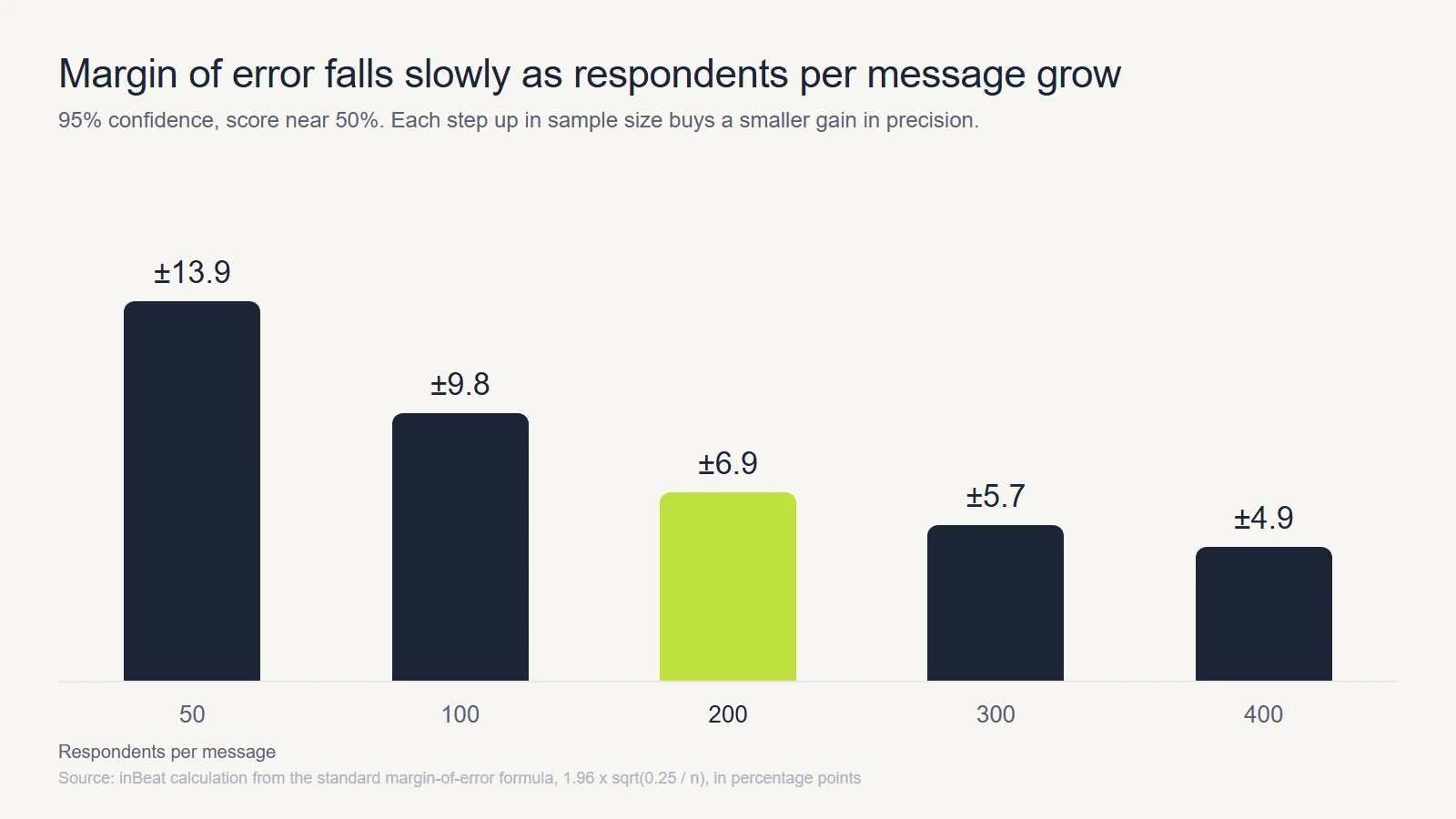
Report top-2-box shares (the percentage answering 4 or 5), since these calculations apply to proportions. Statistical power is a separate consideration: detecting a true 10-point gap, such as 50% versus 40%, with 80% power requires about 390 respondents per message under standard assumptions.
Multiple comparisons require adjustments to the testing plan. With opt-in panels, sampling bias may exceed the theoretical margins, so treat these numbers as planning benchmarks, rather than guarantees of population accuracy.
On a tight budget, I'd drop a low-priority claim before shrinking every sample. Screen participants for category-buying experience and offer incentives appropriate to the audience.
How to Read Message Testing Results and Pick a Winner
When the data comes in, I eliminate claims that fail the comprehension or relevance checks. Believability and purchase motivation then guide my choice among the remaining options.
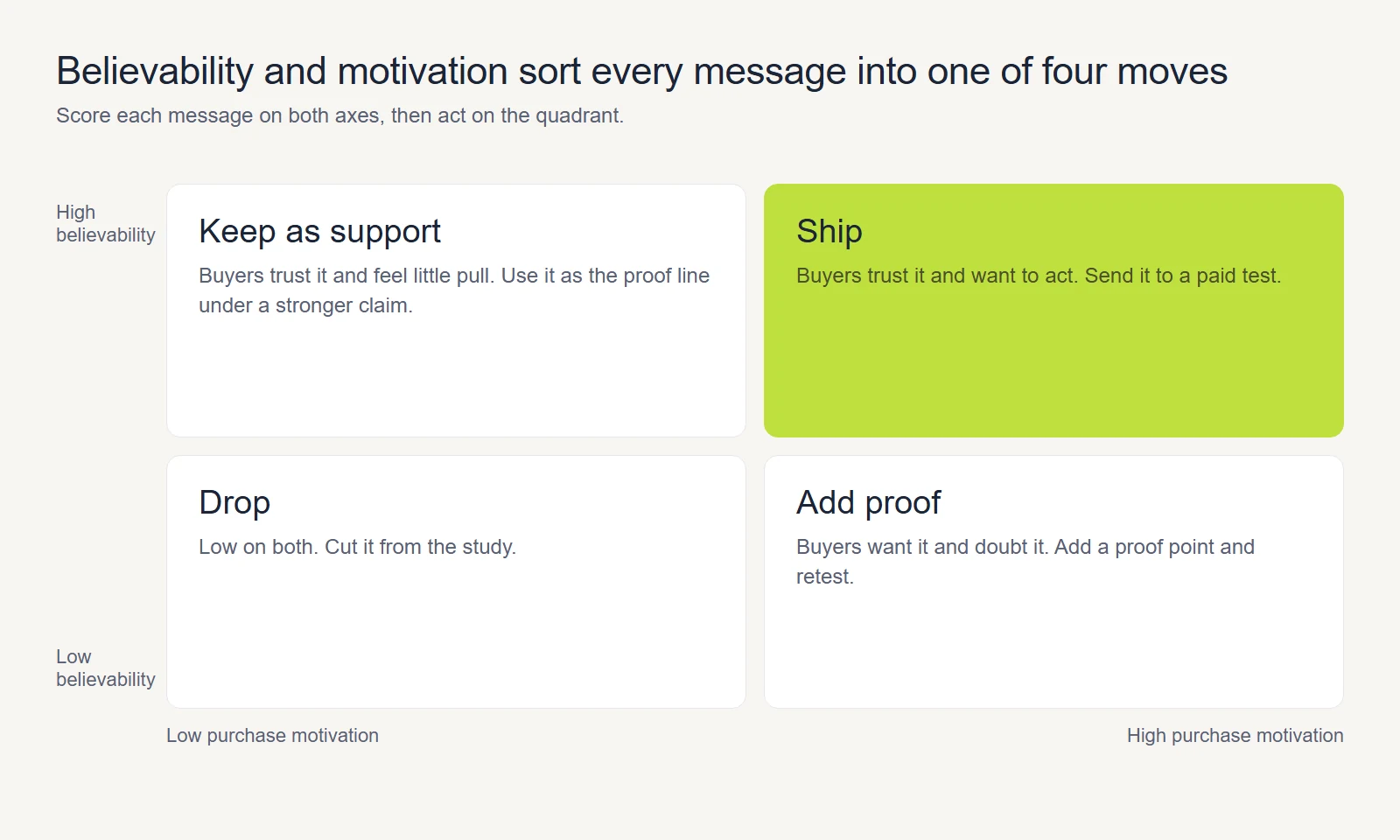
Use the matrix to decide what deserves further work. Leads below the pairwise significance threshold remain inconclusive.
| Pattern in the data | What it means | Next action |
|---|---|---|
| High understanding, low belief | Buyers get it and doubt it | Add a proof point and retest |
| High belief, low relevance | The claim is true for someone else | Check who scored it and rewrite for the buyer group |
| Segments disagree | One message may not fit all buyers | Split the message by segment |
| Interviews and survey disagree | Different measures or a possible misreading | Inspect responses and investigate |
| Lead below the pairwise threshold | Inconclusive difference | Send both to a paid test |
For two closely ranked finalists, an A/B experiment can reveal which performs better in live advertising.
An incrementality study, by contrast, measures whether advertising generates additional outcomes. Understanding the difference between A/B testing and incrementality helps you select the right design.
A client once told me about a particularly frustrating result: the top-ranked message in their survey had turned out to be the weakest in live ads.
On our next call, I asked to see the questionnaire alongside the campaign results. We separated what buyers said from how they behaved, which put the discrepancy in perspective. Since then, I've preferred to review both sources before approving a larger production budget.
How to Validate Message Testing Winners in Paid Social With Dark Posts
To see how survey finalists perform in the feed, run a controlled, low-budget split test with one claim per ad. Allow at least 7 days and enough delivery to evaluate your primary metric.
For creator-led campaigns, a dark-post test lets you compare versions without publishing each one on the main feed. My approach looks like this:
- Build low-cost static or talking-head ads in the same format, one per finalist claim.
- Use randomized, non-overlapping test groups and comparable budgets.
- Keep the hook structure, creator, format, offer, and landing page consistent; vary the claim and its required proof.
- Set decision thresholds before launch. For example, three to five times target CPA with zero acquisitions can serve as a spending limit, but is insufficient on its own to establish an inferior message.
- Review performance after the planned duration and sample size; flag early stops as inconclusive.
Meta and TikTok both recommend running split tests for 7 to 30 days. The latter also recommends estimated testing power of at least 80%.
The calendar alone says little about reliability. Check delivery and uncertainty before selecting a winner.
| Survey signal | Possible performance signal | What to investigate |
|---|---|---|
| High comprehension | Thumb-stop and hook rate | Attention to the opening |
| High believability | Click-through rate | Interest in learning more |
| High relevance | Conversion rate | Conversion behavior after the click |
| High motivation | CPA | Acquisition cost versus target |
Be careful about what you infer from these metrics. A high click-through rate might simply reflect curiosity about an implausible promise. Read behavioral data alongside the original survey responses.
Our Hurom campaign shows how those principles apply across a full creative program. The team moved from discount-led messaging to health-related concerns and experimented with hooks, calls to action, creator personas, product angles, and video lengths.
Hurom — Case Study 01. Source: inBeat on Vimeo
The case study reports a 300% increase in return on ad spend, 65% lower CPA, and 33% month-over-month profit margin growth.
The page omits the baseline, full campaign timeframe, and impact of any individual claim. I see these figures as outcomes of the broader program; using them to forecast the effect of a message test would be a stretch.
How to Turn a Winning Message Into a Creator Brief
When a claim is ready for production, give creators the central promise and its supporting evidence.
A good creator brief, in my view, preserves the hypothesis while allowing enough freedom for a natural performance on camera.
| Brief element | Locked | Left to the creator |
|---|---|---|
| The claim | Core meaning; exact wording if required | How it's said on camera |
| The proof point | The evidence | Where it appears in the video |
| Openers | Three concepts to test | Style of each opener |
| Offer and call to action | Terms and link | Placement |
| Format and length | Set by the placement | Pacing |
I also prefer a modular approach, which gives the team several testable edits from a single shoot. Include:
- About 3 openers
- 1 to 2 core bodies
- 2 proof clips
- 2 calls to action
For a more detailed shot list, see our guide to building a modular UGC brief.
B2B Message Testing: What Changes When the Buyer Is a Committee
In B2B message testing, sample the key buying roles separately.
A claim that appeals to the finance lead may leave procurement or the end user indifferent. Compare their responses first, pooling the data only when the research objective and weighting justify it.
Take the "One order, one invoice" claim from the earlier matrix.
An office manager might picture fewer emails; a finance lead could wonder whether the invoice can be reconciled automatically. I'd tailor the follow-up questions to those expectations before settling on the positioning.
| Dimension | DTC | B2B |
|---|---|---|
| Panel source | General consumer panels | Verified professional panels such as Wynter's |
| Who decides | Often an individual or household | A committee |
| Sampling | Group or segment as needed | Sample each role separately first |
| Sample size | Larger panels may be accessible | A small audience raises the weight of qualitative work |
Can AI Personas and Synthetic Respondents Replace a Message Testing Panel?
AI personas and synthetic respondents can help draft and explore hypotheses, but I'd reserve production decisions for research with actual buyers. A February 2026 arXiv study tested two open-weight models against US World Values Survey data across more than 70,000 respondent-item instances.
Persona prompting offered no clear aggregate improvement in accuracy and sometimes worsened alignment. The paper is a preprint focused on a specific dataset, so its findings offer a caution about synthetic panels without settling the question.
Kantar's earlier GPT-4 experiment also reported overly positive responses compared with about 5,000 human participants, along with weak subgroup results. Even Qualtrics positions synthetic data as better suited to idea screening than launch decisions.
Where I do see value is early in a project. AI could narrow 30 candidate messages to 10 by identifying overlapping ideas, vague wording, and unexplored angles. I'd put the remaining options in front of real buyers.
Message Testing Best Practices: A Pre-Launch Checklist
Here's my checklist before approving production:
- Every message was tested as plain text.
- Each version isolates one main claim.
- The hypothesis and rejection criteria were set before fielding.
- Believability was scored next to purchase motivation.
- Sample size reflects the difference the study needs to detect.
- Uncertain pairwise differences are flagged as inconclusive.
- A controlled paid test is planned for the finalists.
- The brief locks the claim and leaves delivery open.
Test Messages Before Production With inBeat Agency
I want a clear reason to back a creative idea. A polished deck full of promising concepts only gets you so far.
Giving your team the evidence to make that case is especially valuable when you're choosing where to allocate a limited budget.
At inBeat Agency, my team can design a research and creative testing plan around your audience and priorities. Book a strategy call to get started.
FAQs
Does message testing still hold when a creator delivers the message on camera?
Yes, provided the original claim remains intact. Evaluate delivery separately and let creators express the validated meaning and evidence in their own words.
How do you test messages when the reachable audience is under a few thousand people?
With a small audience, I'd prioritize interviews with each relevant buying role and continue until new themes become scarce. Reserve a survey for a handful of finalists and report the uncertainty. A paid test is an option if you can achieve enough reach and conversion volume.
Is a seven-point margin of error acceptable for a go or no-go on a production budget?
It can be useful for ruling out weak claims. With 200 independent respondents per message, ±6.9 points is the approximate single-message margin near 50%. A two-group comparison needs roughly a 10-point lead for 95% significance under those assumptions, so a three-point difference remains inconclusive.
Use a predetermined kill threshold to limit unnecessary spend and adequately powered results to choose a winner.
How often should core messaging be retested?
I'd revisit core messaging annually, or sooner if buyer attitudes, competitors, or positioning change. GLG likewise recommends testing as attitudes evolve. A major launch is another good opportunity to check whether existing claims still resonate.
Can the same process test pricing and offer claims?
Yes. Message testing can show whether buyers understand an offer's terms and believe its value. To estimate willingness to pay or compare price sensitivity, use a pricing-specific research design.