

The questions to ask an influencer marketing agency that actually predict whether it will lower your CAC are about three things:
- How it turns creator content into paid media (allowlisting, dark posting, usage rights).
- How it sources and rejects creators.
- Which metric it will accept accountability for after the first month.
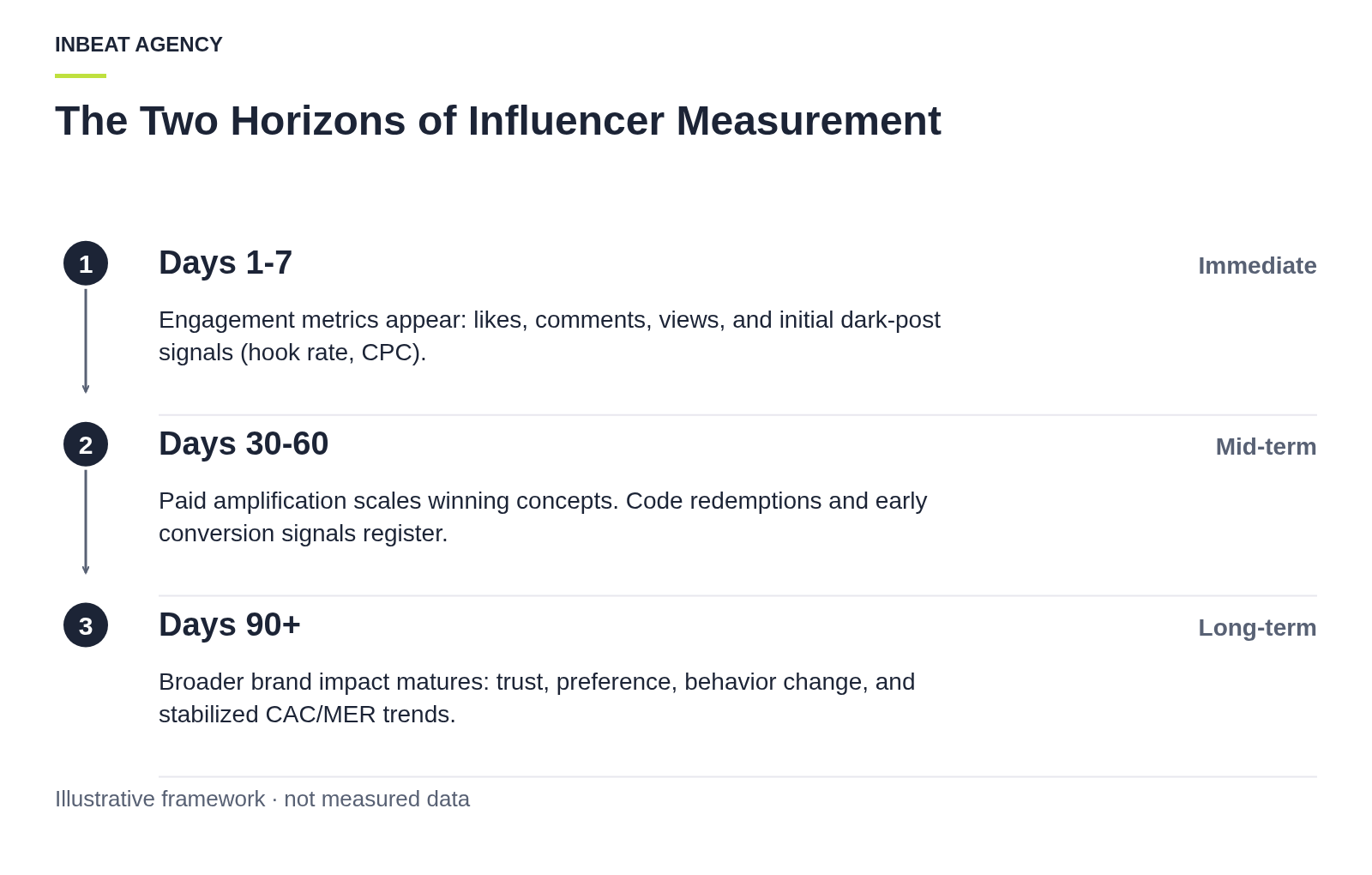
Follower counts and service menus tell you almost nothing, because every agency answers those well. The gap matters because of timing. Engagement shows up within days, while the trust and behavior change you're paying for arrive much later and need ongoing optimization.
This article gives you the questions, the strong and weak answers, and a scoring sheet to use before a pitch deck arrives.
P.S. If you'd rather see how a creator-plus-paid-social system answers these questions in practice, inBeat's influencer marketing work is a reasonable place to start.
In our experience, many agency interviews test the wrong skill. They confirm that the agency knows creators, when the decision hinges on what happens to the content after it's posted. In our view, creators are a creative engine, and paid media is how that creative reaches anyone past the first audience.
The ad account is also a testing ground: it's where you find out which message and which messenger acquires a customer at a price you can live with. An agency that keeps sourcing, creative, and media buying in separate rooms can't run that loop, no matter how good its roster looks. So we'd ask about dark posts, allowlisting rights, and the 90-day metric before we asked about reach.
Why the standard influencer marketing agency checklist misses the questions that decide your CAC
Agency checklists can cover creator selection, paid amplification and measurement. For an acquisition program, ask how those capabilities connect in practice and who owns each step.
Standard agency checklists miss the questions that decide your CAC because they were written to evaluate a middleman, and a middleman's job ends when the post goes live.
Most published question lists were written for a brokerage model
Read the lists that rank for this query, such as the ones from OVO Talent, Aspire and Tapfiliate, and a pattern appears. The questions cluster around audience demographics, follower tiers, content style, and which services are on the menu.
Those are fair questions. They're also questions any competent agency has rehearsed, so they don't separate candidates. The underlying assumption is that the agency's product is a connection to creators.
If your goal is acquisition, the product you're buying is a supply of testable creative plus the machinery to amplify and measure it, and none of the standard questions touch that machinery.
They don't help you focus on business impact metrics
Weak interviews can cost you more money in the long run. Likes, comments and views appear within days of a post. Trust, preference and purchase behavior take longer and depend on continued optimization.
An agency can therefore report a successful first month using metrics that say nothing about whether a single asset was allowlisted, scaled or tied to a purchase event. Picture a hypothetical pitch deck: 12 million impressions and a 6% engagement rate, with no line about paid amplification or conversion tracking. It looks like proof and functions as a distraction.
What this list does differently
The interview below weights three areas:
- Strategic fit
- Sourcing mechanics
- Paid media plus measurement
Commercials and a scoring method follow. Try this with your current influencer marketing RFP. Sort every question into two piles: 'any agency can answer this' and 'only an operator who runs paid media and measurement can answer this'. The second pile is usually close to empty. The interview below fills it.
Questions that test strategic alignment and category expertise
Strategic alignment questions work when they force the agency to talk about your business outcomes instead of campaign outputs, and the fastest tell is whether the answer contains an efficiency metric.
Ask how they would define influencer marketing success at the business level
Open the first call with it: how would you define success for our business beyond this single campaign?
- A strong answer names CAC, MER, payback, or a retention horizon and explains how creator activity will move it.
- A weak answer stops at impressions and engagement.
Take this example: one agency says it would want blended CAC to hold while creator spend doubles; another says it would target 10 million impressions. Only the first has thought about your P&L.
Score the answer on that single criterion.
If the agency needs prompting to mention an acquisition or efficiency metric, note it and move on; the framework in inBeat's piece on the 3 R's of influencer marketing is a useful reminder that reach comes last of the three.
Ask what influencer campaigns they have run in your vertical and on your priority platform
Ask for two or three campaigns in your category, then ask which platform carried the spend. TikTok-native operators and Instagram-native operators build differently: hook structure, creator persona, pacing, and the way paid placements are set up all diverge.
App growth and DTC ecommerce diverge too, because one optimizes to installs and in-app events while the other optimizes to purchase and repeat. Other guides make a similar argument for asking about specific, relevant work.
Be wary of an agency promising fast brand impact in your category; engagement arrives quickly while brand effects take longer, so a quick-brand-lift promise is a timeline over-claim.
Ask what they would refuse to do with your budget
This question exposes whether the agency pushes back on vanity briefs. A strong answer names something concrete: refusing to book a celebrity-tier creator when the goal is testable creative, or declining an organic-only plan when the brand has no distribution. A weak answer is a version of 'whatever you need'.
You're hiring judgment, and judgment sometimes says no.
| Question | Strong answer sounds like | Weak answer sounds like | Why it matters |
|---|---|---|---|
| How would you define success for our business? | Blended CAC, MER or payback, with a horizon | Impressions, reach, engagement rate | Reveals whether the agency thinks in acquisition terms |
| What have you run in our vertical and platform? | Two named campaigns, platform-specific build notes | Generic category familiarity | Platform mechanics and funnel type change the work |
| What would you refuse to do with our budget? | A specific refusal tied to your goal | Anything you want | Tests whether judgment or order-taking is on offer |
On this facet, the specialist agency, generalist digital agency and in-house team compare like this:
| Option | Strategic fit strength | Where it falls short |
|---|---|---|
| Specialist influencer agency | Deep platform and creator pattern knowledge | May optimize to campaign metrics unless pushed |
| Generalist digital agency | Sees the whole funnel and budget | Often treats creators as one line item without sourcing depth |
| In-house team | Knows the business metrics best | Sourcing volume and creator relationships take years to build |
This comparison is our own assessment; we take the specialist side for programs where creator volume is the constraint, and the generalist side where the creator budget is a small share of a larger media plan.
Questions that expose how creators are actually sourced and vetted
Sourcing questions reveal whether an agency matches creators to your persona or sells you whoever it already has under contract, and the single most useful number is how many it screened to place one.
Ask how many creators they screen to place one
Ask for the screened-to-placed ratio and the rejection reasons from the agency's last three campaigns, and ask before the second meeting so there's time to check. Volume is a proxy for persona matching.
An agency that screens hundreds to place a handful can build a matrix of persona and angle, then find a creator for each cell. A roster-only agency reverses the logic: the creators come first and the brief bends to fit them.
And that does not benefit your brand.
Consider a hypothetical: two agencies propose the same 20 creators. One shows you the 400 it screened and why 380 were cut. The other sends a roster PDF. The first agency's list is a decision; the second's is inventory.
Academic work on how agencies operate, such as this study of influencer marketing agencies, treats selection as core agency labor, which is exactly why you should see it documented. inBeat publishes its own stated approach to ranking creators and agencies on its methodology page; ask any candidate for the equivalent.
Ask how they detect inflated engagement and audience mismatch
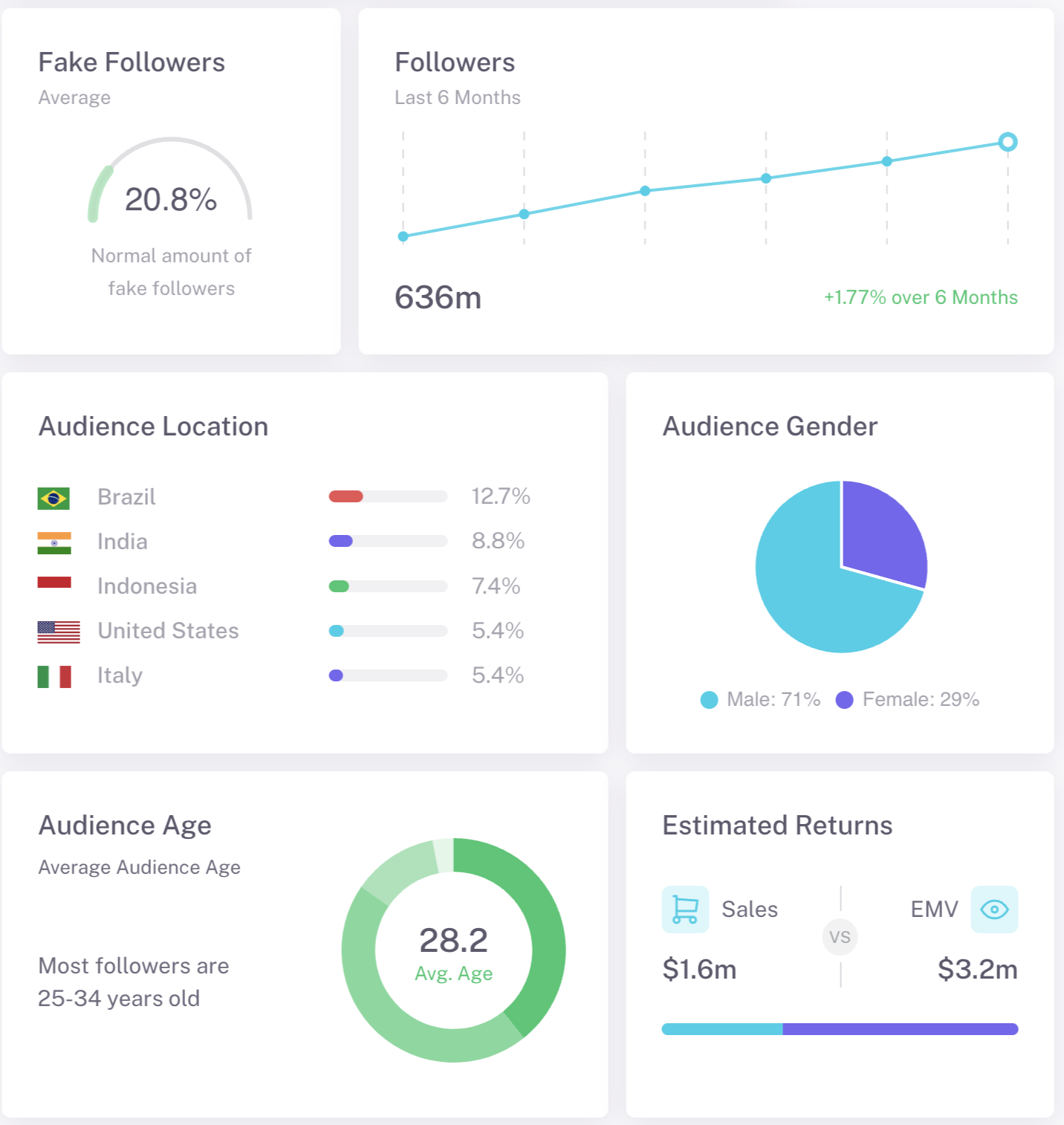
Ask which checks run before a creator reaches your shortlist, and expect specifics on four fronts:
- Engagement authenticity: how comment quality, engagement velocity and follower growth curves are read for purchased or botted activity.
- Audience geography and age: how the agency verifies that a creator's audience sits in your market and above any age floor your category requires.
Past brand history: whether the creator has promoted a competitor recently, and how conflicts are handled. - Disclosure record: whether past sponsored posts were labeled correctly. A strong answer describes tools and a human review step. A weak answer is 'we know our creators'.
Ask whether creators are selected for content, for audience data, or both
This question separates agencies that think about paid amplification from those that don't. When a creator's handle is allowlisted, the brand can use that creator's audience data to reach its target consumer and build lookalike audiences.
That means a creator has two kinds of value: the content itself and the audience seed. An agency that sources only for organic fit leaves the second value unused.
Ask directly: when you shortlist, do you weigh what the creator's audience is worth as a paid targeting input? The mechanics of rights and account setup belong in the next section; here you only need to know whether the agency considers it at all.
The micro versus macro default tells you the agency's model. A micro-heavy mix suggests volume sourcing, persona matching and many testable variants. A macro-heavy mix suggests reach buying and fewer, more expensive bets.
Neither is wrong; ask which one they default to and why, then check that it fits your goal metric.
Red flags in this section are easy to spot once you know them:
- Refusal to show the shortlist rationale or the rejected pool.
- Roster exclusivity pitched as a feature when it works as a constraint.
- No answer, or a vague one, when you ask for the rejection rate.
- Vetting described as intuition without a repeatable process.
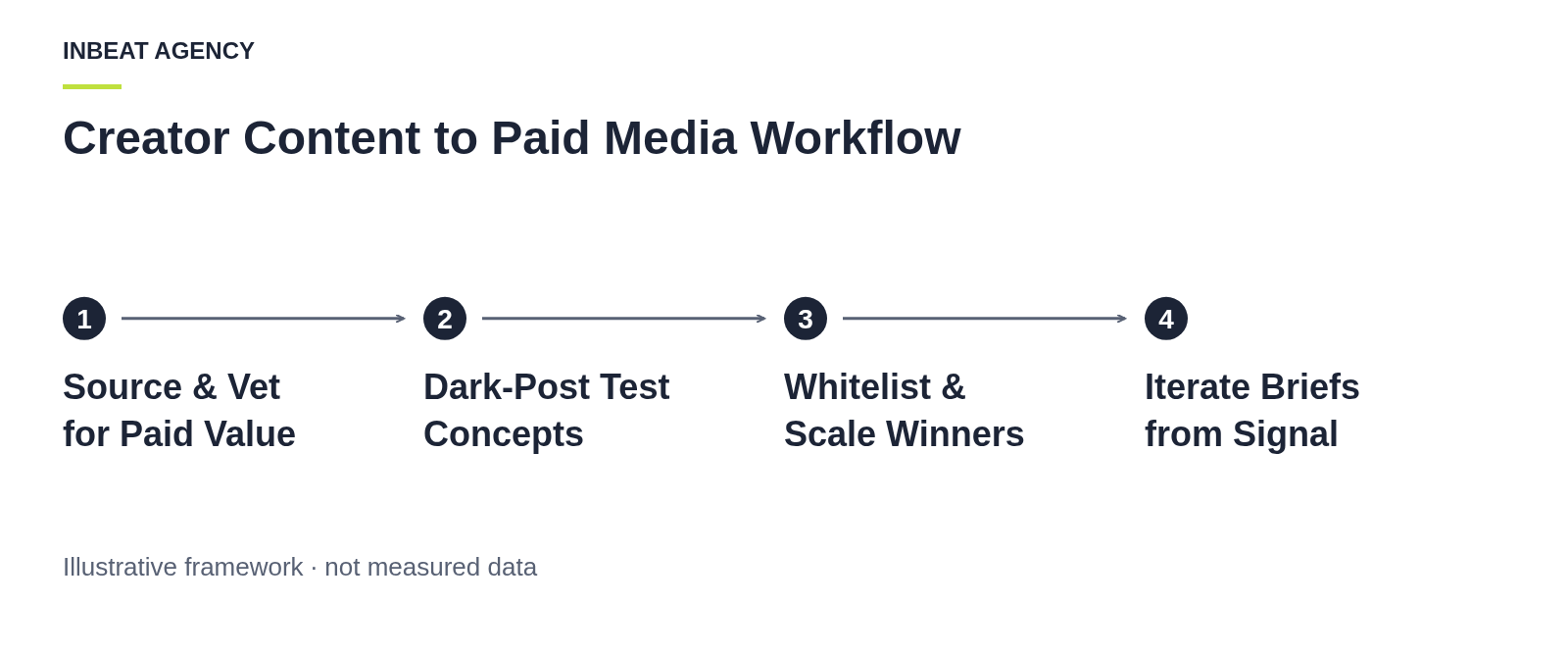
Questions about paid media integration: allowlisting, dark posting and usage rights
Paid media integration questions are the ones most pitches never face, and they decide whether the content you pay for can ever be scaled beyond a creator's own followers.
This is where creator content and performance marketing stop being separate line items; the paid layer is what turns a good post into a scalable ad.
Ask who owns the ad accounts and the allowlisting permissions
Ask it bluntly: whose Business Manager will the campaigns run in, and who holds the allowlisting permissions on each creator handle?
- Allowlisting lets a brand run ads from a creator's handle and use that creator's audience data to reach its own target consumer and build lookalikes, as we explained above.
- Branded content tooling on Instagram works along similar lines, with the creator granting the brand permission to promote tagged posts.
The permission chain matters because it determines what you keep on exit.
If the ad account is agency-owned, the pixel history, audience seeds, creative performance data and platform learning leave with the agency. If it's brand-owned with agency access, you keep all of it and can change partners without restarting the learning phase.
An agency that can't explain the setup in plain terms can't scale what works, because scaling is the setup.
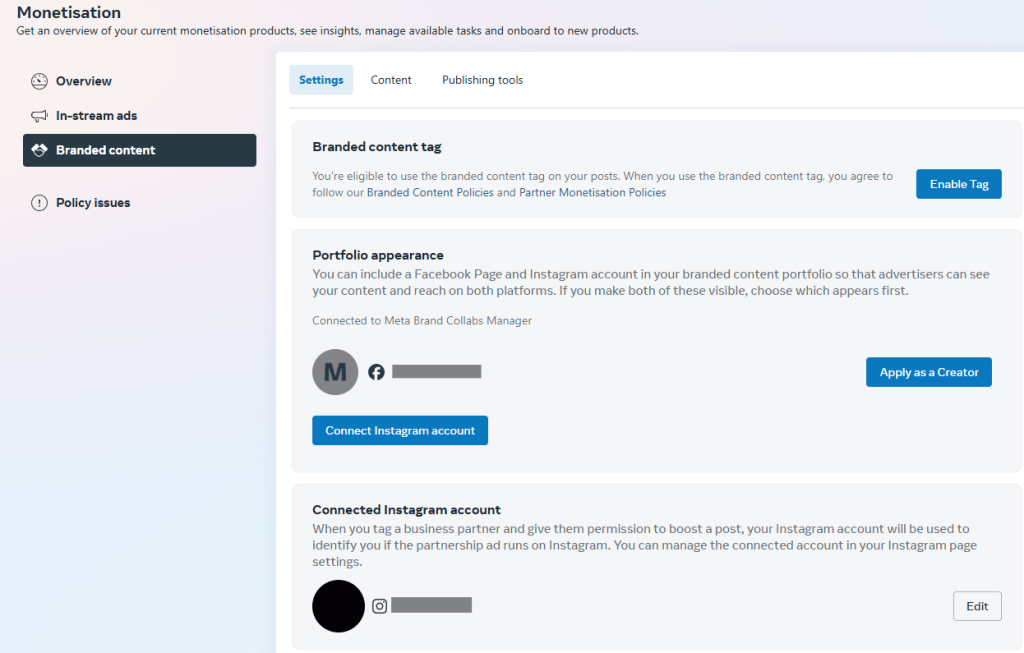
Ask next how concepts are tested before anything scales.
The answer you want is dark posting: running creator content as unpublished ads to small, controlled audiences, reading the signal on hook rate, click-through and cost per result, then whitelisting and scaling only the winners. An agency that skips this step is guessing at scale with your money.
Ask how usage rights are priced and for how long
Ask for the rights structure in writing before you see a proposal, and reject any proposal that leaves rights 'to be discussed later'. The cost trap is predictable.
A creator video beats your studio creative in a dark-post test, you want to put real budget behind it, and then you discover the contract covers 30 days of organic usage and nothing else.
That's a hypothetical, but it's a familiar way creator programs lose their best asset. Renegotiating after a winner appears puts every bit of pricing power on the creator's side.
| Rights model | What you can do | Typical cost logic | Risk when a winner emerges |
|---|---|---|---|
| Per asset, organic only | Creator posts on their own channel; you can reshare | Lowest base fee | You can't run it as an ad without a new negotiation |
| Per campaign, fixed window | Use across your channels and paid for a set period | Fee scales with window length and channels | The window closes just as the asset starts compounding |
| Perpetual, all channels | Use indefinitely in organic and paid | Highest upfront fee, often negotiated as a bundle | Low risk, but you may overpay for assets that never win |
| Paid-only extension option | Pre-agreed price to extend paid usage on request | Base fee plus a fixed extension rate | Lowest renegotiation risk; the price is set before the winner exists |
The table describes structures only. No rate evidence sits in our ledger, so read the cost column as pricing logic and don't treat it as a benchmark.
Our position: negotiate the paid extension option into every creator agreement at the outset. It costs a little in base fee and saves the program the moment something works.
Ask what share of past creator content ended up in paid
This single question reveals the agency's model.
Ask what percentage of creator assets from its last three programs ran as paid ads, and how those ads performed against the brand's existing creative.
An agency that treats creators as a creative engine will have a ready number and a story about which concepts scaled. An agency that treats creators as a posting channel will have to think about it.
Follow up with a process question: who decides which assets go to paid, on what signal, and how quickly after the post goes live?
The right answer is a media buyer reading dark-post data within days, feeding results back into the next round of briefs. If the media buyer and the creator team have never met, you've found the gap this whole article is about.
Questions about influencer marketing ROI and incrementality
Measurement questions separate agencies that will be accountable from those that will produce attractive reports, and the first thing to ask is which metric they'll stand behind after 90 days.
Ask which metric they are willing to be accountable for after 90 days
Ask each shortlisted agency to name the single metric it will accept accountability for at 90 days, then write that metric into the contract.
The reason for the horizon comes straight from the timing problem.
Engagement appears quickly, while trust and behavior change take longer and improve with ongoing optimization.
A 30-day report full of engagement is a report on the fast horizon only. Ask how the agency will report on both horizons without letting the fast metric stand in for the slow one.
- A strong answer pairs an early leading indicator (hook rate, cost per click on dark posts, code redemptions) with a lagging scoreboard (blended MER or CAC trend) and says which one it expects to be judged on.
- A weak answer offers engagement now and promises brand lift someday, unmeasured.
Ask how they distinguish attributed sales from incremental sales
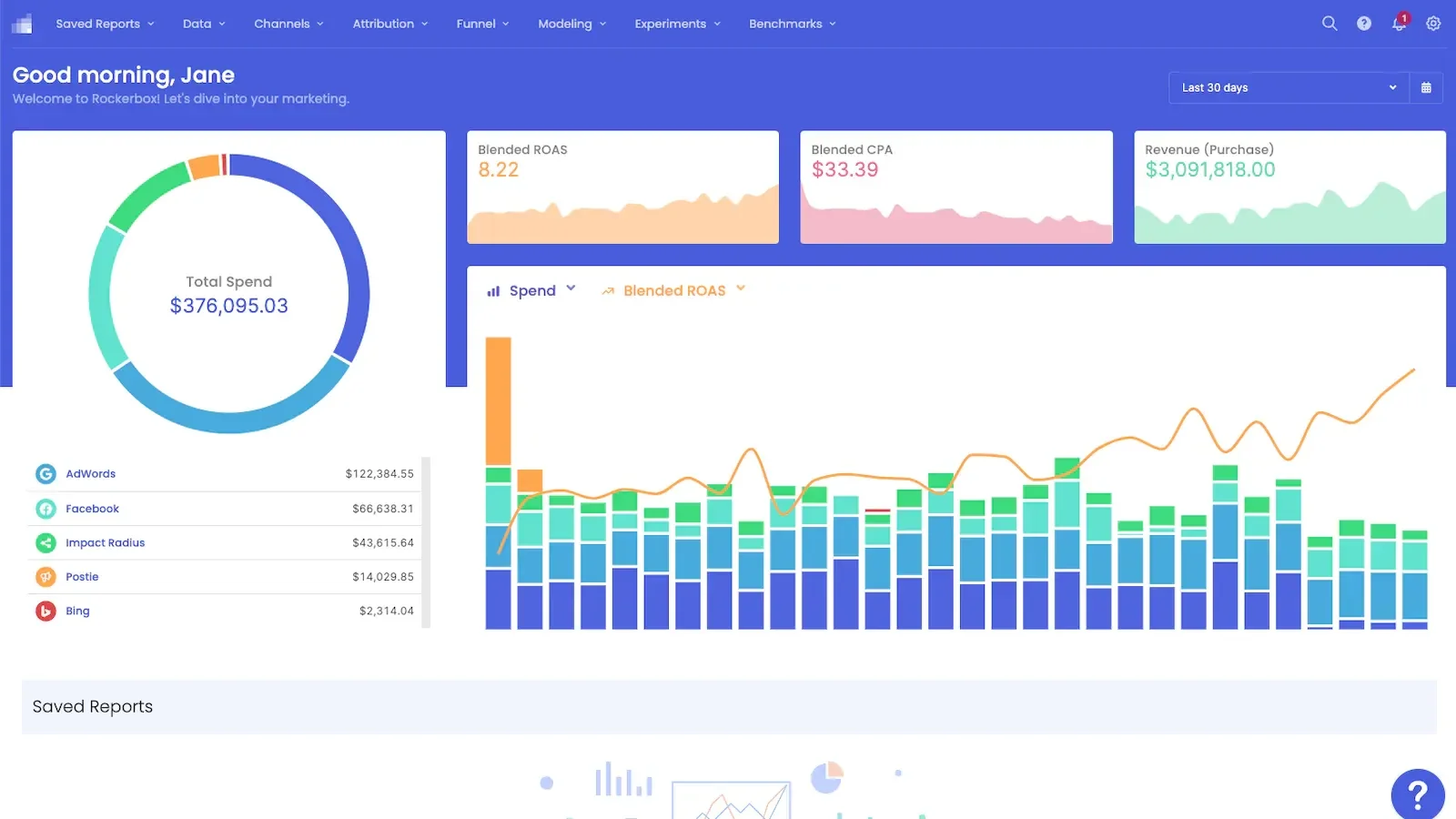
Attribution tells you which sales touched a creator. Incrementality tells you which sales wouldn't have happened without one. Ask which of the two the agency reports, and how. Walk through the stack:
- Creator-level codes and links, which are cheap and useful but capture only the customers who bother to use them; inBeat's comparison of affiliate and influencer marketing covers why code-based tracking undercounts brand effects.
- Post-purchase surveys, which capture self-reported discovery and influence missed by click tracking; they do not independently establish incremental sales.
- Platform conversion APIs, which connect paid creator ads to purchase events with less loss than pixel-only setups.
- Holdout or geo tests, which withhold creator activity from a matched market or audience and read the difference.
- MER as the blended scoreboard: total revenue divided by total marketing spend does not depend on attribution windows, but can change with seasonality, pricing, other channels and the spend included. It does not isolate creator-driven incremental revenue.
An agency doesn't need to run all five, but it should know why each exists, and volunteer which ones your budget can support. Keep this conceptual in the interview; there's no universal benchmark for incremental lift, and any agency quoting one without your data is guessing.
| Agency claim | Follow-up question | Acceptable evidence | Red flag |
|---|---|---|---|
| Our campaigns drove 1,200 code redemptions | What was the baseline, and what did MER do? | Redemptions alongside a matched-market holdout and a blended MER trend | Redemptions presented alone as ROI |
| We deliver strong ROAS on creator ads | Platform-reported or incremental? | Conversion API data plus a geo or audience holdout | Platform-attributed ROAS quoted as truth |
| Engagement was above benchmark | What happened to acquisition cost over 90 days? | CAC trend reported next to engagement | Engagement offered as the only success measure |
| We track everything | What can't your report tell us? | A named list of limits | Claims of complete visibility |
The redemption figures in the table are hypothetical illustrations of report structure; none of them is a measured result.
Ask what their influencer marketing report will not be able to tell you
Honest agencies volunteer limits. Expect to hear about:
- Cross-device leakage, where a viewer sees a creator on mobile and buys on desktop with no link between them.
- The organic halo problem: creator content lifts branded search and direct traffic that no attribution model assigns to the creator.
- Small-sample noise on micro creators, where one viral post or one dead week distorts a creator's apparent efficiency.
- Some acknowledgment of signal loss as platforms tighten tracking, which is the durability question in disguise.
Ask how the agency's measurement plan survives the next privacy change, and listen for a shift toward blended metrics and tests instead of dependence on any one platform's attribution.
Two final questions on this topic.
- What's the reporting cadence, and does it distinguish leading from lagging metrics?
- And who owns the dashboard, the data connections and the historical reports when the engagement ends?
If paid creator data feeds the measurement (and it should!) the account ownership you settled in the previous section decides whether that history is yours to keep.
Questions about agency fees, contracts, and compliance
Commercial questions matter because the fee model shapes the agency's incentives, and the failure protocol matters because some creator will eventually miss, breach, or go off-brand.
Ask how their influencer marketing fee is structured and what it does not cover
Ask for a sample contract alongside the proposal and compare the fee incentive against your goal metric. Each model rewards something, and you want it rewarding the thing you're buying.
| Fee model | Agency incentive | Best for | Watch for |
|---|---|---|---|
| Monthly retainer | Deliver the scope efficiently and retain the client | Ongoing programs with steady creator volume | Scope creep in either direction; define deliverables |
| Percentage of creator spend | Book more and more expensive creators | Reach-led programs with large creator budgets | Misalignment when the goal is more testable creative per dollar |
| Per deliverable | Ship assets on time | Defined content production runs | Quantity over quality; tie acceptance to brief criteria |
| Performance component | Hit the agreed metric | Performance-led programs with clean measurement | Metric gaming if the metric is attribution-based only |
We don't cite fee percentages because no pricing evidence sits in our ledger; the incentives are structural and hold regardless of rate.
Picture this, though: a brand wants many testable creator variants at low unit cost, but signs a percentage-of-spend deal. Every creator the agency books at a higher rate raises its own fee. The model and the goal are pulling in opposite directions from day one.
Then ask what the fee excludes. Platform and tooling fees, paid usage extensions (the rights cost line from earlier), reshoot costs when a first cut misses the brief, and creator payment float, meaning who pays creators and when, and whether you're financing that gap.
Ask what the process is when a creator misses, breaches or goes off-brand
Ask for the creator-failure protocol in writing; a verbal reassurance doesn't count. It should specify a replacement policy with a timeline, whether a kill fee applies and who bears it, how many content approval rounds are included, and who holds takedown authority when a post breaches brief or brand safety.
A strong protocol names the person who makes the call and the hours within which they make it. A weak one says 'we've never had a problem'.
Ask how disclosure compliance is monitored after publication
Briefing disclosure requirements is the easy part. Monitoring them is the process question.
Ask who checks published posts for correct sponsored labels and disclosure language, how soon after publication, and what happens when a creator's post is non-compliant.
You want a named owner, a checking cadence and a correction path, because the regulatory and reputational exposure sits with the brand regardless of who briefed the creator.
Finally, cover exit terms: notice period, handover of data and assets, and transfer of ad account access and creator permissions. A clean exit clause is the cheapest insurance in the contract.
How to score influencer marketing agency proposals
Score the answers with a weighted sheet before the pitch deck arrives, so presentation quality can't rescue a weak operating model.
Weight paid integration and measurement above presentation
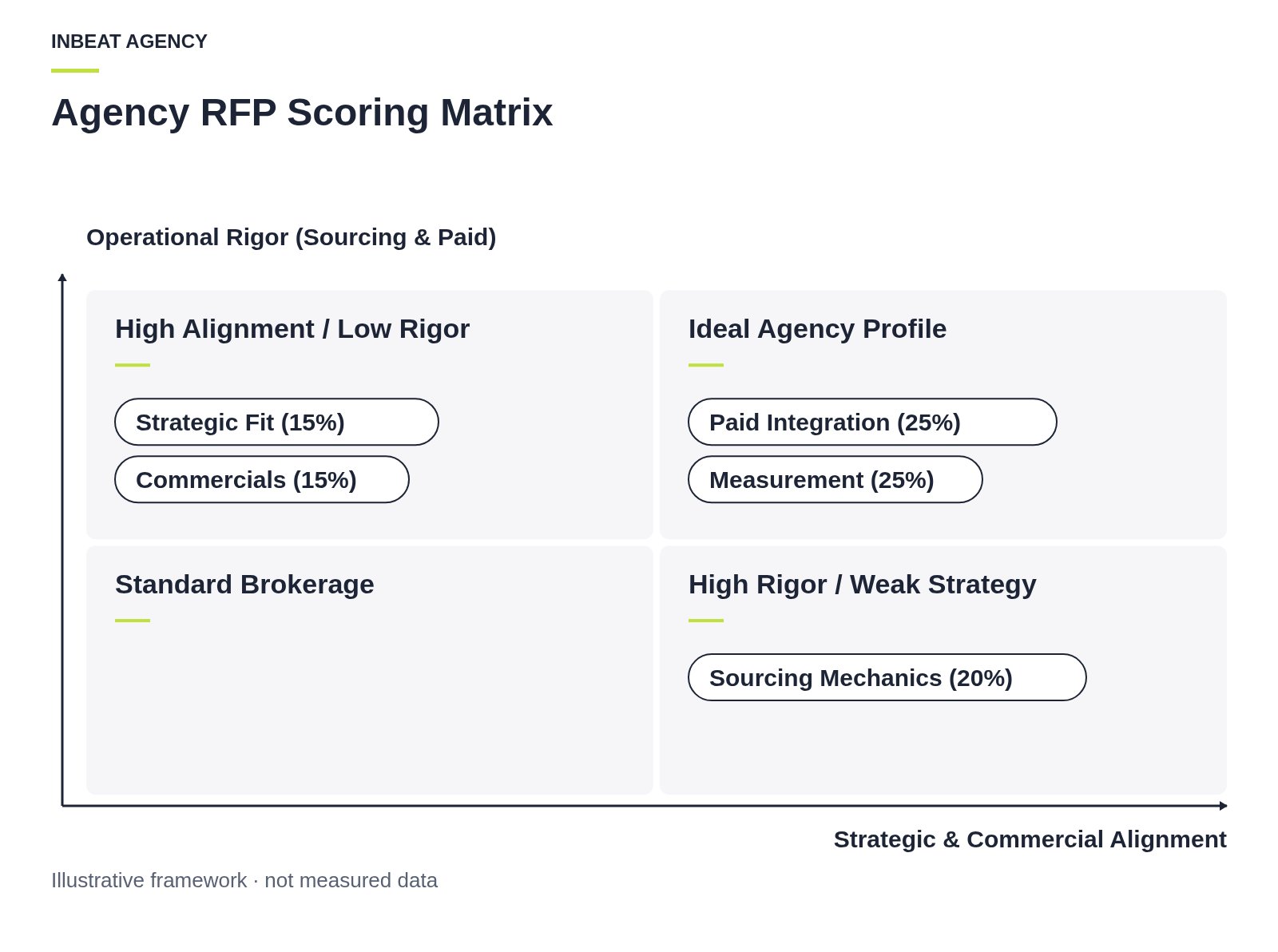
Copy the table below into your RFP evaluation sheet. The weights are editorial recommendations, tuned for a program whose goal is acquisition; adjust them if your goal is awareness, but adjust them deliberately.
| Evaluation area | Suggested weight | What a 5 looks like | What a 1 looks like |
|---|---|---|---|
| Strategic fit | 15% | Names your acquisition metric and a relevant vertical campaign | Talks about reach and generic category familiarity |
| Sourcing mechanics | 20% | Shows screened-to-placed ratio, rejection reasons and vetting steps | Presents a roster with no rationale |
| Paid integration | 25% | Explains account ownership, dark-post testing and pre-agreed paid rights | Cannot say how content moves into paid |
| Measurement | 25% | Names a 90-day accountability metric, separates attributed from incremental, lists limits | Offers engagement reporting only |
| Commercials and risk | 15% | Fee aligned to goal, written failure protocol, clean exit terms | Fee misaligned, protocol verbal, rights deferred |
The weights are our own recommendation and don't come from a study. The measurement row carries weight because of the two-horizon problem Pepper describes: an agency that only promises fast engagement should lose points on the slow-impact row, since it has no plan for the part of the outcome you actually want.
Score agency answers on specificity, ownership and admitted limits
Within each area, grade three things.
- Specificity: did the agency describe a process with steps, or offer an assurance?
- Ownership: did it name who does the work and who makes the call?
- Admitted limits: did it volunteer what it can't measure or control?
Generic confidence scores low on all three; a candid, detailed answer with acknowledged gaps scores high. A hypothetical to show why the weighting matters: two agencies tie on presentation and vertical experience, then separate by 12 points once the paid integration and measurement rows are weighted. Without the sheet, you'd have picked on chemistry.
Run the scoring twice: after the call and after the written proposal
Have two people score independently after the first call, then compare notes. Repeat after the written proposal arrives. Agencies that talk well and write vaguely show up as a drop between the two rounds, which is itself a signal.
For tiebreakers, ask for a reference call with a churned client as well as a current one. A former client will tell you how the exit went, which is the part no pitch covers.
How inBeat answers these questions
We built inBeat to answer these questions the way this article says an agency should, so it's fair to hold us to the same sheet.
One system for sourcing, creative and media buying
inBeat describes itself as a creative growth agency that combines influencer sourcing at volume, UGC and performance creative production, and paid social media buying, sold together as a single system, as stated on the inBeat homepage.
In practice, that means the people finding creators, the people briefing the content and the people reading the ad account results work as one team, which is the structural condition for the make, launch, learn, repeat loop this article keeps returning to.
Sourcing considers paid audience value, content is dark-post tested before it scales, and the media buyer's data feeds the next round of briefs.
Published case studies as the only proof
We don't want you to take the model on faith. The proof we'll point to is the set of published case studies on our site, and we'll only stand behind the figures exactly as those pages state them.
Read the Bumble, Bluehouse Salmon and Genomelink case study pages, then ask us the sourcing, paid integration and measurement questions from this article about each one. Anything the pages don't state, we haven't claimed.
Book a strategy call
Bring this question list to a strategy conversation with inBeat and ask us the same things. Score our answers with the sheet above. If we come up short on any row, you'll know exactly where, and so will we.
FAQ
Should ad accounts used for allowlisting sit with the brand or the agency?
With the brand, with the agency granted partner access. Allowlisting permissions attach to your Business Manager, and so do the pixel history, audience seeds and creative performance data. If the account is agency-owned, all of that leaves when the relationship ends and your next partner starts from zero. Agency-owned accounts are only defensible for a short pilot, and even then the contract should specify a transfer.
How do I judge an agency's incrementality claim if it has never run a holdout test?
Call it what it is, an attribution claim, and ask the agency to label it that way. Then ask what it would propose as a first test: a geo split, an audience holdout, or at minimum a post-purchase survey to size the untracked halo. An agency that understands the difference will welcome the question and scope the test. One that insists its platform-attributed numbers already prove incrementality is telling you how it will report later.
Is a percentage-of-creator-spend fee ever the right model for a performance-led program?
Rarely, and only when creator spend is capped and the goal metric is written in alongside it. The model rewards booking more expensive creators, while a performance-led program usually wants more testable variants per dollar. If you must use it, pair it with a performance component tied to a blended metric such as MER, so the agency can't win by inflating the base it's paid on.
What should a creator replacement clause specify when a creator misses a deadline or breaches brief?
Four things: the trigger (missed deadline, off-brief content, disclosure failure, brand-safety breach), the replacement window in business days, who bears the cost of the replacement and any kill fee, and who has authority to demand a takedown. It should also state how many approval rounds are included before a reshoot becomes billable. Without the trigger and the window, the clause is a promise with no enforcement.
How many creators should an agency screen relative to the number it places?
There's no benchmark we'd cite, so ask for the agency's own ratio and judge the reasoning. What you're looking for is evidence that the pool was large enough to match persona and angle, and that rejections happened for stated reasons: audience mismatch, engagement authenticity, brand history, disclosure record. An agency that screens few and places most of them is selling a roster.
When does a broad digital agency beat a specialist influencer agency?
When creators are a small share of a larger media plan and the priority is coordinating them with search, paid social and CRM under one budget owner. The generalist sees the whole funnel. The specialist wins when creator volume is the constraint, because sourcing at scale, vetting and creator relationships take years to build and a generalist rarely has them. If you're unsure, the 'share of content that ended up in paid' question usually settles it: whichever agency can answer it with a number and a process is the one that treats creators as a creative engine.
Cover photo: Photo: Tomáš Malík / Pexels. Art direction: inBeat Agency.