.svg)
.svg)
.svg)
.svg)


.svg)




A creator can make an outfit look irresistible in 15 seconds. But what happens when shoppers receive it and the fit disappoints? According to a 2026 Coresight Research and Alvanon report, 23.4% of US online apparel and footwear sales are returned, with sizing and fit responsible for roughly 70% of online apparel returns.
That makes fashion influencer marketing about much more than finding the right creators. Drawing on examples from Revolve, Victoria's Secret, American Eagle, SET, Universal Standard, and Target, this guide explores how brands coordinate launches, manage samples, secure content rights, and turn creator attention into lasting sales.
See what actually works.
P.S. If you would rather skip the trial and error, our influencer marketing agency builds and tracks these programs for fashion brands. Book a free strategy call.
TL;DR: Seven Rules for Fashion Creator Programs
- Work backward from the drop date, and clear paid usage before the drop.
- Collect every creator's sizes first, then ship each creator their own size and cover the full size range across your roster.
- Track every sample from shipment to delivery, and every creator post through disclosure review.
- Match creator tier to the job: volume, launch moments, or long-term advocacy.
- Write paid usage rights per placement, with a term that fits the selling season.
- Report creator sales net of returns, and test store lift with holdouts.
- Test posts at launch, then scale proven sellers while stock lasts.
One thing before the mechanics. We run creators, media, and measurement as one system, because each one changes what the others can do.
Creators supply native, testable creative with trust already attached. Paid media is the lab where that creative proves it can sell. Measurement decides which creator, which garment, and which size run earn the next dollar. Fashion adds a clock and a tape measure to that loop: every drop expires, and every unit comes in sizes. Teams that plan around both finish each drop with a sharper brief for the next one.
What Is Fashion Influencer Marketing?
Fashion influencer marketing is paying, gifting, or co-creating with creators so they wear, style, and sell a brand's apparel and accessories, then reusing that content in paid media and retail. Brand awareness still matters, but in the fashion industry the measurement now ends at revenue, and the creator economy supplies the volume of content to get there.
Four constraints separate fashion from other categories:
- Seasons end, so a drop has a short selling window.
- Sizes multiply every sample you ship.
- Returns erode every sale.
- Drops compress most of the demand into a few days.
This guide is about running programs. For a list of creators to start from, see our roundup of fashion influencers in New York or Los Angeles.
How to Build a Fashion Influencer Launch Calendar: Seasons, Drops, and Fashion Week
A fashion influencer launch calendar works backward from the drop date: the creator shortlist is locked about 16 weeks out, seeding kits ship about 10 weeks out, and paid usage is cleared before the drop. Those timings are our planning template, built from running seeding programs. Adjust them to your lead times.
Plan Backward From the Drop Date
Set campaign objectives per moment. A fashion week appearance buys awareness, and the drop itself should be judged on sales. Content production also needs room: a lookbook-style shoot takes longer than a try-on video, so book it earlier.
Samples ship before the content deadline for a practical reason: garments arrive late or in the wrong size more often than anyone plans for, and you need weeks to recover.
Keep paid testing and scaling separate. Once creator posts are live and authorized, start with small test budgets while the drop is fresh. Use the first 24-72 hours of sales data to identify promising posts, then increase spend where performance and available stock support it. Adjust the timing to the collection's selling window.
Fashion Week and Festival Creator Programs
Revolve runs one of fashion's best-known festival-style creator programs, and its 2026 numbers show what that kind of event can and cannot prove. On April 11 the retailer held its ninth annual Revolve Festival in Coachella Valley. Management says Revolve earned the highest earned media value among all brands across both Coachella weekends, according to CreatorIQ, and that the top post of the whole festival generated nearly $25 million in earned media value, according to Meltwater.
Both figures price attention, and neither is a revenue number. The only sales statement in the record is an older line in Revolve's 10-K, which says the festival "historically resulted in peak sales during the second quarter of each fiscal year." Read festival results the same way: EMV for reach, sell-through for sales.
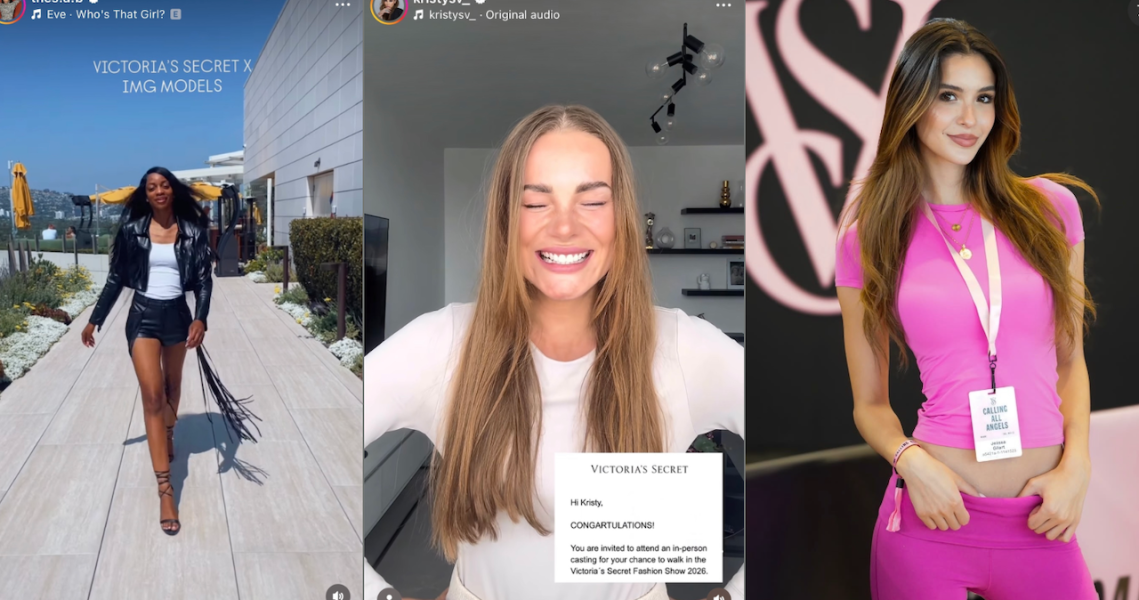
Victoria's Secret runs the same play on a runway calendar. Its 2025 Fashion Show engaged thousands of creators directly, produced more than 1,700 pieces of content, and brought more than 150 creators to VIP store events. For the 2026 show it is turning to the same creator program to build buzz, though Glossy reports no figure for how many gifted creators posted.
A fashion week creator program costs event access, travel, and samples. Choose attendees by tier, as laid out in the creator tiers section below.
Back-to-School and Gifting Seasons
Match each seasonal moment to a creator job and a format:
- Spring drop: try-on and styling videos that show fit on real bodies.
- Fashion week: front-row and behind-the-scenes content for reach.
- Back-to-school: get-ready-with-me videos and hauls from students.
- Holiday: gift lists, with December still Kendra Scott's highest-volume gifting period.
American Eagle shows what a seasonal plan looks like in 2026. Its back-to-school campaign launched July 22 and runs about 10 weeks, pairing two to three big names with thousands of smaller creators, five sorority chapters from August, and limited-edition jeans sold through mall events. The company expects more than 25 creators at launch, and each partner creator or chapter is expected to produce between four and 10 pieces of content across Instagram and TikTok.
American Eagle disclosed no 2026 results, so the lesson here is the structure of the calendar. Add the season layer to your influencer brief template: drop date, selling window, and the sizes in stock.
Sample Logistics for Fashion: Sizing, Shipping, and Tracking
Fashion sample logistics means collecting each creator's measurements before anything ships, sending each creator their own size across a full size range of creators, and logging every unit from dispatch to post. The Coresight and Alvanon figure above covers the prior 12 months and does not state its sample, so treat it as an estimate. The direction is still clear.
Sizing Intake: Collect Fit Data Before Shipping
Send every creator a short intake form before you pick a size. Collect:
- Height and usual size by garment type (tops, bottoms, outerwear)
- Bust, waist, and hip measurements, plus shoe size
- Preferred fit (relaxed, true to size, fitted)
- The date the measurements were taken
Refresh the form every drop. Bodies and sizes shift, and the shift is large right now: PwC research using Numerator data, reported by Glossy, found 21% of US households included a current GLP-1 user as of May 2026, and 73% of those users reported a meaningful change in clothing size. That is a secondary source, so use it as a reason to ask again.
Fit data matters on camera too. A creator who reviews a wrong-size garment publishes a fit problem to the same audience that will return it later. Bershka cut returns by 10% after overhauling its sizing standards with Alvanon, per the Coresight report, which gives no period for that result.
Size Inclusivity: Ship the Full Size Range
Seed creators across the size range you actually sell, with at least one creator per size band, and log the size each one wears on camera. Size inclusivity in fashion creator work starts with who receives the sample.
The demand is already visible in 2026 data. Universal Standard's capsule with Abisola Omole runs sizes 00 to 40, and the brand reports that nearly 90% of units sold in size 14 or above, with sizes 18 to 24 accounting for 54%. Revenue and sell-through were not disclosed. The runway shows the opposite pattern: Felicity Hayward counted only 115 curve or plus-size appearances across about 11,550 looks at the spring 2027 shows, around 1%.
Seeding across a full size range is a logistics job, and inBeat's product sampling agency sends product to creators for reviews and tracks what comes back.
Sample Tracker: Seven Steps Per Creator
Run every seeded unit through the same seven steps:
- Log the creator and their tier.
- Record the intake sizes.
- Assign a SKU and a size.
- Ship with a kit card and a tracking number.
- Confirm delivery.
- Set a post-due date.
- Record the live post URL, confirm the disclosure was checked, and note whether the creator kept or returned the sample.
Start with a sample tracker that records every garment sent to a creator. Keep one row per unit so your team can check delivery status, track sizes, and account for samples that are kept or returned.
Use this record to catch delivery issues and keep seeding inventory under control. Retire a SKU from seeding when stock reaches your reserve, since every sample shipped is one less unit available for sale.
Delivery is only half the process. One creator may publish several posts featuring the same samples, while a single video can include multiple garments. Track that content separately, with one row per post and shared creator and campaign IDs connecting the two records.
Together, these trackers connect shipped products to published content without duplicating logistics records. Use post-specific tracking links where possible to compare individual assets. A promo code shared across several posts can identify creator-attributed sales, but rarely shows which post drove the purchase.
What Do FTC Guidelines Require for Gifted Product?
Free product counts as a material connection, and the FTC's revised Endorsement Guides, announced in June 2023, apply to it. The FTC's own question-and-answer page says that if you receive a free or discounted product to review, the connection should be disclosed everywhere you endorse it. Tagging a brand you are wearing is itself an endorsement, and "#ad" works for both a paid post and a free product.
TikTok needs extra care. The FTC says a disclosure in the text description is "very unlikely to be clear and conspicuous", so put it on screen in the video. Advertisers also need reasonable programs to train and monitor their endorsers, which is why the tracker has a disclosure column.
Add a follower-quality check to creator vetting too. The FTC's Consumer Reviews and Testimonials Rule, effective October 21, 2024, bans buying fake indicators of social media influence, such as bot-generated followers. For penalties and examples, our FTC guidelines for influencers post has the detail.
Which Creator Tier Fits Fashion Best: Nano, Micro, Mid-Tier, or Macro?
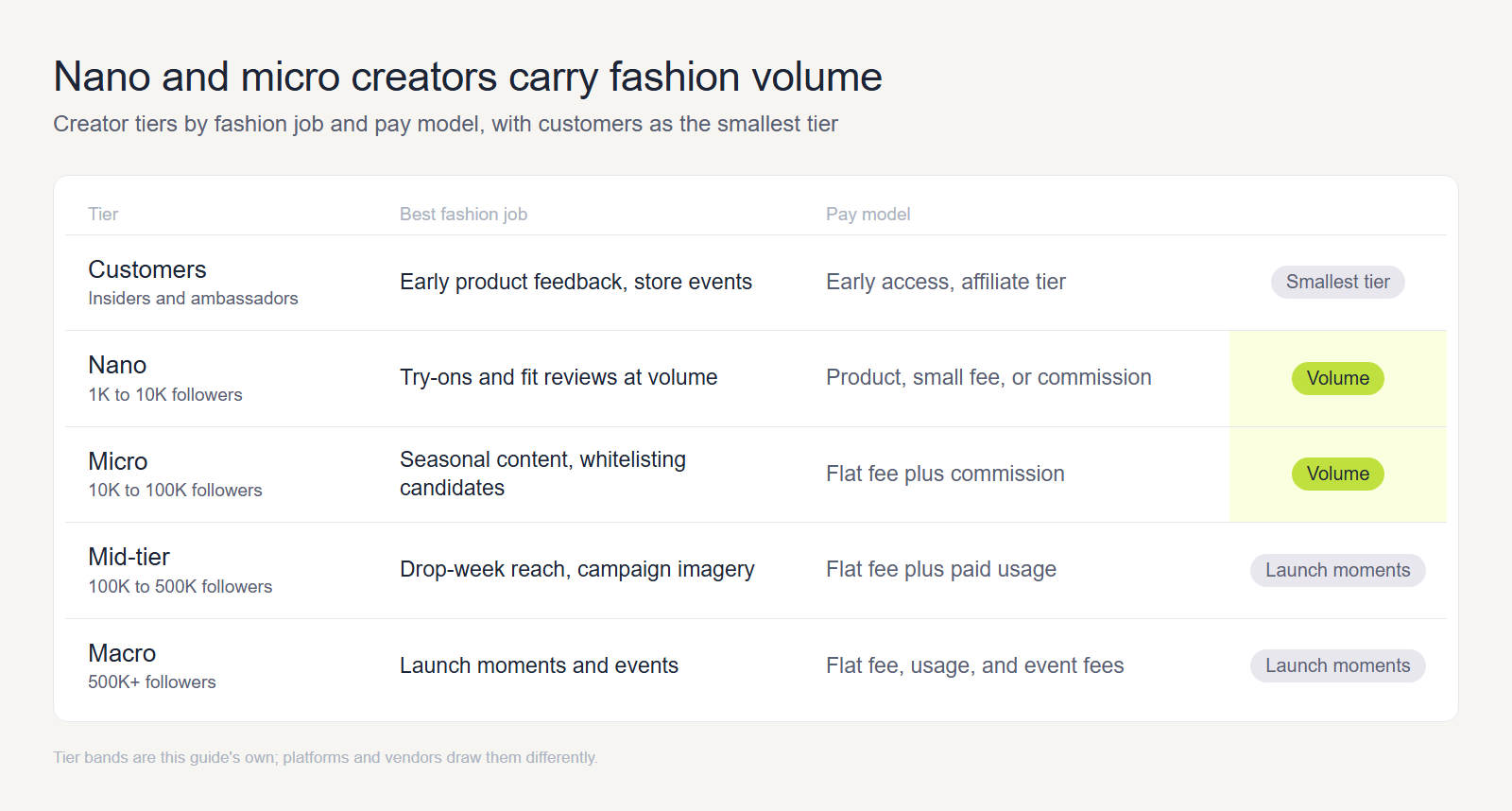
Nano and micro creators carry fashion volume, mid-tier and macro creators carry launch moments, and customers can act as the smallest tier. This guide uses its own bands: nano 1K to 10K followers, micro 10K to 100K, mid-tier 100K to 500K, and macro above 500K. Platforms and vendors draw these lines differently, so check the band edges before you compare any benchmark.
Fashion Creator Tiers: Roles, Pay Models, and Benchmarks
Engagement benchmarks provide another point of comparison. HypeAuditor reports average Instagram engagement ranges of 4-5% for creators with 1K-5K followers, 2.5-3.5% for 5K-50K, 2-2.5% for 50K-500K, and 1-2% for accounts above 500K. These follower bands differ from our tier definitions. On TikTok, HypeAuditor reports that nano creators make up 87.7% of creators, with a 10.3% engagement rate. Treat these figures as platform-specific vendor benchmarks rather than fashion-specific performance expectations.
For typical creator fees by platform and follower count, see our guide to how much content creators cost.
Micro Influencer and Nano Seeding at Volume
A creator with 5,000 followers can move a product. In November 2023 one posted about Pacsun's Casey low-rise baggy jeans, and 11,000 pairs sold in 48 hours. Pacsun went on to sell $20 million on TikTok Shop in 2024. In September 2025, Pacsun reported that TikTok accounted for 10% of its e-commerce business, up from 8% in 2024.
American Eagle's 2026 roster follows the same logic. Of the five creators Glossy names in its plan, four have between 2,000 and 9,900 Instagram followers. Run nano seeding with three rules:
- Match the creator's audience size and style to the garment.
- Seed 15 to 30 creators per drop, so one miss does not sink the launch.
- Read sell-through after the first week and send the next kit only to creators whose posts moved units.
Our guide to nano-influencer marketing covers sourcing and vetting.
Mid-Tier and Macro Creators for Launch Moments
Hire mid-tier and macro creators for event access and campaign imagery. Fashion bloggers who built audiences before short video now sit mostly in these tiers, and they bring styling credibility and photography. Brief them with the calendar dates and the usage window from the rights section below, because their fees rise when the term is unclear. For the luxury end of these tiers, see our guide to luxury brand influencer marketing strategies.
Brand Ambassadors and Long-Term Creator Relationships
Move a creator from per-drop deals to a season-long deal when you see repeat sell-through, consistent fit feedback, and engaged communities that comment on product details. Long-term influencer relationships earn you first access to the next drop, a fit-feedback loop, and pre-priced paid usage.
Two 2026 programs show different ways to build that tier. Victoria's Secret's tiered creator program has more than 16,000 members since October 2023, and higher tiers earn higher affiliate commissions, gift cards, features on the brand's social channels, and event invitations.
SET started its customer "Insiders" program with two customers and added around 15 for its Coastline launch. Most sit on ShopMy's entry-level or ambassador tiers, so SET can see their sales. SET's CEO says "our community is our influencer."
SET later reported $3.5 million in online sales within 24 hours of its Coastline launch, although the company did not disclose how much of that revenue came from its Insiders program.
For program design and a 90-day pilot, read our post on brand ambassador programs.
Budget Lines Fashion Programs Forget
Budget the full cost of a creator sale:
- Landed cost of samples, including extra sizes
- Outbound and return shipping
- The creator fee
- The paid usage fee
- Whitelisted media spend
Fashion Content Usage Rights: Lookbooks, Product Pages, and Paid Ads
Content usage rights should be defined by placement. A brand may need permission for organic reposts, product pages, and paid ads, with separate terms and fees where applicable.
Paid usage rights for advertising are also distinct from the platform authorization needed to run partnership or Spark Ads.
Usage Rights by Placement
A branded content tag or ad authorization is a platform feature, while the licence defines what the brand can do with the content. A product-page video still needs permission for website use, even when it never runs as a paid ad.
For term lengths and base pricing, our post on UGC usage rights covers the mechanics.
Fashion-Specific Clauses for Usage Rights
Set the term to the selling season plus a sell-off period. A 90-day window cut mid-collection leaves you paying again for a winning post while stock is still on shelves.
Add four clauses that fashion content needs and generic UGC templates skip:
- Releases: model, photographer, and stylist releases when the creator hires a team for content creation.
- Music and audio: the licence for any track used in the video.
- Third-party items in frame: review visible logos, artwork, and borrowed garments for any clearances required by the planned commercial use.
- Customer-style user-generated content: whether a reposted try-on falls under the creator's licence or the customer's.
Our post on why global UGC usage rights fail covers tiered licences, territories, and expiry tracking.
Usage Rights Checklist Before Signing
Before you sign, confirm:
- Every placement is listed
- The term is stated in dates
- The renewal price is fixed
- Releases are attached
- Edit rights are stated
- Disclosure language is included
- Contract termination and platform authorization revocation are addressed separately.
How to Measure Fashion Creator Sales: Affiliate Links, Promo Codes, and In-Store Lift
Measure fashion creator sales in three layers: tracked links and promo codes for online sales, a post-purchase survey for what the codes miss, and store-level comparisons for retail. Earned media value belongs in a fourth column, because it tracks reach. Our guide to earned media value explains how to interpret it.
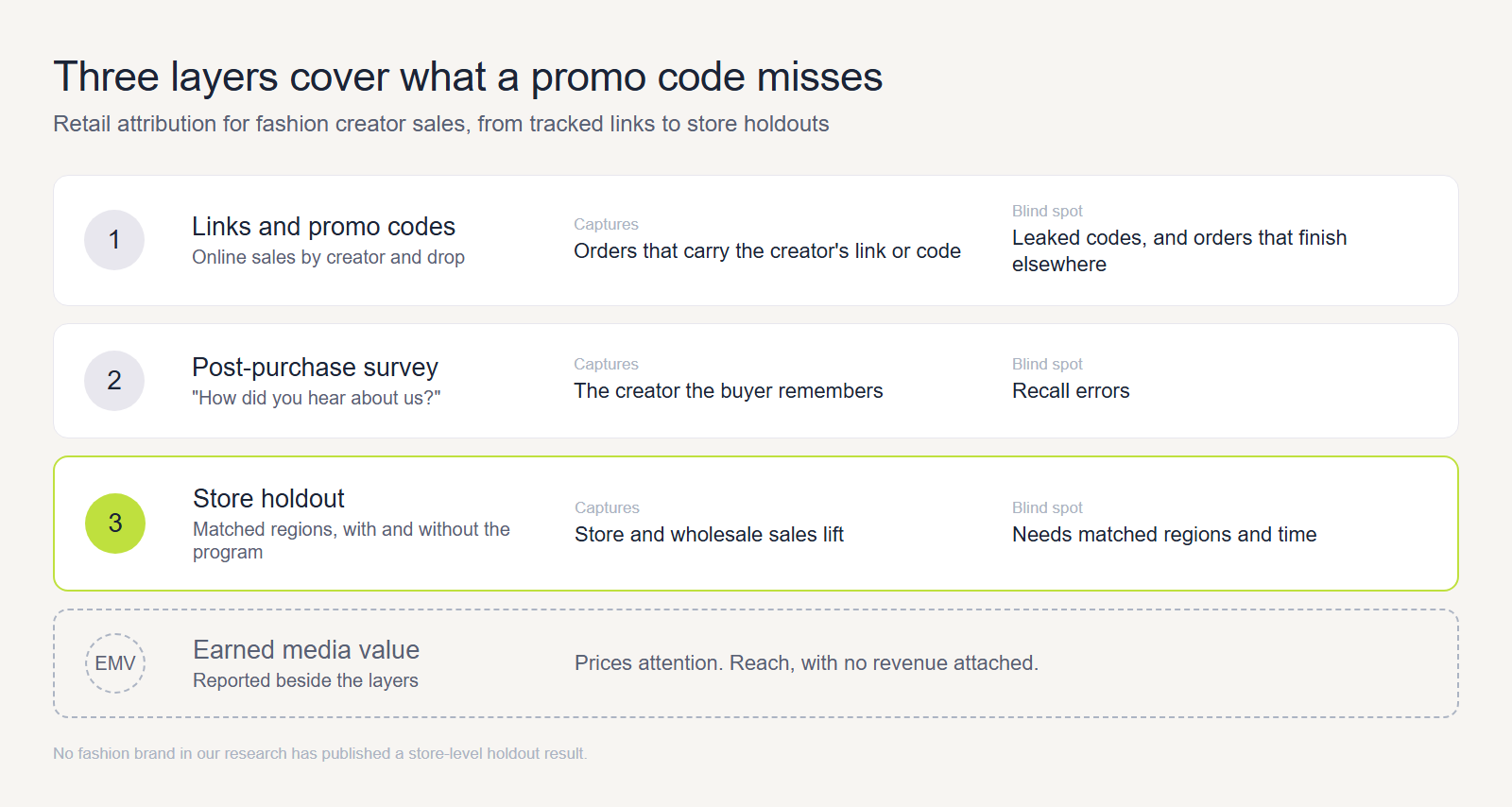
Affiliate Links and Promo Codes
Affiliate platforms give brands creator-level sales data. LTK says its platform powers over $6 billion in annual retail sales, with more than 8,000 retailers (company-reported, October 2026). Pacsun launched its own PS Community Hub app in January 2026, where creators share content and earn affiliate commission inside the Pacsun ecosystem. BoF gives no commission rate or sales figure for it.
Issue a unique promo code per creator and per drop. One code posted to a coupon site breaks attribution for everyone who shares it.
Our guide to influencer marketing attribution models covers UTMs, windows, and model choice.
In-Store and Wholesale Lift Tests
To estimate incremental retail lift, choose test and control markets with similar sales trends before the campaign. Run geo-targeted creator activations or paid distribution in test markets, then compare changes in store sales against the control group over the same period. National organic posts can reach both groups, so account for that exposure when interpreting the results.
Ask retail partners for store-level sales by SKU and market, then compare those figures against campaign dates, inventory, and promotions. Use GA4, affiliate dashboards, and post-purchase surveys for online attribution. These tools add context, while the test-versus-control comparison helps estimate incremental retail sales.
Net-of-Returns Reporting
Report creator-attributed sales net of returns. The Coresight estimate from the top of this guide equals $47.1 billion in returns on a $201.1 billion US online apparel and footwear market in 2025. The NRF and Appriss report puts all online retail at 17.6% for 2023, a useful cross-check from a different data set.
Here is the arithmetic, using illustrative numbers: if a creator campaign generates $10,000 in attributed online sales and 23.4% of that revenue is refunded, net sales fall to $7,660. At the same media spend, revenue-based ROAS falls too. The original order conversion rate remains unchanged, so track retained orders and refunded revenue separately. Ask finance for customer returns by SKU and size, then match them to creator-attributed orders where tracking allows. Keep those returns separate from samples sent back by creators.
Whitelisting, Partnership Ads, and Spark Ads: How to Scale Winning Creator Content
Whitelisting means running paid ads through a creator's own handle, which Meta calls partnership ads and TikTok calls Spark Ads. For fashion drops, start with small paid tests when approved posts go live, then scale the content that proves it can sell. TikTok reports that creator ads drive a 70% higher click-through rate and a 159% higher engagement rate than non-creator ads at the same CPM.
That is TikTok's own analysis of its campaigns, so treat it as a platform claim for social media ads, and test it in your own account.
Select Winners With Sell-Through Data
Compare creator-attributed sales by SKU and size, then use post-specific tracking data where available to identify winning content. Check hook rates, saves, and available inventory before scaling. Follower count matters less once actual performance data comes in.
Kendra Scott's 2026 Mother's Day campaign shows the value of selective amplification. The brand produced more than 200 video assets with a lead creator and dozens of others, then boosted only the strongest performers. As CMO Michelle Peterson told Glossy, "Boosting everything would dilute the impact of what is actually resonating." While the brand's reported approach focuses on audience response, sales data can help fashion marketers take that selection further.
Start with small paid tests at launch, then use the first sell-through results to decide where to increase spend.
Partnership Ads and Spark Ads Mechanics
These periods describe platform authorization, not the usage term agreed in the contract. Before launch, confirm that both the contracted rights and the creator's platform permission cover the planned ad flight.
Meta's help center says advertisers need permission from the partner whose handle the ad includes, and creators can revoke it at any time. The ads use signals from both accounts for ranking. On TikTok, each Ads Manager account supports a maximum of 10,000 Spark Ads, according to TikTok's help center.
TikTok's caption lock makes pre-launch review important. Confirm the disclosure and any promotional code in the caption before the creator authorizes Spark Ads. Track the authorization expiry separately from the contractual usage term, and request renewed authorization if the paid flight will run beyond it.
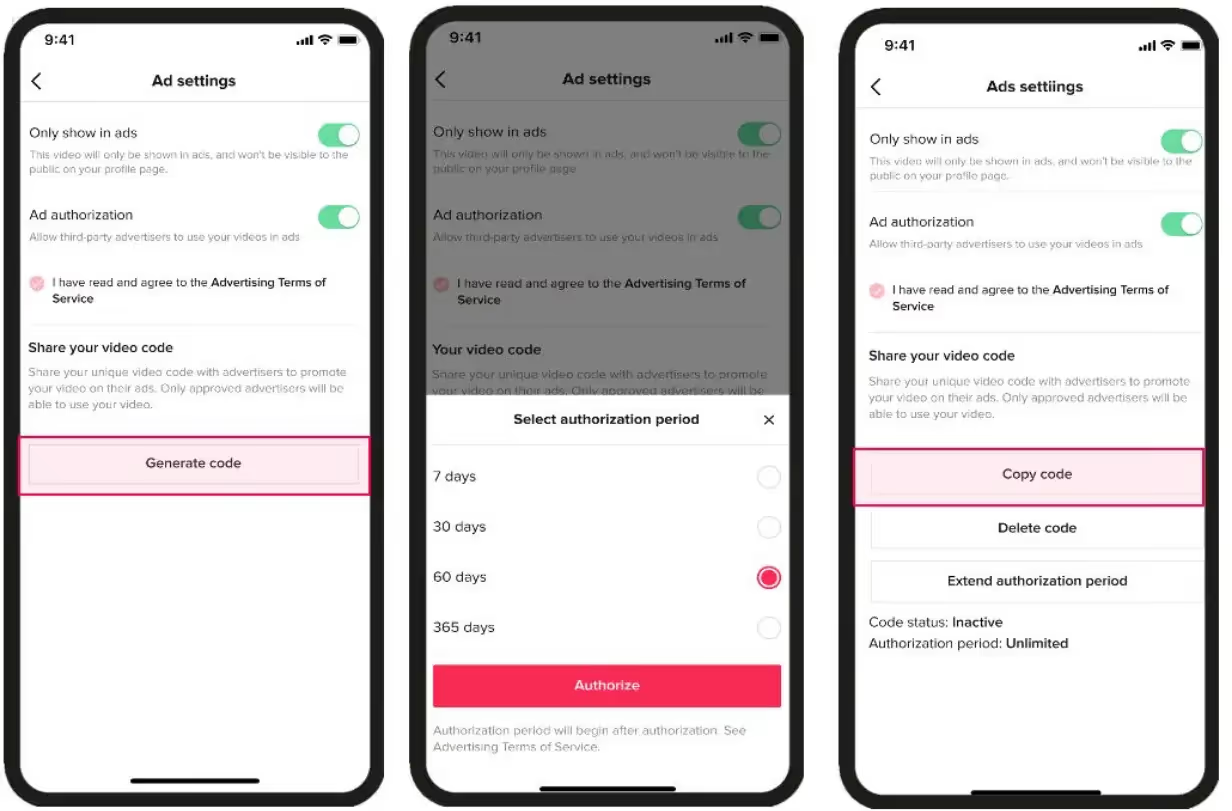
Scale Steps
Follow the same order every drop:
- Confirm the contract grants paid usage rights for the planned platforms and flight dates.
- Obtain active partnership or Spark Ads authorization, with renewal arranged if needed.
- Start with launch SKUs that have sufficient stock across their size runs.
- Test with small budgets, then raise spend on posts that generate sales.
- Swap in the next drop's creator posts when fatigue shows.
- End ads when the window closes.
Stock Guardrails for Whitelisted Ads
Never whitelist a SKU with a thin size run. A winning post that points at sold-out sizes wastes spend and sends shoppers away. Sync paid flights to stock, and pause when a size band drops below your reserve. Public whitelisting results from fashion brands are scarce, so any benchmark you use here comes from platform data.
Co-Branded Collections and Live Shopping Influencers
Two second-wave formats suit programs that already track sales: co-branded collections with creators, and live shopping.
Co-Branded Collections With Creators
A co-branded collection with a creator can start from a single post. Universal Standard's capsule began after creative director Abisola Omole posted an Instagram birthday wish list in May 2025 that included a capsule with a size-inclusive brand. The seven-piece collection launched in September 2026, priced $150 to $225, and nearly 60% of first-week unit sales on its US site came in the first 48 hours, according to the brand. Revenue was not disclosed.
Target's launch with creator Embreigh Courtlyn used a different route. The 16-year-old's tween fashion line went into more than 2,000 Target stores on June 14 and generated more than $2.2 million in its first two weeks, according to the brand. Her team ran a surprise launch day with about 20 creator friends. "Not once did we post a link to the Target website," says Kristi Kaylor, founder of the talent management firm The Loft Entertainment.
A collection needs more than a campaign plan: it needs a signed answer on IP ownership, size range, return policy, and revenue share. Business of Fashion reported in December 2025 that a growing number of brands are launching creator collaborations.
Live Shopping Influencers on TikTok Shop
Live shopping influencers can drive a spike on TikTok Shop, where affiliate creators already do much of the selling, but the format has not replaced short video. Crocs' first TikTok Shop Super Brand Day in October 2024 produced $1 million in sales and a 28,300% increase in live shopping sales against the period before the event. Crocs' chief brand officer said the company does not view livestreams strictly as a sales driver, per Modern Retail.
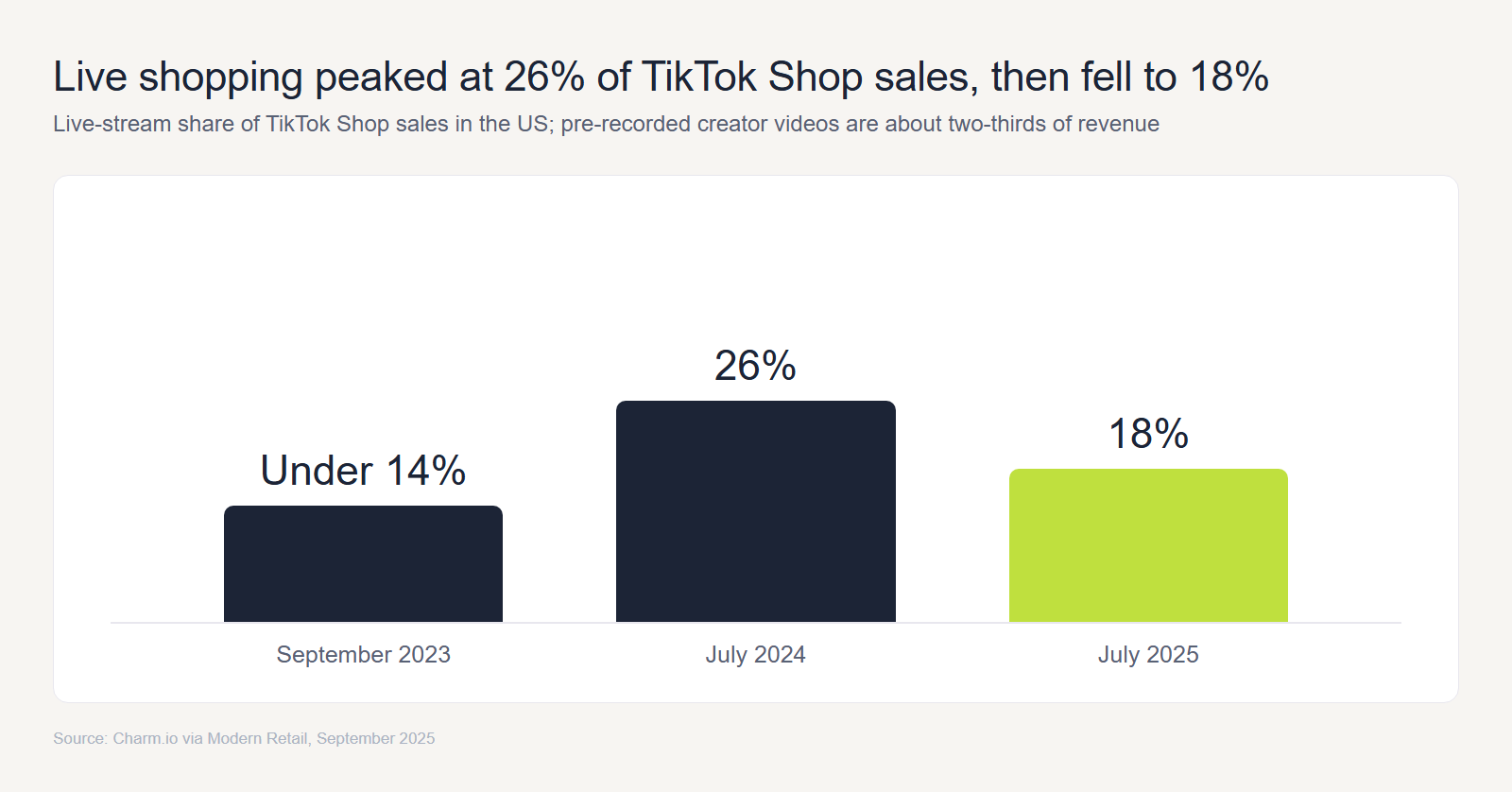
Charm.io data in the same report shows live at just under 14% of TikTok Shop sales in September 2023, 26% in July 2024, and 18% in July 2025, while pre-recorded creator videos account for about two-thirds of revenue.
Fashion creator Shamela Brown, with 126,000 followers, says she has driven nearly $5 million in gross merchandise value since joining TikTok Shop in November 2024, including $700,000 in sales in one of her highest-performing months, with a focus on try-on videos. Those figures are self-reported. Skims ran a 45-minute shoppable livestream called Kimsmas Live on December 3, 2025, and disclosed no sales number.
Test live only after short-video sell-through is stable.
Scale Fashion Creator Programs With inBeat Agency
Good influencer marketing strategies for fashion run on the loop described at the top of this guide. The calendar, size tracker, rights checklist, and net-of-returns report are the parts of that loop that fashion brands most often skip.
If you want a second set of eyes on yours, book a strategy call and we will walk through your launch calendar, seeding tracker, usage-rights template, and scale plan.
FAQs
Should the attribution window differ for a $300 coat and a $30 tee?
Potentially. A $300 coat may involve more consideration than a $30 tee, but price alone shouldn't determine the attribution window. Review the time between the first tracked creator interaction and purchase for each product category, then choose a window that reflects actual buying behavior.
How many creators should a first fashion drop seed?
Use 15-30 creators as a starting range, then adjust the roster to your sample inventory, shipping capacity, and review workload. A smaller group with confirmed sizing and on-time posts can be more useful than a larger one you struggle to track. Expand once your first drop shows the process can handle it.
Do customer ambassadors need the same FTC disclosure as paid creators?
Yes, when they receive a free or discounted product. The FTC's guidance says a connection through free or discounted product should be disclosed everywhere the person endorses it. Apply the same disclosure language to customers who earn commissions or early access, and add a disclosure check to their row in the tracker.
What if a creator's sample arrives late or in the wrong size?
Check how much time remains before the content deadline, not just the drop date. Reship the correct item if the creator still has time to try it on and produce the content. Otherwise, move the deliverable to a later activation and update both tracking records.
How do you verify a creator's sales claims before paying for a storefront or affiliate tier?
Ask for a dashboard export from the platform that recorded the sales, such as ShopMy, LTK, or TikTok Shop. Many sales figures in the 2026 reporting are self-reported, including Shamela Brown's nearly $5 million in gross merchandise value, so a screenshot of the platform's own report is the right standard. Match the period and the unit (sales or gross merchandise value) to your campaign.