
A client sent me a screenshot of the comments under their cart-abandonment ad, and many of them said some version of "I already bought this, stop following me." The click-through rate looked healthy that week, but sales from the audience had gone flat.
That kind of backlash can be a sign of psychological reactance, the urge to resist when people feel their freedom to choose is threatened.
A 2026 meta-analysis of 142 samples found that commanding language in advertising increased psychological reactance and had a small negative effect on persuasion.
In this guide, I'll show you which copy triggers that response, how to recognize it in your ad account and how to write persuasive ads that leave the decision with the buyer.
TL;DR
- Psychological reactance is the urge to resist a message that feels like it limits your choice, and it can make an otherwise persuasive ad less effective.
- Directive commands, fake urgency, guilt-based opt-outs and over-frequent retargeting can provoke that response.
- In separate experiments, a one-day offer drew more responses than an extremely short deadline, while aggressive interface tactics increased sign-ups at the expense of goodwill.
- One lab experiment suggests committed customers may be particularly sensitive to assertive ads. Retention copy is where I'd start testing a softer message.
- Test one copy variable at a time as a dark post and read click-through rate, comments, conversion rate and CPA together.
The creative shapes who clicks, but a click tells me very little about whether someone wants to buy. I care about how the message performs all the way through to purchase.
That makes small, controlled creative tests worth running before scaling. I count a losing ad as money well spent when it teaches the team something.
What Is Psychological Reactance in Marketing?
Psychological reactance in marketing is a buyer's urge to resist a message that seems to threaten their freedom to choose.
Stop Trying To Sell (Do This Instead). Source: Frank Kern on YouTube
It often shows up as ignoring the ad, disliking the brand or doing the opposite of what the ad asks. Jack Brehm proposed reactance theory in 1966, and a review in Management Review Quarterly still starts from that origin.
Researchers commonly measure the response through two components: anger and negative thoughts. A meta-analysis of 20 studies and 4,942 participants supports treating those components as a combined measure of reactance.
In a survey study on Facebook ads, perceived intrusiveness and threatened freedom were associated with reactance and ad avoidance. Greater perceived autonomy was associated with less perceived intrusiveness.
The result for advertisers is a boomerang effect.
The 2017 paper "Just do it" found that assertive ads lowered ad liking, brand liking and the money committed customers allocated to the brand.
One question guides my copy recommendations: does this line leave the buyer room to say no? A message that leaves the reader no meaningful choice needs revision before its appeal is worth testing.
Pushy Ad Copy Patterns That Trigger Reactance
Four patterns worth checking for reactance risk in paid social are directive commands, fake or extreme urgency, guilt-based opt-outs and retargeting that follows buyers too closely.
The risk labels reflect my interpretation of the evidence, and the rewrites show how to preserve the offer without adding unnecessary pressure.
| Copy pattern | What the reader hears | Reactance risk | Lower-pressure rewrite |
|---|---|---|---|
| "Buy now before it's too late" | The decision is already made for me | Potentially higher with committed customers | "Sale ends Sunday at 11:59 p.m. ET." |
| "Only 2 left" on an item that isn't scarce | A claim I can't check is rushing me | Higher when misleading | State the real restock or end date |
| "No thanks, I don't want to save money" | The brand is calling me foolish | High | "No thanks" or "Maybe later" |
| The same cart ad many times in a few days | The brand is watching me | Depends on exposure and relevance | Cap frequency and change the angle |
Directive Commands in Headlines and CTAs
Controlling language, such as "you must" and "don't miss out", is a classic trigger. The meta-analysis from the intro links assertive wording to perceived threats to freedom.
Most of its evidence comes from nonprofit messaging, where reactance was greater than in commercial advertising. For paid media, I see this as a reason to test the wording against actual purchase behavior before changing every CTA.
I'd be especially careful with commands in retention ads, where the customer already has a relationship with the brand. Adding "please" does not remove the problem: in the "Just do it" research, a polite "Please buy now" still drew a negative reaction from loyal customers.
Fake or Extreme Urgency and Scarcity Claims
Urgency can create a similar sense of pressure through artificial time constraints. False scarcity and resetting countdown timers also draw regulator attention. On 6 February 2019 the UK's CMA announced commitments from Expedia, Booking.com, Agoda, Hotels.com, ebookers and trivago to stop pressure selling, including a false impression of availability or popularity. The commitments were not an admission of breach.
The FTC's 2022 dark patterns report names a "baseless countdown timer" as a pattern that creates pressure with a clock that resets.
Guilt-Based Opt-Out Copy
Confirmshaming is opt-out button text that casts the choice as foolish, such as "No, I like paying full price." In Luguri and Strahilevitz's 2021 experiment, 19.6% accepted the service under confirmshaming versus 14.8% in the control content condition.
Acceptance was the measured outcome; psychological reactance was outside the scope of that experiment.
My preference is a neutral opt-out: a higher acceptance rate tells us little about whether customers feel good about the decision.
Retargeting Ads That Follow Buyers Too Closely
Retargeting can backfire when it reveals how much the brand knows, and the closest evidence is about personalized ads.
A Journal of Retailing study of a personalized ad campaign on Facebook reported sharp drops in click-through rates when customers realized their data had been collected without consent. The authors frame it as feelings of vulnerability, so I use it as evidence of backlash and leave the word reactance out of that claim.
Scarcity and Urgency Marketing: Where Pressure Turns Into Backlash
Scarcity marketing and urgency marketing can encourage action, especially when buyers have enough flexibility to evaluate an offer.
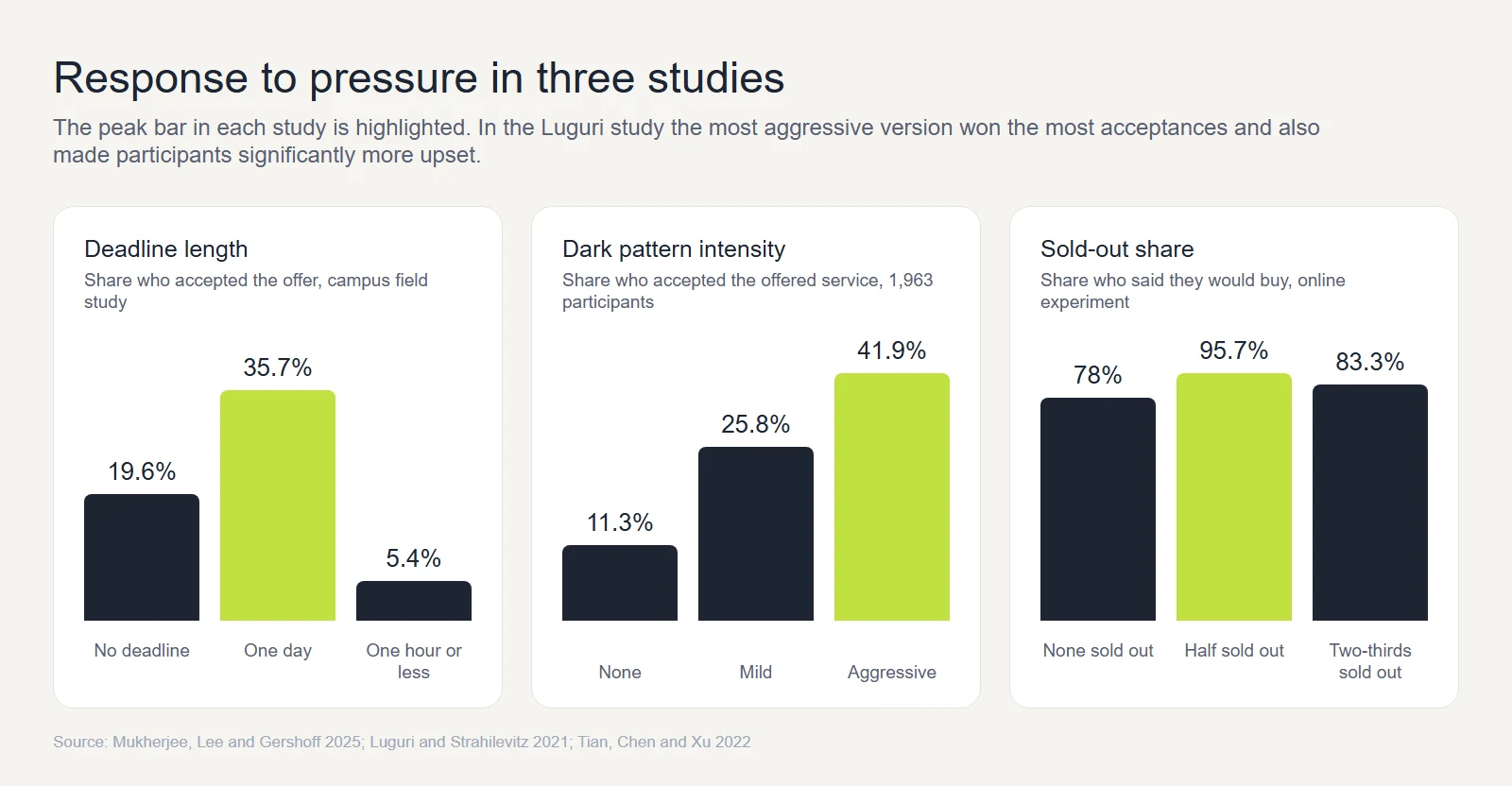
Extreme restrictions may reduce willingness to buy, while aggressive interface tactics can secure sign-ups at a cost to goodwill. These three experiments measured different behaviors, so compare the conditions within each study.
| Pressure level | Study | Result |
|---|---|---|
| No deadline, a one-day deadline, a deadline of an hour or less | Mukherjee, Lee and Gershoff 2025, campus chocolate field study | 19.6%, 35.7% and 5.4% accepted the offer |
| No dark pattern, mild, aggressive | Luguri and Strahilevitz 2021, 1,963 participants | 11.3%, 25.8% and 41.9% accepted the service; aggressive patterns "generated a powerful backlash" |
| No options sold out, half sold out, two-thirds sold out | Tian, Chen and Xu 2022, online experiment | 78%, 95.7% and 83.3% intended to buy |
The apparent gains need some context.
The gap between no deadline and a one-day deadline in the chocolate study was marginal (p=.057), and the drop from half to two-thirds sold out was also marginal (p=.07).
In the Luguri study the aggressive version won the most acceptances and also made participants significantly more upset, so a conversion win can carry a hidden cost.
For a real promotion, the time buyers have to evaluate the offer is particularly important. The 2025 paper adds a freedom effect: when store flexibility was high, 63% chose the time-limited deal, and when it was low, only 42.2% did.
Use deadlines for genuine offers and give buyers enough time for the purchase they are considering.
That's the test I'd use when reviewing urgency hooks. inBeat's own list of ad hooks includes FOMO hooks, and they can lift engagement. These experiments are a reason to test where urgency starts hurting response in your own audience.
Which Audiences Show the Strongest Reactance?
Committed customers may be particularly sensitive to assertive advertising. The evidence comes from the "Just do it" study with undergraduates (N=84), which gave participants a USD 25 gift card to allocate:
- Committed participants allocated an average of USD 13.91 after a non-assertive ad and USD 7.37 after an assertive one.
- Uncommitted participants allocated USD 4.79 after a non-assertive ad and USD 5.96 after an assertive one, a difference that was not statistically significant.
The student sample and lab setting make this a useful reason to prioritize retention tests. Predicting a specific sales impact would require evidence from your own accounts.
A founder told me on a call that her angriest commenters were also her repeat buyers, and that she'd read it as engagement until she looked at what they were saying.
Her observation is consistent with the lab finding, although repeat buying and brand commitment are different things.
Brand commitment is only one possible explanation. Individual differences and the source of the message also deserve attention.
- Person and culture. Trait reactance varies by person, and psychologist Cristel Russell notes in Psychology Today that it also varies by culture.
- Source and trust. inBeat's piece on manufactured intimacy summarizes a 2023 experiment with 210 Chinese university students in which stronger parasocial relationships reduced resistance to food-related product placement. The sample is small and the category narrow, so I treat it as a lead.
How to Spot Reactance in Your Ad Account
Hostile comments and rising negative feedback can alert you to reactance. Treat these five signals as diagnostic clues, then test whether the wording is contributing to the problem.
| Signal | Where to find it | What it likely means | Check next |
|---|---|---|---|
| Hostile or sarcastic comments | The ad's comment section | Possible objection to wording or targeting | Read 30 comments and sort by reason |
| Rising hide or report feedback | Ads Manager, where the platform shows it | Possible irritation or perceived intrusion | Compare with the previous creative |
| Click-through rate flat while conversion falls | Ads Manager and analytics | Possible mismatch between clicks and purchases | Test a softer headline |
| Fast bounces after high-click ads | Landing page analytics | Possible mismatch between ad and landing page | Compare the ad copy and the page headline |
| Frequency rising while click-through falls | Ads Manager | Fatigue or reactance | Compare wording and creative freshness separately |
My first check is the comment section, because comments often reveal why buyers dislike an ad. Start with 30 comments, grouping them by reason: price, repetition, tone, trust.
Complaints about tone give me a reason to test the headline first. Complaints about repetition put frequency higher on the list.
Repetition can contribute to both fatigue and reactance.
A fresh visual with the same wording helps you test whether creative freshness is part of the problem.
Then compare two versions with identical visuals and different wording using a randomized audience split. If the softer message performs better, you have evidence that wording affects response.
The psychological mechanism still needs separate evidence. Ongoing creative testing supplies the baseline each signal is compared with.
Retargeting Frequency and Ad Fatigue: Where to Set the Cap
If complaints point to repeated exposure, the frequency benchmarks in inBeat's guide to Meta creative fatigue offer a starting point: roughly 2.5 for cold audiences and 5.0 for retargeting. Treat them as prompts to investigate performance over a consistent reporting window.
The appropriate cap depends on the purchase cycle, because a USD 15 product and a USD 400 product give a buyer very different amounts of time to decide.
A 2025 Epsilon survey of US consumers illustrates the trade-off: 58% reported choosing against a purchase because repeated ads annoyed them, while 31% reported making a purchase after multiple exposures.
These are self-reported experiences, so they cannot establish the ideal number of impressions.
Still, retargeting can bring potential buyers back.
A randomized field experiment found that switching it on made 14.6% more users return to the advertiser's site within four weeks. The outcome measured was returning visitors.
Use conversion efficiency and negative feedback alongside frequency when deciding how much exposure to allow. Frequency controls depend on the campaign objective and optimization settings.
Where a hard cap is available, inBeat's guide explains how to set a frequency cap in Ads Manager.
Those trade-offs make three checks especially useful for warm audiences:
- Test a lower exposure level for recent cart abandoners when repetition complaints or efficiency data justify it. Where caps are unavailable, adjust audience windows and budgets.
- Refresh the creative angle when performance and audience feedback suggest fatigue.
- Exclude recent buyers from acquisition retargeting as soon as conversion data permits, unless the campaign intentionally promotes a relevant repeat purchase.
How to Write Autonomy-Supportive Ad Copy
When the wording itself is the problem, autonomy-supportive ad copy gives buyers a clear benefit and room to make their own decision.
Early in my media buying I wrote "last chance" copy for most sales because it won the first test. Two weeks later the same audience stopped responding, and the comments were where I first saw why.
- Lead with one outcome. A single creative angle and offer keeps the ad from stacking asks the reader has to resist.
- Replace commands with invitations. "See the offer" lets the shopper evaluate it with less pressure. Test whether that invitation still communicates the intended next step.
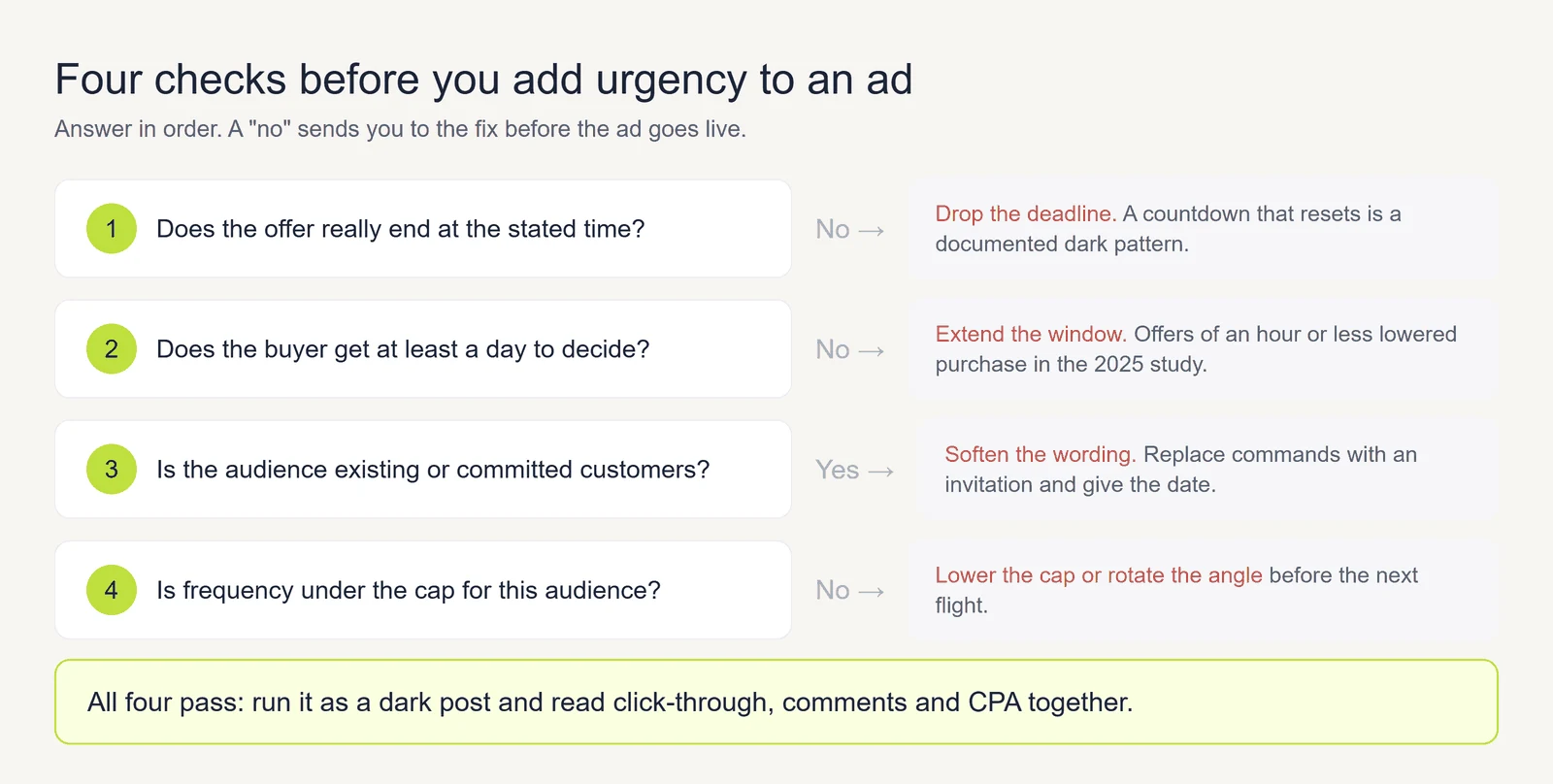
- State deadlines that are true and checkable. Give the date and time, and make sure the offer really ends.
- Give the reader an exit. A plain "No thanks" or "Maybe later" makes declining easy without implying that the shopper made a bad decision.
- Test "but you are free" lines on small asks only. Carpenter's 2013 meta-analysis of 42 studies found a weighted effect of r=.13, and a 2024 re-examination found that the seven low-risk-of-bias studies showed no clear effect (g=0.11, interval -0.18 to 0.40). I'd try it on a free offer and nowhere else.
- Let creators carry the claim. Fix the claims and leave the delivery open, because an over-specified brief reads as a script, and overly directive delivery may undermine the creator's credibility.
| Pushy version | Autonomy-supportive version | Why it works |
|---|---|---|
| "Don't miss out. Buy now before it's gone." | "The offer ends Sunday at 11:59 p.m. ET. See what's included." | A verifiable deadline and a clear next step, if the offer genuinely ends then |
| "You NEED to stop doing this to your skin." (TikTok hook) | "Three things I changed in my skin routine, and the one I'd skip." (TikTok hook) | It offers a story and leaves the reader to judge |
| "Claim your last chance" (CTA) | "Learn more" (CTA) | It asks for a small step and makes no claim about time |
These rewrites are untested inBeat illustrations.
If you want a team to rewrite your top ads on this logic, inBeat offers creative ad copywriting services.
Reactance Examples From Real Campaigns and Regulators
Public campaign results rarely isolate psychological reactance.
The following cases show the risks of pressure tactics and one brand's alternative approach; they cannot establish that reactance caused the reported outcomes.
| Case | What it did | What happened | Lesson |
|---|---|---|---|
| Patagonia, "Don't Buy This Jacket" (2011) | Ran a Black Friday ad telling shoppers to buy less | Sales rose almost a third, to USD 543M, in 2012, and the year included about nine months of the campaign | Sales rose, but the company was also opening new stores, so the ad can't take the credit |
| Six UK booking sites (2019) | Gave false impressions of room popularity and availability | CMA commitments to stop false availability and popularity claims | Pressure that can't be verified draws enforcement |
| Emma Sleep (2022 and 2026) | Ran a flash-sale countdown while another sale started right after | The ASA upheld the complaint in 2022, and a High Court order followed on 22 May 2026 | A deadline that isn't a deadline is a legal risk |
Patagonia's ad is often filed under reverse psychology marketing or the forbidden fruit effect, and the numbers don't prove that. I'd call it a brand-values campaign that happened to coincide with growth.
The public studies establish a reason to test autonomy-supportive copy, but they give limited evidence about paid-social conversion outcomes.
Treat the example rewrites as testable hypotheses.
How to Test Reactance in Paid Social Copy
To find out whether the same effects apply to your own campaigns, test one wording variable at a time. Use a controlled audience split and assess conversion efficiency alongside comments and click-through rate.
- Change one variable. Test a command against an invitation, or a deadline against no deadline, and keep the rest identical. inBeat's guide to A/B testing UGC ads covers CTA wording and placement, which is the cheapest variable to start with.
- Match audience and budget. Use Meta's split-testing tools to randomly assign people to non-overlapping groups from the same eligible audience. Keep placements, optimization, budget, creative assets and the landing page consistent so the wording is the main planned difference. Name each variant with the variable it tests, such as "invitation opener", so the readout stays legible a month later.
- Run each variant as a dark post. A dark post keeps the variant off your organic page feed, although targeted followers may still see it as a paid ad. The guide to dark posting for creator content shows how to keep the test clean.
- Read the metrics together. A variant can attract more clicks yet produce a higher cost per purchase. Check conversion tracking, landing-page behavior and comments about tone before attributing the difference to reactance. The test can establish the effect of the wording more readily than the psychological mechanism behind it.
- Set a spending and decision rule. For exploratory tests, consider a spend guardrail of three to five times target CPA if a variant generates no purchases. For a controlled experiment, define the duration, minimum sample and success criterion in advance to avoid distorting the result through early stopping.
Log each result in a sheet so the next test starts from evidence:
- The variant name and the spend.
- The outcome.
- One line on what the comments said.
- A copy pressure level, from none to strong, so patterns across tests show up when the sheet has ten rows.
I ran the same offer with a command opener and an invitation opener for a week. The command won on click-through rate and the invitation won on cost per purchase, so I kept the invitation.
Sample size decides how far to trust a result.
Plan the sample around baseline conversion rate and the minimum effect worth detecting. Early gaps may reflect random variation, so assess the result after the planned test period and relevant conversion lag. I'd rerun any surprising winner once before rewriting a whole account around it.
When Aggressive Advertising Still Works
Milder, truthful urgency can be worth testing for straightforward offers. Aggressive dark patterns may produce immediate acceptance while damaging goodwill; the experiments above show why short-term sign-ups alone are a poor basis for a creative decision.
When deciding whether to test urgency, I look at three conditions:
- The decision is relatively easy to evaluate, such as a transparent free trial or a low-priced add-on.
- The audience has little established brand commitment, which the lab experiment suggests may change the response to assertive wording.
- The claim is true and checkable, such as a real end date.
A USD 10 impulse purchase gives me more room to test truthful urgency. For a USD 300 purchase, reassurance would be my first test, with enough time for buyers to evaluate the offer.
The experiment measured immediate dissatisfaction, so the longer-term business cost remains a question for your own data.
I'd compare repeat purchase rate and unsubscribe rate across pushy and soft cohorts before declaring a winner on first-purchase conversion alone.
Build Lower-Pressure Ad Creative With inBeat Agency
Start the audit with high-engagement ads where purchase efficiency is declining, especially when repeat buyers complain about the wording.
Once you've identified those ads, test one headline or CTA while keeping the offer intact. That gives you a clearer basis for deciding whether to revise the message across the account.
If you want help applying it, book a strategy call and bring your top five ads. The call covers which lines carry pressure and how to test them against your budget.
FAQs
Does reactance still apply to a cart abandoner who already showed intent?
Yes, it can. Cart abandonment shows interest in a product, but it does not establish brand commitment. I'd start with a low-pressure reminder and monitor exposure before adding urgency.
Do "Shop Now" buttons trigger reactance?
A standard "Shop Now" button is not inherently evidence of reactance. The studies discussed here examine assertive messages and pressure; the button label itself was not isolated. I'd keep the button and soften the headline and body copy.
How do I separate reactance from ordinary fatigue in Meta Ads Manager?
Test creative freshness with the wording fixed, then test assertive versus invitational wording with the visual fixed. Randomly split eligible audiences where possible. Comments about repetition or tone can guide the diagnosis, but neither pattern establishes reactance by itself.
Does a real sale deadline trigger reactance the way a fake countdown does?
In the chocolate study, a one-day deadline increased acceptance relative to no deadline, although the difference was marginal. The deadline of an hour or less drew much lower acceptance. The ASA ruling on Emma Sleep turned on the deadline being false, because another sale began right after it ended. Even a genuine deadline can feel restrictive if buyers have little flexibility.
Does reactance change when a creator delivers the claim?
Possibly, though the evidence is thin. A small 2023 student experiment found stronger parasocial bonds reduced resistance to product placement. A tightly scripted hard sell from a creator can reintroduce the pressure.