

Your best-performing ad at home might be the first thing you need to rethink abroad.
In an Ipsos analysis of more than 1,200 ads, only 31% achieved the same level of performance when tested across countries. A translated headline and a new location setting can only take you so far.
Before launching in another market, you need to know where to spend, how much to test, which creative elements to adapt, and how to judge results locally.
Here's how we approach international paid social in seven steps, from selecting the first markets to deciding which campaigns deserve more investment.
TL;DR: The Seven-Step Answer
- Markets: rank candidates on five criteria and fund the two or three that pass.
- Platforms: start with one primary paid platform per pilot market, then add others when results and budget support expansion.
- Structure: group campaigns by country, language cluster, or cost tier, and keep ad sets few enough to clear learning.
- Budget: use target cost per optimization event × 50 as a Meta learning-volume planning estimate, rather than a guaranteed minimum.
- Creative: build one master concept, then choose to translate, adapt, transcreate, or re-shoot per market.
- Rules: set privacy, disclosure, and usage-rights checks per country before launch.
- Measurement: judge each market on its own CAC, run geo holdout tests once a market's spend is large enough, and scale only what clears your scale rules.
Our view: the creative is part of the targeting. Who appears in the ad, which objection they address, and how they speak to the audience all shape who responds.
That makes local relevance a planning decision, not a final translation check. Before funding a new country, ask whether your offer and proof will make sense to the buyers you want to reach.
P.S. If you would rather have a team run the pilots, our paid social agency plans and buys media across markets. Book a free strategy call.
What Is an International Paid Social Strategy?
An international paid social strategy sets out where to advertise, what to run in each country, and how to decide which markets earn more budget.
It brings media allocation, account structure, creative adaptation, local requirements, and performance measurement into one plan.
Organic international social media marketing focuses on publishing and community engagement. Paid social adds decisions about bidding, budgets, attribution, and local acquisition costs.
Across countries, you also need a fair way to compare results when costs, audiences, and operations differ. Creator content can supply the ads, but media buying still needs to reflect each country's economics.
Four terms will come up throughout the process:
- Market: one country, plus the language or languages you advertise in there.
- Master concept: the core idea, angle, and proof structure of an ad before any market adapts it.
- Localization: the umbrella for everything done to a master concept for a market.
- Transcreation: rewriting the idea for a market so it keeps its intent and effect in the new language.
Step 1: Prioritize Target Markets Before You Spend
Score candidate markets against five criteria, then choose two or three you can fund properly. Spreading the same budget across ten countries may produce activity without enough data to make a useful decision.
| Criterion | Question to answer | Evidence source | Go or hold signal |
|---|---|---|---|
| Audience size | How many people in the target segment can the platform reach there? | Ads Manager reach estimate by country | Estimate comfortably above the budget's reach needs |
| Readiness | Can you ship, accept local payment methods, show prices in local currency, and serve a landing page in the ad's language? | Operations and checkout audit | All four work before the first ad runs |
| Competitive intensity | How many local and global advertisers run similar ads? | Platform ad libraries | Visible gaps in angle or format |
| Margin per order | Does the unit economics survive local costs, duties, and returns? | Finance model | Positive after local costs |
| Creative fit | Can your message land without a new product story? | Concept check with local creators | Concept survives a local read |
Operational readiness can decide whether the test succeeds.
A Portuguese ad sending people to an English landing page can inflate CPA even with good targeting. That's why we make the landing page match the localized ad before launch, so the test reflects demand rather than a language mismatch.
Choose location targeting deliberately.
Meta's location controls generally reach people living in or recently in the selected area, rather than giving advertisers a dependable separate residents-only option. Check the controls available in your account and use first-party purchase or delivery locations to assess who actually converts.
Plan for a 60- to 90-day pilot, with an initial scale, hold, or cut review after about 30 days. The later review gives slow-moving conversion cycles more time to develop.
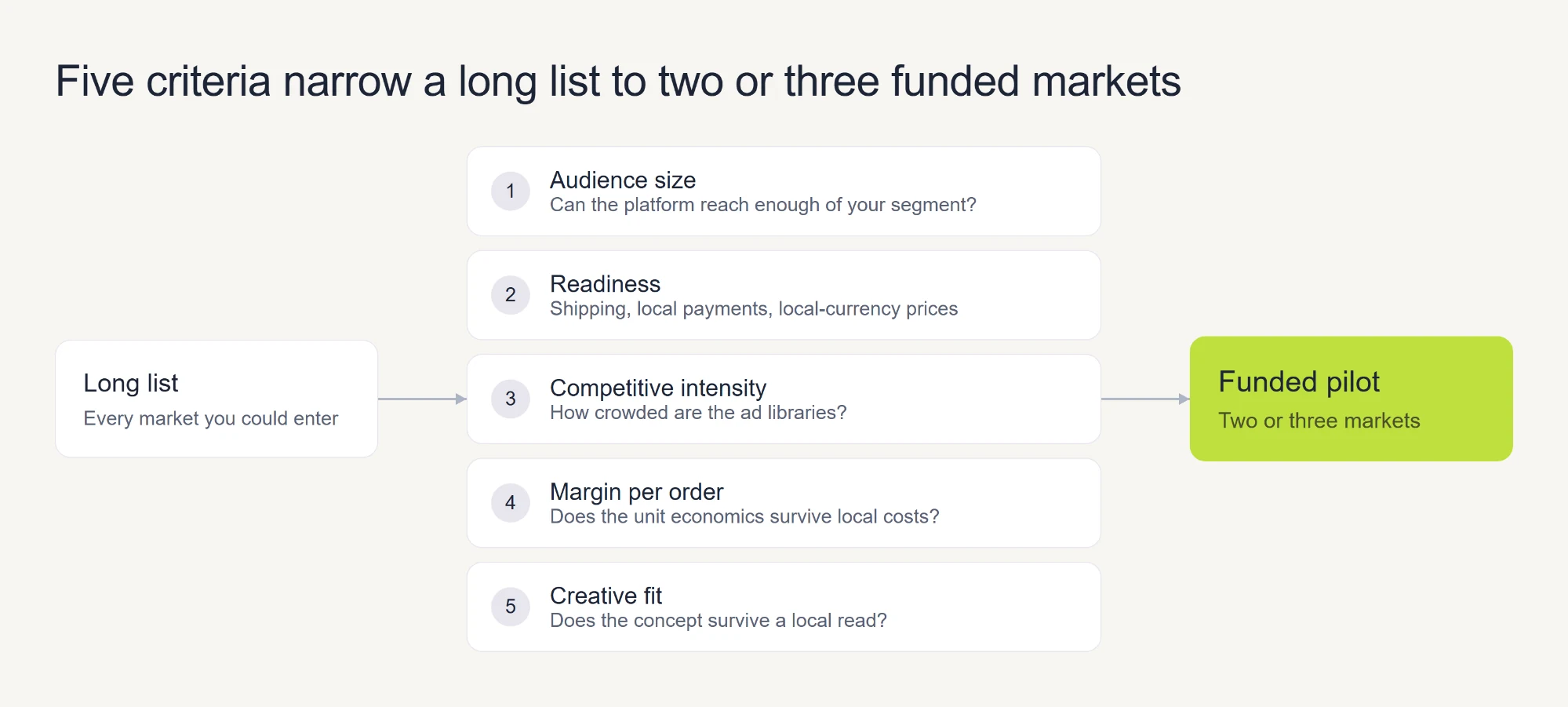
With that shortlist in place, Step 4 explains how to turn it into a test budget.
Step 2: Choose Paid Social Platforms by Market
Once you know which markets are viable, choose the platform most likely to reach buyers in each one.
Start with a single channel and add another when the budget can support a useful test. Confirm local ad availability, formats, and category restrictions first.
Next, see what competitors actually run. Ad libraries and social listening help you compare their formats, offers, and messaging. A quiet channel could signal an opportunity, low demand, or limited ad access, so investigate before assigning spend.
Salesforce used LinkedIn for paid social within a broader campaign targeting mid-market businesses in India. It also tested messaging tailored to local retail companies;
LinkedIn reports that the locally relevant version doubled engagement in an A/B test. The result shows why channel choice and local messaging work best when planned together.
| Market cluster | Platforms to evaluate | Local platform to evaluate | What to verify before launch |
|---|---|---|---|
| US, Canada, UK, Western Europe | Meta, TikTok, YouTube | LinkedIn for B2B | Category ad restrictions and reach estimates |
| Japan, South Korea, Taiwan, Thailand | Meta, TikTok, YouTube | LINE, KakaoTalk | Ad product access and any local partner requirement |
| Mainland China | Local platforms such as Douyin and WeChat | Not applicable | Local entity or authorized partner |
| Latin America | Meta, TikTok, YouTube | WhatsApp click-to-message ads | Payment options and currency |
| Gulf states | Meta, TikTok, Snapchat | Not applicable | Local ad content rules |
Use the table to build a shortlist, then confirm availability and restrictions in each country's platform documentation. Both can change.
Even after choosing a channel, its placements can change.
DataReportal found that the potential reach of ads on Messenger fell by more than 95% in six months in Meta's planning tools, after Meta stopped delivery to the Messenger inbox placement. Revisit reach by country and placement each quarter instead of relying on last year's forecasts.
Step 3: Structure Campaigns by Country, Language, or Cost Tier
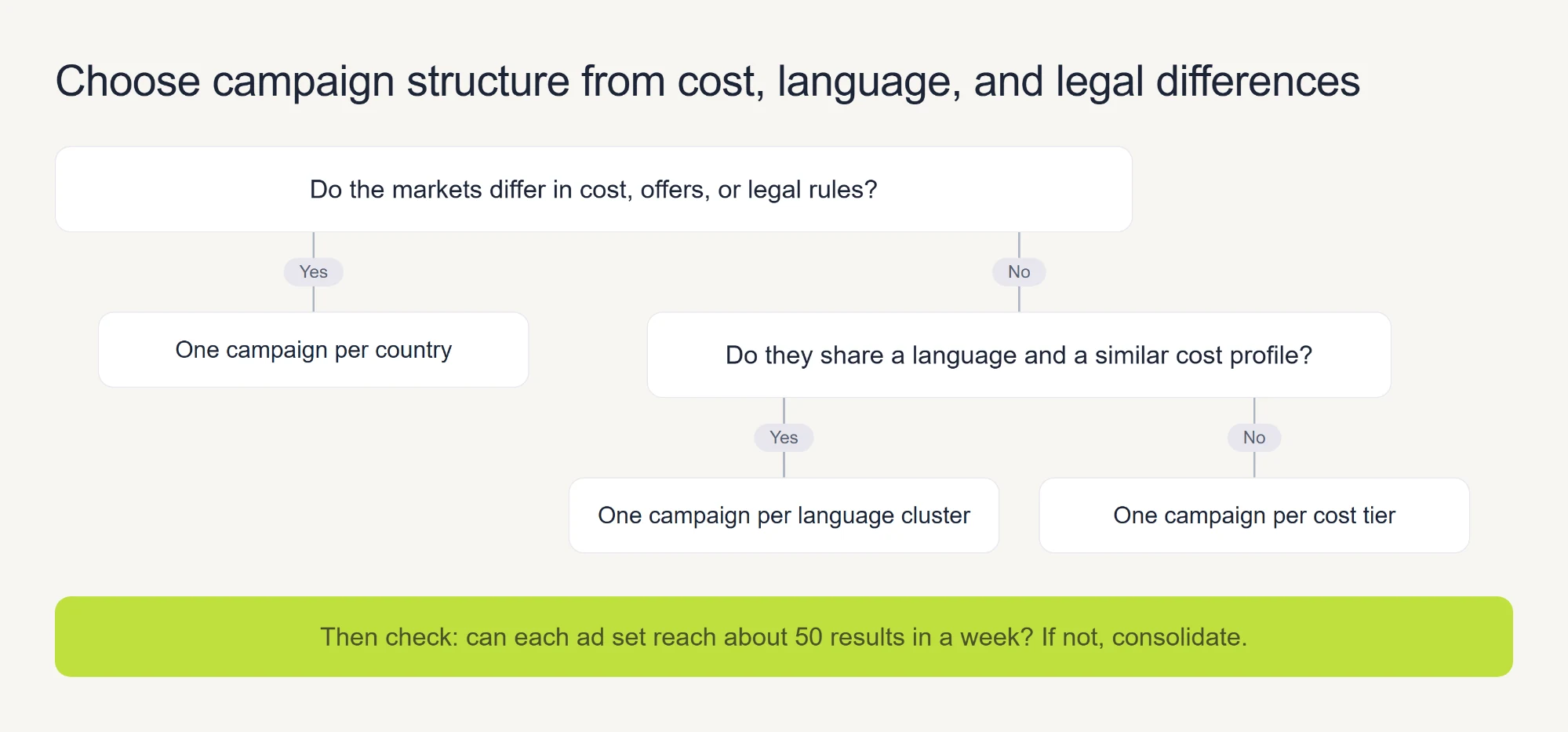
Now decide how much separation each market needs. Use country-level campaigns when offers, costs, or rules differ; language clusters when economics are similar; and cost tiers when cheaper countries would otherwise take most of the spend.
Keep the structure simple enough to gather useful data.
| Structure | Best fit | Main risk | Signal to switch |
|---|---|---|---|
| One campaign per country | Markets with different costs, offers, or legal needs | Many small ad sets that stay in learning | Ad sets repeatedly learning-limited |
| One campaign per language cluster | Several countries sharing a language and similar costs | Delivery drifts to the cheapest country | One country takes most of the spend |
| One campaign per cost tier | Mixed portfolio of high-cost and low-cost markets | Different audiences share one creative set | Conversion rates diverge inside a tier |
That separation comes at a cost when conversion volume is low.
Meta advises advertisers to consolidate similar content into fewer ad sets. Keep only the distinctions needed for cost control, reporting, and compliance.
Centralize reporting, naming, and budget oversight while allowing account structure to reflect local billing, currencies, legal entities, and platform requirements. Countries can share an account where appropriate and still have distinct creative, landing pages, and performance reporting.
Language settings also vary by platform.
On Meta, dynamic language optimization lets one campaign serve up to 48 additional languages, with headline, primary text, and URL set per language.
Per-language URLs work only with traffic, engagement, leads, or sales objectives, so check the objective and ad type before you plan a language rollout around it.
Step 4: Allocate Your International Social Media Advertising Budget by Market
Meta's roughly 50 optimization events per ad set per week is a planning reference, rather than a guaranteed budget floor. Multiply the expected event cost by 50 to estimate spend for that volume, then adjust for actual delivery.
Estimate a Test Budget for Each Market
For each market, multiply the expected cost per optimization event by the event volume you want to collect. Here are two illustrative scenarios rather than fixed minimums:
- Market A: at $30 per optimization event, 50 events would imply roughly $1,500 per ad set per week.
- Market B: at $8 per optimization event, 50 events would imply roughly $400 per ad set per week.
TikTok's budget guidance also varies by optimization event and includes CPA-based starting points. Check the current recommendation for your event and adjust it against actual conversion costs and volume in each market.
If the budget spreads conversion volume too thin, reduce the number of markets or consolidate similar ad sets. Then give the test time to settle, while still fixing genuine delivery or tracking problems.
Split Core and Test Budgets
Once performance data starts coming in, compare expected customer lifetime value with acquisition cost, margin, and payback. Cheap conversions are less attractive when those customers spend less or cost more to serve.
From there, divide spend between established markets and new tests. A 70/30 core-to-test split is one starting point, rather than a fixed rule. On a first international launch, every market remains a test, so use early results to adjust the allocation.
Handle Currency, Billing, and Tax
Confirm billing details early, since account currency can be difficult to change later.
Meta lets you change an ad account's currency only once every 60 days and only without a current balance, and the change creates a new ad account. Accounts on monthly invoicing cannot change currency at all.
Next, account for taxes that may sit on top of media spend.
Meta states that a daily budget does not include VAT, so the total charged can exceed it, and that VAT treatment depends on the country of the "Sold To" address.
TikTok deducts taxes from the account balance according to the advertiser's regional tax policy. Ask finance which entity will pay in each market, and whether VAT can be recovered.
Step 5: Localize Ads: Translate, Adapt, Transcreate, or Re-Shoot
Start with a master creative concept, then decide whether the market needs a translation, light adaptation, rewritten hook, or new footage.
Keep the central promise recognizable while tailoring the details that affect local response.
| Tier | What changes | When to use it | Time and cost driver | Test before scaling |
|---|---|---|---|---|
| Translate | Words and on-screen text | Product-led ads with little cultural content | Word count, review time | Native-speaker read, then pilot |
| Adapt | Text, offer, visuals, and format details | Same idea, different norms for price, units, or imagery | Asset versions, approvals | Pilot against the master as control |
| Transcreate | The line, joke, or hook is rewritten for the market | Humor, wordplay, slang, or emotional claims | Copywriter time per market | Concept check, then pilot |
| Re-shoot | New footage with local talent | Persona or setting must feel native | Casting, production, licensing | Small paid pilot before volume |
Test the original master concept alongside its localized version in the pilot market. That comparison helps show whether the changes improved results enough to justify the extra production work.
Sephora applied this approach to TikTok creative across Malaysia, Thailand, and Australia.
It produced 12 UGC-style assets in a month with captions adapted to local markets. TikTok's case study reports 4.13 times as many conversions and a 134% higher conversion rate. These are campaign-level outcomes, so they illustrate Sephora's production approach without isolating the effect of localization.
For video, the choice between dubbing and subtitles depends on audience habits, cost, and how much spoken copy carries the message. Native-language voiceover can extend proven footage into smaller markets without a full re-shoot.
Treat in-platform translation as a first draft.
Meta's generative AI text translation covers single image, video, and carousel ads, and the translated text cannot be edited, so a native speaker should review wording before the ad goes live.
Humor, emotional claims, and culturally specific references deserve an extra review before production. A small focus group or a check with local creators can reveal wording and visuals that audiences interpret differently.
Teams that want help with the production side can talk to our performance creative agency.

Step 6: Set Compliance, Disclosure, and Usage-Rights Rules per Country
Before launch, give each country a short rule sheet covering privacy, disclosure, and creator licensing. It makes legal and creative reviews easier to coordinate across markets. Confirm the details with counsel; this section is not legal advice.
Privacy and Consent
In the EU, the Digital Services Act imposes advertising transparency duties on platforms, restricts targeting based on sensitive personal data, and prohibits profiling-based ads to minors when the provider knows with reasonable certainty that the recipient is a minor.
Although these duties primarily apply to platforms, they affect the targeting and disclosure options advertisers see. Check with legal how consent requirements affect pixel and server-side event tracking in each EU market, since missing consent can reduce measured conversions.
Ad and Creator Disclosure
Disclosure needs its own review step rather than being left entirely to creators. In 2024, a European Commission sweep of 576 influencers found that 97% posted commercial content but only 20% systematically disclosed it.
Spell out disclosure requirements in creator briefs and approval checklists. For US campaigns, refer to the FTC's endorsement guidance; in the UK, check Advertising Standards Authority rules.
Creator Usage Rights by Territory
Set out usage rights in the creator agreement: territory, channel, duration, and permitted edits. Spark Ads authorization controls access inside TikTok, while the contract determines where and how a brand can legally use the content.
For a two-country pilot, license only the territories and placements you expect to use. Budget separately for later extensions and cross-border payments, rather than paying for worldwide rights upfront.
| Area | EU | UK | US | What to check before launch |
|---|---|---|---|---|
| Targeting data | Sensitive-data targeting restricted; profiling-based ads to minors prohibited | Confirm with counsel | Confirm state-level rules | Audience definitions and exclusions |
| Ad labeling | DSA ad labeling duties on platforms | ASA rules | FTC endorsement guidance | Disclosure wording in each language |
Step 7: Measure Performance Across Markets and Decide Where to Scale
After the pilot, review each country's results alongside the full portfolio, then decide whether to scale, hold, or cut.
Because ROAS is a ratio, currency differences alone do not make it incomparable. Attribution windows, refunds, taxes, margins, and conversion definitions matter more.
Report Each Market on Its Own CAC and a Blended MER
First, separate the metrics: CPA measures an optimization action, CAC measures an acquired customer, and MER compares total revenue with total marketing spend.
For DTC, check CAC and margin; for apps, downstream customer value; for B2B, qualified leads and pipeline. Use a shared reporting currency and consistent country-language UTMs.
Validate With Geo Holdout Tests
Run a geo holdout incrementality test when a market's spend is large enough to move sales.
Platforms publish geo-lift evidence too: a Circana analysis of 97 geo-lift studies across the UK, France, Germany, Spain, Italy and the Netherlands, published by TikTok, reported an average 2.7% in-store sales uplift against a 2.3% social benchmark. Treat vendor-published studies as directional.
A cross-market average can hide meaningful differences.
In a TikTok for Business N26 case study, Spain recorded +37% installs and +43% registrations, while Germany recorded +47% and +49%, respectively. Report each market independently before combining the results.

Apply Scale, Hold, or Cut Rules
Agree on the decision rules before the first ads launch. At the 30-day check, the goal is to know what to test next, even if a final scaling decision needs more data.
| Signal at the 30-day check | Decision | Next test |
|---|---|---|
| Enough optimization events; CAC and margin meet targets | Scale in steps | Add a second creative concept |
| Enough events; CAC above target but improving | Hold | Test a new angle or landing page |
| Too few optimization events for a reliable read | Consolidate or replan | Pool volume; review event and budget |
| Enough data; CAC above target without improvement | Cut or pause | Reallocate to the next-ranked market |
Which Operating Model Works for Global Paid Social: Centralized, Hub-and-Spoke, or Local?
A small pilot usually works best with centralized decisions.
As markets become more varied, a hub-and-spoke model can help: one team coordinates budgets, reporting, and standards while local specialists review messaging, offers, and compliance. Make that shift when the workload calls for it, rather than at a fixed country count.
Volkswagen offers a useful example of central coordination with local creative production.
For a TikTok campaign promoting its electric ID. range, creators across nine European markets worked from a shared brief and filmed locally.
The brand amplified their content through paid formats and reported reaching 40.2 million people. That gave Volkswagen one shared brief without requiring identical executions in every country.
| Model | Who decides | Best fit | Failure mode |
|---|---|---|---|
| Centralized | One team controls accounts, budget, and creative | Small pilots with similar markets | Local nuance gets missed |
| Hub-and-spoke | Hub owns accounts, data, and budget; locals own review | Multiple markets with different local needs | Slow approvals if roles blur |
| Local | Each market runs its own ads and budget | Markets with separate legal entities | Duplicate work and split learnings |
When people work across time zones, clear handoffs keep approvals and creative changes moving. Tag assets by country, language, and licensing terms in a shared library so everyone knows which version they can use.
The next decision is who owns what.
Some brands keep accounts, data, and budget in-house while a partner handles creative and new-market launches; our guide to in-house or agency media buying covers those trade-offs. Either way, assign budget, creative, and approval ownership before launch.
How Much Does International Paid Social Cost?
Media spend is only the starting point. Include creative localization, licensing, translation and voice work, tools, and local review when estimating the cost of each country.
| Cost line | Typical driver | How to estimate |
|---|---|---|
| Creative localization | Number of markets and tier | Versions per market × per-version quote |
| Creator licensing | Territory, channel, duration | Quote per creator and license term, plus how to pay creators across borders without delays |
| Translation and voice | Word count and talent per language | Words × vendor rate, plus talent fees |
| Tooling | Asset library, reporting, translation tools | Seats and volume |
| Local review | Legal, brand, and language review | Hours per market per round |
Ask vendors to quote the exact countries, formats, and deliverables you need. That gives you a fuller cost per market, including the production expense of a pilot you may ultimately stop.
How Does International Paid Social Differ for DTC, App, and B2B Brands?
The same seven-step framework applies to DTC, app, and B2B brands, although each measures success differently. The table shows where the plan needs to change.
| Business type | Primary risk | What changes in Steps 1 to 7 |
|---|---|---|
| DTC ecommerce | Shipping, returns, local checkout | Step 1 readiness gates and Step 4 tax and currency matter most |
| App | Store availability and install quality | Step 4 sizes budgets around install costs; Step 7 tracks downstream app value |
| B2B | Small audiences and long sales cycles | Step 2 favors LinkedIn; Step 7 uses lead quality as the main metric |
Common Mistakes in International Paid Social Campaigns
- Dividing a limited test budget across too many markets or platforms before any can generate useful data.
- Comparing platform ROAS without aligning attribution, margins, and refunds.
- Assuming a translated home-market winner will perform equally well abroad.
- Sending a localized ad to a landing page with the wrong language or offer.
- Buying worldwide creator rights for a limited-territory pilot.
- Making constant ad-set edits before results stabilize, while ignoring genuine tracking problems.
Build an International Paid Social Strategy With inBeat Agency
Every new market brings its own audience, costs, and creative questions.
That's why we plan media, production, and measurement together rather than treating localization as the last step.
At inBeat Agency, we help brands choose where to test, produce local variations of proven concepts, and agree on the criteria for scaling before the first campaign launches.
Book a strategy call to walk through your markets, budget, and creative plan with our team.
Frequently Asked Questions
Should one ad set target several countries or one per country when budgets are small?
Separate ad sets make sense when country-level costs or offers differ. If budgets are tight, combining similar markets may provide enough conversion volume to learn. Watch delivery by country so the lowest-cost audience does not absorb the test.
How do you set a CPA target in a market with no baseline?
Start with home-market acquisition costs, then adjust for local order value, margin, and conversion rates. Treat the number as a working estimate until the pilot produces enough reliable conversions to replace it.
Does a winning US creative transfer to another country unchanged?
Sometimes. Test the original ad against a local version under comparable conditions, then judge them on the same outcome. If the adaptation wins, use what you learned to guide the next round of creative.
How long should a new-market pilot run before you call it?
Review the first results around day 30, then revisit the decision over 60 to 90 days if the buying cycle calls for it. Learning status alone cannot tell you whether a test is reliable; look at conversion volume, customer economics, and the direction of results.
How should currency swings change budget?
Review budgets at a consistent cadence and report spend, revenue, and acquisition costs in one currency. When exchange rates move substantially, check their effect on margin and payback before shifting budget.
How do you attribute sales when a creator video in one country drives purchases in another?
Country-level UTMs and paid location settings help separate intended audiences, but cross-border purchases can still occur. Use first-party customer location to identify that spillover, then consider a geo-based incrementality test when the volume warrants it.