.svg)
.svg)
.svg)
.svg)


.svg)






Mashup ads win paid social for a supply reason. A creator library of twelve clips is a fixed asset when each clip ships as one finished ad. The same twelve clips become dozens of distinct candidates once you treat them as modules and cut them into new arguments. That matters because Meta's delivery system rewards creative that is genuinely different and allocates spend to maximize results across the whole campaign, which is also why grading a mashup on its own average CPA misleads you, as Jon Loomer's explanation of the breakdown effect lays out. This article covers what separates a mashup from a compilation, how it compares with single-creator UGC, why Andromeda-era retrieval favors it, how to read the tests honestly, and how to build and scale a library without a reshoot every month.
P.S. If your creator library is bigger than your editing bandwidth, inBeat's performance creative team cuts and tests mashup matrices as part of one growth creative system.
We think of a creator as an engine that produces parts, and we think of a finished creator video as the least interesting thing it produces. The hook, the demonstration, the offhand line that answers an objection: those are the parts. A mashup is what you get when you stop shipping parts as whole ads and start assembling arguments from them. That's also how targeting works now. The face on screen and the angle in the first two seconds decide who watches, so a library of recombinable modules is a library of audience tests. Media buying is where those tests run. Dark-post the matrix, read blended CAC, scale what earned it.
TL;DR: why mashup ads win paid social
- A mashup ad splices clips from several creators into one hook-to-CTA narrative. A compilation stacks clips in a row. The difference is editorial intent: a mashup argues one claim, a compilation just shows footage.
- Mashups multiply testable creative from footage you already own. A brand holding twelve creator videos can cut dozens of variants without booking a shoot, and that supply matters more as delivery systems reward diversity over volume of near-duplicates.
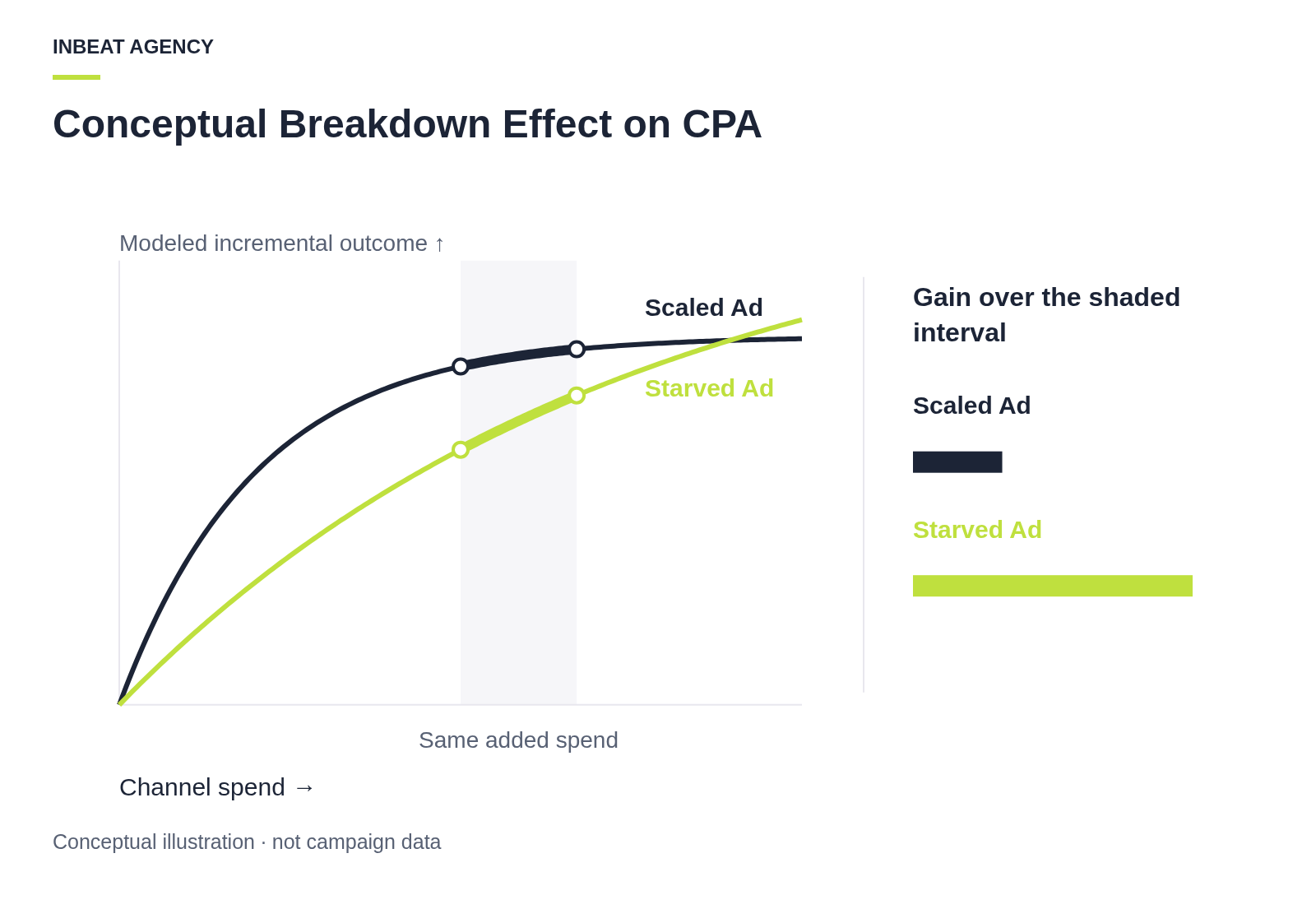
- Judge mashups at campaign level. Costs rise with spend on any single asset, so the variant Meta scaled tends to look worse on average CPA than it really is, a pattern Jon Loomer describes as the breakdown effect.
- Assemble every edit from four modules drawn from different creators: hook, proof stack, objection handle and CTA. When a variant underperforms, rebuild only its weakest module.
- Scale by feeding winning hooks and objections into the next batch of creator briefs, not by pouring budget onto one edit.
A mashup ad is an edited argument, not a compilation
A mashup ad is clips from multiple creators, or multiple takes from one creator, cut into a single structure that runs from hook to call to action. The word travels from music, where a mashup combines existing recordings into a new work while a playlist only queues them, a distinction the Internet Policy Review analysis of mashup music turns on. The advertising version borrows that logic: the source clips already exist, the new work is the argument.
Compilations stack clips; mashups sequence them toward one claim
The montage or highlight reel that circulates under the same name puts six creators in a row and lets the viewer draw a conclusion. A mashup decides the conclusion first, then picks the clips that carry it. The problem-solution frame is the dominant shape, and the stealthoseads teardown of a problem-solution mashup shows how tightly the edit has to hold to one pain and one fix. That frame has a limit: it flattens products with several benefits into one, so plan on one mashup per benefit; a single mashup for the whole brand won't hold together.
The four modules every mashup carries
Every mashup that holds together has a hook, a problem or desire framing, a proof stack in which several faces agree on the same point, an objection handle, and a CTA. The AdCollection issue on UGC mashups shows what the proof stack looks like in practice: multiple personas gathered around one winning hook. Your first action is an audit. Tag every clip in your library by which of the four modules it can serve, and you'll see how many arguments the footage can already carry.
A mashup is one candidate in a campaign
The format only makes sense as a unit in a testing matrix. Meta allocates spend to maximize total results across the campaign, with no reward for each ad's standalone efficiency, as the breakdown effect explanation describes, so no single mashup is ever judged in isolation by the system. Plan for a set of variants, never for one hero edit.
Mashups beat single-creator UGC on supply, not on charisma
Mashups win against single-creator UGC on supply and on compounding proof. They lose on the depth of one person's likability. Which side matters depends on how much fresh footage you can afford each month and how much your category relies on one trusted face.
Single-creator UGC has a ceiling set by one persona and one shoot
A single-creator asset fatigues as one unit. When its hook stops working, the whole ad stops working, and you cannot swap the opening without going back to the creator for another round. Every angle you want to test costs a brief, a fee, a turnaround wait and a review cycle. That's fine when one creator's persona is the entire pitch, and it's a bottleneck when you need a new hook every week.
Mashups turn the same footage into a persona and angle matrix
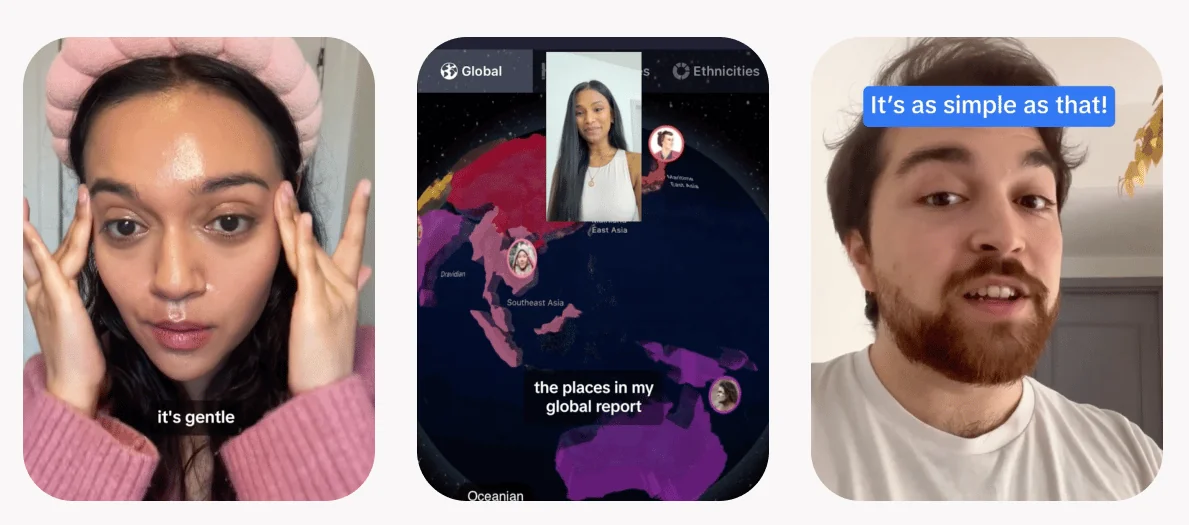
With N creators and M angles, a mashup library gives you an N by M grid of testable candidates from footage you already own. The AdCollection examples built for Squeeze Skin, NielsenIQ and GenomeLink illustrate the pattern: diverse personas cut around one claim. Social proof also compounds here. Several unrelated faces agreeing on the same point reads as consensus in a way one enthusiastic person never can. The cost logic is a comparison of inputs, since we have no sourced savings figure to offer: a mashup costs editing hours on existing rights, while net-new creative costs creator fees, briefs and calendar time. Precis frames the alternative cost in its piece on rescuing creative ROI from boring ads, and for context on how media cost itself moves, Top Draw maintains an overview of 2026 online advertising costs.
The trade: borrowed likability per creator gets diluted
When you work with a creator you buy their likability, and a mashup spreads that across five people for a few seconds each. For categories where one trusted face carries the sale, keep the single-creator ad and use mashups as the proof layer around it.
| Dimension | Single-creator UGC | Mashup ad | Brand-produced creative | What it depends on |
|---|---|---|---|---|
| Cost inputs | Creator fee, brief, turnaround per angle | Editing hours on existing footage and rights | Production crew, studio, agency time | Size and usage terms of your existing library |
| Fatigue behavior | Fatigues as one unit | Modules can be swapped individually | Fatigues as one unit, slower to replace | Testing cadence and spend concentration |
| Persona depth | One deep persona | Several shallow personas agreeing | Brand voice, no borrowed persona | Whether one face carries the sale |
| Proof effect | One testimonial | Stacked consensus | Claims without third-party faces | How skeptical the audience is |
| Whitelisting | Runs cleanly from the creator's handle | Usually runs from the brand handle | Brand handle | Rights and disclosure setup |
| Fair comparison | Compare at matched spend | Compare at matched spend or campaign level | Same rule | The breakdown effect distorts head-to-head CPA |
The last row matters most. The ad Meta scaled shows rising costs as spend concentrates on it, so comparing a scaled mashup against a starved single-creator ad on average CPA misleads, per the breakdown effect. Compare at matched spend or at campaign level, and keep the ROAS versus ROI distinction that Hurree's comparison of the two draws when you report upward. Start this week by taking one fatiguing single-creator winner and briefing three mashup variants that keep its hook but swap the proof stack.
Fraser Cottrell explains why repurposing existing creator footage into modular mashup ads ranks among the most scalable, conversion-focused creative formats for paid social. Source: Fraser Cottrell on YouTube
Andromeda rewards creative diversity, and mashups are the cheapest way to get it
Meta's Andromeda changed the stage at which creative gets considered, and that shift is why mashups earn more than recuts. Everything below about diversity is mechanism-level inference from what Meta has published; Meta has not published a diversity threshold, and we're not going to invent one.
What Meta's Andromeda retrieval engine changed about how ads get selected
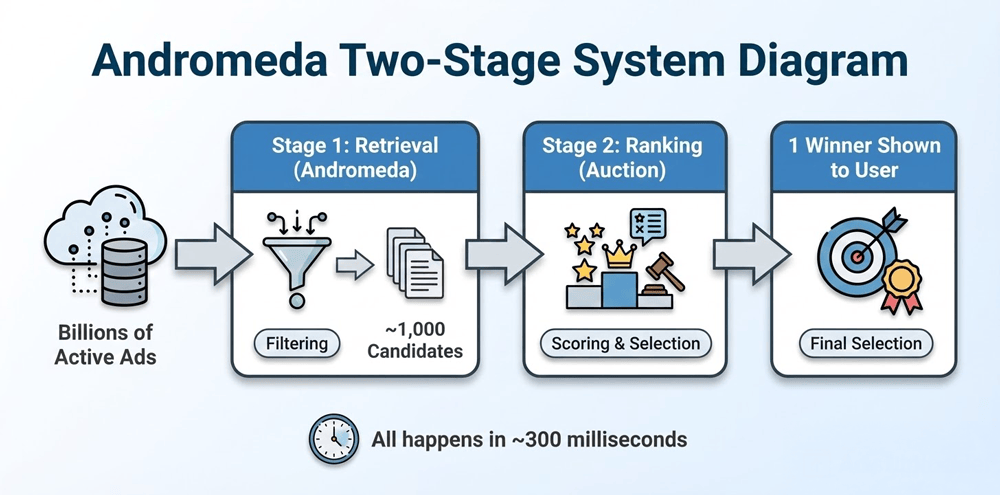
Meta Engineering's December 2024 post describes Andromeda as a next-generation personalized ads retrieval engine that powers Advantage+ automation. Retrieval is the step before ranking: the system pulls a set of candidate ads from a much larger pool for a given person, and only those candidates go on to be ranked and priced. That makes retrieval the gate. An ad that never gets retrieved for a user never competes for the impression, regardless of how good its bid or its ranking score would have been.
Why near-duplicate creative collapses into one delivery slot
A retrieval system that selects candidates by how well they match a person has no reason to pull five versions of the same ad that differ only in background color, caption font or music track. Those variants occupy the same semantic position, so in practice they compete for one slot. Practitioner write-ups of the 2025 and 2026 changes, including Social Media Examiner's guide to Facebook ad algorithm changes for 2026, Dataslayer's changelog of Meta Ads updates and Pattern's note on Meta's latest ad setup change, all point toward more automation over placement and setup, which pushes the advertiser's remaining control into the creative itself. That's consistent with our reading, though none of it is a published rule.
How a mashup library feeds the retrieval stage differently
A mashup library produces candidates that differ where it counts: a different hook, different faces, a different framing of the problem, a different objection answered. Those register as distinct positions for retrieval to consider, so the library gets more separate chances to match a person than a stack of recolored duplicates does. Above retrieval sits the allocation layer, which maximizes total results across the campaign instead of per-ad efficiency, as the breakdown effect explanation describes. Distinct candidates give that layer real options to allocate between; near-identical ones give it a coin flip.
The practical move: run a similarity check on your live ad set. Group variants by hook, on-screen persona and framing, and retire anything that differs only in color, caption or music. Then replace each retired slot with a mashup that argues the same claim through a different face and opening. You've spent the same budget and given the system something new to retrieve.
The breakdown effect makes single-ad CPA a trap when you read mashup tests
Single-ad CPA is the wrong scoreboard for a mashup test, and the more variants you run, the more wrong it gets. The mechanism is what Jon Loomer calls the breakdown effect. His post is a marketer's explanation of platform behavior. Meta hasn't documented the mechanism, so we treat his account as well reasoned and hold it at that level.
Why the ad that got the most spend looks worse than it is
Costs rise as you spend more on any given asset. So when Meta pushes budget toward one variant, that variant's average CPA climbs with scale, while the variant that looked strong early but received little budget keeps a low average from its cheap first impressions. Loomer describes exactly this: the starved early leader can end with a lower average CPA than the asset the system scaled. It looks like Meta chose a worse ad. In his account, the system was maximizing total results across the campaign, and the scaled ad was the one that could absorb budget at an acceptable marginal cost.
Read mashup results at ad-set and campaign level
With three ads, you might catch this by eye. With thirty mashup variants, average CPA becomes a random-looking scatter of starved low numbers and scaled high numbers, and the temptation to kill the scaled one and force budget onto the cheap-looking one grows. Resist it. The reporting rule is to compare blended CAC and MER for the ad set and campaign before and after adding mashup variants. If the blend improved, the library is working, whatever the variant table says. Our guide to A/B testing UGC ads covers how to structure the test so the blend is readable.
| Metric | Misleading read | Correct read | Decision it drives |
|---|---|---|---|
| Variant average CPA | Scaled variant is worse because its number is higher | Average includes expensive late impressions; compare at matched spend bands | Keep or pause a variant |
| Starved variant CPA | Cheap number means a hidden winner | Low spend, low confidence; it hasn't been tested at scale | Whether to force budget manually |
| Blended ad-set CAC | Ignored in favor of variant table | Primary read before and after adding variants | Whether the library is helping |
| Campaign MER | Treated as finance's metric | The scoreboard for the whole matrix | Budget for the next batch |
| Marginal cost at matched spend | Not tracked | Cost of the last band of spend on each variant | The only fair variant-versus-variant call |
The rows above follow from the rising-cost-with-spend mechanism in the breakdown effect post.
What to do when Meta favors your apparently weaker edit
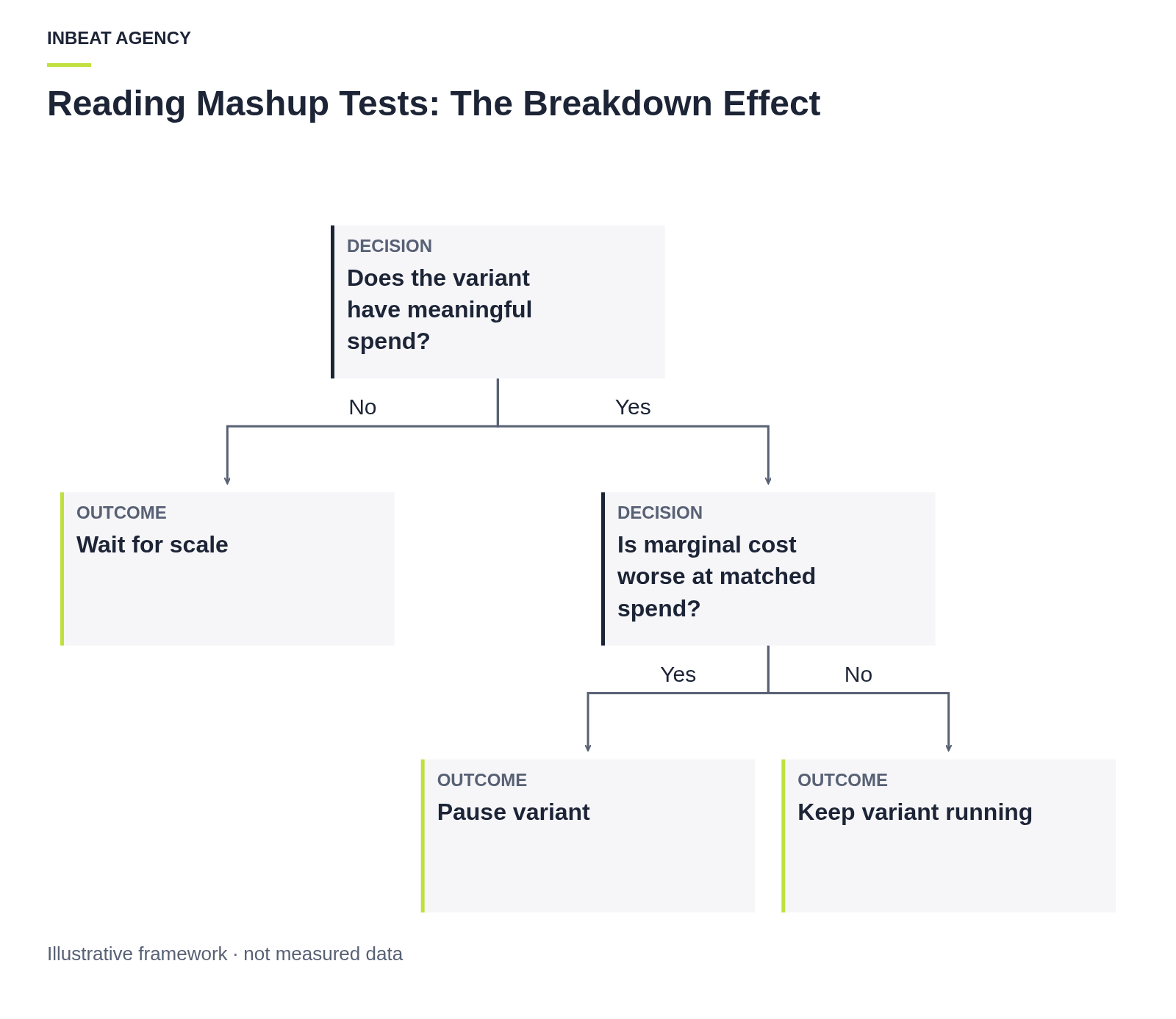
Override only when a variant has both meaningful spend and worse marginal cost at a matched spend band. Average cost alone never qualifies. If the favored edit is expensive at the margin and a rival has held cheaper at similar spend, pause the favored one. If the rival has never been fed, move it to its own test cell instead of forcing budget inside the same set. Rebuild your creative dashboard around marginal cost at spend bands, and the argument about which variant to keep gets shorter.
How to assemble a mashup ad that holds together
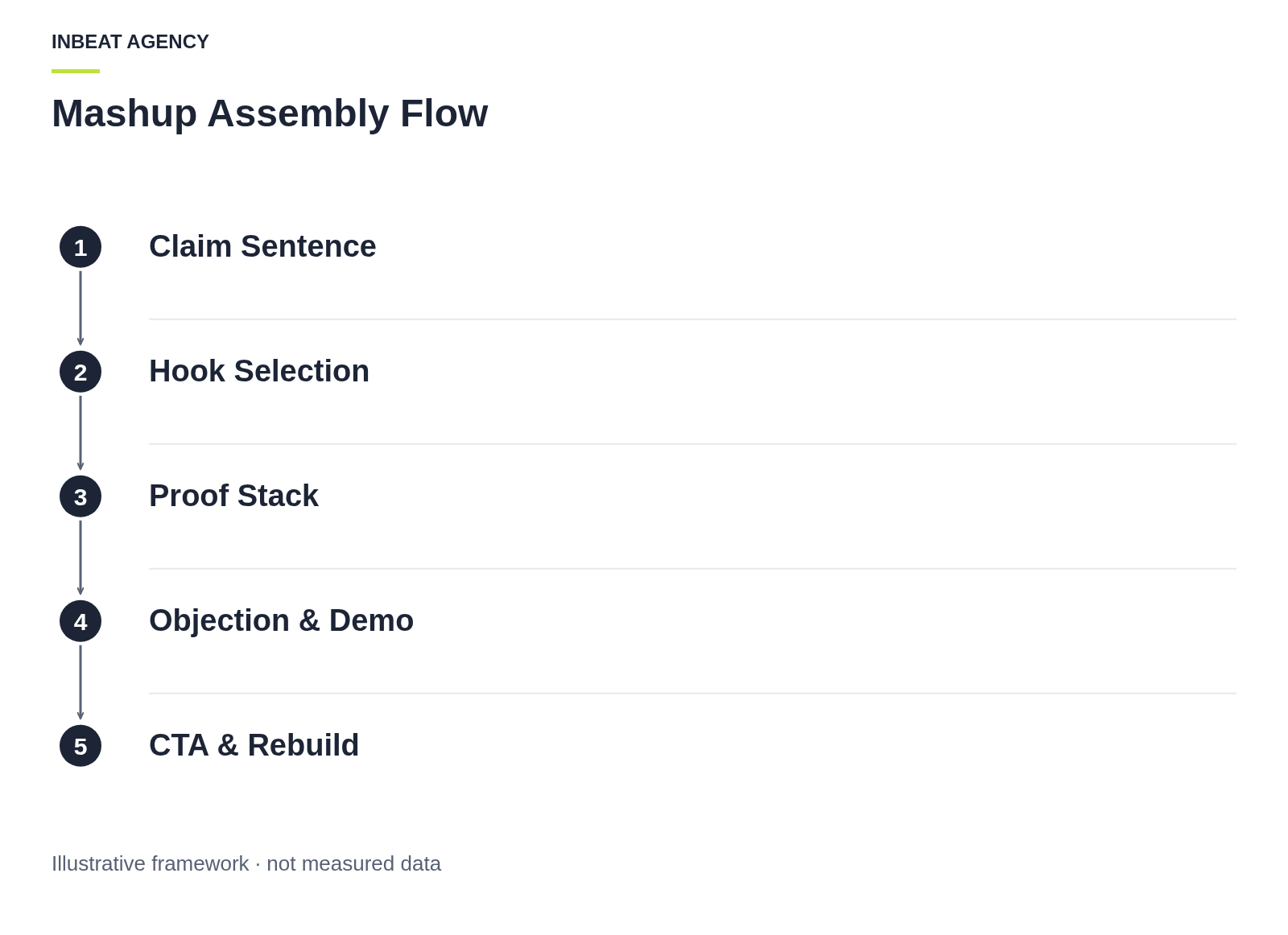
Cut the mashup in this order, and rebuild only one module between versions.
- Write the claim as a single sentence before you open the timeline. One benefit, one audience, one outcome, in the words a customer would use. This sentence is the contract every clip has to honor. If a clip argues a different benefit, it goes in a different mashup, no matter how good it is. Editors who skip this step produce the disjointed edit the format gets blamed for, because the footage is doing the arguing instead of the cut.
- Pull the hook from the clip with the strongest first two seconds, regardless of who shot it. Ignore follower counts and ignore which creator you like most. Watch the openings of every clip tagged as a potential hook with the sound off, and pick the one that makes you want to know what happens next. Then check that its promise matches the claim sentence. A hook that promises speed cannot open a mashup that argues comfort.
- Build the proof stack from three to five creators saying the same thing in different words, and cut on the shared noun. If the claim is about sleep, find the moment each creator says sleep, or the product name, or the result, and cut so the shared word lands at the edit point across faces. The repetition reads as consensus and the cut reads as intentional. The stealthoseads Desky teardown walks a problem-solution mashup second by second and shows how pacing tightens once the proof clips share a target. Pro tip: have the editor log the timestamp of the shared noun in every clip during the tagging audit, so the proof stack assembles from a spreadsheet instead of from scrubbing.
- Insert one objection handle and one demonstration, then close with a CTA that matches the hook. The objection handle is the clip where a creator says what they were worried about and why it didn't happen. The demonstration is the product in use, ideally from a creator who hasn't appeared yet so the viewer gets one more new face. The CTA restates the hook's promise in the same verb. If the hook opened with a question, the CTA answers it. The AdCollection examples are useful to study here for how the close ties back to the opening.
- Normalize the seams, then rebuild only the weakest module. Match loudness across clips, conform every clip to one aspect ratio with the same crop logic, and run one caption style throughout. The seams will still be visible, and that's fine; consistent captions and audio make them read as intentional. Once the variant has run, identify the weakest module from campaign-level reads; its raw average CPA will mislead you, since the breakdown effect inflates the average on any variant that received spend. Swap that one module for version two and leave the rest untouched, so you learn what the swap did.
Cut one mashup this week following these five steps, and log which module you changed in version two. After three or four cycles you'll have a record of which hooks, proof clips and objections carry your claim, and that record is worth more than any single winning edit.
Scaling mashups: budget the matrix, not the edit
Budget the matrix as a standing line item, and treat each edit as a disposable test inside it. The numbers below are operating rules we'd set. We know of no evidence that establishes a correct spend floor or percentage, so treat them as starting points and tune them to your account.
Launch as dark posts in one testing ad set with equal exposure floors
Structure the test as one ad set per angle, with every mashup variant for that angle inside it. Set a minimum spend floor per variant before anyone is allowed to judge it, because a variant with a handful of impressions has a CPA in name only. Since Meta allocates to maximize total campaign results and costs rise with spend on any single asset, as the breakdown effect post explains, the equal floor is the only way to see each variant at a comparable stage. A hypothetical matrix of four hooks by three proof stacks becomes twelve dark posts in one set; the set's blended CAC is the read, and the floor decides when reading begins.
Promote the module that won, then propagate it
When a variant wins, don't just scale the ad. Isolate which module drove it. If the hook was the difference, propagate that hook across the other proof stacks. If the proof stack was the difference, drop it behind the other hooks. This is the same remix logic Annette Markham sketches in her note on remix as a research method: recombination is how you learn which part carried the meaning. Promotion by module turns one win into a round of informed variants instead of one scaled asset that will fatigue on its own schedule.
Recycle learning into the next creator brief
Reserve a fixed share of monthly paid social spend for new mashup batches so the library never fatigues in unison. Then close the loop: the hooks and objections that won become the shot list for the next creator round. Ask the next five creators to deliver the winning hook in their own words, the objection handle for the objection that actually came up in comments, and a demonstration of the moment the proof stack keeps circling. Future edits get cheaper because the footage arrives pre-tagged.
One scaling limit sits inside media buying, where no editor can reach it. When marginal cost rises across all variants at once, the audience is saturating, and no recut fixes that. Widen the audience, change the platform mix or accept the ceiling; Digital Applied's 2026 platform comparison is a reasonable starting point for thinking about where reach might come from next.
This is the point where creative and media buying have to sit together; inBeat's paid social practice runs the testing structure and the creative iteration from the same dashboard. Set a standing percentage of spend for new batches and a spend floor per variant, and write both into the media plan.
Where mashups break: trust, sameness and the AI question
Mashups fail in three predictable ways, and each one has a lever. The trust and AI arguments here are mechanism-based; we have no sourced figures that quantify them, so read them as conditions to check, with no claim of proven effect size.
Unrelated creators erode trust when the claim shifts between them
Mixed personas work when every clip agrees on one claim. They fail when each clip sells a different benefit, because the viewer is asked to trust five strangers who don't seem to agree with each other. The fix is upstream: a one-line claim contract for each mashup, and a hard rule that any clip arguing a different benefit gets rejected from that edit. Brand consistency then comes from the frame around the clips: one caption system, one color grade applied across all footage, one CTA voice, and disclosed creator credits so the mix reads as a curated set of voices.
Mashups fatigue too, just later
The format delays fatigue by letting you swap modules, but it does not cancel the underlying mechanism. Costs rise as spend concentrates on any given asset, per the breakdown effect explanation, and a mashup library is still a finite set of assets. Recut the same twelve clips enough times and every variant shares the same faces, so the audience learns them together. When marginal cost climbs across the whole library, the answer is fresh footage from the brief loop described above. Another round of recuts won't reset it.
AI-generated clips change the cost curve but not the proof logic
Synthetic footage lowers the cost of a clip and raises how many variants you can produce, which is real. What it doesn't change is why the proof stack works. Several unrelated real people agreeing carries borrowed likability and the implicit claim that these people exist and chose to say this. A synthetic face carries neither. Our post on AI UGC ads covers where synthetic creative enters the production mix; our position for mashups is to use it for hooks, demonstrations and B-roll where a face isn't the point, and to keep the proof stack human. Whether that line moves depends on how audiences respond to disclosure, and we won't put a date on it.
How inBeat builds mashup ads into one growth creative system
The thesis of this article is also how we run the work. Creators sourced at volume supply the raw modules. Performance creative tags the library, writes the claim contracts and cuts the matrix. Media buying launches the dark posts, holds the spend floors, reads marginal cost at matched bands and scales what earned it. The three functions share one dashboard, because the editor deciding which module to rebuild and the buyer deciding which variant to feed are answering the same question with the same data.
The scoreboard on that dashboard is blended CAC and MER. Variant CPA is a diagnostic, never a verdict, for the reasons the breakdown effect section spells out. That's the practical meaning of driven by creative and loyal to data: the creative supplies the hypotheses, the media laboratory decides which ones survived, and the next round of briefs starts from the survivors.
If you want to see how your own library maps into a matrix, bring your creator footage and your current CAC to inBeat's paid social team and we'll work through it with you, with performance creative handling the cuts. Book a strategy call and we'll start with the tagging audit.
FAQ
Should a mashup run from the brand handle or be whitelisted from one creator's handle when it features several creators?
Run it from the brand handle by default. Whitelisting borrows one creator's identity, and a mashup featuring five faces under one person's name reads as a mismatch to viewers and can strain the other creators' agreements. Reserve whitelisting for single-creator cuts, and use the brand handle plus disclosed credits for the mashup that stacks their proof.
How many creators is too many in a single mashup before the claim gets diluted?
The claim sets the limit, and headcount follows from it. Three to five voices in the proof stack usually read as consensus; beyond that, each face gets too little time to register and the edit starts to feel like a montage. If you have more good clips than that, cut a second mashup with a different hook instead of lengthening the first.
How long should a mashup variant run before you judge it, given the breakdown effect?
Judge on spend. Days elapsed tell you little about a variant. Set a spend floor per variant before launch and don't read any variant until it clears the floor. Then compare marginal cost at matched spend bands instead of average CPA, since the variant Meta favored will carry a higher average simply because it was scaled. Blended ad-set CAC before and after the batch is the first read; the variant table comes second.
Can you mix clips from creators shot for different campaigns without re-clearing usage rights?
Only if each creator's agreement covers paid usage, editing and recombination for the new context and period. Many creator contracts grant rights for a specific campaign or duration, and a mashup that resurfaces old footage under a new claim can fall outside them. Check each agreement during the tagging audit and flag clips that need re-clearing before they enter a proof stack.
Does adding mashup variants to an existing ad set reset learning on the winners already in it?
Adding ads is a significant edit to the set and can affect delivery of what's already there, so treat it as one. The cleaner structure is a dedicated testing ad set for new batches, with proven modules promoted into scaling sets afterward. That keeps the winners' delivery stable and keeps your before-and-after blended read honest.
When does a fatiguing mashup library need new footage instead of new cuts?
When marginal cost rises across every variant at once. A single fatiguing variant is a module problem; swap its weakest module. A library-wide climb means the audience has learned the faces, and no recombination of the same twelve clips resets that. Send the winning hooks and objections to the next creator round and cut from fresh footage.
Cover photo: Photo: SHVETS production / Pexels. Art direction: inBeat Agency.