.svg)
.svg)
.svg)
.svg)


.svg)




%20(1).png)

An employee posts a candid take on a product. Marketing wants to turn it into an ad. Legal spots an unsupported claim. Who decides what happens next, and how much control does the employee have?
Trust is too important to leave those answers vague. Edelman's 2026 brand study found that 88% of consumers consider trust an important or critical purchase criterion. This guide shows how to launch an employee advocacy program in 90 days, from voluntary recruitment and disclosure rules to incentives, measurement, and permission-based paid reuse. The aim is a program that supports employee voices instead of scripting them.
Follow the launch plan.
TL;DR: The 90-Day Launch Plan in Five Answers
- Write permissions and disclosure rules in days 1-14, before anyone is invited.
- Recruit a small opt-in pilot cohort by role, then train it in one 45-minute briefing.
- Tag links to the company website with UTM parameters starting on day 31.
- Wait until day 61 to boost posts, and only with the employee's written approval.
- Report program cost next to reach, and keep earned media value out of the ROI line.
What Is an Employee Advocacy Program?
An employee advocacy program is a voluntary program where employees share or write brand-relevant posts on their own profiles inside written company guardrails.
Employee Advocacy: Why Your Employees Are Your Best Influencers Source: YouTube
It differs from an employer-brand page because the post lives on a personal profile in the employee's own voice. It differs from an internal newsletter because the audience is external. The guardrails make it a program: a permissions matrix, disclosure rules, training, and a review loop.
This guide is B2B-first and LinkedIn-first. It flags where the plan changes for B2C, and it leaves recruiting and employer-brand uses out of scope.
How Employee Advocates Differ From Brand Ambassadors
Employee advocates differ from brand ambassadors in who they are, how they are rewarded, and which rules apply.
Program type | Who participates | Pay or incentive | Main compliance exposure | Main KPI |
|---|---|---|---|---|
Employee advocacy | Staff, on their own profiles | Recognition, small tokens, rarely cash | Disclosure of the employment connection; labor-rights speech | Participation rate and tagged sessions |
Customer ambassador | Repeat buyers | Discounts, status tiers, commissions | Disclosure of rewards and codes | Referred revenue |
Creator partnership | Paid external creators | Fees plus paid usage rights | Sponsored-content disclosure; licensing | Cost per acquisition on the creative |
Our guide to creating a brand ambassador program covers the customer and creator versions. It leaves employee programs out on purpose, because incentives and compliance work differently for staff.
Where an Employee Advocacy Program Fits: B2B, B2C, and Small Teams
For B2B teams, LinkedIn is a natural starting point for employee expertise and industry commentary. B2C programs may also use Instagram or TikTok for product-led content, while smaller companies can test either approach without dedicated software.
For B2B, LinkedIn's write-up of the Edelman-LinkedIn 2025 report found that 41% of target buyers were encouraged by a C-suite executive to consider a vendor after engaging with its thought leadership. Expert voices from inside the company supply that kind of content.
In B2C the content turns toward products. Gap Inc. opened its creator program to staff at Old Navy, Gap, Athleta, and Banana Republic, and says the program produced almost 30,000 unique posts reaching 154 million people since launch. That figure covers every participant in the creator program, employees and others, and Gap describes staff participation as voluntary with no quotas.
Small teams do not need software on day one. The tooling section shows what a channel and a sheet can carry, and our guide to B2B and B2C content marketing covers how content habits differ between the two models.
The 90-Day Employee Advocacy Launch Plan at a Glance
The 90-day plan runs in three phases: foundation in days 1-30, a pilot in days 31-60, and scale in days 61-90.

Each row below names its owners and has one exit criterion, so the table can move straight into a project plan. Every number in the exit criteria is a suggested starting point to adjust for your company.
Phase and days | Deliverable | Owner | Exit criterion |
|---|---|---|---|
Foundation, days 1-7 | Permissions matrix and approval tiers | Program owner, legal | Legal signs off the three tiers |
Foundation, days 5-14 | Disclosure rules and wording table | Legal, program owner | Wording table approved; monitoring owner named |
Foundation, days 15-30 | Pilot cohort recruited by role | Program owner, managers | 15 to 25 employees opted in |
Foundation, days 22-30 | 45-minute briefing and cheat sheet | Program owner | At least 80% of the cohort attended or watched the recording |
Foundation, by day 30 | Incentive menu approved | Program owner, HR | HR and legal approve the list |
Pilot, days 31-60 | Weekly calendar and 15-minute review | Program owner | Four weekly reviews held |
Pilot, from day 31 | UTM-tagged links on posts directing traffic to the company website | Program owner, analytics | Tagged sessions visible in GA4 |
Pilot, day 60 | First four-level scorecard | Program owner, analytics | Participation rate compared with the 50% starting target |
Scale, days 61-90 | Boost top posts with written approval | Paid media lead, program owner | Paid-use consent on file before any spend |
Scale, day 90 | Expand, hold, or stop decision | Program owner, sponsor | Decision recorded against the scorecard |
Brand Governance: Build the Permissions Matrix in Days 1-7
Write the permissions matrix before you invite anyone, because every later step depends on what employees may post and who approves it.
Assign the Program Owner and Approval SLA
Name one program owner, with named contacts in legal and HR, and set a one-business-day approval SLA for Tier 3 posts. Add an escalation path that states who decides, and within how many hours, when a post goes off message. Name the owner first; the FAQ covers which team should hold the role.
Sort Content Into Three Approval Tiers
Sort every post type into one of three tiers, so employees know what they can publish without asking.
Tier | Examples | Who approves | SLA | Can the employee edit? |
|---|---|---|---|---|
Tier 1: pre-approved | Launch posts, award announcements, claims-library statements | Marketing, once, in advance | None | Personal framing allowed; approved claims must remain unchanged. |
Tier 2: employee-written inside the claims library | Expert takes and behind-the-scenes posts that use approved claims | Self-publish, weekly spot check | None | Yes |
Tier 3: high risk | Customer names, financials, roadmap, competitor mentions, regulated claims | Legal | One business day | Only after approval |
The claims library is a short list of approved statements, each with its proof. Tier 2 posts stay inside it, which keeps self-published posts accurate without a queue.
Keep Participation Voluntary and Protect Labor-Rights Speech
Make participation opt-in, keep it out of performance reviews, and write the policy so it never restricts talk about pay or working conditions.
The NLRB says employees have the right to discuss pay, benefits, and working conditions with coworkers on social media. The Board's 2023 Stericycle standard treats work rules as presumptively unlawful when they could chill those rights.
It still governed as of early October 2026, although the NLRB's General Counsel has asked the Board to overrule it. Draft narrowly and have counsel review the policy.
Compliance Controls: Write the Employee Disclosure Rules in Days 5-14
Employees must disclose the employment connection when a post could be viewed as promoting the company's product, and the FTC says a generic "paid" label is not enough for an employee.
This section follows US rules. The UK and EU differ, and the FAQ covers the multi-country question. It is practical guidance and not legal advice, so have counsel approve the final wording.
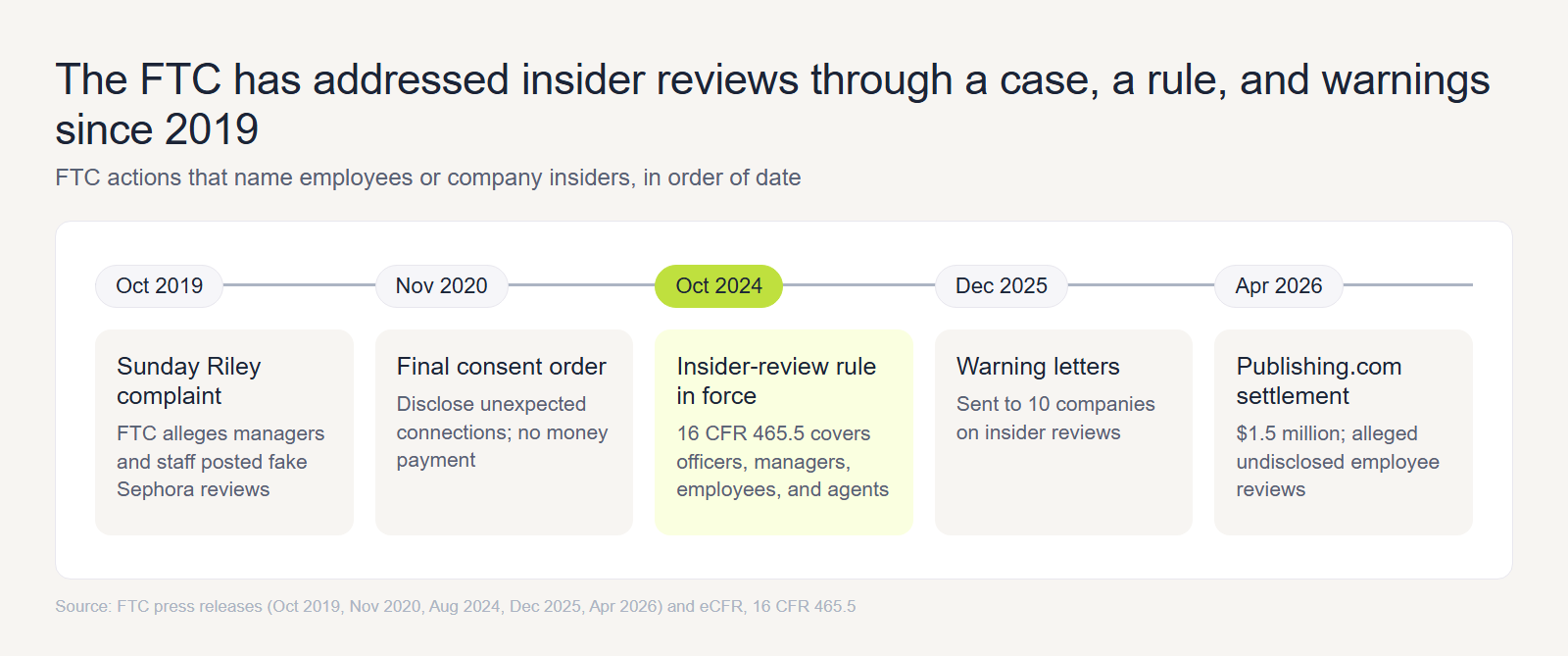
The FTC's Consumer Reviews and Testimonials Rule covers certain undisclosed insider reviews and company-distributed testimonials, including reviews solicited by managers. It does not automatically apply to every LinkedIn post an employee publishes. The broader FTC Endorsement Guides explain when employees promoting their company's products or services should disclose that relationship, even on personal accounts.
The Sunday Riley case shows why these disclosures matter. According to the FTC's complaint, the skincare company's CEO and managers posted product reviews on Sephora using fake accounts and encouraged employees to do the same. The FTC's November 2020 final order prohibited deceptive reviewer identities and required disclosure of unexpected material connections, along with instructions to employees about their disclosure responsibilities.
Enforcement continues. FTC staff sent warning letters to 10 companies in December 2025 that warned of possible Consumer Review Rule violations, including undisclosed insider reviews, and of penalties of up to $53,088 per violation. In April 2026, Publishing.com agreed to pay $1.5 million in a mixed case that alleged undisclosed employee and relative reviews.
When an Employee Must Disclose
Employees should disclose their connection when a post promotes the company's products or services and readers may not already recognize that relationship. For consistency, this program uses a visible first-line disclosure for promotional posts, including:
- Resharing company news with a product endorsement or call to action.
- Recommending a company product from a personal account.
- Publishing promotional content in return for a reward.
- Reviewing company products on third-party sites.
- Publishing an employee endorsement that the company later promotes as an ad.
General workplace updates may fall outside endorsement requirements, depending on their content and context.
Our guide to FTC guidelines for influencers lists employment ties among the material connections that need disclosure.
Disclosure Wording by Post Type
Put the disclosure in the first line, where it is visible without a click. The FTC's Q&A says a disclosure in the first line counts, and a short one such as "my company's" can suffice.
Post type | Disclosure needed | Wording example | Where it goes |
|---|---|---|---|
Reshare of a company post | Yes, if promotional | "I work at {Company}. Our team shipped this." | First line |
Personal product endorsement | Yes, if endorsing the product | "Disclosure: I work at {Company}." | First line |
Post made for a reward | Yes, plus the reward | "I work at {Company} and got a team gift for sharing." | First line |
Review on a third-party site | Yes, clear and conspicuous | "I'm an employee of {Company}." | Start of the review |
Boosted post | Yes, per the platform | Employment disclosed in the LinkedIn profile headline and original post | Profile headline and first line of the post |
Monitor and Correct Undisclosed Posts
Sample posts weekly and correct any miss within two business days.
- Pull a sample of the week's advocate posts.
- Flag any post that lacks a disclosure or breaks a tier rule.
- Remind the employee of the rule in a private message.
- Ask them to add the disclosure or remove the post.
- Log the miss and the fix.
This follows the FTC's FAQ, which says a company should run a formal program that reminds employees of its policy periodically, and that a company that actively encourages employee reviews is responsible for monitoring them. It is the only monitoring procedure in this plan, and the weekly review points back to it.
Recruitment: Build a Pilot Cohort and Set an Employee Participation Rate Target in Days 15-30
Recruit a pilot cohort by role, using a short opt-in invitation, once the permissions matrix and disclosure rules are signed off.
IBM's head of influence and advocacy programs puts the cohort logic plainly: "You don't need 10,000 advocates. You need the right 15."
Trust inside companies is also shifting. Edelman's Trust at Work 2026 found that trust in coworkers fell from 82% to 73% and trust in direct managers from 79% to 72%, and that six in ten employees fear being monitored without consent.
That favors invitations from managers employees already trust, plus a plain statement of what the program tracks, such as public posts and tagged link traffic, and what it never tracks.
Choose Advocates by Role
Choose advocates by what each role can credibly say.
Role | What they can credibly say | Best channel | Example post |
|---|---|---|---|
Sales and customer success | What buyers ask and how problems get solved | A lesson from a customer call, with the customer unnamed | |
Product and engineering | How and why the product works | A short walkthrough of a feature decision | |
Founders and executives | Strategy and market view | A point of view on a market shift | |
Subject-matter specialists | Deep expertise on one topic | LinkedIn, YouTube | A practical how-to from their own work |
Send an Opt-In Invitation
Make the invitation short, specific, and easy to decline.
- Brief each manager before any invitation goes out.
- Send a one-page invitation that states what is asked and what is never asked.
- Confirm the date of the 45-minute briefing.
- Schedule the first post after the briefing and after day 30.
- State that anyone can opt out at any time.
Set the Pilot Participation Targets
Track two rates separately. The opt-in rate is the share of invited employees who join the pilot. The employee participation rate is the share of opted-in advocates who publish at least one post within 30 days.
A suggested starting target is 50% participation. Review early posting activity and barriers on day 45, then assess the full 30-day rate on day 60. Public vendor benchmarks rarely explain their methodology, so treat 50% as an adjustable pilot target rather than an industry standard.
Training: Run a 45-Minute Advocate Briefing in Days 22-30
Teach three things in one 45-minute briefing: the rules, the voice, and the workflow. Record it, add a one-page cheat sheet, and finish before the first pilot post.
What the Briefing Covers
- The Tier 3 list and the escalation path.
- The wording table for disclosures.
- How to write in first person with one idea and one proof point.
- Where the weekly menu lives and how long approval takes.
- Who to ask when a post feels risky.
The one-page cheat sheet works like a creator brief, and our influencer brief templates show how to keep one specific.
Set Artificial Intelligence Drafting Rules
AI may draft the post, the advocate edits it and adds a personal detail, and nothing posts automatically.
LinkedIn's User Agreement says generated content should be reviewed and edited before sharing, and it bans bots that create, comment on, like, or share posts. Its Professional Community Policies bar agreeing in advance to like or re-share each other's content. A LinkedIn product leader said in November 2025 that engagement pods violate its policies.
That rules out engagement pods and any "everyone like the post at 9:00" request in a team channel.
Incentives: Design Employee Recognition and Rewards With Disclosure in Mind by Day 30
Start with employee recognition and add rewards only when participation stalls.
A reward creates a material connection, and 16 CFR 255.5 lists prizes among the connections that need disclosure. LinkedIn's community policies also ban contests, sweepstakes, and giveaways run on the platform, and they require a clear notice for endorsements made for personal benefit. Leaderboards should rank teams only.
Incentive | Example | Disclosure impact | Risk | When to use |
|---|---|---|---|---|
Recognition | Public thanks, a monthly "voice of the month" note from a leader | None expected | Favoritism if criteria are vague | From day 31 |
Learning and visibility | Conference seat, speaker coaching, a session with leadership | Low; document it | Reads as a loyalty perk | After the first month |
Small token | Team lunch, branded gift | Yes, if tied to a post | A gift for a post becomes a material connection | When participation stalls |
Cash or prize | Bonus, raffle | Yes, with a clear notice | Contest rules; LinkedIn's contest ban | Last resort, after legal review |
Team leaderboard | Team ranking by posts and tagged sessions | None | Resentment if individuals are ranked | Optional |
Content Calendar and Weekly Review Loop: Run the Pilot in Days 31-60
Run the pilot on a shared content calendar and review it every week.
Build the Content Calendar Around Five Post Types
Five post types cover most of what a B2B cohort can say.
- Product explainers, Tier 1 for pre-approved copy or Tier 2 for employee-written posts using approved claims.
- Customer proof, Tier 1 or Tier 3 depending on whether the customer is named.
- How we work, behind the scenes, Tier 2.
- Expert points of view from specialists, Tier 2.
- Company news reshares, Tier 1.
Each advocate picks one or two posts a month from the weekly menu.
Send Content Sharing Requests on a Fixed Weekday
Send one weekly drop on the same weekday, with three ready options per advocate:
- An approved announcement or proof point the employee can introduce in their own words.
- A Tier 2 prompt.
- An own-voice question.
For posts linking to the company website, include a UTM-tagged URL. Give advocates a suggested publishing window and a clear reply path. A fixed weekly drop helps establish a consistent sharing routine.
Which Internal Communication Tool, Spreadsheet, or Advocacy Platform Should You Choose?
For a pilot, a Slack or Teams channel plus a shared sheet is enough. Add a platform when manual tracking breaks or approvals queue up.
LinkedIn also discontinued its Employee Advocacy feature and My Company tab from November 2024, which removes one free option.
Setup | Best for | What breaks first |
|---|---|---|
Channel plus shared sheet | A pilot of one cohort | Tracking, once posts multiply |
Intranet or internal communication tool | Companies with an active intranet | Per-advocate analytics |
Dedicated advocacy platform | Multiple cohorts and approval queues | Cost, if participation stays low |
When you evaluate a platform, check for an approval workflow, per-advocate UTM links, exportable analytics, policy-compliant sharing, and a clear data-consent model.
Run the 15-Minute Weekly Review
Hold the review at the same time every week.
- Read the weekly KPI subset: active advocates, posts, and tagged sessions.
- Run the weekly disclosure sample from the compliance section.
- Check for repetitive or scripted wording and log any tone issues.
- Choose next week's menu.
- Flag posts that qualify for paid reuse.
Measurement: Track the Program With a Four-Level KPI Scorecard
Track the program with four levels: participation, activity, outcomes, and risk.
Level | KPI | Formula | Source | Cadence |
|---|---|---|---|---|
Participation | Opt-in rate | Opted-in employees divided by invited employees | Tracking sheet | After recruitment |
Participation | Active advocates | Opted-in advocates who posted at least once in the past 30 days | Tracking sheet | Weekly |
Participation | Participation rate | Active advocates divided by opted-in advocates | Tracking sheet | Monthly |
Activity | Posts per advocate | Posts divided by active advocates | Sheet, profiles | Weekly |
Activity | Menu use | Posts from the weekly menu divided by all posts | Sheet | Weekly |
Outcomes | Impressions | Sum from each advocate's LinkedIn analytics | LinkedIn analytics | Monthly |
Outcomes | Tagged sessions | Sessions with utm_medium=employee-advocacy | GA4 | Weekly |
Outcomes | Pipeline assists | Opportunities with an advocate-tagged touch | CRM | Monthly |
Risk | Disclosure misses | Posts missing a disclosure divided by posts sampled | Weekly sample | Weekly |
Risk | Off-message posts | Posts escalated divided by all posts | Review log | Weekly |
Report at cohort level, and put advocate IDs in links and keep names out of them. That respects the monitoring concern raised in the recruitment section. When leadership asks for a business case, our social selling statistics roundup collects LinkedIn and B2B figures in one place.
How Do You Tag Advocate Links With UTM Parameters?
Add four UTM parameters to advocate links pointing to your website so GA4 can identify the resulting traffic. Posts without links still count toward participation and can be evaluated through native platform analytics.
- utm_source=linkedin
- utm_medium=employee-advocacy
- utm_campaign=your pilot name
- utm_content=advocate ID
Google Analytics documents that utm_source, utm_medium, and utm_campaign values appear in the Traffic acquisition report. Keep every value lowercase, because GA4 treats differently cased values as separate entries.
Much advocate traffic still arrives as direct or dark social, so add a "how did you hear about us" field to forms and pass the answer into the CRM. Our guide to influencer marketing attribution models uses one content value per creator and covers incrementality testing, which belongs after the pilot.
How Do You Calculate Program Cost and Brand Reach Value?
Brand reach value equals impressions divided by 1,000, multiplied by a CPM assumption, and it estimates earned media only.
The example below uses placeholder numbers. Replace each with your own.
- Impressions: 10 active advocates posting 4 times each over the 90 days, 1,500 impressions per post, 60,000 in total.
- Value: 60,000 divided by 1,000, times a $30 CPM assumption, gives $1,800. Discount 20% for audience overlap, which leaves $1,440.
- Cost: 4 owner hours a week for 13 weeks at $60 is $3,120, legal review is 8 hours at $200 for $1,600, rewards are $400, and tooling is $0. The total is $5,120.
On these numbers, earned media value covers about a quarter of the cost. The program's case then rests on tagged sessions, pipeline assists, and the paid reuse in the next section. Our earned media value guide explains why that figure stays a reach estimate and never a business result.

Paid Reuse: Extend Advocacy Campaigns With Paid Media in Days 61-90
Days 61-90 shift the program from organic posting to paid testing, using the pilot's strongest posts to decide where to allocate budget.
Lenovo, with 63,000 employees, piloted LinkedIn Thought Leader Ads on employee and executive posts. In its award submission, the company reports engagement rates 6x higher than LinkedIn's historical benchmarks and a 63% higher CTR for audiences who saw the ads first. Three ads from a Gartner event reached a 6.92% engagement rate at $0.38 per engagement.
Dreamdata, a B2B software company with 51-200 staff, used organic engagement to pick videos and amplified them to named accounts.
Its LinkedIn case study reports 3-4x higher engagement than brand-led ads and that 83% of closed-won deals were influenced by Thought Leader Ads. Both sets of figures are self-reported, "influenced" is multi-touch language, and Dreamdata sells attribution software. In the sources we reviewed, LinkedIn does not publish a platform-wide lift figure for these ads.
If you want a roadmap for the formats around these posts, our creative strategy services cover the 90-day testing plan and LinkedIn B2B ad formats.
LinkedIn Thought Leader Ads
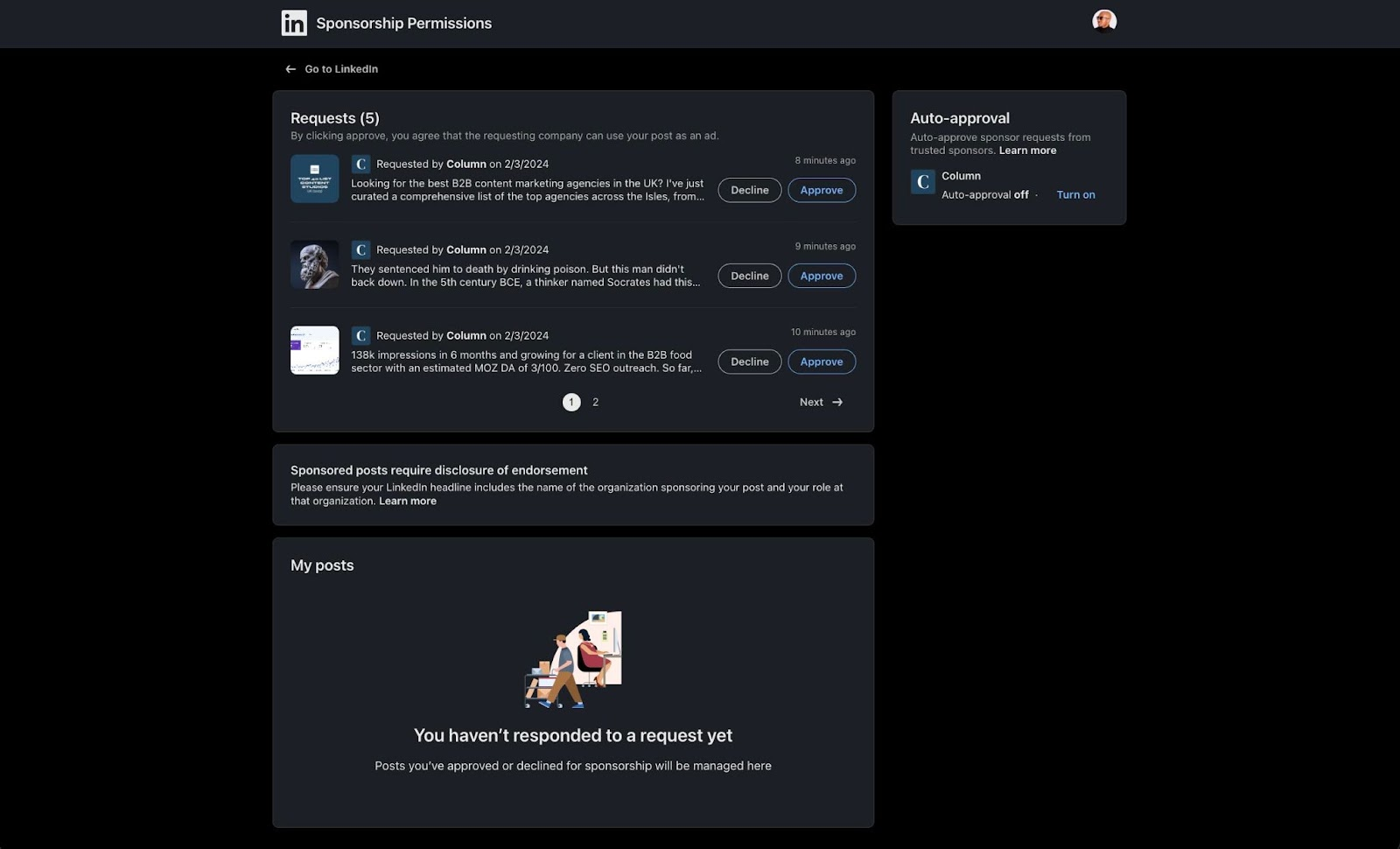
LinkedIn Thought Leader Ads let a company promote an employee's post once the employee approves.
- The advertiser requests permission from the member.
- The member's profile must show a full name, and the post must be public.
- Reposts are ineligible, so promote the original author's post.
- The member can revoke approval at any time, and the ad stops.
- Creator Marketplace does not show posts from authors in Digital Markets Act countries.
- Objectives are brand awareness, engagement, and video views.
The details come from LinkedIn's help pages on Thought Leader Ads, permission requests, and Creator Marketplace. Single-image and video Thought Leader Ads have no call-to-action buttons. If a destination link is needed, include it in the employee's original post before sponsorship.
Optional Paid Formats: Meta Partnership Ads and TikTok Spark Ads
For programs that extend to Instagram or TikTok, paid reuse follows different authorization rules. Both platforms let account owners control advertising permissions, with important differences in duration and revocation.
Platform | How permission works | Duration or revocation | Notes |
|---|---|---|---|
The partner grants permission per post or through an ad code | The partner can revoke at any time; a code serves up to 2 partners, and turning it off blocks new ads while active ads keep running | Accounts of one business with ads access to both need no permission | |
The creator turns on ad authorization and shares a code | 7, 30, 60, or 365 days | Caption is locked after authorization; a private video becomes public once used |
Get Separate Permission for Paid Use
Platform authorization allows an advertiser to promote an employee's post, while a separate written agreement defines the scope of that permission. For this program, secure both before launching paid campaigns.
The consent paragraph names:
- The platforms.
- The duration.
- The revocation method.
- How active ads and permissions are handled when employment ends.
We apply the same rule in creator programs, and our guide to usage rights explains why organic reposting, paid ads, and whitelisting require separate permissions. When an employee leaves, stop any active ads featuring their content, coordinate the revocation of platform permissions, and confirm that paid use has ended.
Choose Which Posts to Boost
Prioritize posts that outperform the cohort's median engagement and communicate one clear, well-supported idea.
- Pick candidates from the list flagged in the weekly review.
- Match the planned campaign's platform and dates to the employee's written consent.
- Confirm the post's claims sit inside the claims library.
- If the original post includes a link, make sure the landing page supports its main claim.
Test eligible employee posts through LinkedIn Thought Leader Ads after securing the author's approval. Start with a small budget, compare performance across posts, and pause ads when results decline.
What Risks Damage Brand Trust, and How Do You Catch Them Early?
The biggest risk is making coordinated promotion look like spontaneous employee opinion.
Amazon's FC Ambassadors showed how fast that happens. Critics said the Twitter accounts looked scripted, one ambassador said an earlier group "got a gift card", and parody accounts followed. Digiday's 2026 retrospective treats the episode as a disclosure and astroturfing warning for employee creator programs.
Symptom | Likely cause | Check | Fix |
|---|---|---|---|
Participation under target | Weak role fit or an unclear ask | Day-45 review of training and content fit | Re-brief, change the menu, then consider rewards |
Identical or scripted-sounding posts | Advocates reuse the same suggested wording or AI-generated drafts | Weekly similarity check | Share approved facts and topic prompts, then encourage employees to add their own perspective |
Off-message post | A Tier 3 topic went out without approval | Review log | Escalate through the owner's path and re-brief |
Leaderboard resentment | Individuals ranked in public | A pulse question in the weekly review | Rank teams only |
Reach reported as ROI | Earned media value shown to leadership as return | Scorecard review | Report it beside tagged sessions and pipeline assists |
Build a Smarter Advocate Network With inBeat
The first 90 days should reveal which employees want to participate, what resonates with their audiences, and which posts deserve a wider reach. From there, the challenge is scaling successful content while keeping each employee's voice intact.
At inBeat, we help B2B teams develop expert-led content and turn promising organic posts into paid campaigns. Book a strategy call to explore what that could look like for your team.
FAQs
How should a multinational set one employee advocacy policy when US, UK, and EU disclosure rules differ?
Write to the strictest rule and keep the disclosure first and visible. The UK's ASA says content from anyone connected to the brand, employees included, must be obviously identifiable as advertising, and that tags such as #iworkwith are unlikely to be enough. LinkedIn's Creator Marketplace also leaves out authors in Digital Markets Act countries, so check eligibility by country before planning paid reuse.
How do you count advocate posts in attribution when one buyer sees several colleagues' posts?
Roll advocate IDs up to the account and attribute at account level. Each advocate's utm_content value identifies the advocate, but impressions from different colleagues overlap, so adding them together overstates unique reach. Use account-level multi-touch attribution, and treat the "how did you hear about us" answers as a cross-check.
Should executives be in the pilot cohort, and how do you report their results?
Yes, if they have a credible expertise slice, and report them as their own cohort. Executive networks and engagement tend to differ from the average advocate's, so mixing them in inflates the participation and reach averages and hides how typical employees perform.
Which team should own the employee advocacy program: marketing, communications, or HR?
Give it to the team that already owns the content calendar and approvals, which is usually marketing or communications, and give legal and HR named roles. HR should hold the voluntary-participation rule and the incentive policy, because both touch employment terms.
Should the pilot include remote and frontline staff?
Include remote staff when they hold a credible expertise slice; a channel-plus-sheet setup works across locations. Frontline posting during shifts is a policy decision for HR and legal, so settle whether it happens on paid time before inviting anyone.