.svg)
.svg)
.svg)
.svg)


.svg)






%20(1).png)

An executive's content can shape a vendor shortlist before anyone books a demo. In Edelman and LinkedIn's 2024 study, 73% of B2B decision-makers said thought leadership was a more trustworthy basis for evaluating a company's competence than traditional marketing materials.
Their 2025 research adds another clue: 41% of target buyers said a C-suite executive encouraged them to consider a vendor after engaging with that vendor's thought leadership.
But earning attention and generating demand are two different things. These eight examples reveal how executives build influence, which business outcomes are actually documented, and how creators, employees, and paid media can extend their reach.
See what actually works.
TL;DR
- The eight cases use different formats: founder-led LinkedIn posts, newsletters, signed research, and informal executive video. A recognizable perspective matters more than copying one publishing schedule.
- Demand evidence varies. Kausas cites demo-form attribution; Bar-Joseph claims $2M+ in monthly LinkedIn pipeline; Gray and SparkToro disclose reach or research findings without a content-attributed sales figure. Keep those categories separate.
- Authorship varies too. Some leaders write personally, some work with teams, and Bar-Joseph says Claude helps draft posts. Credibility comes from ownership of the ideas and accurate firsthand detail, not a universal no-AI pledge.
- Start with a repeatable format, capture self-reported attribution, and add employee, creator, or paid distribution only when there is a clear purpose for it.
What Counts as Executive Thought Leadership That Builds Brand Authority?
Executive thought leadership is a public point of view associated with an identifiable leader and supported by operating experience, original analysis, or firsthand observation. Its effect may be credibility, buyer consideration, or qualified demand; not every example has a traceable pipeline result. The difference from generic corporate copy is accountable authorship and specificity, not an automatic lead count.
The buyer data shows why the format matters. In the Edelman-LinkedIn study, 86% of buyers said they'd be likely to invite a thought-leadership publisher into an RFP, and 60% said they'd pay a premium for one. The 2025 report adds that 35% of hidden buyers, the internal stakeholders outside the main evaluation, also say an executive nudged them toward a vendor.
Only 15% of surveyed buyers rated the thought leadership they encounter as very good or excellent, according to the Edelman-LinkedIn research. That leaves room for work built on direct experience and evidence instead of generic executive commentary.
Here, "creator-led demand" describes buyer interest generated through content associated with a named person. Employees, outside creators, and paid media can extend that reach, but only sourced or influenced pipeline should be called pipeline.
Executive Thought Leadership Examples From Founder-Led Brands
Six founder-led programs show how a personal channel can build awareness, communities, or sales interest. The documented level of direct authorship and the strength of the business evidence differ substantially by case.
Adam Robinson (RB2B): Daily LinkedIn Posts as the Main Acquisition Channel
RB2B's founder treats daily LinkedIn posting as the company's main distribution channel. According to a SaaStock write-up of his talk, RB2B went from $0 to $5M ARR in 13 months with five people, and all of its traffic came from LinkedIn.
Adam Robinson: How I went from $0-$5m ARR in 13 months using LinkedIn. Source: SaaStock on YouTube
His point of view is that a founder's profile is the highest-leverage way to grow a startup, and that posts shouldn't sell directly. The profile link and the website do the selling. Founderpath reports that one post about a cease-and-desist letter drew 1,600 likes, 913 comments, and about 1,600 leads through a Google Form.
His routine is concrete. He posts daily, joins or hosts podcasts, and sends up to ten connection requests a day to ideal customers.
Thought-leadership ads then amplify the posts that already won organically. He writes and appears on camera himself, and he built his topic list by studying another operator's feed in a spreadsheet.
Test a small set of recurring founder topics, then let the profile and website carry the product pitch.
Marty Kausas (Pylon): Build-in-Public LinkedIn Posts That Drive Demo Bookings
Pylon's CEO writes his own first-person LinkedIn posts about building the company in public. According to Kyle Poyar's Growth Unhinged newsletter, LinkedIn is Pylon's biggest source of pipeline by self-reported attribution, meaning the answer prospects give when they book a demo. No pipeline or revenue figure is tied to the posts.
The first post that took off was about the founder journey. In a Founder-Led Sales Stories interview, Kausas says it reached 300K+ impressions and prospects began mentioning that they had seen Pylon on LinkedIn. Poyar adds that a later post about living in the office drew 1.2 million impressions.
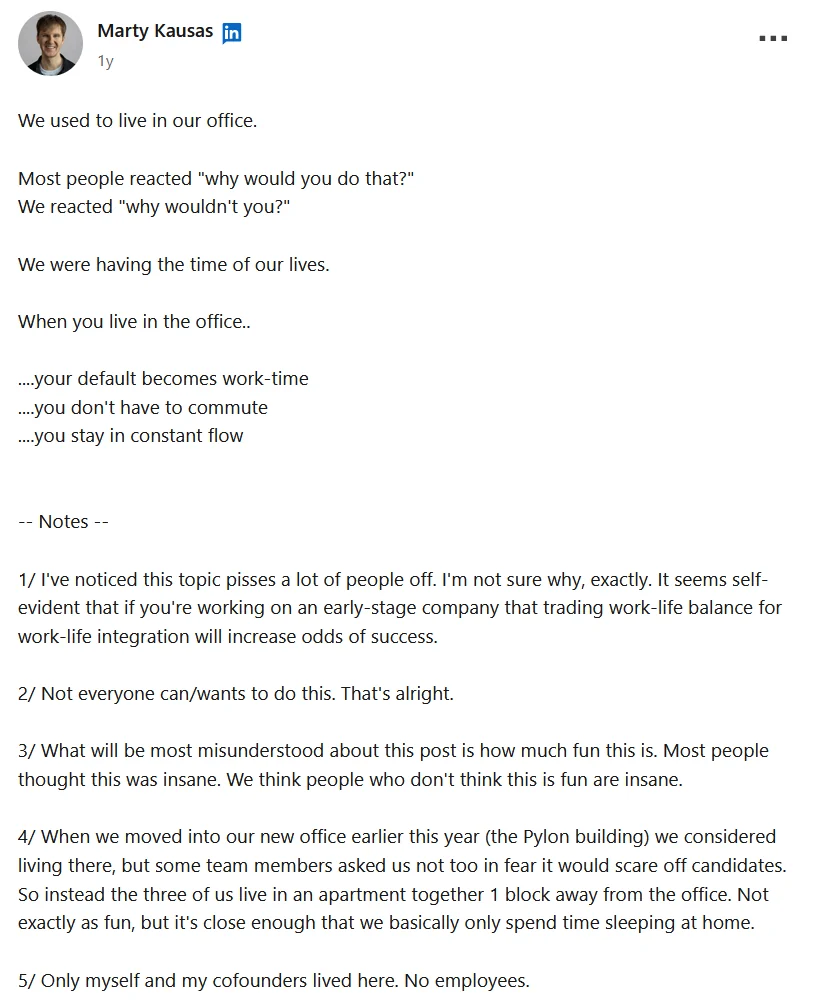
His point of view is that founder stories work as a sales channel. Poyar reports that the first post produced a spike in demo bookings, and that each of the three co-founders now posts every day from their own account.
For co-founder teams, give each leader a distinct angle rather than repeating the same product announcement.
Jason Lemkin (SaaStr): Candid Operating Data as a Business Development Engine
SaaStr's founder publishes operating figures and candid accounts of the business. In one account, he put registrations for SaaStr AI Annual 2026 at 142.9% of the prior year's pace. The same reporting names sponsor results: Artisan said it closed more than $250,000 on-site at the prior year's event and over $1 million afterward, while Brex's Sam Blond described four five-figure deals in under three weeks. These are event and sponsor outcomes, not demonstrated conversions from Lemkin's posts.
His operating thesis is that AI agents can absorb parts of the go-to-market workload. A Lenny's Podcast episode describes an arrangement of 20 agents overseen by 1.2 humans as performing work comparable to roughly ten sales reps. In separate writing, he says SaaStr operates with three humans plus agents. These are his reported operating comparisons, not a general headcount benchmark.
The content reads as his because it names what hurt. He has written that SaaStr lost nearly all of its non-AI sponsors.
SaaStr's sponsor page is sales copy, but it lists 240,000 monthly podcast downloads as owned distribution. The byline is his; how much he drafts personally and how often he posts aren't documented.
Put the cost or trade-off next to the result that looks impressive.
Dave Gerhardt (Exit Five): A B2B Newsletter and Daily LinkedIn Presence With a Public No-AI Line
Gerhardt's clearest signal is authorship. In the opening of his newsletter, he writes, "I really write this newsletter (not AI)," and invites replies because "it is really me." On a March 2025 podcast, he said he writes every day and argued that PR people ghostwriting for founders goes too far.
The cadence is documented. He posts to LinkedIn daily, and the Exit Five site shows seven newsletter issues between Aug 26 and Sep 24, 2026, about twice a week.

The newsletter banner claims 42,000 readers.
On the same podcast he said Exit Five checks attribution by asking members and sponsors where they heard of it, and the answer is "LinkedIn, LinkedIn, LinkedIn." There's no number attached. His point of view is that B2B buyers trust creators more than brands, so influencer marketing is a distribution strategy. That makes this entry the bridge to the creator-led section below.
Invite direct replies under the author's name, then answer the questions that deepen the conversation.
Justin Welsh: Weekly Essays and a Reported $10M in Cumulative Revenue
Welsh publishes an essay every Saturday and posts daily on LinkedIn and X. In his account of the first $10M, he says the business generated more than $10M in cumulative revenue over five years and nine months without paid ads, at roughly an 89% margin. He also reports 185,000 newsletter subscribers after 40 months and two $2,500 sponsorship slots per issue. These are his business figures; the source does not isolate the revenue attributable to any single publishing format.
The revenue split below is Welsh's own breakdown of the business total, not revenue from the newsletter alone:
| Revenue line | Amount |
|---|---|
| Products | $6.75M |
| Consulting | $1.17M |
| Sponsorships | $795K |
| Subscriptions | $695K |
| Community | $630K |
He's the sole author with no employees, and he's a former SaaS CRO, so the credibility comes from first-hand operating experience. One limit: his buyers are creators and solo operators, and few are B2B procurement teams.
Choose a publishing rhythm readers can recognize and the author can sustain.
Amos Bar-Joseph (Swan AI): LinkedIn Posts He Credits With Monthly Pipeline
Swan AI's CEO says his LinkedIn writing generates more than $2M of pipeline a month. In a January 2026 LinkedIn post he wrote that his AI content engine produces $2M+ monthly pipeline from LinkedIn without a marketing hire, after hundreds of posts and over 10M impressions in 2025. The post does not define pipeline, and the figure is unaudited.
Business Insider reported one of his viral posts, a screenshot of a $113,421.87 Anthropic invoice, and quoted him saying his company is in the seven-figure ARR range. Swan declined to give exact revenue figures. Swan's funding announcement says it grew from zero to more than 200 customers in 2025, and it does not tie that growth to his posts.
His point of view, per the announcement, is that revenue per employee will define AI-era companies. He says he drafts his posts with Claude. Swan sells go-to-market tooling, so the posts also advertise the product.
Show the workflow or artifact behind an ambitious claim, not only the claim itself.
Executive Thought Leadership Examples From Research Teams and Enterprise Leaders
The remaining two examples broaden the format: signed research by SparkToro's leaders and short self-filmed videos from a large enterprise executive.
Rand Fishkin and Amanda Natividad (SparkToro): Original Research, a Signed Byline, and a No-AI Pledge
SparkToro's point of view is that traffic is a poor goal because influence moves off the site. Its research speaks to Google search visibility directly: 68.01% of US Google searches ended without a click in the first four months of 2026, up from 60.45% in 2024 and 49% in 2019. Fishkin notes that the data panels differ across years, a caveat that makes the argument easier to trust.
The anti-ghostwriting mechanism is explicit. That 2026 study states that no AI was used to write it, and Fishkin calls using AI for such work disrespectful and unethical. Natividad, SparkToro's Chief Evangelist, writes on the blog under her own byline, and a weekly "5-Minute Whiteboard" video comes with a full transcript. Fishkin also says posts without a link get about 10x the reach, from SparkToro's own data.
The cited sources do not connect this content to customers or revenue. The case therefore illustrates original research, personal authorship, and distribution potential, not attributable sales.
Attach a real name and a transparent method to original research.
Jon Gray (Blackstone): Short Selfie Videos From an Enterprise Investor
Blackstone's Jon Gray films selfie-style running videos and uses them to talk about markets, travel and investing. According to Fortune, he posted nearly 50 videos in the past year, his LinkedIn posts regularly generate nearly 440,000 impressions and average more than 100,000 views per video, and one travel montage drew 5.9 million views, according to Blackstone.

The voice is his own. Blackstone's head of corporate affairs says "It's really just all him," with no coaching, prep calls or talking points, and Gray calls himself the accidental influencer after resisting the idea for an extended period.
Compliance rules still apply, and the review generally takes a few hours. He aims for 90 seconds or less and says studio-produced content reaches fewer people.
The business link is anecdotal. Gray says clients mention the videos in meetings, and Fortune reports that he sees the account as a personal channel rather than a formal conversion program. No leads, attributed deals, or revenue figures are tied to the videos in the sources cited here. The case demonstrates recognizable executive voice and substantial reach, not measured pipeline.
Test short, low-production videos, with the review process appropriate to the business.
Comparing the Eight Examples: Format, Proof, and Distribution
Side by side, the examples differ most in format, cadence, and the kind of evidence they offer for demand.
Format, Cadence, and Executive Involvement
| Example | Main format | Documented cadence | Executive involvement | Primary distribution |
|---|---|---|---|---|
| Robinson (RB2B) | LinkedIn posts, video | Daily (his routine) | Writes and appears himself | Organic LinkedIn, ads on winners |
| Kausas (Pylon) | First-person LinkedIn posts | Daily, all three co-founders | Writes his own posts | Organic LinkedIn |
| Lemkin (SaaStr) | Articles, podcast, events | Not documented | Publishes under his name; drafting process undocumented | Owned newsletters, events |
| Gerhardt (Exit Five) | Newsletter, LinkedIn | Daily LinkedIn; twice-weekly email | Writes it, says so | Email, LinkedIn, community |
| Welsh | Weekly essay, social | Saturday essay; daily posts | Sole author | Organic social, newsletter |
| Bar-Joseph (Swan AI) | LinkedIn posts, monthly newsletter | Monthly newsletter; LinkedIn not documented | Publishes under his name; says Claude assists drafting | Organic LinkedIn |
| SparkToro | Research, video, blog | Weekly whiteboard | Named authors on research/blog; specific drafting varies by piece | Research pickup, podcasts |
| Gray (Blackstone) | Short selfie videos on LinkedIn | Nearly 50 videos in one reported year; no fixed day documented | Films himself, no scripted talking points | Organic LinkedIn |
Point of View, Proof, and Audience Response
| Example | Core point of view | What the evidence actually shows | Audience response | Evidence quality |
|---|---|---|---|---|
| Robinson | Founder LinkedIn is the top growth lever | $5M ARR in 13 months, reported from his talk; no post-level sales attribution | One post drew 1,600 likes and 913 comments (Founderpath) | Self-reported |
| Kausas | Founder stories on LinkedIn work as a sales channel | LinkedIn is the biggest pipeline source by reported demo-form answers | 300K+ impressions on the first post | Self-reported, relayed by a newsletter |
| Lemkin | AI agents replace GTM headcount | Event registrations at 142.9% of prior-year pace; no post-to-deal attribution | Post-level audience response not quantified | Event/sponsor reporting, not post-attributed |
| Gerhardt | Buyers trust creators over brands | 42,000 newsletter readers claimed in site banner; no attributed deal count | Replies invited | Self-reported |
| Welsh | Productize what the audience asks for | Over $10M cumulative business revenue, self-reported; channel split unknown | 185,000 subscribers | Self-reported, detailed |
| Bar-Joseph | Revenue per employee will define AI-era companies | $2M+ monthly LinkedIn pipeline claimed by founder, unaudited | Viral invoice post confirmed by Business Insider | Self-reported, unaudited |
| SparkToro | Traffic is a poor goal | Original zero-click search research; no content-attributed revenue figure | Not documented | Research published; sales link undocumented |
| Gray | Executives should talk to clients directly and show who they are | Substantial LinkedIn video reach; no sourced pipeline figure | Clients mention the videos in meetings | Reach reported by Blackstone, no demand figure |
The comparison shows why consistent formats, identifiable authors, and specific evidence can help. It also shows the limits: some publishing schedules are undocumented, and reach or business-wide revenue cannot substitute for content-attributed pipeline.
How to Keep Executive Content From Sounding Ghostwritten
A credible executive voice comes from identifiable judgments, details the leader can defend, and an approval process they actually own. A producer may interview, edit, or format the material. The problem starts when the final post contains no specific decision, example, or perspective that the executive would recognize as theirs.
Put a Named Human Behind Every Post
Specify who supplied the argument, who checked the facts, who wrote or revised the draft, and who approves publication. Some leaders choose to disclose that they write without AI, while others use editorial or AI assistance. The universal requirement is a defensible point of view and an accountable named owner.
Use Firsthand Evidence the Executive Can Defend
Use firsthand evidence: a decision made, an operating trade-off, an anonymized customer pattern, or a figure the team can substantiate. State what the number measures. Company revenue, an event deal, and a post-attributed lead are different facts, even when the executive can speak to all three.
Show Accountability and Failure
Show the trade-off behind a decision when it teaches the audience something: a bet that failed, a constraint, or a change of mind. Use a real example and explain what happened next. Credibility comes from owning a specific judgment, not inserting a formulaic failure story every quarter.
Run a Weekly Executive-to-Post Workflow
A producer can reduce the work of publishing while the executive retains control of the substance. This is a suggested weekly workflow, not an industry benchmark:
- Record a 20-minute conversation with the executive on one live customer or market question.
- Have a writer turn the transcript into a draft that keeps the executive's own phrases.
- The executive rewrites the first and last paragraphs and adds one number or story only they know.
- The executive posts or approves from their own account.
- Review the replies, and carry the best questions into next week's conversation.
After approval, the team can repurpose the same recording into clips or graphics without asking the executive to generate new ideas for every asset. Editorial support remains compatible with personal ownership.
How to Budget Executive Time for Thought Leadership
No comparable weekly time logs are available for the eight cases, so there is no defensible average. A producer-supported pilot might begin with a 20-minute interview plus executive fact-checking and approval; that is a planning assumption, not a measured time requirement. Fully self-written pieces can take far longer. Lenny Rachitsky, a separate example, reports spending 10 to 30 hours on an individual post.
For planning purposes, distinguish personally written posts, producer-assisted posts, and videos recorded by the executive. The sources document Gerhardt and Welsh writing personally, Gray filming himself, and Bar-Joseph using Claude; Lemkin's drafting arrangement is not documented. The time commitment in each path remains a planning variable, not a measured cross-case benchmark.
How Executive Thought Leadership Turns Into Creator-Led Demand
A founder post or executive video can reach beyond the leader's followers through employee reposts, creator partnerships, and paid media. Those channels expand the opportunity to be seen; demand still needs separate evidence, such as demo-form attribution or sales conversations. The eight main cases do not publish comparable pipeline results for a combined creator-distribution program.
Amplify the Executive With B2B Creators and Employee Advocates
Brands are testing LinkedIn as a paid creator channel. Digiday reports that Notion's share of influencer marketing budget allocated to LinkedIn rose from about 25% to roughly 40% over approximately a year. Those are Notion's reported budget allocations, not a benchmark for every B2B marketing team.
Employees extend reach too, and inBeat's guide to an employee advocacy program covers how to launch one. Omnisend reported that a branding manager's personal post reached 31,000 people, against 1,600 for a comparable company-page post, which the company reported itself.
A supporting example outside the eight comes from Lovable. In Lenny Rachitsky's summary of Elena Verna, engineers publicly announce their own releases instead of routing every update through marketing.
A post dropped in an internal channel gets comments and reposts from the team within about two hours. That's a secondary account, so read it as the company's described practice.
Format matters as well. Hidden buyers value a unique format or style more than target buyers do, 60% against 51%, according to the 2025 Edelman-LinkedIn report. That's a case for varied promotion strategy: video, short essays, and voice that doesn't match a brand template.
Test Paid Creative and Amplify Executive Posts
Use separate tests for separate ad formats. On LinkedIn, Direct Sponsored Content lets a brand test unpublished creative from its company Page. Thought Leader Ads, by contrast, sponsor an eligible organic post from a person, with the member's permission. Select a strong existing executive post, obtain the required authorization in Campaign Manager, and amplify that post without rewriting its message as an unpublished brand ad.
Our guide to dark posting for creator content covers the unpublished-ad side.
Test paid reach against a defined buyer audience and an appropriate outcome, such as qualified traffic or demo-form attribution. A high-engagement hook is useful input, but engagement alone does not establish pipeline. The mechanics and creative restrictions depend on the ad format; use the platform's current specifications before launching.
Earn Citations in Google and AI Search Results
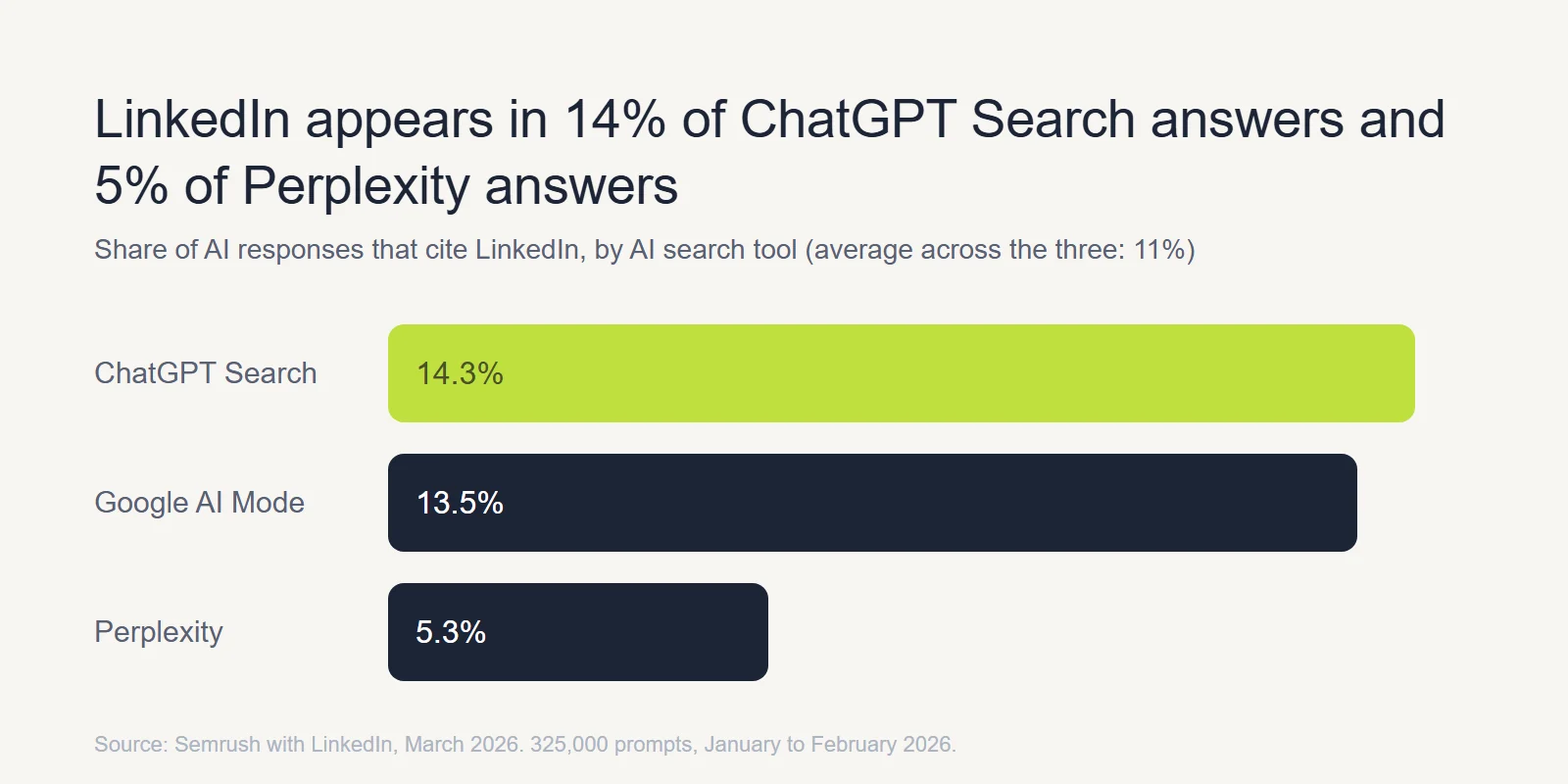
A Semrush study with LinkedIn, based on 325,000 prompts, found LinkedIn was the second most-cited domain and appeared in 11% of the AI responses studied. About 75% of cited LinkedIn post authors had posted five or more times in the preceding four weeks, and authors with fewer than 500 followers also appeared among citations. This is an observational association, not proof that posting more causes a search engine to cite an executive. The study does not isolate executives, and Semrush sells the tools used in the analysis.
Digiday reports that CMOs struggle to link AI visibility to sales, so AI citations work as a leading signal.
How to Measure Executive Thought Leadership ROI
Measure executive content in stages: audience fit, buyer actions, sourced opportunities, and influenced opportunities. These signals support diagnosis, but they are not a financial return calculation. The Edelman-LinkedIn research found that only 29% of producers could link sales leads to specific pieces of thought leadership, underscoring the need for clear definitions and a modest attribution claim.
Track Buyer Signals Before Business Pipeline
Replies, direct messages, branded searches, and "how did you hear about us?" answers often appear before a sales opportunity. Gerhardt's self-reported attribution and Robinson's lead form show two ways to capture these signals. Use LinkedIn's available aggregate viewer demographics, including company categories where shown, alongside explicit CRM touchpoints. Do not describe anonymous post viewers as identifiable leads.
Build an Executive Thought Leadership ROI Model
The table below is a working model. The lags are inBeat's assumptions.
If the team can estimate incremental contribution, financial ROI = (incremental gross profit attributable to the program - total program cost) / total program cost. Count executive time, editorial work, outside production, and paid distribution in total cost. Report this estimate separately from sourced pipeline and influenced pipeline. If incremental profit cannot be reasonably estimated, label the section a measurement framework rather than a proven ROI result.
| Signal | Metric | Where to read it | Typical lag |
|---|---|---|---|
| Reach in target accounts | Impressions and aggregate viewer demographics where available | LinkedIn analytics | Days |
| Buying-group engagement | Known replies, DMs, and trackable engagement; aggregate saves separately | LinkedIn, CRM | Weeks |
| Branded search lift | Branded query impressions and clicks, checked against a baseline | Search Console | 1 to 3 months |
| Self-reported attribution | "How did you hear about us" answers | Demo and sign-up forms | Immediate, noisy |
| Meetings sourced | Meetings that cite the executive or content | CRM | 1 to 3 months |
| Pipeline influenced | Opportunities with documented content touchpoints, not assumed causation | CRM | 3 to 9 months |
Connect Executive Content to the Sales Pipeline
Agree on two definitions with sales: sourced pipeline, where the buyer explicitly identifies executive content as an entry point, and influenced pipeline, where a documented touchpoint appears during an existing opportunity. Review the categories monthly. An influenced deal is not proof the content caused the deal, and none of the eight case profiles provides audited incremental attribution.
Executive Thought Leadership Maturity Model: Which Example Should You Copy?
Use this four-stage model to choose the next capability to build. It is an inBeat planning framework, not a verified ranking of the eight organizations.
Four Stages of Executive Thought Leadership Maturity
| Stage | What it looks like | Closest example | Next move |
|---|---|---|---|
| 1. Occasional posts | Irregular posting, no stated point of view | None of the eight | Pick one point of view and one publishing day |
| 2. Recurring format | A recognizable voice or recurring format, not necessarily a fixed day | Welsh, Gray | Add one number only your company has |
| 3. Proof-led | Own data and self-reported demand signals | Kausas, Bar-Joseph; Gerhardt for qualitative attribution | Tie the self-reported answers to CRM pipeline |
| 4. Extended | Additional people or paid media extend the leader's content | Robinson (paid amplification), Pylon (co-founder distribution) | Test eligible executive posts with permission and defined goals |
Diagnostic Framework: B2B Startups and Enterprise Executives
| Situation | Start with | Avoid |
|---|---|---|
| B2B startups with no audience | Founder-led writing on a sustainable cadence and a clear profile CTA (Robinson, Kausas) | Waiting for a content team before publishing |
| Executive at a large or regulated firm | Short videos in the executive's own voice with a short compliance review (Gray) | Copying informal posting habits without legal/compliance review |
| A company whose staff build the product | Let builders announce releases (Lovable) | Routing every post through marketing approval |
| Enterprise executive with a comms team | Named author, own data, fixed cadence | Copying audience-size targets from creator-led founders |
Gray is the only enterprise-scale case in this set, and Fortune reports his reach but no business outcome, so the last row also relies on the named-author and own-data rules and on the Edelman buyer evidence.
What Can Go Wrong With Executive Thought Leadership?
Even a well-run program has predictable failure modes. These are the ones worth checking before committing an executive to a calendar:
- Presenting company-wide revenue, follower counts, or self-reported pipeline as independently proven returns from content.
- Burnout from a cadence the executive cannot sustain, particularly when every post requires urgent review or fresh personal input.
- Generic drafts that omit the executive's own decisions, evidence, and recognizable language.
- One-person dependency, where the audience belongs to the executive and leaves with them.
- Public claims that turn out wrong, which is why the accountability habit matters.
Build Executive-Led Demand With inBeat
inBeat helps B2B teams turn an executive's actual expertise into usable content, support it with creators or employees, and test distribution against buyer signals. The starting point is a voice the audience can recognize and a clear idea of what the program is meant to achieve.
Want a second opinion on your executive content? Book a strategy call. We'll identify which format fits the leader, which proof is already available, and what distribution is worth testing first.
FAQs
Does executive thought leadership work for a B2B startup with no audience?
Yes. Robinson and Kausas illustrate founder-led publishing as an early distribution channel, though their reported results should not be treated as guaranteed benchmarks. Start with one credible point of view and a manageable schedule. Add amplification only after the content starts attracting the right conversations.
How do you attribute pipeline to an executive's LinkedIn posts when buyers rarely engage?
Ask "how did you hear about us?" on relevant forms, record explicit mentions of an executive or post in the CRM, and review the pattern with sales each month. Use LinkedIn viewer demographics as aggregate context, not individual-level proof. Keep sourced pipeline separate from influenced pipeline.
Should executives use AI to draft their posts?
They can, provided the executive supplies the ideas, checks every factual claim, and approves the final wording. Some leaders prefer to write unaided; others use an editor or AI for first drafts. The relevant test is whether the post reflects their judgment and any applicable company, platform, and disclosure policies.
When does paying creators to amplify an executive make sense?
When creators can introduce the executive's ideas to relevant buyers beyond the brand's existing audience. Strong organic posts are a useful starting point, but a small paid test can also validate new messages. Define the target audience, content permissions, and success metrics before investing.
Can an enterprise executive copy these founder-led programs?
The mechanics transfer, and Blackstone's Jon Gray is the enterprise case here, so start with the Edelman buyer evidence and a small pilot.