



Marketing budgets have plateaued. Gartner's 2026 CMO Spend Survey puts the average at 7.8% of company revenue, 18% below where it stood four years ago, while 73% of CMOs describe the growth expected of them as high, very high, or overly ambitious.
When finance asks for 20% less on top of that, the pressure lands on ad spend, media spend, and every line that cannot prove itself within a quarter.
This guide sorts marketing budget cuts into three decisions: what to protect, what to pause, and what to stop. It covers the math of a cut, a test for every line, a 90-day sequence, and the measurement that shows whether the cut is working.
P.S. If you want a second set of eyes on where the cut should land, our paid media agency audits spend line by line.
TL;DR: What to Do When Marketing Budget Cuts Hit 20%
- A 20% media cut can mean about 29% fewer impressions if CPMs are 13% higher than the baseline. This is a scenario, not a forecast.
- Cut where the next dollar adds the least value, rather than taking 20% from every channel.
- Keep retention, high-intent search, creative learning, and brand or SEO work when the business case supports them.
- Pause lower-priority work with a restart condition and a realistic estimate of what bringing it back will cost.
- Stop verified duplication and check when each saving actually takes effect.
Why a 20% Cut Can Reduce Reach by More Than 20%
If media spend drops 20% while CPM increases 13% across the same comparison window, impressions fall roughly 29%, calculated as 0.80 / 1.13 - 1. The 13% reference comes from Triple Whale's historical Meta ecommerce benchmark across more than 40,000 connected brands: median CPM rose from $13.30 to $15.06 between August 2024-July 2025 and August 2025-July 2026. It is a comparison scenario, not forecast inflation after today's budget decision.
Start with a baseline index of 100. Spending falls to 80 and a CPM index of 113 means buying about 71% of the previous impression volume. The table isolates those two variables; actual conversions also depend on click-through rate, conversion rate and channel mix.
| CPM change | Spend index (comparison baseline = 100) | Change in impressions | Change in cost per conversion if click-through rate and conversion rate hold |
|---|---|---|---|
| 0% | 80 | -20% | 0% |
| +10% | 80 | -27% | +10% |
| +13% (historical Meta example) | 80 | -29% | +13% |
| +20% | 80 | -33% | +20% |
| +30% | 80 | -38% | +30% |
Source: inBeat scenario calculation using historical Triple Whale Meta ecommerce CPM data. The same benchmark reports CTR up 15.97%, conversion rate down 4.73% and median CPA up 3.14%. These are study medians, not an account-level decomposition, and show why a CPM change alone cannot predict acquisition cost.
With CTR and post-click conversion rate unchanged, a higher CPM increases cost per conversion by the same percentage. When either rate or the mix changes, that relationship no longer holds. Track platform cost per conversion separately from blended customer acquisition cost and contribution margin. The scenario tells you how reach could shift, but not which impressions are worth preserving.
Why Across-the-Board Cuts Can Backfire
An equal-percentage reduction is easy to explain, yet it treats each channel's next dollar as equally valuable. Targeted cuts can preserve profitable acquisition and reduce unnecessary gaps in brand presence. Actual market-share effects depend on the category, competitors and which activity is removed.
McKinsey's 2023 discussion cautions against an indiscriminate 10% reduction by channel and recommends reviewing waste and reallocation opportunities. Its examples are guidance on prioritization, not a guarantee of savings in every account.
Kantar describes a UK beverage brand that stopped advertising completely in one region for a year while maintaining media in another. Market share fell two percentage points in the dark region and remained stable in the funded region; spending resumed the next year without recovering the loss. A one-year blackout is more extreme than a selective 20% reduction, so this case illustrates risk from prolonged lost presence rather than predicting this cut's outcome.
There are circumstances where cash timing or category demand changes the answer:
- Cash available by the deadline can matter more than longer-term efficiency. Check notice periods, cancellation penalties and alternative reductions before assigning savings to this quarter.
- If the category is shrinking, campaigns that worked last quarter may sell less today. Recheck margins and inventory before deciding what can wait.
The Five-Question Protect / Pause / Stop Test
For each expense, ask what it delivers, what happens if it disappears and how soon the saving reaches the business. The answers matter more than a numerical score.
- Protect means keeping enough budget for profitable sales the activity adds, or for a capability that would take time and money to rebuild.
- Pause means reducing or suspending a line with a review date, a restart trigger and an estimate of re-entry costs.
- Stop means removing verified duplicate or uneconomic scope from the current plan, subject to contract terms and a new business case if circumstances change.
Check the deadline and contract terms first. Then weigh the sales at risk against what it would cost to restart the activity. Use the five questions together rather than adding up points.
| Test | Question to ask | Protect when justified | Pause or diagnose | Stop only with evidence |
|---|---|---|---|---|
| Revenue link | Does it tie to sales inside the buying cycle? | Credible incremental contribution | Contribution plausible but uncertain; investigate | Verified no useful purpose after review |
| Payback window | How long until spend returns? | Payback fits cash and margin constraints | Payback later, cash needed sooner | Uneconomic after alternatives checked |
| Restart cost | What does switching it off and restarting cost? | High rebuild or restart cost | Feasible restart, cost documented | Restart economics unattractive |
| Evidence | Has a holdout or test shown lift? | Reliable lift or strong supporting evidence | Evidence incomplete; set diagnostic | Credible test finds negligible incremental value |
| Owner | Who decides to change it, against which KPI? | Owner with review date | Owner or KPI missing; assign and assess | No business case after accountable review |
Poor tracking or a missing owner calls for a short review before a program is stopped. A weak dashboard does not prove the activity adds no sales. Put the potential saving and the demand at risk next to the final verdict.
Brand consistency and existing SEO assets sometimes justify a minimum maintenance floor even when the return appears beyond the immediate cash window. They still require owners, budgets and periodic review.
What to Protect: Five Common Candidates
Start with five areas that are costly to lose or slow to rebuild. Protect the amount that still earns its place in the budget, then reassess as the cut takes effect.
Customer Retention and Customer Loyalty Programs
Gartner's 2026 survey says investment in loyalty and retention has declined as allocation shifts toward paid media. Before reducing lifecycle work, compare the contribution from repeat customers with the cost of replacing them.
- Suppress recent purchasers from acquisition campaigns where that exclusion improves incremental efficiency.
- Keep lifecycle email journeys and loyalty offers that generate profitable repeat purchases.
- Review repeat-purchase rates and margins after discounts. Reduce incentives that eat into profit without generating additional sales.
High-Intent Non-Brand Paid Search
High-intent non-brand search often merits protection when the incremental acquisition cost stays within the available customer margin. Proximity to the purchase alone cannot justify a full budget, especially where organic results may capture some of the same demand.
Review search terms, landing pages and marginal returns before setting the floor. Treat branded queries separately: the 2014 eBay branded-search experiment motivates testing cannibalization in your own account, not a universal stop decision.
Creative Testing and Paid Social Media Production
A lean creative-testing capability can remain valuable during cuts if there is enough delivery to compare ideas. Test a customer objection or offer hypothesis at a time and weigh production cost against the expected learning.
Meta's creative-fatigue indicator is a late diagnostic available only for eligible setups, rather than a universal 2x rule for every ad. Watch changes in response and frequency, and refresh when those signals justify it rather than following a fixed monthly calendar.
Creator-led production can offer additional asset options where rights and editing costs make sense; the creative-fatigue guide explains how to diagnose refresh needs.
Brand Messaging and Market Positioning
Maintaining a recognizable promise still matters when paid exposure falls. Preserve a practical message and content capability, then decide separately whether the market requires a minimum paid brand reach.
Email and organic social can keep relationships active but mainly reach people already familiar with the brand. They cannot automatically replace paid reach to new buyers. Record branded demand and relevant brand signals before reducing paid media. Kantar also models a German telecom blackout; that result is simulated, not an observed six-month campaign outcome.
SEO Maintenance for Pages That Already Convert
Existing organic pages with qualified conversions may be economical to maintain compared with replacing lost rankings. Ahrefs reports that 1.74% of newly published pages in its sample reached the top ten within one year and 72.9% of top-ten pages were more than three years old; those figures describe ranking-page age, not a promised SEO payback period.
Prioritize technical issues and updates that defend valuable organic traffic. Consider net-new content when its commercial case and likely payback fit the planning window; a blanket freeze can miss useful near-term opportunities.
For the trade-offs between paid and organic in full, see organic and paid acquisition.
| Line item | Verdict | Decision basis | Signal to revisit |
|---|---|---|---|
| Customer retention and loyalty | Protect | Profitable repeat purchases after offers | Review discount cost and retention cohorts |
| Non-brand paid search | Protect | Incremental CAC within contribution margin | Marginal terms deteriorate; inspect overlap |
| Creative testing | Protect | Tests produce decisions worth their cost | Insufficient volume or creative saturation |
| Brand messaging | Protect | Useful demand and messaging capacity | Demand signals weaken; examine cause |
| SEO updates to ranking pages | Protect | Organic conversions justify maintenance | Valuable traffic or ranking shifts |
| Net-new content | Pause by default | Expected payback falls outside the current cash window | Near-term commercial case with acceptable payback appears |
What to Reduce or Pause
Candidates include weaker marginal prospecting, some events or broad account coverage, and experiments unlikely to produce a decision at the current budget. They may be operationally reversible, although restarting can involve algorithm relearning, audience rebuilding or event lead time. Define the trigger and likely costs before reducing them.
Broad Prospecting on Paid Social Media
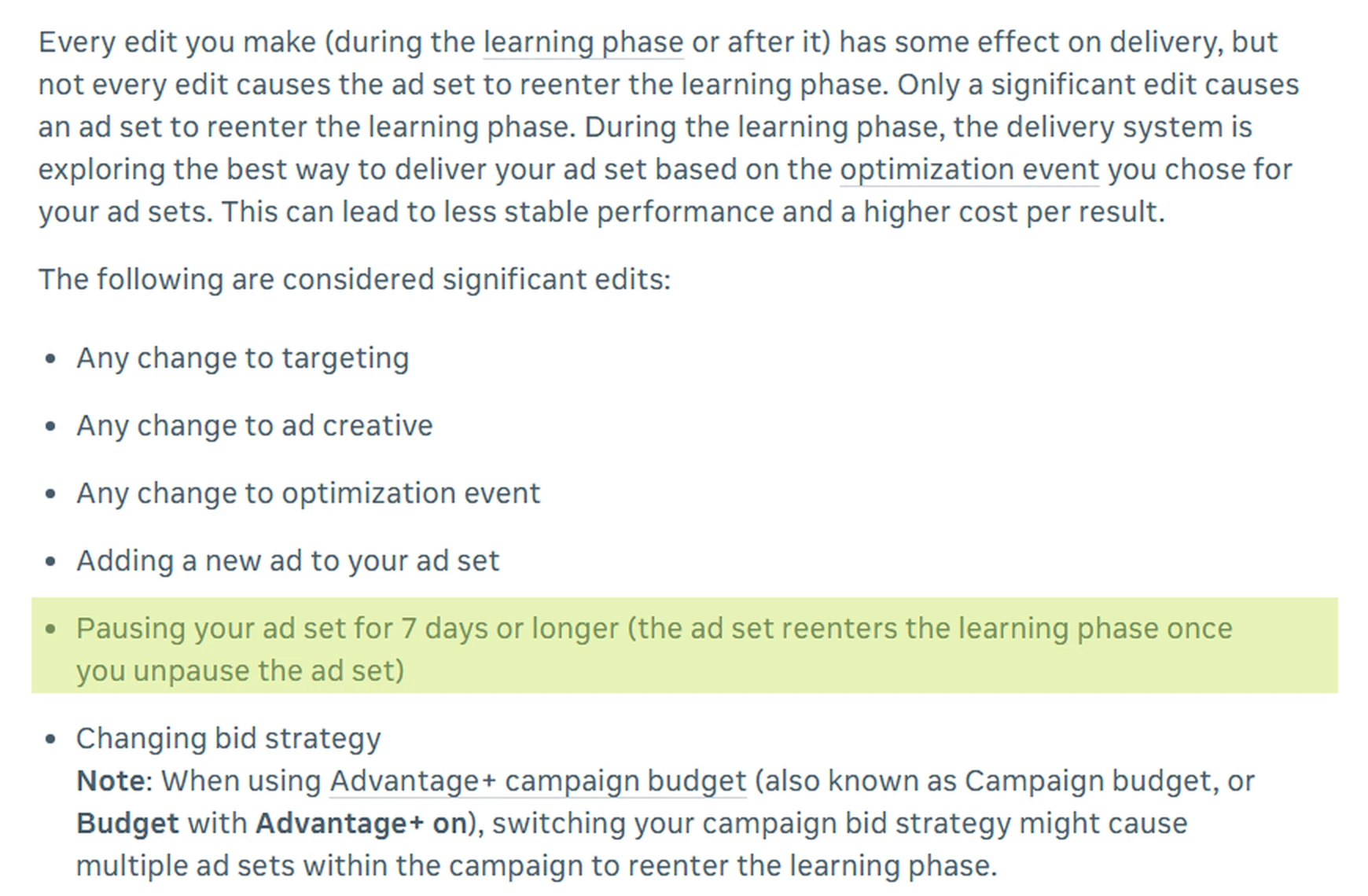
On Meta, an ad-set pause of seven days or more is listed as a significant edit and can require renewed learning. Meta describes roughly 50 optimization results in a week after the last significant edit as a common stabilization guide, not a universal eligibility threshold. Budget changes may also count as significant depending on magnitude, with no guaranteed safe step size.
Maintain only retargeting segments whose incremental margin, quality and frequency justify their floor. Exclude recent purchasers or overlapping low-value audiences where appropriate. As prospecting declines, the future retargeting pool can shrink, so monitor reach and repeat exposure.
Conference Attendance and Broad Account Based Marketing
Select events based on access to strategic accounts, expected qualified pipeline and contribution after travel and sponsorship costs. Compare cancellation terms and booking lead times before removing an event. For ABM, preserve work tied to named accounts the sales team is actively pursuing. Defer broader account tiers when qualified opportunities are moving slowly, and tie the restart decision to a specific pipeline or account-coverage need.
- Assess which accounts and buying committees an event can credibly reach.
- Compare pipeline quality and expected contribution with the full cost and deal timing.
- Keep events with a defensible case; defer lower-priority commitments when their cash-release dates help the plan.
Experimental Digital Advertising Channels Without a Learning Plan
Fund an experiment only if the hypothesis, success measure, budget and duration can generate a decision. Set a minimum meaningful signal and a stop rule in advance; learning thresholds vary by platform and are not substitutes for statistical power.
What to Stop: Verified Low-Value Scope
Start with duplicated scope or expenses whose cost outweighs the value they add. Give poorly tracked or temporarily unowned work a quick check before ending it, especially when restarting would be costly.
Overlapping Agency Retainers and Duplicate Martech
Compare vendor statements of work and actual usage, then remove confirmed overlap without losing necessary capacity. Gartner reports paid media at 31.4% of marketing budgets and emphasizes scrutiny of legacy spending; McKinsey also describes agency overlap and unused martech as possible savings sources.
An in-house versus agency cost comparison can help evaluate a genuinely overlapping service, provided transition and contract costs are included.
Spend With No Owner and No Decision Attached
Assign an owner and a short deadline to explain what decision the expense serves, what evidence exists and whether it has strategic value. If no defensible use emerges, discontinue the specific scope on the earliest feasible date.
Legacy Placements Renewed on Autopilot
Review recurring sponsorships and display placements for verified duplication, weak incremental contribution and cancellation terms. Stop those that fail the review and can actually be exited. Branded-search campaigns follow the separate testing logic in the paid-search section. Once the clear exits are identified, timing becomes the next problem: which savings can take effect within 90 days?
A 90-Day Plan to Cut 20%
Start with finance's exact cash requirement and its deadline, then sort possible reductions by contribution risk and release date. Workstreams overlap: negotiating a contract and stepping down a campaign may happen during the same weeks.
- Days 1-10: Define whether the 20% target applies to controllable programs or the full department. Capture a pre-cut baseline, incremental margin assumptions, expense owners, contract notices, penalties and cash-release dates.
- Days 10-30: End verified low-value cancellable scope and renegotiate contracts. Separate this-quarter cash savings from commitments that expire later.
- Days 15-45: Reduce reversible campaigns in monitored stages and defer lower-priority events or tests when allowed by their terms. Record a line-specific restart condition.
- From Day 30: Review protected floors against their own purpose: incremental acquisition margin, repeat purchases, existing SEO conversions or longer-horizon brand demand. Diagnose adverse signals before changing allocation.
- Days 30, 60 and 90: Reconcile cash actually released with the target and compare incremental customers, contribution and pipeline with the baseline. Resolve any remaining cash gap explicitly.
Here is a hypothetical $100,000 monthly controllable-program plan covering media, events, lifecycle and vendor fees. The 20% reduction applies to this defined $100,000 pool, not automatically to the company's entire marketing budget. Payroll and existing brand or SEO work fall outside this illustration and still have real costs. The $80,000 after column is a possible post-implementation endpoint, conditional on the proposed cancellations taking effect.
| Line | Before | After | Change | Verdict |
|---|---|---|---|---|
| Retention and lifecycle email | $6,000 | $6,000 | 0% | Protect |
| Non-brand paid search | $24,000 | $24,000 | 0% | Protect |
| Retargeting | $10,000 | $10,000 | 0% | Protect |
| Creative testing | $10,000 | $10,000 | 0% | Protect |
| Broad prospecting | $22,000 | $17,000 | -23% | Pause (step down) |
| Conferences | $8,000 | $4,000 | -50% | Pause |
| Experimental channels | $5,000 | $2,000 | -60% | Pause |
| Agency/martech scope ($3,000 duplicate) | $10,000 | $7,000 | -30% | Stop $3,000 overlap; retain $7,000 |
| Cancellable low-value legacy placements | $5,000 | $0 | -100% | Stop verified legacy scope |
| Total | $100,000 | $80,000 | -20% |
Illustrative post-implementation budget, not client results or guaranteed Day-30 cash savings. The reductions require contract exit or timing confirmation.
The unchanged $50,000 reflects assumed profitable retention, non-brand search, retargeting and creative activity for this example only. Retargeting protection needs evidence of incremental value and adequate audience quality.
Existing brand and SEO work remain outside these rows, while branded-search cuts are excluded from the booked savings pending account-specific testing.
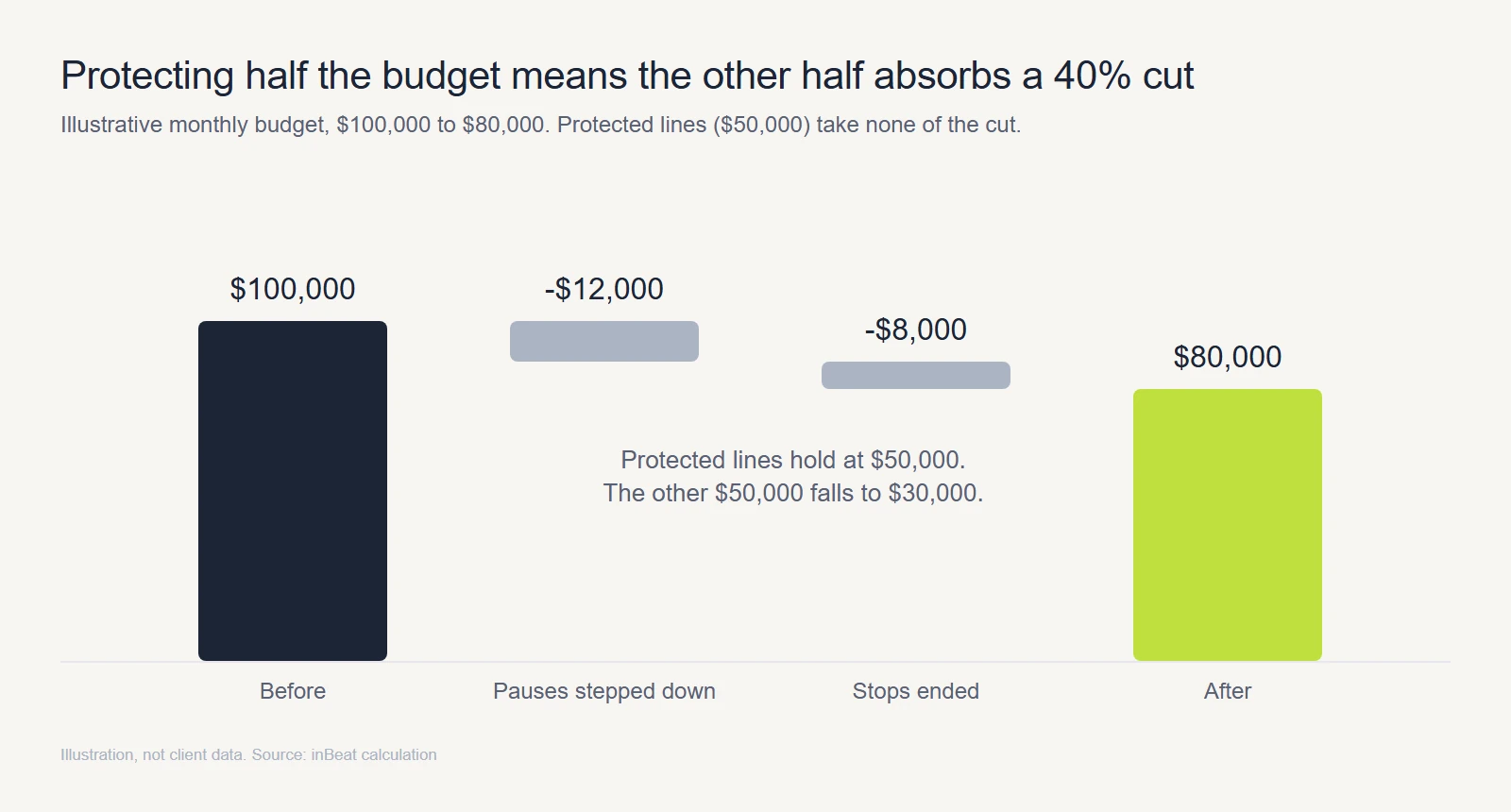
The table reconciles $100,000 before to $80,000 after, with $12,000 in staged reductions and $8,000 in removed scope. If $3,000 of overlap survives a contract until after Day 90, it belongs in future savings, not cash already available. If all other cuts take effect, only $17,000 of the planned $20,000 monthly run-rate reduction is available by that deadline. Finance then needs another $3,000 per month in feasible reductions, a renegotiated timeline or agreement to the shortfall. Track cash actually saved separately from the eventual monthly run-rate. The next test is whether the expected incremental contribution given up fits the business case.
How to Tell Whether the Cut Is Working
When volume and test design permit, use an incrementality experiment for the specific line being reduced. Otherwise compare carefully annotated trends with a matched market or account cohort, and present causal conclusions as provisional. Keep cash released beside total customers, revenue, gross margin, pipeline and blended acquisition cost.
Meta Lift access criteria are different from having enough power to detect a useful effect. Verify current eligibility in Events Manager and size the holdout around expected effect, volume and duration rather than assuming a universal $10,000 minimum or 10% split. Google's geo-experiment guidance recommends pre-test data at least three times the experiment's duration for that specific design.
Review a small set of decision metrics against the baseline:
- Cash actually released by date and any committed future savings.
- Incremental customer or opportunity volume and contribution margin, with uncertainty noted.
- Blended CAC and line-specific conversion indicators, read alongside demand and conversion lags.
| What you see | What it may indicate | What to check next |
|---|---|---|
| Cost per conversion up, conversion rate flat | Could reflect pricier auctions or saturation | Check CPM, reach, frequency and mix |
| Conversion rate down, CPM flat | Possible creative or page-response issue | Check audience, creative and page changes |
| Branded search down after a paid social cut | Possible weaker upstream demand | Compare seasonality, matched markets and rivals |
| Sales flat, platform ROAS up | May reflect attribution mix rather than lift | Check blended revenue, margin and controls |
| Pipeline down in later months (B2B) | Could reflect lower earlier demand creation | Compare new opportunity cohorts over full cycle |
For complex paths, a marketing measurement agency can help distinguish platform credit from business contribution; a single dashboard cannot establish causality by itself.
How to Make the Case to Finance
Finance needs to know when each saving begins and what profitable demand may be lost. Show four figures on one page: savings by the deadline, savings that arrive later, estimated profit at risk and any gap to the 20% target. Label estimates clearly.
Attach the assumptions, protected minimums, the person responsible for each decision and the review date. If the account already operates near efficient marginal acquisition cost, a 20% reduction is a volume trade-off: expected lost contribution belongs next to the cash saved. That estimate should reflect how long it takes new demand to become revenue.
| What finance says | Response |
|---|---|
| "Cut 20% across the board." | Offer a targeted cash schedule and estimate contribution at risk. |
| "Marketing is a cost center." | Show incremental margin evidence and the protected minimum. |
| "We need cash this quarter." | Separate released cash, later savings and the deadline gap. |
| "Prove it's working." | Propose a feasible test or qualified trend review with an owner and date. |
B2B vs. DTC: Adjust the Evidence Window
The cash, margin and restart questions stay the same, but the evidence window changes. Many DTC campaigns can show purchase effects within days or weeks; higher-consideration products take longer. B2B programs often need opportunity cohorts across a full sales cycle before a reduction can be judged. Use leading signals now and later revenue by cohort, with seasonality in view.
| Factor | B2B | DTC |
|---|---|---|
| Useful observation window | New opportunities now; closed revenue by cohort over a sales cycle | Purchases in days or weeks for simpler offers; longer for considered products |
| Candidate to protect | Named-account coverage with a sound contribution case | Profitable lifecycle and incremental retargeting segments |
| Candidate to pause | Broad ABM reach or events with weak qualified pipeline | Prospecting with weaker marginal contribution |
| Evidence to use | Opportunity cohorts, account exposure and pipeline quality | Incremental orders, gross margin and blended acquisition cost |
| Restart trigger | Coverage gap or qualified pipeline shortfall with feasible payback | Inventory, demand or margin case with cash available |
When and How to Restore a Paused Line
Once money becomes available again, the question changes: which paused activity deserves the first dollar back? Reopen it when the original constraint has changed, cash is available and expected incremental contribution justifies the first funding step.
A DTC trigger may involve inventory or acquisition efficiency; a B2B trigger may be a gap in account coverage or qualified pipeline. Consider relearning costs before assuming the former return will repeat.
A media mix model can help compare marginal returns where history and variation are sufficient. Otherwise, use a focused test or directional account evidence, and disclose the uncertainty. Record the first funding step, the expected response and a date to reassess.
Compare possible restarts using these factors:
- Expected incremental contribution from the first funding step.
- Available cash and a payback window finance can accept.
- Audience, creative or event-booking costs required to restart.
- Inventory needs, account coverage and the urgency of pipeline gaps.
Where practical, restart one activity at a time and compare results with the trigger set earlier. A protected program that was trimmed can also earn money back if the numbers support it.
Build a Cash Plan That Protects Demand
A budget cut works when finance receives the saving it needs and marketing understands what demand may be lost. The strongest plan puts both on the same page, then sets a date to review the trade-off.
inBeat's paid media and measurement teams can audit the line items and identify which decisions need better evidence. Book a strategy call to review the cash plan and the risks behind it.
FAQs
How do you cut 20% when the account already runs near its lowest efficient cost per conversion?
When low-value waste is already gone, a 20% cut trades volume and possibly contribution margin for liquidity. Compare marginal acquisition cost with the contribution of the next customer, preserve only justified minimums and give finance a range for lost demand. If the requested cash target requires giving up profitable conversions, make that trade-off explicit.
How do you size a holdout test when the cut has already shrunk the budget?
Check current Meta Conversion Lift requirements in-product before planning a test. Historical eligibility criteria described in published guides, such as $5,000 in past-year spend and 500 conversions, are different from enough statistical power to detect a change. Assess matched-market or account holdouts for adequate volume; if neither works, report blended trends as directional evidence.
What changes when the 20% lands mid-year and part of the spend is committed to annual contracts?
A contracted expense may be paused operationally while its invoices continue. Record notice dates and penalties, and ask about renegotiation or credits. Count only cash released by finance's deadline toward the current-period target; put later savings in a separate column. Any remaining gap must be covered by other changes or an explicit agreement on timing.
How should a B2B team with a 90-day sales cycle read the first 30 days of data after a cut?
Keep tracking closed revenue, but recognize that early post-cut wins mostly reflect pipeline created earlier. During the first 30 days, compare qualified opportunity creation, meeting progression and account engagement by cohort. Judge win rates and contribution from post-cut cohorts only after enough of the sales cycle has passed.
If finance wants the whole 20% from paid media, how do you show the effect on branded and organic search?
Compare branded query demand, direct visits and organic conversions in markets or cohorts where the paid reduction can be distinguished. A decline may suggest weaker upstream demand, but seasonality or competitor activity could also explain it. Without a credible control, describe the pattern as suggestive rather than proof that the cut caused it.
What changes in the plan when creators produce the creative?
Creator production changes which costs are fixed. Compare creator fees, usage rights and editing time with studio costs and the number of concepts you can actually test. Preserve enough creative capacity to learn only when distribution volume and contribution justify it; negotiate licensing before retiring useful assets.


