
An Instagram influencer strategy scales when creators supply testable creative, media buying tests each one and creative-level CAC picks winners. Creators bring the message-and-messenger combinations, controlled spend sits behind each one, and the CAC read decides which combinations get whitelisted and which get cut.
Most programs never get there because budget arrives before measurement does.
Influencer Marketing Hub's benchmark survey found that 72.22% of respondents expected their influencer budget to rise by 50% or more, which describes intent at the time and says nothing about what those budgets proved.
This guide walks through the eight decisions that turn Instagram creators into an acquisition system: the scoreboard, tiers, vetting, the test matrix, the pipeline, amplification, measurement and contracts.
P.S. If you'd rather have the sourcing and paid testing run for you, inBeat Agency's influencer marketing services cover creator sourcing at volume through to amplification.
We don't think of an Instagram creator as a distribution channel. We think of them as a creative engine who happens to carry a persona, and we let media buying handle the reaching. That flips the planning question. Instead of asking how large a creator's audience is, you ask how many message-and-messenger combinations you can put into market this month and how quickly you can read which ones acquire customers at an acceptable CAC.
Set CAC Targets for Your Instagram Influencer Strategy
Before any outreach, write a one-page charter that names the target CAC, the MER floor, the split between discovery and amplification budget, and the 30-day proof threshold. Everything downstream, from tier choice to contract language, gets easier to decide once those four numbers exist.
Set the Scoreboard: CAC and MER Before Any Creator Outreach
Pick one commercial outcome the program answers for.
For most consumer brands that's new customers at or below a target CAC, judged against a blended marketing efficiency ratio (total revenue over total marketing spend) so that creator spend can't hide inside a channel-level ROAS.
Engagement, saves and follower lift are diagnostic signals you'll use later, but they never appear on the scoreboard.
Size the Test Budget for Your Instagram Campaign
Split the budget into two pools.
- The discovery pool funds many small creator deals whose job is to produce distinct hooks and personas to test.
- The amplification pool is reserved for paid spend behind whichever assets earn it.
As a starting hypothesis, and only that, a hypothetical first-quarter DTC program might put roughly 40% into discovery across twenty to thirty small partnerships and hold 60% for amplification, then adjust the ratio once the first batch reports.
The discovery pool is a learning cost.
Judge it by how many readable signals it produced per dollar, and judge only the amplification pool on CAC. For a wider view of how creator spend sits next to paid, inBeat Agency's comparison of paid ads versus influencer marketing covers the tradeoff.
Decide What a Creator Post Has to Prove in the First 30 Days
Write the kill and scale criteria before the first brief leaves. A hypothetical version: an asset is scaled if its dark-post CAC lands within 20% of the charter target on a fixed test budget within 30 days; it's cut if it misses by more than 50% after the full test budget has been spent; anything in between gets one hook variation and a second test.
The specific thresholds matter less than the fact that they're written down before anyone is emotionally attached to a creator.
Choose Instagram Creator Tiers by What You Need Them to Do
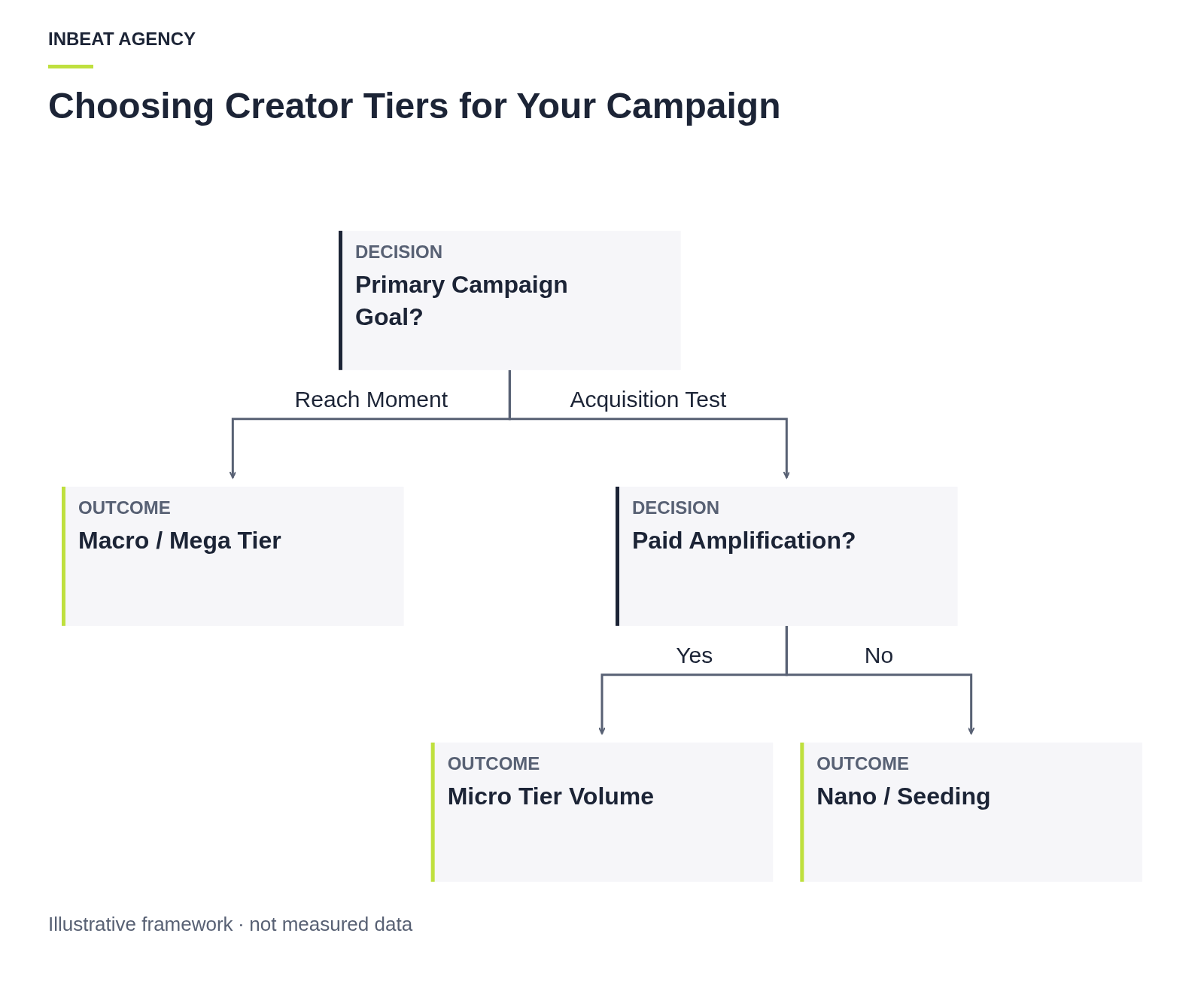
Choose micro creators matched by persona as the default for acquisition programs, and reserve macro and mega creators for launches and reach moments.
Follower-count tiers are industry conventions, and the ranges below are the ones most agencies and platforms use, and none of them is a measured threshold: nano under about 10k followers, micro roughly 10k to 100k, macro roughly 100k to 1M, mega above 1M.
Shopify's review of influencer marketing uses a similar vocabulary. What matters is what each tier is for.
Use Nano and Micro Creators for Creative Testing
Nano and micro creators give an acquisition program the three things it runs on: persona volume, varied hooks and creative you can afford to test in quantity.
A 2024 meta-analysis in the Journal of the Academy of Marketing Science supports the persona part of that claim, finding that follower characteristics, especially social identity, had the strongest effects on consumer attitudes and engagement, while post characteristics did more for purchase intention.
That review aggregates studies across platforms, so treat it as directional for Instagram.
The practical read is that a creator's audience identity is doing targeting work.
Twenty micro creators, each with an audience that looks like one of your personas, give you twenty distinct audience identities and twenty distinct hooks.
Take a hypothetical comparison at the same total cost: one macro post yields one hook, one persona and one data point, while twenty micro posts yield twenty hooks you can dark-post, rank and learn from.
For acquisition, the second option almost always wins because the value is in the learning, and micro creators are also more willing to grant paid usage rights at sensible prices.
Use Macro and Mega Creators on Instagram for Reach
Large creators are for the moments when you already know the message and need it heard once, widely: a product launch, a retail listing, a seasonal push. They rarely give you diverse creative, they're expensive to license for paid, and a single underperforming post is a costly lesson. When the job is a reach moment, they're the right tool.
Mix Instagram Creator Tiers by the Job Each One Performs
Assign each planned campaign a tier mix using the table below, and write the job each tier performs next to its budget line.
The cost and rights columns reflect typical deal structures we encounter, they aren't measured market rates, and they shift by category and market. The choice between micro and macro influencers depends on four things:
- Your category (considered purchases tolerate longer informational content from micro creators)
- Your AOV (higher-ticket products justify more cells and more testing)
- Your launch timing (a hard launch date argues for one macro moment on top of the micro base)
- Whether paid amplification is planned. If it isn't, the case for micro volume weakens, because the learning has nowhere to go.
Vet Instagram Creators for Audience Fit Before You Vet for Reach
Run every shortlisted creator through the signal table below and reject anyone who fails the audience identity check, regardless of reach. The 2024 meta-analytic finding that follower social identity drives attitudes and engagement makes audience fit the first filter: does the creator's audience look like the customer you're trying to acquire?
Check Audience Identity Match Against Your Buyer Persona
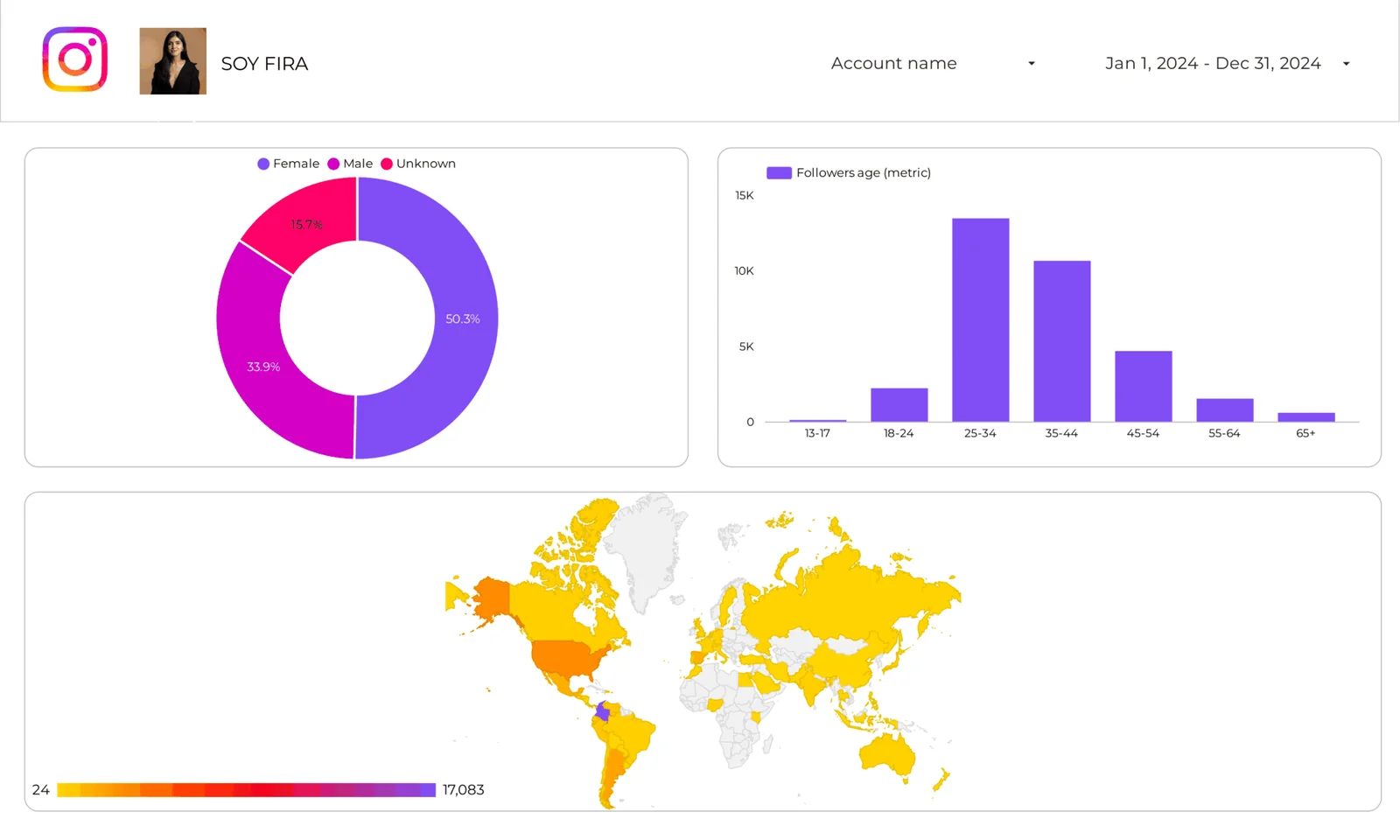
- Start with who comments. Read fifty recent comments and classify the commenters: are they the persona, adjacent to it, or other creators trading engagement?
- Cross-check audience geography against your shipping or service footprint, since a US brand gains little from a creator whose audience is mostly elsewhere.
- Then look at the ratio of sponsored to organic posts; a feed that's mostly ads has already spent its credibility.
The same test works for B2B and niche consumer brands, where the audience is small but precise.
Consider a hypothetical B2B software brand comparing a 12k-follower operations creator whose comments come from practitioners describing their own workflows against a 200k lifestyle account with generic praise. The first passes the identity check and the second fails it, and the follower count is irrelevant to that verdict.
Read Engagement Quality Past the Headline Rate
Per-post engagement rate is easy to inflate with giveaways, engagement pods and purchased likes. Read the harder signals instead:
- Saves and shares (ask the creator for screenshots of post insights)
- Comment specificity
- Story completion when the creator is willing to share it
- Whether questions in the comments get answered
Academic work on engagement with sponsored posts on Instagram is a useful reminder that engagement on sponsored content behaves differently from engagement on organic content, so ask for insights on past paid posts specifically.
Check Brand Safety and Past Sponsored Work
Scroll at least a year back. You're looking for categories that conflict with yours, claims that would embarrass you if repeated, and whether previous sponsorships were disclosed. Disclosure habits are a good proxy for how the creator will treat your brief.
The limits are real. Manual vetting produces false positives, audit tools estimate rather than prove fraud, and no process removes fake followers entirely. The goal is to lower the odds of paying for an audience that doesn't exist, and the paid test later will catch what vetting misses.
Build the Persona-by-Angle Instagram Content Matrix
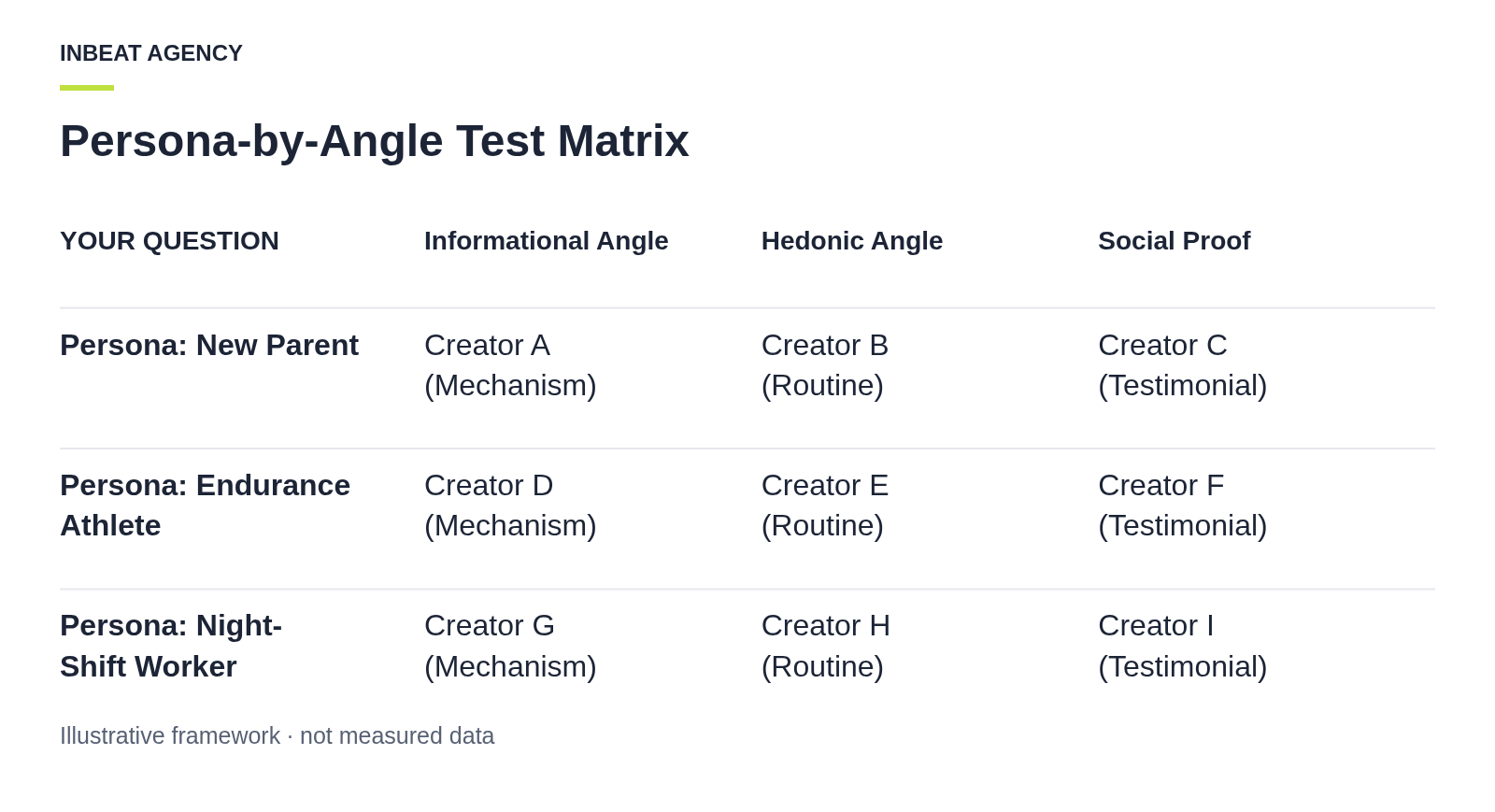
Draft a matrix with personas as rows and message angles as columns, then list the creator type needed for each cell before any outreach. This grid is the core of the strategy, because it turns creator selection into an experiment design rather than a shopping list.
Define Three to Five Buyer Personas for Your Instagram Strategy
A persona earns a row only if it needs different content to convert. Age brackets rarely qualify; life situations and motivations do.
A hypothetical supplement brand might settle on three:
- The new parent buying energy without caffeine
- The endurance athlete buying recovery
- The night-shift worker buying sleep regulation
Each has a different objection, a different vocabulary and a different set of creators they already trust. Three to five rows is the practical range. Fewer and you're guessing which audience the product is for; more and you can't fund enough creators per cell to read anything.
Define the Content Angles that the Instagram Creators Should Test
The angle axis comes straight from the evidence. The 2024 meta-analysis cited above found that post characteristics, specifically informational value and hedonic value, exert stronger effects on purchase intention than on attitudes.
Both belong in the grid, so no single house style is allowed to dominate.
- Informational means the ingredient or mechanism explainer.
- Hedonic means the pleasure of use, the morning routine, the way it feels.
- Social proof means the before-and-after or the testimonial.
For the supplement brand, that produces nine cells, and each cell is a distinct hypothesis about what makes this persona buy.
Match Instagram Creators to Personas and Angles
The creative is the targeting. As Meta's targeting options have narrowed, the persona carried inside the influencer generated content does the audience selection that campaign settings used to do.
A night-shift nurse talking about sleep in her own kitchen selects for night-shift workers in a way no interest setting can.
That's why each cell needs a creator whose own audience matches that row. You don't need one creator filming nine variations. The same face across all cells collapses the persona axis and leaves you testing only angles.
Pro tip: Sprout Social's State of Influencer Marketing report is worth reading alongside this for how brands describe creator selection, though our approach is stricter than most.
As a rule of thumb, aim for at least two creators per cell in the first round and a minimum of six cells. Two creators per cell lets you separate a weak angle from a weak creator; one creator per cell can't. With nine cells and two creators each, the hypothetical supplement brand briefs eighteen creators in round one, which is exactly the volume micro tiers make affordable.
Once filled, the matrix becomes two documents.
Read down the rows and you have the brief list for the sourcing pipeline, each brief carrying its persona and angle. Read across the completed grid and you have the dark-post test plan for the paid team, with each cell a named ad set and a fixed test budget. Everything in the next two sections executes this grid.
Run an Instagram Creator Content Pipeline
Set up a batch tracker with columns for matrix cell, creator, brief sent, asset received, usage rights and paid status, and run outreach in weekly batches. The pipeline exists to deliver fresh creative to the media team continuously, so cadence matters as much as any single step.
- Source candidates per matrix cell. Work cell by cell. For each cell, build a longlist of ten to fifteen creators whose audience matches the persona row and who already make content in the angle's format. Use search, hashtag and audience-lookalike tools, then apply the vetting table from the previous section. Expect roughly a third to survive.
- Outreach in weekly batches. Send one batch per week so replies, negotiations and deliveries stagger. Personalize the first line with a reference to a specific post, state the deliverable and the fee range up front, and give a reply deadline.
- Negotiate a standard deal structure. A rate card by tier and deliverable, a template contract and a fixed fee for paid usage rights remove most negotiation delay. The rights fee is the one line worth defending; the section on contracts covers the wording.
- Brief the angle and the persona, and leave the script to the creator. The brief names who the content is for, what it needs to make them believe, and which claims are off limits. It does not dictate lines. An experiment published in Electronic Markets found that, from the marketer's side, outcomes were best when influencers promoted products as genuine recommendations and used an impartiality disclosure. Scripted content undermines the genuine-recommendation framing that makes the format work, so briefs protect the creator's voice by design.
- Approve with a light review. One round, limited to factual accuracy, claim compliance and disclosure. Style notes usually mean the brief was wrong.
- Deliver assets with usage terms attached. Every file lands in the tracker with its rights status, so the media team can see at a glance what can be dark-posted and whitelisted. An asset without confirmed rights doesn't move to paid.
Pro tip: brief the hook. Ask creators for a first two seconds that name the persona's problem in their own words, and leave the body of the Reel entirely to them. The hook is what dark-post testing reads first, and it's the one element where a nudge pays for itself.
On cadence, a hypothetical eight-week pipeline runs like this:
- Weeks one and two source and brief the first eighteen creators
- Week four delivers the first batch of assets
- Week six delivers the second while week five outreach fills the cells that underperformed
- Week eight delivers the third
The media team receives a new batch every two weeks from week four onward, which is the rhythm that lets the make, launch, learn loop actually turn.
The operational bottlenecks are rarely creative.
They're negotiation turnaround, contract redlines and lost track of which asset has which rights. A rate card, a template and a tracker solve most of it. Practitioner threads like this r/socialmedia discussion of planning a strategy for a large account show how much of the creator side is also process, which is why a predictable brand-side process gets better creators to say yes.
Amplify Winners with Whitelisting and Dark Posts
Launch every delivered asset as a dark post with a fixed test budget, then whitelist and scale only the creators whose cells clear the CAC threshold from the charter. This is where creator work becomes an acquisition channel.
Dark-Post Every Matrix Cell Before Anyone Sees an Organic Result
A dark post is creator content run as an unpublished ad, from the brand handle or the creator's, so it never appears on a feed as an organic post.
That lets you read signal at controlled spend without waiting for organic reach to decide anything.
- Set up one ad set per matrix cell.
- Load both creators' assets into it.
- Give each cell the same fixed test budget and the same audience settings.
- Let it run for the test window in the charter.
Because targeting is held constant, differences in CAC between cells come from the creative, which is exactly the variable you're trying to learn about. Organic performance is irrelevant at this stage. A creator's post can earn a wall of likes and produce no customers, and the reverse happens more often than most teams expect.
Whitelist the Creators Whose Cells Earned It
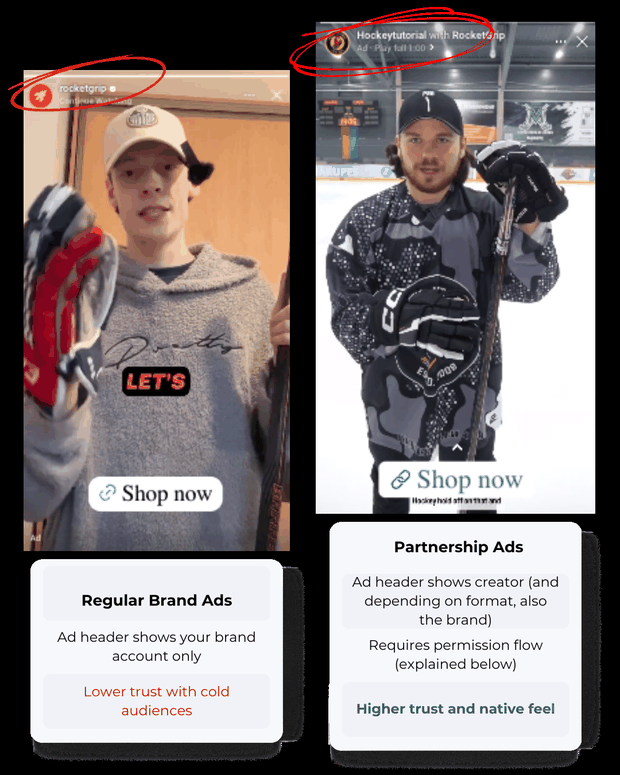
Whitelisting means the creator grants your ad account permission, through Meta's partnership tools, to run ads from their handle.
The ad unit then carries the creator's name and face, and the borrowed trust that comes with it.
The Electronic Markets experiment's finding that genuine-recommendation framing with impartiality disclosure served marketers best explains why whitelisting tends to outperform reposting from the brand handle: the ad still reads as a person recommending something and doesn't sound like brand advertising.
Whitelist only the creators whose cells beat the CAC threshold. Scale spend on those cells in steps, watching for CAC creep as frequency rises, and cut the cells that missed. Never scale on organic engagement.
The precondition is legal: no paid amplification without signed usage rights and handle permissions, which the contracts section covers in detail.
Whitelisting and dark posting are where creative and media meet; inBeat Agency's paid media team runs this loop alongside creator sourcing. Our published Hello Fresh case study documents one creator-plus-paid program of this kind, and the figures printed on that page are the only results we'll cite for it.
Feed Creative-Level CAC Back into the Next Batch of Briefs
The loop closes when the winning cells shape the next round.
If the night-shift persona with a hedonic angle beat the target while the athlete persona missed across all angles, the next batch briefs three more night-shift creators with hook variations and drops the athlete row or reframes it. Over two or three rounds, the matrix narrows toward the combinations that acquire customers, and the discovery pool shrinks as the amplification pool grows.
Organic-only creator programs rarely reach predictable commercial scale.
They can work for low-price impulse categories with strong word-of-mouth dynamics, and for brands whose creative supply is so limited that paid testing has nothing to test.
For everything else, reach controlled by the platform's organic algorithm is not a channel you can plan against.
Paid spend behind creator content converts an uncertain reach outcome into a controllable one, and creative-level CAC is the only reading that tells you where to put the next dollar.
Measure Your Instagram Influencer Strategy
Build a creative-level report keyed to matrix cells, and add a post-purchase survey question asking which creator the customer saw. The report's job is to apply the charter, so every line traces back to CAC or MER and every softer metric is labeled as diagnostic.
Pick the Metrics that Assess Creator Performance
The 2024 meta-analysis above draws a line that most dashboards blur: follower social identity drives attitudes and behavioral engagement, while post informational and hedonic value drive purchase intention.
Different outcomes, different drivers, so different metrics.
Reach, engagement, saves and sentiment measure the attitude side and tell you whether a creator's audience is receptive. Conversions, CAC and MER measure the purchase side and tell you whether the content sold anything.
Reporting engagement as ROI mixes the two and is the most common way creator programs lose executive trust.
HubSpot's social media marketing report is a reasonable read on how marketers describe their own measurement priorities, and a reminder that self-reported priorities and actual attribution are different things.
Track Results at the Creative Level
A blended campaign ROAS tells you the program worked or didn't. A creative-level report tells you which persona-angle cell worked, which is the only information that improves the next brief.
Name every ad by matrix cell and creator, and report CAC by cell first and by creator second. A hypothetical report might show a mid-reach creator's dark post producing the lowest CAC in the program despite the weakest organic engagement, a result that would be invisible in a campaign-level view and that changes the next round entirely.
Attribution tools, in order of trust:
- Platform-reported conversions from dark posts, because they sit inside a controlled ad environment
- Unique codes and links, which are clean but miss anyone who searches the brand later
- Post-purchase surveys, which catch the organic halo codes miss but rely on recall
- Geo or audience holdouts, which are the most credible and the most expensive
Use Holdouts and Incrementality Tests When Spend Justifies Them
At small budgets, holdouts produce noise, so lean on platform conversions plus surveys and accept the uncertainty. Once a cell is scaling meaningful spend, run a geo holdout or a conversion-lift test to check that the CAC you're reporting is incremental.
State what you can't control in the report itself: platform attribution windows, the organic halo that codes never capture, and the statistical noise of small creator budgets.
The confidence levels are practitioner judgments about method reliability and shouldn't be read as measured error rates.
Lock Down Disclosures, Usage Rights and Contract Terms
Adopt a template contract that includes disclosure wording and paid usage rights by default, and audit existing agreements before amplifying any older content. None of this substitutes for counsel in your jurisdiction, and the FTC guidance below applies to US marketing; other markets have their own rules.
Disclose Every Material Connection Clearly and Conspicuously
The FTC's Endorsement Guides FAQ states the standard plainly: where a connection between an endorser and a marketer is one that a significant minority of consumers wouldn't expect and it would affect how they evaluate the endorsement, it should be disclosed clearly and conspicuously.
That covers:
- Gifted product, along with paid fees
- Affiliate codes, because a commission is a connection
- Whitelisted ads, where the paid relationship is even less obvious to a viewer who sees the creator's handle on the ad unit
The disclosure has to travel with the content into every placement. Compliance and performance point the same way: the Electronic Markets experiment found marketers did best when creators framed promotions as genuine recommendations and used an impartiality disclosure. Honest labeling is a performance choice as well as a legal one.
Write Usage Rights for Paid Amplification into the First Contract
Usage rights are the high-stakes field. Specify duration, channels, whether the brand may run the content as dark posts from its own handle, whether the creator grants handle permissions for whitelisting, and whether edits or cutdowns are permitted.
The evaluation check is simple: read the signed terms and ask whether they permit the whitelisting plan the media team has already drawn up.
Consider a hypothetical brand that whitelisted a creator Reel on a verbal agreement, watched it become the top-performing ad in the account, and then had to pull it mid-flight when the creator's manager objected.
The lost spend is recoverable; the lost learning cycle isn't. Rights negotiated after the content performs cost more and arrive slower.
Standardize Exclusivity, Approval and Takedown Terms
Exclusivity is the second high-stakes field. Too broad and micro creators refuse or price it in heavily; too narrow and your top performer promotes a competitor next week.
A category-specific window of a few weeks around the paid flight is a workable default.
Keep approvals to one round, define payment timing against delivery, and include a takedown clause tied to a morality provision so that a creator's conduct or a misleading claim doesn't sit in your ad account.
Brand safety risk comes from three places: creator conduct, misleading claims in content, and platform policy changes that reject or restrict ad formats.
You can control the second through briefing and approval, and mitigate the first through vetting and takedown clauses. The third you can only plan around, by keeping rights flexible across channels and never building the whole program on a single ad format.
Make, Launch, Learn, Repeat: How inBeat Agency Runs Instagram Creator Programs as One System
The system is simple to describe and hard to run in silos. Creators supply testable creative that carries a persona. Media buying puts controlled spend behind every cell and reads CAC at the creative level. The data decides which creators get whitelisted and scaled, and it writes the next batch of briefs. Each part shapes the others, which is why we run them as one loop. Three services handing work down a line lose that.
That's how inBeat Agency is built.
Our offer is influencer sourcing at volume, UGC and performance creative production, and paid social media buying, sold as one growth creative system. Our influencer marketing work fills the matrix and our paid media work runs the laboratory, and the only results we cite are the ones printed on our case study pages.
Where to start depends on your current bottleneck.
If creative supply is thin, begin with the matrix and the pipeline so the paid team has something to test. If media efficiency is the problem, begin with dark posting and whitelisting, because you probably already own content that has never been read at controlled spend. If measurement is the gap, begin with the charter and the creative-level report, because scaling without a scoreboard is where budgets disappear. Pick the weakest link and fix that one first.
Book a strategy call with inBeat Agency's influencer marketing team to map your first persona-by-angle test.
FAQ
Whitelisting or reposting creator content from the brand handle: which converts better and when does the difference matter?
Whitelisting tends to win because the ad still reads as a person recommending something, which matches the genuine-recommendation framing that served marketers best in the Electronic Markets experiment. The difference matters most for considered purchases and unfamiliar brands, where trust is the constraint. For a well-known brand running a price promotion, reposting from the brand handle often performs comparably and is simpler to license.
How many creators per matrix cell do you need before a dark-post result is worth acting on?
Two per cell is the practical floor, because one creator can't tell you whether the angle or the creator failed. Act on a cell after both assets have spent the full fixed test budget. Treat one strong asset and one weak one as a creator signal, and two weak ones as an angle signal.
Does an FTC disclosure still need to appear when a creator's Reel runs as a whitelisted ad?
Yes. The FTC standard applies to any connection a significant minority of consumers wouldn't expect, and a paid relationship behind an ad that carries the creator's handle is exactly that. Keep the disclosure in the creative itself so it survives every placement, and confirm it with counsel for your market.
What is the smallest budget at which a persona-by-angle test is still worth running?
Small enough to fund six cells with two micro creators each and a fixed dark-post test budget per cell. If you can only afford one creator per cell, shrink the grid to fewer personas rather than thinning the cells, because a grid you can't read teaches nothing.
Can this Instagram creator system work for a B2B or niche brand with a tiny addressable audience?
It can, and the persona-fit vetting step is where it lives or dies. A small, precise audience is an advantage when the creator's followers are the buyers. Expect fewer cells, smaller creators and a longer test window, and lean more heavily on post-purchase surveys because platform conversions will be sparse.
How do you handle a creator whose organic post underperforms but whose dark post beats the CAC threshold?
Scale the dark post and ignore the organic result. Organic reach is decided by the platform's algorithm; CAC under controlled spend is decided by the creative. Renew the creator for the next batch, brief hook variations around the winning angle, and make sure the rights and handle permissions cover the extended flight.