
The same creator video can run in two ads. One appears under a brand’s handle, while the other uses the creator’s identity. The footage may be identical, but the context changes.
According to Deloitte’s 2026 research, 45% of U.S. consumers who engage with creators say creator-led ads feel more authentic than traditional advertising.
That perception helps explain the appeal of influencer whitelisting. Brands can promote creator content while keeping the creator’s identity visible. However, access introduces questions about permissions, fees, usage rights, and performance.
How do you know whether it’s worth paying for? Here’s what matters.
TL;DR
- Whitelisting lets a brand advertise using an authorized creator identity. Meta calls the format partnership ads, while TikTok offers Spark Ads.
- Authorization happens through platform permissions, post codes or account links, rather than shared passwords.
- Meta supports post-level codes and account-level permissions. TikTok supports both video codes and account linking through Business Center; video-code windows can last 7, 30, 60 or 365 days.
- Access fees often sit alongside content and usage-rights fees. Their value depends on the fee, the planned ad spend and the actual improvement in acquisition costs.
- A clear agreement should cover scope, duration, revocation, edit approvals and disclosure before the ads launch.
What Is Influencer Whitelisting?
Influencer whitelisting is the practice of advertising with a creator's identity after receiving their permission. Depending on the platform and setup, the brand may promote an existing post or create new ads featuring that creator.
The Complete Guide to Influencer Whitelisting (For Brands). Source: Rooster Sánchez on YouTube
The creator authorizes the identity or content, while the brand usually manages budget, targeting and reporting through its ad account.
The platforms use different product names and permission routes:
- Meta: partnership ads. Meta says branded content ads are now called partnership ads.
- TikTok: Spark Ads, which can use an authorized post or a connected TikTok account.
- Industry shorthand: whitelisting or allowlisting. Content licensing is related, but it covers a different set of rights.
We use "whitelisting" through this guide because it is the term most marketers search.
This distinction matters: creator-handle access allows a brand to advertise with that identity, while content usage rights define where, how and for how long the brand may reuse the creative.
How Whitelisting Works: From Creator Permission to Live Ad
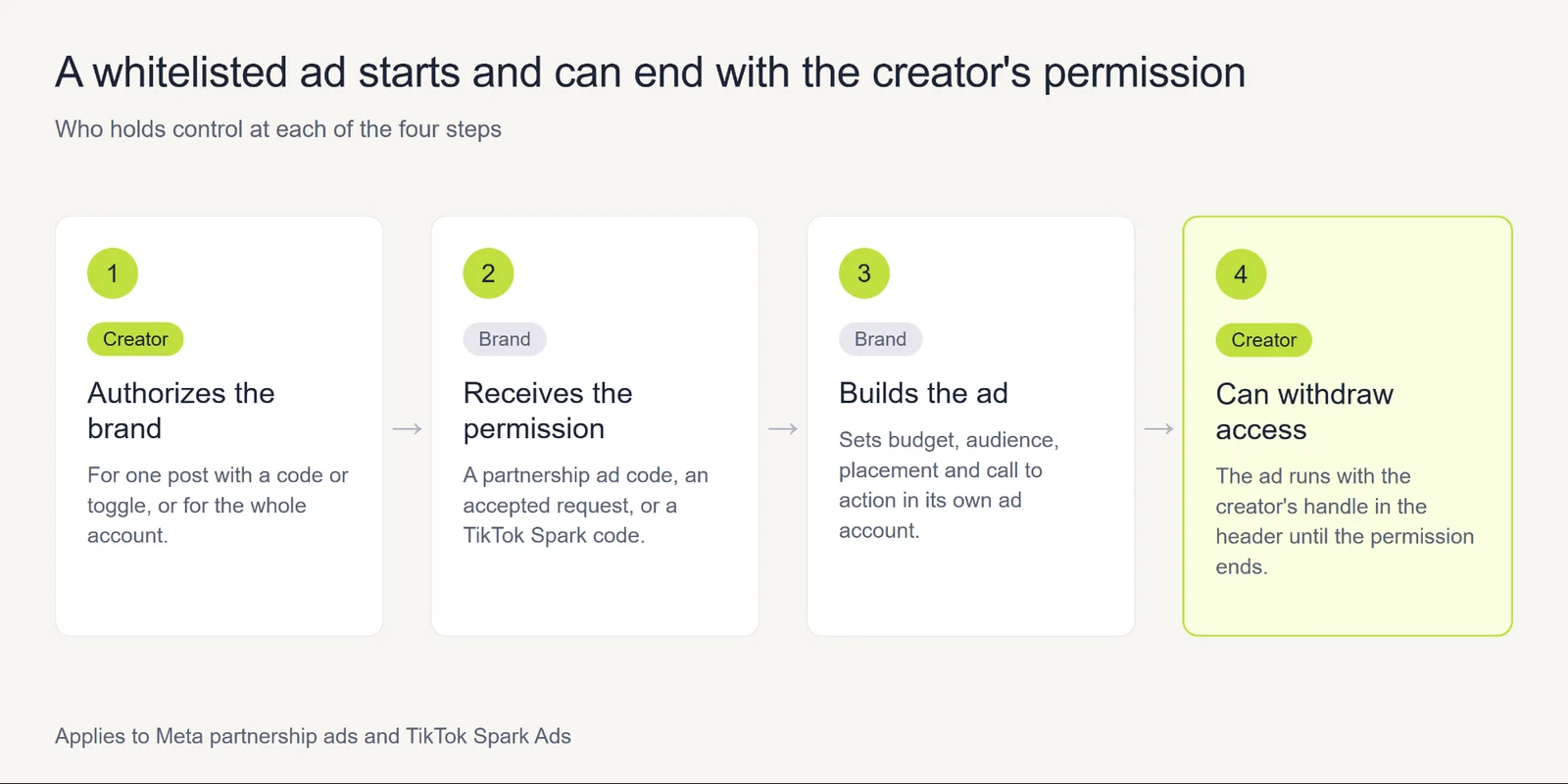
In practice, a whitelisted campaign moves through four stages. The creator grants access, while the brand handles distribution and reporting.
- First, the creator approves a specific post or a broader account connection, depending on the platform.
- Next, the brand receives the post code, approved request or linked-account access.
- With access in place, the brand builds the ad and sets the audience, budget, placements and call to action.
- Once live, the ad uses the approved creator identity. However, changes to permission affect active ads differently depending on the platform and access type.
Meta describes the result as ads where the partner and advertiser accounts are featured in the header, and the ad uses signals from both accounts for ranking.
That division of responsibilities becomes clearer in the table:
| Control | Creator | Brand |
|---|---|---|
| Which posts are available | Chooses, per post or per account | Requests |
| Ad copy and call to action | Approves scope in the agreement | Edits in Ads Manager |
| Budget and targeting | None | Sets and pays |
| Comments on the ad | Can unhide or delete their own | Can hide on the ad |
| Changing or revoking access | Platform-dependent | Can remove its own access; impact on live ads varies by permission type |
| Performance insights | Limited | Full, in the ad account |
Meta's guidance explains the comment and permission controls. The other rows summarize common responsibilities, which the agreement should define explicitly.
Permission Types for Meta Partnership Ads and TikTok Spark Ads
Meta offers post-level and account-level permissions. TikTok supports individual video codes and Business Center account linking, so the right setup depends on whether you need one post or a continuing program.
| Platform and product | Permission type | Who grants it | Duration | Revocation | Best for |
|---|---|---|---|---|---|
| Meta partnership ad, content-level | Toggle on a tagged post, or a partnership ad code | Creator | Per post | Creator, any time | Short tests, one-off promotion |
| Meta partnership ad, account-level | Request accepted by the creator | Creator | Until removed | Creator or brand | Ongoing programs, many creatives |
| TikTok Spark Ad | Authorization code for one video | Creator | 7, 30, 60 or 365 days | Subject to code and live-ad restrictions | Promoting eligible creator videos |
| TikTok Spark Ad (account link) | Business Center account authorization | Creator approves link | Until removed or changed | Creator or business; active ads may be affected | Ongoing programs with multiple posts |
Meta Content-Level Permission
Content-level permission covers a specific post, story or reel, which makes it useful for one-off tests without a broader account relationship.
A brand can create an ad when the creator turns on the boost permission for a post that tags the brand in the paid partnership label.
The other route is a partnership ad code, which works even when the post was never tagged as branded content. That second route matters because an older organic post can still become an ad.
Meta Account-Level Permission
Account-level permission lets a brand create partnership ads from a partner's handle without pre-existing content, and without a fresh permission request for each post.
Depending on the permissions granted, the brand may also be able to include or exclude the partner's custom audience. Meta notes that creators can accept requests in Instagram, Facebook or Creator Marketing Hub, making it important to agree on the scope before approval.
TikTok Spark Ads: Video Codes and Account Links
For a single-video Spark Ad, the creator enables ad authorization and selects a window of 7, 30, 60 or 365 days, and then shares the code with the brand. For ongoing campaigns, TikTok also supports account linking through Business Center, with separate permissions for existing posts and new videos.
A video code covers one post, while Business Center account linking can cover multiple eligible posts with the appropriate permissions. The access route should therefore match the expected volume of creative.
For a closer look at the video-code route, our Spark Ads guide covers the specs, metrics and best practices.
Older Meta Business Manager partner-access instructions may still appear in tutorials. For new programs, prioritize Meta's current partnership-ad permission flow and verify the available controls in your account.
How to Set Up Whitelisted Ads on Meta and TikTok
A single post may need only a code, whereas an ongoing creator partnership may benefit from account-level access.
Either way, permissions and creative rights should be agreed before the campaign schedule is fixed.
Run a Meta Ad From a Single Post Code
Use this route for a test or a one-off promotion.
- The creator picks the post and generates a partnership ad code in the Instagram app.
- The creator sends you the code.
- Search for the post by ad code in Creator Marketing Hub, where content search accepts an ad code, a post ID or a post URL.
- Create the ad in Ads Manager and edit copy, headline and call to action as needed. Meta says the original post stays unchanged while you edit the ad.
- Preview, confirm the creator's handle appears in the header, and publish.
Run Meta Ads From the Creator Handle With Account Access
Use this route for an ongoing program with several creatives per creator.
- In Meta Business Suite, open Creator Marketing, go to Manage permissions and click Add partnership.
- Search for the creator's username and select the account you want to partner with.
- Click Send request.
- The creator accepts in Creator Marketing Hub, the Instagram app or the Facebook app.
- Create ads from the creator's handle, with or without existing posts.
Those steps follow Meta's account-level permissions page. To boost existing Instagram content, the brand must be tagged through the paid partnership label, an @mention, a people tag, a product tag or Instagram Collabs. On Facebook, the paid partnership label is required.
Run a TikTok Ad From an Authorization Code
Use this route for a video that already shows organic traction.
- The creator opens the video, turns on ad authorization and chooses the window.
- The creator copies the code and sends it to you.
- You apply for authorization in TikTok Ads Manager's creative library and paste the code.
- With the permission in place, the brand can choose the objective and launch the ad.
- Before deleting an original video, coordinate the campaign closeout. TikTok requires ads using a video code to be removed from Ads Manager before that code can be deleted.
A seven-day code may cover a short activation, but a longer test needs room for review and extensions. Matching permission dates to the media plan helps avoid an interruption.
Run TikTok Spark Ads Through Business Center
For a program involving several creator posts, an account link can be easier to manage than collecting individual video codes.
In TikTok Business Center, the advertiser starts a request to link the creator's TikTok account, then shares the authorization request or QR code. The creator reviews and approves access in TikTok. Once linked, the advertiser can select eligible posts for Spark Ads in Ads Manager, within the approved scope.
If the campaign also needs the business to publish new videos through the linked identity, that permission must be granted separately.
Before launching, confirm which posts and capabilities are authorized, who can remove access and how the campaign will handle changes.
Whitelisting vs. Dark Posting vs. Boosting: What Is the Difference?
These terms describe different layers: whitelisting grants advertising permission, dark posting refers to an unpublished ad format, and boosting promotes existing content.
A campaign can use more than one approach.
| Method | What it is | Whose handle shows | Needs creator permission | Best use |
|---|---|---|---|---|
| Boosting | Promote an existing public post | Whoever posted it | Only if it's the creator's post | Extend a post that is already working |
| Dark post from brand handle | Unpublished ad shown as a paid placement, not on the brand's profile | Brand | Only when using licensed creator content | Clean tests of creative variants |
| Whitelisted partnership ad | Ad delivered from the creator's handle | Creator, with the brand tagged | Yes | Trust-led performance ads |
| Spark Ad | TikTok ad using an approved video or linked creator account | Creator | Yes, via code or account link | Promoting eligible creator videos |
For example, a Meta partnership ad can be created as an unpublished ad. It can reach the selected audience without appearing on the creator's profile.
Test design is a separate topic. Our dark posting guide covers how to structure hook, audience and call-to-action tests, so this guide focuses on the permission layer and the money.
Why Brands Run Ads Through Creator Accounts
A creator's identity can make an ad more relevant to people who already know that person. On Meta, partnership ads can also draw on signals associated with both the advertiser and creator.
These are useful reasons to experiment, although neither guarantees cheaper conversions. The important question is whether the added context improves results enough to justify access costs.
Creator Handle Adds Social Proof to the Ad
An existing creator post may bring likes, comments and an established discussion into paid distribution. For viewers seeing the product for the first time, that context can be more persuasive than a fresh brand ad with no visible interaction.
However, the benefit depends on the quality of those comments and whether they support the campaign message. New ads created under account-level permissions begin without the same history, so teams should compare these formats rather than assume the social proof will always help.
Partnership Ads Use Signals From Both Accounts
As one directional benchmark, Meta reports that adding partnership ads to business-as-usual campaigns delivers on average 19% lower CPAs.
Importantly, Meta's figure compares business-as-usual campaigns with campaigns that add partnership ads. It does not isolate the effect of a creator handle on the same creative. Use the figure as context, then measure your own results against a comparable control.
Creators Supply Testable Ad Creative
There is also a creative-testing benefit. When the brief includes raw footage, alternative hooks and permission to make edits, the media team can build variants around different audience questions or objections.
For example, one version might lead with a product demonstration while another begins with a specific problem. That said, access to a creator's handle does not automatically grant broad editing rights. These deliverables and permissions need to be agreed separately, which is why the creative brief and contract should work together.
How Much Does Whitelisting Cost?
Whitelisting access often carries a fee beyond content production. Whether that investment makes sense depends on the scope, the actual access cost and the performance improvement the campaign can deliver.
Whitelisting Fee Models
In practice, agreements often use one of four pricing approaches:
| Model | How it is priced | When it fits | Watch-out |
|---|---|---|---|
| Percentage of base fee per month | A share of the content fee for each month of access | Short, defined windows | Long windows compound quickly |
| Flat access fee per window | One price for 30, 60 or 90 days | Predictable budgets | Renewal terms need writing |
| Percentage of ad spend | A share of media spend | Creators with large audiences | Cost rises with every scale-up |
| Bundled into the content fee | No separate fee; the content fee covers an agreed window | Small tests | Creator may cap the window |
For context, inBeat's paid-ad content-usage rights benchmarks range from 20-30% of the base rate for three months to 30-50% for twelve.
These percentages describe content licensing, not the fee to run ads through a creator's handle. Because the permissions cover different rights, the agreement should price each separately and specify its own expiry and renewal terms.
Break-Even Math: When the Fee Pays Back
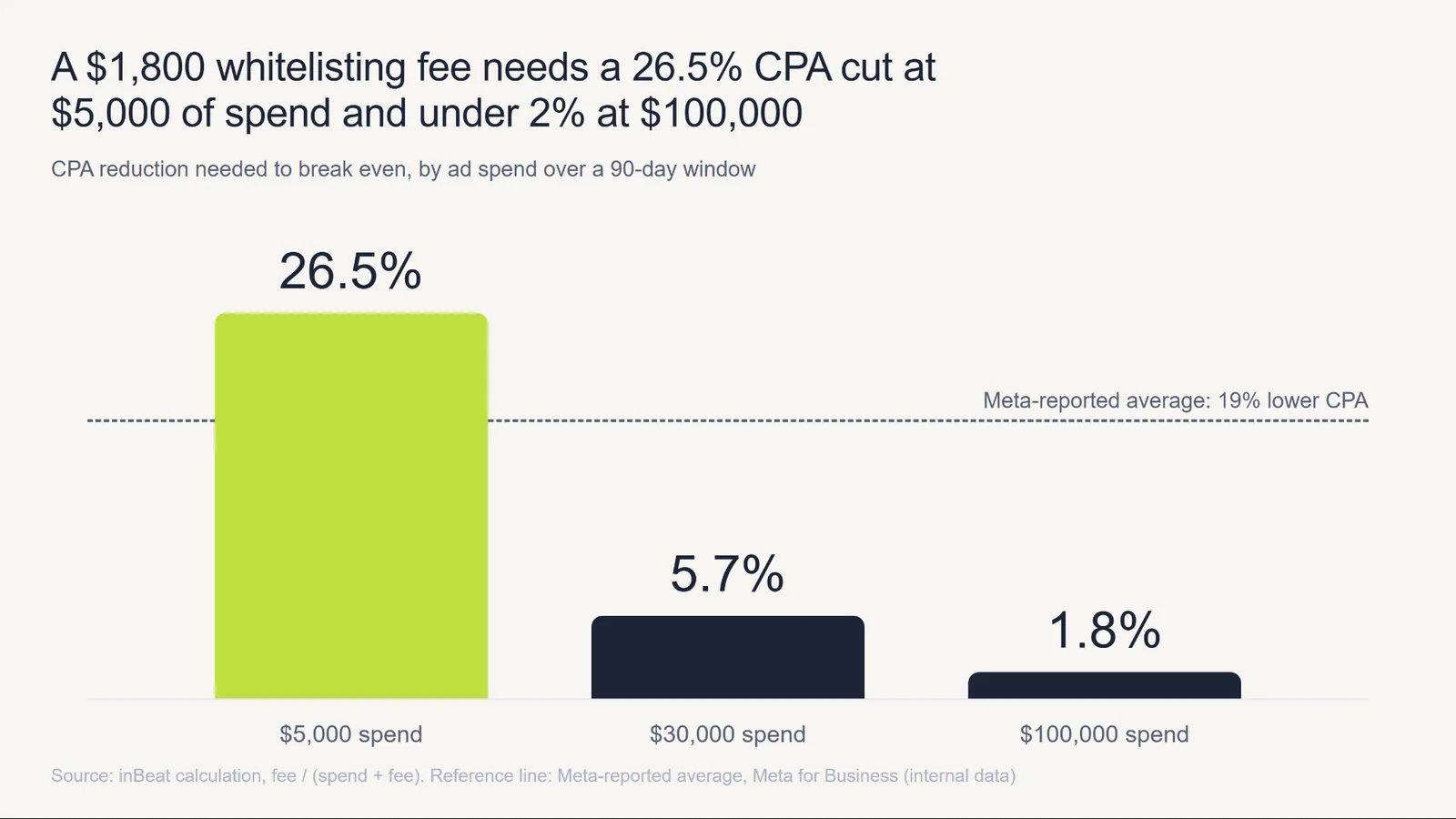
For an apples-to-apples comparison at equal media spend, the break-even CPA reduction is the access fee divided by ad spend plus that fee. It is a planning calculation rather than a performance forecast.
Consider a creator with a $2,000 content fee and an additional access fee equal to 30% of that fee per month.
Over 90 days, the access fee reaches $1,800. This is an intentionally expensive example: monthly access charges add up, while content-usage licences may follow different pricing rules.
| Ad spend over the window | Whitelisting fee | CPA reduction needed to break even |
|---|---|---|
| $5,000 | $1,800 | 26.5% |
| $30,000 | $1,800 | 5.7% |
| $100,000 | $1,800 | 1.8% |
At $5,000 of spend, the required CPA improvement is 26.5%; at $30,000, it falls to 5.7%. Meta's 19% benchmark offers context, but measures a different comparison and should never be treated as a guaranteed return from whitelisting.
This illustration assumes the same content-production and usage-rights costs in both scenarios and excludes other incremental expenses. The useful input is your actual access fee alongside the spend and CPA you expect to test.
When Creator-Handle Access Costs Are Hard to Justify
Access becomes harder to justify when the fee outweighs the performance improvement the campaign can realistically deliver. Watch for these warning signs:
- A small media budget paired with a high fixed access fee.
- A code window that ends before testing and follow-up activity are complete.
- Creative that requires a lengthy approval cycle for each revision.
- A creator whose audience has little overlap with the target market.
- No comparable brand-handle control, making the extra value of the creator identity difficult to isolate.
Where the rights allow it, a brand-handle test can help establish a baseline before paying for creator-handle access. The team can then compare promising variants on equal terms.
What to Include in a Creator Whitelisting Agreement
A useful agreement answers five questions: what access is granted, how long it lasts, who approves edits, how access can end and who handles disclosure. Clear terms also make campaign extensions easier to manage.
List Permissions as Separate Line Items
The scope may include creator-handle delivery, unpublished ads, audience-related permissions and changes to copy or calls to action. Each is a separate right, so the agreement should cover only what the campaign actually needs.
With Meta account-level permissions, the parties should agree whether custom-audience options fall within the approved scope before the request is accepted.
Set the Term in Days From First Ad Launch
For the commercial term, define when the paid usage window begins, such as the first live ad, and how long it lasts. Platform authorization follows its own schedule: TikTok video codes offer 7, 30, 60 or 365 days, whereas Business Center connections use a separate approval process. Align the agreement with the actual activation, expiry and renewal dates rather than assuming a 90-day contract creates a 90-day platform code.
It also helps to agree on what happens to active ads at expiry and who starts a renewal. Related licence terms, including territory, channel and exclusivity, are covered in our guide to why global usage rights fail in performance media.
Define Revocation and Approval Rights
Meta explains that creators can revoke permissions at any time. Since a changed permission can affect live ads in different ways, the contract should cover notice, a pause procedure and replacement creative.
A practical split allows the brand to adjust copy and calls to action within agreed limits, while changes to on-camera claims or the creator's spoken message return to the creator for approval.
Name Who Handles Disclosure
Disclosure needs both a visible label and an owner who reviews the final ad. The FTC reminds influencers that it is their responsibility to make disclosures and that platform tools alone may be insufficient.
For video content, the disclosure should appear in the video itself rather than only in the caption. Our FTC guidelines guide goes through the rules by content type.
| Clause | What to specify | Failure it prevents |
|---|---|---|
| Permissions | Delivery, dark posting, audience data, edit rights | Disputes over what access covered |
| Term | Days from first launch, renewal option | Ads expiring mid-scale |
| Revocation | Notice period, pause plan | A winning ad vanishing without warning |
| Approval | Who signs off copy changes | Edits the creator did not agree to |
| Disclosure | Label owner, placement | Compliance gaps |
How to Choose Creator Content Worth Whitelisting
Content worth whitelisting should suit the campaign goal, rather than simply being the post with the most organic engagement. Existing performance is one useful signal, but a new paid-first concept can also be tested.
- For existing posts, saves, shares and recurring questions in the comments can reveal what viewers find useful or persuasive.
- Where organic signals are limited, a creative brief with alternative hooks, endings and raw clips gives the team more useful material to compare.
- From there, compare a small set of variants before choosing what to scale, following the approach in our creative testing guide.
- The best-performing variants can then move into creator-handle ads once the necessary permissions and licensing terms are in place.
- Finally, the authorization window should match the media plan, with a reminder scheduled early enough to handle renewal.
How to Measure Whitelisted Ad Performance
To assess whether the creator identity adds value, start with a comparable ad-level test. CPA, conversion rate and CTR help evaluate the ad, while blended CAC and MER show how the broader marketing effort is performing.
Keep creative, audience and budget as comparable as possible, and label the results by creator, post and permission window. Frequency matters alongside conversions, since even effective creator ads can become repetitive to the same audience.
| What you see | What it likely means | What to check |
|---|---|---|
| CTR up, CPA flat | The handle attracts clicks, the landing page does not convert them | Landing page and offer |
| CPA down, frequency climbing | The ad is working and starting to tire | Refresh schedule |
| Comment tone turns negative | Audience or claim mismatch | Hide, review with the creator, pause |
| Delivery drops to zero | Authorization expired or was revoked | Permission status |
It also helps to break down performance by creator, creative and authorization window rather than relying on a campaign average that hides important differences.
When attribution becomes more complex, our guide to influencer marketing attribution models explains the trade-offs between common models. Where feasible, a holdout test can provide better evidence of incremental impact.
Common Whitelisting Mistakes and Risks
Even with clear terms, problems can emerge during delivery. Common risks involve expired access, unclear responsibilities and account-security shortcuts.
| Risk | What happens | Safeguard |
|---|---|---|
| Authorization expires mid-flight | A profitable ad stops | Set a reminder before expiry, earlier for short codes |
| Permission changes during a winning campaign | Ad availability or delivery may change | Defined escalation and backup creative |
| Delivery outside the licensed territory | Rights dispute | Territory in the agreement |
| Creator controversy mid-campaign | Brand-safety exposure | Pause trigger in the contract |
| Comment moderation gaps | Objections go unanswered | Assign an owner for the ad's comments |
| Sharing a login | Account security exposure | Use platform permissions only |
Because platform controls support both post codes and account linking, creators and brands can avoid sharing passwords. A request to exchange logins is a warning sign when secure permission tools are available.
Before requesting access, the brand also needs to screen the creator. Our influencer vetting checklist covers audience quality, brand safety and pre-contract risk.
Scale Whitelisting With inBeat Agency
Whitelisting is most useful when the creative plan, access rights and measurement approach are settled together, rather than added one by one after a campaign starts.
As an influencer marketing agency, inBeat brings creator sourcing, paid creative testing and permission planning into the same process. That helps teams compare real campaign options instead of treating creator-handle access as an automatic add-on.
Book a strategy call if you want to compare creator-handle advertising with running the same creative from your brand account. We'll review the budget, rights and test plan together, so the decision is grounded in the numbers.
FAQs
What happens to a running partnership ad if the creator revokes permission?
It depends on the permission. On Meta, disabling a post code may prevent new ads without immediately ending every existing one, whereas account-level permission changes can affect live delivery. Creators can also stop individual active ads. The agreement should cover what gets checked, paused or replaced when access changes.
Can you run a partnership ad from an old organic post that never tagged your brand?
Yes, if the creator shares a partnership ad code for that post. Meta says the code route works regardless of whether the post is branded content or tags the advertiser.
Can a whitelisted ad run without appearing on the creator's profile?
Yes, depending on the platform and ad setup. A Meta partnership ad can be created as an unpublished ad, which means the paid creative can reach a selected audience without appearing as an organic post on the creator's grid. This still requires the relevant creator permissions and agreed content rights.
Can a brand keep using creator footage after whitelisting access ends?
That depends on the content licence, which is separate from permission to advertise through the creator's account. A brand may retain the right to use footage in ads from its own handle after creator-account access expires, but only if the agreement allows that channel, term and type of edit. The expiry of one permission does not automatically answer what happens to the other.
How long should a TikTok authorization window be when the test takes two weeks and winners run longer?
For a two-week test with possible extensions, a 30- or 60-day post code may offer a more useful buffer than seven days. For ongoing programs, Business Center linking is another option, with its access and renewal terms defined separately.
Is whitelisting worth it when ad spend over the whole access window is under $5,000?
There is no universal spend minimum. On $5,000 in media, a $600 access fee needs roughly a 10.7% CPA reduction to break even, while a $1,800 fee requires about 26.5%. What matters is the negotiated fee, expected performance and a comparable control.