.svg)
.svg)
.svg)
.svg)


.svg)





What if your next ad came from someone who bought your product before your team ever contacted them?
In fact, US creator ad spend is projected to reach $44 billion in 2026, up from $37 billion in 2025.
Yet while brands commission UGC, their customers are already sharing unboxings, reviews, and product demos on their own.
The challenge is turning those spontaneous customer-generated posts into a reliable source of ad creative, with the right permissions, disclosures, and quality standards in place.
See how to build it.
P.S. If you'd rather skip the build, our UGC agency sources creators and tests the results in paid. Book a free strategy call.
inBeat POW: We treat creators as a creative engine and paid media as the lab that shows which content deserves more budget. Buyers are the first rung of that supply: they produce native footage once, and a loop of make, launch, learn, and repeat decides who gets a license, a brief, and eventually a fee. Run as a creator-led approach, buyer content becomes the front end of a pipeline.
TL;DR: Customer-Generated Content vs UGC
Buyers already make content about products they use, and a pipeline of requests, briefs, licenses, and tests turns it into a steady supply of creator-style assets.
- Customer-generated content is voluntary buyer content, while sponsored UGC is commissioned. In both cases, brands need permission to reuse it.
- One seven-stage pipeline runs from the first request to a paid-creator promotion, with a named owner at each stage.
- FTC rules allow incentives that are disclosed and not tied to a particular sentiment.
- A written usage license allows brands to run buyer content as ads, while ads using the buyer's post or account require additional platform authorization.
- Buyer content proves concepts, and sponsored UGC supplies volume on a schedule.
What Is Customer-Generated Content, and How Does It Differ From UGC?
Customer-generated content is content a buyer makes voluntarily about a product they used, with no direction from the brand. UGC is the wider label and also covers commissioned work.
Marketing School explains what customer-generated content is. Source: YouTube
Three working definitions follow:
- Customer-generated content: a buyer posts, reviews, or films something on their own, with no brand request and no payment.
- Directed customer content: a buyer makes content after a brand request, a reward, or a brief, and keeps some creative control.
- Sponsored UGC (also searched as paid UGC): content a creator makes for an agreed price, format, and deadline, with usage rights settled up front.
We use "buyer content" for the first two together. The pipeline below starts from customer-generated content, adds a request, a reward, and a brief along the way, and so produces directed customer content, with sponsored UGC as the top rung.
The distinction matters for how content is sourced, disclosed, and planned. Copyright generally starts with the person who creates the content, while a license determines how the brand can use it. Genuine buyer content is also the least controllable, which is why it needs a process before becoming a marketing asset.
For the split between organic and paid UGC, and how both differ from influencer posts, see our guide to UGC vs influencer marketing.
Is UGC Paid? How Customer-Generated Content Differs From Creator-Generated Content
It depends on the type. Customer-generated content is unpaid, because the buyer posts on their own. Sponsored UGC, also called creator-generated content or paid UGC, is made by a creator for an agreed fee and brief.
Creators who sell "UGC" as a service are producing this paid type, which is why the definitions above keep the two apart.
Sponsored UGC and Buyer Content Compared: Rights, Control, and Volume
Use buyer content to prove concepts and test messages, and use sponsored UGC when you need a set number of assets, with rights, on a schedule.
Dimension | Customer-generated content | Directed customer content | Sponsored UGC |
|---|---|---|---|
Origin | The buyer's own idea | Brand request, reward, or brief | Brand commission |
Payment | None | A reward such as product, discount, or points | An agreed fee |
Brand control | None | Partial | High: brief and revisions |
Brand usage rights | License needed before reuse | License captured at submission | Usage rights defined in the agreement |
Ad eligibility | License required; platform permission for creator-post ads | Paid-use license required; platform permission for creator-post ads | Paid rights agreed upfront; creator-handle ads need authorization |
Plannable volume | Low | Medium | High |
Disclosure duty | When a material connection exists | Required when a reward applies | Required |
Best job | Proof and concept discovery | Repeatable proof and ad testing | Scheduled volume and scale |
Influencer content sits outside this table. The creator sets the audience and the fee, and rights are negotiated deal by deal.
A brand with steady orders should start with directed customer content, because the buyers already exist. A launch with no buyer base should start with sponsored UGC and add the buyer pipeline as orders accumulate.
Repurposing is already common: Aspire's 2026 data shows 77% of brands repurpose creator content in paid ads.
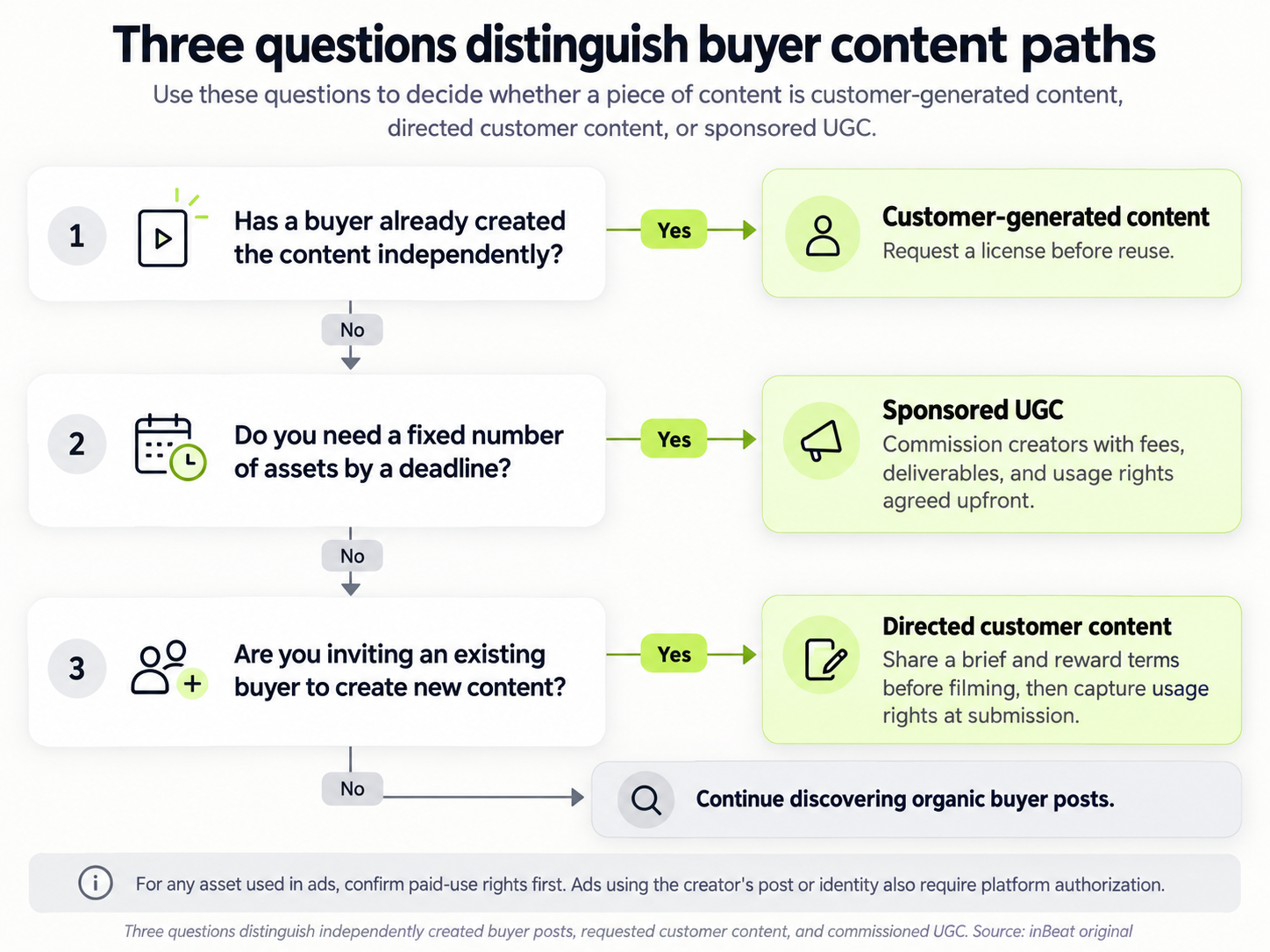
Route each content opportunity with three questions:
- Has a buyer already created the content independently? If yes, treat it as customer-generated content and request a license before reuse.
- Do I need a fixed number of assets by a deadline? If yes, commission sponsored UGC with fees, deliverables, and usage rights agreed upfront.
- Am I inviting an existing buyer to create new content? If yes, share a brief and reward terms before filming, then capture usage rights at submission.
For any asset used in ads, confirm paid-use rights first. Ads using the creator's post or identity also require platform authorization.
Why Customer-Generated Content Works as Social Proof, and Where the Evidence Stops
Buyer content is linked to higher conversion on product pages, the evidence for paid social is thinner and mostly vendor or dated, so the table grades each claim.
Context | What the source reports | Evidence grade |
|---|---|---|
Reviews on a product page | Purchase likelihood is 270% higher with five reviews than with none | Academic research center, 2017, foundational |
Shopper reliance | 55% of shoppers say they're unlikely to buy without UGC | Vendor survey, method not shown |
Personal recommendations (not buyer UGC) | 88% trust recommendations from people they know | Nielsen survey, older fieldwork; indirect evidence only |
Partnership ads (creator partnerships, not buyer content) | Adding partnership ads to business-as-usual campaigns delivers 19% lower CPA and 13% higher click-through rates on average | Meta first-party data, method not on the page |
Directed content in ads | 26 directed campaigns beat 41 traditional campaigns on conversion rates, conversions, and ROAS | Peer-reviewed, small single-industry sample |
These sources support customer content as social proof and suggest potential for buyer-style creative in paid ads. However, the advertising studies largely examine commissioned or directed content rather than spontaneous buyer posts. No neutral benchmark exists for buyer content run as ads, for standard rights terms, or for moderation outcomes.
How a User-Generated Content Strategy Becomes a Buyer-to-Creator Pipeline
The pipeline moves one buyer through seven stages, and each stage has one owner, one input, and one output.
Stage | Owner | Input | Output | Where it fails |
|---|---|---|---|---|
Recruit | Lifecycle or CRM | Delivered orders | Eligible buyers and scheduled requests | Request sent too early or to everyone at once |
Incentivize | Brand and legal | Reward menu | A disclosed offer | Reward tied to what the buyer says |
Brief | Creative | Product moment and approved claims | A one-page brief | A script that strips the buyer's voice |
Consent | Brand and legal | Content submission or existing post | A logged usage license | Grant missing or silent on ads |
QA | Social or brand | Submission and license | An approved asset | Claims or disclosure slip through |
Promote | Paid media | An approved, licensed asset | A test result and a live ad | Boosting before authorization or testing |
Measure | Growth | Test and cost data | Cost per usable asset and ladder moves | Reading click-through rate alone |
For content that buyers have already posted organically, skip the brief and request a license for the existing asset. For new submissions, share the brief before filming and capture usage rights when the content is submitted.
Stage 1: Recruit Buyers for User-Generated Content After Delivery
Schedule the first content request a fixed number of days after delivery, once the buyer has used the product. Send it after the reward and brief are ready.
Yotpo advises triggering on the delivery date and gives 21 days for supplements against 4 for apparel. Judge.me calls 14 days after fulfillment the common default, and more than 76% of its users keep it.
The two sources differ on apparel, so treat any window as a starting point and test your own.
Both sets of numbers come from review requests, and content requests follow the same logic, since the buyer needs time with the product. The request belongs to the post-purchase customer experience: one ask, one action, one place to submit. If posts already exist, our guide to finding and reusing customer posts covers discovery, and this pipeline covers what happens after you find one.
Delivery-Based Request Timing by Product Category
Product category | Suggested request delay | Source |
|---|---|---|
Fashion and accessories | 7 to 10 days | Judge.me |
Skincare and beauty | 14 to 21 days | Judge.me |
Electronics | 14 to 21 days | Judge.me |
Home and kitchen | 14 to 21 days | Judge.me |
Supplements and wellness | 21 to 30 days | Judge.me |
Apparel (example) | 4 days | Yotpo |
Supplements (example) | 21 days | Yotpo |
Judge.me sets its delays from fulfillment and advises factoring in delivery time, while Yotpo counts from carrier delivery. Start with the range for your product category and move the window once you see the submission rate.
Trigger Segments for Buyer Content Requests
Three triggers cover most programs:
- A repeat order: a second purchase shows the buyer likes the product enough to return.
- A post that tags the brand: social listening finds it, and the request goes out through the same form link as every other trigger.
- A milestone use date: for example, day 30 of a subscription.
Build triggers on behavior and keep star ratings out of them. If you plan any rating-based selection, ask counsel first; stage 2 covers the FTC rule.
Content Request Message Template
A request needs four lines: the ask, one action, what the buyer gets, and the submission link. The link takes buyers through the brief in stage 3 before they upload their content and grant usage rights.
Hi {first name}, you've had your {product} for {14} days. We'd love to see how you use it. Interested in sharing a short video? Start here: {link} to see the brief and submit your content. Everyone who submits gets {reward}, whatever the video says.
Stage 2: Choose an Incentive and Disclose It
Rewards can encourage buyer submissions, but the requirements depend on whether the content is a consumer review or an advertising testimonial. Keep incentives independent of sentiment and disclose material connections.
The FTC's Consumer Reviews and Testimonials Rule (16 CFR Part 465), effective October 21, 2024, prohibits incentives tied to positive or negative consumer reviews, whether the condition is explicit or implied. Buyer videos used in advertising are generally testimonials, subject to truthfulness requirements and the FTC's Endorsement Guides. An incentivized consumer review may qualify as both.
Free or discounted products, loyalty points, early access, and other promised perks can create material connections that require disclosure. The FTC can seek civil penalties of up to $53,088 for knowing violations of Part 465 in 2026, although that penalty does not automatically apply to every missing disclosure.
Incentive | Best fit | FTC treatment | Main risk |
|---|---|---|---|
Free product or refill | Low-cost consumables | Disclose as a material connection | Content skews toward the product given |
Discount code | Repeat buyers | Disclose; same offer to every submitter | Draws coupon seekers |
Loyalty points | Existing loyalty programs | Disclose; points redeemable for prizes are a named example | Posts without a label |
Gift card or cash | Higher-effort video | Disclose | Cost grows with volume |
Feature on brand channels | Engaged, proud buyers | Disclose if promotional exposure was offered as a benefit | Slower to scale |
Inclusion in paid ads | Top contributors | Disclose material connections; confirm paid-use rights | Rights and revocation |
Two studies show that incentives change who writes and what they say, so keep the offer the same for every buyer. In an Airbnb field experiment, a $25 coupon for reviewing listings that had no prior reviews raised the review rate by 53% and produced lower average ratings, with no change in nights sold (2014 to 2016 marketplace data).
In a Journal of Marketing Research study, paying students for a dining hall review raised the positivity of the text by 55%.
For disclosure wording, see our guide to FTC guidelines for influencers.
Stage 3: Give Buyers a One-Page Brief
Give buyers a one-page brief covering the product moment to show, an approved product point they can discuss, the video length, claims to avoid, and where to submit.
For new submissions, the brand request makes the content directed, while the brief provides guidance without scripting the buyer. Keep it short enough to read on a phone:
- What to show: the product in use at one real moment.
- One product point: an approved feature or benefit the buyer can discuss in their own words, if it reflects their experience.
- Length and format: vertical video, 15 to 60 seconds, shot on a phone.
- Claims to avoid: health, results, or comparison claims you can't back up.
- Disclosure line: the sentence a buyer adds when a reward applies.
- Where to submit: the form link, which also carries the license.
Brief the product moment and leave the wording to the buyer; our guide to briefing creators for native content shows how to do that without a script.
Put the brand in the first seconds. System1's test with TikTok found that creator ads earned 39% more attention than traditional brand ads, yet viewers identified the brand at roughly half the rate. The creative team writes the brief once per product line and reuses it.
Stage 4: Capture Consent and Usage Rights in Writing
A public post is not a license, so get the grant in writing at submission, naming the platforms, the paid-ad use, and the duration.
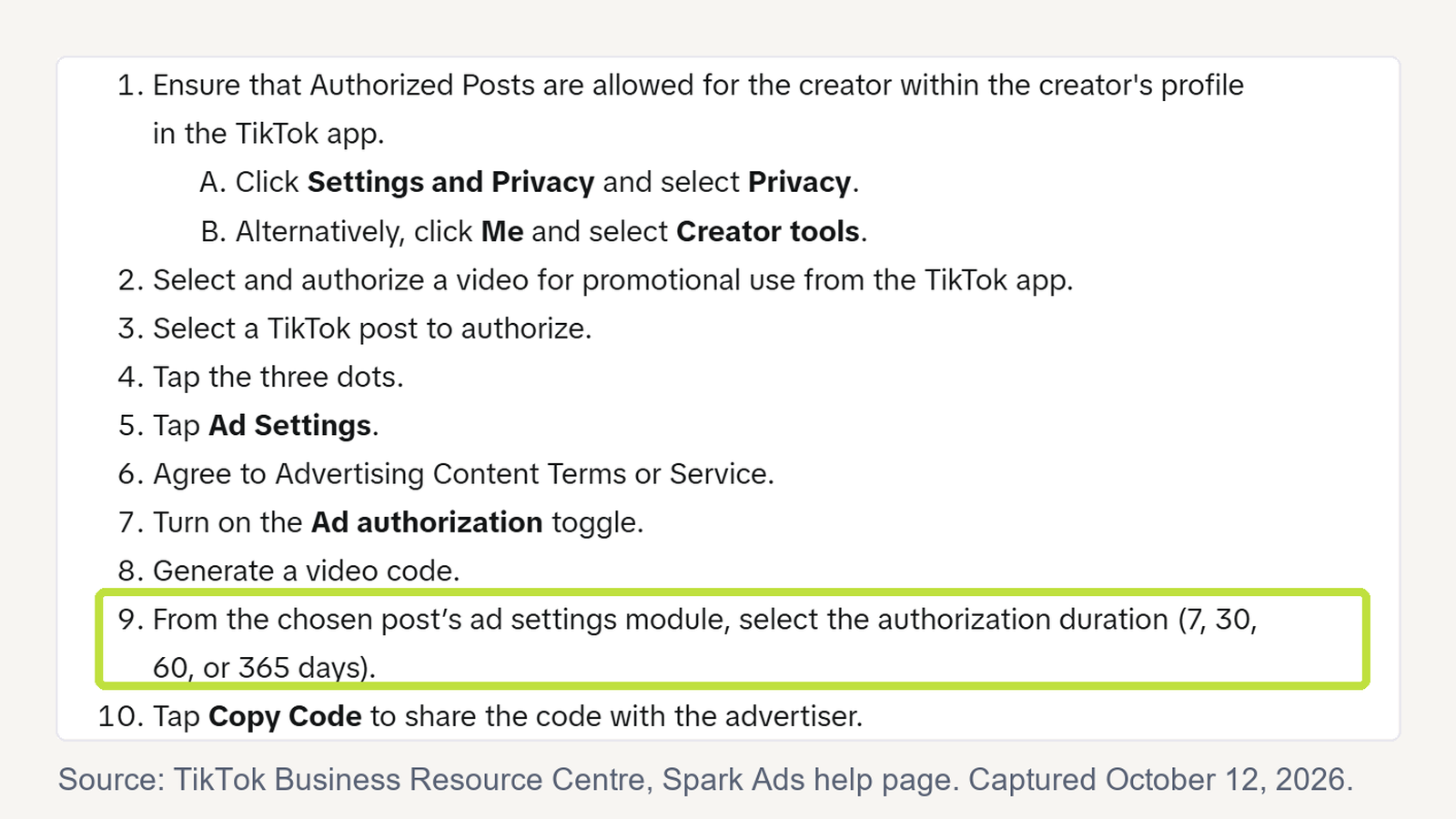
A usage license defines how the brand can reuse the buyer's content. If the brand runs the licensed video from its own account, no separate creator-post authorization is needed. Ads using the buyer's original post or creator identity require additional platform permission, such as a TikTok Spark Ads authorization or Meta partnership ad permission.
Consent at Submission
- Put the grant in the same flow as the submission: a checkbox, the buyer's handle, the platforms, and one plain-language line about ad use.
- Send posts found in the wild the same form link, and use a DM with a logged screenshot as the fallback.
- Stop any asset that shows minors or third-party faces until you've cleared them.
Our UGC usage rights guide covers the paid-creator version of this grant; the buyer version drops the payment step.
Usage License Terms: Scope, Platforms, Duration, and Revocation
Use | What the license names | Platform mechanism |
|---|---|---|
Organic repost | Platforms, credit, duration | Native repost or tag |
Website and email | Placements and duration | None; the license alone governs |
Brand-account ad | Paid use, platforms, duration, edit rights | No creator-post authorization needed |
Meta partnership ad | Ad use, platforms, duration, edit rights | Creator grants content-level or account-level partnership ad permission. |
TikTok Spark Ad | The same, plus authorization length | The creator picks 7, 30, 60, or 365 days; the caption can't be edited after authorization, and a private video becomes public when used |
Duration and renewal | Start date, end date, renewal terms | Tracked in the rights register |
Write the terms per asset: platforms, ad use, start date, and end date. Aspire reports that 67% of brands put usage rights into the creator's contract or rate, so settling rights at the start is the pattern for hired creators too. Music is a separate rights layer, and a trending sound can block a boost.
Log Every License in a Content Library Rights Register
Log each license in a rights register inside your content library, and let no asset ship without a row.
Field | What it records | Why |
|---|---|---|
Asset ID | A unique ID for the file | Links the file to its license |
Buyer handle | The account that posted | Contact for renewal or revocation |
Grant date | When the buyer agreed | Starts the clock |
Scope and platforms | Organic, website, paid, and which platforms | Defines the allowed use |
Expiry | The end date | Triggers removal or renewal |
Platform authorization (if needed) | Creator-post permission, code, and validity period | Tracks platform permission separately from the usage license |
Disclosure status | Whether a reward applies and a label is present | Proof for the repost duty |
Music cleared | Original audio, cleared track, or neither | Flags blocked boosts early |
Status | Submitted through live | Shared with stage 5 |
The content library becomes the one list that marketing teams and the paid team both pull from.
Stage 5: Run Content Moderation and QA on Every Submission
Nothing goes live until it has passed a fixed checklist and a license check.
- Submitted: log the asset in the register.
- License checked: confirm the logged grant covers the planned use.
- Screened: run the checklist below.
- Approved: sign off, or reject with a reason.
- Live: publish and record the date.
Check | Pass condition | Fix or reject reason |
|---|---|---|
Product shown correctly | The right product, used as intended | Wrong product or unsafe use |
Claims | Claims are accurate, substantiated, and reflect the buyer's experience | Unsupported or misleading claim |
Disclosure | Label present when a reward applies | Missing or buried label |
People | No minors or third-party faces | Faces without consent |
Music | Original audio or a cleared track | Uncleared track |
Brand marks | No competitor logos or products | Competitor visible |
Quality | Readable, steady, usable framing | Too dark, too short, or cropped |
When a brand reposts an incentivized post, the disclosure duty follows the repost: under the FTC's endorsement guides, a repost that drops the relationship must clearly disclose it again. Reject without losing the buyer: give one sentence on why, one fix, and a thank-you.
Stage 6: Distribute Approved Content Across Owned Pages and Paid Social
Send approved buyer content to owned placements, then test licensed assets in paid social before committing more budget.
Owned Placements: Product Pages, Email, and Review Widgets
Product page galleries, review widgets, and post-purchase emails are the standard owned placements. Change one placement at a time and track it as a conversion rate optimization test, so you know which spot earned the lift.
UGC-Based Ads: Test Before You Boost
- Confirm the register shows paid-ad use for the asset.
- If using the buyer's post or creator identity, obtain the required Spark Ads or Meta partnership ad permission. For brand-account ads, upload the licensed asset directly.
- Run a controlled A/B test against your current ad, keeping the objective, audience conditions, and other variables consistent so you can compare creative performance.
- Scale only the winner and set a refresh date.
The Meta figures in the evidence table are averages across advertisers; your own control decides whether a buyer post earns spend.
Stage 7: Measure Cost per Asset and Move Winning Buyers Up the Creator Ladder
Score each batch on cost per usable asset and click-through rates against a control, then promote the buyers whose posts win.
KPI | Formula | What it tells you |
|---|---|---|
Submission rate | Submissions ÷ requests sent | Whether timing, reward, and ask work |
Approval rate | Approved ÷ submitted | Whether the brief steers well |
Rights-cleared rate | Assets with valid usage licenses ÷ total assets collected or identified | How much buyer content is cleared for reuse |
Cost per usable asset | (Rewards + review labor cost + license administration cost) ÷ approved assets | What an asset costs you |
Click-through rate against control | Buyer ad click-through rate compared with the control's | Whether buyer creative earns clicks |
CPA against control | Buyer ad CPA compared with the control's | Whether clicks become customers |
Read click-through rate and CPA together. A post that wins on clicks and loses on CPA stays an engagement asset and stays off the ad budget.
Buyers move up a five-rung ladder, and each rung has a behavior signal:
- Buyer: placed an order.
- Reviewer: left a review or answered a request.
- Contributor: submitted content and granted a license.
- Ambassador: submits repeatedly, or a post won as an ad; this is the rung for a longer-term arrangement.
- Paid creator: moved to a fee under a sponsored UGC agreement.
Treat the thresholds as hypotheses (two licensed posts before an ambassador offer, for example) and test them.
How Much Does Each Usable Asset Cost, From Buyer Posts to Commissioned Creators?
Customer-generated content has no upfront production fee, though licensing may carry a cost, directed customer content costs the reward, and sponsored UGC has a median advertised budget of $100 per video. All three also carry review time, and the first two carry license admin.
Source | Cash cost | Hidden cost | Volume ceiling |
|---|---|---|---|
Customer-generated content | No production fee; possible licensing cost. | Review time and license admin | Set by buyers' own posting |
Directed customer content | The reward | Requests, review, and license admin | Set by order volume and response rate |
Sponsored UGC | Median advertised budget of $100 per video; half of per-video briefs sit between $50 and $200, with usage rights quoted on top | Usage rights and revisions | Set by budget |
Agency-run volume | Quoted per scope | Management time | Set by contract |
The $100 median comes from 593 per-video briefs listed between December 2025 and September 2026. These are advertised budgets that come before any negotiation, and licensing is usually a separate line, so treat the median as an opening price. Our UGC rates guide lists the common add-ons, including usage-rights fees.
Here is the stage 7 formula with assumed numbers, for the arithmetic only:
- 1,000 requests
- 40 submissions
- 25 approved assets
- $300 in rewards
- 10 hours of review and license admin at $30 an hour
Cost per usable asset is ($300 + $300) ÷ 25, or $24.
At 15 approved assets, the same spend gives $40, which is why the approval rate from stage 7 matters as much as the reward.
A request pipeline depends on order volume and response rates, so it can't promise a delivery schedule.
What a User-Generated Content Platform Covers, and What Still Needs a Person
Software handles collection, forms, queues, and display, and your team keeps the claim, the license, and the paid decision.
Task | A platform can | A platform cannot |
|---|---|---|
Collect submissions | Send requests after delivery and host the submission link | Choose the reward or write the ask |
Host consent | Capture a checkbox grant and store it | Decide what your license should cover |
Moderate | Run a queue and flag keywords | Judge claims or brand fit |
Display | Show approved content in review widgets or galleries | Prove that display lifts conversion |
Hand off to paid | Export approved posts | Guarantee ad authorization |
Platforms also leave the volume question open, and our UGC agency vs platform guide compares sourcing options at 10, 30, and 100 assets a month. Tools such as Judge.me, Yotpo, and Bazaarvoice cover the collection and display rows. Ask each vendor whether it syncs ad authorization, since that is the row most likely to stay manual.
Build a Scalable Creator Pipeline With inBeat
A buyer pipeline gives you proof, and a creator pipeline gives you volume. inBeat connects the two: we write the briefs, source the creators, and test every asset in paid.
On a strategy call, we map your post-purchase flow against the seven stages, check where licenses and authorizations are missing, and plan the first test.
FAQs
Can you edit a buyer's video before running it as an ad?
Yes, if the usage license allows edits and the ad format supports them. Brand-account ads can use edited versions of the licensed video, while Meta partnership ads and TikTok Spark Ads have additional platform-specific restrictions.
How does the pipeline change for a B2B or high-AOV brand with few orders a month?
Run the same seven stages at a smaller scale, and move the request to a milestone such as the first completed project. With few orders a month, a request pipeline yields few posts, so treat each buyer who grants a license as an ambassador candidate, brief them one to one, and lower the stage 7 threshold of two licensed posts.
What do you do when a buyer revokes permission while the post is running as an ad?
Pause the ad, log the revocation in the register, and swap in the next approved asset. Meta lets creators revoke partnership permission at any time, so keep two or three licensed replacements in the library before you scale spend.
Can AI-generated UGC replace the buyer pipeline?
AI-generated UGC can fill gaps in volume, but it has no buyer behind it, so it can't supply real social proof or genuine content from customers. See our comparison of AI UGC ads and real UGC for where each fits.
How much buyer content is enough on a product page before more stops helping?
Gains slow quickly after the first few reviews: the Spiegel Research Center found the marginal benefit diminishes rapidly after the first five. After that, test placement, format, and recency in conversion rate optimization tests before adding volume.
What should you do when a buyer asks to be paid after their post wins as an ad?
Offer a forward-looking agreement: a fee for new content under a sponsored UGC license, with the original grant unchanged for the original asset. If you pay a one-off bonus for the winning post, record it in the register and keep the disclosure label on the post.
SEO METADATA (remove before publishing)
Title tag: Customer-Generated Content vs UGC: Buyer Creator Pipeline
Meta description: Customer-generated content vs UGC: learn how to recruit buyers, brief them, secure usage rights, review submissions, and turn their content into ads.
Slug: /blog/customer-generated-content-vs-ugc
Primary keyword: customer-generated content
Secondary keywords: user generated content strategy, ugc usage rights, ugc content moderation, content library, sponsored UGC, ugc ads, user generated content platform
Author: Ioana Cozma (content, SEO, UGC and influencer content strategy)