
Brand-vs-brand advertising looks simple from the outside: name a rival, say you're better, wait for sales. In practice the format rewards precision.
A meta-analysis of studies from 1975 to 1996 found that comparative ads beat non-comparative ads on attention, brand awareness and purchase intention, yet they score lower on source believability. The examples below show where over-claiming turns into court orders and regulator bans.
This guide covers nine documented campaigns, from a 1962 car-rental slogan to a Domino's promotion launched in August 2026. It pulls out what made each claim hold or fail, then covers the rules in the US, UK and EU and how to measure a comparison campaign.
Let’s dive in.
TL;DR
- Comparisons land when one difference is obvious. Avis turned second place into a service promise; Anthropic made a product-policy distinction the audience could recognize.
- A price headline can go further than the evidence beneath it. Aldi's Christmas claim overstated its basket comparison; Tesco's loyalty-value poster made its narrower basis visible.
- A taste-test percentage or a market-share increase describes its sample or market. Neither proves the advertisement caused new purchases.
- Use creative tests to choose among accurate executions. To establish incremental brand or sales effects, plan an appropriate test-and-holdout study.
What Is Comparative Advertising?
Comparative advertising can identify a rival directly or through recognizable cues. Some messages compare measurable prices or product attributes; others position a challenger against a better-known brand or invite a head-to-head trial.
The FTC's comparative-advertising policy addresses comparisons of alternative brands on objectively measurable attributes or price, where the alternative is identified by name, illustration or distinctive information. That objective-claim definition is narrower than the full range of competitive creative shown below.
A direct comparison names the rival, as Verizon and T-Mobile did. An indirect one makes the rival identifiable without spelling it out: Avis could talk about being No. 2, while Anthropic portrayed an ad-supported AI assistant without naming ChatGPT.
There is a spectrum between an objectively testable claim, an implied comparison and a competitive challenge. The legal question turns on the message consumers actually take away, not the campaign label a marketer uses.
A comparison campaign can carry that message across TV, paid social, creator content and a landing page. Each format should stay consistent with the evidence behind the particular assertion it makes.
The 9 Comparative Advertising Examples at a Glance
The nine cases span the early 1960s through 2026. Some contain objective product or price assertions; others show positioning, product trials or the legal significance of words that initially sound subjective.
| Brand pair | Year | Comparison format | What we can verify |
|---|---|---|---|
| Anthropic vs. OpenAI | 2026 | Indirect policy contrast | Post-game user activity rose; no causal ad estimate |
| Pepsi vs. Coca-Cola | 1975; 2025–26 | Brand-run taste challenge | Participant preferences and pre-ad market context; no sales attribution |
| Avis vs. Hertz | Early 1960s | No. 2 service positioning | Share figures in 2013 retrospective, not primary data |
| Apple vs. Microsoft | 2006–09 | Mac vs. PC characters | Historical spend and sales; ad-only effect unknown |
| Verizon vs. T-Mobile | 2025–26 | Savings-plan assertions | Separate NAD matter; federal interim injunction, then dismissal |
| Aldi vs. Sainsbury's | 2023–24 | Christmas basket superlative | ASA upheld complaints; pack-size and timing problems |
| Tesco vs. Sainsbury's | 2025 | Clubcard conversion value | ASA rejected challenge to the specific poster |
| Domino's vs. fast-food icons | 2026 | Trial-led brand challenge | Receipt promotion described; verified sales effect unavailable |
| Papa John's vs. Pizza Hut | 1997–2000 | Quality wording and ingredients | Appeal distinguished puffery, misleading context and materiality |
Comparison Campaigns Against a Market Leader: 4 Examples
These four campaigns use a challenger frame, but the comparisons differ: Avis positioned itself against Hertz without naming it, while Apple personified the broader Windows PC category. See our guide to legacy brand marketing for the leader's side of that choice.
1. Anthropic vs. OpenAI: "No Ads in Claude" in Super Bowl TV Ads
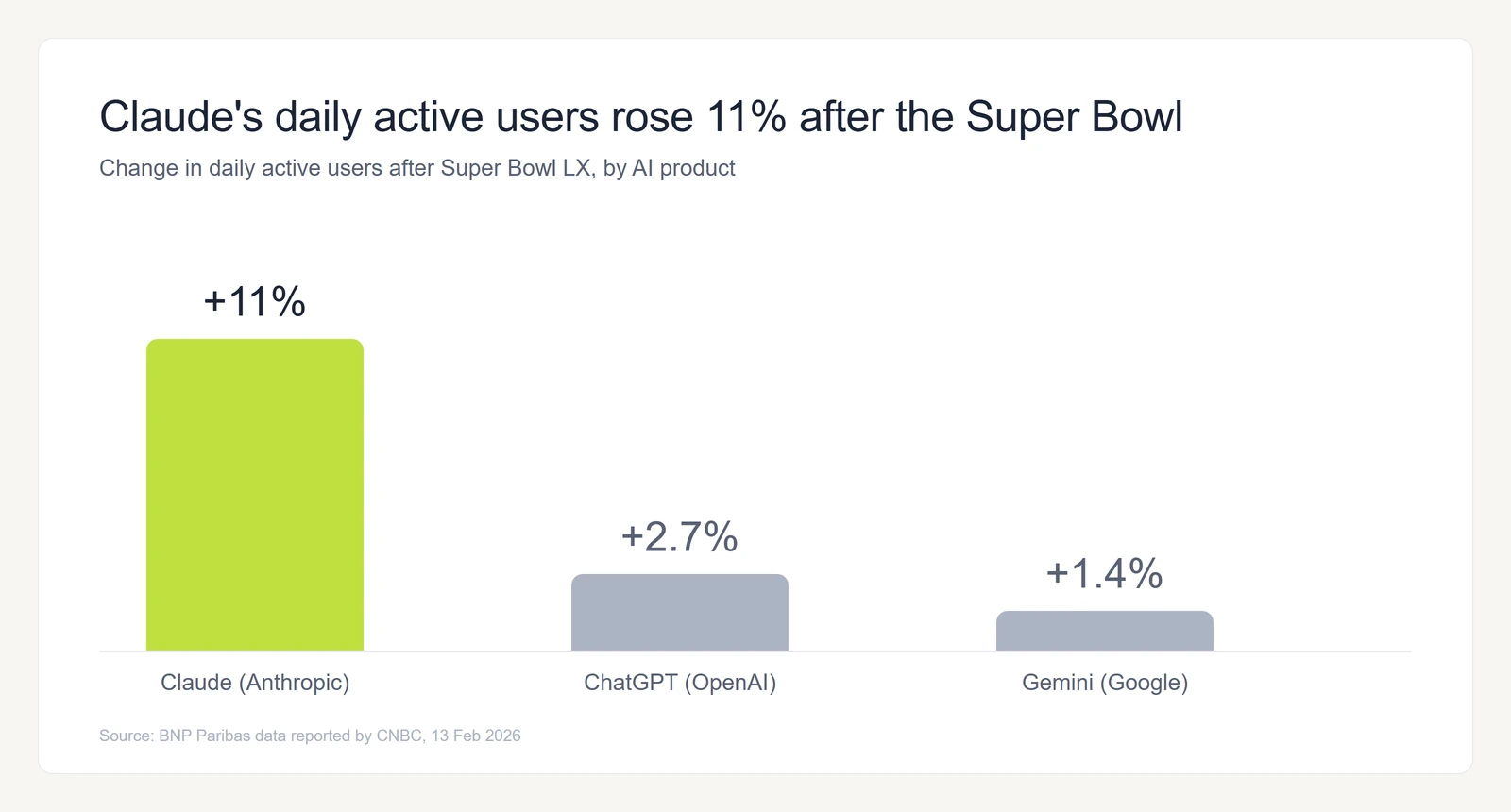
Anthropic's Super Bowl spots made a policy distinction visible: an AI assistant interrupted by ads versus Claude's ad-free promise. After the game, BNP Paribas tracking reported by CNBC recorded 11% more Claude daily active users and 6.5% more site visits; ChatGPT and Gemini rose 2.7% and 1.4%.
The line was "Ads are coming to AI. But not to Claude." The commercial never named ChatGPT, though Variety identified the reference. A 60-second pregame spot and 30-second in-game version translated product policy into an instantly recognizable rival contrast.
A 30-second slot averaged $8 million, and CNBC reported Anthropic was spending millions.
Sam Altman answered on X, calling the commercials "deceptive" and "clearly dishonest."
Claude started from a much smaller user base than ChatGPT, which makes the percentage comparison less revealing than it first appears. A new Claude model launched that same week, giving users another reason to visit.
Anthropic's Super Bowl 2026 advertisement, "How can I communicate better with my mom?" Source: Anthropic on YouTube
2. Pepsi vs. Coca-Cola: Blind Taste Tests and Market Share
Before the 2026 Super Bowl spot, Pepsi Zero Sugar held 1.4% of the US carbonated soft-drink market versus Coke Zero's 4.6% in the first nine months of 2025. Its volume grew 18.1% against 4.8% for Coke Zero, according to Beverage Digest data cited by Marketing Dive. These figures predate the campaign.
The Pepsi Challenge began in 1975 with unbranded sips. A 2025 tour revived it, and the 2026 Super Bowl spot "The Choice" gave Coca-Cola's polar bear an unexpected preference for Pepsi Zero Sugar.
PepsiCo said 66% of participants in its 2025 Challenge preferred Pepsi Zero Sugar to Coke Zero Sugar, and reported a win in every market where it ran those events. The release did not publish a representative sampling method.
Pepsi's strongest creative choice was to put the blind-test surprise in the hands of Coca-Cola's own mascot. The published 66% result supports a participant-level taste preference, not a claim about all American consumers.
Pepsi Zero Sugar's "The Choice" campaign creative. Source: Pepsi on YouTube
3. Avis vs. Hertz: "We Try Harder" Without Naming the Rival
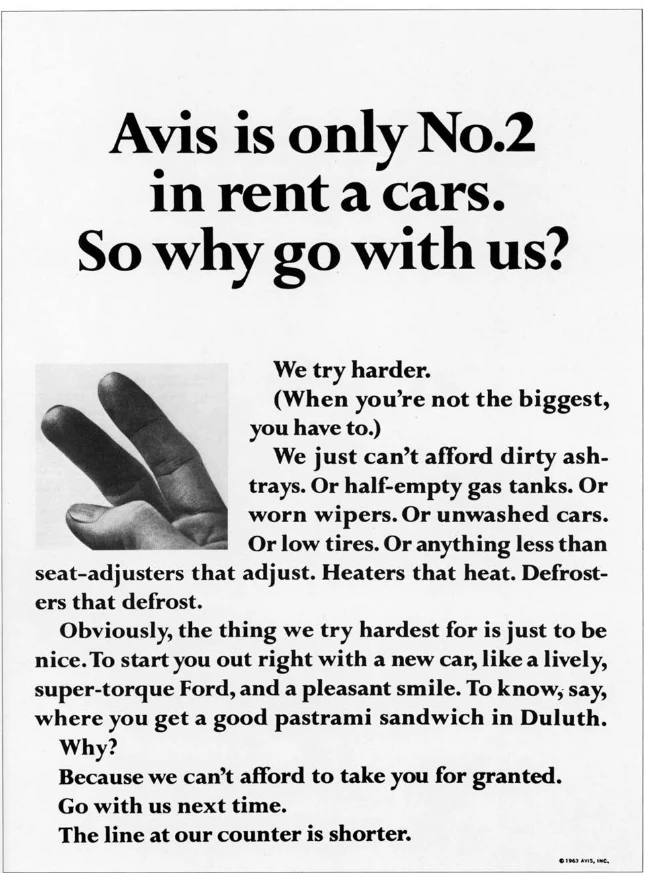
In the early 1960s, Avis turned second place into "We Try Harder": "When you're only No. 2, you try harder. Or else." It never named Hertz, but "Avis can't afford dirty ashtrays" made the competitive implication clear. The story comes from Seth Stevenson's 2013 Slate retrospective, republished by the New Haven Register.
Hertz stayed silent until 1966, then answered with an ad that began, "For years, Avis has been telling you Hertz is No. 1." The same article reports that the share gap narrowed from 61-29 in 1963 to 49-36 in 1966, then settled at 48-35 by 1969.
The 61/29, 49/36 and 48/35 share figures are reported retrospectively, without an identified 1960s primary dataset or proof of ad causality. The lasting creative move was to turn a disadvantage into a promise of extra care.
4. Apple vs. Microsoft: "Get a Mac" and the Media Budget Response
Apple's "Get a Mac" ads, which ran from 2006, set a relaxed Mac against a fumbling PC thwarted by viruses and crashes. The New York Times reported, citing TNS Media Intelligence, that Apple spent $264 million on TV ads in 2008 and that Microsoft answered with $163 million in the first six months of 2009, more than twice Apple's spending in that period.
IDC estimated Apple's US desktop-and-laptop share at just over 8%, more than double its 2006 figure. Apple reported 3.05 million Mac sales in fiscal Q4 2009, up 17% year over year.
Mac and PC became recurring characters that made a complicated platform rivalry immediately recognizable. Microsoft's responses kept the conversation going, though the economy and Apple's growing iPod and iPhone businesses also influenced sales, making the campaign's isolated effect impossible to determine from these figures.
Price and Savings Comparison Claims Under Regulator Review: 3 Examples
The first four campaigns show how a rival can sharpen a brand's positioning. Price and savings claims create a different challenge: a good story still has to survive a close look at the numbers behind it. The next three cases show what happens when that evidence is challenged.
5. Verizon vs. T-Mobile: "Save Over $1,000" and a Court Injunction
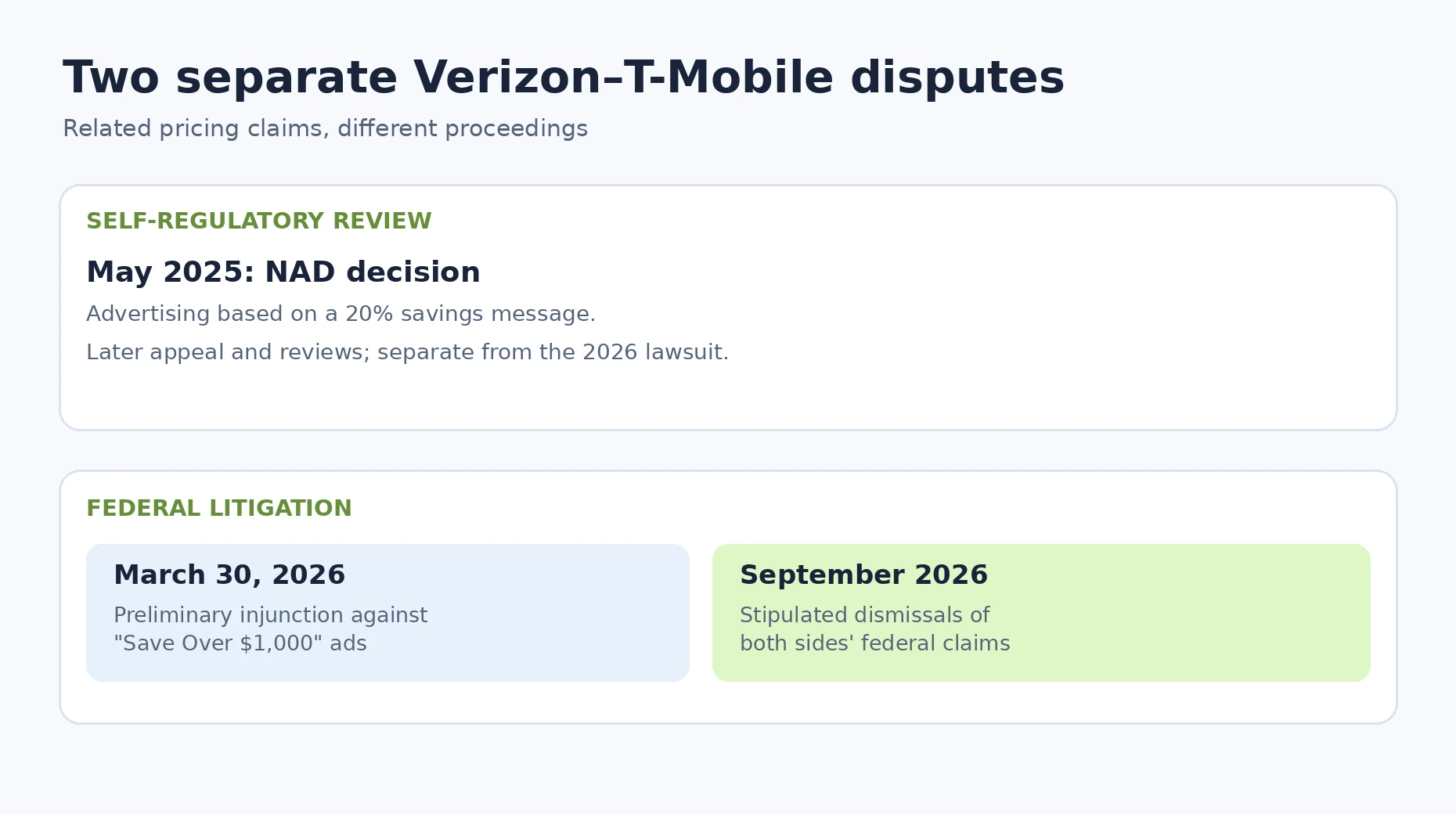
Verizon sued T-Mobile over "Save Over $1,000" in February 2026. On March 30, Judge Lewis Kaplan issued a preliminary injunction. A summary of the order describes an "apples-to-oranges" comparison: T-Mobile's promotional rate versus Verizon's standard rate, plus a satellite-service cost attributed to Verizon that most customers did not incur. This was interim relief, not a final merits judgment.
T-Mobile's “Druski Takes The Chair” ad promoted the savings claim later challenged by Verizon. Source: T-Mobile on YouTube (2026)
T-Mobile also advertised savings of more than $3,700 over five years against Verizon and AT&T. It disagreed with the ruling and pointed to HarrisX data showing its customers paid the lowest bills over five years. It countersued over Verizon's "better deal" campaign.
Verizon's “A Better Deal” campaign invited rival carriers' customers to compare their bills, a central theme in T-Mobile's countersuit. Source: Verizon on YouTube
Both sides dismissed their federal claims in September 2026; reporting establishes neither settlement terms nor a final trial ruling. The earlier 2025 NAD/NARB dispute, with later compliance review, concerned separate 20% savings ads, not this federal suit.
6. Aldi vs. Sainsbury's: A Cheapest-Christmas-Dinner Claim Banned by the ASA
In December 2023 Aldi ran a four-page newspaper wraparound headed "The home of Britain's cheapest Christmas dinner." It showed Sainsbury's at £44.81 and Aldi at £33.80, and told shoppers to "Swap & Save over 20%." The Advertising Standards Authority upheld Sainsbury's complaint on 20 March 2024, as BBC News reported.
In its March 2024 ruling, the ASA upheld all three challenged issues, including a separate claim about prices being "2022 price locked." Its concerns about the Christmas-dinner comparison fell into three areas:
- Scope: "Britain's cheapest Christmas dinner" implied a broader market-wide advantage than the cited basket evidence established. The Which? research Aldi used had put Lidl just 4p behind and recognized both as budget-friendly.
- Verifiability: For seven of the 12 food comparisons, Which? supplied product-weight ranges rather than each retailer's exact pack size. Shoppers therefore lacked enough detail to check whether the basket compared equivalent quantities.
- Timing: The price check came from late November, before many consumers bought their fresh Christmas ingredients. It did not reliably establish the price comparison during the relevant shopping window.
Aldi called the outcome an "advertising technicality," but the concerns involved the scope, timing and checkability of what its headline invited shoppers to believe.
7. Tesco vs. Sainsbury's: A Narrow Loyalty-Card Claim the ASA Cleared
Tesco's poster, examined by the ASA in February 2025, said Clubcard offers more grocery-spending value than Nectar. Prominent points-conversion figures and qualifications explained the basis: Clubcard points were worth "2x the value of Nectar points" when converted to spend, with a comparison date.
Sainsbury's complained that the ad implied overall superiority. The ASA didn't uphold the complaint, because consumers were unlikely to read the claim as superiority across all features of the schemes.
Tesco displayed the specific points-to-grocery-value comparison and qualified it. Aldi's wider supermarket superlative rested on a basket shoppers could not fully verify. Those facts explain the different ASA outcomes here, not a universal rule that narrower advertising always wins.
Product Features and Wording Limits in Brand-vs-Brand Ads: 2 Examples
The price cases turned on the basis of measurable claims. The final two take a different route: Domino's used a competitor's purchase to prompt a product trial, while Papa John's shows how a quality slogan can acquire a factual meaning in context.
8. Domino's vs. Fast-Food Icons: A Receipt-Upload Giveaway
Domino's launched "Pizza Can't. The Domino Can" in August 2026. Restaurant Dive describes a 60-second hero film about conventional pizza occasions, separate from the competitor-facing "Is the Domino Worthy?" promotion. That second execution challenged customers to compare the new personal pizza with familiar fast-food items through a receipt offer:
- Buy a Big Mac, Whopper, Crunchwrap Supreme, Chick-fil-A chicken sandwich or Chipotle burrito.
- Upload the receipt to a microsite.
- Receive a code for a free Domino, while supplies last.
The planned giveaway was worth about $1 million, with supporting event-season advertising. The cited campaign reports offered no verified redemptions or incremental sales. Its creative device was a trial incentive after a rival purchase, not an unproven numerical claim of better taste or price.
9. Papa John's vs. Pizza Hut: When "Better" Is Puffery
In 2000, the Fifth Circuit appeals court treated Papa John's "Better Ingredients. Better Pizza." slogan on its own as non-actionable puffery: a broad statement of opinion rather than an objectively measurable promise. Pizza Hut had prevailed at trial over advertisements that also made specific ingredient comparisons.
Alongside sauce and dough assertions, the slogan implied something more factual. The court found the contextual message misleading, but Pizza Hut had not proved the misinformation was material to buying decisions. The appeals result was therefore narrower than either a blanket ban or a complete factual vindication.
Context changes what "better" communicates. An opinion beside ingredient comparisons can imply a measurable benefit; a misleading implication and its materiality are separate legal questions.
How to Make a Comparative Ad Persuasive and Defensible
These cases raise three planning questions: does the creative communicate a difference, can the brand prove the impression it creates, and what evidence would show a behavioral effect? Treat the checks below as a workflow, not guaranteed persuasion factors.
Make the Difference Easy to Understand
Pepsi makes its product difference tangible through a blind taste test, while Tesco turns a loyalty-card comparison into a simple points conversion. Fast comprehension is distinct from legal verifiability, which may require product, date and method details. T-Mobile's disputed savings assumptions show why a simple headline can conceal a complex calculation.
Write the main promise as one sentence before choosing a visual treatment. Our ad hooks guide includes competitive hooks, but the hook still needs to express the substantiated comparison accurately.
Match the Comparison to Your Position in the Category
Challenger framing can attract attention, but these cases do not prove that smaller or newer brands always benefit more. Avis positioned its service promise against an unnamed market leader. Apple, a hardware maker, personified the Windows PC category, so Apple and Microsoft market-share figures are not interchangeable.
Established brands have a different calculation. As New York Times reporting on BrandIndex noted, Microsoft answered Apple's comparisons and had narrowed the perceived-value gap by May 2009. The survey reported perception, not a controlled estimate of the rebuttal's effect.
Hertz delayed its reply to Avis. Leaders should ask whether rebutting a comparison clarifies a consumer benefit or merely extends the challenger's story.
State the Basis of Comparison Inside the Ad
The price-comparison basis may need the check date, precise products and pack sizes, matched retailer or plan, and treatment of loyalty discounts. Choose the information according to what the headline implies and what readers need for verification.
In a specific 2026 Lidl case, NAD accepted a seven-day price window on the record; that is not a general seven-day safe harbor. It also scrutinized loyalty-versus-base prices and an "exact same basket" description.
An ASA decision about Co-op shows that a product-list link alone may be insufficient if the basis for matching items remains unclear.
Match the Evidence to the Exact Claim
A "cheapest basket" assertion needs matching quantities, prices and dates. Customer reviews can support attributed experience, not numerical superiority. Evidence should substantiate what the headline actually leads shoppers to believe.
Save each claim's test methods, sample details, product matches, price records and approved wording. FTC substantiation guidance emphasizes a reasonable basis for objective assertions before release, rather than after a challenge.
Account for Brand Perception Before Launch
Brand perception can change the result of a taste claim. In a 2004 Neuron study, 67 volunteers had blind taste tests and brain scans, and knowing the brand changed their preference for Coke while the Pepsi label had no such effect.
For perception-sensitive claims, compare blind and branded responses to see whether the advertised advantage changes when labels appear. The 67-person study makes that a useful diagnostic, not a universal requirement for challengers.
Plan for Media Coverage and the Rival's Response
Comparisons can provoke earned coverage and rival responses. Altman's criticism extended the Anthropic conversation; Apple and Microsoft kept answering each other. Media attention is a separate outcome from sales, and any rebuttal should have its own factual support.
Before launch, agree who owns a factual correction, who handles press queries and what alternate creative can run if a challenged line needs to be narrowed.
Do Not Borrow More Credibility Than the Source Gives You
A research logo can lend authority. It can also damage trust when the headline promises more than the underlying study established.
Which? objected to the use of its research in Aldi's ad. Attribute an external source to its actual sample and findings instead of implying an endorsement of a stronger claim.
| Pre-launch gate | Evidence artifact | Decision |
|---|---|---|
| Comprehension | Unprompted viewer readback | Rewrite if the main implied difference is misunderstood |
| Exact comparator | Matched products, sizes, plans and dates | Hold launch until the comparison is substantiated |
| Qualification visibility | Ad and landing-page proof review | Keep material limits visible next to the promise |
| Brand/perception check | Blind vs branded response where relevant | Reassess taste assertions changed by labels |
| Measurement readiness | Primary KPI, pre-registered test plan and holdout feasibility | Confirm success criteria and measurement feasibility before launch |
| Coverage and reply | Named press, legal and creative owners; approved response plan | Assign escalation ownership and prepare a fact-checked response |
| Source credibility | Original research and permission/attribution check | Avoid implying unsupported endorsement |
Is Comparative Advertising Legal? What the FTC, ASA and EU Require
Comparative advertising is generally permitted, but the test and enforcement route depend on the market and the consumer impression. This table summarizes the frameworks; the sections below explain their practical differences.
| Region | Rule-maker | What it requires | How a challenge happens |
|---|---|---|---|
| US | FTC, state UDAP laws, federal courts | Truthful, clear, not deceptive; disclose the basis | FTC action, a rival's Lanham Act suit, or a National Advertising Division (NAD) case |
| UK | Advertising Standards Authority (ASA) | CAP Code 3.32 to 3.34: not misleading, same needs, objective and verifiable features | A complaint to the ASA, often from the rival |
| EU | Member-state courts and regulators | Directive 2006/114/EC conditions: not misleading, same needs, objective and verifiable features, no denigration | National enforcement of the directive |
US Comparative Advertising Law: FTC Policy, UDAP Laws and the Lanham Act
The FTC's comparative advertising policy statement supports truthful comparisons with identifiable competitors; it does not exempt them from ordinary deception and substantiation rules.
The FTC judges comparative ads by the same test as other advertising: whether they tend to be false or deceptive. Section 5 of the FTC Act declares unfair or deceptive acts or practices unlawful. States add their own Unfair and Deceptive Acts and Practices (UDAP) laws, and Verizon's suit included a New York deceptive-practices claim alongside its federal one.
Competitors may sue under Lanham Act section 43(a) for advertising misrepresentation, subject to the law's requirements. NAD offers an industry self-regulatory route, distinct from FTC and state enforcement. The separate 2025 and 2026 T-Mobile proceedings illustrate that distinction.
UK Comparative Advertising Law: The Advertising Standards Authority and the CAP Code
For non-broadcast advertising, the UK CAP Code's comparison provisions include rules 3.32–3.34. In plain terms:
- Rule 3.32 bars comparisons with an identifiable competitor that mislead about either product.
- Rule 3.33 requires products that meet the same needs.
- Rule 3.34 requires an objective comparison of material, relevant, verifiable and representative features, which may include price.
Price comparisons may also implicate CAP rule 3.38 on the basis of comparison, plus substantiation and qualification provisions such as rule 3.7. Those additional rules matter to the different findings in the Aldi and Tesco cases.
The Business Protection from Misleading Marketing Regulations 2008 add the same conditions in statute, including no discrediting or denigrating of a competitor.
EU Comparative Advertising Law: Directive 2006/114/EC Conditions
Article 4 of Directive 2006/114/EC sets EU comparative-advertising conditions, implemented nationally. The UK now applies its own domestic regime, although some requirements overlap. The directive addresses:
- misleading content
- comparing products for the same need
- objective and verifiable features
- avoiding confusion, denigration and unfair use of a rival's reputation
For a multi-country campaign, check the law and enforcement approach in each EU member state rather than assuming a single centralized procedure.
How to Test a Comparison Claim in Paid Social and With Creators
Once you know which claims the evidence and local rules can support, the next decision is how to deliver them. In paid social and creator content, creative treatment can vary without stretching what the evidence actually shows.
- Decide the variable first. For creative A/B, keep a supported comparison and method fixed while varying its treatment. Testing different attributes requires separate proof and qualifications for each. Identical disclosures can misstate different claims.
- Where possible, randomize eligible audiences while keeping spend, timing and a preselected metric comparable. Agree on the stopping rule before inspecting the results.
- When creators make the comparison, give them the approved claims, their supporting evidence and the correct disclosure requirements before filming. Our FTC guidelines for influencers explain how to disclose the commercial relationship.
- Place material qualifications close to the claim in the ad. Use the linked landing page for accessible methodology and underlying details, rather than expecting a buried page to fix a misleading headline.
Choose a fully substantiated creative winner on the preselected metric. Better clicks do not establish brand or sales lift. If eligible, plan a separate powered study with exposed and holdout groups before the measurement campaign; feasibility, budget and audience overlap matter.
How to Measure a Comparison Campaign
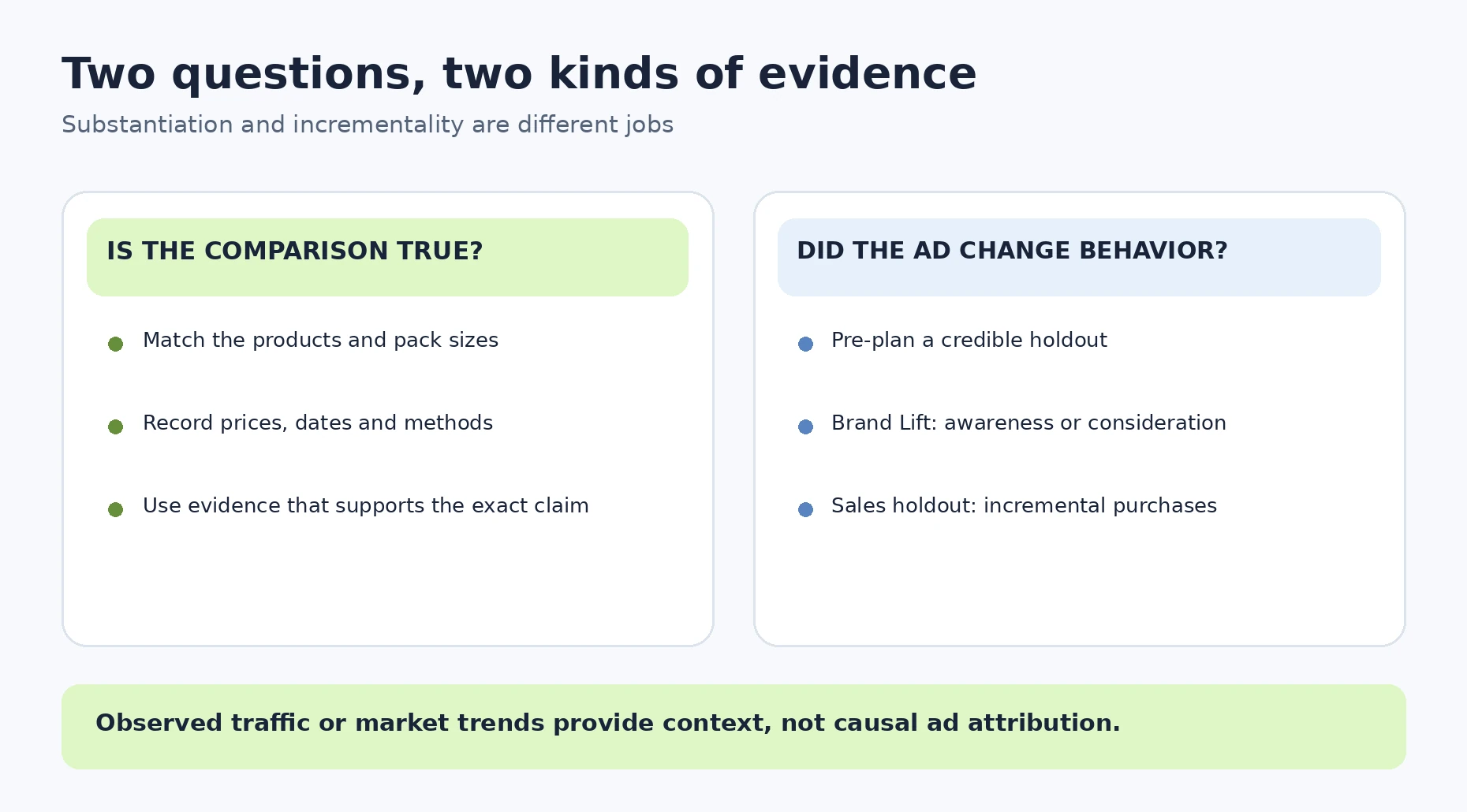
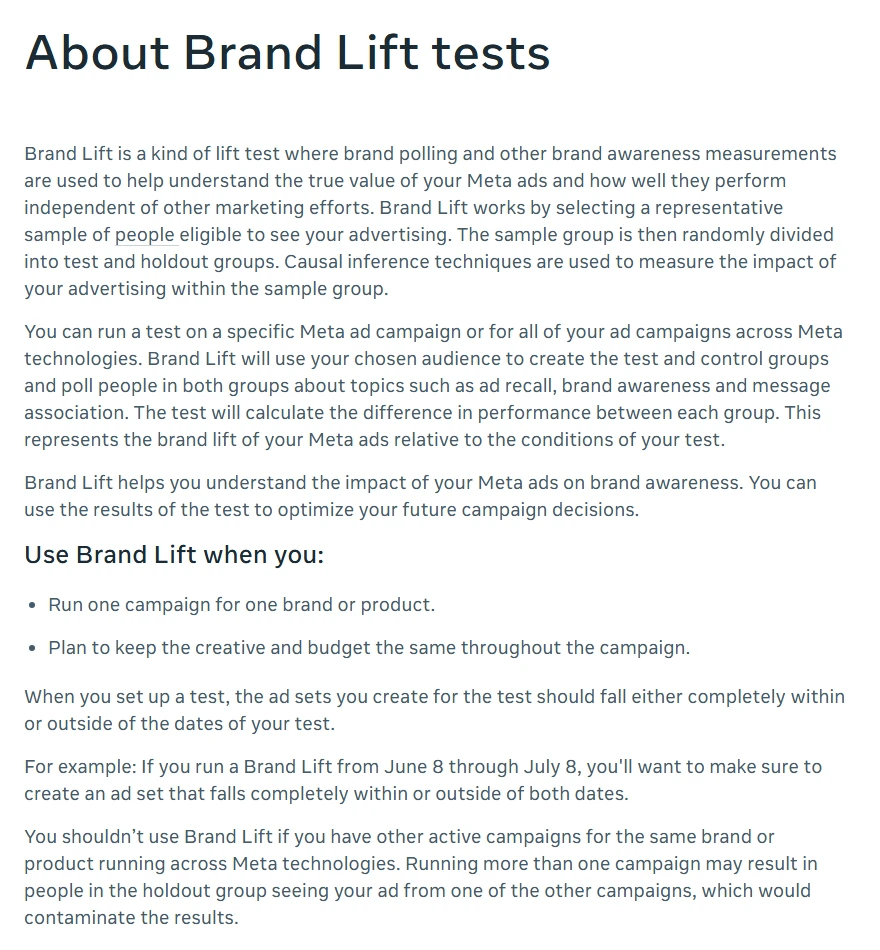
A creative test chooses among ads; an incrementality study asks what the campaign caused. Brand Lift can estimate survey outcomes and a sales holdout can test conversion effects where feasible. A marketing attribution system assigns recorded outcomes to touchpoints rather than estimating the counterfactual.
- Choose an outcome before launch: consideration for a brand objective or incremental purchases for a sales objective. Specify the evaluation window and the result needed to justify more spend.
- Record baseline branded search, site activity or brand-tracker data. These contextualize the trend but cannot replace an experimental control group.
- When eligible, Meta Brand Lift compares exposed and holdout groups on survey outcomes such as awareness. Minimums, overlap limitations and statistical power depend on the current setup, so settle the study plan before launch.
- For purchases, use a separately planned sales holdout or geo design where feasible. Our guide to incrementality testing explains approaches and the assumptions behind them.
- Track branded search, traffic and market reports in a secondary measurement dashboard. Label them observational signals rather than causal results.
Report the experiment's effect and uncertainty separately from the diagnostic dashboard. A traffic spike may justify investigation without justifying a claim of incremental sales.
Build Comparison Campaigns That Hold Up With inBeat Agency
A rival-facing idea needs a memorable difference the advertiser can defend. inBeat helps teams identify that angle, develop paid-social creative and define what measurement should reveal. The work begins with the product advantage rather than a big headline searching for evidence.
Have a concept in mind? We can pressure-test the message and the experiments worth running before committing a larger budget.
Book a strategy call to talk through the concept.
FAQs
How should a brand word a survey result in a comparison claim?
Describe who was actually tested. PepsiCo said 66% of Challenge participants preferred Pepsi Zero Sugar, while an executive reportedly called the group "Americans." Those are different claims unless the sample represents that population.
Use "participants" for participant data. A population-wide result requires its own representative evidence.
Is an ad that never names the rival still a comparison ad in law?
It can be. Both the FTC definition and the UK rules above cover a rival identified by illustration or other distinctive information, and Lanham Act section 43(a) lets a competitor sue over misleading advertising that damages it, named or not.
What does challenging a rival's ad cost, and how long does it take?
NAD guidance describes SWIFT as 20 business days from its qualifying starting point and standard-track decisions as typically 20 business days after the final meeting. Filing fees depend on track and membership. Court timing varies; a quick preliminary order says little about final disposition.
Is Brand Lift the same as Conversion Lift?
No. Brand Lift tests survey outcomes such as recall or consideration; Conversion Lift estimates incremental conversions. Each has separate eligibility and minimums. Consult Meta's current Brand Lift guidance and Conversion Lift guidance for the exact study before booking media.