

Your campaign could be losing older customers before they even consider the offer.
A AARP survey found that one in five adults aged 50 or older had decided against buying from a brand because of age stereotypes in its advertising.
Yet many campaigns still group everyone aged 65+ together, relying on familiar images of retirement, safety, and decline.
A 68-year-old shopping for herself and a 47-year-old daughter researching options for her father may need the same product, but respond to completely different messages.
So which buyer are you reaching, where are they paying attention, and what would make your ad feel relevant to them?
TL;DR: Advertising to Seniors
- Segment by buying role, not age alone. Separate older adults purchasing for themselves from family members who help research or make decisions. Build personas around actual needs and behavior.
- Choose channels using audience evidence. Facebook and YouTube are useful starting points for testing among adults 65+, while search captures purchase intent. Try Instagram and TikTok where caregiver research supports them.
- Make creative relevant and accessible. Use authentic people, practical benefits, readable text, and messages that respect individual circumstances instead of age stereotypes.
- Test messages for each buyer. Direct buyers and adult children may care about different outcomes. Compare creative angles, using engagement as an early signal rather than a sales result.
- Measure the full purchase journey. Include phone calls, offline sales, and family-assisted decisions where data and consent permit. Judge results against observed conversion cycles before scaling.
How to Segment Older Audiences by Age and Buying Role
The label “senior” covers people with very different routines, product needs, and buying roles. Use age bands as a starting point, then check what actually distinguishes customers in your category.
Before opening Ads Manager, draft two or three audience cards. Each should define:
- Buyer role: Who uses the product, who researches it, and who influences or pays for the purchase.
- Needs and context: The task, concern, or situation that starts the search; age is only one clue.
- Channel hypothesis: Where this buyer might discover or evaluate the offer, to be checked against customer evidence.
- Message to test: One specific benefit, proof point, or objection for the first creative round.
Three Age Bands With Different Media Habits
Use ages 55 to 64, 65 to 74, and 75+ as working segments, then check whether customers in your category actually differ by needs, media habits, and buying roles. Retirement, mobility, and family involvement vary within every group.
According to Pew Research Center's 2026 U.S. survey, 65% of adults aged 65+ use YouTube and 59% use Facebook. Among adults aged 50 to 64, the respective figures are 85% and 71%. These are self-reported platform-usage rates, rather than ad reach or conversion benchmarks.
Pew reports data for ages 50 to 64 and 65+, so it cannot establish separate media habits for adults 65 to 74 versus 75+. Use customer interviews, first-party data, and channel tests to check those finer distinctions.
A 58-year-old buying for herself and an 82-year-old arranging a purchase with family may need different messages, even if both appear in the same senior-marketing plan.
Subjective Self-Perception: The Gap Between How People Feel and the Number on the Form
Chronological age can reveal broad differences, but people of the same age may describe their identities, routines, and priorities quite differently.
Pew's study of aging in America documented a gap between chronological and perceived age. Research on age perceptions across adulthood also explores how people judge age and life stages. These studies provide context for avoiding assumptions; they do not establish which actor or script produces more conversions.
Instead of assigning a numeric “felt age” to each persona, ask customers what they want to accomplish and how they describe their own lives. Use those findings to develop concepts, then test them with the intended audience.
The Adult Child or Caregiver as a Second Buyer
In categories such as senior living, healthcare, insurance, and home safety, an adult child or another family member may help research, pay for, or decide on a purchase. Confirm who takes each role before building a separate audience.
For example, an adult child aged 45 to 60 may research options on a phone between work and family obligations. That is a useful persona hypothesis, rather than a description of every caregiver.
Consider a hypothetical hearing-aid brand with two different buying roles:
Direct buyer (70+, illustrative): Wants a straightforward fitting process and clear information about everyday use. Test a message showing how the product fits into a normal routine.
Adult-child helper (48, illustrative): Compares options and helps organize the purchase. Test a message explaining how reviews, fitting appointments, or delivery work.
These are example audience cards, not assumptions about everyone in those age ranges.
Write the cards down before anything else. Every channel, creative and measurement decision in the rest of this article reads off them.
How to Choose Channels for Advertising to Seniors
Build a channel matrix with one row per platform and one column per buyer persona, then put the first test budget into the two cells with the fastest feedback loop.
1. Facebook and YouTube as the Paid Baseline for 65+
Start by testing Facebook and YouTube with older buyers. The 2026 Pew usage figures above suggest both offer potential reach among U.S. adults aged 65+, while your own paid campaigns will determine which delivers qualified responses.
Facebook can provide creative-level signals such as views, comments, clicks, and lead quality. The speed of those signals depends on budget and audience volume, and the purchase outcome may take longer to appear.
YouTube can support demonstrations, explanations, and testimonials for considered purchases. Test formats and early hooks with the intended audience instead of assuming that a specific age band will respond best to one placement.
2. Instagram and TikTok to Reach Adult Children
Instagram and TikTok are worth testing for family decision-makers when customer research, site analytics, or first-party data point to those channels.
In Pew's 2026 U.S. survey, 41% of adults aged 50 to 64 report using Instagram and 31% report using TikTok. Those figures describe platform use by age, rather than caregiver status or purchasing behavior, so confirm the fit before assigning budget.
For adults aged 65+, the same survey reports 21% Instagram use and 11% TikTok use. Direct-to-senior campaigns on either platform should begin as measured experiments rather than assumed defaults.
3. Search for High-Intent Moments in Both Journeys
Search can capture purchase intent across both roles, but the exact queries depend on the category. A direct buyer might search by brand or a product concern, while a family helper might use comparisons or phrases such as “for a parent.” Check search-term reports before splitting keywords; the two sets can overlap.
Where search-term data shows distinct intents, test separate ad groups and landing pages.
A landing page written only for someone helping a parent may be irrelevant to a direct buyer. Likewise, a page focused solely on personal use may miss questions about arranging a purchase for someone else.
4. Direct Mail, Television and Print Versus Digital
Digital is often a practical first test when fast creative feedback matters. Direct mail, television, and print can still be useful for less digitally active audiences, provided the choice follows customer research, cost, and the campaign objective.
The matrix below offers starting hypotheses for channel tests. It does not establish that any platform is faster, cheaper, or better for a particular age group; use response data, cost, and customer research to decide.
These channel roles and feedback descriptions are planning hypotheses, not performance benchmarks. Confirm them using your own customer and campaign data.
Before finalizing the matrix, ask recent customers where they first heard about the brand and which channels they actually use. Pair those answers with campaign data before assigning budget.
Ad Creative for Older Adults Without Age Stereotypes
Build creative around real customer situations, clear product benefits, and formats people can comfortably follow. Test messages by buying role, then interpret early engagement alongside qualitative feedback and qualified conversion outcomes.
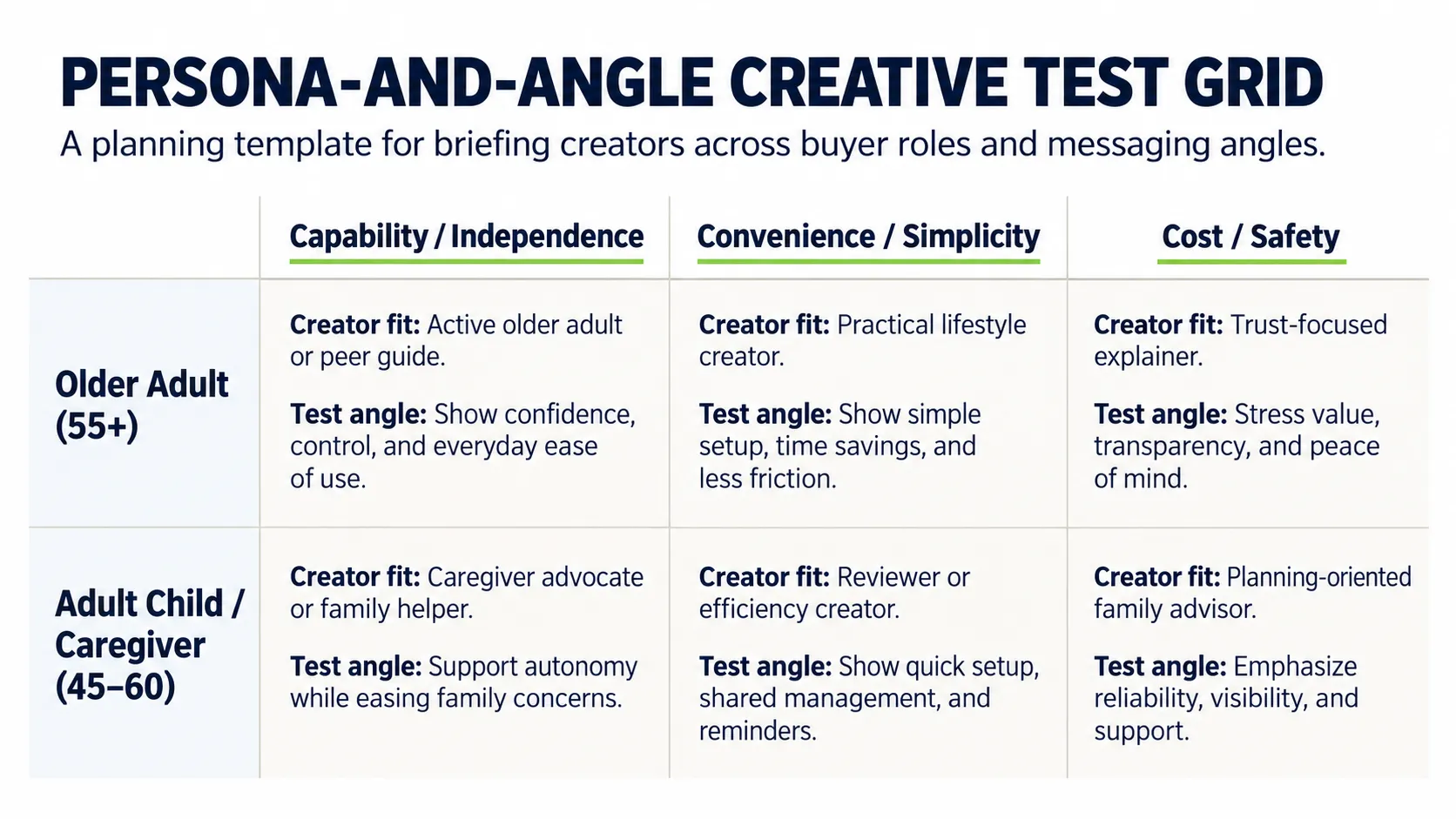
With the channel matrix in place, brief creators for direct buyers and family decision-makers using distinct situations and clear claims. Vary the message angle before investing in more production.
Cast People Who Reflect Your Audience’s Real Lives
Cast people who credibly represent the product's real use cases, including older adults with different lifestyles and abilities. There is no universal reason to make every actor ten or fifteen years younger than the intended audience. Check whether the people shown feel authentic to customers before finalizing the concept.
Use direct, respectful copy that explains a specific activity or benefit. Terms such as “senior” or “elderly” may carry different meanings across categories, so choose language using customer input rather than an automatic ban or formula.
Lead With Utility and Vitality Over Frailty
Lead with a concrete product benefit that matters to the buyer. For a hearing-related offer, “Follow the conversation at dinner” and “Find a clearer way to hear everyday conversations” are two possible concepts to test. Creative performance depends on the audience, product, and claims, so neither should be declared the winner in advance.
Safety, cost, mobility, independence, and convenience can all be legitimate priorities. Use customer research to decide which angle deserves testing first, and show the benefit without portraying aging itself as a problem.
For a hypothetical regulated-category campaign, compare an everyday demonstration with a more conventional studio ad. Review claims and disclosures before testing. Use early engagement to identify promising messages, then assess lead quality and conversion outcomes before scaling.
Mobile-First Readability: Type, Contrast, Pacing and Captions
Make every ad easy to follow on the device the customer actually uses. Review four elements before approving a cut:
- Type: Use legible sizes and keep on-screen copy short enough to read.
- Contrast: Keep the main claim, product details, and CTA easy to distinguish from the background.
- Captions: Add accurate subtitles, especially for sound-off viewing.
- Pacing: Leave enough time to process the message, then test the cut with people from the intended audience.
Pro tip: Watch the finished ad on a phone with sound off. If the key benefit or product is hard to identify, revise the edit before launching.
Creator and UGC Content Briefed for Native Tone
Build creator briefs around the buying role and a believable first-person situation. Each brief should cover:
- Who is speaking: A direct buyer or a family member helping with research or purchase.
- Real-life scene: The specific task where the product is useful.
- Product proof: What the creator can actually show, including any brand-approved claim or disclosure.
- Room for natural wording: A clear outcome and boundaries, without forcing a line-by-line script.
- Feedback to review: Confusion, objections, lead quality, and later conversion signals.
A direct buyer might show everyday use; a family helper might show comparison or setup. The point is to test two distinct stories rather than assume one voice speaks for both.
Our guide on why creator content still feels scripted explains how to brief a real situation while allowing the creator to choose natural wording.
Choose creators who can demonstrate the product in believable situations and whose audiences resemble the buyer roles you are researching. Read comments for confusion or condescension, and compare lead quality before expanding a concept.
How to Measure ROI and Conversion Lifecycles for Direct and Caregiver-Assisted Purchases
Family-assisted purchases can involve several people and online or offline touchpoints. Use appropriate first-party evidence to understand that journey, while separating attribution from proof that an ad caused a sale.
1. Map the Senior Path and the Adult-Child Path Separately
Document two journeys with two sets of touchpoints before you argue about attribution models.
A direct buyer may move from an ad to a phone call, store visit, or online order. A family member may research on one device while someone else completes the purchase. Map the actual touchpoints through interviews, call notes, and available conversion data.
The journey table is a planning template built from the audience cards; it carries no benchmark durations or rates.
2. Track Assisted Conversions Across Devices and Households
Combine several signals while making the limits of each clear:
- Optional self-reporting: Ask who the purchase is for or how the buyer heard about the brand, without treating the answer as a verified ad path.
- Call tracking: Identify phone inquiries and connect them to campaigns where attribution is supported.
- Consent-based CRM notes: Record family involvement or decision roles only where collection is appropriate.
- Offline conversion imports: Match eligible offline outcomes to earlier interactions only when identifiers, permission, and platform support allow.
These signals can suggest family-assisted buying patterns. They cannot reliably prove that one person saw an ad and another family member converted. Test incremental impact separately where feasible.
3. Account for Longer Lead-to-Close Lags and Lifetime Value
Review CAC alongside observed lead-to-close time and category-specific lifetime value, where reliable data is available. CAC alone may hide differences between purchase paths.
A senior-living inquiry or insurance switch can take weeks or months to close. A fixed 30-day evaluation window may therefore undervalue campaigns if many qualified leads convert later.
Set evaluation windows using observed lead-to-close times from your CRM or research. Where reliable household-level lifetime value is available and appropriately collected, review it alongside first-order revenue; otherwise report the metrics you can verify.
4. Read Platform Feedback as the Early Signal Before Revenue Lands
Treat hold rate, engagement, comments, and early lead quality as indicators of message response. They can help prioritize concepts, while revenue and incrementality require separate evidence.
A video that people watch to the end shows attention; it cannot establish whether the ad caused an additional purchase.
Where campaign scale and platform tools permit, design a controlled lift test such as a geo or audience holdout and evaluate results over a realistic purchase cycle. If a controlled experiment is impractical, report directional trends and the limits of causal inference rather than presenting attribution as proof.
Read comments from each buyer group to identify unclear or patronizing messaging. Combine that qualitative feedback with lead quality and later conversion data before making major budget changes.
Planning a buyer-role creative test for your brand? Book a strategy call.
Frequently Asked Questions About Advertising to Seniors
Is Meta's age-range setting worth using when the persona in the ad already selects the audience?
Check the audience configuration before treating an age range as a firm boundary. With the default Advantage+ audience, most age ranges are suggestions, while its enforced minimum-age control can be set only between ages 18 and 25. That means a suggested 50+ or 40+ range may still deliver impressions to younger people.
Where available and appropriate, a manual or “further limit your audience” setup can apply stricter age boundaries. Check actual delivery by age and any restrictions for special ad categories before deciding how narrowly to target.
What tagline approach works for seniors without sounding patronizing?
Name the activity the person gets to keep doing and leave age out of the line entirely.
In regulated or health categories, pair that capability phrase with a concrete feature so the practical benefit stays explicit in the same line.
Which categories tend to involve an adult child in the purchase, and how do you confirm it for your own brand?
Senior living, home care, hearing and mobility aids, insurance and estate or financial planning are categories where an adult child may be involved.
Confirm the pattern with an optional “who is this purchase for” question, carefully documented inbound calls, and customer interviews. Differences between shipping and billing details can provide clues but cannot establish a caregiver relationship by themselves; handle personal data under applicable privacy rules.
How long does a test need to run before you judge results, given slower conversion cycles among older buyers?
Assess early creative response once a test has enough exposure to make the signals useful. Judge lead quality and sales outcomes against the actual lead-to-close cycle observed in your category, rather than assuming every campaign needs the same number of days.
Use early engagement to prioritize or revise creative concepts. Evaluate channel viability using qualified leads and observed conversion windows before pausing a campaign for weak short-term CAC.
Will the same playbook hold as Gen X moves into the 65+ bracket?
The platform mix will change as cohorts age, so update the evidence and your own customer research regularly.
Use current benchmarks such as Pew's 2026 survey as context, then continue segmenting by buyer role, day-to-day needs, and observed purchase behavior. The process should evolve with your audience rather than assume that any cohort has fixed channel habits.
How do you handle regulated offers such as Medicare or financial services in creator content for mature viewers?
Brief creators on the use case and keep the regulated claims in brand-controlled text, disclosures and landing pages that compliance has approved.
The creator carries the situation and the trust; the offer specifics, eligibility language and required disclaimers come from you, reviewed before anything is dark-posted.