.svg)
.svg)
.svg)
.svg)


.svg)





%20(1).png)
If you market to New York City the same way you market to Chicago, Dallas, or Phoenix, you will see the impact in your performance metrics quickly.
New Yorkers respond differently to pricing, creative, social proof, and media placement. Density, income polarization, cultural velocity, and nonstop advertising exposure reshape how people evaluate brands.
Start with spending power. The U.S. Bureau of Labor Statistics Consumer Expenditure Survey shows that households in the New York metro area spend significantly more annually than the national average.
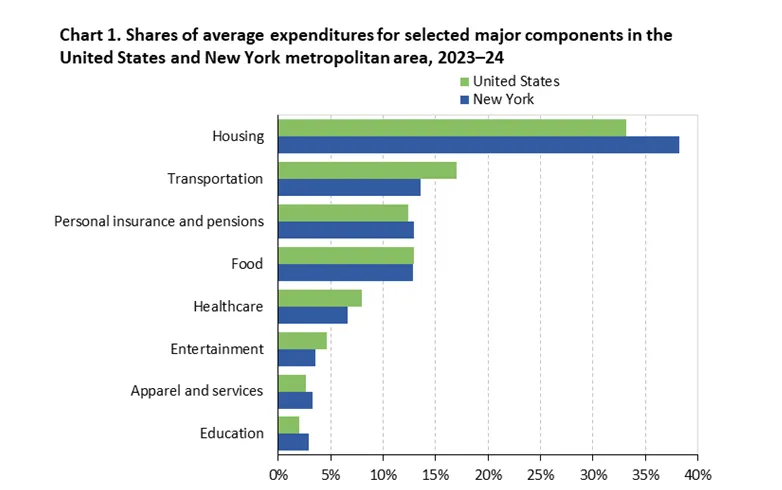
Higher expenditure levels shift buyers’ needs around luxury items, expensive brands, and overall customer satisfaction.
Now layer in New Yorkers’ travel patterns. The MTA reports that the New York City subway sees around 3.4 million riders on an average weekday.
This daily concentration of movement increases contact with outdoor advertising, digital screens, and mobile social media advertising throughout the commute. In a market where attention is constantly divided across digital channels, creative fatigue occurs faster.
You’re on the right page to learn to leverage all that.
In this blog, we’ll cover:
- Why NYC is a completely different consumer ecosystem
- Purchasing behavior differences in NYC vs other US markets
- How media consumption differs in NYC
- Why national campaigns often underperform in NYC
- What brands must do differently in NYC, and whether the higher cost is worth it
P.S. Are your New York campaigns costing more while conversions stay flat? At inBeat Agency, we build data-driven performance systems tailored to real NYC consumer behavior so your media spend actually brings ROI in this market. Book a free strategy call now.
Key Takeaways
- NYC compresses exposure, competition, and trend cycles, which forces brands to move faster and test smarter.
- Higher CAC in New York often reflects stronger purchasing power and elevated quality expectations.
- Borough-level identity influences messaging, pricing sensitivity, and consumer response patterns.
- Creative fatigue sets in quickly, which makes volume and rapid iteration essential.
- Strong hooks and immediate value signals determine whether users engage or scroll past.
- Social proof, influencer validation, and UGC significantly influence purchase decisions in NYC.
- National campaigns underperform when messaging lacks cultural specificity and local relevance.
- Precision targeting and structured performance testing drive sustainable growth in this market.
Why NYC Is a Completely Different Consumer Ecosystem
New York is not just bigger. It is denser, louder, faster, and more competitive. Once you break down how those forces interact, the performance differences start to make sense.
Let’s explore what actually makes this ecosystem different and how it reshapes consumer behavior in ways most markets do not experience.
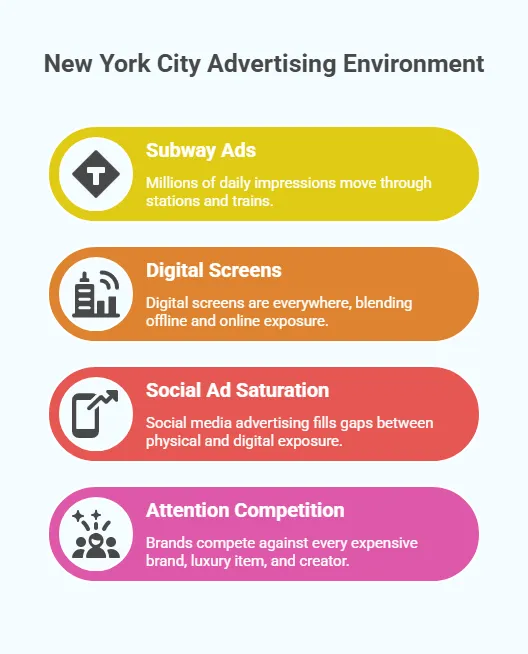
1. Extreme Population Density & Daily Ad Exposure
In most cities, consumers encounter ads in predictable pockets of time. However, in New York City, exposure is constant. You are competing for attention from the moment someone leaves their apartment to the moment they return (and even after that).
Subway Ads
As we shared above, the New York City subway sees around 3.4 million rides on an average weekday. This means millions of daily impressions moving through the same stations, trains, and corridors.
Outdoor advertising in New York City delivers enormous reach. In fact, a single NYC billboard can generate over 1.4 billion impressions per week, a scale of exposure that most U.S. markets rarely match.
So, if you rely on outdoor advertising, you are competing inside one of the most saturated transit systems in the world. Here, repetition builds quickly, and ad fatigue (Meta guide) follows just as fast.
Digital Screens
Walk through Midtown, SoHo, or any of the distritos de Nueva York, and you will see digital screens everywhere. Retail windows, taxis, LinkNYC kiosks, office lobbies. Media placement in this city is layered.
Offline and online exposure blend into one continuous stream. This environment raises the bar for creative storytelling. And generic visuals disappear instantly.
Social Ad Saturation
Now add social media to the mix. Commuters scroll through Instagram, TikTok, LinkedIn, and YouTube between stops. Social media advertising fills those gaps.
More than 85% of New Yorkers report using social media daily, which makes digital channels a constant part of everyday life across the five boroughs. This level of usage means your ads appear almost every day as people move between work, errands, and social plans.
In a city where mobile usage dominates the customer journey, digital channels compete aggressively for seconds of attention. Attribution modeling becomes more complex because touchpoints stack quickly.
Attention Competition
Here is what this means for you. You are not just competing against brands in your category.
You are competing against every expensive brand, every luxury item launch, every on-demand service, and every creator pushing content in New York.
Social hierarchies and visible consumption patterns amplify that competition.
As a result, your campaigns need sharper hooks, faster creative testing, and stronger Consumer Insights backed by real market research. In New York City, attention is scarce. If your message does not land immediately, consumers move on without hesitation.
2. Cultural Velocity & Trend Compression
In New York City, trends move on compressed timelines.
New York has been described as the cultural capital of the world, and as many as 800 different languages are spoken across its neighborhoods. This shows how diverse ideas and influences collide at scale.
So, what feels new this week can feel overexposed next week. And if your campaign development cycles are slow, you lose relevance before your media even scales.
Trends move faster because culture overlaps here. Fashion, finance, tech, and media collide daily. A product spotted in SoHo can circulate across social media within hours. Consumer sentiment shifts quickly as digital trends spread through tightly connected communities.
You are also dealing with micro-trends instead of broad national waves. A specific neighborhood, creator circle, or niche interest group can drive sudden demand spikes. Social listening and consumer research mostly detect these signals before traditional market research catches up.
Creator-led momentum pushes it even further. Influencer marketing carries weight in New York because audiences follow hyper-local voices closely. When a creator highlights something, traction builds fast. If you wait too long, that moment passes. In New York, speed and sharp performance measurement make the difference.
3. Hyper-Local Identity Within One City
New York City looks like one market, but you are really selling into borough-level realities. SoHo, Harlem, Williamsburg, and Queens each run on different cues around status, price, and convenience.
Queens is also deeply global, with about 48% foreign-born. Manhattan shows extreme spread in buying power, too. Its income inequality ratio reaches 53.18 between the top and bottom income quintiles.
This is why borough-specific messaging beats one-size-fits-all creative here.
Purchasing Behavior Differences in NYC vs Other US Markets
Once you understand the ecosystem, the buying behavior starts to make sense. New Yorkers do not just see more ads. They process them differently.
In our experience working across New York City accounts, we have learned that expectations are higher, decisions are faster, and social proof carries more weight than in most U.S. markets. This is where many teams misread the signals.
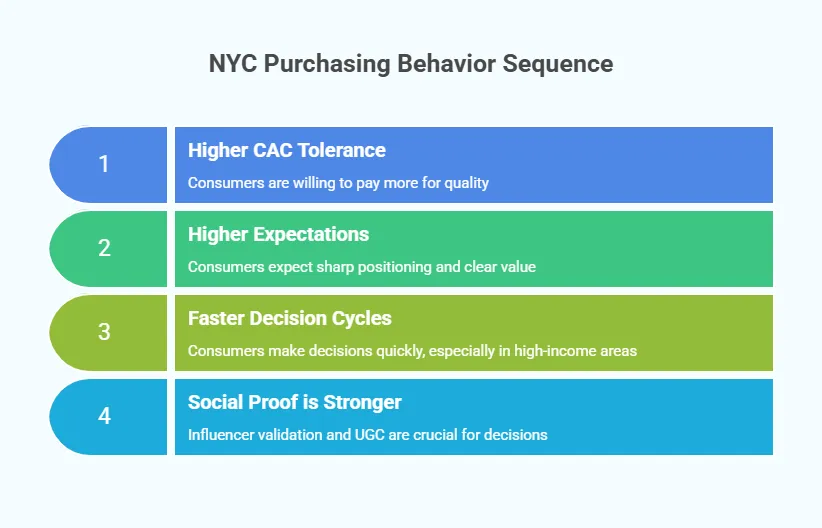
Higher CAC Tolerance, Higher Expectations
Attention in New York is expensive. Media costs are higher, competition is tighter, and premium placements fill quickly. This naturally pushes CAC up.
Here is where most teams mess up. They assume higher CAC means weaker performance.
From what we have seen, higher acquisition costs mostly reflect stronger purchasing power and brand sophistication. Consumers here expect quality, sharp positioning, and clear value.
So, if your offer feels average, it gets filtered out instantly.
Faster Decision Cycles
You are dealing with compressed decision timelines, especially in high-income pockets like Manhattan, parts of Brooklyn such as Williamsburg, and areas of SoHo where luxury retail concentration is high. Disposable income clusters in these neighborhoods accelerate purchasing, particularly in fashion, beauty, dining, and on-demand services.
When your offer aligns with identity, status, or convenience, decisions happen quickly. We have observed that limited drops, exclusive launches, and culturally relevant products convert fast in places like SoHo.
JLL named SoHo the most active prime urban retail corridor in North America in 2024, which reflects just how concentrated purchasing activity is in that area.
If your campaign development lags or your retargeting window stretches too long, you lose that initial surge of intent.
Social Proof is Stronger
Social proof plays a bigger role in NYC. Influencer validation, creator endorsements, and authentic UGC usually tip the scale. New Yorkers pay attention to what others are wearing, using, and posting.
Around 69% of consumers say they trust influencer recommendations, which shows how powerful creator validation has become in shaping decisions. At the same time, 70% of consumers now expect to see user-generated content before purchasing, which means social proof is no longer optional
Pro tip: At inBeat Agency, we rely heavily on influencer marketing and social listening in this market because momentum builds quickly in New York. FOMO is real here. When traction starts, it compounds as creators and audiences amplify each other. When it does not, interest fades just as quickly, and the opportunity passes.
We saw this clearly with our NYC-based client, Mindbloom. We partnered with 15+ creators who had personally experienced the treatment and produced authentic, testimonial-driven UGC.
This approach reduced CAC by 25% and increased referral sign-ups by 40%. When social proof feels credible and locally relevant, performance follows.

Why National Campaigns Often Underperform in NYC
This is where most teams get surprised. A campaign that performs well nationally suddenly stalls in New York City. CPMs rise, CAC climbs, and conversion rates dip. It is rarely the product. It is usually the positioning.
Here is where things break down:
- Generic creative fails: What works in broader U.S. markets mostly feels flat in New York. From what we have seen, stock visuals and safe messaging disappear instantly in a city flooded with stimuli. Creative needs sharper identity cues and stronger visual presence to compete.
- Messaging is too broad: National campaigns usually speak to everyone. In NYC, this approach weakens impact. You are marketing to specific borough-level identities and social hierarchies, so tighter segmentation and localized messaging outperform broad brand narratives here.
- Lack of cultural specificity: This is the biggest gap. Brands ignore local context, trend cycles, and visible consumption patterns. Trust us, New Yorkers can tell when a campaign was built for a national audience and simply geo-targeted. Therefore, cultural fluency matters here more than most teams realize.
- Weak hooks lose immediately: In NYC, attention windows are short. If your first few seconds do not signal relevance, users scroll past. That’s why at inBeat Agency we prioritize hook testing heavily in New York campaigns: early engagement determines everything downstream.
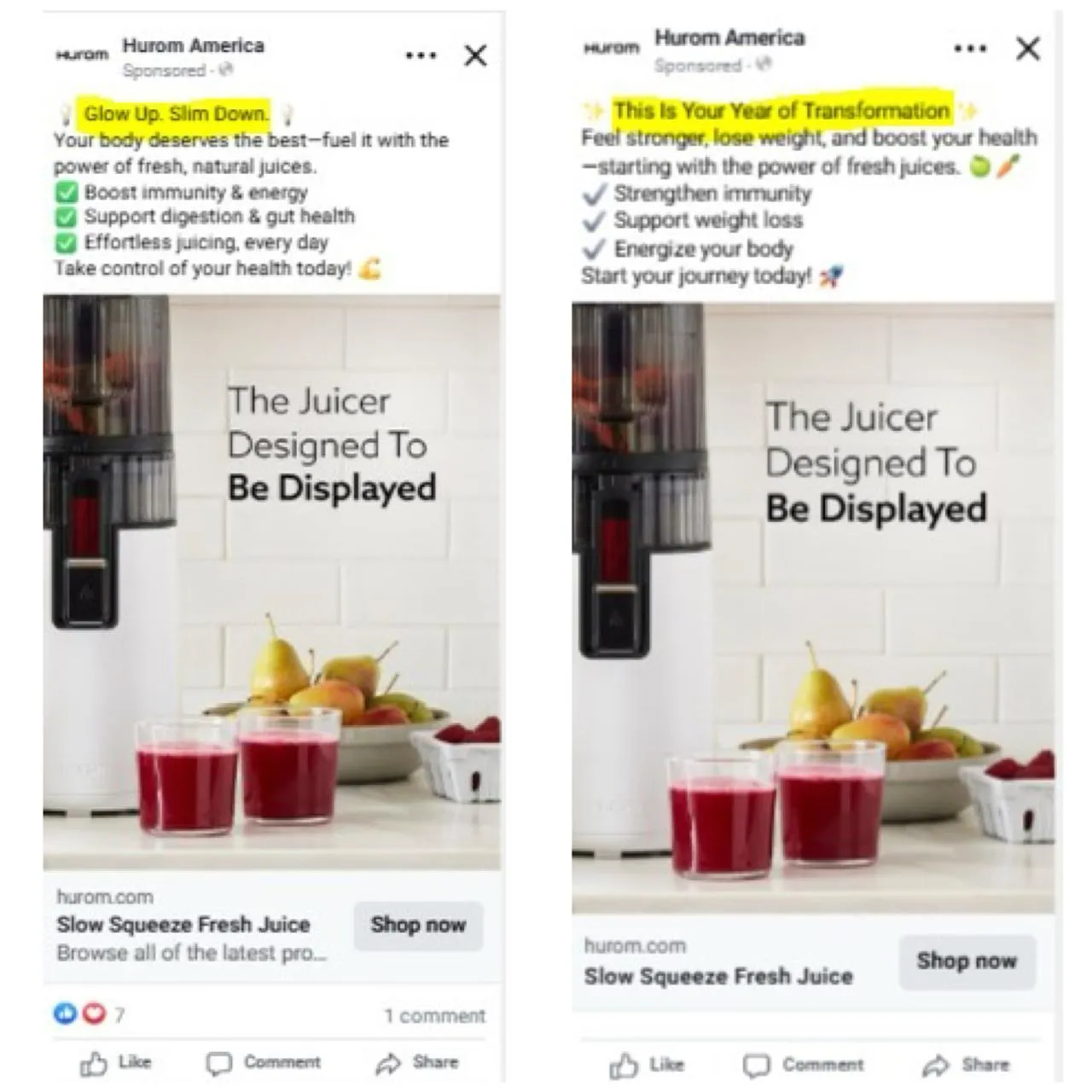
For example, for our client Hurom, we ran multiple hook tests against a single creative asset to see which opening drove stronger engagement. Our focused testing approach led to a 36% reduction in CAC, a 2.5X increase in ROAS, and a 65% drop in CPA.
“Hooks testing is like the main core of our creative testing. As for Texts, Headlines, and CTA's, we mostly use at least 3 different text options per creative, and we optimize later depending on results.” Mustafa M. Ali - Paid Media Lead at inBeat Agency
If you want national performance metrics in New York, you need local intelligence behind the execution.
What Brands Must Do Differently in NYC
Now that you understand what affects performance in NYC, the real question is what you do differently. As we explained above, applying national playbooks here rarely works. So let’s explore what actually needs to change if you want your campaigns to compete in this market.
1. Increase Creative Volume and Accelerate Iteration
If you want to win in New York, you cannot rely on one hero creative. This is where most teams mess up. They launch a polished asset, let it run for weeks, and hope it holds. Remember that in NYC, creative fatigue sets in quickly.
To compete, you need:
- Multiple hook variations running simultaneously
- Different messaging angles for different borough-level audiences
- Short testing cycles with fast feedback loops
- Constant rotation before fatigue sets in
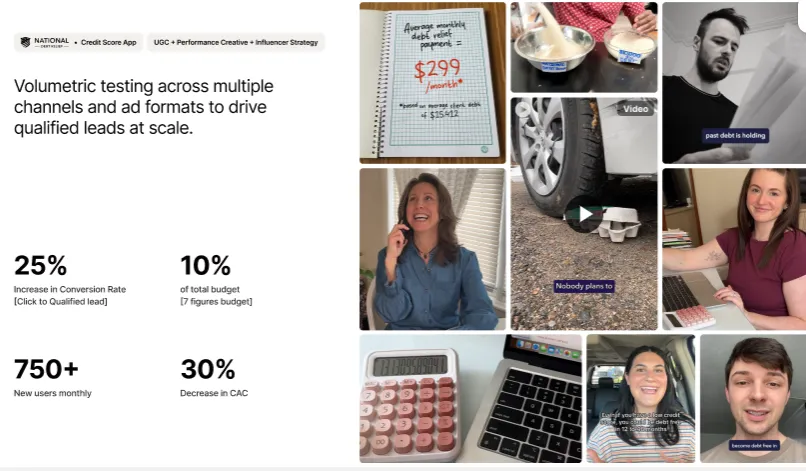
Pro tip: At inBeat, we treat creative as a performance engine. We run volumetric testing across multiple channels and ad formats instead of betting on a single asset.
For example, when we partnered with National Debt Relief, we deployed high-volume creative testing across UGC and performance-driven assets. This approach increased conversion rate by 25% from click to qualified lead, reduced CAC by 30%, and drove 750+ new users per month. Testing at scale changed the trajectory.
We have also learned that in New York, iteration speed determines efficiency.
- Slow creative cycles raise costs.
- Fast, structured testing lowers them.
2. Move from Broad Targeting to Borough-Level Precision
Targeting “New York City” as one audience sounds efficient. However, in practice, it flattens nuance.
As we have shared above, each borough carries its own income patterns, cultural signals, and consumption habits. Manhattan’s premium retail corridors behave differently from residential areas in Queens. Williamsburg responds to trend-driven positioning in ways other neighborhoods may not.
Therefore, instead of running one broad campaign, break it down:
- Tailor messaging by borough-level income and lifestyle signals.
- Adjust offers based on price sensitivity and category demand.
- Align creative with neighborhood identity cues.
- Analyze performance by zip clusters, instead of just city-wide averages.
Precision sharpens performance. When your targeting reflects how New Yorkers actually live and spend, engagement improves and wasted impressions drop.
3. Strengthen your Hook and Shorten the Payoff Window
In New York, you do not get a warm-up. You get a few seconds. If your opening line or first frame does not signal relevance immediately, the scroll continues.
Many brands spend too much time building context before delivering value. That delay costs you. In this market, the hook needs to do the heavy lifting upfront. You need a clear benefit, a strong identity cue, and immediate relevance.
You should:
- Lead with a relatable pain point.
- Present the outcome (price, offer, or transformation) early.
- Show social proof within the first few seconds.
- Test multiple opening lines against the same asset.
In our campaigns, we obsess over the first 3 seconds. We have seen small hook changes shift conversion rates meaningfully. When you shorten the payoff window, you reduce drop-off and protect your CAC.
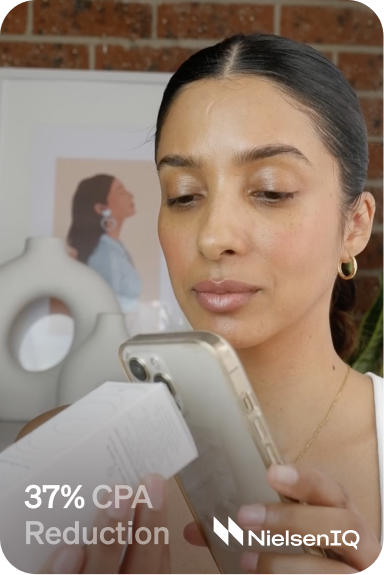
For example, in a campaign we created for the NielsenIQ Consumer Panel app, the ad opened with a direct line:
“Shopping’s gotten well expensive, innit?”
That statement tapped into real consumer frustration around rising grocery costs. We immediately followed with the benefit:
“You can scan your groceries to earn free gift cards.”
The transition from problem to solution was immediate and clear. Viewers understood the value within seconds, which strengthened engagement and reduced early drop-off.
4. Build a Creator-Led Paid Strategy
If you are still separating influencer marketing from paid media, you are leaving performance on the table. In New York, creator content and paid amplification work best together.
Many teams treat creators as awareness-only. They run organic posts, track vanity metrics, and stop there. That approach limits scale. In our experience, the real leverage comes when creator content feeds directly into paid campaigns.
You should:
- Source creators who already reflect borough-level identities.
- Turn top-performing organic posts into paid assets.
- Test testimonial-style UGC inside your ad accounts.
- Amplify momentum quickly once traction appears.
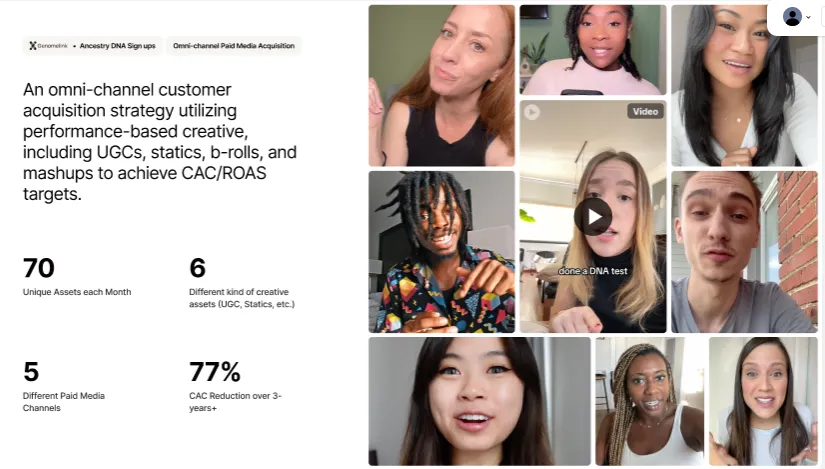
We applied this approach with Genomelink. Instead of relying on traditional brand creative, we built an omni-channel acquisition strategy powered by performance-based creator assets.
We deployed 70+ unique assets per month across 5 paid media channels, including UGC, stat-driven creatives, and mashups. This structure reduced CAC by 77% while hitting aggressive ROAS targets.
Creator-led paid strategy works in NYC because it blends credibility with scale. When content already feels native to the feed, amplification becomes more efficient.
Is NYC Worth the Higher Cost?
Yes, New York City can justify higher acquisition costs because it mostly delivers stronger lifetime value and higher spending power. Customers in this market adopt premium products quickly, thereby increasing average order value and long-term revenue.
Beyond direct revenue, NYC creates cultural amplification. Trends that gain traction here usually influence broader national behavior, and brand credibility built in New York strengthens perception in other markets. Success in NYC can carry weight far beyond the city itself.
Build a High-Performance NYC Strategy with inBeat
If you want to align your campaigns with how New Yorkers actually think, evaluate, and buy, inBeat Agency can help. We design performance-driven systems built specifically for NYC consumer behavior, from borough-level targeting to structured creative testing and creator-led paid strategies.
Our approach connects consumer insights, real-time performance measurement, and rapid iteration so your media spend leads to higher ROAS in this competitive market.
Book a free strategy call to see how your current campaigns stack up and where performance can improve.
FAQs
Why is NYC customer acquisition more expensive?
Customer acquisition in NYC costs more because media competition is intense and premium placements fill quickly. You are competing in the largest U.S. market with higher spending power and elevated brand expectations. Higher CAC typically reflects stronger purchasing power and denser competition, not weaker performance.
Do NYC consumers convert faster?
In many categories, yes. Certain boroughs with higher disposable income and strong identity alignment move quickly when an offer feels relevant. When your hook communicates value immediately, and the payoff is clear, decision cycles compress and conversions accelerate.
Is influencer marketing more effective in New York?
Influencer marketing usually performs strongly in NYC because creator density is high and audiences follow hyper-local voices closely. Social proof spreads fast in this environment. When creator content feels culturally aligned, paid amplification becomes more efficient.
How should brands test campaigns in NYC?
You should test aggressively and iterate quickly. We suggest running multiple hook variations, segment by borough when possible, and shorten feedback loops. Creative fatigue sets in faster here, so performance testing needs to keep pace with the market.
What are the 4 P's of consumer behavior?
The 4 P’s refer to Product, Price, Place, and Promotion. In NYC, each requires sharper positioning. Product quality expectations are higher, price sensitivity varies by borough, place includes digital and physical layering, and promotion must compete in a saturated media environment.
What are the 4 C's of consumer behavior?
The 4 C’s focus on Customer, Cost, Convenience, and Communication. In New York, customer identity shapes behavior, cost perception shifts by income cluster, convenience drives impulse decisions, and communication must be fast, clear, and culturally relevant.
How does inBeat Agency tailor campaigns specifically for the New York market?
We design campaigns around real NYC consumer behavior. Our team builds borough-level targeting structures, adapts messaging to local identity cues, and tests creative against New York-specific engagement patterns. We focus on speed, cultural relevance, and measurable performance from day one.
Does inBeat Agency handle both influencer marketing and paid media for NYC brands?
Yes, we manage both influencer marketing and paid media under one performance strategy. We source and vet creators, develop UGC-style assets, and then amplify top-performing content through structured paid campaigns. This integration allows us to scale credibility and acquisition simultaneously.
How does inBeat approach creative testing in high-competition markets like NYC?
We treat creative as a performance lever. Our team runs multiple hook variations, tests different angles simultaneously, and shortens feedback cycles to adapt quickly. In a market like NYC, where fatigue sets in fast, our structured testing approach protects efficiency and improves scalability.
Appendix
- https://www.bls.gov/regions/northeast/news-release/consumerexpenditures_newyork.htm
- https://www.mta.info/agency/new-york-city-transit/subway-bus-ridership-2024
- https://www.outfront.com/markets/new-york-city
- https://cmsny.org/publications/data-briefing-on-new-york-city-immigrants/
- https://commercialobserver.com/2024/12/soho-north-america-most-active-retail-corridor-2024/
- https://powerdigitalmarketing.com/blog/social-media-trends-2026/
- https://www.tribegroup.co/blog/top-creator-marketing-statistics