%20(1).png)

If you’re running Meta advertising in New York, you already feel the pressure. Meta’s average CPM in the US is around $23 per 1000 impressions, which places the U.S. among the more expensive global markets.
New York sits at the center of that competition. National averages already reflect strong advertiser demand across Meta Platforms, but in a market where brands compete aggressively across digital channels, CPM pressure intensifies quickly.
Add rising local ad spend and highly media-aware social media audiences, and your margin for error tightens fast.
At the same time, targeting automation inside Meta Platforms continues to expand through Advantage+ tools and AI-powered systems. As automation increases inside Ads Manager, your creative development and overall paid strategy carry more weight in determining performance.
The real challenge for NYC brands is understanding when Meta Ads actually produce efficient customer acquisition cost and when they simply drain budget.
In this blog, we’ll cover:
- Why Meta Ads behave differently in NYC and when they actually work best
- When Meta campaigns struggle, and what typically breaks performance
- The creative formats and testing systems that drive stronger results
- How to scale ad spend profitably and whether Meta still makes sense in 2026
P.S. Still running Facebook Ads in New York and watching your customer acquisition cost creep up? Don't worry, our team at inBeat Agency can help you build full-funnel Meta campaigns powered by creative testing, performance tracking, and data-backed creative that actually scales. Book a free strategy call now!
Key Takeaways
- Creative testing drives performance more than minor audience targeting adjustments in NYC’s competitive environment.
- Clear differentiation protects your ad spend and improves conversion rates in high-CPM markets.
- Meta amplifies proven demand but rarely creates it from scratch.
- Clean tracking through Meta pixel and Conversion API improves optimization stability.
- UGC-style creative builds trust faster than overly polished brand messaging.
- Landing page efficiency directly impacts customer acquisition cost at scale.
- Scaling profitably requires horizontal expansion, budget discipline, and creative refresh cycles.
- Meta remains powerful, but only for brands with strong economics and structured execution.
Why Meta Ads Are Different in NYC
When you run Meta ads in New York, you operate inside one of the most competitive ad markets in the country. A market where ad spend moves fast across Meta Platforms, and performance marketers track every signal inside Ads Manager.
And this isn’t an unimportant channel.
Meta ads account for roughly 42% of all social media ad spend in the US. This dominance across Meta’s Family of Apps means brands continue to prioritize Facebook Ads, Instagram Reels ads, and related placements at scale.
When that level of national budget concentration meets a market like New York, pressure compounds quickly. This kind of environment changes how your campaigns perform and how precise your paid strategy needs to be.
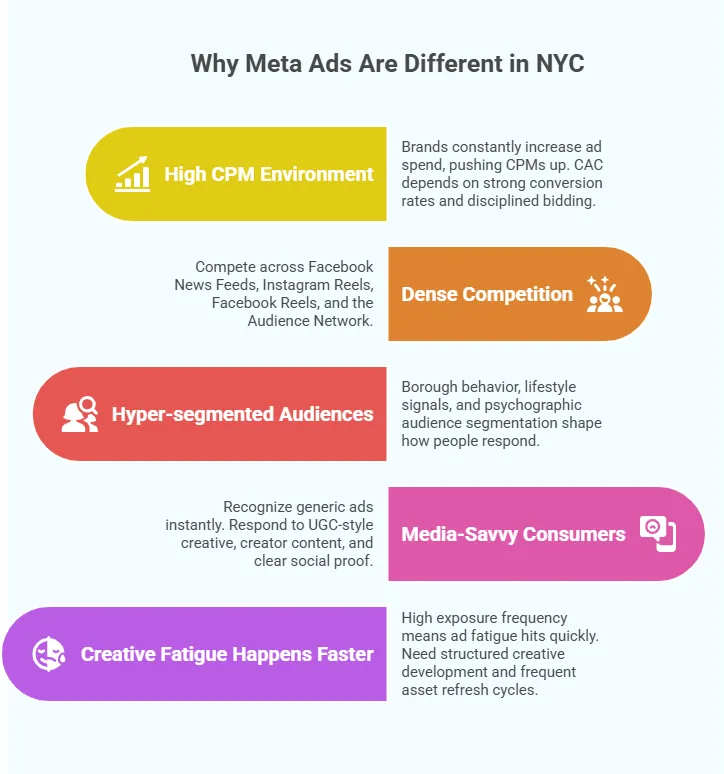
Let’s explore what makes NYC Meta advertising fundamentally different:
- High CPM environment: You’re bidding inside a city where brands constantly increase ad spend. Higher demand pushes CPMs up, which means your CAC depends heavily on strong conversion rates and disciplined bidding and budget management. If your creative development or landing pages are weak, the math breaks quickly.
- Dense competition: You have to compete across Facebook News Feeds, Instagram Reels, Facebook Reels, and the Audience Network alongside funded startups and aggressive e-commerce brands. Many are running structured A/B tests and continuous optimization cycles, which expose weak creative testing quickly.
- Hyper-segmented audiences: New York is not one audience. Borough behavior, lifestyle signals, and psychographic audience segmentation shape how people respond. Broad audience targeting can work, but only if your ad creative speaks directly to specific mindsets.
- Media-savvy consumers: Your audience recognizes generic ads instantly. They respond to strong UGC-style creative, creator content, influencer partnerships, and clear social proof. Data-backed creative wins attention, whereas lazy messaging easily loses it.
- Creative fatigue happens faster: High exposure frequency means ad fatigue (Meta guide) hits quickly in New York. In fact, across Meta ad impressions, an average user sees the same creative about 4.2 times. And once exposure reaches 4 views, conversion likelihood drops by roughly 45%.
That’s why your UGC-style video ads that worked last month can slow you down fast. You need structured creative development, frequent asset refresh cycles, and serious continuous optimization inside Ads Manager to protect performance.
When Meta Ads Work Best for NYC Brands
The truth is, Meta Ads can be incredibly profitable for NYC brands, but only when the conditions are right. The platform rewards clarity, strong creative development, clean performance tracking, and disciplined ad spend.
If you treat it like a plug-and-play PPC model, you’ll struggle. However, when you treat it like a system built on testing, measurement, and continuous optimization, performance becomes far more predictable.
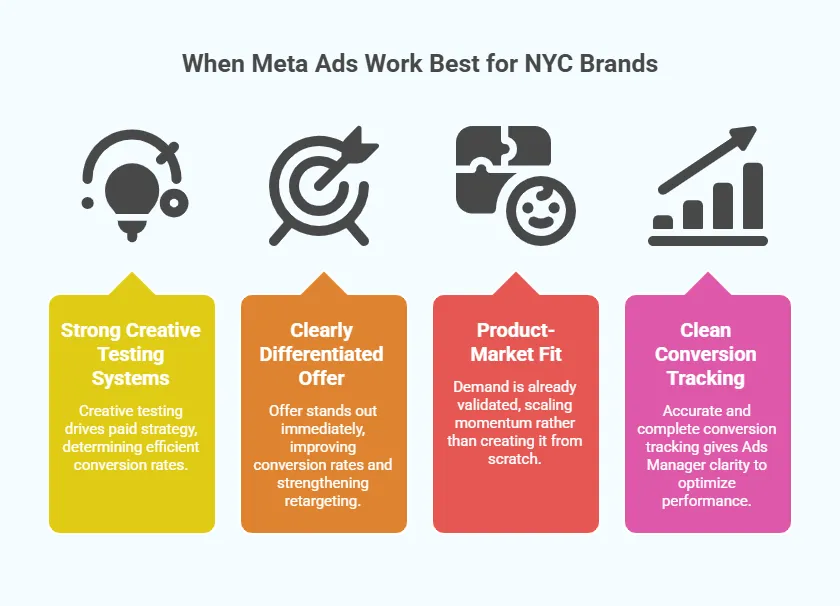
Below are the situations where Meta advertising tends to perform best for New York brands:
1. When You Have Strong Creative Testing Systems
Meta Ads work best in NYC when creative testing drives your paid strategy.
Audience targeting inside Meta Platforms is increasingly automated through Advantage+ tools and AI-powered systems, so your edge rarely comes from tweaking audiences inside Ads Manager.
It comes from your creatives. In fact, research shows that creative quality accounts for roughly 49% of sales lift. This shows how heavily performance depends on what your audience actually sees.
Strong hooks, clear positioning, and scroll-stopping visuals determine whether your ad spend turns into efficient conversion rates across Meta.
Based on our experience, in a high-CPM market like New York, weak creative can get expensive fast. You need structured A/B tests, fast iteration cycles, and constant review of performance data to see what actually resonates.
UGC-style creative, founder content, and authentic messaging usually outperform polished ads because media-savvy consumers respond to real signals. When you refresh assets before ad fatigue sets in and treat Ad Creation as an ongoing system, your customer acquisition cost becomes far more stable.
2. When Your Offer Is Clearly Differentiated
Another scenario when Meta advertising performs far better in NYC is when your offer stands out immediately. If you sell something interchangeable, high CPMs and rising ad spend expose it quickly.
The point is, NYC buyers compare options fast. They scan reviews, check competitors, and evaluate value within seconds. If your value proposition looks like everyone else’s, your conversion rates suffer and your customer acquisition cost climbs.
That’s where clarity changes the outcome. When your messaging targets a specific audience segment and your ad creative highlights a distinct benefit, results improve across Meta’s Family of Apps.
Plus, we have observed that strong differentiation also strengthens audience retargeting and makes social proof more persuasive.
3. When You Already Have Product-Market Fit
Another situation where Meta Ads perform strongly in New York is when your demand is already validated. Meta advertising scales momentum rather than creating it from scratch.
In our experience working with New York brands, campaigns scale fastest when product-market fit is already clear, and conversions happen before paid traffic increases.
Meta advertising then becomes a momentum multiplier. Instead of spending budget to “figure out” what resonates, we use paid media to accelerate what already works. Customer acquisition cost stabilizes more quickly, creative testing becomes more directional, and scaling feels controlled.
This matters even more in a post-iOS environment because Meta Platforms rely on performance data to optimize delivery.
When purchases or lead capture events occur consistently, Ads Manager has strong signals to work with. As a result, customer acquisition cost stabilizes, and scaling becomes more controlled.
4. When You Have Clean Conversion Tracking
Equally important is your data foundation. Meta Ads work far more efficiently when your conversion tracking is accurate and complete.
Meta Ads optimize based on event signals. When your Meta pixel, Conversion API, and first-party data are properly configured, Ads Manager receives consistent, deduplicated conversion signals.
That clarity directly impacts delivery efficiency and cost control.
Structured performance tracking also improves attribution confidence. When you understand how Meta supports upper-, mid-, and lower-funnel activity, you make smarter budget allocation decisions.
From what we’ve seen, brands with clean tracking infrastructure scale with far more predictability because optimization is grounded in reliable performance data.
When Meta Ads Do NOT Work Well in NYC
Meta advertising struggles in New York when operational readiness does not match market pressure. In a dense, high-CPM environment, small weaknesses get amplified quickly. The platform does not forgive gaps in economics, infrastructure, or decision-making speed.
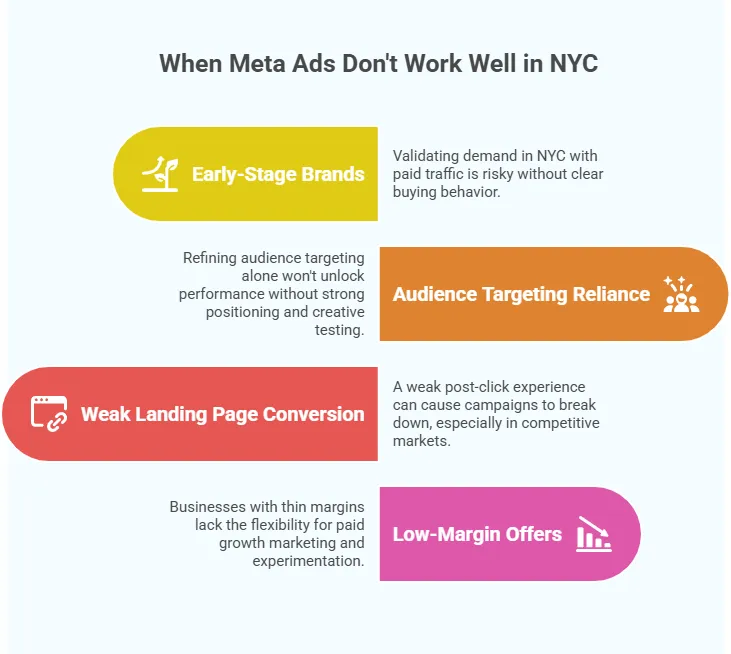
Below, we have mentioned the most common situations where performance usually breaks down:
1. Early-Stage Brands Without Proof
If you are still validating demand, NYC may not be the market to test paid traffic aggressively. Without clear buying behavior or repeat conversion signals, optimization becomes unstable. In this environment, Meta typically becomes an expensive research tool instead of a growth channel.
2. Brands Relying Only on Audience Targeting
Even when demand exists, some teams believe refining audience targeting inside Ads Manager will unlock performance. They duplicate ad sets, narrow interests, stack lookalikes, and tweak placements, hoping for a breakthrough.
In reality, automation across Meta Platforms already handles much of the distribution logic through Advantage+ tools. Without strong positioning and consistent creative testing, those targeting adjustments deliver only marginal gains.
In New York, marginal gains rarely offset rising ad spend or materially improve customer acquisition cost.
3. Businesses with Weak Landing Page Conversion
Remember that if your post-click experience is weak, even strong campaigns can break down. Meta can generate traffic, but it cannot fix friction after the click.
In fact, even just a 1-second delay can reduce landing page conversions by roughly 7%. In a high-volume environment like New York, those drops compound quickly.
So, if your landing pages lack clarity, speed, or persuasive structure, conversion rates collapse under high volume. We have observed that in competitive markets like NYC, inefficiency stacks up quickly, pushing customer acquisition costs beyond sustainable levels.
4. Low-Margin Offers with High CAC Sensitivity
Finally, some business models simply do not leave enough room for paid scale. If your average order value is low, your gross margins are tight, or your lifetime value is unclear, even small increases in customer acquisition cost can wipe out profitability. This pressure shows up even faster in New York’s high-CPM environment.
Earlier, we mentioned that refining audience targeting alone does not unlock performance. That still stands. Creative testing and strong positioning matter far more than minor targeting adjustments.
However, even when your strategy is correct, Meta advertising requires budget flexibility. Testing new creative, validating messaging angles, and allowing the algorithm to stabilize inevitably creates short-term performance swings.
If your unit economics cannot absorb short-term volatility, scaling becomes fragile. Without a margin buffer, even minor fluctuations in conversion rates or ad spend can push campaigns into negative returns.
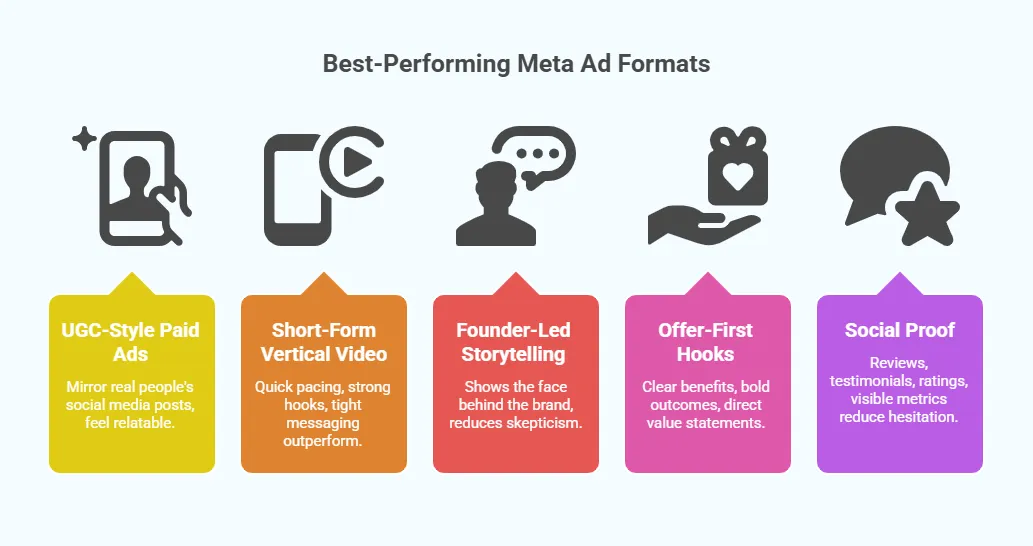
Best-Performing Meta Ad Formats for NYC Brands
In New York, your creative has seconds to earn attention. People scroll fast across Instagram posts, Stories and Reels, Facebook Reels, and Facebook News Feeds.
If your format feels generic or overly polished, it blends into the feed. The ads that win here feel native, immediate, and specific.
Remember that the strongest performers share one common trait: they feel real.
UGC Ads
UGC-style paid ads perform consistently because they mirror how real people post on social media. In fact, research shows that 84% of people are more likely to trust a brand if it uses user-generated content in its marketing.
This is because UGC-style creative and creator content feel less staged and more relatable, which matters in a media-savvy market. When your ads look like something a friend would share, engagement improves, and conversion rates follow.
For example, our client Prose regularly uses UGC-style content on its Instagram handle. They feature UGC creators who share their personalized haircare experience in a natural, conversational way. The format feels authentic, which strengthens credibility and makes the value proposition easier to understand.
Short Video Ads
Short-form vertical video builds on that same principle. Quick pacing, strong hooks within the first 3 seconds, and tight messaging outperform slower, brand-heavy formats. NYC audiences reward clarity. If your opening fails, the scroll continues.
Founder-Led Ads
Founder-led storytelling adds another layer of trust. When you show the face behind the brand, you reduce skepticism and strengthen credibility. From what we have seen, founder content mostly increases engagement because it feels transparent rather than promotional.
Benefits-led Ads
Offer-first hooks then drive action. Clear benefits, bold outcomes, and direct value statements perform better than vague awareness messaging. In a high-CPM environment, direct messaging protects your ad spend.
For instance, in a Facebook ad we created for Hurom, the copy led immediately with “Glow Up. Slim Down.” The promise was clear before the product details appeared.

Social Proof Ads
Finally, social proof accelerates decision-making. Reviews, testimonials, ratings, and visible metrics reduce hesitation. Our client Mindbloom frequently shares real customer stories on Instagram, highlighting tangible outcomes instead of generic claims. That visible proof shortens the path from impression to conversion.
A strong example is how our client Mindbloom shares customer testimonials and real transformation stories on its Instagram. Instead of generic promotional messaging, the content highlights real experiences and outcomes.
In New York, the formats that perform best combine authenticity, clarity, and proof. Attention comes first, trust follows, and conversions happen when both are aligned.
How NYC Brands Scale Meta Profitably
Scaling Meta advertising in New York requires structure. You cannot simply increase ad spend and expect performance to hold. If you want predictable growth, you need disciplined expansion and creative-led decision-making.
Here’s how successful NYC brands approach it:
- Horizontal scaling: Instead of pouring more budget into one winning ad set, we suggest expanding into new creative angles, audience segments, and placements across Meta’s Family of Apps. This spreads risk and protects your customer acquisition cost.
- Creative refresh cycles: As mentioned earlier, in NYC, ad fatigue shows up quickly. To avoid this, you should monitor performance data inside Ads Manager and replace declining creatives before conversion rates slip.
- Budget ramp strategy: When you increase the budget gradually, Meta’s optimization system adjusts more smoothly. Remember that sudden spikes mostly disrupt delivery and push CAC higher. Therefore, we always recommend controlled scaling as it keeps results stable.
- Creative-led media buying: Your media buying should follow performance data from creative testing. When you let strong creative guide budget allocation, scaling becomes intentional rather than reactive.
Should NYC Brands Still Invest in Meta?
Yes, but only if you approach it strategically.
As mentioned above, Meta platforms still command a significant share of U.S. social media ad spend, and Facebook Ads and Instagram Reels remain core attention channels. In New York, where competition is intense across digital channels, Meta continues to offer scalable reach and full-funnel capability.
However, winning nowadays requires more than a budget. Automation through Advantage+ tools and AI-powered optimization means creative quality, first-party data, and clean performance tracking matter more than manual audience targeting tweaks.
If your economics are sound and your system is structured, Meta remains one of the most scalable paid growth channels available.
Turn Meta into a Predictable Growth Engine with inBeat Agency
If you’re looking to scale Meta advertising in New York with structure, clarity, and performance-driven execution, inBeat Agency can help.
As a certified Meta partner, we combine creative testing, data-backed strategy, and disciplined media buying to build full-funnel Meta campaigns that scale predictably.
Book a free strategy call with our team and see where your Meta performance stands.
FAQs
Are Meta Ads expensive in NYC?
Yes, Meta Ads in New York are more expensive than many other U.S. markets due to high competition and aggressive ad spend. However, cost alone does not determine profitability. If your creative, positioning, and conversion tracking are strong, you can maintain efficient customer acquisition cost even in a high-CPM environment.
Do Instagram ads work better than Facebook ads in NYC?
It depends on your audience and creative format. Instagram Reels and short-form vertical content usually perform well for DTC and lifestyle brands, while Facebook News Feeds can still drive strong results for older demographics and service businesses. In most cases, running placements across Meta’s Family of Apps allows Ads Manager to optimize distribution based on performance data.
Is TikTok better than Meta for NYC brands?
TikTok can drive strong top-of-funnel attention, particularly with UGC-style video ads. However, Meta typically offers deeper retargeting, broader audience targeting controls, and more mature Performance Tracking systems. For many NYC brands, TikTok supports awareness while Meta drives more consistent conversion volume.
What is the 20 rule on Facebook ads?
The “20 rule” refers to creative refresh discipline. Many performance teams aim to introduce new creative variations regularly so that no single ad accounts for more than roughly 20 percent of total spend for too long. This reduces ad fatigue and stabilizes conversion rates in competitive markets.
What is the 3-2-2 method of Facebook ads?
The 3-2-2 method is a structured creative testing framework inside Facebook Ads. It involves launching three different creatives, two primary text variations, and two headlines within the same campaign. This setup quickly generates multiple combinations and gives Ads Manager stronger performance data to identify which messaging and visuals drive the best conversion rates.
Does inBeat Agency handle both creative production and media buying?
Yes, we manage both creative development and media execution. Our team produces UGC-style creative, founder-led content, and performance-focused ad assets, then we handle bidding and budget Management, audience targeting, and continuous optimization to ensure creative and media work together.
What makes inBeat Agency different from other Meta advertising agencies in New York?
Unlike many other agencies, we focus on systems. Many agencies rely heavily on audience targeting tweaks. We build creative-led scaling systems supported by first-party data, Conversion API integration, and disciplined budget control. This structure makes scaling more predictable in high-CPM markets like NYC.
Appendix
- https://www.adamigo.ai/blog/meta-ads-cpm-cpc-benchmarks-by-country-2026
- https://socialpulsestats.com/social-media-advertising-statistics-2025-platform-performance-data-roi-analysis/
- https://www.logicalposition.com/blog/creative-velocity-the-meta-ads-strategy-revolutionizing-performance-marketing
- https://www.circana.com/post/the-right-five-keys-to-unlock-advertising-effectiveness
- https://www.bigcommerce.com/glossary/page-load/
- https://www.social.plus/blog/84-of-people-trust-brands-more-when-they-use-user-generated-content