.svg)
.svg)
.svg)
.svg)


.svg)





What happens between watching a creator test-drive a car and deciding to buy one? For automotive marketers, much of that journey remains invisible, even when the content helps move a potential buyer closer to a dealership.
The scale of the tracking problem is striking. According to Autotrader's 2025 study with Clarivoy data, 92% of marketplace-assisted vehicle sales never surfaced as leads in dealer CRMs. The average buyer encountered 62 touchpoints, while dealerships tracked only two. Although these findings cover marketplace activity rather than influencer campaigns specifically, they reveal why connecting marketing exposure to actual purchases remains so difficult.
Automotive influencer marketing has the potential to bridge that gap, provided creator partnerships, dealer networks, and paid distribution work together. This guide breaks down what that looks like in practice.
inBeat Agency POV: We don't think a car creator's job is to reach people. Their job is to make the ad a dealer could never make: a real owner, a real commute, an honest question about towing, charging or the third row.
Reach is what the media budget buys, aimed at the DMAs where the rooftops sit. The persona inside the content does the audience selection that platform settings can't do anymore, so you match creators to buyers and ignore follower counts. Then you run paid social as the lab: dark-post the variants, read cost per booked test drive, and scale only what the dealer's CRM says earned it. Spend that teaches you nothing about which message moves which buyer is the real waste.
TL;DR
- Judge creator content by dealer-side results: tracked test-drive appointments set and kept.
- Build attribution in layers: creator UTMs and landing pages, appointment codes the BDC logs, CRM match-back, then geo holdouts.
- Use YouTube for research and short-form for discovery, then amplify through allowlisted ads in each dealer's DMA and scale only what lowers cost per booked appointment.
- Audi, Kia and Healey Brothers each tie creator or social content to something the dealer can count, but none offers a conversion rate you can reuse.
- Settle loaner insurance, FTC disclosure and usage rights before the car leaves the lot.
- Start with one dealer, three matched creators and a 30-day read on appointments.
Why Automotive Influencer Marketing Stalls at Awareness
Where Car Buyers Actually Convert: Search and the Showroom
A sponsored video can do everything right and still leave the dealer empty. The buyer watches, forms a view of the car, then weeks later types a model name and a city into Google, clicks a dealer ad and books a slot. The Autotrader and Cox Automotive finding from the intro is the clearest public evidence of where that journey lands: buyers spend about 95 days in market and touch dozens of channels, and the dealer's CRM sees almost none of them. The creator's post starts the journey. It almost never finishes it.
That's why judging auto influencer marketing on its own engagement is a category error. The honest question for every creator deliverable is what it fed into search and into the dealer's lead queue. Neither the creator nor the algorithm connects a view to a booked appointment; the dealer's lead queue and search campaigns do.
Vanity Metrics Hide the Gap Between Creator Reach and Dealer Leads
Take a sponsored car video judged only on views. Millions of plays, warm comments and a satisfied OEM brand team can sit next to zero tracked test-drive bookings at the three nearest dealers, because nobody built a path from the video to a rooftop. Same asset, opposite verdict. Audi South Africa's TikTok Test Drive, covered below, did the reverse: it was built to be judged on bookings from the start.
The metric you pick decides which campaigns get renewed, so a reach-only scoreboard rewards creators who are good at reach and quietly punishes the local owner-creator whose audience actually lives near the dealership.
What a Creator-Led Pipeline Changes
The rest of this article runs on a three-layer pipeline: creator creative matched to persona and geography, paid distribution through allowlisted ads targeted to dealer DMAs, and dealer attribution through bookings, show rate, CRM match and branded-search lift.
Each later section operationalizes one layer. One limit up front: there's no public benchmark for how often creator exposure becomes a test drive, and the cases below are single campaigns, so you'll need to instrument your own and treat anyone quoting an industry rate with suspicion.
Pull your last automotive creator campaign report and write down the dealer-side metric it was tied to. If the answer is none, that's the first thing to fix.
How to Measure Automotive Influencer Marketing ROI Across a Long Sales Cycle
Measure qualified test-drive appointments or dealer leads, and define that unit before anyone briefs a creator. A closed sale is the metric finance wants, but on a purchase cycle that stretches across weeks or months, sale attribution arrives too late to tell you which creator or angle to rebook. Appointments set, appointments kept and leads accepted by the dealer can be read inside a month, which is fast enough to steer the next batch of creative. Generic influencer ROI models still have to bolt onto dealer systems you don't fully control.
Lead-Level Attribution: Trackable Links, Dedicated Landing Pages and Test-Drive Booking Forms
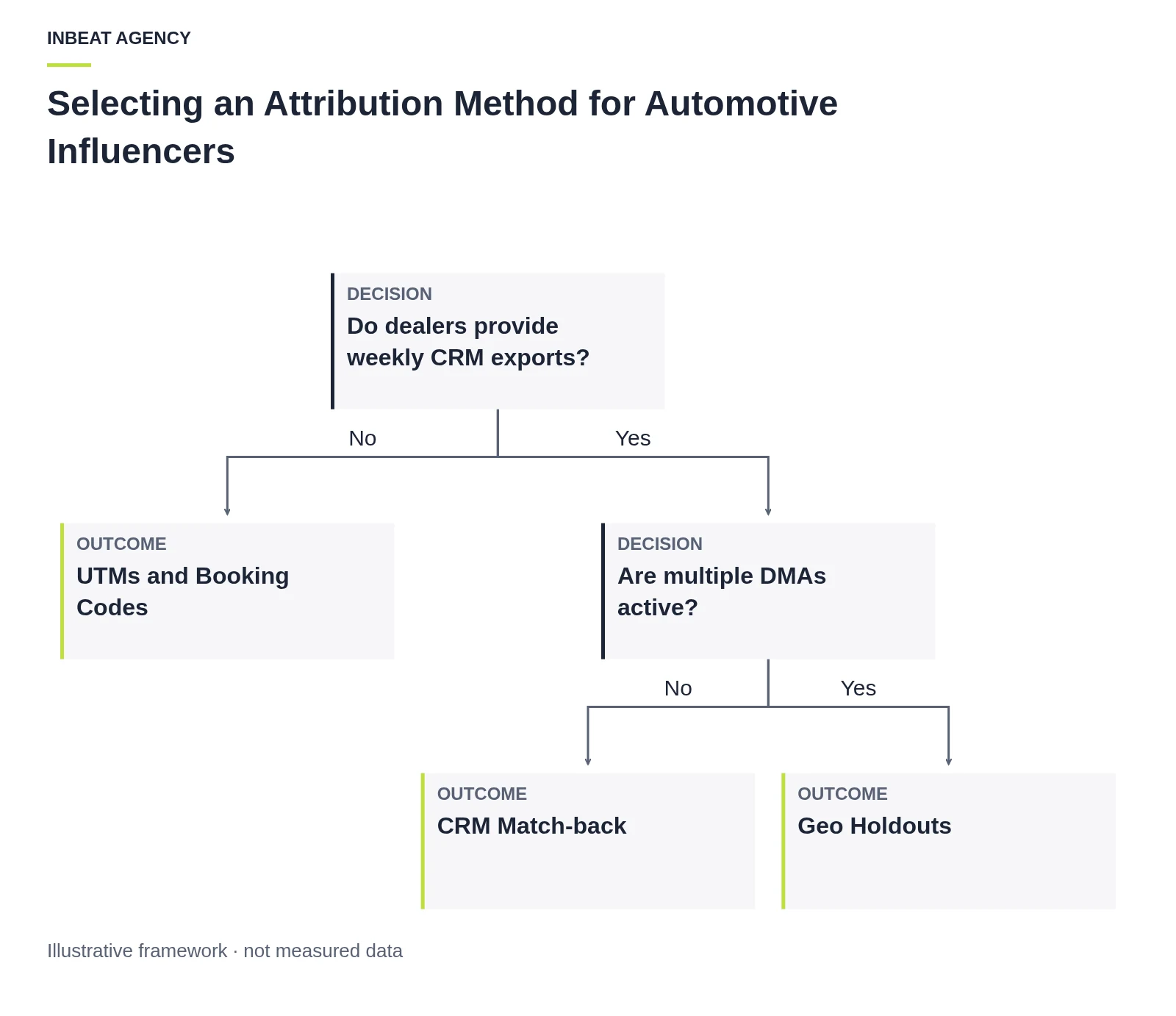
Build the attribution stack in this order, because each layer depends on the one below it:
- Creator-specific UTMs and landing pages. One page per creator, one per dealer, with the booking form embedded. Shared links destroy your ability to compare creators.
- Appointment or promo codes the dealer actually reads. A code on the booking confirmation that the BDC logs at check-in catches walk-ins who never clicked.
- CRM match-back by email or phone. Lead data from the landing page matched against the dealer's CRM and DMS to confirm show and sale events.
- Geo holdouts to size incremental lift once the three layers above are running.
The weakest point is usually step two. If the dealer's BDC isn't trained to ask for the code, your tracked bookings undercount by whatever share of buyers walked in cold after watching.
CRM and Dealer-Management-System Matching for Showroom and Sale Events
Match-back is where the chain most often breaks. Dealer CRMs are rarely clean: duplicate records, leads entered by hand with mistyped phone numbers, and salespeople who log a showroom visit as a fresh walk-in because that's how their pay plan reads.
Across a DMA with several rooftops of the same brand, one buyer can appear as a lead at three dealers. Co-op programs add their own reporting templates that often don't have a field for creator spend.
When those problems appear, do three things:
- Deduplicate on hashed email and phone before reporting, and report at DMA level when dealer-level numbers are contested.
- Agree a weekly export with each dealer principal at contract stage.
- Keep appointment-level data as your primary read, with sale match-back as a lagging confirmation that gets updated at 60 and 90 days.
How Do You Test Incrementality When Last-Click Fails?
Geo holdouts answer the question codes and UTMs can't: would those buyers have booked anyway?
Take a regional dealer association with twelve markets. It runs allowlisted creator ads in six, picks six matched holdouts on prior-year sales and lead volume, and compares test-drive bookings and branded-search volume across the two groups for eight weeks.
If exposed markets show more bookings and more model-plus-city searches, you have a defensible incremental read and a reason to expand.
Branded-search lift deserves to be a secondary KPI here, because most of a car buyer's journey happens outside the dealer's CRM, so creator content that moves people to search for the model near them is doing real work even when they never click the creator's link.
The time-to-read column reflects how these methods tend to operate in dealer environments; treat the ranges as planning assumptions and check them against your own CRM cadence.
Pick the one method in the table your current dealer access can support, define its KPI in the creator brief, and add the next layer only when that one is producing clean weekly numbers.
Which Platforms and Formats Reach Car Buyers: YouTube vs TikTok vs Instagram
YouTube is the default for consideration content and short-form is the default for discovery, and neither moves a buyer to a dealer without a paid and search handoff. That's the side we take, and it cuts against the common habit of treating a YouTube test drive as the whole program.
YouTube Long-Form Reviews Own the Research Phase
When a buyer is comparing two three-row SUVs, a twelve-minute ownership review beats anything you can say in fifteen seconds. The Autotrader and Cox Automotive release shows why research content matters: 48% of car shoppers start on a marketplace, 23% on a search engine and only 14% on a dealer website, so most of the comparing happens before the dealer is involved.
The practical brief: question-led titles. "Is the hybrid trim worth it for a 40-mile commute?" seeds the exact query the buyer will later type, and the dealer's search ads can capture that query. Generic "first drive" titles don't.
Where YouTube fails is geography. A national review channel's audience is spread across every DMA, so even a strong video sends a trickle to any single rooftop. That's why a YouTube-only plan can't serve a dealer group on its own.
TikTok and Instagram Reels Drive Discovery and Lifestyle Fit
Short-form does what long-form can't: it puts the car in a specific life. A local creator loading a stroller into the trunk or showing a Level 2 charger install tells a persona-matched viewer this car is for people like them.
Short-form's weakness is the opposite of YouTube's: it's great at reach and persona, poor at answering the detailed questions that precede a visit. Cutdowns from the long review, re-shot by local micro-creators, bridge that gap.
Which Format to Brief for Each Dealer Objective
The duration ranges in the table are briefing targets, so adjust them to what your creators' audiences already watch.
A workable pairing: one twelve-minute YouTube ownership review of a mid-size pickup, then three short-form cutdowns shot by micro-creators who live in the dealer's DMA, each answering a single towing, payload or financing question and ending with the dealer's booking link. Map your next brief that way, one platform per stage, with a measurement hook assigned to each before production starts.
Which Automotive Creator Campaigns Drove Test Drives and Leads?
Three public cases show the pipeline from different ends: a platform-native test drive, a creator-built configurator, and dealership staff as local creators. None gives a conversion rate you can reuse, and the Audi and Kia results are published by the agencies that built the work, so read them as design ideas.
Audi South Africa: A TikTok Test Drive Built for Showroom Bookings
Audi started from one fact: 94% of people who test drive an Audi buy one, yet test drives were dropping as shoppers moved to TikTok. Ogilvy South Africa answered with the world's first TikTok Test Drive, an interactive ad that used TikTok's native "turn phone" mechanic so users steered the Audi RS 3 with their phone.
According to the One Show entry, 9 million people completed the virtual drive within days, and over 900,000 clicked through to the RS 3 site to learn more or book a real test drive. Showroom test drives rose more than 72% against the pre-launch period and RS 3 purchases rose 37%, on a budget under R500,000.
Those figures are self-reported, and the format was a brand-built ad that did not use creators. The part worth copying is the measurement design: the campaign was built around the showroom event, so the result could be read in bookings.
Kia K4: Eight Creators Behind a TikTok Configurator
For the 2025 K4, Kia Motor America and INNOCEAN USA worked with eight TikTok creators on videos covering the most popular trims and options. They turned the videos into a configurator that runs inside TikTok: users swipe through creator-made trim, color and interior options, then share the finished build with a local Kia dealer.
According to the Shorty Awards entry, it produced over 300,000 K4 configurations and over 40 million impressions. The detail to borrow is the dealer handoff at the end of the build: creator content that finishes in something a local rooftop can act on.
Healey Brothers: Salespeople as Local Creators
Healey Brothers Automotive Group runs 10 franchises across 9 locations and sells around 1,000 vehicles a month. It turned its own salespeople into creators. CMO Jay Healey told the Car Dealership Guy podcast that he would rather have 10 engaged new followers in Goshen, New York than a thousand from Canada, that organic posts get tested and the top performers become Meta ads, and that campaigns are judged on cost per lead and cost per unit sold.
The podcast recap gives no campaign-level numbers, so treat it as an operating model. It is the dealer-side version of the same loop: local creators, paid testing and a sold-unit scoreboard.
The common thread is the endpoint. Each case is tied to something the dealer can count: test drives, configurations shared with a dealer, or cost per unit sold. That is the standard the rest of this article builds toward.
How to Use Car Creator Campaigns to Drive Dealership Test Drives
Run the pilot with one dealer group and three matched creators before you touch the network. The sequence below is the operating order; skipping ahead to creator sourcing is how programs end up with great content and no booking path.
- Pick the dealer group and geography. One rooftop or one tightly grouped dealer with a single DMA, a principal who'll share CRM exports, and inventory of the model you're promoting. Enthusiasm from the principal matters more than store size.
- Define the booking mechanism and tracking. A dealer-specific landing page with a test-drive form, appointment codes the BDC logs, and a weekly export agreed in writing. If the dealer can't commit to the export, pick a different dealer.
- Source micro and mid-tier creators whose audience sits in that geography and matches the buyer persona. Audience location data beats follower count every time; a creator with eight thousand followers in the DMA outperforms a national name for a local store.
- Brief a test-drive-first content angle with a dealer-specific call to action. The deliverable is the question the content answers plus the invitation to come drive it at this store, with the booking link in the first comment, bio or Story sticker.
- Route traffic to the dealer landing page or booking form. Never to the OEM site, never to the creator's general link page.
- Read bookings, show rate and branded-search lift over 30 days. Appointments set and kept are the primary read; model-plus-city search volume in the DMA is the secondary one.
- Feed the results into the next creator batch. Rebook the creator and angle with the lowest cost per kept appointment, drop the rest, and brief the new batch on what the comments asked.
Persona selection is where most of the value sits. For a three-row SUV, the right creator is a local parent who can show the third row with car seats in it. For a performance trim, it's a tuner or track-day creator whose audience already argues about tire compounds. For an EV, it's a commuter who's EV-curious and willing to film the first week of charging anxiety honestly. Persona and reach don't cover the handoff, which is where pilots die.
The handoff has three parts:
- Who answers the lead: name a BDC agent or salesperson, with a backup, and put their phone number in the brief so the creator can mention a real person.
- How fast: set a response target measured in minutes, because a creator-sourced lead who's booking on a Sunday night expects confirmation before Monday.
- How the dealer reports back: the weekly export from step two, plus a two-line note on lead quality from the salesperson who met them.
That qualitative read is what tells you whether the tuner creator sent serious buyers or sent fans who wanted a selfie with the car.
The search tie-in runs through step four. Content built to answer model-specific questions pushes buyers into the model-plus-city searches the dealer's own search ads already bid on. Brief the creators and the dealer's search agency together so the questions in the videos match the keywords in the campaigns.
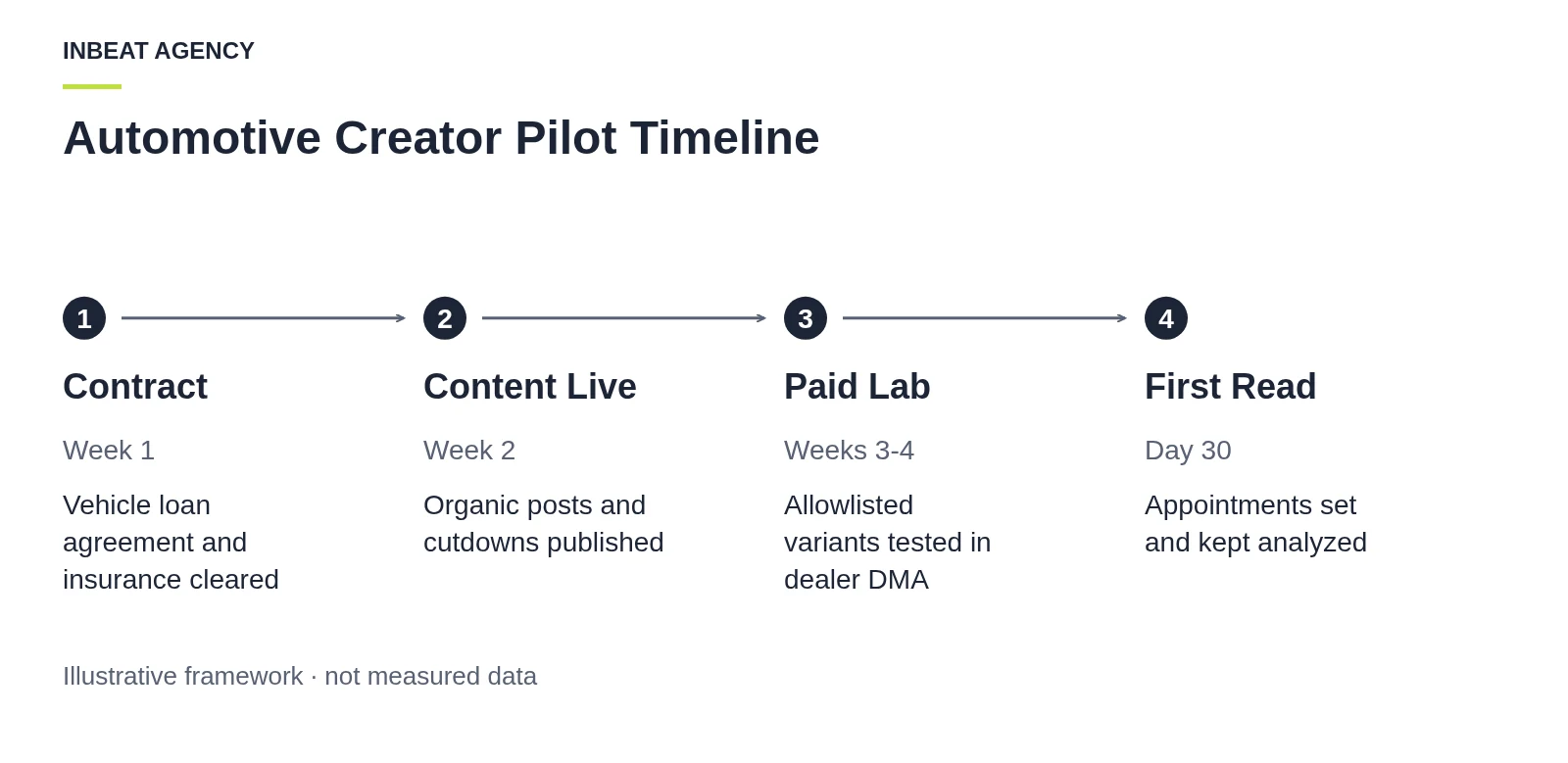
A single-dealer pilot looks like this:
- Three local creators and one booking page.
- Contract and loan paperwork cleared in week one.
- Content live in week two.
- Allowlisted ads tested in weeks three and four.
- A 30-day read on appointments set and kept.
- A decision at day 45 about which creator to rebook.
Insider tip: ask the dealer to tag creator-sourced leads in the CRM with the creator's handle as the lead source. You'll want that split when the second batch starts.
How to Amplify Creator Content With Paid Social Allowlisting for Local Dealers
Secure allowlisting permission in every creator contract, then budget a dark-post test per dealer DMA. Once the content exists, the job is distribution: the dealer gets the reach and you get the data.
Allowlisted Creator Ads vs Organic Posting for Dealer Geographies
Organic reach is set by an algorithm you don't control and that changes without notice. Allowlisting, which means running paid ads from the creator's own handle through your ad account, gives you three things organic never will: geographic control, so the ad only runs in the DMA where the rooftop sits; frequency control, so the same buyer sees the content enough times to act; and creative-level data, so you know which creator and angle earned the booking.
It's also the more durable setup: if TikTok halves organic distribution tomorrow, an allowlisted campaign keeps running at the same cost per booking.
This is also how the creative does the targeting. Platform audience settings keep narrowing, so the persona inside the content selects the audience: a parent-creator's video stops the parent, a tuner's video stops the tuner. Paid delivery just makes sure the right people in the right DMA see it.
Dark-Posting Creative Variants and Reading the Signal Before Scaling
Treat the first two weeks as a lab:
- Dark-post several creator variants (different creators, different hooks, same dealer CTA) to the dealer DMA at modest, equal budgets.
- Read cost per booking or cost per qualified lead; clicks tell you nothing about the showroom.
- Kill the bottom half and shift budget to the winners.
- Repeat with a second batch built on what won.
A workable setup: three creator handles, two DMAs, six ad sets, and cost per booked appointment as the only scaling trigger. Nothing scales until it beats the account average, and nothing gets a second flight without a reason written in the brief. Price usage and allowlisting rights into the deal, since creators reasonably charge more when their face carries paid media.
Can Co-Op Funds Pay for Creator Amplification?
Co-op programs reimburse dealers for approved advertising, and most are built around search, display and local broadcast. Creator amplification can qualify when it's structured like the media co-op already understands: a dealer-specific landing page, DMA targeting that matches the dealer's assigned territory, the dealer's name and offer in the ad, and reporting that ties spend to that dealer's leads and bookings. Check the OEM's co-op guidelines before promising reimbursement, because approval rules vary by brand and change often.
Budget paid social amplification alongside dealer search capture. Search is where the buyer's intent gets captured, so the creator ads create the demand and the dealer's search campaigns catch it.
Cutting search to fund creators breaks the pipeline you just built.
Pro tip: put the creator's handle in the UTM of every allowlisted ad. When the dealer's search agency sees branded queries rise, you'll want to show which creator lit the fuse.
Do Car Companies Give Cars to Influencers? Loans, Insurance and FTC Disclosure
Get the paperwork done before the car moves. The sequence is contract, proof of insurance or brand-provided coverage, driver eligibility check, then a condition report signed at handover. A creator who already has the keys has very little incentive to read clauses.
Loaner Logistics: Fleet Coordination, Pickup and Return, Mileage and Fuel Terms
A dealer-supplied loaner for a 72-hour creator loan needs a one-page checklist attached to the agreement. A workable version:
- Vehicle identified by VIN, with trim, options and current mileage recorded.
- Pickup and return times agreed, with a named dealer contact for each.
- Mileage cap and fuel or charge return condition stated.
- Walk-around photos and a signed condition report at both ends.
- Permitted drivers listed; nobody else behind the wheel.
- Prohibited uses listed: track days, towing beyond rating, off-road, lending.
- Content deadlines and approval window confirmed.
Fleet coordination matters more than it sounds. A demo car pulled for a creator is a car a salesperson can't demo, so schedule loans around the store's slow days and give the sales manager the dates in writing.
Insurance and Damage Liability in the Creator Contract
The contract should say who pays for what if something goes wrong. Common structures are the dealer's garage policy covering the loan with the creator responsible up to a deductible, or the brand buying short-term coverage for the loan period. State which applies, cap the creator's exposure so the deal is fair, and require a valid license and clean record check before pickup.
Add misuse prohibitions that match the checklist above, plus a clause that reckless or illegal driving voids the agreement and the fee. None of this substitutes for your own counsel, and state laws on loaner liability vary.
FTC Disclosure, Usage Rights and Brand-Safety Vetting
The creator must disclose the loan or payment clearly in every post and every cutdown, and the disclosure has to survive into the paid versions. An allowlisted ad that drops the disclosure is a compliance problem for the brand as well as the creator. Write the required disclosure language into the brief and have your approval window check for it.
Usage rights are the clause that makes everything in the amplification section possible. Specify duration, platforms, paid usage, allowlisting from the creator's handle, and the right to edit cutdowns. Price it openly.
Vet the creator's back catalog for driving behavior, brand conflicts and content that would embarrass a dealer principal in a small market. Treat this as operational guidance and have counsel review the template once before you reuse it.
Does Automotive Influencer Marketing Work for Tier 3 Dealerships and Aftermarket Brands?
Yes, with one adjustment: the endpoint changes by tier. A single dealer measures appointments, an OEM or regional association measures dealer-reported leads across markets, and an aftermarket or service brand measures tracked sales or service bookings. The creator layer and the paid layer stay the same.
Tier 3 Dealers: Micro-Creators Plus DMA-Targeted Paid Social
A single-rooftop store can run the whole pipeline with three local micro-creators and a modest allowlisting budget confined to its DMA. The endpoint is appointments set and kept, read straight from the store's CRM. The scale is small, which is the point: the store learns which persona and angle fills its showroom before anyone spends network money.
OEM and Regional Associations: Fund the System, Let Dealers Own the Lead
Associations should pay for creator sourcing, content and the testing budget, then hand distribution and lead handling to each dealer with the reporting template fixed in advance.
Selling that structure to dealer principals is a persuasion job as much as a marketing one, which is why it has more in common with the B2B marketing playbook than with consumer campaign planning: you're convincing independent business owners to share data and adopt a shared process.
Aftermarket and Service Brands: The Same Pipeline With an Ecommerce or Service-Booking Endpoint
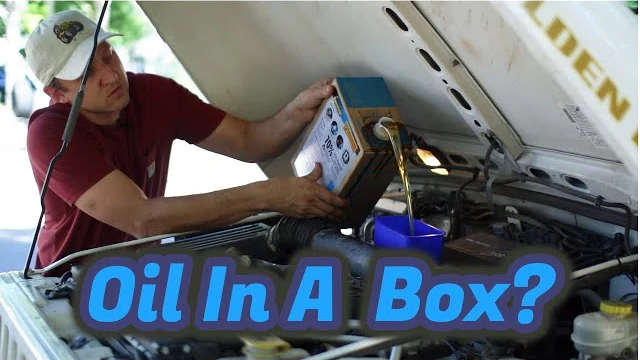
Aftermarket has the strongest downstream capture of all, because Statista's April 2024 to March 2025 ranking shows U.S. repair, service and parts search ads converting highest among the industries presented; the exact rate sits behind a paywall. Creator content there should be built to seed parts and service queries: the brake-pad install video that ends with the part number. Creators already show parts and service in the wild, as in the Havoline boxed-oil demo below; the gap is tying them to search capture and tracked sales.
This article prioritizes vehicle sales and test drives, and aftermarket is where the same pipeline transfers with a different endpoint. Identify your tier, name the endpoint metric you own, and change only the last step of the pipeline.
How inBeat Approaches Automotive Influencer Marketing as Creator-Led Paid Media
The method we've described is one operating loop. Creators matched by persona and geography supply the creative a dealer could never shoot. Paid social tests that creative in the dealer's DMA, reads cost per booked appointment, and scales only what earned it.
Dealer-side data, bookings, show rate and branded-search lift, decides what the next batch of creators gets briefed on. Awareness comes out of that loop as a by-product.
We run influencer sourcing, UGC production and paid social buying as one system because the loop breaks when they're separated. The sourcing team needs to know which persona won last flight, the production team needs the comments from the dark posts, and the media team needs rights cleared before content exists.
The decision in front of you is whether creator content stays an awareness line item or becomes a measured pipeline with a dealer at the end of it. If it's the latter, scope one dealer pilot and decide who owns measurement before you engage an automotive marketing agency or hire in-house. See how we run paid social as the testing lab for creator content and scope a single-dealer pilot with us.
FAQ
How many creators does a single dealership need to run a meaningful test-drive pilot?
Three matched creators is enough to compare angles and personas without diluting a small budget. Fewer than three and a single creator's off week looks like a failed strategy; more than five and a single store's booking volume can't separate them.
Can dealer co-op funds legally pay for allowlisted creator ads, and what reporting do associations typically require?
It depends on the OEM's co-op guidelines, which vary by brand and change often. Programs that approve it usually expect dealer-specific landing pages, DMA targeting that matches the assigned territory, the dealer's name and offer in the creative, and spend tied to that dealer's reported leads.
What should the contract say about usage rights so the brand can run creator content as paid ads after the loan ends?
Name the duration, platforms, paid usage, allowlisting from the creator's handle and editing rights for cutdowns, with disclosure language that must survive into every paid version. Price it as a separate line so neither party is surprised.
How do you avoid double-counting leads when several dealers in one DMA run the same creator campaign?
Deduplicate on hashed email and phone before reporting, report at DMA level when store-level numbers are disputed, and give each dealer its own landing page and appointment code so a buyer who books at two stores shows up as one person with two appointments.
Should branded-search lift count as a creator campaign KPI if the dealer also runs search ads?
Yes, as a secondary KPI read in exposed versus holdout geographies. Search is where automotive intent converts, so creator content that lifts model-plus-city queries is doing its job even when the dealer's search ads take the last click.
How long should you wait before judging a creator campaign when the average purchase cycle is two to three months?
Judge appointments set and kept at 30 days and make the rebooking decision then. Update sale match-back at 60 and 90 days as a lagging confirmation, and don't hold the next creator batch hostage to it.