

When you’re searching for a media buying agency in New York, the hard part is telling apart agencies that buy paid social, firms that negotiate television and out-of-home inventory, and enterprise partners built to manage a national or international media mix.
This shortlist separates those models.
It compares 12 agencies by the work they are equipped to handle, their New York presence, and the evidence they publish. It also covers pricing structures, account ownership, fee transparency, and the questions worth asking before you hand an agency your media budget.
Compare Media Buying Agencies in NYC
These firms are grouped by practical fit; we didn’t treat them as interchangeable competitors. “NYC office” means the agency publishes a New York City address or identifies the city as its headquarters. Engagement levels are directional because most agencies quote each scope individually.
| Agency | Strongest fit | Media coverage | NYC presence | Likely engagement level |
|---|---|---|---|---|
| inBeat Agency* | Consumer acquisition that depends on frequent creative testing | Paid social, search, YouTube, CTV, creator-led media | NYC office | Growth and midmarket |
| Socium Media | Ecommerce and lead-generation performance | Search, shopping, paid social, CTV | NYC office | Growth and midmarket |
| Markacy | Financially accountable growth programs | Digital, retail media, TV/CTV, print, OOH | NYC headquarters | Growth to enterprise |
| Ramp97 | Senior-led independent planning and activation | Digital, programmatic, search, social, traditional | NYC office | Midmarket and enterprise |
| The Charles Group | Media, creative, and customer experience under one partner | Programmatic, paid social, search, CTV, OOH | NYC office | Midmarket and enterprise |
| M+C Saatchi Performance | Multi-market and app-first performance campaigns | Search, social, programmatic, streaming, retail, audio | New York team | Midmarket and enterprise |
| Horizon Media | Large, complex national media programs | Full-funnel media, audience intelligence, advanced measurement | NYC headquarters | Enterprise |
| Tinuiti | Commerce-led full-funnel growth | Search, social, marketplaces, retail media, streaming TV | New York base | Upper midmarket and enterprise |
| Criterion Global | International expansion and difficult local inventory | Digital, programmatic, TV, audio, OOH, specialty media | NYC office | Midmarket and enterprise |
| DCW Media | Integrated local and national campaigns | TV, radio, OOH, OTT/CTV, search, social, display | NYC office | Midmarket |
| Corinthian Media | Broadcast, direct response, and hands-on negotiation | TV, cable, radio, digital, print, OOH | New York address | Small to midmarket |
| AKA NYC | Entertainment, attractions, and attendance campaigns | Integrated media, creative, social, ticketing, audience intelligence | NYC office | Midmarket and enterprise |
* Publisher disclosure: inBeat Agency publishes this article and is included first because it has a verified New York agency team, named case studies, and direct evidence connecting creative production with paid-media outcomes. Inclusion is not presented as an independent third-party award.
What Does a Media Planning and Buying Agency Actually Handle?
Media planning decides how the advertising budget should be distributed. Media buying turns that plan into placements, platform campaigns, negotiated inventory, and ongoing optimization.
Media Planning & Buying. Source: Corkboard Concepts on YouTube
The same digital marketing agency usually handles both, but you should confirm where strategy ends and execution begins.
A complete engagement may include:
- Audience research and market prioritization (local and national markets)
- Forecasting reach, frequency, acquisition cost, or revenue
- Channel selection and budget allocation for different digital ads on social media and search engines
- Publisher, platform, or inventory negotiations
- Campaign trafficking and quality assurance
- Creative specifications and production coordination
- Bid, audience, placement, and budget optimization
- Attribution, incrementality testing, and reporting
The provider label also matters:
| Provider | Primary responsibility | When it fits |
|---|---|---|
| Media planning agency | Builds the audience, channel, timing, and investment strategy | You have execution resources but need an independent plan |
| Media buying agency | Negotiates or activates placements and optimizes delivery | You already know the business objective and need specialist execution |
| Paid media agency | Manages measurable digital channels such as search, social, display, and shopping | Brand awareness, acquisition, lead generation, or ecommerce is the priority |
| Full-service agency | Combines media with creative, brand, web, CRM, or production | You want fewer partners and accept a broader scope |
If your shortlist is primarily digital, compare it with these NYC paid media agencies. A dedicated paid media management partner may be a closer fit than a firm built around television, radio, print, and outdoor inventory.
12 Media Buying Agencies in NYC, Grouped by Specialty
This is not a universal ranking. A specialist that is right for a DTC acquisition program may be wrong for a national television buy, a Broadway launch, or a multinational market-entry campaign.
Performance media and creative-led buying
1. inBeat
inBeat combines paid media with performance creative and creator-led production. Its media team manages Facebook & Instagram, Google, TikTok, YouTube, Snapchat, and broader omnichannel programs, while creative learnings feed the next round of ads. That structure is useful when creative fatigue is the main constraint on growth.
The agency’s published work gives buyers concrete performance evidence. For NielsenIQ’s Unroll.Me, inBeat reports a 75% reduction in CPA and more than 100,000 monthly downloads from a strategy built around paid media and scalable UGC. Its broader paid media case studies cover consumer goods, apps, wellness, beauty, and food and beverage.
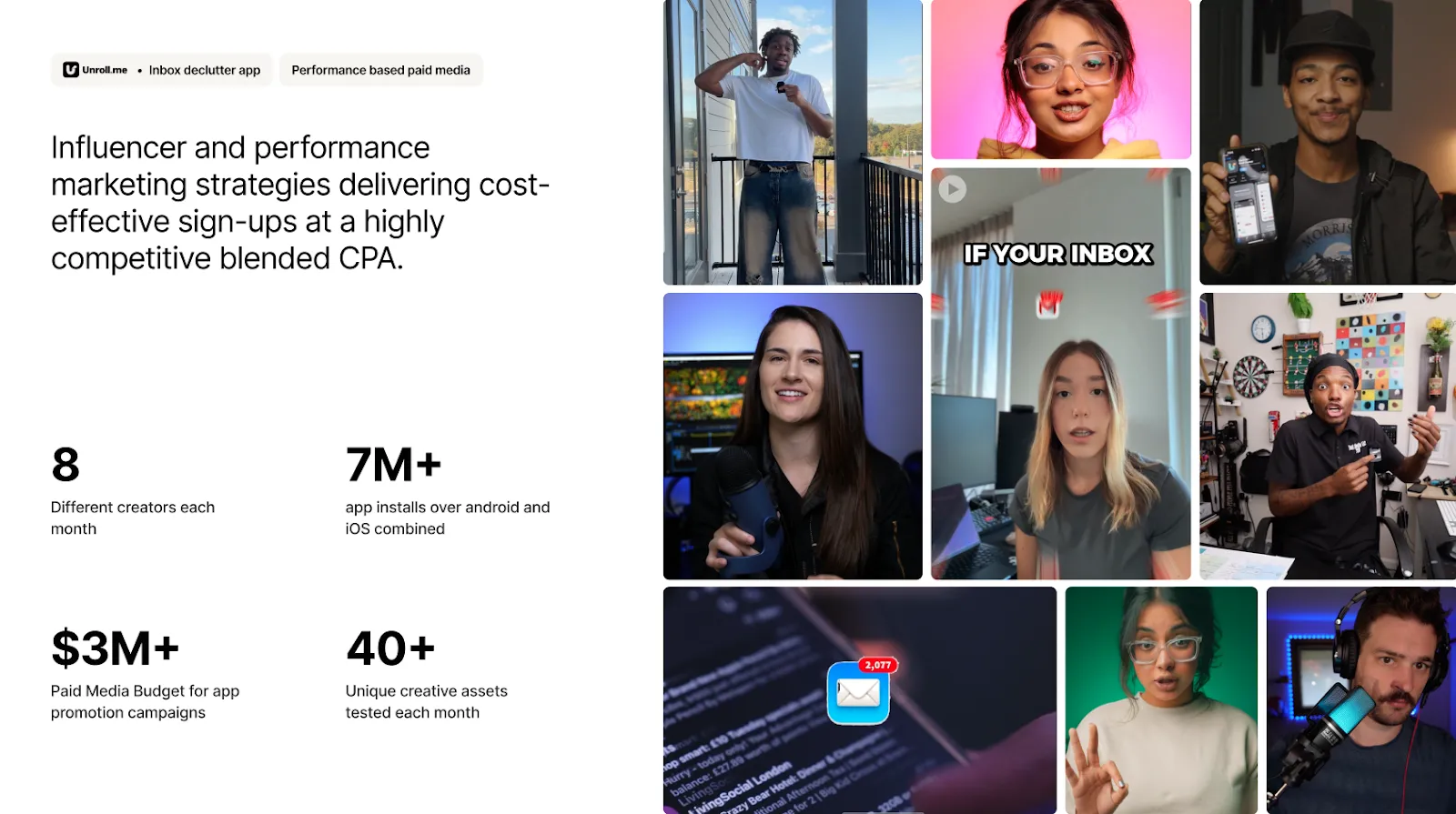
Does it fit? Choose this model when you want media buyers and creative strategists working from the same test results. A brand that already has a large internal studio and mainly needs linear TV negotiation may find a traditional specialist more suitable.
2. Socium Media
Socium Media is a New York performance agency focused on paid search, paid social, shopping and feeds, SEO, and connected TV. Its case-study library is particularly relevant to ecommerce, fashion, consumer, and lead-generation teams that want channel execution without moving to a large network agency.
One useful proof point is its work for fashion brand Amanda Uprichard. Socium says an audit identified underused paid-media opportunities and that Facebook and Instagram became the primary new-customer growth channels. Other published work covers paid search, shopping, social, and CTV for brands such as Catbird, Vince, Canopy, and Eberjey.
Does it fit? The agency belongs on a shortlist when the center of gravity is measurable digital acquisition. If most of the budget goes to broadcast negotiation, transit inventory, or international market entry, one of the later specialists will offer a closer operational fit.
3. Markacy
Markacy approaches media allocation as a financial decision. The Manhattan-headquartered firm connects paid acquisition with customer economics, contribution margin, measurement, CRM, and broader growth strategy. Its channel coverage includes paid social and search, marketplaces, retail media, linear TV, CTV, print, and out-of-home.
That makes Markacy distinct from agencies that optimize only toward platform-reported ROAS. Its positioning is aimed at CMOs, CFOs, private equity teams, and growth leaders who need media plans connected to P&L impact. Published case studies describe work across DTC and consumer brands, including paid-media acquisition, lifecycle marketing, conversion optimization, and financial planning.
Does it fit? Markacy is worth considering when the assignment includes capital allocation or incrementality along with campaign management. For a narrow single-platform brief, its broader consulting layer may be more than the business needs.
Independent and integrated media partners
4. Ramp97
Ramp97 is an independent New York media agency covering strategy, planning, buying, activation, and optimization across digital, programmatic, and traditional channels. The agency emphasizes senior involvement and publishes a named leadership team; so it’s not positioning the account around a large delivery bench.
Its work illustrates the range. Ramp97 reports that a Microsoft Advertising campaign produced a 56% lift in likelihood to purchase and a 40% increase in awareness versus the cited competitor benchmark. A separate CPG launch used made-for-TikTok creative and weekly production sprints to reach nearly six million targeted viewers while exceeding platform benchmarks.
Does it fit? Ramp97 suits organizations that want one independent team across brand and performance media, especially in B2B, healthcare, and CPG. During the pitch, ask which channels will be managed directly and which require external buying or production partners.
5. The Charles Group
The Charles Group integrates media with creative, brand, content, customer experience, and technology. Its media practice covers audience planning, programmatic advertising, paid social, search, OTT/CTV/online video, OOH/DOOH, lifecycle marketing, analytics, and attribution.
The attraction is coordination. A lifestyle, luxury, hospitality, or enterprise brand can develop the campaign idea, assets, landing experience, CRM, and media plan through one partner instead of reconciling several agencies. The company identifies HP and Aveda among the brands served by its media practice.
Does it fit? That breadth is useful when media and creative need to launch together. It also makes scope definition important: ask which disciplines will have dedicated staff, who controls daily platform optimization, and whether media measurement remains comparable when the same partner produces the creative and evaluates the campaign. This is therefore a better fit for an integrated brief than a standalone placement request.
6. M+C Saatchi Performance
M+C Saatchi Performance brings a global network to performance media. Its capabilities span paid search, social, programmatic, streaming, retail, influencer, affiliate, and audio, with team members based in New York.
The agency’s published work is useful for evaluating channel depth. For New York ticket marketplace TickPick, it documents both a podcast-led awareness campaign and a separate full-funnel programmatic assignment. Recent material also covers outcome-oriented CTV planning for app-first brands and multi-platform acquisition for companies such as Gopuff.
Does it fit? This is a credible option for apps, ecommerce businesses, and brands coordinating media across markets. It is likely to fit a more complex brief better than a local campaign with a small number of placements. Ask which office will lead the account and how global strategy will translate into day-to-day New York execution.
Enterprise and commerce media
7. Horizon Media
Horizon Media is headquartered in New York and operates at a different scale from most independent specialists on this list. It is designed for large national advertisers that require broad buying power, audience intelligence, advanced measurement, specialist business units, and coordination across many channels.
The agency reports more than 2,400 employees and over $8.5 billion in media investments. Its public work includes an NYC out-of-home climate campaign developed with JCDecaux and Intersection, while its WHY Group produces audience and cultural research for planning teams.
Does it fit? Horizon is most relevant to enterprise brands running sustained, high-complexity programs. Smaller advertisers should establish whether their budget will receive an appropriately senior team and whether the operating model offers enough flexibility. Scale creates access and specialization, but it does not automatically make a large agency the best choice for a focused growth brief.
8. Tinuiti
Tinuiti is a large independent media agency known for combining performance media with commerce. Its scope includes paid search, social, Amazon and other marketplaces, retail media, affiliate, analytics, streaming TV, display, and broader full-funnel planning.
The fit is strongest when product discovery and purchase happen across retailer, marketplace, search, and social ecosystems. Tinuiti’s recent agency-of-record work for Allies of Skin covers streaming video and TV, paid search, paid social, and commerce media within one strategy. Its omnichannel work for OLLY included OTT, audio, YouTube, high-impact display, editorial partnerships, and digital out-of-home.
Does it fit? Tinuiti deserves consideration from enterprise ecommerce, retail, and consumer brands that need commerce expertise alongside brand media. A smaller advertiser should ask about minimum viable spend, team composition, and which services are included. Don’t assume every capability will appear in the initial scope.
International, traditional, and local-market buying
9. Criterion Global
Criterion Global has a New York office and specializes in international media planning, market entry, and multi-market growth. It works across digital, programmatic, search, social, retail, OOH, television, audio, sponsorship, and specialist inventory.
Its New York work shows why a locally experienced buyer can matter. Criterion reports securing roughly 45% of NYC public-bus inventory in a concentrated period for a Barbie campaign around Toy Fair. For Vita Coco, it used subway and street-level placements and reports delivering more impressions than projected while improving the planned CPM and reducing the top-line investment.
Does it fit? This combination of cross-border planning and local-market execution makes Criterion useful for international brands entering the US or US brands expanding abroad. The model is less obviously suited to a company seeking only ongoing Meta or Google campaign management.
10. DCW Media
DCW Media is an independent New York media buyer working across traditional and digital channels. Its services cover television, radio, outdoor, OTT/CTV, paid search, social, display, audio, audience planning, and campaign reporting.
The case-study library is oriented toward concrete local and regional assignments. For Uncle Giuseppe’s Marketplace, DCW describes buying and optimizing cable, outdoor, OTT/CTV, Meta, display, and Google Search. Other examples cover higher education, healthcare, finance, and New York-area organizations that need coordinated reach across the tri-state market.
Does it fit? DCW is a practical candidate when local broadcast or outdoor placements must work alongside digital acquisition. Ask how the agency prices planning, whether media is bought as agent or principal, and how cross-channel results are normalized when television, search, social, and outdoor produce different kinds of response data.
11. Corinthian Media
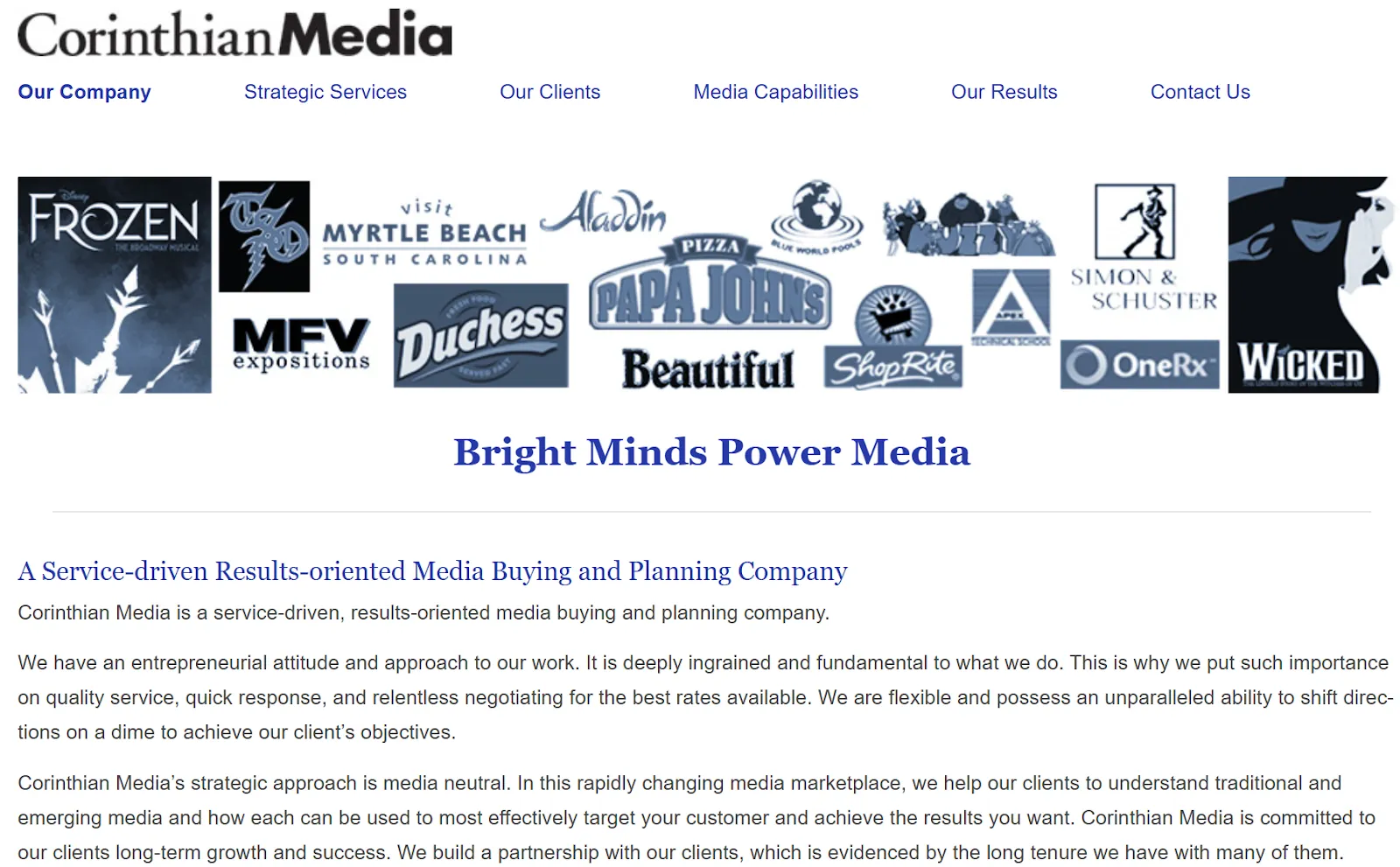
Corinthian Media is a boutique planning and buying firm founded as an alternative to large agencies. Its capabilities include national and local broadcast, cable, radio, digital, print, out-of-home, sponsorships, promotions, and trade or barter opportunities.
The agency is especially relevant to direct-response advertisers and businesses that still rely on negotiated broadcast inventory. In one published martial-arts case study, Corinthian says a revised target and media plan increased call volume by 262%, reduced cost per lead by 52%, and raised sales by 35%. Another case describes using television to increase volume for a web-based credit service after online-only growth had plateaued.
Does it fit? Corinthian’s strength is hands-on traditional buying; it’s not a modern creative-content engine. Confirm the current digital measurement stack and creative-production responsibilities if the brief extends far beyond broadcast and local-market response.
Entertainment and cultural campaigns
12. AKA NYC

AKA NYC is the category specialist in this group. The agency works with Broadway productions, cultural institutions, attractions, and destination brands, combining media with creative, social, ticketing, and business intelligence.
Its experience is particularly relevant when success is measured in attendance, ticket sales, or a time-bound cultural moment. AKA has handled media planning and buying for the New York Botanical Garden and has published campaign work involving Times Square, print, social, influencer activity, and entertainment launches. The agency also identifies a team of more than 100 people across New York and Los Angeles.

Does it fit? For a theater, museum, attraction, or live event, that audience knowledge can be more valuable than a generalist’s larger channel list. Ecommerce and B2B buyers, however, will usually find closer acquisition expertise elsewhere on this shortlist.
Which agencies should you compare first?
Use the campaign objective, media mix, and operating model below to reduce the 12 agencies to a shortlist of three or four.
Which Type of Media Buying Agency Do You Need?
Start with the job the media must perform. For a social-first acquisition brief, an experienced paid social agency in NYC may be sufficient. If search captures most existing demand, prioritize PPC management in New York, product-feed expertise, landing-page measurement, and disciplined query reporting.
| Your priority | Capabilities to require | Agencies to examine first |
|---|---|---|
| Scale a consumer acquisition program | Paid social and search, high-volume creative testing, revenue reporting | inBeat, Socium Media, Markacy |
| Connect brand and performance media | Cross-channel planning, programmatic activation, creative coordination | Ramp97, The Charles Group, M+C Saatchi Performance |
| Manage an enterprise media portfolio | Specialist teams, buying scale, governance, advanced measurement | Horizon Media, Tinuiti |
| Enter new geographic markets | Local market intelligence, cross-border planning, centralized reporting | Criterion Global, M+C Saatchi Performance |
| Combine digital with TV, radio, or outdoor | Direct inventory experience, negotiation, reach and frequency planning | DCW Media, Corinthian Media, Ramp97 |
| Sell tickets or drive visits | Entertainment audiences, local media, ticketing and attendance measurement | AKA NYC |
Do You Need an Agency Based in New York City?
Not always. A New York address does not make an agency better at Google Ads, Meta buying, or ecommerce measurement. Those capabilities can be delivered remotely if communication, access, staffing, and reporting are strong.
Local presence becomes more relevant when the campaign involves:
- Outdoor advertising like subway, transit, street furniture, billboard advertising, or place-based inventory
- New York television and radio negotiations
- Neighborhood- or borough-level audience targeting & planning
- On-site production, experiential work, or rapid local coordination
- Broadway, hospitality, tourism, cultural, or real-estate audiences
- Regular in-person work with an internal marketing or procurement team
Ask every agency to classify its presence precisely: headquartered in NYC, maintains an NYC office, has New York staff, or simply serves clients in the market. Those are not equivalent claims.
How Much Do Media Buying Agencies in NYC Charge?
The 4A’s and ANA compensation guide gives 15% of media spend as an example of a commission arrangement; it is an illustration, not a mandatory industry rate. ANA research also shows why buyers should expect several models: its 2022 compensation study found fee-based structures used by 82% of respondents, while an earlier media-specific study found commissions were more common in programmatic buying than in digital media generally.
For a local directory benchmark, DesignRush currently reports an average hourly rate of approximately $140 among the top 50 NYC firms it tracks. Treat that as a characteristic of its listed profiles; we’re not saying that every media buying agency in New York charges $140 per hour.
| Pricing model | How it works | What to clarify |
|---|---|---|
| Percentage of media spend | The agency receives an agreed percentage of the spend it manages | Which channels count as billable media and whether the rate changes at higher spend levels |
| Monthly retainer | A fixed fee covers an agreed team and scope | Included hours, channels, meetings, reporting, and optimization cadence |
| Project fee | A fixed amount covers planning, launch, audit, or a defined campaign | Change-order rules and whether ongoing optimization is included |
| Hourly or labor-based fee | You pay for staff time by role or blended rate | Estimated hours, seniority mix, and overage approval |
| Hybrid model | A base retainer is combined with a spend-based or performance component | Minimum fee, incentive calculation, caps, and measurement source |
| Principal media | The agency acquires inventory and resells it to the advertiser | Markups, inventory quality, rebates, audit rights, and conflicts of interest |
There is no single NYC rate card. The fee depends on media spend, channel complexity, campaign duration, creative requirements, geographic scope, and the amount of senior strategy involved.
Request two separate figures in every proposal:
- Agency compensation: strategy, planning, buying, optimization, reporting, and account service.
- Pass-through costs: media, ad-serving technology, data, research, verification, production, and third-party vendors.
That split is more informative than comparing headline retainers.
How to Evaluate a Media Buying Agency
Review actual media-buying experience
Do not treat a long services page as proof of depth. Ask for two recent assignments with a similar budget, channel mix, geography, and business objective. The agency should explain the starting constraint, the media decision it made, and the result—not just show final creative.
Also check how central media buying is to the business. An agency that allocates only a small portion of its work to media may still be capable, but you should know whether you are hiring a specialist practice or an add-on service.
Ask the right questions during the pitch
| Ask this | A useful answer should clarify |
|---|---|
| Who owns the ad accounts and campaign data? | Your access during the engagement and what transfers when it ends |
| Do you buy media as our agent or as a principal? | Whether inventory is purchased on your behalf or resold to you |
| Do you receive rebates or preferred-media incentives? | What incentives exist and whether they are disclosed or returned |
| Which team members will plan and optimize the campaign? | Named senior oversight and named day-to-day operators |
| Is creative included? | Formats, volume, revision limits, refresh cadence, and additional fees |
| How do you measure incrementality? | Tests beyond platform attribution, including holdouts, lift studies, or media-mix analysis where appropriate |
| What is included in the quoted fee? | Technology, data, reporting, verification, production, and third-party costs |
| What happens at termination? | Notice period, data export, account transfer, creative ownership, and outstanding media commitments |
Watch for pricing and transparency red flags
Be cautious when an agency will not explain how it earns money.
The proposal should separate media spend from commissions, hourly fees, research fees, reporting fees, technology charges, and other markups. You should also know how much of your media capital reaches publishers and platforms.
Other red flags include:
- Restricting access to raw performance or sales data
- Withholding real-time analytics
- Insisting on owning ad accounts without a clear transfer clause
If the agency recommends proprietary inventory, a people-based stack, or its own media-tracking tools, ask how each component is priced, evaluated, and connected to your existing systems.
Programmatic digital supply chains deserve particular scrutiny.
IAB guidance on programmatic transparency emphasizes explicit fees, auditable supply chains, disclosed business arrangements, and the absence of hidden rebates or biased auction mechanics. Put those expectations in the contract.
The same principle applies when an agency recommends programmatic marketing, display advertising, or media and streaming services based mainly on click-through rates. The proposal should explain inventory quality, audience controls, financial interests, data ownership, and how results will be evaluated beyond platform-reported engagement.
How We Selected These Agencies
We reviewed current NYC media-buying search results and examined full competitor pages from Clutch, The Manifest, DesignRush, Sortlist, GoodFirms, Growth Partner Index, and 50Pros. These sources helped identify the comparison fields buyers repeatedly encounter, but directory placement alone was not enough for inclusion.
Each agency retained here met the following requirements:
- Media planning or buying is a verifiable capability, whether the agency specializes in programmatic digital, display advertising, media and streaming services, or an integrated channel mix.
- The agency publishes evidence of a New York office, headquarters, or New York team.
- Its channel, audience, or buyer specialization is identifiable.
- Current services were checked against the agency’s own website.
- At least one additional proof signal, such as a case study, named assignment, or independently hosted company profile, was available.
- The available evidence demonstrates more than broad digital-marketing coverage.
We gave greater weight to agencies that connect market insight, audience segmentation, and channel/platform analysis to media decisions. Evidence of hyper-local insight also mattered where the agency claimed specific knowledge of New York audiences or placements.
Capabilities such as content and creative support, influencer marketing, UGC creation, and creative tools were considered when they contributed to strategy-led campaigns. However, these services did not compensate for weak evidence of media-planning, buying, or optimization expertise.
We removed firms whose central business was web design or broad digital marketing when the available evidence did not demonstrate comparable media-buying depth. We also avoided treating directory ratings and minimum project figures as permanent facts because those profiles can change.
What to Prepare Before Contacting an Agency
A concise brief produces a more useful proposal than a request to “improve media performance.” Prepare:
- The business objective and the decision deadline
- Monthly or campaign media budget, separated from agency and production fees
- Priority audiences and geographic markets, including any luxury buyers, local communities, or other specialized segments
- Current channels, agencies, and internal owners
- Historical spend, sales data, and results by channel
- Any existing channel/platform analysis or market insight
- The metrics leadership actually uses, such as CAC, qualified pipeline, contribution margin, revenue, reach, brand lift, or click-through rates
- Current media mix modeling capabilities and expectations
- Existing creative capacity and the required level of content and creative support
- Production needs involving UGC creation, influencer marketing, 3D renderings, augmented reality, or other specialized formats
- Creative tools, UX design resources, and any user experience problems that could affect campaign performance
- Analytics, attribution, CRM, ad-account, and media-tracking tool access
- Data warehouse requirements, including who can run an SQL command or provide the necessary exports
- Details of any people-based stack or customer-data platform already in use
- Regulatory, legal, licensing, privacy, or brand-safety constraints
- Launch date, campaign duration, and internal approval process
You do not need a finished media plan. You do need enough commercial, creative, and technical context for agencies to recommend meaningfully different approaches and price the work consistently.
If performance media and creative testing are your central needs, share the brief with inBeat’sNYC paid media team and ask for a proposed testing and measurement structure.
Frequently Asked Questions
What is the difference between media planning and media buying?
Media planning determines the audience, channels, timing, reach, frequency, and budget allocation. Media buying negotiates or activates the placements and optimizes delivery. Many agencies perform both functions, but the proposal should identify who owns strategy, negotiation, platform execution, and measurement.
Does a media buying agency need to be located in NYC?
No. Digital campaigns can be managed effectively from anywhere. NYC presence matters more for local outdoor, transit, television, radio, entertainment, experiential work, or frequent in-person collaboration. Ask whether the firm has an actual office, local staff, or simply serves New York remotely.
How much media spend should you have before hiring an agency?
There is no universal threshold. Your budget must be large enough for the agency fee, media investment, creative production, and measurement to coexist without starving the campaign. Ask each firm for its minimum viable media spend and the staffing included at that level.
Should the advertiser own the ad accounts?
Usually, yes. Advertiser-owned accounts protect historical data, billing visibility, audience assets, and continuity if the relationship ends. If the agency must use its own account or buying seat, the contract should define access, data export, markups, termination procedures, and ownership clearly.
Can one agency manage digital, television, CTV, and out-of-home media?
Yes, but confirm that the channels are staffed capabilities and not available only through partners. Ask who negotiates each buy, how reporting is normalized across channels, and whether the agency has recent work resembling your mix. Compare dedicated programmatic advertising agencies if automated media is a major part of the brief.